
Industrial Machinery: What It Includes and How to Source It From China
 ·
Updated October 13, 2026
·
29 min read
Industrial machinery means the machines a factory uses to move, separate, dry, clean or hold something — as opposed to the product it sells. A gearbox, a conveyor, a filter press, a dryer, a scrubber and a rupture disc are all industrial machinery, and they have almost nothing else in common. What they do share is the way they are bought: none of them can be specified from a catalogue, all of them are ordered against a drawing, and every one of them is accepted or rejected on the same four figures. This page is the hub for that whole family — what belongs in it, which of the seven groups a given job falls into, and where to read the detail on the specific machine you are buying.
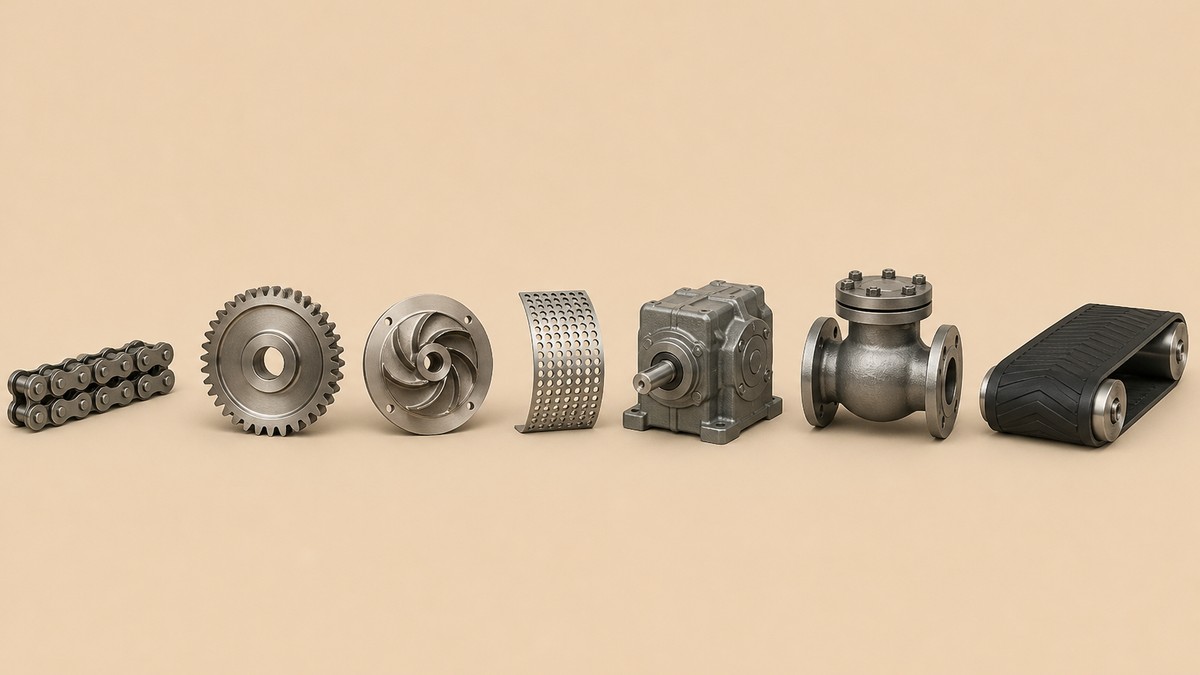
What Every Machine on This Page Has in Common
| The question | Why it decides the order | Where the detail lives |
|---|---|---|
| Which of the seven groups does the job belong to | It decides which figures matter and which standards the plant already answers to | The family map in this page, then the machine's own guide |
| What is being moved, separated, dried or cleaned | Density, flow behaviour and what the material may touch drive most of the design | The four figures, in the section below |
| What the plant is already obliged to do | A written hazard assessment and any permit limits exist before the machine is chosen | Where the rules live, and the certificate section |
| Who is expected to maintain it | Access, spares and wear parts decide whether the plant gets the rated output after a year | The machine's own guide, and the failures section |
| What has to be written down before the order | A machine ordered from a description is a machine that arrives as a description | The specification and inspection guides linked below |
What Counts as Industrial Machinery
The plain definition is machinery used in the course of making or handling something else. A lathe in a job shop is industrial machinery; the same lathe sold to a hobbyist is not, and the two are bought in completely different ways. What separates them is not the machine but the transaction around it: industrial machinery is purchased against a specification, installed as part of a process, and held to a performance figure by whoever signed for it.
That distinction is why this whole category behaves the way it does. Three consequences follow, and they apply to a gearbox and a thermal oxidizer equally.
- It is specified, not selected
- There is no catalogue that lists the right answer. The machine is described by what it has to do — how much, how fast, how fine, how hot — and the factory sizes it from those figures. A buyer who arrives with a part number has usually already had somebody else make the decision.
- It is bought once and used for years
- The buying price is a fraction of the cost. Wear parts, fuel or power, downtime and the cost of a rebuild over a fifteen-year life usually dwarf it, which is why the cheap quotation is so often the expensive one and why access and spares belong in the enquiry rather than in the maintenance budget.
- It carries obligations beyond the buyer
- A machine that turns, cuts, burns, lifts or emits is covered by rules in a way that a hand tool is not. Some of those rules are about the machine's design, some about what leaves the site, and some about the person standing beside it. They are not optional extras, and a machine bought without them is a machine that will have to be modified.
One clarification is worth making because it saves arguments. Industrial machinery is not the same as industrial supplies. A filter cloth, a gasket, a length of hose or a bag of media is a consumable, ordered from a catalogue against a size and a material, and replaced on a schedule. The machine the cloth goes into is capital equipment, and it is bought the other way. Most sourcing arguments that go badly are arguments where the two have been confused: somebody has tried to buy a machine by its consumable, or a consumable by its specification.
The Seven Families in This Category
Everything on this site in the hardware and machine group falls into one of seven families. The map matters because the family decides which figures you have to bring, what the machine's failure modes are, and which of the rules apply.
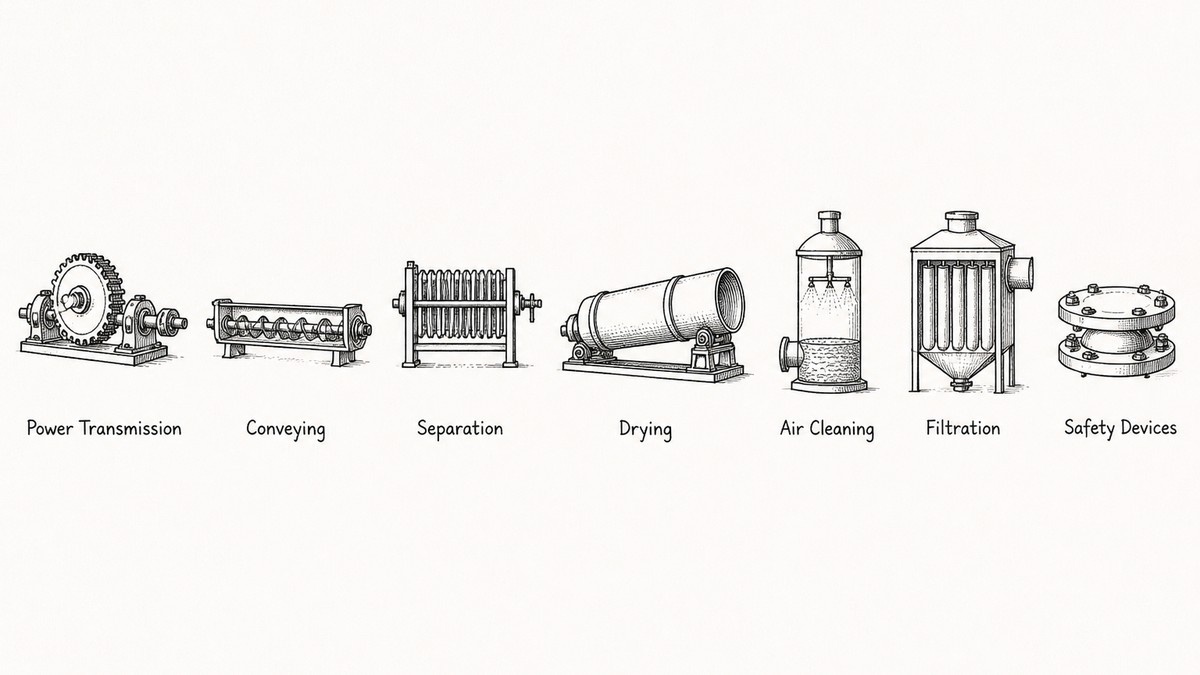
- Power transmission
- Gears, gearboxes, chains, sprockets, belts, screws, shafts, couplings and the pumps that drive them. The figure that matters is torque at a speed, and the figure that is most often wrong is the starting load rather than the running load.
- Conveying
- Machines that move material: screw conveyors, belt conveyors, elevators, feeders and the casters and forks that move the load itself. The figure that matters is throughput in mass per hour, and the constraint is almost always the material's own flow behaviour.
- Separation
- Machines that divide one stream into two: filter presses, screens, classifiers, cyclones and centrifuges. The figure that matters is the cut — what passes and what does not — and it is usually expressed as a size or a moisture, not as a percentage.
- Drying
- Rotary dryers, spray dryers, tray and fluid bed dryers. The figure that matters is water removed per hour, with both the inlet and outlet moisture stated on the same basis, and the constraint is what the material tolerates at temperature.
- Air cleaning
- Scrubbers, oxidizers, baghouses and cyclones. The figure that matters is the loading in the gas and the limit it has to meet, and the constraint is that a limit is written as an enforceable number rather than as a target.
- Filtration
- Filter elements and the housings around them, including sintered metal, woven and pleated elements. The figure that matters is the rating at a stated efficiency, and the trap is that two ratings quoted the same way can mean different things.
- Safety devices
- Rupture discs, relief valves, flame arresters, guards and the instruments that watch a process. The figure that matters is the set point with its tolerance, and these are the parts where a wrong number is a hazard rather than a cost.
Two practical points follow from the map. First, most real plants need two or three of the seven at once, and the interfaces between them are where the design risk sits — the dryer's outlet feeding the blender's inlet, or the conveyor's discharge feeding the press's feed. Second, the families fail differently. A power transmission part that is undersized fails loudly and quickly; an air cleaning device that is undersized fails slowly and quietly, as a stack reading that creeps up; a filtration element that is wrong fails economically, as a replacement interval nobody budgeted for. Knowing which kind of failure you are exposed to tells you where to spend the inspection money.
How to Find Which Machine You Actually Need
Most buyers arrive at this category with a problem rather than a machine. Something is too wet, too coarse, too hot, too dusty or too slow, and the question is what to buy. Four questions narrow it faster than any catalogue, and they are worth answering in order because each one removes whole families.
First, what is the material, in its own terms? Solid, powder, slurry, liquid or gas. A dry free-flowing powder, a damp cake and a thin slurry are three different starting points, and the same plant may have all three at different stages. Write down what the material actually is at the point the machine will see it, not what it is when it arrives at the site.
Second, what has to change about it? Move it, divide it, dry it, clean it, hold it, or protect against it. This is the family question, and the answer is usually one sentence — "we need to take it from about twenty per cent water to about four" — that pins the family and the figure at the same time.
Third, what is the rate, and at what size? A machine is bought at a duty, and the duty is a rate at a specification. "Two tonnes an hour at a four per cent moisture" is a duty. "A big dryer" is not. If the rate and the output specification cannot both be stated, the requirement is not ready and any quotation received is a guess that will be argued about later.
Fourth, what does the plant already have to satisfy? A permit limit, a written hazard assessment, a quality standard, a customer audit. These are the constraints that turn a commercially sensible machine into a non-compliant one, and they are cheapest to discover before the enquiry goes out rather than after the machine is built.
Two shortcuts are worth resisting because they are the two most common ways this goes wrong. The first is buying the machine that the last plant bought, which assumes the two duties are the same when the material is rarely identical. The second is asking a supplier to recommend the family, which produces a recommendation for whatever that supplier makes. The family question is the buyer's to answer, and it is answerable in an afternoon if the four questions above are done honestly.
The Four Figures Every Machine Order Needs
Across all seven families, the same four properties of the material decide the design. They are not the only figures a given machine needs, but they are the four that go missing most often, and each one has a specific way of going wrong when it is absent.
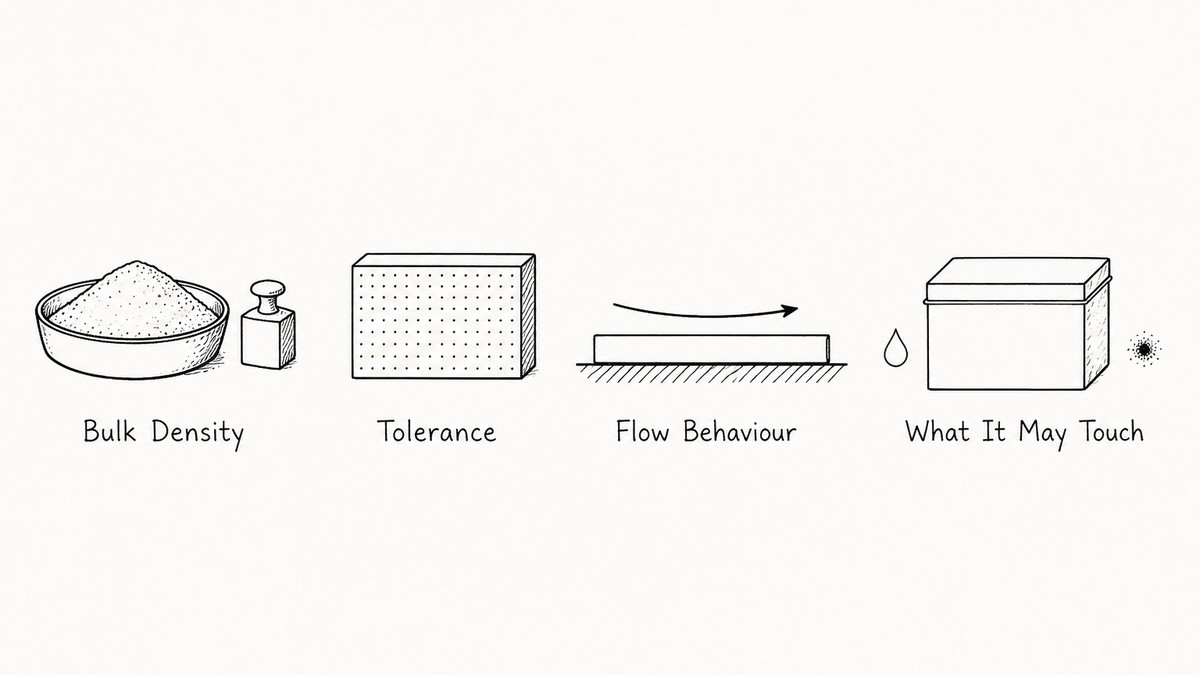
- Bulk density
- Mass per unit volume as the material actually sits, not as the solid it is made of. A machine sized on the wrong density is the wrong size in either throughput or torque, and the gap between a loose and a packed figure for the same powder is often large enough to change the model. Measure it as it will be fed, and say which figure you measured.
- Tolerance
- How close to the target the output has to be, and how much variation the process downstream will accept. This is the figure that decides whether a machine is adequate or expensive, because tightening a tolerance almost always costs money — a finer screen, a slower throughput, a second pass. A tolerance that has never been written down cannot be designed against.
- Flow behaviour
- How the material behaves when it is moved or stored: whether it pours, bridges, floods, sticks or dusts. It is the property that decides hopper angles, discharge openings, conveyor type and whether a machine needs an air broom or a vibrator. It is measured with simple tests rather than assumed, and the difference between a free-flowing and a cohesive powder is usually the difference between a machine that works and one that blocks every shift.
- What the material may touch
- The material of construction, and the list of things that must never reach the product: lubricants, metal, water, cleaning chemicals, and the material of the previous batch. This is the one figure that is a rule rather than a preference in several industries, and it is the reason a machine can be mechanically perfect and commercially useless.
Two supporting figures belong beside those four on almost every order, and both are commonly left out. The first is the **ambient or site condition** — a machine sized for cold dry air performs differently in a hot humid one, and a machine installed at altitude behaves differently again. The second is the **duty cycle**: whether the machine runs continuously or in batches, and how many hours a year. A machine rated for intermittent duty and run continuously fails early, and it fails in a way that the supplier will correctly describe as outside the rated condition.
The practical way to hold all of this is to get it into one document that the factory signs and works to, rather than leaving it across an email thread where it will be re-read selectively. That is what a specification sheet that lists the duty, the material and the finish surface by surface is for, and it is the single highest-value document in the whole transaction.
Where the Rules Live
Industrial machinery is regulated from three directions at once, and buyers are usually aware of only one of them. Understanding which direction a given machine is governed from explains why two similar purchases can have completely different paperwork.
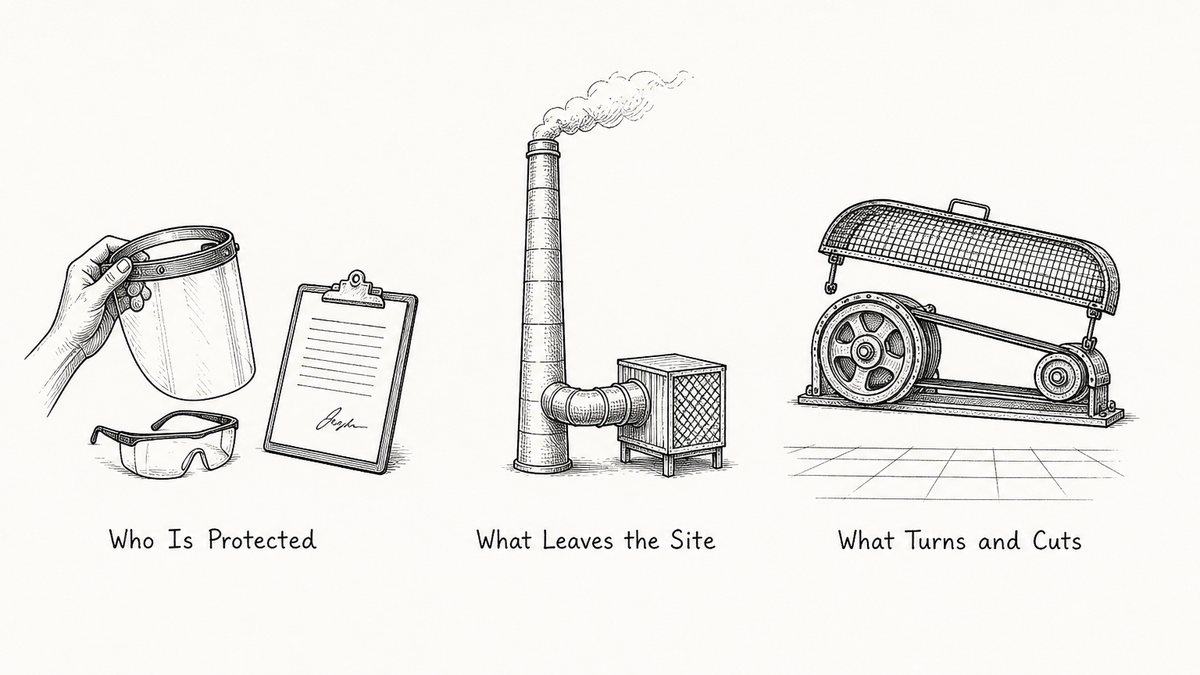
The first direction is what leaves the site. If the machine turns material into dust, fume or solvent vapour, the machine becomes part of an emission source and the obligations attach to the facility. A single sentence decides whether that applies, and the sentence is worth reading because it names machines rather than describing them. Under the applicability list at 40 CFR 60.670, the rule reaches "each crusher, grinding mill, screening operation, bucket elevator, belt conveyor, bagging operation, storage bin, enclosed truck or railcar loading station" at a mineral processing plant — so the same machine in a food plant is answering to an entirely different set of obligations. The point is not the specific list; it is that the applicability of an air rule is decided by the plant the machine stands in, not by the machine.
The second direction is what turns and cuts. Machinery has moving parts, and the obligation to guard them is written with a precision that surprises people who have only met the general industry version. One example, from the mining rules, shows the shape. Under the guarding rule at 30 CFR 57.14107, moving parts must be guarded against contact with gears, sprockets, chains, drive, head, tail and takeup pulleys, flywheels, couplings, shafts and fan blades — and then the rule provides an exception with a number in it: guards are not required where the exposed parts are at least seven feet from a walking or working surface. A figure like that is a design instruction. It tells the buyer either to guard the drive or to show the distance on the drawing, and it removes the argument that "nobody stands there."
The third direction is who is protected. This one follows the machine rather than being designed into it, and it is the direction buyers most often overlook because it is not the factory's problem in the same way. It is covered in the next section, because it is the one obligation that should be settled before the purchase order rather than after installation.
One practical consequence ties the three together. When a machine is quoted from China against a European or American installation, the design duties are the buyer's to translate — a factory will build to a drawing, not to a regulation it has never read. Which is why the useful enquiry names the obligation rather than the rule: "the drive must be guarded or the clear distance dimensioned on the GA drawing" is an instruction a factory can act on, while a citation is not.
The Document That Should Come Before the Order Goes Out
There is one obligation in this whole subject that is not about the machine at all, and it is the one that should be finished before a single quotation is requested. It is a written assessment of the hazards in the place the machine will stand.
The rule sits in the general industry PPE standard, and it is more concrete than the phrase suggests. Under 29 CFR 1910.132, the first requirement is an assessment rather than a purchase:
“(d)(1) The employer shall assess the workplace to determine if hazards are present, or are likely to be present, which necessitate the use of personal protective equipment (PPE).”
The next paragraph turns it into a document with a name and a date on it:
“(d)(2) The employer shall verify that the required workplace hazard assessment has been performed through a written certification that identifies the workplace evaluated; the person certifying that the evaluation has been performed; the date(s) of the hazard assessment; and, which identifies the document as a certification of hazard assessment.”
And the standard opens by describing what the assessment is for:
“(a) Application. Protective equipment, including personal protective equipment for eyes, face, head, and extremities, protective clothing, respiratory devices, and protective shields and barriers, shall be provided, used, and maintained in a sanitary and reliable condition wherever it is necessary by reason of hazards of processes or environment, chemical hazards, radiological hazards, or mechanical irritants encountered in a manner capable of causing injury or impairment in the function of any part of the body through absorption, inhalation or physical contact.”
Read as a buyer, that certificate is a specification. It names the workplace, so it covers the machine's position; it names a person, so it has an owner; and it has a date, so it can be reviewed when the process changes. The hazards it lists — mechanical, chemical, thermal, dust — are exactly the hazards the machine has to be designed around. A buyer who already has a current certificate knows what guarding the machine needs, what the operators will be wearing, and which of the seven families the new machine is going to interact with.
A buyer who does not have one is not merely missing a document. They are choosing guarding, access and material handling by habit, and habit is what produces a machine that is technically compliant and practically wrong: a drive guard nobody opens, a platform at the wrong height, an access door on the side the pipework went. The certificate is cheap to produce and it is the earliest point at which the machine's real requirements become visible.
One more paragraph in the same section is worth carrying into the equipment order, because it explains why the relatively cheap parts of a machine matter so much:
“(c) Design. All personal protective equipment shall be of safe design and construction for the work to be performed.”
The machine and the equipment around it are one system. A guard, a platform edge, a handrail, an access panel, a lifting point and a maintenance stand are all part of what makes a machine safe to work on, and they are all decided on the general arrangement drawing. They are also the lines that a quotation will quietly leave out, which is why the questions in the next section are about scope rather than about price.
What Buying From China Changes
None of the engineering changes when a machine is bought from a Chinese factory. The figures are the same, the rules are the same and the failure modes are the same. What changes is where the decisions get made, and how visible they are while there is still time to change them.
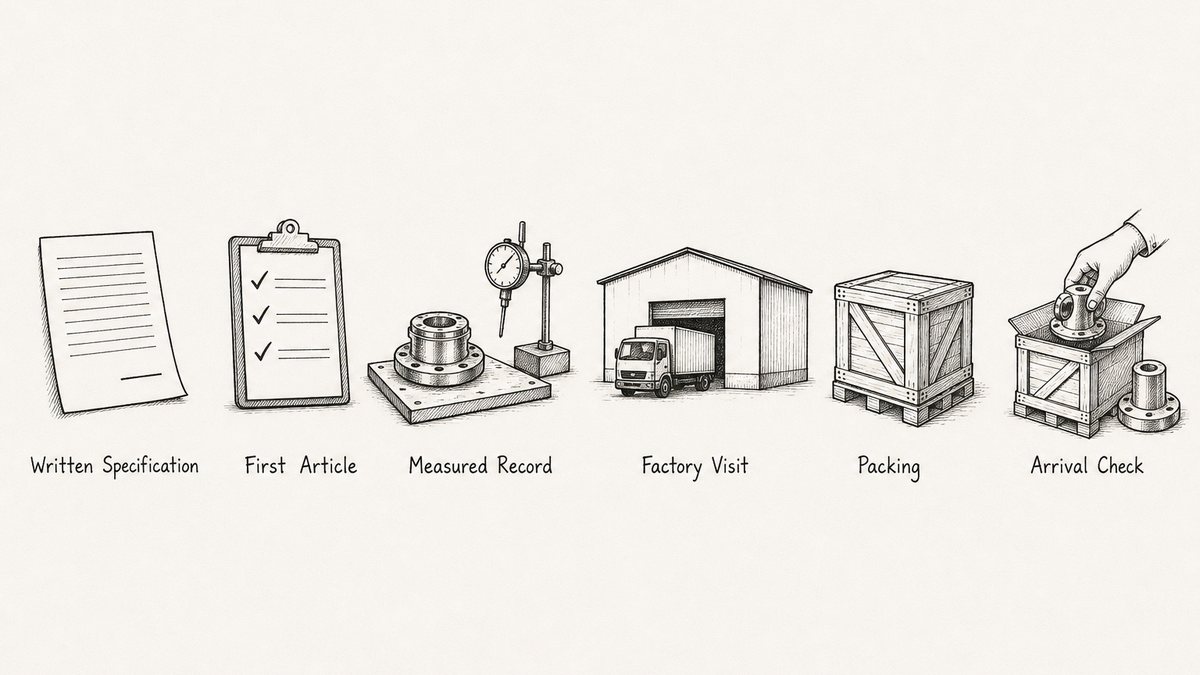
- Written specification
- The duty, the material figures and the finish, in one document with a revision number. This is the stage where a Chinese factory is at its most capable: given a complete sheet it will build to it accurately and to a competitive price. Given a paragraph it will build to its own reading of the paragraph, which is not the same thing.
- First article
- On a series order the first unit is checked before the rest are built, and on a single machine the first sub-assembly — the frame, the chamber, the rotor — is checked before the finish work starts. This catches a tooling or interpretation error while it is one machine's problem rather than a shipment's, and it is the reason a first article inspection on the frame before the run continues is worth more here than in most categories.
- Measured record
- The measurements taken with instruments and written down, not a set of photographs. Photographs show what a factory chose to photograph; a record of the frame's flatness, the clearances, the weld profile and the plate thickness shows what the machine is.
- Factory visit
- Useful, and often oversold. A visit confirms that the factory exists, that the machine in front of you is the machine ordered, and how it is being built. It rarely confirms the material certificates or the heat treatment, which is why it complements a measured record rather than replacing it.
- Packing
- The stage most often left out of the scope and most often the reason a good machine arrives damaged. A machine frame that is not braced, a control panel that is not boxed, a machined face with no protection, and a crate whose base is too thin for the sea crossing are all packing decisions taken without the buyer.
- Arrival check
- The stage the buyer owns. It is worth doing against the same list used at the works, because the difference between what was measured in the factory and what arrives at the site is the only evidence there will ever be about what happened in transit.
The single most useful habit in this whole process is to keep the measurement list identical at every stage: the same dimensions on the general arrangement drawing, the same dimensions in the first article record, the same dimensions in the pre-shipment record, and the same dimensions checked on arrival. When the list is consistent, a discrepancy points at a stage. When the list changes between stages, a discrepancy points at nothing and the argument becomes about memory.
The Failures That Repeat Across All of Them
The seven families are mechanically different, but four failures turn up again and again across all of them, and none of the four is about a component wearing out. They are about what happens between the specification and the arrival.
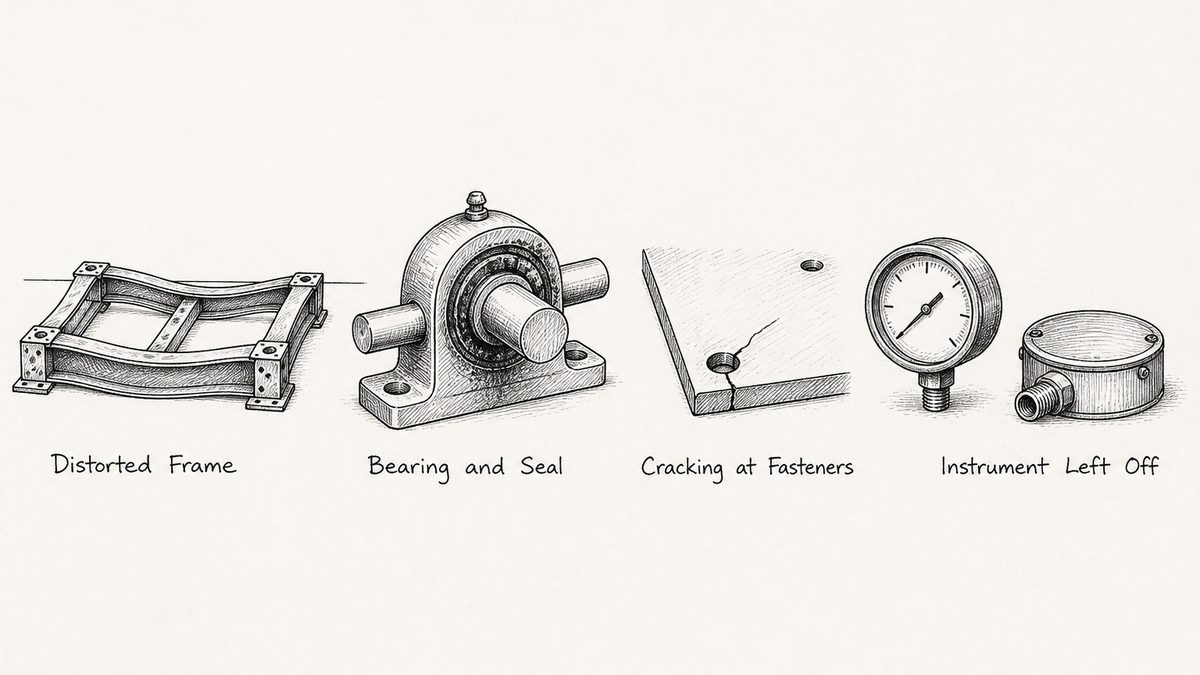
- Distorted frame
- The base is not flat or not square, and everything bolted to it inherits the distortion. It comes from welding without restraint, from stress relieving that was quoted and not done, or from a base plate too thin for the machine's own weight. It is cheap to find at the works with a straight edge, and expensive to fix once a machine is sitting on it.
- Bearing and seal
- The most common mechanical failure across the whole category, and it is usually a symptom rather than a cause: misalignment, an unbalanced rotating assembly, a bearing chosen for price, or a seal running on a surface that was never finished for it. Fretting and discolouration around a seal are visible on a machine that has only been run briefly, which makes this a factory-stage check rather than an early-warning instrument.
- Cracking at fasteners
- Cracks that start at bolt holes and corners, because a restraint was too rigid, a plate was too thin at the hole, or the machine was over-tightened onto an uneven base. A crack at a fastener is the failure that turns a maintenance job into a replacement, and it usually starts in the first few hundred hours.
- Instrument left off
- The quietest of the four and the most expensive over a life. A gauge, a thermowell, a sampling point or a differential pressure tap that was in the specification and not in the scope leaves a plant that cannot measure what it is doing. It is invisible on a photograph, absent from the price comparison, and unfixable later without cutting into finished work.
All four are decided before the crate closes, and that is the argument for treating every machine in this category the same way regardless of what it does: one measurement list, taken at the works with simple tools, recorded in writing. On most of these machines the list is short and measured with a straight edge, a feeler gauge, a tape and an alignment check — which is what makes a pre-shipment inspection with the frame flatness and the clearances written down unusually good value in this category. It costs little, it is repeatable, and it converts an argument about opinion into a comparison of two numbers.
The Machine Directory
Everything below is a full sourcing guide for one machine, written the same way: the duty, the figures that decide it, the rules it answers to, its failure modes and what to put in the enquiry. Find the family, then the machine.
Power transmission. This is the group most often bought in from a specialist, and the one where a wrong figure fails fastest. Start with gear motors and the gearboxes behind them, which is usually the item that sets the starting duty for everything downstream, and sprockets and their tooth forms where a chain drive is doing the work. For positioning rather than power, ball screws used for positioning carry their own accuracy figures, and plastic gears where metal is the wrong answer are a materials question before they are a cutting question. On the hydraulic side, hydraulic pumps and their displacement and hydraulic fittings and their flare angles are two halves of one system and have to be ordered against the same pressure.
Conveying. The group where the material's own behaviour decides the machine. screw conveyors for bulk powder and granules are the workhorse of the group and are sized on volume rather than mass. Where the load itself has to move, industrial casters rated for their load and forklift forks and the attachments that go with them are both bought on a rated capacity that has to include the load's own centre of gravity rather than just its weight.
Separation and filtration. Machines that divide a stream, and the elements that do the dividing. filter presses and their filter plates set the moisture of a cake and therefore the duty of whatever dries it next. Where the duty is finer and the medium is a metal element rather than a cloth, sintered metal filter elements are rated in a way that has to be read carefully before two quotations can be compared.
Size reduction, drying and blending. The process end of the category, where the figures are all about the material rather than the machine. hammer mills and the screens that set their output decide a particle size; rotary dryers and their lifters and spray dryers and their atomizers both remove water but from completely different starting points; and ribbon blenders and their ribbon geometry are what most of that material meets next.
Air cleaning and liquid handling. The group with the most written obligations attached. wet scrubbers and the pressure drop they run at are chosen against a gas volume and a particle size, while thermal oxidizers and their operating limits are chosen against a solvent and a destruction figure. On the liquid side, screw pumps for thick liquids are the usual answer when a peristaltic will not last and a centrifugal will not prime.
Flow control and safety devices. The smallest parts with the largest consequences. ball valves and their body materials and solenoid valves and their coil ratings are both bought on a seal material rather than on a bore size, and orifice plates and orifice flanges are the parts that make a flow measurable. Where the job is to fail safely instead of to hold, rupture discs and the holders they sit in are the one item in this whole category where a wrong number is a hazard rather than a cost.
The Six Gates Every Article Here Has Passed
Every guide linked above was put through the same six checks before it was published, and knowing what they are tells you what the guides can be trusted for.
- The keyword has real numbers behind it
- Volume, difficulty and traffic potential from a keyword tool, with the source and the date recorded. No figure in any of these guides is estimated, and a term with no data is left out rather than guessed at.
- The search results were read before writing
- Who ranks, how strong those pages are, and what the People-Also-Ask questions actually ask. A term whose questions are all about brand rankings is a term where a sourcing guide cannot win, and those were passed over.
- The rules are quoted from the source
- Where a guide cites a regulation, the text was read from the current official source and quoted. Where a section had been removed or superseded, it is not cited.
- The vocabulary is plain
- Written so that a reader without a technical dictionary can follow it, with the trade term explained the first time it appears rather than left to carry the meaning.
- The links were checked
- Every internal link resolves to a live page, every external link resolves to the source it claims to be, and no link repeats a sentence that appears on another article.
- The figures were verified
- Every plate in every guide is a hand-drawn engineering drawing, checked character by character against the brief, with no numerals on the drawing and no metadata that should not be there.
The point of listing them is not to claim perfection. It is that these are the checks that separate a guide somebody can act on from a page that reads well and costs a plant money. When a guide here says a figure is enforceable, that figure was read in the rule; when it says a search term was rejected, there is a record of why.
What to Send, and What to Check
Whichever of the seven families the machine belongs to, the same eight things go into the enquiry. A buyer who sends all eight gets a quotation that can be compared with the next one; a buyer who sends three gets a price for a box.
Eight Lines Every Machinery Enquiry Needs
| What to send | Why the factory cannot answer without it |
|---|---|
| The duty: what the machine has to achieve, expressed as a rate at a specification | A rate without a specification, or a specification without a rate, is not a duty and cannot be designed against |
| The material in its own terms, at the point the machine will see it | Solids, powder, slurry, liquid and gas lead to different families, and the same plant may have all five |
| Bulk density as it will be fed, with the basis stated | It sets the size and the torque, and a loose figure and a packed figure are not interchangeable |
| Flow behaviour and any bridging, flooding or dusting tendency | It decides hopper angles, discharge sizes and whether the machine needs an air broom or a vibrator |
| The tolerance the output has to hold, and how much variation is acceptable | This is the difference between an adequate machine and an expensive one, and it is the buyer's to set |
| What the material may touch, including anything that must never reach it | It fixes the material of construction, the lubricants, the seals and the cleaning method |
| Site conditions and duty cycle: ambient, altitude, continuous or batch, hours a year | A machine rated for a different condition fails early, and correctly described by the supplier as outside its rating |
| Any obligation already in force: permit limit, hazard assessment, audit or customer standard | These turn a commercially sensible machine into a non-compliant one, and they are cheapest to find now |
Reading the answers back is the same exercise in every family. Check that the duty came back as a rate at a specification rather than as a model number. Check that the density and the tolerance are the figures you sent, not typical values. Check that the material of construction follows from what the material may touch. Check the list of items excluded from the scope, because that list is where the money is. Check whether the guard, the access, the instruments and the spares are inside it. And check that the drawing you are sent is the drawing you specified, because a quotation is a price and a general arrangement is a commitment.
What is industrial machinery?
Industrial machinery is the equipment a business uses to make, move, divide, dry, clean or hold something else. The dividing line is not the machine but the transaction around it: industrial machinery is bought against a specification, installed as part of a process, and held to a performance figure by whoever signed for it. A lathe in a job shop is industrial machinery; the same lathe sold to a hobbyist is not. That difference explains why this category behaves the way it does — there is no catalogue that lists the right answer, the purchase price is only part of the cost over a life of ten or fifteen years, and machines that turn, cut, burn, lift or emit carry obligations that a hand tool does not.
How many types of industrial machinery are there?
There is no fixed number, but for sourcing purposes almost everything falls into seven groups, and using them makes a large subject manageable. They are: power transmission (gears, gearboxes, chains, sprockets, screws, shafts and the pumps that drive them); conveying (screw and belt conveyors, elevators, feeders, casters and forks); separation (filter presses, screens, classifiers, cyclones and centrifuges); drying (rotary, spray, tray and fluid bed dryers); air cleaning (scrubbers, oxidizers, baghouses and cyclones); filtration (the elements and housings, including sintered metal); and safety devices (rupture discs, relief valves, flame arresters, guards and the instruments that watch a process). The group matters because it decides which figures you have to bring, how the machine fails, and which rules apply.
How do I work out which machine I need?
Answer four questions in order and most of the field removes itself. First, what is the material at the point the machine will see it — a powder, a damp cake, a slurry, a liquid or a gas? Second, what has to change about it — moved, divided, dried, cleaned, held, or protected against? Third, what is the rate, and at what specification? A duty is a rate at a specification, so "two tonnes an hour at four per cent moisture" is a duty and "a big dryer" is not. Fourth, what is the plant already obliged to meet — a permit limit, a written hazard assessment, a quality standard or a customer audit? Those four answers identify the family and most of the figures. What they do not do is identify a model, because the model follows from the figures rather than the other way round.
Is it cheaper to buy industrial machinery from China?
Usually, on the machine itself, and the honest answer is that the machine price is the least interesting number in the comparison. What matters is the delivered cost of a machine that does the duty, and that includes the specification work, the inspection, the packing, the freight, the duty, the commissioning and the cost of the parts you will replace over its life. A machine bought cheap and specified loosely is expensive at the point where it does not hold the tolerance or the plant cannot get spares, and that cost lands years after the price comparison was won. The advantage of buying from a Chinese factory is strongest when the specification is complete and the volumes are real; it is weakest when the buyer is hoping the factory will work out what they need.
What should I have ready before I ask for a quotation?
Four things, and none of them is a machine name. The duty, written as a rate at a specification. The material figures — bulk density as fed, flow behaviour, and what the material may touch. The site conditions and the duty cycle. And any obligation already in force, such as a permit limit, a written hazard assessment or a customer standard. Of those, the written hazard assessment is the one most buyers do not have and the one that pays for itself soonest, because it is a document that names the workplace, the person who assessed it and the date, and it tells you what the machine has to be guarded and separated from before anybody quotes you a guard.
What goes wrong most often when buying machinery from China?
Four things, and none of them is the machine's quality. A frame that arrives twisted because welding was done without restraint or the base was too thin, which is cheap to find at the works with a straight edge and expensive to fix once a machine is sitting on it. A bearing or seal failure traceable to misalignment, an unbalanced assembly or a seal running on a surface that was never finished for it — and visible on a machine that has only been run briefly. Cracking at a bolt hole or a corner, which usually starts in the first few hundred hours. And an instrument, gauge or sampling point that was in the specification and not in the scope, which leaves a plant unable to measure what it is doing. All four are decided before the crate closes, which is why a measurement list taken at the works with simple tools is worth more than a set of photographs.
Send the duty and the material — the machine name is the last thing to settle
Tell us what the machine has to do rather than what it is called. The material in its own terms, the change you need, the rate at that specification, and what the plant is already obliged to meet. Then the family, the four figures, the finish and the drawings.
Request a Machinery Sourcing Quote
Questions & Comments
We read every one and reply within 24 hoursMost machinery arguments come down to two things that were never written down: the duty expressed as a rate at a specification, and the four material figures the machine has to be sized on. Send us both, and we will pin them down before the order.