
Ball Valve Manufacturer Guide: Types, Body Materials, Seals and Testing
 ·
Updated October 10, 2026
·
22 min read
A ball valve looks like the simplest thing in a catalogue: a body, a ball with a hole through it, a handle, and a quarter turn. That is why so many orders go wrong. The part that actually decides whether the valve lasts is the seat, and the seat is named in the quotation with a word that covers several different materials. The part that decides whether you can ever automate the valve is a mounting pad that costs almost nothing to specify and cannot be added later. And the part that decides whether the valve fits the pipe at all is a thread standard that looks identical to the wrong one until you try to thread it. This guide covers which body type your line needs, which seat material survives your fluid, where the bore you are buying is written down, what the standards on the label actually cover, what a pressure test does and does not prove, and where a cheap quotation takes its money back.
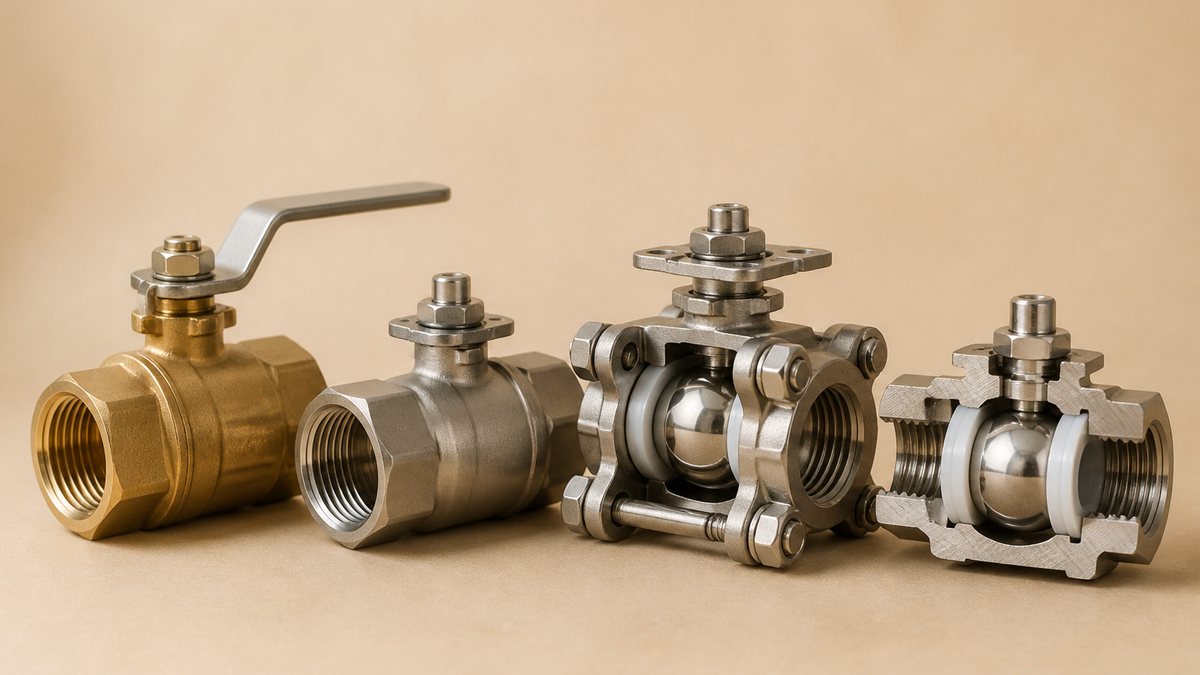
What Each Choice Actually Buys You
| If your situation is | The choice that follows | Why it is the right trade |
|---|---|---|
| General water, air or light oil service, small sizes, replaced when it fails | One or two-piece brass, floating ball, reduced port | Cheapest way to get a quarter-turn shutoff, and the reduced bore costs nothing if the line can live with the pressure drop |
| The valve sits in a line you cannot easily cut out, and seats will need changing | Three-piece body | The centre section comes out in place, so seats and ball are replaced without disturbing the pipework |
| Large size, high pressure, or a quarter turn that has to be easy | Trunnion mounted ball | The ball is carried on bearings instead of being held by the seats, so the turning force does not climb with line pressure |
| Line losses matter, or you are metering or pigging through it | Full port | The bore matches the pipe inside diameter, so the valve stops being a restriction |
What Is a Ball Valve, and What Actually Decides Its Price?
A ball valve shuts off flow by rotating a bored ball a quarter turn inside the body, so that the hole through the ball lines up with the pipe or turns away from it. Nothing squeezes, nothing seats on a thread, and nothing has to travel far. That is why the design seals well, opens fast, and costs less than most alternatives at the same size.
Its price is set by four things, and they are not equally visible on a quotation:
- The body material and how it was made
- Brass, bronze, carbon steel and stainless steel are different prices, and so are the two ways of making the body. A body can be cast from a mould, or machined out of a solid bar. Cast bodies are cheaper at volume and the tooling is a one-time cost. Bar-stock bodies need no casting tool at all, which makes them the practical choice for small quantities and for sizes and shapes that would not justify a casting pattern.
- The seat and seal materials
- This is the smallest line on the quotation and the largest factor in how long the valve lasts. Seats are named by a family — the same word can mean three materials with different temperature and pressure limits — so the name alone tells you nothing until the supplier says which grade.
- The bore
- A valve sold as a one inch size can have a bore noticeably smaller than one inch. Reduced port is legitimate and cheaper; it is the mismatch between what the buyer assumed and what the bore is that causes the argument.
- Testing and paperwork
- Every valve is pressure tested before it leaves, but not every valve is tested to the same standard, in the same way, or with a record that travels with the goods. For a valve going into a plant, the paperwork is part of the product.
The useful habit is to stop treating the valve as one item and start treating it as three specifications that happen to share a body: what it is made of, what it is sealed with, and what it has been proven to do. A quotation that answers all three is comparable with another quotation. A quotation that answers only the first one is not a shorter quote, it is a quote you will renegotiate after the samples arrive. If you are comparing suppliers on machined fluid parts for the first time, the same reasoning is written up for the hydraulic fittings on a ball valve, where the material grade and the thread form do the same job of separating two apparently identical quotes.
Which Ball Valve Type Do You Actually Need?
Two separate choices get tangled together here. The first is how the body is assembled, which is a maintenance decision. The second is how the ball is held, which is a size and pressure decision. Buyers who think about them as one choice usually pay for the wrong one.
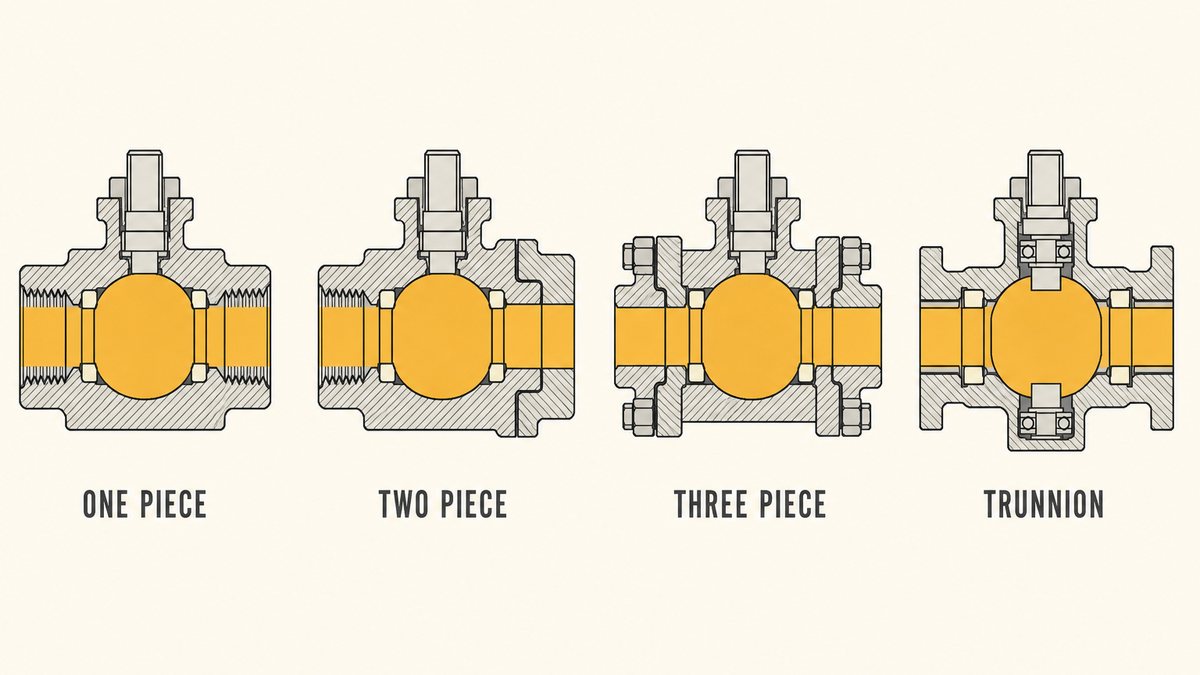
How the body goes together. A one-piece valve has the body made as a single piece with the end connections screwed or welded in, so the internal parts cannot be reached without taking the valve out of the line. A two-piece valve splits into a body and one end cap, so the internals come out if you can get the valve to a bench. A three-piece valve has a centre section held between two end caps, and that centre section carries the ball and the seats — so on a three-piece valve you can change the seats and the ball while the end caps stay bolted to the pipe.
That difference is the whole reason three-piece valves exist. It is not a strength difference and it is not a quality difference; it is the difference between a repair that takes an hour in place and a repair that means draining a line. If the valve is in a place you can shut down and open up, a two-piece is fine. If it is not, a three-piece pays for itself the first time a seat fails.
How the ball is held. In a floating ball valve, the ball rests against the two seats and is pushed into the downstream seat by the line pressure itself. The higher the pressure, the tighter the ball is pressed into the seat, which is why floating valves seal so well — and also why the force needed to turn them climbs as pressure rises. Floating is the normal choice for small and medium sizes and it is what most buyers actually receive.
In a trunnion mounted valve, the ball is held on bearings at the top and bottom, so it does not press into the seat. The seat is pushed against the ball by a spring instead. At large sizes and high pressures this is the only way to keep the turning force low enough that a person, or a small actuator, can operate the valve. If your valve is large and your technician cannot turn it, the problem is not the handle.
Body Materials: Brass, Bronze, Carbon Steel and Stainless Steel
The body material is chosen by what runs through the valve and where the valve sits, not by what looks solid. Four families cover almost everything you will be quoted.
- Brass
- The default for water, air and light oils in small sizes, and the cheapest body you will be offered. Two things deserve attention. First, some waters attack brass and strip the zinc out of it, which is why the alloy matters and not just the word brass. Second, if the valve is on drinking water, many markets restrict how much lead the alloy may contain — so a brass valve for potable water is a specific alloy with a document, not any brass valve.
- Bronze
- Chosen where brass is not quite enough — seawater, some chemicals, and higher temperatures. It costs more and machines differently, so the price step over brass is real rather than a markup.
- Carbon steel
- The industrial and oil-and-gas default where strength and pressure rating matter more than corrosion resistance. Bodies in this family are usually made to a published valve standard, and the standard is what carries the pressure and temperature ratings.
- Stainless steel
- The answer for chemicals, marine air, food and pharmaceutical service where a wetted part must not rust. Grades are not interchangeable: the common austenitic grades behave differently in chlorides, and a valve that is fine on a washdown line can pit in a chlorinated one. Ask for the grade, not just the word stainless.
One clarification saves arguments. The word "stainless" describes the body. The ball, the stem and the seats are separate parts made from separate materials, and a stainless body is often fitted with a stainless ball and a polymer seat. When you compare two stainless valves, compare all four parts, because that is what the two suppliers priced differently.
Seats and Seals: the Line That Decides How Long It Lasts
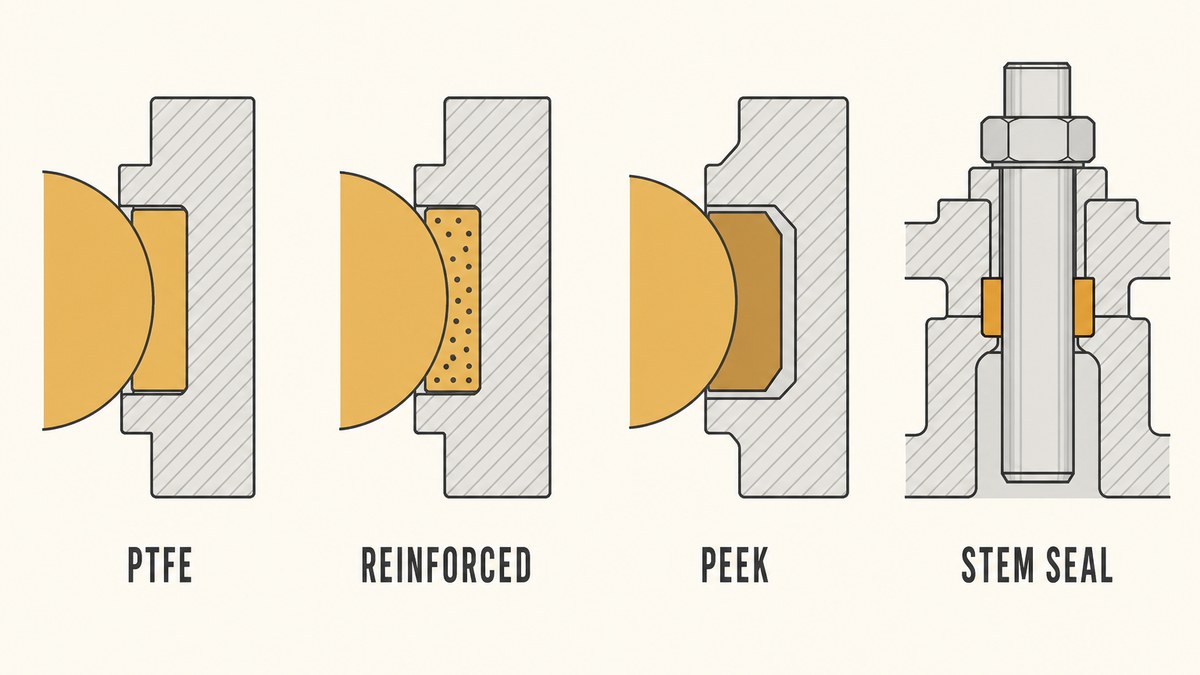
The seat is the ring the ball presses against, and the stem seal is the packing around the shaft. Together they are the only things standing between your fluid and the outside world, and they are where the temperature and chemical limits of the whole valve are actually set. The body can be stainless steel and the valve can still be limited to a modest temperature, because the seat is not.
The trap is that seat materials are quoted by family name. Three genuinely different materials are all sold as a seat for the same valve, and only one of them is right for your line:
- Plain PTFE. The standard soft seat: excellent chemical resistance across a very wide range of fluids, very low friction, and a modest temperature ceiling. It is also soft, so at higher pressures it can be pushed into the gap between the ball and the body — which is why the pressure rating of a PTFE-seated valve is often lower than the body could take. If the valve is for food or pharmaceutical contact, this is also the seat you will be asked to document, and perfluorocarbon resins used in contact with food are covered by 21 CFR 177.1550, the rule for perfluorocarbon resins in the United States.
- Reinforced PTFE. The same polymer with a filler added — typically glass, carbon or a similar filler — which makes the seat harder, less likely to deform under pressure and better at higher temperatures. Fillers are not neutral, though: they change chemical compatibility and they change how the seat behaves against the ball. Ask which filler and how much of it, because "reinforced" on its own is not a specification.
- PEEK. A high-performance polymer used where neither PTFE grade will survive, at higher pressures and temperatures and in services where a soft seat would extrude. It costs materially more, which is why a quotation that says PEEK cheaply should be checked rather than celebrated.
The stem seal is a separate decision with its own materials, usually elastomers, and its own limits. It is also the part most likely to be left out of the conversation, because it is inside the body and nobody looks at it. A valve that holds on the seat test and weeps at the stem a month later was specified on the seat and not on the stem.
Full Port or Reduced Port? The Bore You Are Actually Buying
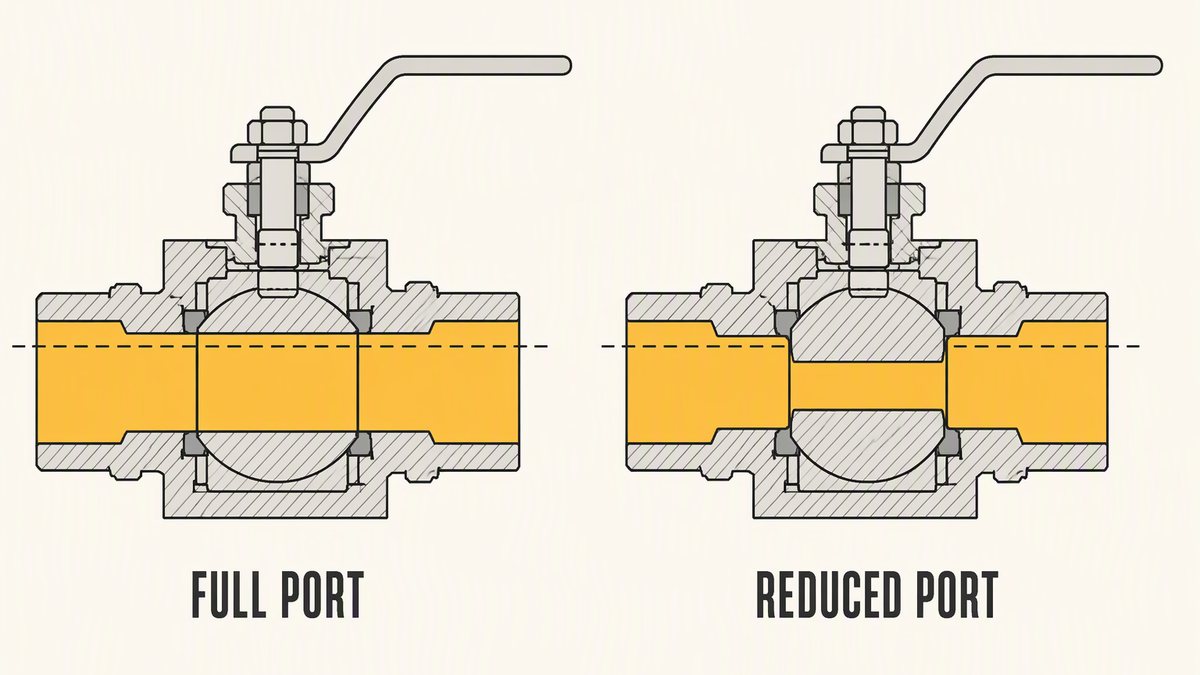
The size of a ball valve is the size of its connection, not the size of the hole through it. A valve described as one inch will screw onto a one inch pipe, and the bore inside it can be noticeably smaller than one inch. Both versions are legitimate products and the difference is written down — but only if you ask for the drawing.
In a full port valve, the bore through the ball is close to the inside diameter of the pipe, so the valve adds almost nothing to the line's pressure loss. In a reduced port valve, the bore is smaller, which makes the valve shorter, lighter and cheaper, and makes the line slightly harder to push fluid through. For an isolation valve that is either fully open or fully shut, that permanent restriction is often an acceptable trade. For a line where flow matters, it is a cost you pay on every hour of operation.
Three situations make the choice for you:
- Anything you plan to push through the line. If a cleaning pig, a sampling probe or a meter has to pass the valve, a reduced bore either cannot take it or disturbs the measurement. Full port is not a preference here, it is a requirement.
- A line that is already tight on pressure. If the pump is sized close to what the system needs, a reduced port valve can be the extra loss that turns a working system into a marginal one. Replacing it later costs more than specifying it now.
- A valve bought by size alone, for stock. Reduced port is the sensible default for general MRO stock — cheaper and more compact — as long as the bore is understood and not assumed.
There is a simple way to stop this being a matter of trust. Ask for the bore dimension, or ask for the flow coefficient, and put whichever you get on the drawing. A quotation that gives a size and no bore has not described the valve you will receive; it has described the thread on the end of it.
Which Standard Is Your Valve Built To?
A standard is the contract behind the label. It is what turns a drawing into a set of ratings someone else has already agreed on, and it is the reason two valves from two factories can be compared at all. Three families do most of the work on the valves you will be quoted.
The pressure and temperature rating standard. In North American practice, the ratings, dimensions, tolerances, materials, examination requirements, testing and marking for valves with flanged, threaded and welding ends are set by ASME B16.34. What matters to a buyer is that this is the document that decides how much pressure a given body in a given material can hold at a given temperature — which is why "300 pound" is a rating and not a description of the wall thickness.
The industry product standard. Sectors with their own engineering traditions publish their own specifications for the products they buy. The petroleum and petrochemical industries buy through the standards published by the American Petroleum Institute, and a valve ordered to one of those specifications is being bought against a document written for that service rather than a general one. A supplier who cannot say which of these applies to your valve is quoting a shape, not a specification.
The mounting standard. If the valve may ever be automated, the interface between the valve and the actuator is covered by a separate standard, which sets the flange dimensions and the drive arrangement for attaching a part-turn actuator. That is the pad on top of the valve. It has nothing to do with flow and everything to do with whether an actuator can be bolted on later, which is why it is worth deciding when the valve is ordered rather than when it sticks.
- Ask which parts of the standard apply
- A standard can cover the body but say much less about what is inside it. A valve can genuinely be built to a rating standard and still be limited by a seat that the standard does not govern. The body rating is not the valve rating.
- Ask for the rating at your temperature
- Pressure ratings are quoted with a temperature attached, because materials lose strength as they get hot. A valve rated generously at ambient may be rated far lower at working temperature, and that lower number is the one your line has to live with.
- Ask for the document, not the claim
- "Built to standard" is a sentence. A material certificate, a test record with a serial number, and a drawing that states the bore and the seat material are documents. The difference between the two is what you discover when something fails.
What Testing Actually Proves
Every valve that leaves a factory is pressure tested. That sentence is true and almost useless, because there are two different tests and they prove two different things.
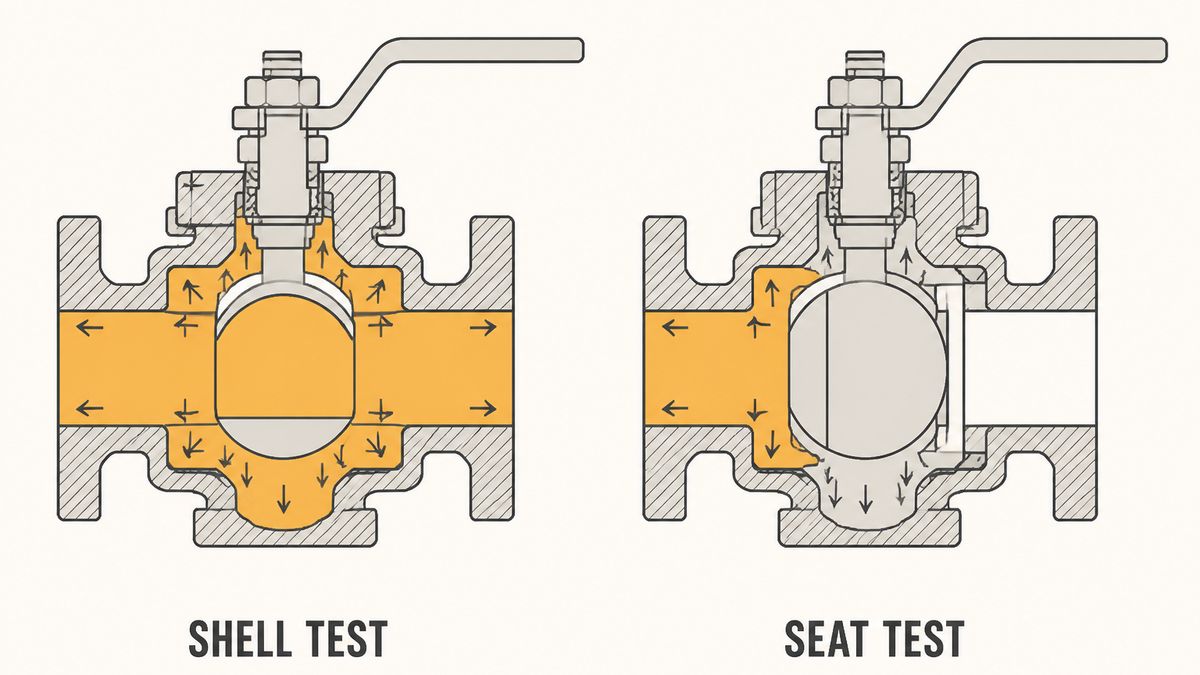
The shell test pressurises the inside of the body with the valve open, to prove the body casting and the joints between the body parts hold. It is run at a pressure above the valve's rating, because its job is to break a bad casting at the factory rather than in your plant. It says nothing about whether the valve closes.
The seat test — the leak test — pressurises one side of the closed ball and looks for fluid passing the seat. It is run at a lower pressure than the shell test and it is the test that describes the valve's actual job. A valve can pass the shell test comfortably and still weep past the seat.
Two expectations belong in the conversation before you order:
What a test does not prove is endurance. A pressure test takes a valve that has just been made and shows it is sound that day. It says nothing about how the seat behaves after thousands of cycles, or how the stem seal ages. That kind of proof comes from cycle testing, which is a design qualification done once for a product line rather than a test done on your shipment — so if the claim matters to you, ask for the cycle test report for that product, not a pressure certificate for that box.
Then inspect what arrives. Test certificates belong in your incoming inspection plan along with the visual checks, and the same sampling logic used for any other component applies — a written how many ball valve units to pull per batch keeps "acceptable" meaning the same thing to your supplier and to you.
Lever, Gear or Actuated? And the Mounting Pad That Decides
How the valve is turned is decided in the same conversation as the valve itself, and it is decided on the drawing rather than at the bench.
A lever is the default and it is the right answer for small valves that a person operates by hand. As the valve grows, the force needed to turn the ball grows with it, and beyond a certain size a plain lever becomes unsafe or simply impossible. That is where a gear operator comes in — it is not a feature added for convenience, it is the point at which a person can no longer turn the valve directly.
If the valve has to be operated by a control system rather than a person, it needs an actuator, and an actuator bolts onto a pad on the top of the valve. That pad is the mounting standard mentioned earlier. It is a machined feature of the body, and that is the whole problem: it cannot be added to a valve that was made without it. The valve you buy without a mounting pad is a manual valve for life, and the only way to automate it later is to replace it.
- Specify the pad even if you are buying manual valves
- A pad costs very little to include at the machining stage and it preserves an option you may need in two years. Adding it later is not an option, it is a new order. The size of the pad and the shape of the drive have to match the actuator you will eventually use, so decide the actuator family before the valve drawing is signed.
- Match the drive, not just the flange
- An actuator has to turn the stem, and the stem's drive shape is part of the interface. A pad that matches the flange but not the drive is an adapter at best and a wasted order at worst.
- Decide the failure position
- An actuated valve has to answer a question a hand lever never did: when the power or the air supply is lost, does the valve open or close? That answer changes the actuator, not the valve, and it has to be known before the actuator is ordered.
One alternative is worth knowing before an actuator is chosen, because it is cheaper and often better for small lines. Where the requirement is simply an electrically operated shutoff on a small pipe, the usual answer is not an actuated ball valve but a the valve that switches a ball valve, whose coil and seal materials set its limits in exactly the way the seat sets a ball valve's. Ball valves earn their place where the line is larger, the pressure is higher, or the flow has to pass through cleanly when open — not where a small line simply needs to be switched on and off by a controller.
All three of those are drawing decisions rather than purchasing decisions, which is why they belong in a design review before any quotation is requested. The same discipline of fixing the interface before the tool is cut is set out in a reviewing a ball valve design before tooling, and a valve body is exactly the kind of part where a late change costs a pattern instead of an afternoon.
Cast Body or Bar Stock? Where the Tooling Money Goes
There are two ways to make a valve body, and they have completely different cost shapes. A cast body is poured in a mould, so the money goes into a pattern up front and the piece price falls with volume. A bar-stock body is machined out of solid material, so there is no pattern to pay for but you pay for the metal you turn into chips and for the machining time, on every single part.
Which one is cheaper depends on your quantity, and the crossover is further away than most buyers expect. Below it, bar stock wins because there is no tooling to amortise. Above it, casting wins because the pattern cost is spread thin and the material waste disappears. That is the same structural trade that governs tooling for moulded plastic parts, and if you have compared the two before, the arithmetic is set out in what an the tooling price on a ball valve — the tooling is a different process, but the question of when a tool pays for itself is identical.
The pattern then raises the same ownership question that arrives with every tool. If the supplier pays for the pattern, the supplier usually keeps it — and a valve you cannot re-quote is a valve whose price you no longer control. The clauses to settle before the pattern is cut are the ones covered in tool ownership after a ball valve order: who paid for it, who holds it, whether it can be moved, and in what condition it comes back.
One detail is worth checking on a cast body, because it does not show on a price list. A casting has to be cleaned, machined at the joints and at the seat pockets, and then finished. Ask what the sealing surfaces are machined to and whether the body is pressure tested before assembly, because a cheap cast body is usually a body that was machined quickly.
Who Makes Ball Valves, and What a Cheap Quote Leaves Out?
Ball valves are made in enormous volume, which makes them easy to buy and easy to buy badly. The suppliers you will meet fall into three groups: factories that machine or cast their own bodies, assemblers that buy bodies and seats and bolt them together, and resellers that do neither. All three can send you a working sample. Only the first two can answer a question about a seat grade.
A cheap quotation is usually a quotation for a narrower scope than you assumed. Five things get quietly dropped:
- The seat grade. The quotation says the valve has a soft seat, which is true of three different materials with different limits. The cheap quote is the one that will not name the grade, because naming it is what lets you compare it.
- A mounting pad. A manual valve without a pad is cheaper by a small amount and permanently un-automatable. This is the saving that costs the most later.
- The right thread. Thread families look almost identical across a bench and do not interchange. A supplier who does not ask where the valve is going may ship the standard they always ship, and the mismatch is discovered by your fitter. Ask for the thread form in writing, before the order, not after a leak.
- Testing records. Every valve is tested. Far fewer arrive with a test record that carries a serial number you can match to the valve in your hand.
- Documentation for a regulated use. If the valve is on drinking water or in food contact, the alloy and the seat both have to be traceable, and the paper has to travel with the goods. A quotation that cannot name the document has not answered the question.
Two checks make the comparison cheap. First, establish who you are actually dealing with, because a factory and a reseller behave very differently when you ask to see the pattern drawing or a material certificate — the method is described in how to tell a factory from a trader. Second, check any certificate that matters against the issuer's own record rather than against a photograph, using the same approach set out for looking the ball valve certificate up at the certifier. Neither check costs anything, and both change the questions you ask.
Finally, price the valve where it ends up rather than where it is bought. A valve is dense, it is usually small, and it is often air-freighted to keep a project on schedule — and the the landed total on a ball valve order. A slightly more expensive valve that is right the first time is usually the cheaper valve.
What Are the Common Failure Modes?
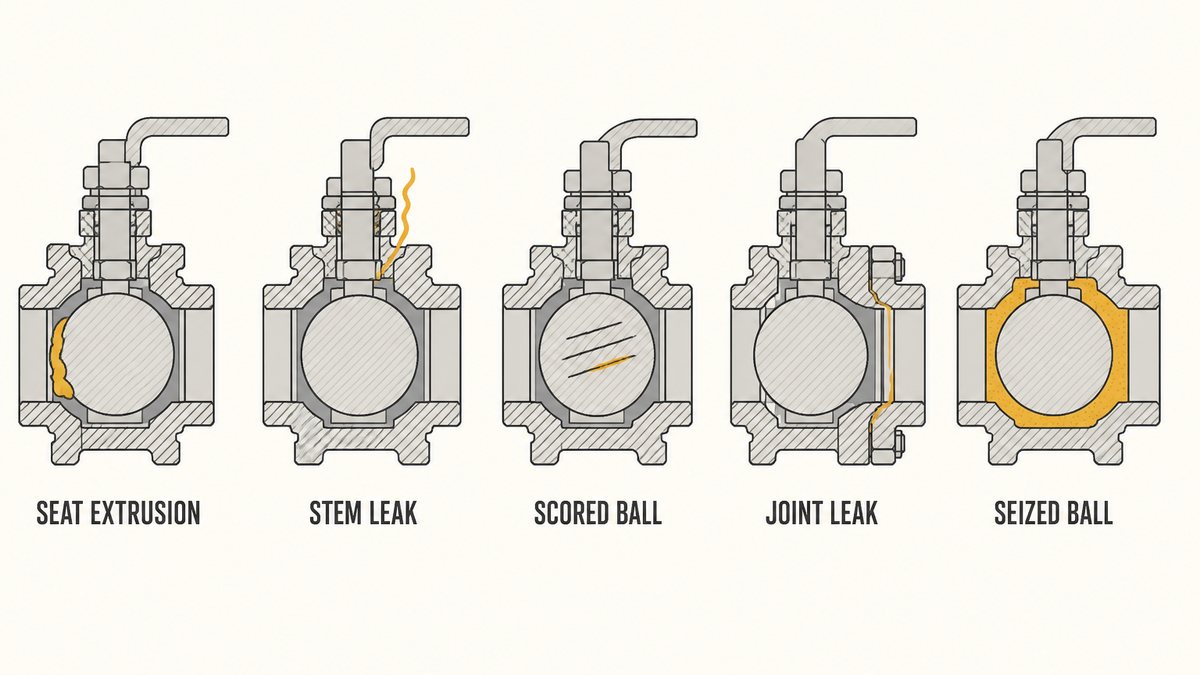
Ball valve failures are unusually easy to read, because each one has a signature and each one traces back to a decision rather than to a mystery. Five cover almost everything a buyer meets.
- A seat pushed out of shape
- A soft seat under more pressure or temperature than it was chosen for slowly deforms and gets pushed into the clearance behind the ball. The valve does not fail suddenly, it just stops sealing, and re-tightening the packing does nothing because the packing was never the problem. It is a seat grade decision that shows up months later.
- A weeping stem
- The stem has to turn, so it cannot be sealed by a static gasket — it is sealed by a packing or an elastomer ring, and that material has its own fluid and temperature limits. A stem leak that appears after weeks is usually a seal material that was chosen for the body's service rather than for the media in it.
- A scored ball
- Because the seat contacts the ball directly, anything abrasive in the line scratches the ball's surface, and every scratch becomes a path for fluid to creep past. This is why a ball valve on a dirty line seals well at first and badly later, and why a filter upstream is part of the valve's specification.
- A leaking body joint
- On two and three piece valves, the joint between the body sections has its own seal. Damaged in assembly or left under-tightened, it weeps at the outside rather than past the ball. It is a boring failure and an easy one to miss during inspection because the leak is not where anyone looks first.
- A valve that will not turn
- A ball valve left in one position for a long time seizes, because whatever is in the line can dry, cure or settle in the cavity around the ball. The ball is then glued in place rather than jammed. This is the only failure on the list that is prevented by maintenance instead of by specification, and it is why a valve in infrequent service should be cycled on a schedule rather than left alone.
Four of those five were settled by the specification, which is the argument for spending the time on the seat grade, the bore and the pad rather than on the last few per cent of the unit price.
Frequently Asked Questions
How do I know whether my valve should be full port or reduced port?
Ask what has to pass through it and how much pressure the line can afford to lose. If a pig, probe or meter must travel through the valve, or if the line is already tight on pressure, you need a full port valve because the bore has to match the pipe. If the valve only isolates a section and the line can tolerate a small permanent restriction, a reduced port valve is cheaper, shorter and lighter. In both cases ask for the bore dimension and put it on the drawing, because the size written on the valve describes the thread rather than the hole.
What is the difference between a floating ball and a trunnion mounted valve?
In a floating ball valve the ball is held between the two seats and line pressure pushes it into the downstream seat, so the seal improves as pressure rises and the force needed to turn it rises as well. In a trunnion mounted valve the ball is carried on bearings and the seat is spring loaded against it, so the turning force stays manageable at large sizes and high pressures. Floating is the normal choice in small and medium sizes. Trunnion is what you specify when a person, or a small actuator, still has to be able to turn it.
Why is a stainless steel valve not automatically a high-temperature valve?
Because the body and the seat are different materials with different limits. A stainless body may be fitted with a polymer seat, and the seat is what decides the temperature ceiling — the body could take far more heat than the seat can. If temperature matters, ask for the rating at your working temperature and ask which seat material is fitted, because the body's strength is only half the answer.
Do I need a test certificate with every ball valve shipment?
It depends on where the valve is going, but the question to ask is always the same: can I match a record to the valve in my hand? A certificate without a serial number proves that a factory tests its valves, not that it tested yours. For plant, marine or regulated service, specify that the test record travels with the shipment and carries an identifier, then check the record against the valve rather than filing it unread.
Can I add an actuator to a ball valve I already bought?
Only if the valve was made with a mounting pad on top. The pad is a machined feature of the body, so a valve built without one cannot be automated later — the practical answer is to replace it. If there is any chance the valve will be actuated in the future, specify the pad now, and decide the actuator family at the same time, because the pad size and the drive shape both have to match the actuator you will eventually fit.
What thread do ball valves use, and why does it matter?
There are two families in common use and the names are often shortened in conversation, which is where the trouble starts. They look nearly identical on a bench and they do not interchange; forcing one into the other damages both the valve and the fitting. The thread form is part of the valve's specification, not a detail to be sorted out on site, so state the thread form in writing on the order and check it on the first sample before the shipment is released. A thread mismatch is the cheapest possible problem to prevent and one of the most expensive to discover.
Send the line conditions, not just the size
Tell us the fluid, the working pressure and temperature, the pipe size and thread form, whether anything has to pass through the valve, and whether it may ever be actuated. Those six answers settle the body type, the bore, the seat grade and the mounting pad before a price means anything. We will come back with the configuration we recommend and why, the body and seat materials named by grade rather than by family, the bore dimension and the thread form in writing, the mounting pad and its actuator interface, and the test record that will travel with the shipment — quoted with the testing and documentation lines shown separately rather than folded into the unit price.
Request a Ball Valve Sourcing Quote
Questions & Comments
We read every one and reply within 24 hoursIf you are holding a valve quotation and trying to work out whether the two numbers are really comparable, post three things and we can usually say: the fluid and its working temperature, the line pressure, and whether the valve has to be turned by hand or by an actuator. If you already have drawings, add the bore dimension and the seat grade the supplier named. Those two lines explain most of the gap between two valve quotations, and they are the two lines a short quote tends to leave out.