
What is AQL (Acceptable Quality Limit) in China Factory Inspection? Complete Table & Calculator Guide (2026)
 ·
Updated September 28, 2026
·
15 min read
·
Updated September 28, 2026
·
15 min read
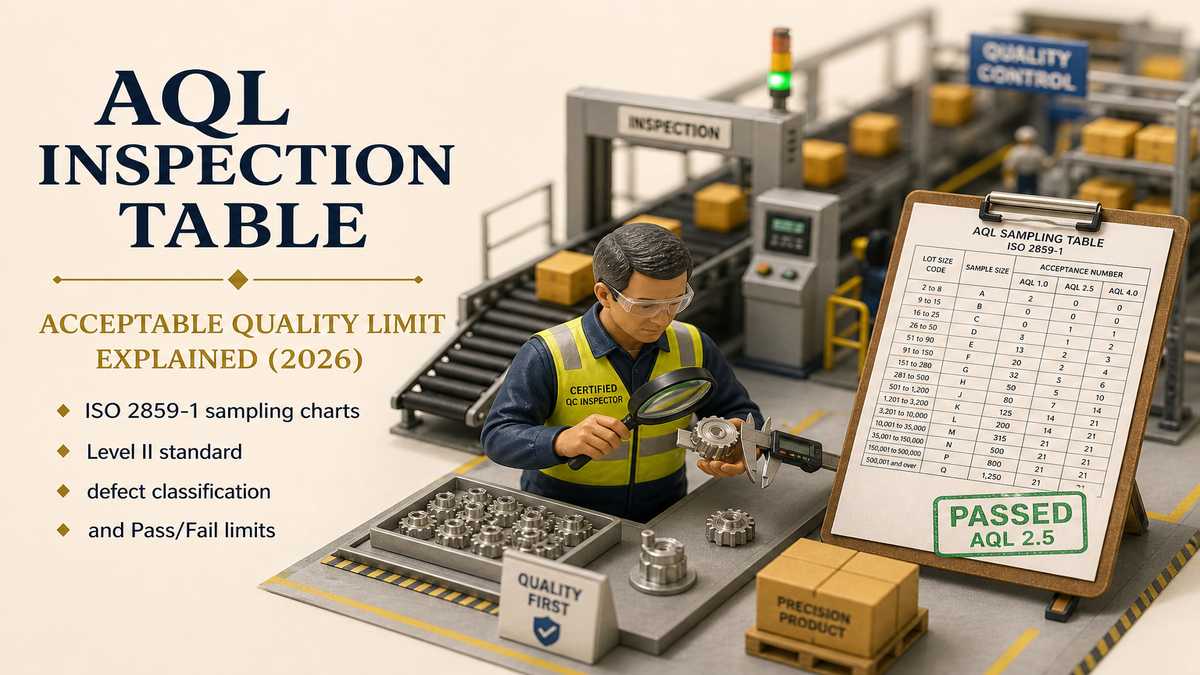
Direct Answer: AQL (Acceptable Quality Limit) is an internationally recognized statistical sampling standard (governed by ISO 2859-1 and ANSI/ASQ Z1.4) used to determine whether a production batch from a Chinese factory passes or fails pre-shipment quality inspection. Instead of spending thousands of dollars checking every single piece in a 10,000-unit order, an inspector randomly pulls a mathematically determined sample (for example, 200 or 315 units). The entire shipment is accepted or rejected based on strict defect limits: Critical: 0 (Zero Tolerance), Major: AQL 2.5 (Max 2.5% defects), and Minor: AQL 4.0 (Max 4.0% defects). It is the single most powerful legal tool you have to prevent defective goods from leaving China.
When manufacturing custom goods in China, telling a supplier “make sure the quality is good” is a recipe for disaster. What an ambitious factory owner considers “acceptable” might result in a 30% Amazon return rate for your brand. Quality is not a feeling; it is a mathematical contract.
By defining your AQL standards in advance, you remove all ambiguity. If an inspection fails, you have black-and-white mathematical proof to hold the factory accountable, withhold final balance payments, and demand 100% sorting and re-inspection at the factory’s expense. In this guide, we break down how to read the official AQL sampling tables, classify defect severity, calculate exact sample sizes, and handle failed inspections like a seasoned professional.
How to Read the AQL Table in 3 Simple Steps
The AQL sampling methodology is published by the International Organization for Standardization (ISO 2859-1 standard) and the American Society for Quality (ASQ). Reading the standard two-table system takes less than 60 seconds once you understand the 3-step workflow:
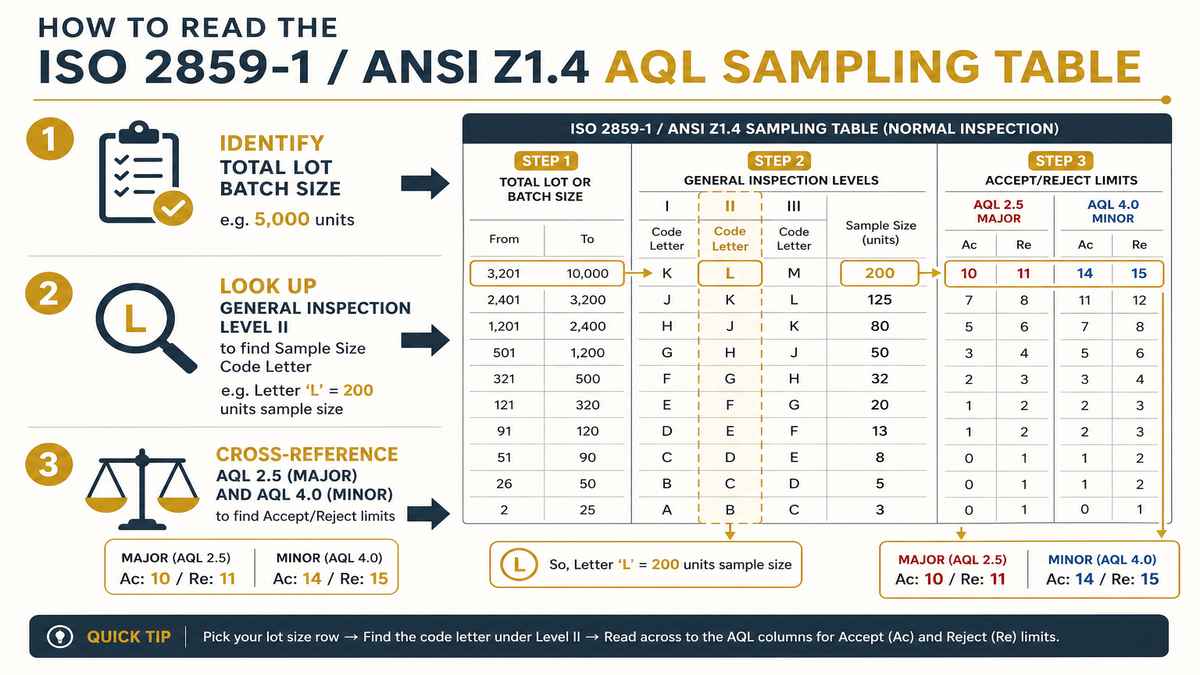
Table 1: AQL Sample Size Code Letters (General Level I, II, III)
Table 1 translates your factory batch size into a standard Sample Size Code Letter across three General Inspection Levels:
| Total Order Lot Size (Units) | Level I (Reduced / Budget) | Level II (Normal / Standard) | Level III (Tightened / High-Risk) |
|---|---|---|---|
| 2 to 8 | A | A | B |
| 9 to 15 | A | B | C |
| 16 to 25 | B | C | D |
| 26 to 50 | C | D | E |
| 51 to 90 | C | E | F |
| 91 to 150 | D | F | G |
| 151 to 280 | E | G | H |
| 281 to 500 | F | H | J |
| 501 to 1,200 | G | J | K |
| 1,201 to 3,200 | H | K | L |
| 3,201 to 10,000 | J | L | M |
| 10,001 to 35,000 | K | M | N |
| 35,001 to 150,000 | L | N | P |
| 150,001 to 500,000 | M | P | Q |
| 500,001 and Over | N | Q | R |
Table 2: Master AQL Sampling Chart (Single Normal Sampling)
Table 2, standardized under the ANSI/ASQ Z1.4 sampling plan standards, sets the exact Accept (Ac) and Reject (Re) numbers for each code letter:
| Sample Code Letter | Sample Size (Units) | AQL 0.65 (High-End) | AQL 1.0 (Strict) | AQL 2.5 (Standard Major) | AQL 4.0 (Standard Minor) | ||||
|---|---|---|---|---|---|---|---|---|---|
| Ac | Re | Ac | Re | Ac | Re | Ac | Re | ||
| A | 2 | 0 | 1 | 0 | 1 | 0 | 1 | 0 | 1 |
| B | 3 | 0 | 1 | 0 | 1 | 0 | 1 | 0 | 1 |
| C | 5 | 0 | 1 | 0 | 1 | 0 | 1 | 0 | 1 |
| D | 8 | 0 | 1 | 0 | 1 | 0 | 1 | 1 | 2 |
| E | 13 | 0 | 1 | 0 | 1 | 1 | 2 | 1 | 2 |
| F | 20 | 0 | 1 | 0 | 1 | 1 | 2 | 2 | 3 |
| G | 32 | 0 | 1 | 1 | 2 | 2 | 3 | 3 | 4 |
| H | 50 | 1 | 2 | 1 | 2 | 3 | 4 | 5 | 6 |
| J | 80 | 1 | 2 | 2 | 3 | 5 | 6 | 7 | 8 |
| K | 125 | 2 | 3 | 3 | 4 | 7 | 8 | 10 | 11 |
| L | 200 | 3 | 4 | 5 | 6 | 10 | 11 | 14 | 15 |
| M | 315 | 5 | 6 | 7 | 8 | 14 | 15 | 21 | 22 |
| N | 500 | 7 | 8 | 10 | 11 | 21 | 22 | 21 | 22 |
The 3 Tiers of Product Defects: Critical vs. Major vs. Minor
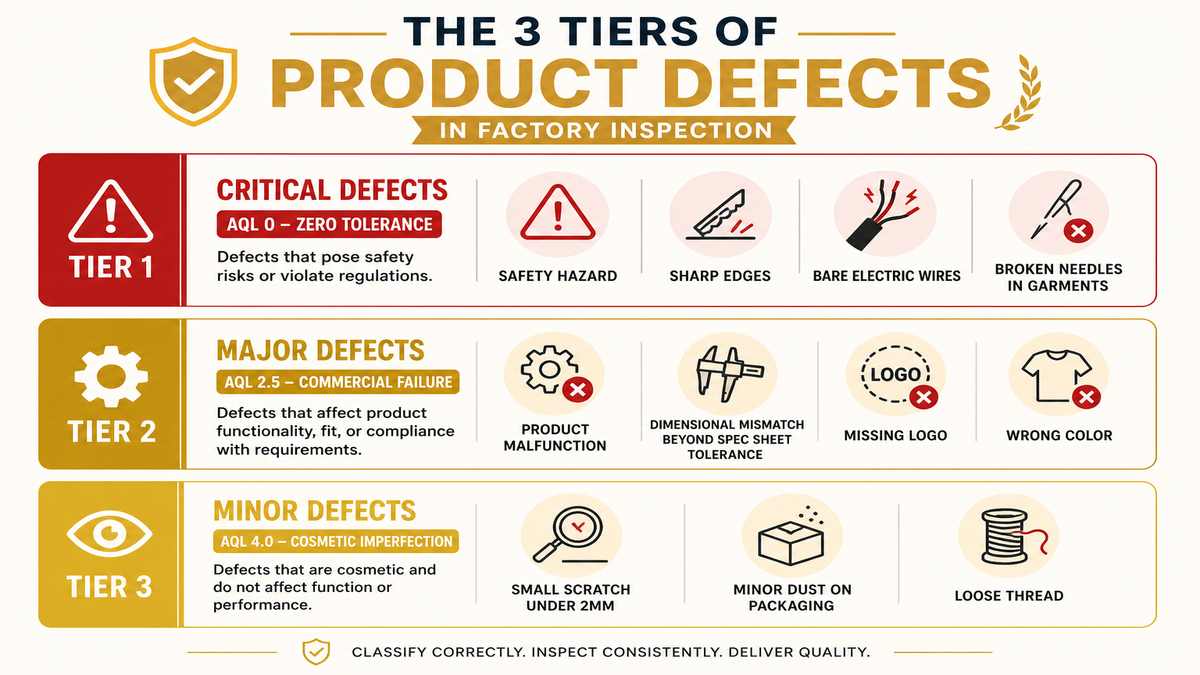
An AQL table is useless unless your inspector and supplier agree on what constitutes a defect. In professional quality control, defects are divided into three rigid tiers:
1. Critical Defects (AQL 0 — Zero Tolerance)
Defects that make the product dangerous, hazardous to human health, or illegal to sell under local consumer safety laws. If a single Critical defect is found in the sample, the entire shipment instantly FAILS.
- Exposed electrical wiring or shock hazards in electronics.
- Broken sewing needles left inside garments or plush toys.
- Sharp metal burrs on children’s toys or kitchenware.
- Missing required safety warnings (e.g., choking hazard labels or suffocation warnings on polybags).
2. Major Defects (AQL 2.5 — Functional or Commercial Failure)
Defects that affect the core function, durability, or primary aesthetic of the product, causing customers to return the item or leave 1-star reviews.
- Product will not turn on or power button jams.
- Dimensions exceed tolerances listed on your factory product specification sheet.
- Wrong Pantone color, missing brand logo, or incorrect barcode printing.
- Severe scratches over 5mm on the primary visual face of the product.
3. Minor Defects (AQL 4.0 — Cosmetic Imperfections)
Small imperfections that do not hurt product function or reduce usability, but fall below pristine retail expectations.
- Tiny hairline scratch under 2mm on the bottom or back of the item.
- Slight color variation within agreed master sample tolerances.
- Minor cardboard crease on outer master shipping packaging.
- Loose thread on a garment hem that can be trimmed in seconds.
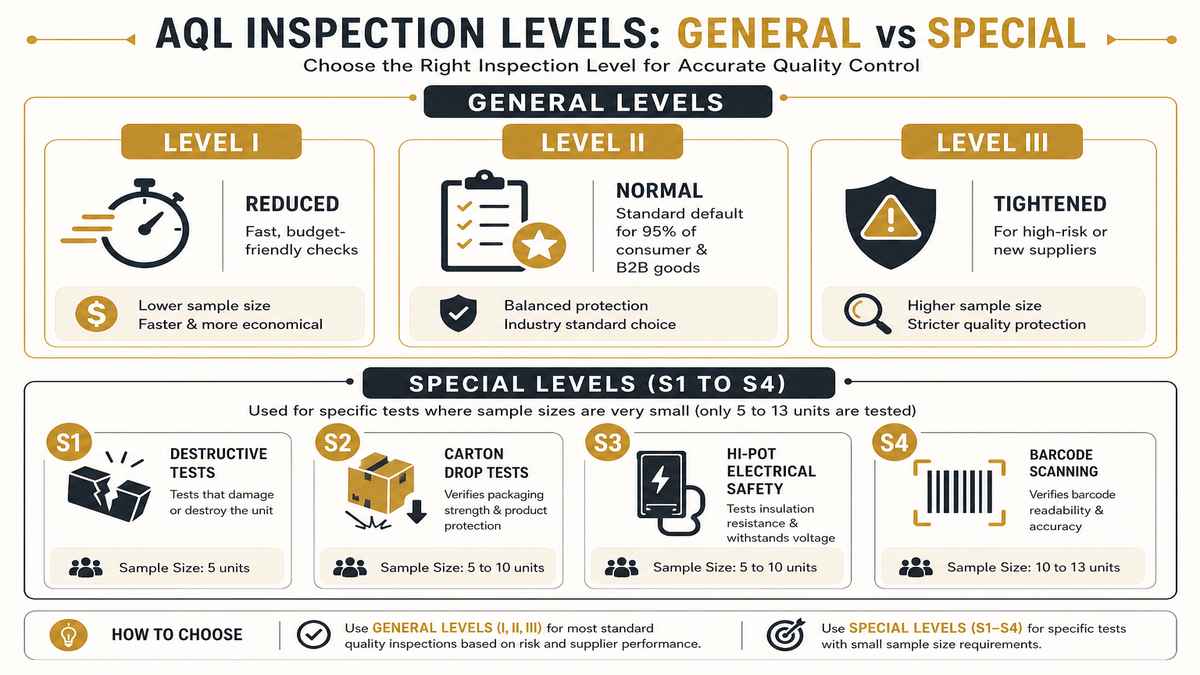
General Inspection Levels (I, II, III) vs. Special Levels (S1–S4)
Why do AQL charts have Level I, Level II, Level III, and Special S-Levels? Choosing the right inspection level balances inspection time and cost against product risk:
What to Do When Your AQL Inspection FAILS (4-Step Action Plan)
When an inspector sends you an official report marked “FAILED – OVER AQL LIMIT”, stay calm and follow this proven 4-step protocol:
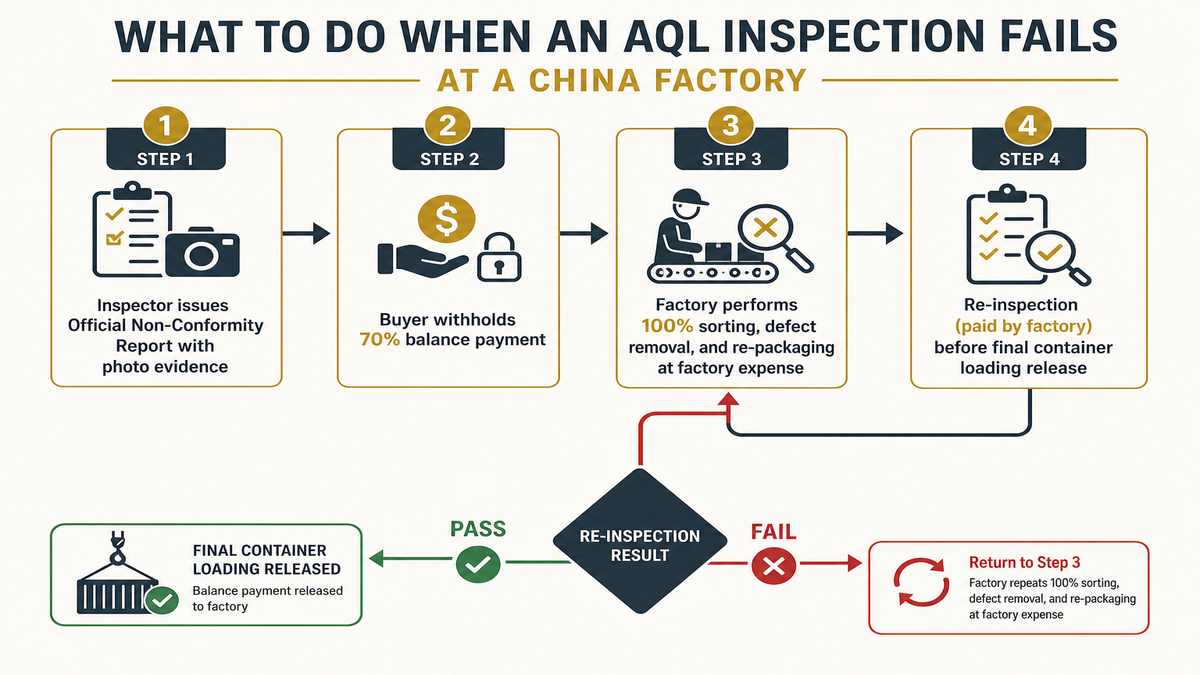
- Immediately Freeze the 70% Balance Payment: Never release the final balance or sign shipping releases under FOB container booking or Alibaba DDP shipping agreements until quality issues are resolved. Your final balance payment is your only financial leverage.
- Review the Photo Evidence and Defect Log: Check whether the failures are concentrated in one production line or across all cartons. For example, if 15 Major defects were caused by upside-down barcode stickers, that is a fast 2-day packaging fix. If 15 Major defects were cracked plastic casings, that is a tooling issue.
- Demand 100% Sorting and Rework at Factory Expense: Send an official formal defect notice to the factory manager: “The batch failed AQL 2.5 with 18 Major defects. The factory must unbox 100% of the production lot, remove and replace all defective items, and repack the cartons at factory expense.”
- Require a Mandatory Re-Inspection Paid by the Factory: As standard practice in professional sourcing agent and inspection management contracts, the supplier must pay the \$299 re-inspection fee for the inspector to return and re-sample the reworked batch.
On-Site Functional Tests Inspectors Run Alongside AQL
Visual defect counting under AQL tables is only half the battle. A professional quality inspector also performs mandatory physical and on-site functional tests on a selected sub-sample:
| On-Site Test Type | Sample Size (Special Level) | Testing Procedure | Pass Criteria |
|---|---|---|---|
| ISTA-1A Carton Drop Test | 1 Full Master Carton | Drop 1 corner, 3 edges, and 6 flat faces from a height of 76 cm (for cartons under 10 kg). | Zero product breakage, zero inner retail box tearing. |
| 3M Tape Logo Adhesion Test | 5 Units per Color | Apply 3M 600 adhesive tape firmly over printed logo, rub for 10 seconds, pull off rapidly at 90 degrees. | Zero peeling, flaking, or ink transfer to the tape. |
| Barcode Scanability Check | 13 Units (Level S-3) | Scan Amazon FNSKU and UPC barcodes using a handheld smartphone and 1D/2D laser scanner. | 100% instant first-pass barcode decoding. |
| Hi-Pot & Power-On Stress Test | 5 Units (Level S-1) | Run electrical appliances at full rated voltage continuously for 15 minutes. | No overheating, short circuits, or electrical leakage. |
3 Binding QC Clauses to Put in Your Chinese Factory Contract
To ensure your supplier takes AQL standards seriously, include these three binding legal clauses in your supply contract before paying your 30% initial deposit:
- Mandatory Level II Pre-Shipment Inspection: “Final 70% balance payment is strictly conditional upon the production batch passing an independent Pre-Shipment Inspection conducted under ISO 2859-1 General Level II (AQL 0 Critical / 2.5 Major / 4.0 Minor).”
- Factory Pays for Re-Inspection Costs: “If the inspection fails AQL limits, the factory shall carry out 100% sorting and rework at its own expense. The factory shall pay the \$299 re-inspection fee for the third-party inspector to return.”
- Late Delivery Penalty for Rework Delays: “Any shipping delays caused by factory quality rework exceeding the agreed ship date shall trigger a late penalty of 0.5% of total order value per day, deductible from the final balance payment.”
Frequently Asked Questions (FAQ)
What is AQL in China factory inspection?
AQL stands for Acceptable Quality Limit. It is a statistically proven sampling standard (ISO 2859-1 / ANSI Z1.4) that defines the maximum number of defective units permitted in a random sample batch during pre-shipment inspection.
What is the standard AQL level for consumer goods?
The global industry standard for consumer and B2B goods is General Inspection Level II with AQL 0 for Critical defects, AQL 2.5 for Major defects, and AQL 4.0 for Minor defects.
How many units are inspected in a 5,000-piece order under AQL Level II?
For an order of 5,000 units, General Level II assigns Sample Size Code Letter “L”, which requires checking exactly 200 random units. Under AQL 2.5 / 4.0, the batch passes if there are 10 or fewer Major defects and 14 or fewer Minor defects (0 Critical).
What should an importer do if an AQL inspection fails?
Never release the 70% final balance payment. Issue the official inspection report to the factory, demand a 100% full sorting and rework at factory expense, and require a re-inspection paid for by the supplier before releasing the container.
Does AQL guarantee 100% zero-defect shipments?
No. AQL is a statistical probability standard designed to balance inspection cost with quality assurance. It provides 95% statistical confidence that the defect rate across the entire batch remains below your specified percentage limit.
Stop defective shipments before container loading
Our bilingual certified quality inspectors in Yiwu, Ningbo, and Shenzhen conduct on-site Pre-Shipment AQL inspections, issue comprehensive same-day PDF reports with photo evidence, and oversee 100% factory reworks.
Book an on-site factory inspection
Questions & Comments
We read every one and reply within 24 hoursNeed help calculating sample size for your production batch or disagreeing with a factory about a Major vs. Minor defect? Drop your product type and order quantity below — our QC team will calculate your numbers.