
China Wholesale Markets: Which Town Actually Has Your Product
 ·
Updated August 24, 2026
·
Updated August 24, 2026
Ask most buyers to name a China wholesale market and you get one answer: Yiwu. Ask them where to buy socks, buttons, bed sheets or door locks at factory prices and the answer usually stops there. It should not. China’s wholesale trade runs through dozens of specialist market towns, each one built around a single product, and picking the right town matters more than anything you will do once you arrive.
This page maps the ones that matter to foreign buyers. For each market you get what it actually sells, where it is, and — the part most lists skip — whether it is worth your time or whether you should stay online instead.
These markets exist because one town decided to make one thing. That is why prices are low and choice is deep. It is also why a market that is perfect for socks is useless for door locks. Match the town to your product first; everything else is detail.
Why a market town beats a search box
A specialist market town is not just a building full of stalls. It is the shopfront for a cluster of factories that all make the same thing, often within a few miles of each other. That structure does three things for you that a website cannot.
The trade-off is time and cost. A trip is days of your life plus flights and hotels, which only pays back above a certain order size. Where that line sits is covered further down.
The four that most buyers should know first
If you only ever visit a handful, these are the ones with the broadest pull for overseas buyers.
Yiwu International Trade City — Yiwu, Zhejiang
The one everybody has heard of, and for once the reputation is earned. Yiwu covers 5.5 million square metres with more than 75,000 stalls across five districts, arranged by category: toys and jewellery, bags and hardware, buttons and stationery, knitwear and footwear, then imports and bedding.
What makes Yiwu different from every other market on this list is that it is built for breadth, not depth. You can fill a mixed container with forty unrelated products in one building. No other market comes close to that. The trade-off is that Yiwu sells you what the factories in the region make; for one product in serious volume, a specialist town will usually beat it on price and on how far a supplier will bend.
Best for: importers filling a shop or a mixed container, and anyone buying in China for the first time. We have a full walkthrough in the Yiwu market guide, plus a district-by-district breakdown of what sits where.
Huaqiangbei Electronics Market — Futian, Shenzhen
Roughly 38,000 businesses packed into a 2.9 square kilometre subdistrict (2020 count), selling phone parts, components, finished consumer electronics and repair supplies. It is the reason Shenzhen gets called the hardware capital of the world.
Two honest warnings. Parts of the market have been converting to cosmetics retail since around 2020, so the electronics footprint is smaller than older guides suggest. And it has a documented problem with stolen handsets being traded in the area. Checking who you are dealing with matters more here than at any other market on this list.
Best for: electronics importers, accessory and repair-parts buyers, hardware startups. See the Huaqiangbei guide for how to work the buildings.
Guangzhou’s garment clusters — Liwan and Tianhe
Guangzhou is not one market but around a dozen separate districts spread across a huge city. For clothing, two names come up constantly: the Shisanhang zone in Liwan for fast-fashion womenswear, and Shahe in Tianhe at the cheapest end of the price ladder.
Both run on speed. Styles turn over in weeks, which is a strength if you sell fast fashion and a real problem if you need to reorder the same item for two years. Ask directly how long a style will run before you build a listing around it.
Best for: fashion buyers who reorder often and value newness over consistency. The Guangzhou markets guide maps the clusters and the travel time between them.
China Light & Textile City — Keqiao, Shaoxing, Zhejiang
The best-documented market on this list and the one most foreign buyers have never heard of. Keqiao turned over RMB 441.4 billion in 2025, up 10.07% on 2024, and has ranked first among China’s textile markets for 32 straight years. It holds over 3.2 million square metres of trading floor and had 38,831 registered market entities as of September 2025.
It sells fabric rather than finished goods: apparel cloth, home textiles, curtains, trims, greige cloth and raw materials. Around 5,000 foreign buyers are based in the town full time, which tells you how much serious garment sourcing runs through it.
Best for: anyone making clothing or home textiles rather than buying them finished.
The specialist towns
This is where the real advantage sits. Each of these towns makes one narrow thing, in volumes that are hard to believe until you see them.
| Market / town | City, province | What it actually sells |
|---|---|---|
| China Science & Technology Hardware City | Yongkang, Jinhua, Zhejiang | Power tools, door locks and security doors, vacuum flasks, scooters, metal parts, auto parts, decorative hardware, fitness equipment |
| Qiaotou Button City | Qiaotou, Yongjia County, Wenzhou, Zhejiang | Buttons and zippers |
| Datang Socks City | Datang, Zhuji, Shaoxing, Zhejiang | Socks and hosiery |
| Dieshiqiao Home Textile City | Haimen, Nantong, Jiangsu | Bedding, bed linen, curtains, hotel and hospitality linen |
| Puyuan Sweater Market | Puyuan, Tongxiang, Jiaxing, Zhejiang | Wool sweaters and knitwear, plus the full knitting supply chain |
| Haining Leather City | Haining, Jiaxing, Zhejiang | Leather jackets, fur, leather goods |
| Shengze textile market | Shengze, Wujiang, Suzhou, Jiangsu | Silk and woven fabrics |
| Sijiqing Garment Market | Shangcheng, Hangzhou, Zhejiang | Women’s fashion, Hangzhou-style womenswear |
| Wenzhou shoe cluster | Wenzhou, Zhejiang | Footwear |
| Yuyao Plastic City | Yuyao, Ningbo, Zhejiang | Plastic raw materials and plastic products |
| Dongyang furniture cluster | Dongyang, Jinhua, Zhejiang | Redwood and classical Chinese furniture, woodcarving |
| Donghai Crystal City | Donghai County, Lianyungang, Jiangsu | Crystal, quartz, gemstones, crystal jewellery |
| Linyi Small Commodity City | Linyi, Shandong | Low-cost general merchandise, northern China distribution base |
| Hankou North | Wuhan, Hubei | General consumer goods, central China distribution |
Yongkang — hardware, not electronics
Worth spelling out because it is the single most commonly mis-described market in China. Yongkang is a hardware town. China Science & Technology Hardware City is the country’s largest specialist hardware market: 4,500-plus shops across 450,000 square metres, with 2009 turnover of RMB 35.7 billion including US$875 million of exports, ranking first nationally among comparable markets.
The confusion comes from one of its trading zones being labelled “electrical appliances”, which sits alongside zones for metal materials, machinery parts, auto parts, decorative hardware and fitness products. If someone tells you Yongkang is an electronics market, they have copied that error from somewhere without checking. You want Shenzhen for electronics.
Best for: tool, DIY, lock, kitchenware and auto-parts importers. The China Hardware Fair runs here each September.
Qiaotou — the button capital
A town of 66,000 people in Yongjia County that makes, as of 2015 figures, around 60% of the world’s clothing buttons and 80% of its zippers — 15 billion buttons and 200 million metres of zipper a year.
This is the kind of place that only makes sense once you have been caught out by trims. Buttons, zips, labels and hang tags come from different suppliers than your garment, with their own minimums and often longer lead times. Buyers who sort the garment and forget the trims lose weeks.
Datang — socks
Known as Sock City. By 2008 it was producing eight billion pairs a year, about a third of world output, employing over 100,000 people across the town and surrounding villages. Worth noting that a 2012 report described the cluster as being in decline, so treat the 2008 peak as historical rather than current — but the concentration of sock manufacturing here is still without equal.
Dieshiqiao — bedding and home textiles
Founded in 1982 and now over 1.5 million square metres with 15,000-plus shops carrying more than 600 brands. 2024 turnover was around RMB 150 billion, shipping to over 130 countries. If you sell bed linen, curtains or hotel linen, this is the address.
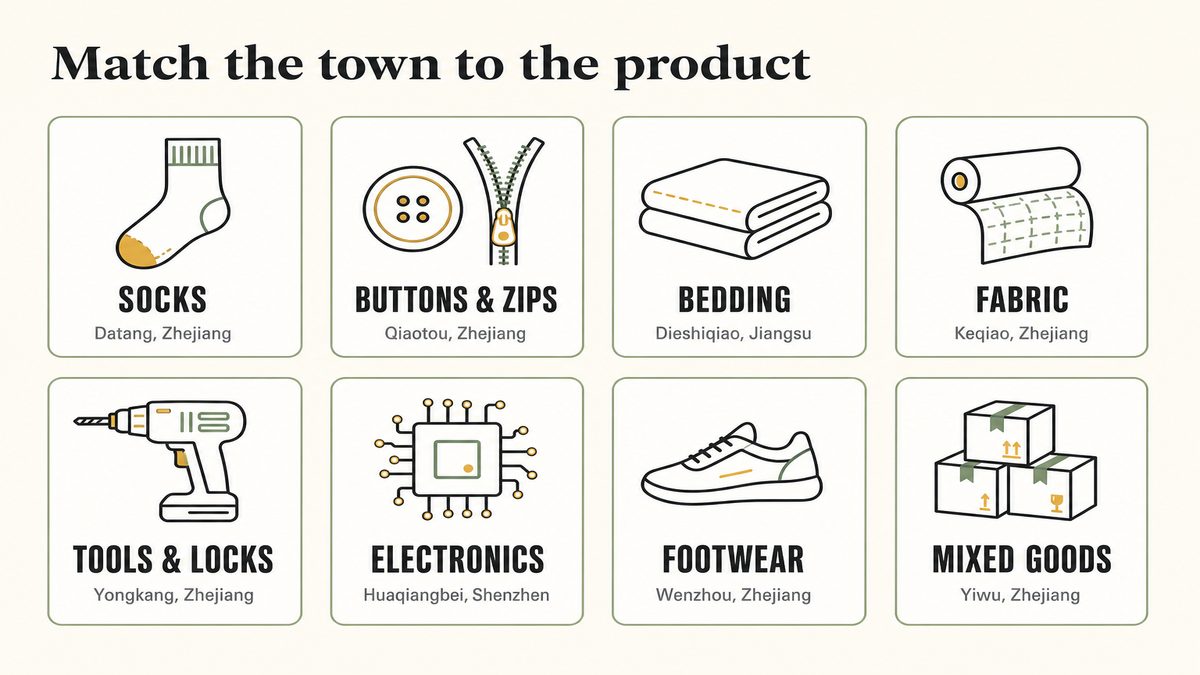
What you sell, where you go
The reverse lookup most buyers actually need.
| If you sell… | Go to | Rather than |
|---|---|---|
| Mixed general merchandise | Yiwu | Anywhere specialist — you need breadth |
| Clothing you manufacture yourself | Keqiao for fabric, Qiaotou for trims | A garment market selling finished stock |
| Finished fast-fashion clothing | Guangzhou (Liwan, Tianhe) or Sijiqing | Keqiao — that is fabric, not garments |
| Socks or hosiery | Datang | A general knitwear market |
| Sweaters and knitwear | Puyuan | Yiwu’s knitwear district for volume orders |
| Bedding, curtains, hotel linen | Dieshiqiao | Keqiao — that is cloth by the roll |
| Phone parts, components, electronics | Huaqiangbei | Yongkang — that is hardware |
| Tools, locks, kitchenware, auto parts | Yongkang | Huaqiangbei — that is electronics |
| Leather jackets and bags | Haining, or Baiyun in Guangzhou | A general clothing market |
| Shoes | Wenzhou cluster | A mixed footwear section |
| Silk and woven fabric | Shengze | Keqiao if you need volume synthetics |
| Plastic products or raw resin | Yuyao | Ordering through a trader |
| Crystal and gemstone jewellery | Donghai | Yiwu’s jewellery district for real stones |
| Classical wooden furniture | Dongyang | A general furniture market |
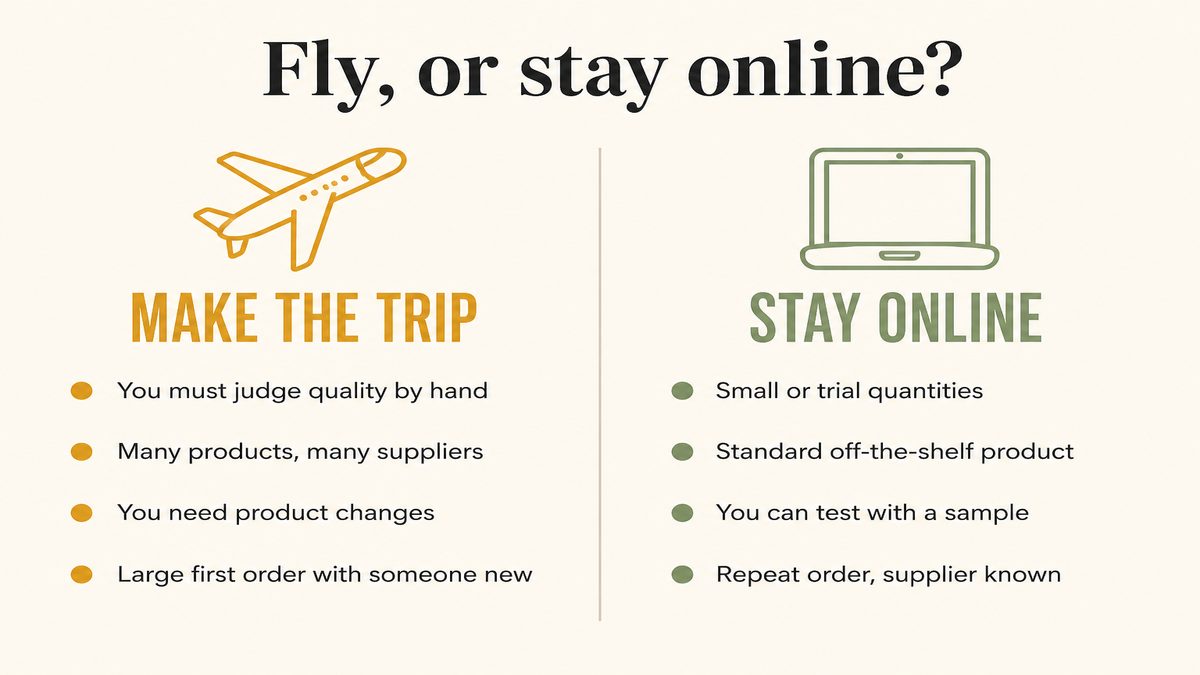
When to fly and when to stay online
This is the question the platform blogs will not answer honestly, because they want you clicking.
A market trip costs you flights, hotels, roughly a week, and a visa. That is real money before you have bought anything. It pays back in four situations and not otherwise.
1. You need to judge the goods with your hands
Fabric weight, stitching, plastic thickness, smell, how a hinge feels. Photographs hide all of it. If your returns come from quality complaints, go.
2. You are buying many items from many sellers
Twenty products from twenty suppliers online means twenty conversations, twenty samples and twenty payments. In a market it is two days of walking.
3. You want the factory, not the listing
Changes to a product — a colour, a size, your logo, different packaging — are hard to arrange by message and easy to arrange in person, because the workshop is often nearby.
4. You are about to spend serious money with someone new
Meeting a supplier in their own building tells you things no amount of due diligence online will. It is the cheapest insurance available on a large first order.
Stay online when your order is small, your product is standard, and you can afford to test with a sample shipment. There is no honour in flying to China to buy 200 phone cases. The guide to online B2B marketplaces covers which platform suits which job, and if you are weighing markets against a trade show, we compare both in Canton Fair versus the wholesale markets.
The strongest approach is usually both: find candidates online, then visit to confirm before the order gets big. How to run that first stage properly is set out in how to find China wholesale suppliers.
Five ways buyers waste a market trip
1. Going to a general market for a specialist product
Yiwu has a knitwear district. Puyuan is a knitwear town. For one sweater in volume, the town wins on price and on how far the supplier will bend. Breadth and depth are different products.
2. Treating a city as one market
Guangzhou’s clusters can be forty minutes apart in traffic. Buyers who plan Guangzhou like Yiwu lose two of their four days in taxis. One cluster per day.
3. Assuming every stall is a factory
Many are traders, and that is fine — but the price and the flexibility should differ. Ask about a change to the product. A lead time means production; “let me check” means a middleman.
4. Forgetting the trims and the packaging
Buttons, zips, labels, polybags and printed cartons come from different suppliers with their own minimums and longer lead times than the goods. Sort them on the same trip.
5. Using an old market list without checking
These markets move, rebuild and change. Sijiqing’s East Building reopened after an upgrade in 2019 and satellite sites have opened elsewhere in Hangzhou. Confirm the building is trading before you book anything.
On that last point: several published market lists carry errors that have been copied between sites for years — Yongkang described as electronics being the clearest example. Check the category before you buy a plane ticket.
Planning a trip that works
Three practical rules that hold across every market on this list.
On price itself, the lever that works in every market is total order value rather than pushing on unit price alone. Three styles at 200 pieces each is often accepted where one style at 200 is refused, because the production run makes sense either way. Longer scripts are in the guide to negotiating with Chinese suppliers.
And remember the stall price is not your cost. Packaging, inland transport, consolidation, freight and duty all sit on top. The full arithmetic is worked line by line in the breakdown of how a stall price becomes a landed cost.
Tell me what you are buying and I will tell you which town
Send your product list and rough quantities. You will get back which market actually holds your product, how many days it needs, and an honest answer on whether the trip is worth making at your order size.
Send an enquiryCommon questions
Which is the biggest wholesale market in China?
Yiwu International Trade City, at 5.5 million square metres with more than 75,000 stalls. But biggest is not the same as best for you. Yiwu is built for breadth — many different products in modest quantities. If you buy one product in volume, a specialist town like Datang for socks or Yongkang for hardware will usually beat it on price and on how far a supplier will bend for you.
Can I visit these markets without an invitation?
Yes. The major markets are open to foreign buyers and deal with them daily. A few individual buildings restrict casual browsing during their busiest domestic trading hours, and some operate trade-only, but you do not need an invitation to walk in. You will need a valid visa, and it is worth checking current entry rules before booking as these change.
Is Yongkang an electronics market?
No. This error appears on several sourcing sites and gets copied around. Yongkang is China’s largest specialist hardware market — power tools, locks, security doors, vacuum flasks, scooters, auto parts and metal goods. The confusion comes from one trading zone being labelled “electrical appliances”. For electronics you want Huaqiangbei in Shenzhen, which is a different city and a different province.
Do I need an agent to buy at a Chinese wholesale market?
Not always. If you have one category, you are staying in one cluster and you have bought in China before, you can handle it alone — enough English is spoken to do straightforward business. Help earns its cost when you need goods from several markets combined into one shipment, when someone needs to check production after you fly home, or when you want to get from a stall to the factory behind it.
How much cheaper are these markets than buying online?
There is no single figure, and anyone quoting one is guessing. What is reliable is the direction: you are closer to the factory, so there are fewer margins stacked on top, and you can negotiate in person. The saving only matters after you add flights, hotels and a week of your time — which is why trips make sense above a certain order size and not below it.
Are these markets open all year?
Mostly yes, unlike trade fairs which run for set periods. The major exception is Chinese New Year, when markets and the factories behind them close for two to four weeks — and production slows for weeks either side. Avoid planning a first trip anywhere near it. Individual buildings also keep their own hours, often built around domestic wholesale rhythms rather than visitor convenience.
Questions & Comments
We read every one and reply within 24 hoursPlanning a market trip, or not sure which town holds your product? Tell me what you are buying and roughly how many — I will point you at the right market and tell you honestly if the trip is worth it.