
How to Find China Wholesale Suppliers
 ·
Updated August 24, 2026
·
Updated August 24, 2026
Finding a supplier in China is not hard. Finding one that still answers your messages after the third order, ships what the sample looked like, and tells you when something goes wrong — that is the part people underestimate. This page covers where to look, how to tell the options apart, and what to check before any money moves.
Most buyers pick a channel by accident — they use whichever site they heard of first. The channel decides your price, your minimum order, and how much protection you have if things go wrong. Choose it on purpose and the rest gets easier.
The four places suppliers actually come from
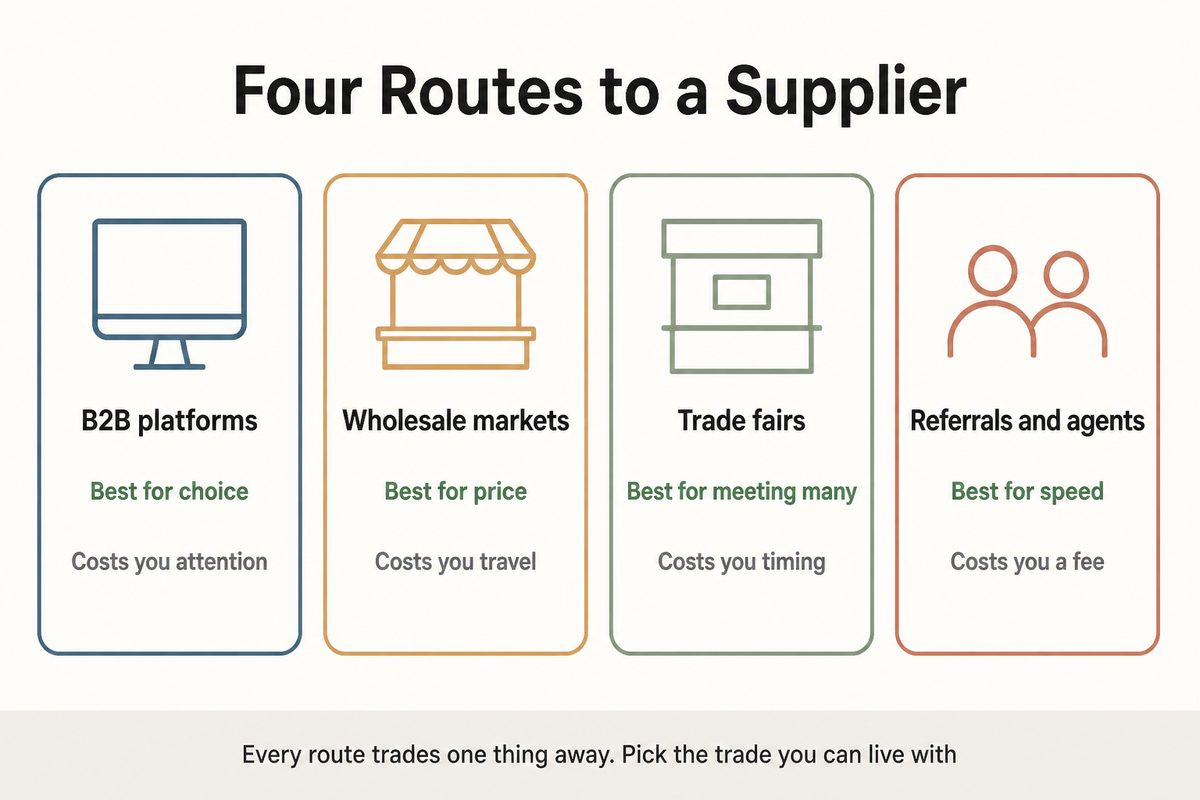
Every supplier you will ever work with reaches you through one of four routes. They are not equally good, and they are not good at the same things.
Nobody uses only one. A common pattern is finding candidates on a platform, meeting them at a fair, then ordering direct once the relationship works. What matters is knowing which one you are using and what it does not give you.
Using B2B platforms without wasting a month
Platforms are where most people start, and where most people lose time. The search returns thousands of results that all look the same, because they are all written by the same kind of sales team.
What the badges actually mean
Every platform sells badges, and buyers read them as a quality rating. They are not one.
A verified or gold badge usually confirms that a company exists, has paid the platform, and had someone visit the address. That is worth something — it rules out the pure fake — but it says nothing about whether they make good products, hit deadlines, or answer you after payment. Paying for a badge is a marketing decision, not a quality one.
Our guide to whether Alibaba is legit and how to check a supplier there goes through each badge and what it does and does not prove, and our beginner walkthrough of Alibaba covers the mechanics of getting from search to first order.
Which platform for which job
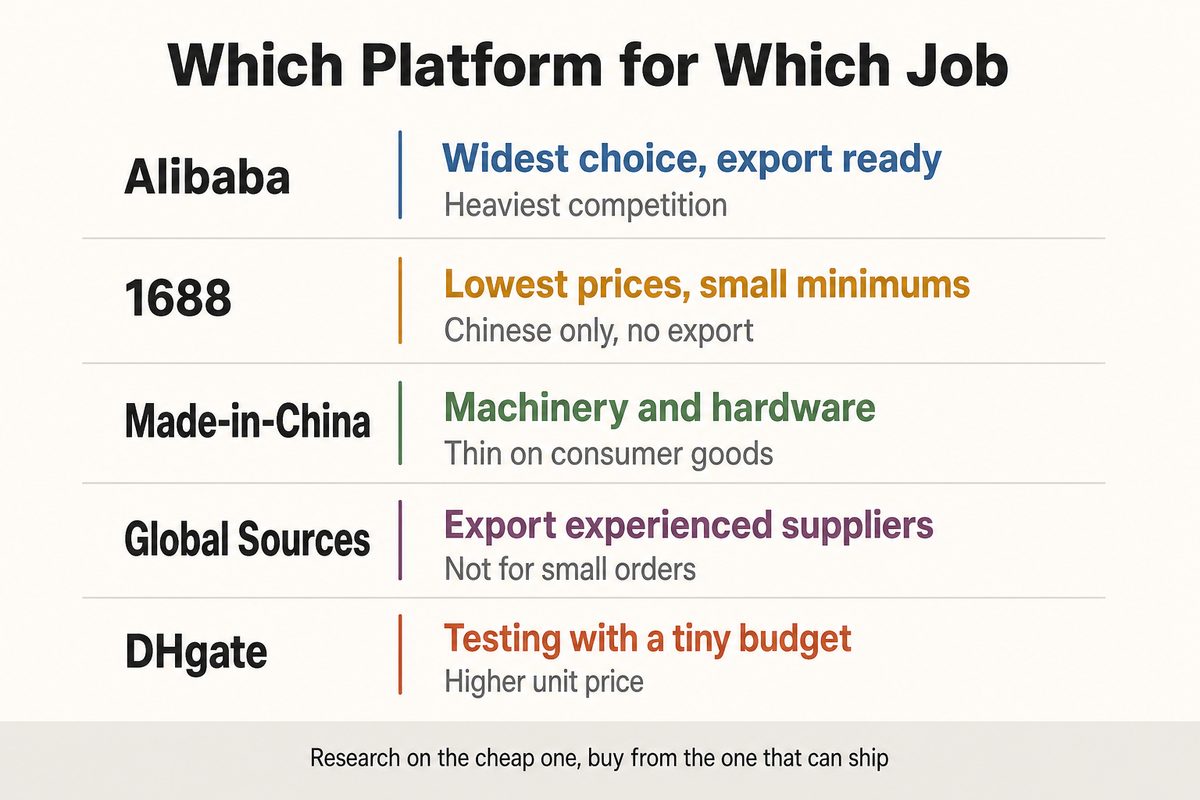
Five platforms cover almost everything, and they are not interchangeable. Picking the wrong one wastes more time than any other early mistake.
A common sequence is to research on 1688 to learn what a product really costs, then buy on Alibaba where the supplier can handle export paperwork. The gap between those two prices is roughly what you are paying for export capability — sometimes worth it, sometimes not.
Those five are the China-facing options. If you are sourcing from India, Turkey, Germany or Latin America, or you want a note on when not to use each site, the wider set is mapped in the guide to online B2B marketplaces.
One thing worth ruling out early: retail apps are not a supply base. Buying stock through Temu or AliExpress works for testing whether a product sells, but you pay a retail price per unit with the margins already stacked in, which stops making sense the moment you reorder.
Reading a listing properly
Three things on a listing page are worth more than the rest of it combined.
Response rate and response time. These are measured by the platform rather than written by the seller, which makes them the most honest numbers on the page. A supplier who is slow to answer before you have paid will not get faster afterwards.
Transaction history. Volume and repeat orders tell you other buyers came back. A supplier with many first orders and few repeats is a signal worth pausing on.
Product range. A company listing kitchen tools, phone cases and garden furniture is not making all of it. That is fine if you want a trader, and a problem if you were told they were the factory.
The message that gets a real reply
Most enquiries get a copy-paste catalogue back because most enquiries say nothing specific. Sales teams triage by how serious you sound.
Give them four things: what the product is, roughly how many, when you need it, and what market it is going to. That last one matters more than people expect — a supplier who hears “United States, retail” knows immediately which standards apply and whether they can handle it.
Ask one question that requires a real answer. Not “what is your best price”, which invites a number with no meaning, but something like “what is the lead time at 500 pieces, and what changes at 2,000”. The reply tells you whether you are talking to someone who knows the production floor or someone reading from a price list.
Factory or trading company
This is the question buyers spend the most energy on, often for the wrong reason.
The usual assumption is that factories are cheaper and traders are middlemen to be cut out. Sometimes true. But a good trading company will handle a mixed order across several factories, answer in fluent English, catch a problem before it ships, and take responsibility when something is wrong. A factory that has never exported to your market may do none of that, at a price that is 5% lower.
A factory suits you when
One product, larger volumes, you need control over the production details, and you have someone who can manage the technical conversation.
A trading company suits you when
Mixed products in one shipment, smaller quantities, first time importing, or you need someone who will chase problems on your behalf.
What matters is knowing which one you have, because it changes how much room there is on price and who you are really negotiating with. The check takes two minutes: ask for the business licence and read the business scope line. If it includes manufacturing, they make things. If it only lists trading or sales, they do not.
Two supporting signals: ask which machine runs your product, and ask for a video call from the production floor rather than the office. A factory answers both without preparing.
What to check before any money moves
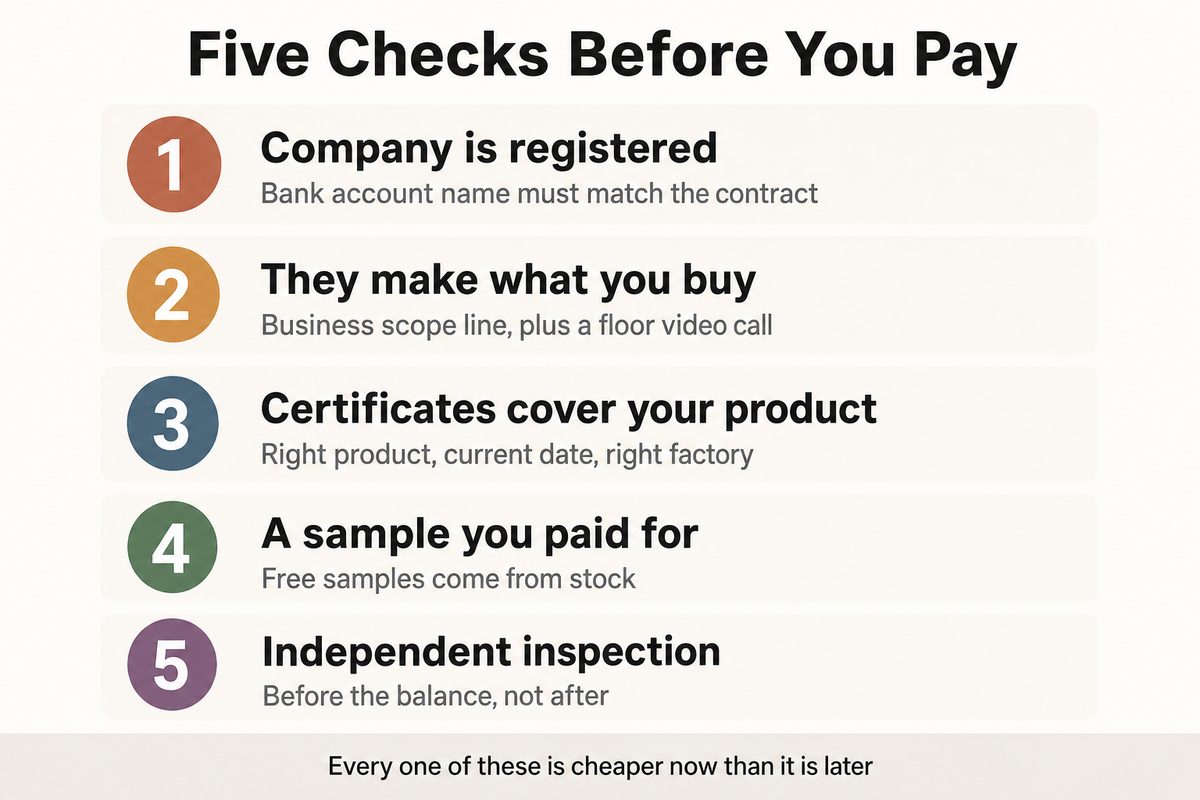
This is the part that separates an expensive lesson from a working relationship, and most of it costs nothing but time.
1. The company is registered and the details match
Company name, registration number, address. The name on the bank account must match the name on the contract — a mismatch here is the single most common way payments disappear.
2. They make what you are buying
Business scope on the licence, plus a video call from the floor. This also settles the factory question above.
3. The certificates cover your product
A statement is not a certificate. When the document arrives, check it covers your specific product, the date is current, and it names the factory making your goods.
4. A sample you actually paid for
Free samples come from stock and may not represent your production run. A paid sample made to your specification is the only one that tells you anything.
5. Someone independent looks at the goods
Before the balance is paid, not after. This is the last point at which a problem is still the supplier’s problem.
Running the registration check properly is worth doing before you get attached to a quote — our guide to checking a supplier’s background covers which records are public and what to read in them.
How the conversation usually goes
Suppliers rarely say no directly. A factory that does not want your order will find a polite way to make you walk away, and reading those phrases saves weeks.
“We are very busy right now” usually means the order is too small to be worth the machine setup. A quote 40% above everyone else means the same thing in a different form. Neither is dishonest — they are declining without causing you to lose face.
The test is simple: ask what quantity would work and when they could start at that level. A genuinely busy factory gives you a date. One that was politely declining gives you a number.
We have written up the full set in the phrases suppliers use and what they actually mean, including the ones that show up around payment. On price specifically, our guide to negotiating with suppliers covers what is genuinely movable and what is not.
Minimum order quantities and why they move
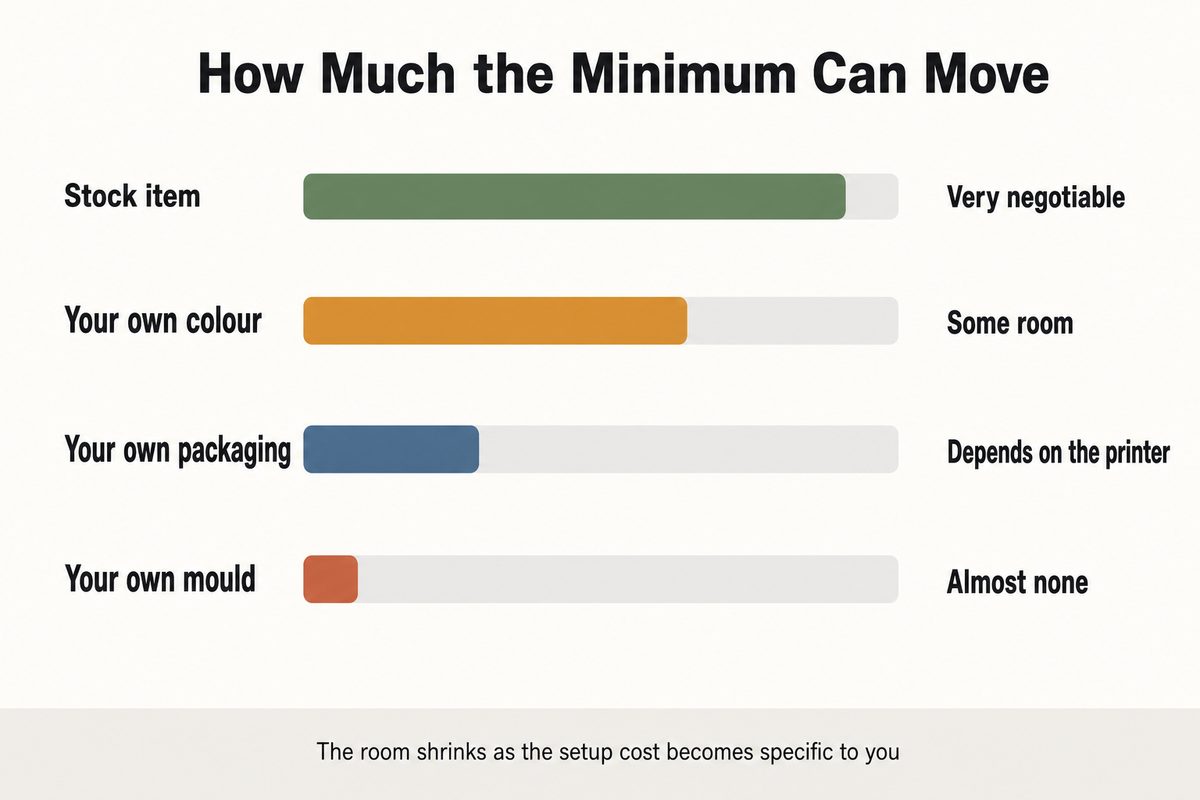
Almost every new buyer hits a minimum that seems impossible, and assumes it is fixed. It usually is not, because the number is recovering a setup cost rather than enforcing a rule.
Understanding what sits behind it tells you how much room there is:
Ask what the setup involves rather than asking them to lower the number. Once you know which cost you are looking at, you can offer the right thing — taking a stock colour first, paying tooling separately, or committing to a reorder.
When to go to the market instead
Platforms are not always the right answer. For some categories, standing in front of the goods beats any amount of searching.
This applies when the product is cheap enough that shipping a sample makes no sense, when you are buying many small items rather than one thing in volume, or when quality is something you judge by handling rather than by specification. Household goods, accessories, gifts, seasonal items — these are market categories.
Three markets cover most of what buyers come for, and they are strongly specialised. They are not the only ones — socks, buttons, bedding, tools and shoes each have their own market town, mapped in the guide to China’s wholesale market towns.
International Trade City, 555 Chouzhou North Road, Yiwu, Zhejiang
Baiyun leather cluster, 1356 Jiefang North Road; Liuhua clothing cluster, 194 Huanshi West Road
Huaqiang Electronic World, 1015 Huaqiang North Road, Futian District, Shenzhen
One caution on addresses: Baiyun and Liuhua are clusters of dozens of separate malls, not single buildings. The addresses above get you to the right area, not to a specific stall.
The trade-off is that you have to be there. Our guides to buying at the Yiwu market, the Guangzhou wholesale markets and Huaqiangbei cover each in detail, and the Canton Fair guide covers the twice-yearly option if you would rather have the factories come to you.
Tell us what you are buying
Send the product, rough quantity and target market. We will tell you which channel makes sense, what the realistic minimum looks like, and what to check first. No obligation attached.
Ask about your productThree routes people forget
Platforms, markets and fairs cover most sourcing, but not all of it. Three smaller channels are worth knowing, mainly because each is good at something the others are bad at.
Searching for the factory’s own website
Many established factories have their own site and never bothered with platform listings, or list only a fraction of what they make. Searching for the product plus “manufacturer” or “factory” turns up suppliers your competitors are not messaging.
The catch is that you get no platform protection and no transaction history to read, so every check in this page has to be done by hand. It suits buyers who already know how to run those checks, not first-timers.
Social platforms
Factory owners and sales managers post production videos on LinkedIn, TikTok and Instagram, and a short clip of a working line tells you more than any listing photograph. It is a reasonable way to find newer or smaller suppliers, and a quick way to see whether a factory exists at all.
Treat it as discovery only. There is no dispute process and no checking, and copying a real factory’s photos is easy. Move the conversation onto normal footing — licence, sample, written specification — before any money is involved.
Referrals
The most underrated route. Another buyer who already works with a factory can tell you things no check will reveal: whether they hit dates, how they behave when something goes wrong, whether quality held on the third order.
Ask sellers in your category who are not in your market. People share suppliers more readily than you would expect when they are not competing with you.
When it makes sense to have someone do it for you
Everything on this page is doable yourself. Whether it is worth your time is a separate question.
The checks are not difficult, but they are slow, and several of them work far better in person or in Chinese — reading a licence, standing in a factory, catching a problem at inspection. If you are buying one product once, doing it yourself is fine. If you are building a range, the hours add up fast.
An agent earns their fee in two places: knowing which suppliers already perform, so you skip the filtering entirely, and being physically present when something needs checking. What they cannot do is make a bad product good. Our guide to whether you need a sourcing agent covers how the fees work and when the maths favours doing it alone.
Four things that go wrong most often
After enough orders, the same problems keep appearing.
Choosing on price alone. The cheapest quote is often from whoever understood your specification least. A supplier who quotes below everyone else has either found a real efficiency or is planning to make something different from what you described.
Skipping the paid sample. A sample costs a small amount and a bad production run costs the whole order. This is the highest-return money in the entire process.
Leaving the specification vague. “Good quality steel” is not checkable. “304 stainless steel” is. Most disputes are about what was assumed rather than what was written.
Paying the full balance before shipping. Standard terms are a deposit up front and the balance against shipping documents. Paying everything early removes your last piece of leverage, and the last moment anyone independent looks at the goods.
Common questions
Where is the best place to find Chinese suppliers?
It depends on the product. B2B platforms suit specific items you can describe in writing. Wholesale markets suit cheap, varied or seasonal goods you need to handle. Trade fairs suit meeting many factories quickly. Most buyers use a combination rather than one channel.
Is a verified supplier badge a guarantee of quality?
No. A badge usually confirms the company exists, has paid the platform, and had its address visited. It rules out the pure fake but says nothing about product quality, deadlines, or whether they will answer after payment.
Should I buy from a factory or a trading company?
Factories suit one product in larger volumes where you need control over details. Trading companies suit mixed orders, smaller quantities, and first-time importers who need someone to chase problems. What matters is knowing which one you have.
How do I check a Chinese supplier is real?
Ask for the business licence and confirm the company name, registration number and address. Read the business scope line to see whether they manufacture. Make sure the bank account name matches the contract name — a mismatch there is the most common way payments go missing.
Can I negotiate a supplier’s minimum order quantity?
Usually, because the number recovers a setup cost rather than enforcing a rule. Stock items in standard colours are very negotiable; your own mould barely at all. Ask what the setup involves rather than asking them to lower the number.
Is 1688 worth using instead of Alibaba?
Prices are lower and minimums smaller, because 1688 shows what Chinese buyers pay. The site is in Chinese and most sellers do not handle export, so you will need an agent or forwarder. A common approach is researching real prices on 1688, then buying on Alibaba where the supplier can manage the paperwork.
What is the cheapest way to find suppliers?
Searching platforms yourself costs nothing but time, and 1688 shows the lowest prices if you can handle the language and the export side. The cheapest route is rarely the cheapest outcome though — a supplier chosen without checks can cost far more than any agent fee.
What payment terms are normal with Chinese suppliers?
A deposit up front and the balance against shipping documents is standard. Paying the full amount before shipping is not, and removes your leverage at the point where problems are still fixable.
Where to go from here
If you are at the very beginning, our complete guide to buying from China puts supplier selection in the wider sequence — costs, shipping, customs and the paperwork that has to line up before goods arrive.
If you already have candidates and want to narrow them down, the checks in this page are the right next step, in the order listed. Registration first, because it is free and rules out the worst outcomes. Sample last, because by then you only want to spend money on suppliers who passed everything else.
Questions & Comments
We read every one and reply within 24 hoursWorking out which channel fits your product, or stuck choosing between two suppliers? Tell me what you are buying and roughly how many, and I will tell you which route makes sense and what to check first.