
China Buying Agents: Fetching a Product, or Finding One That Fits
Ask ten people in this industry what the difference is between a buying agent and a sourcing agent and you will get ten answers, most of them wrong. The honest answer is that the two words overlap heavily, but the work behind them splits along a line that matters: whether someone is finding your product or simply fetching it.
That line decides what you should pay, what you can expect, and which of the two you actually need. Get it wrong and you either overpay for a service you did not need, or you hire someone to fetch when you needed them to find.
The one distinction that actually holds
Strip away the marketing language and there are two different jobs.
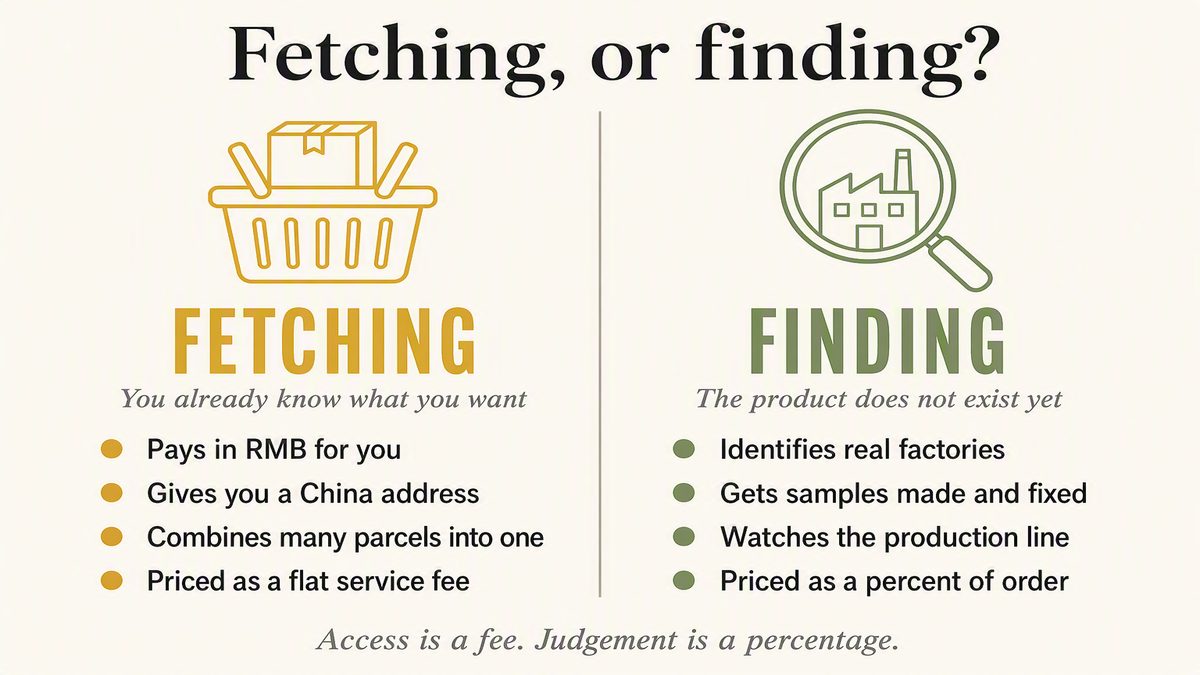
Fetching means the product already exists and you already know where it is. You send a link from 1688 or Taobao, or a photo from a market stall, and someone buys it, checks it, consolidates it with your other purchases and ships it. The skill involved is logistics and care, not judgement.
Finding means the product does not exist yet in the form you want it, or you have no idea which of four hundred suppliers can make it properly. Someone has to identify candidates, work out which are factories and which are middlemen, get samples made, argue about tolerances and follow production. The skill involved is judgement, and it is a completely different job.
In practice the word “buying agent” leans towards fetching and “sourcing agent” leans towards finding. But the words are used loosely enough that you cannot rely on them. What you can rely on is asking which of the two jobs a person actually does all day.
Ask: “If I send you a 1688 link, do you just buy it, or do you first tell me whether that seller is the factory?” A fetching service buys it. A finding service checks first. Neither answer is wrong, but they are different services and should not cost the same.
What a fetching service does well
Fetching services are often called buying agents, purchasing agents, or on the consumer side, shopping agents. Their value is that they solve four specific problems that have nothing to do with product judgement.
Payment. Chinese wholesale platforms mostly expect a domestic payment method. A fetching service pays in RMB on your behalf and bills you in your own currency.
Language. Product pages, seller chat and after-sales disputes all happen in Chinese. Machine translation handles the page but not the argument when something arrives wrong.
Domestic address. Most sellers on these platforms only ship within China. The service gives you an address inside the country, receives everything, and holds it.
Consolidation. This is the one that actually saves money. Buying from eight sellers means eight parcels. A fetching service receives all eight, repacks them into one shipment, and you pay international freight once instead of eight times.
If your situation is “I know exactly what I want and where it is, I just cannot buy it from here” — that is the whole job, and paying a finding service for it is a waste.
What a finding service does that fetching cannot
The moment your product needs to be different from what is already listed, fetching stops being enough.
Changing a material, adding your logo, altering a dimension, meeting a safety standard in your market, or simply buying ten thousand units instead of ten — each of these requires someone to have an opinion, and to be able to defend it against a factory that would prefer to do it the easy way.
A finding service is expected to identify real manufacturers rather than resellers, judge whether a workshop can hold your tolerance, get samples made and iterated, and be physically present while production runs. That last part is the one people underestimate. Problems in Chinese manufacturing are rarely discovered at the end; they are discovered by someone standing on the floor in week two.
The distinction between a real manufacturer and a middleman matters enough that it deserves its own treatment, which is covered in the guide on telling a factory from a trading company.
Which one your situation calls for
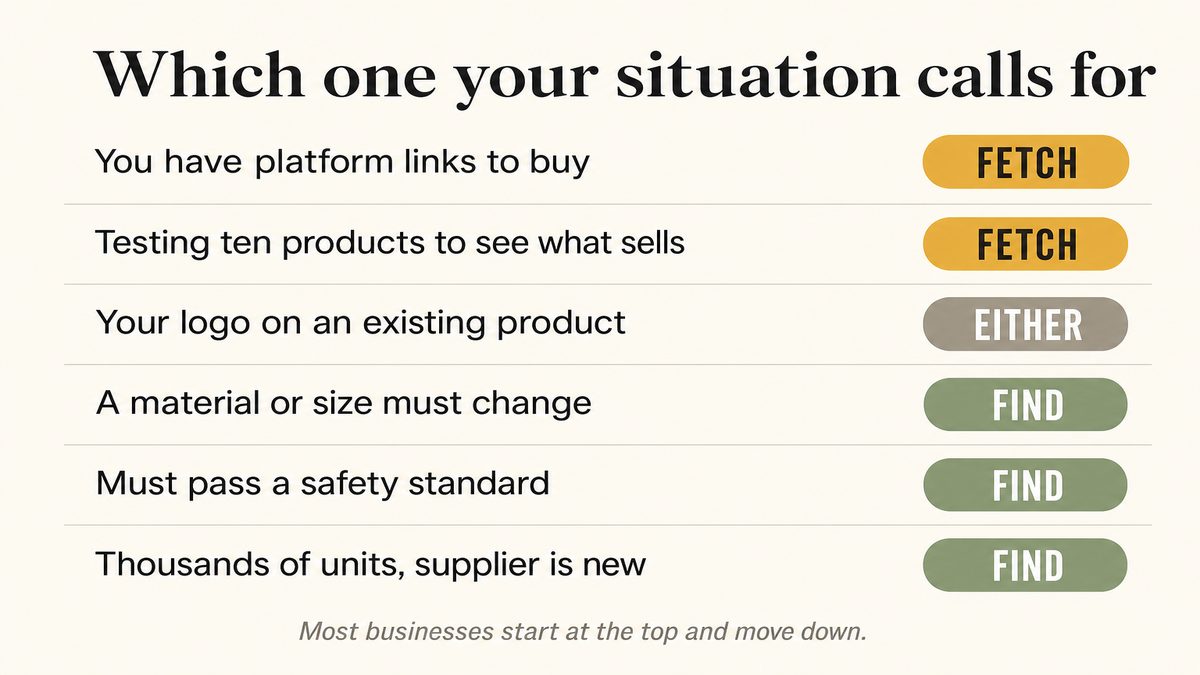
Work down this list. The first line that describes you is your answer.
Most businesses move down this list over time. They start by fetching test quantities, find something that sells, and only then need someone who can find a factory to make it properly. Hiring for stage three while you are still at stage one is the most common way to waste money here.
The 1688 case, specifically
A large share of fetching work is 1688 orders, and it is worth understanding why that platform in particular needs a middleman.
1688 is Alibaba’s domestic wholesale platform. Prices are lower than the export-facing site because the sellers are selling to Chinese buyers, in Chinese, expecting domestic payment and domestic delivery. Nothing about it is built for you.
That gap is the entire reason 1688 agents exist. They are not adding sourcing judgement; they are bridging a platform that was never meant to serve foreign buyers. The fee should reflect that — it is a service charge, not a consulting fee.
What you should watch for is the seller type. Many 1688 listings are traders, not factories, and a fetching service has no obligation to tell you which is which. If the price seems high for the platform, you may be buying from a reseller through an agent, which stacks two margins on one product. The wider platform picture is covered in the comparison of online B2B marketplaces.
Why the two are priced differently
Fetching is priced like a service: a flat fee per order, or a small percentage, because the work is roughly the same whether the goods cost two hundred dollars or two thousand.
Finding is usually priced as a percentage of order value, because the work scales with what is at stake and because the person is expected to save you more than they cost through better supplier selection and negotiation.
This is why comparing a “5% agent” against a “flat $30 per order agent” is meaningless — they are selling different things. The full breakdown of fee models, including the one that is never shown to you, sits in the guide to choosing a China sourcing agent.
One rule holds for both: whoever holds your money should not also be the person judging the goods. If a service buys on your behalf and inspects on your behalf and resolves disputes on your behalf, there is no independent check anywhere in the chain.
Four ways buyers get this wrong
Hiring a finding service to place platform orders. You pay a sourcing percentage for work that is essentially administrative. If your brief is a list of links, say so and pay a service fee.
Expecting a fetching service to catch quality problems. They will check the box arrived and the item matches the photo. They will not tell you the plastic is too thin for your market or that the stitching will fail after twenty washes. That is not what you hired.
Assuming consolidation is free. Storage beyond a certain number of days usually costs money, and repacking eight parcels into one takes labour. Ask for the storage window and the repack charge before goods start arriving.
Treating a low fee as the whole price. On the fetching side, the fee is often small while the freight quote carries the margin. Ask for the landed cost on a realistic basket, not the headline percentage.
Checking either type before you commit
The checks differ because the risks differ.
For a fetching service, the risk is your money and your goods sitting in someone else’s warehouse. Ask how long they have operated, whether the warehouse address is real, what happens if an item arrives damaged from the domestic seller, and who pays to return it. Send one small order before you send twenty.
For a finding service, the risk is bad judgement dressed up as expertise. Ask for work in your product category specifically, not testimonials in general, and ask what went wrong on a recent project. Anyone who says nothing has gone wrong has either not done much or is not being straight with you.
For both, one check applies: whether they accept an independent inspector paid by you. A service confident in its own work has no reason to object.
If you are weighing up named firms rather than service types, the live traffic and backlink figures for twelve of them are set out in the comparison of sourcing companies in China, along with who each one suits.
Who pays when something goes missing
This is the question almost nobody asks before signing up, and it is the one that causes the worst arguments later.
A fetching service sits in the middle of three separate handovers: the domestic seller to the warehouse, the warehouse to the freight forwarder, and the forwarder to you. Loss or damage can happen at any of the three, and responsibility is genuinely different at each stage.
Most services accept responsibility only for the middle leg — the time goods sit in their warehouse. If a domestic seller ships you the wrong item, the service will usually help you argue with that seller, but the loss is yours if the seller refuses. If the international carrier damages a carton, that is a freight claim, and freight claims on consolidated shipments are notoriously hard because nobody can prove which of eight sellers’ goods were damaged.
Two things reduce this. First, ask for photographs on arrival at the warehouse, before consolidation, so there is a record of what condition each item arrived in. Most services offer this either free or for a small fee, and it is the single most useful thing you can buy from them. Second, ask in plain terms what happens if a carton goes missing in transit, and whether insurance is included, optional or absent. A service that answers this clearly is worth more than one that is slightly cheaper.
On the finding side, the equivalent question is who pays for a failed production run. The honest answer is usually that you do, unless the contract says otherwise, which is why the terms you agree matter more than the fee you negotiate.
Using both at once
These are not mutually exclusive, and the sensible pattern for a growing business uses both.
Use a fetching service for the long tail — packaging, accessories, small components, test quantities of things you are curious about. Use a finding service for the two or three products that carry your margin, where a quality failure costs real money.
Splitting it this way keeps your costs matched to your risk. Paying sourcing percentages on a box of poly mailers makes no sense; buying your main product blind off a platform link makes even less.
If your products come from the physical markets rather than online platforms, the geography matters too, and the guide to China’s wholesale market towns covers which town holds which category.
Common questions
Is a buying agent the same as a sourcing agent?
The words overlap and many firms use them interchangeably. The useful distinction is not the label but the work: some services fetch products you have already identified, others find and develop products that do not exist yet in the form you want. Ask which one someone does all day rather than trusting the title on their website.
What does a China buying agent charge?
Fetching work is usually a flat fee per order or a small percentage, because the effort is similar regardless of order value. Finding work is normally a percentage of order value, since it scales with what is at stake. Comparing the two headline numbers directly is misleading because they cover different jobs.
Do I need an agent to buy from 1688?
Usually yes, though not for sourcing reasons. 1688 is built for domestic Chinese buyers: payment, seller chat and delivery all assume you are in China. An agent bridges that gap. What they are not obliged to do is tell you whether the seller is a factory or a reseller, so check that separately if price matters.
Can a buying agent handle custom products?
Some can, many cannot, and the website rarely makes it clear. Anything involving a changed material, a new mould, a safety standard or a tolerance requires someone who can argue with a factory and be right. Ask for examples of custom work in your category before assuming it is included.
Is it safe to let an agent hold my goods?
It is normal practice for consolidation and it is how the model works. Reduce the risk by starting with one small order, confirming the warehouse address is real, and getting the storage window and repack charges in writing. Treat a service that will not put those terms in writing as a warning.
Should I use one service for everything?
Not necessarily. A common and sensible setup is a fetching service for small items, packaging and test quantities, alongside a finding service for the few products that carry your margin. Matching the service to the risk keeps your costs proportional to what could actually go wrong.
The short version
Decide whether your problem is access or judgement. If you know what you want and simply cannot buy it from where you live, you need access, and that is a service fee. If you do not yet know who can make your product properly, you need judgement, and that is worth a percentage.
Most disappointment in this industry comes from paying for one and expecting the other.
Questions & Comments
We read every one and reply within 24 hoursTrying to work out whether you need someone to fetch a product or find one? Describe what you are buying below — product, quantity, and whether anything needs changing. You will get a straight read on which service your order actually calls for.