
Alibaba for Beginners: How to Place Your First Order Without Losing Money
Most beginner guides tell you where to click. This one tells you what each step costs, how long it takes, and where new buyers lose money. Read it once and you will know if your first order is safe before you pay.

Alibaba.com is the largest B2B marketplace in the world. It is where small shops, Amazon sellers and growing brands buy stock straight from Chinese factories. It is also where a lot of first-time buyers lose a few thousand dollars because they treated it like Amazon.
The difference matters. On Amazon you buy one item and it arrives. On Alibaba you agree a price, a quantity, a quality standard and a shipping method with a company on the other side of the world, then you pay a deposit before anything is made. Every one of those four things can go wrong.
This guide walks the whole path in order: account, search, supplier checks, first message, samples, order, payment, shipping, and what to do when something goes wrong. Real numbers are included wherever a real number exists.
Contact 10 to 15 suppliers, buy samples from the best three, pay only inside Alibaba, and never send the final payment before you have proof the goods are right. Everything below is detail on those four moves.
Is Alibaba right for you?
Alibaba is a wholesale site. You are buying from a business, in bulk, and you are expected to act like a business. If you want one item shipped to your house, you want AliExpress instead — same parent company, completely different job.
| Alibaba.com | AliExpress | |
|---|---|---|
| Who sells | Factories and trading companies | Mostly resellers |
| Typical order | 50 to 1,000+ units | 1 unit |
| Price per unit | Low | Two to four times higher |
| Can you brand it? | Yes, your logo and your box | Almost never |
| Who handles shipping | You decide and you pay | Seller handles it |
| Time to first delivery | 4 to 10 weeks | 1 to 3 weeks |
A simple test: if you plan to sell the same product more than once, Alibaba will make you more money. If you are testing whether anyone wants the product at all, buy two on AliExpress first and save yourself the trouble.
You can often get the price and the branding of Alibaba with a much smaller first order. Ask about a trial order. Many suppliers will drop the minimum for a first-time buyer who asks properly, and there is a script for that in the message section below.
Setting up an account suppliers take seriously
Registration is free and takes about ten minutes. The part that matters is not the sign-up form, it is the profile behind it. Suppliers read your profile before they decide how much effort to spend on your enquiry, and a blank profile with a free email address reads like a tyre-kicker.
Three things make the difference:
One habit to start now: keep every conversation inside Alibaba’s message centre. If a deal later goes wrong, that chat history is the evidence used to judge it. A deal agreed on WhatsApp is a deal with no referee.
Searching so you get 40 results, not 4,000
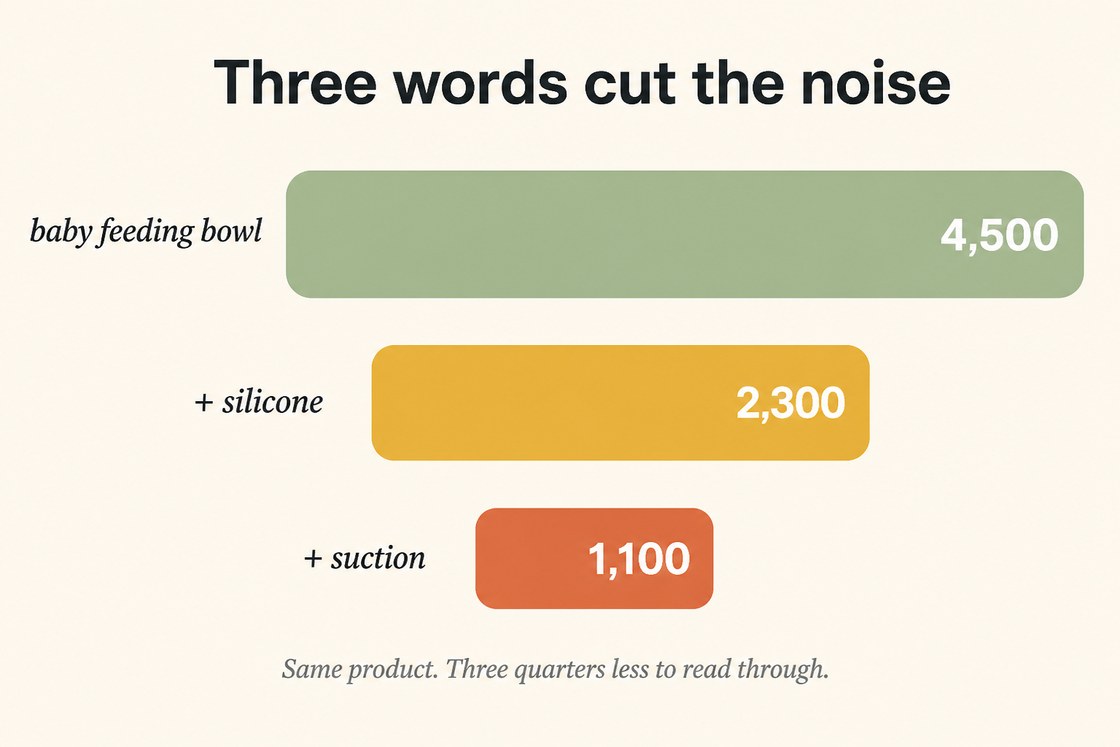
Alibaba’s own guide gives a clean example of why wording matters. Search baby feeding bowl and you get over 4,500 results. Add one word and search baby feeding bowl silicone and it drops to around 2,300. Add a second and search baby feeding bowl silicone suction and you are down to about 1,100.
Three words removed three quarters of the noise. Build your search the same way:
Material + product + key feature + size or model
Example: cotton canvas tote bag zipper 40cm beats tote bag every time.
Then use the filters down the side. Four of them do most of the work:
- Minimum order — set your real ceiling so you stop reading listings you cannot buy.
- Price range — set it slightly wider than your target, because quoted prices move once you talk.
- Supplier type — narrow to verified sellers to cut the thinnest listings.
- Trade Assurance — leave this on. It is the protection layer for everything that follows.
If you have a photo but no idea what the product is called, use image search. It reads shape and colour and finds close matches, and it is genuinely useful for clothing, bags and homeware where the right search word is hard to guess.
Save anything promising to your favourites as you go. You want a shortlist of ten to fifteen suppliers before you write to anybody, because writing to three and hoping is how beginners end up with one bad option and no comparison.
What the supplier badges really mean
This is where most beginner advice goes wrong, so here is the honest version.
A badge tells you a company paid for something or passed a check. It does not tell you the goods will be good. Alibaba’s own guidance is simply to look for suppliers marked as verified or covered by Trade Assurance — a filter to shorten your list, not a guarantee.
You will see claims online that verified suppliers are some exact percentage safer. Nobody publishes that figure and no one can check it. Ignore it. Judge suppliers on what you can see for yourself, using the checks below.
What you can actually check, on any supplier page, in about five minutes:
That last point is worth a whole article of its own, because the difference between a factory and a middleman changes your price, your minimum order and how well quality problems get fixed. If you want the full method, including how to read a business licence and the four questions that expose a reseller in one message, read our guide to telling a real factory from a trading company.
Your first message
Alibaba’s own advice is blunt about the numbers: expect to contact 10 to 15 suppliers to find one good partner. Suppliers read dozens of enquiries a day, most of them one line long, and they answer the ones that look like real business first.
A good first message does three jobs: shows you are real, says exactly what you want, and asks questions that are hard to dodge.
Hello,
I am [name] from [business name] in [country]. We sell [product type] and we are adding [product] to our range for [season or channel].
We need: [material], [size], [colour], [packaging]. I have attached a photo for reference.
Could you tell me:
1. Can you make this exactly as described, and have you made something similar?
2. Unit price at 100, 500 and 1,000 pieces?
3. Your minimum order, and can you do a smaller trial order for a first-time buyer?
4. Sample cost and how many days to make one?
5. Production time for a full order?
6. Are you the factory or a trading company?
We plan to decide within two weeks.
[Name], [business], [email]
Two details make that message work harder than it looks.
Asking for three price points tells you how the price moves with volume. If the price barely drops between 100 and 1,000 units, you are probably talking to a reseller buying at a fixed rate. If it drops steeply, the numbers are coming from a real production line.
Asking outright whether they are the factory is not rude. It is normal trade language, and how they answer is as useful as what they answer. A factory says yes and often offers a video call. A trading company usually says “we have our own factory” without naming it.
Send to all ten to fifteen on your shortlist. Chinese office hours are roughly 9am to 6pm China time, so messages sent late evening European or American time land at the top of the pile.
Samples: the cheapest insurance you can buy
Never skip this. A sample costs a small amount and answers questions that no photo can. Order from your best two or three suppliers, not just one, because a sample only means something when you can compare it with another.
When it arrives, check six things and write down what you find:
Put it in a box and label it with the date and supplier name. If the bulk order turns up worse than the sample, that box is your proof. Without it a quality complaint is your word against theirs.
Placing the order
Before you click anything, get the whole deal written down in one message and have the supplier confirm it. Not spread over three weeks of chat — one message, one list.
- Product, exact specification, and quantity
- Unit price and total price, and what currency
- What the price includes — does it cover getting the goods to the port, or not?
- Packaging: how many per carton, carton size and weight
- Production time in days, starting from when the deposit lands
- Payment split
- Quality standard: “must match the approved sample dated [date]”
That last line does more work than the rest combined. “Good quality” means nothing in a dispute. “Matches the approved sample” is a standard someone else can judge.
Then create the order on the platform, with a Trade Assurance contract, and attach your specification and sample photos to it. Attachments matter: they are what gets read if the order is later argued over.
Pay through Alibaba, on the order. Not to a personal account, not by WhatsApp arrangement, not “to our Hong Kong company for a discount”. Payment made outside the platform sits outside the protection, and that is exactly why someone would ask for it.
Paying: methods, fees and limits
Alibaba lists several ways to pay a Trade Assurance order, and the differences are real money. These figures come from Alibaba’s own buyer guidance:
| Method | Speed | Cost or limit | Best for |
|---|---|---|---|
| Credit card (Visa / Mastercard) | 2–3 working days | Limit of US $20,000 per transaction | Smaller orders, and card protection as a second layer |
| e-Checking | 4–5 working days | US $15 per transaction, US bank accounts only | US buyers moving larger sums cheaply |
| Telegraphic transfer (T/T) | 3–7 working days | Fee varies by your bank | Large orders where a flat bank fee is small in percentage terms |
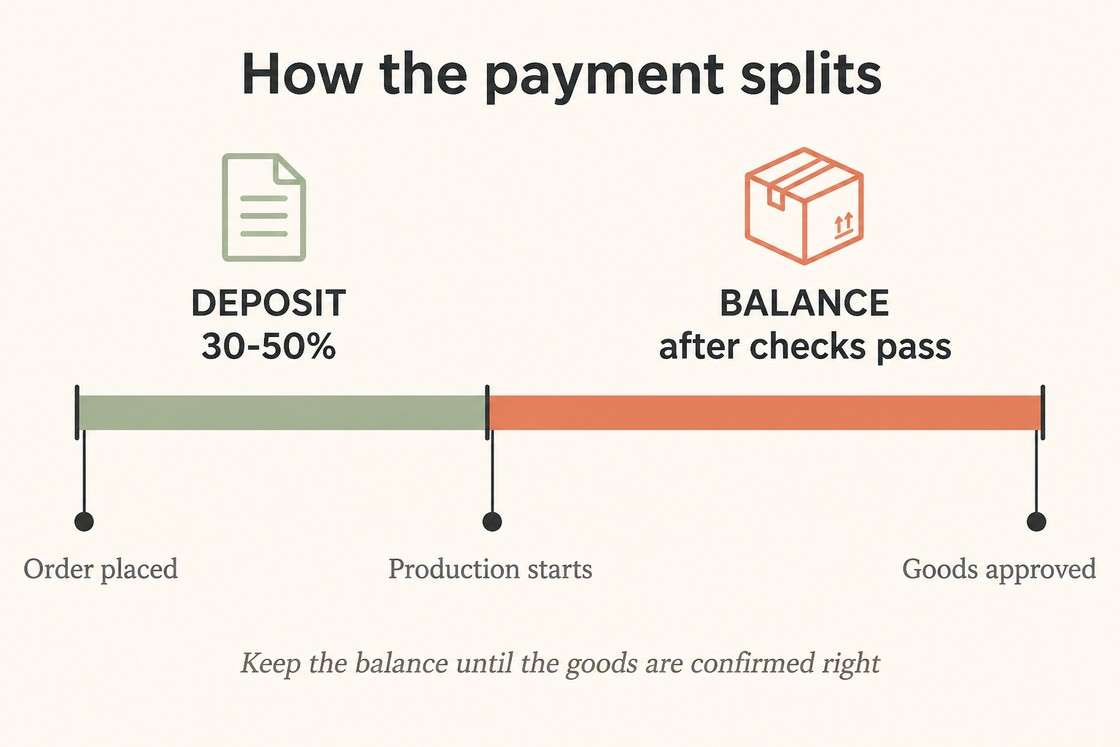
On the split: a deposit of 30% to 50% before production, with the rest paid when the goods are ready or have passed inspection, is the normal shape of the deal. Paying everything up front removes the only leverage you have.
Inspection before the final payment
This is the step most first-time buyers skip, and it is the one that pays for itself fastest.
A third-party inspector visits the factory before shipping, checks your order against your specification, and sends you a report with photographs. Alibaba puts the typical cost at US $100 to $200. Set against a container of goods you have not seen, that is very cheap information.
The trick is in the sequence. Write into your agreement that the final payment depends on passing inspection. That single sentence changes the incentive completely: the factory now needs the goods to be right before they see the rest of the money.
Inspection is chosen as an added service on the Trade Assurance contract, at the time you place the order. Trying to add it after the order is running is harder, so decide up front.
Whether you need one depends on the size of the risk. Under about $1,000, a good sample and clear photos before shipping may be enough. Above that, or for anything with safety rules attached, book the inspection.
Shipping and what lands at your door
Shipping is where a good deal quietly turns into a bad one. A price that looks great per unit can stop looking great once freight, duty and delivery are added.
You have three broad choices:
Two things to settle before you agree a price.
First, ask what the price includes. A quote that only covers getting the goods to the Chinese port leaves you paying for the sea leg, the paperwork at your end, duty, and delivery to your door. Those extras are not small. Ask the supplier directly: “Is this price to your port, or delivered to my address?”
Second, work out your duty before you order, not after. Your customs authority charges a percentage based on what the product is and where it was made. Look up the code for your product, check the rate for your country, and add it to your maths. Guessing here is how a profitable order becomes a break-even one. Duty is only one of about ten lines that sit between the quote and your shelf, and our guide to what your order really costs works through the whole bill with a costed example.
Suppliers sometimes offer to write a lower value on the paperwork so you pay less duty. Customs authorities know the real price of most goods. Getting caught means fines, a hold on the shipment, and a permanent flag on your future imports. The saving is never worth it.
One more piece of paperwork worth knowing about: the label on the goods themselves. Countries have rules about how the country of origin must be written, and getting it wrong can cost you a penalty at the border. If you are shipping to the US in particular, read our guide on why “Made in PRC” is rejected while “Made in China” is accepted before you approve any artwork.
When something goes wrong
Most orders arrive and are fine. Some do not. What decides the outcome is almost always what you did before the problem, not after it.
If the goods are wrong, late, or short:
- Photograph everything before unpacking further. Cartons as delivered, labels, then the fault itself. Include something for scale.
- Put the sample next to the bulk item and photograph them together. This is the single most persuasive image in any dispute.
- Raise it on the platform, on the order. Not by email, not on chat. It has to be on the order to count.
- State what you want. A refund, a partial refund, a replacement, or a discount. A complaint with no requested outcome drifts.
- Do not release the balance while it is being sorted out. Once paid, you are asking for a favour rather than enforcing an agreement.
Deadlines apply to these claims, and they are shorter than people expect, so raise the issue the day the goods arrive rather than after you have had time to think it over. What the protection covers, what it excludes, and how long you have to act is a longer subject — we cover it in detail in what Trade Assurance actually covers.
How long the whole thing takes
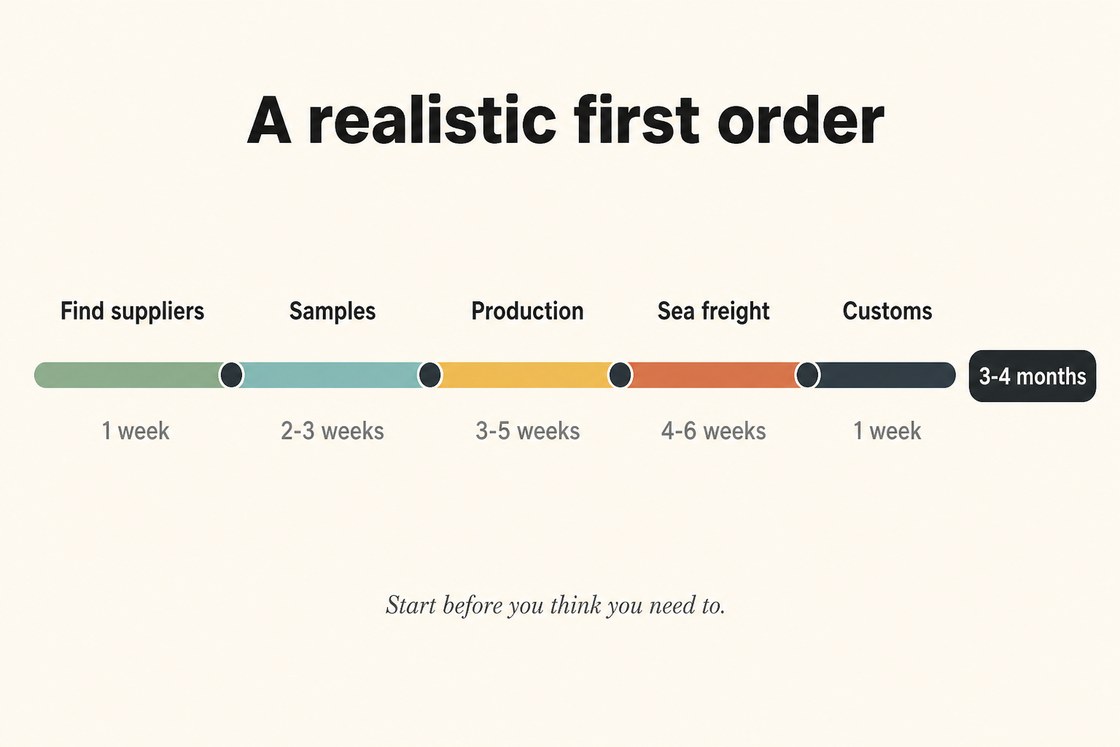
New buyers almost always underestimate this, then order Christmas stock in October. Here is a realistic first-order schedule.
| Stage | Time | Notes |
|---|---|---|
| Shortlist and message suppliers | 3–5 days | Replies arrive over several days |
| Compare quotes, ask follow-ups | 3–5 days | Two rounds of questions is normal |
| Samples made and shipped | 7–20 days | Express shipping, but making the sample takes time |
| Test samples and decide | 2–5 days | Do not rush this part |
| Production | 15–40 days | Starts when the deposit arrives, not when you order |
| Inspection | 2–5 days | Book with the order |
| Sea freight | 25–45 days | Air freight is 3–10 days instead |
| Customs and delivery | 3–10 days | Longer if paperwork is wrong |
| Total by sea | 8–16 weeks | Plan backwards from your selling date |
Note where the time actually goes. Production and shipping are the big blocks, and neither can be hurried much once started. The parts you control are at the front — and rushing those is what causes the expensive problems later.
1. Paying outside the platform
Always presented as a discount or a faster process. It is neither. It is the removal of your protection, and it is the single most common way money disappears.
2. Ordering bulk without a sample
Saves two weeks and risks the entire order. There is no version of this that is worth it.
3. Paying 100% up front
Once the money is gone you have no leverage. Keep a meaningful balance until the goods are confirmed right.
4. Agreeing “good quality” instead of a standard
Write “must match the approved sample dated [date]”. Vague words cannot be enforced.
5. Forgetting freight and duty in the maths
A unit price is not a landed cost. Work out the full delivered figure before you decide the deal is good.
Questions people actually ask
Is Alibaba safe for a complete beginner?
Yes, if you keep the whole deal on the platform. Create the order there, pay there, and keep your messages there. The buyers who lose money have nearly always been persuaded to step outside that system at some point.
How much should my first order be?
Small enough that losing it would annoy you rather than hurt you. For most people starting out that is a few hundred to a couple of thousand dollars. Your first order buys information about the supplier as much as it buys stock.
Can I get a lower minimum order quantity?
Often, yes. Ask directly for a trial order, explain that you will reorder if it sells, and offer to pay a slightly higher unit price for the smaller run. Many suppliers will agree because a small first order that leads to a repeat customer is worth more to them than no order.
Do I need a registered company to buy?
Not to open an account. You may need one to import commercially in your own country, and you will usually need one to reclaim sales tax. Check your local rules before a large order.
Should I use the supplier’s shipping or arrange my own?
For a first order, letting the supplier handle it is simpler and the difference is small. Once you order regularly, your own freight forwarder usually costs less and gives you a direct line when something goes wrong.
What if the goods arrive damaged?
Photograph the cartons before opening anything further, then the damage itself, and raise it on the order straight away. Whether it is the supplier’s problem or the carrier’s depends on who arranged the freight and on what terms.
Can I put my own brand on the products?
Yes, and this is one of Alibaba’s real advantages over retail marketplaces. Ask about your logo and your own packaging in your first message. There is often a one-off charge for print plates or moulds, so ask what that costs before you commit. Our guide to putting your brand on the product covers the four levels of branding and which one to start with.
How do I know the price I am quoted is reasonable?
Get quotes from at least five suppliers for the same specification. The middle of that range is roughly the market. Be careful with the cheapest: it usually means thinner material, a lower grade component, or a quality standard you have not noticed yet. Once you know the market range, there is more to win on terms than on the unit price — see our guide to negotiating with Chinese suppliers.
We check factories in China for a living
Send us the supplier link and what you plan to order. We will tell you whether they are a factory or a middleman, whether the price is fair, and what to watch for before you pay a deposit.
Get a free supplier check
Questions & Comments
We read every one and reply within 24 hoursJust starting out on Alibaba and hit something this guide did not cover? Ask below — suppliers, samples, payment or shipping. No question is too basic here.