
Yiwu Market: What It Is and How to Actually Buy There
 ·
Updated August 21, 2026
·
Updated August 21, 2026
Yiwu Market is the largest small commodity market in the world. That sentence is in every guide you will read, and it tells you almost nothing useful. What you actually need to know is narrower: where to stand on day one, which of the five districts holds your product, what a stall price does and does not include, and when the person quoting you is the maker and when they are just the seller.
I work as a sourcing agent here. I walk these aisles most weeks of the year. This guide is the version I give clients before their first trip, with the parts that only make sense once you have been inside.
Yiwu is set up for buyers who want many different items in small quantities. If you need one product in huge volume, a factory will beat the market on price. If you need forty products to fill a store or a container, nowhere else comes close.
What Yiwu Market actually is
The official name is Yiwu International Trade City. Locals call it Futian Market. Foreign buyers usually just say “Yiwu Market”. All three point to the same place: a run of five connected buildings in Yiwu, a city in Zhejiang Province, about 300 km southwest of Shanghai.
The scale is genuinely hard to picture. The market runs to roughly 6.4 million square metres of trading floor with about 75,000 booths. Twenty-six broad product groups sit inside it, covering something close to two million separate items.
Here is the part that matters more than the size. Yiwu is not a trade fair. It does not open for a week and close. It runs all year, and the same seller sits in the same booth season after season. You can walk in on a Tuesday in March and find the same person you met last October, in the same spot, with a slightly updated range.
That staying power changes how you buy. At a fair you are under pressure to close before the doors shut. In Yiwu you can look on Monday, think about it Monday night, and come back Tuesday with a smaller order to test. Sellers expect that.
Who Yiwu suits, and who it does not
I would rather you learn this from a page than from a wasted flight.
That second row is not me talking you out of a trip. It is the honest split. Buyers who come to Yiwu for the wrong product type leave disappointed and blame the market, when the market was simply never built for what they wanted.
The five districts, and why the layout matters
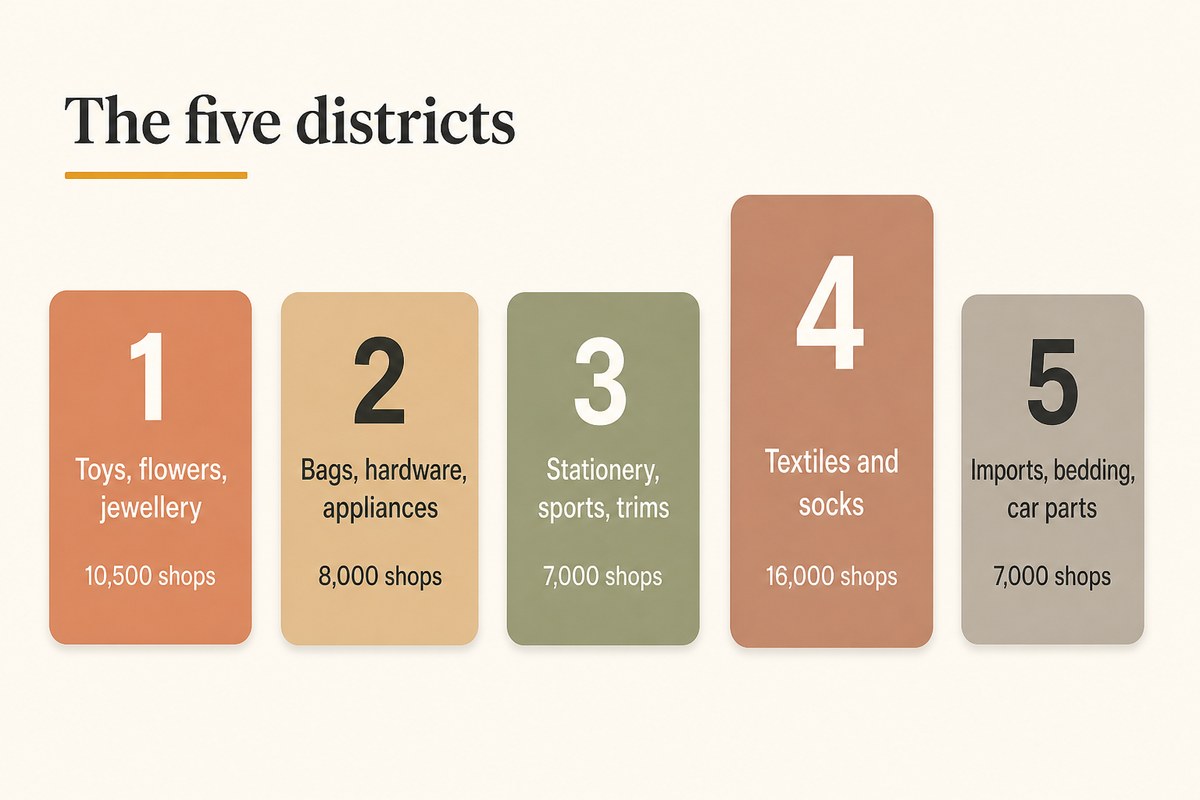
The market is split into five districts. Each one holds a different set of product groups, and each has four or five floors. Walk into the wrong building and you can lose a full day.
Two things about this list catch people out.
First, related products are often split across buildings. Say you want to sell a boxed gift set. The item itself might sit in District 1, but the printed box comes from District 3, where stationery and paper goods live. Two districts, two sets of minimums, two suppliers who have never spoken to each other.
Second, the same product can appear in more than one district at different price levels. Hair accessories show up in District 1 as fashion items and again in District 5 among the higher-end hair goods. Same category name, different price band, different minimums.
I have written a separate walkthrough that lists what sits on each floor and shows how to look up a product and go straight to the right building — see the district-by-district breakdown of Yiwu International Trade City before you plan your route.
What your first day actually looks like
Most guides jump from “the market is huge” straight to “negotiate hard”. The bit in between is where people lose time.
You cannot see the whole market
Let me put a number on it. A single floor of a single district holds well over a thousand booths. If you gave each booth thirty seconds — just long enough to look up, scan the wall, and move on — one floor would take more than eight hours. There are more than twenty floors across the five districts.
So the whole-market walkthrough is not a slow plan. It is an impossible one. Every useful trip to Yiwu is built on skipping almost everything.
What works instead: pick your two or three product groups before you fly. Look up which floors hold them. Spend your first morning on one floor only, walking it end to end without stopping to talk. You are building a mental price range, not buying. By lunch you will know roughly what your item costs and which booths are worth a second visit.
Write down the booth number, every single time
This sounds too obvious to mention. It is the single most common mistake I see.
Booths are numbered by district, floor and street. A buyer photographs a product, walks on, and three hours later cannot find their way back. The photo shows a bowl on a shelf. There are four hundred booths selling bowls on shelves.
Take a photo of the booth number sign before you photograph the product. It costs two seconds and saves an hour.
Timing inside the day
The market keeps steady hours through the year and closes for a short period around Chinese New Year. For opening times and the days worth avoiding, I keep a separate page on Yiwu market timings rather than repeat it here.
What that page does not cover is the rhythm inside a day. Late morning and mid afternoon are when booth owners are present and willing to talk properly. First thing, they are still setting up and dealing with courier pickups. Late afternoon, they are packing and their attention is gone. If you have one serious conversation to have, do not have it at 4:45.
Understanding a stall price
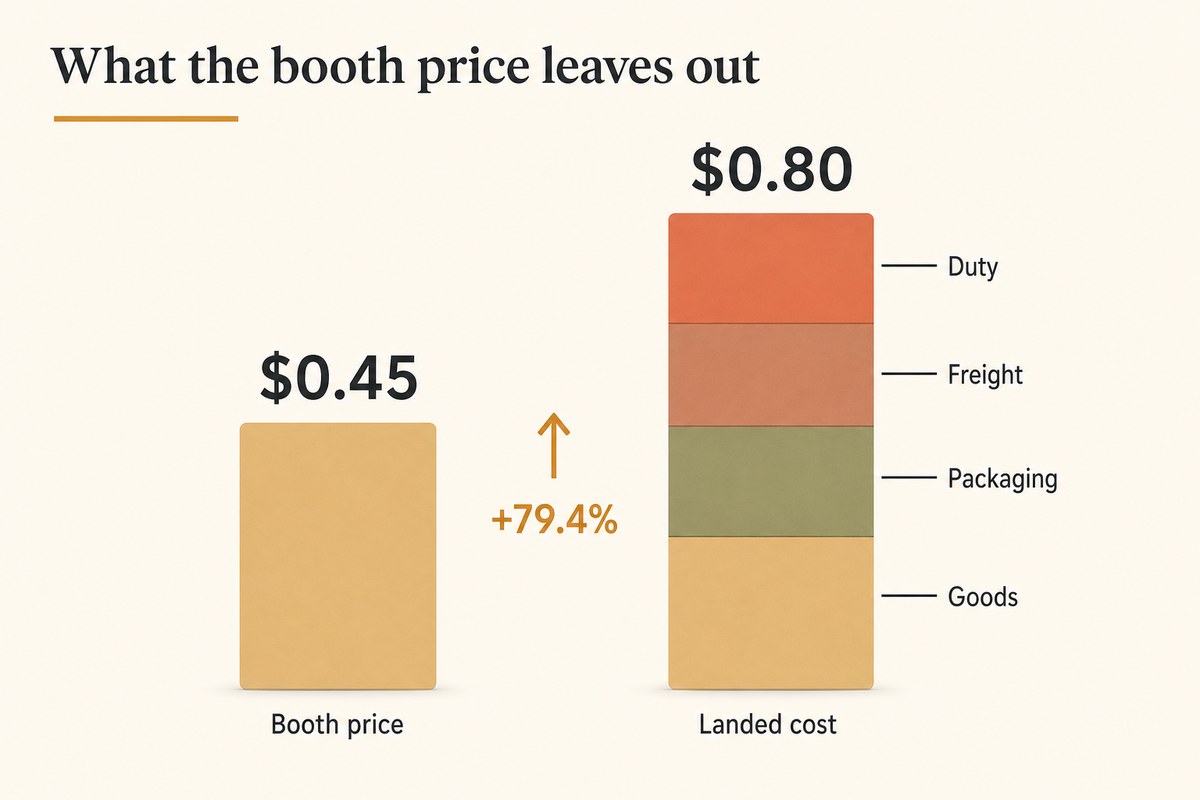
The number a booth owner writes on a scrap of paper is the start of a conversation, not the cost of your goods.
The gap between those two rows is where first-time buyers get their margin wrong. A ¥3 item is not a ¥3 item once it is boxed, labelled, trucked, consolidated, shipped and cleared.
I have set out the full arithmetic — every line between the booth price and stock on your shelf — in the guide to how Yiwu wholesale market pricing and MOQs really work. If you only read one other page before you come, read that one.
MOQ is softer than the sign says
Booths quote a minimum, and new buyers treat it as fixed. It rarely is.
What moves it is not pleading, it is total order value. A seller who will not break a 500-piece minimum on one design will often accept 150 pieces each across four designs. Same money to them, better spread of risk for you.
This is why Yiwu suits buyers with a wide range and shallow stock. You are not asking anyone to do you a favour. You are giving them the same order in a different shape.
Who you are actually talking to
Behind the counter you might have the factory owner, a family member of the factory owner, a full-time trader who buys from thirty small workshops, or a hired salesperson who knows the products but nothing about how they are made.
All four are normal. None of them are a problem by themselves. The problem is not knowing which one you have.
1. Ask about a change, not about the factory
“Can you make this in a different colour, and how long would that take?” A maker answers with a timeline and a minimum. A reseller says they will check and get back to you.
2. Ask what the item is made from
Someone who runs production names the material without pausing. Someone who buys and resells often gives you a vague answer or repeats what is printed on the packaging.
3. Look at the range on the wall
A booth showing one product family in many variations is usually tied to a workshop. A booth showing fifty unrelated items is buying them in.
4. Ask to see the business licence
Read the business scope line. If it lists making or producing, there is a workshop behind it. If it only lists selling or wholesale, you are talking to a trader.
That last check is the same one I use for online suppliers, and it is the fastest tell there is. I have written up how to read the licence and what the wording means in the guide to telling a factory apart from a trading company before you order.
A trader is not a worse choice. For a mixed order across many categories, a good trader is often the better one — they carry the co-ordination you would otherwise pay an agent to do. What you should not accept is a trader charging a maker’s price while telling you they own the workshop.
Five mistakes I watch people make
These are not theoretical. I see each of them several times a year.
1. Trying to see everything
Covered above, but it is the biggest one. Buyers arrive with five days and no plan, walk twenty kilometres, and leave with photographs of booths they cannot find again.
2. Comparing a Yiwu price to an online price
An online listing usually includes packing and a delivered price. A booth price does not. Comparing them straight across makes Yiwu look cheaper than it is, and the difference shows up later as freight and packaging.
3. Ordering from the sample on the wall
Display samples are the best pieces in the run and have been handled for months. Ask for a fresh unit from stock, and where the order matters, ask for a pre-shipment check.
4. Leaving packaging to the end
Retail boxes, hang tags and barcodes come from different booths with their own minimums and their own lead times. Sort them while you are still in the market, not after you fly home.
5. Paying in cash with no paper
Small cash deals happen constantly here and mostly go fine. But if there is a problem, a handful of notes and a verbal promise gives you nothing to point at. Get the order written down, even briefly.
Not checking who owns the goods before you pay. In a market this size, a booth may be selling stock it does not yet hold. That is normal and usually fine. It stops being fine when you pay in full up front for a large order and the seller is waiting on a workshop that has not started. Pay a deposit, hold the balance until you or someone you trust has seen the goods.
Doing it alone versus using help
I run a sourcing business, so treat what follows with that in mind. I will still give you the honest version.
You can absolutely do Yiwu alone if your order is simple, your product sits in one district, you have time to walk, and you are comfortable arranging your own freight. Plenty of buyers do exactly this every week.
Help earns its cost when the job is spread out: goods from four districts that need combining into one shipment, packaging bought separately from product, a pre-shipment check while you are already back home, or export paperwork you have never handled.
The full version of that decision — including the cases where paying someone is a waste of money — is in my honest answer on whether you need a Yiwu sourcing agent.
Before you book the trip
A few practical things worth settling in advance, each covered properly elsewhere so I will not repeat them here.
Tell me what you are buying and I will tell you if the trip is worth it
Send the product and roughly what quantity you need. I will tell you which districts to walk, what the price range looks like, and whether you would be better off ordering without flying at all.
Send an enquiryCommon questions
Is Yiwu Market cheaper than buying online?
On the product itself, usually yes, because you are one step closer to the maker and there is no platform margin. But an online price often includes packing and delivery, while a booth price does not. Once you add packaging, inland transport and freight, the gap narrows. Yiwu wins clearly when you are buying many different items at once, because you consolidate everything into a single shipment.
Do I need to speak Chinese to buy in Yiwu?
Not for simple buying. Many booth owners handle enough English for prices, quantities and lead times, and calculators and translation apps cover most of the rest. Language starts to matter when you are agreeing anything conditional, such as payment terms, defect handling, or what happens if the colour is wrong. Those conversations go badly through an app.
What is the minimum order in Yiwu Market?
It varies by booth and product, and the number on the sign is rarely the real limit. Sellers care about total order value more than piece count, so spreading a similar spend across several designs will often get you a lower minimum per design than pushing hard on one item.
Can I visit Yiwu Market without being a business?
Yes. The market is open to visitors and you do not need to prove you own a company to walk in and look. Individual buyers do buy here. What is harder as a private buyer is the export side, because paperwork and freight are built around commercial shipments, so most small private orders leave by courier instead.
How many days do I need in Yiwu?
For one or two product groups with a clear list, three full days is comfortable: one to survey, one to talk seriously and sample, one for packaging and loose ends. For a wide mixed range across several districts, five days is more realistic. Fewer than two days is only worth it if you already know exactly which booths you are returning to.
Is Futian Market the same as Yiwu Market?
Yes. Futian Market, Yiwu International Trade City and Yiwu Market all refer to the same five-district complex. Futian is the local name, the Trade City name is the official one, and Yiwu Market is what most foreign buyers say. Older material sometimes uses Yiwu Small Commodity Market as well.
Questions & Comments
We read every one and reply within 24 hoursSourcing from Yiwu and hit something this guide did not cover? Ask below — districts, prices, minimums, shipping or agents. Real questions get real answers, and yours probably helps the next buyer too.