
Industrial Casters Sourcing Guide: Load Ratings, Wheel Materials and Mounting
 ·
Updated October 10, 2026
·
25 min read
A caster is four things bolted into one product, and the number written on the side of the box only describes one of them. A 500 kg caster with the wrong bolt spacing will not fit your trolley. A 500 kg caster with a hard wheel will carry the load and destroy a tiled floor doing it. A 500 kg caster on soft rubber will carry the load and refuse to start moving. This guide works through the four characteristics a caster is actually defined by, how to calculate the load each corner really sees, how to read a wheel's material and hardness, what the mounting dimensions mean, and where a cheap quotation quietly saves its money.
The Four Characteristics, and What Each One Decides
| Characteristic | What it decides | What to write in the inquiry |
|---|---|---|
| The fixing system | Whether the caster bolts onto your equipment at all. Nothing else matters if the plate holes do not line up. | The plate class or the bolt-hole spacing, the bolt diameter and the bolt-hole pattern — not just the plate size. |
| The offset | How the caster trails behind the load when it rolls, and therefore how easily it starts moving and how well it steers. | The offset or the swivel radius, and the direction of travel you expect the trolley to be pushed in. |
| The wheel | Rolling effort, floor protection, noise, and whether the wheel survives the floor it runs on. | The wheel material and hardness, the wheel diameter and width, and the floor it will run on. |
| The load capacity | Whether the caster survives the job. It is the capacity of one caster, tested in a standard way, and not the capacity of your trolley. | The load per caster after dividing by the number of load-bearing wheels, the safety factor you want, and whether it is a static or moving load. |
1. What Is a Caster Made Of, and Which Part Decides What?
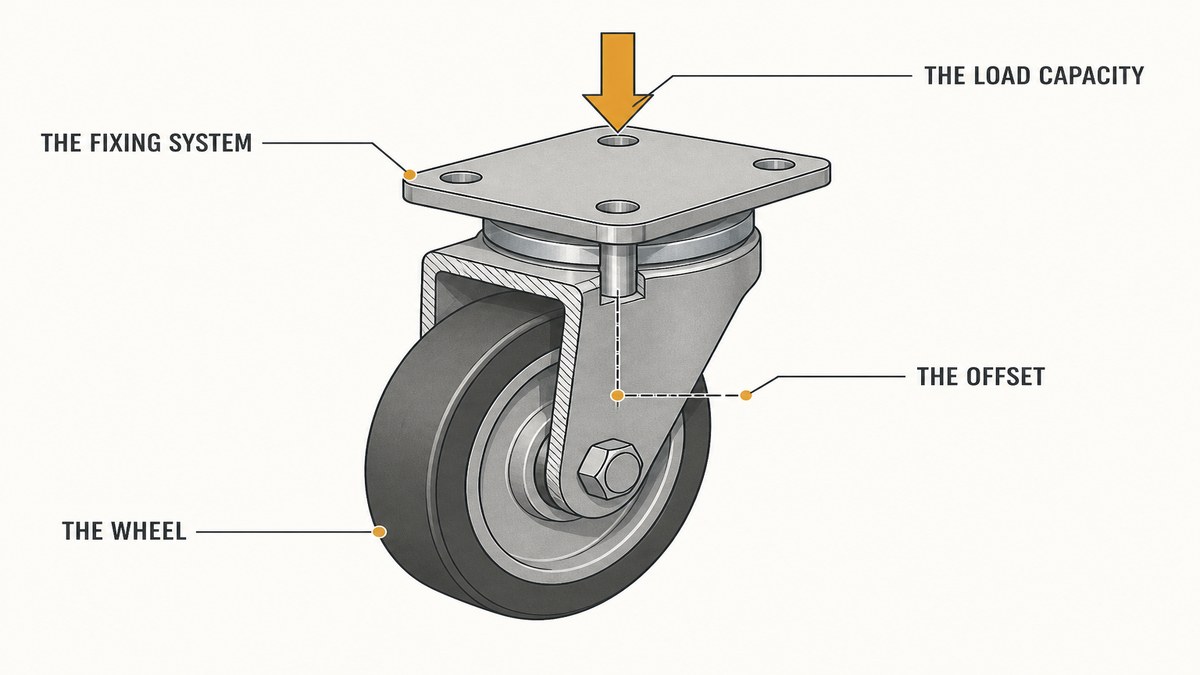
An industrial caster is defined by four characteristics, and the international standard for industrial castors and wheels names exactly those four: the fixing system, the offset, the wheel, and the load capacity. Everything else on a caster — the bracket shape, the finish, the colour of the wheel — is a detail of those four.
That list is worth keeping in front of you, because it is the order in which a caster goes wrong. Buyers normally start with the load capacity, because it is the number printed largest. The fixing system is the one that stops the project: if the plate does not match the mounting holes on your equipment, the caster is scrap metal, however good the wheel is. The offset and the wheel then decide whether the trolley is pleasant to push or a thing your staff avoid.
| Part | What it is | How it fails when it is wrong |
|---|---|---|
| The mounting plate | A flat plate with three or four bolt holes, welded or riveted to the swivel raceway. | Does not fit. The holes are in the right pattern but the wrong spacing, or the bolt diameter is smaller than the plate was drilled for and the caster shifts under load. |
| The swivel raceway | Two rows of balls or a single row of rollers between the plate and the fork, letting the fork turn. | Develops play, becomes stiff, or seizes. Play is measured as a standard test before and after the load tests, which tells you the maker expects it to change. |
| The fork, or rig | The pressed or welded bracket that holds the wheel axle below the raceway. | Bends under a side load when a trolley is pushed across a slope or bumped into a kerb. |
| The wheel | A tyre, a core, and a bearing. The three are chosen separately and pressed together. | The two common ends: the tyre wears flat on a hard floor, or the core and bearing give out under a load the wheel can carry but the bearing cannot. |
| The bearing | A plain bore, a bushing, a ball bearing, or a roller bearing inside the wheel. | Rolling effort climbs, or the wheel develops a rumble and free play, long before anything looks broken. |
The one part that is easy to overlook is the bearing, because it is inside the wheel and not on any drawing the buyer normally sees. It is also where two casters with identical wheels, brackets and load ratings can be genuinely different products. Section seven goes through it.
2. Swivel, Rigid and Offset — Which Corner Gets Which Castor?
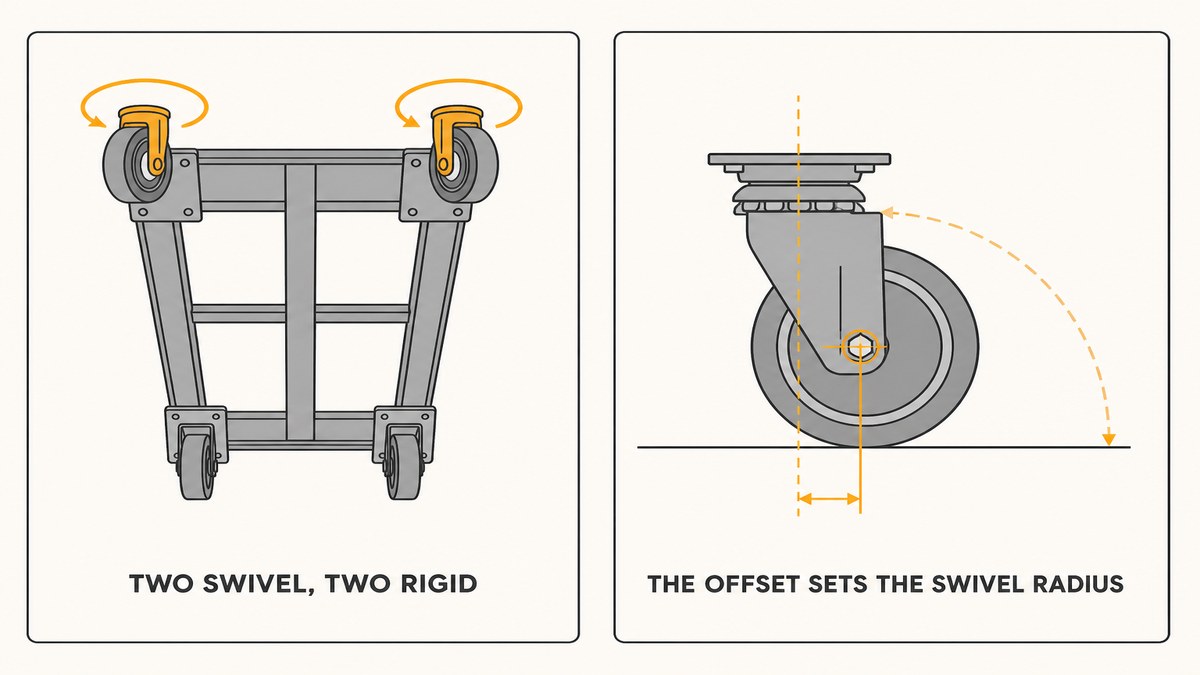
Two swivel castors and two rigid castors is the classic trolley, and on a short wheelbase in a tight space four swivel castors is the better answer. The offset is the third number in that decision, and it is the one almost nobody writes down.
A swivel castor turns about a vertical axis set in front of the wheel axle. The horizontal distance between that axis and the axle is the offset. It is what makes the caster trail: when you push the trolley, the wheel lines up behind its pivot the way a supermarket trolley wheel does, and the trolley goes where you push it. Too little offset and the caster will not self-align, so the wheels skate sideways and the trolley fights you. Too much offset and the caster turns easily but the wheel sits further out from the mounting plate, which raises the load on the raceway and makes the whole assembly taller and wider. The offset also fixes the swivel radius, which is the circle the caster needs to sweep — and that circle is what decides whether a compact four-swivel trolley can actually spin on the spot, or whether the castors collide with each other or the frame.
| Layout | Where it is right | Where it is wrong |
|---|---|---|
| Two swivel, two rigid | Long trolleys and carts that are pushed in a straight line most of the time. Tracks straighter and costs less, because a rigid castor has no raceway to wear. | Tight aisles and short wheelbases, where the rigid pair has to be dragged sideways to turn. |
| Four swivel | Short wheelbases, tight spaces, and anything that has to move sideways or spin in place — including equipment that gets positioned by hand rather than driven. | Long trolleys pushed fast in a straight line, where all four castors hunt slightly and the load wanders. Also more expensive for the same capacity. |
| Rigid only | Equipment that runs on a fixed track or a guide rail, where steering is done by the rail. | Anything that has to be steered by hand. |
There is one more decision hiding here, and it is a cost decision rather than a technical one. A rigid castor is a simpler product than a swivel castor — no raceway, no offset, fewer parts — so the pair that does not need to steer should not be bought as a swivel. On a long cart that is pushed straight down an aisle, fitting four swivels buys nothing and adds two raceways' worth of wear.
3. How Is Load Capacity Actually Calculated?
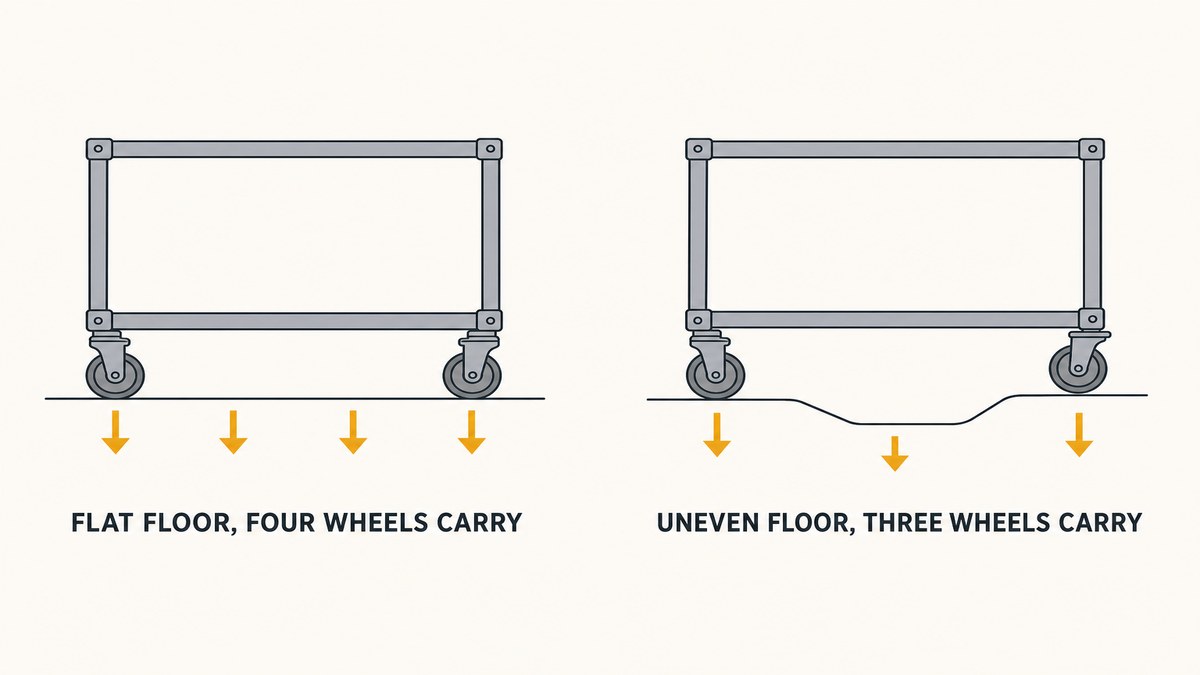
Divide the weight the trolley will carry by the number of wheels that are carrying it, and on a four-wheel trolley that number is usually three, not four. Then add something for the shocks, because the worst load a caster ever sees is not the load standing on it — it is the load arriving.
The figure printed on a caster belongs to one caster, and it is established on a test bench rather than on your floor. The standard for industrial castors sets out both a static test and a dynamic test, with the swivel and wheel play measured before and after, which tells you the number is meant to describe something that changes with use. So the first question about any capacity figure is which test it came from. Two casters can be quoted at the same capacity and behave differently on a rough floor, because one figure survived a static load and the other survived a rolling one.
| Step | What to do | Why |
|---|---|---|
| 1. Total load | Add the weight of the trolley itself to the weight of what it carries. The trolley is not free; on a steel cart it can be a large share of the total. | Buyers routinely size castors against the payload alone and then wonder why the castors feel overloaded. |
| 2. Load-bearing wheels | Divide by three on a four-wheel trolley, and by four only if you are certain the floor is flat and the frame is rigid. | On any real floor one wheel carries little or nothing. The convention exists because three points always sit flat and four do not. |
| 3. Shock allowance | Add a factor for the way the trolley is used: hand-pushed on a smooth floor is different from power-towed across expansion joints. | A wheel hitting a door sill sees several times the standing load. This is the load that breaks brackets, not the payload. |
| 4. The speed limit | Check the speed the application runs at. If it is towed above walking pace, you have moved into a different part of the standards family. | The industrial castor standard covers manually propelled and power-towed applications up to 1.1 m/s, about 4 km/h, and the wider family splits by application — even castors for hospital beds have their own standard. |
Step three is where most silent overloads come from. A trolley that is loaded at a bench and pushed ten metres is a different duty from the same trolley crossing a door sill four times an hour. The worst moment in a caster's day is usually the point where it is loaded or unloaded — the instant the full weight arrives on one corner as the load is set down, or the moment a towed cart jolts. The same reasoning applies where a trolley meets other handling equipment: the interface between a transfer cart and a belted conveyor line is the highest-shock point on the route, because the load is being handed over rather than simply carried.
4. Wheel Material by Floor and Load
Match the wheel to the floor first and to the load second, because the floor is what you cannot change. A soft wheel protects the floor and rolls hard; a hard wheel rolls easily, carries more and marks soft floors. There is no material that does both, and every "which wheel is best" question is really a question about which of those two you can afford to lose.
A caster wheel is a tyre on a core, and that structure is why two wheels of the same size and the same stated material can be different products. The tyre is what meets the floor; the core is what carries the load and holds the bearing. A heavy wheel with a thin tyre behaves like a hard wheel once the tyre has compressed, and a wheel whose tyre is not bonded properly to its core will part company with it under heat and load — a failure that looks like a mysterious wobble before it looks like a broken wheel. Rubber tyres for this duty are a moulded part with its own material and bonding questions, in the same way as any other compression-moulded rubber component, so "rubber" on a quotation is the start of the specification rather than the end of it.
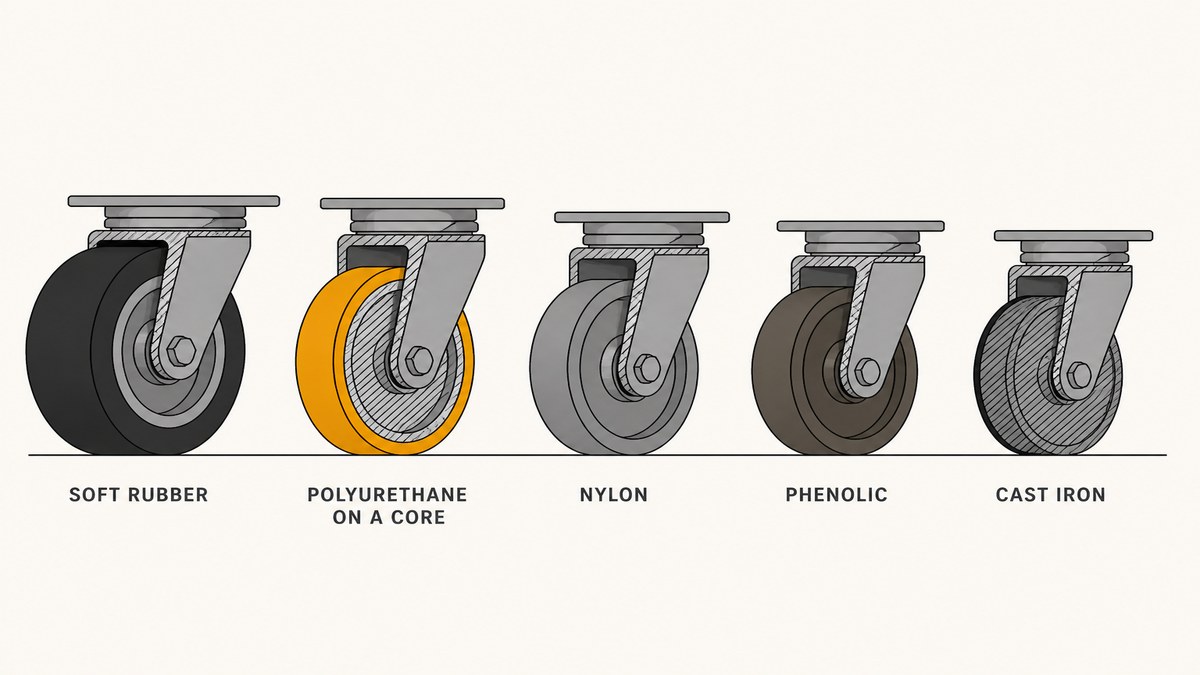
| Wheel | Good on | What it costs you | Where it fails |
|---|---|---|---|
| Soft rubber | Smooth floors you must not mark, quiet operation, and light to medium loads. The default for equipment that gets pushed around a shop floor all day. | Rolling effort. Soft wheels are hard work to start moving, especially once the load is up. | High loads and sharp debris. A soft tyre cuts and then flats. |
| Polyurethane on a metal core | The widest range of floors and loads, and the usual answer for industrial work. Resists oils and many chemicals, rolls more easily than rubber and still protects the floor. | More expensive than plain rubber, and it has a temperature ceiling. | Hot environments and some aggressive chemicals. The tyre can also separate from the core under heat and heavy load if the bonding is poor. |
| Nylon or polyamide | High loads where rolling effort matters, and floors that can take a hard wheel. Very low rolling resistance for its size. | Noise, and no forgiveness. It transmits every bump into the frame and the load. | Soft and tiled floors, and wet or greasy surfaces where it loses grip. |
| Phenolic | High loads at high temperatures, and chemical plants. Stiffer and more heat-resistant than the plastic wheels. | It is hard and can chip. Not a wheel for a floor you care about. | Impact. A phenolic wheel does not deform, so a shock goes through it rather than into it, and it can crack. |
| Cast iron or steel | The heaviest loads, and hot, oily or abrasive environments where no polymer survives. | Floors and noise. It is the loudest wheel there is and the least kind to any surface. | Anywhere the floor matters, and anywhere corrosion does. Bare steel in a wash-down area rusts. |
5. What Does the Hardness Number Tell You — and What It Doesn't?
It tells you where that batch of tyres sits relative to the ones you approved last time. It does not tell you how the wheel will roll or how long it will last, and the hardness standard says so itself.
Wheel hardness is measured on a durometer, with one scale for softer materials and another for harder ones, and quoted as a number with the scale after it. Buyers understandably treat that number as a performance figure: harder means longer life, softer means better floor protection. That reading is only half true, and the standard that defines the method is unusually direct about it — it states that no simple relationship exists between the indentation hardness measured this way and any fundamental property of the material, and that the method is intended mainly for control purposes. Control is the operative word. Hardness is an excellent way to confirm that a delivery matches the sample. It is a poor way to predict a wheel's life on your floor.
What to ask instead is unglamorous and much more useful: the rolling resistance at your load, the abrasion figure for the tyre compound, the temperature range the tyre was compounded for, and — where the floor is the thing you are protecting — whatever floor-loading or floor-marking data the maker has. Where the application touches food, the wheel also stops being an engineering question and becomes a materials question, and the answer is a listing rather than an adjective.
6. The Mounting Interface: Plates, Bolt Spacing and Stems
The mounting dimensions are the most standardised part of the whole product, and the most common reason a shipment is useless. The standard defines top plate classes with fixed outer sizes, bolt-hole spacings and bolt diameters against wheel sizes — which means the plate you need has a name, and the name is not "100 by 100".
There are two plate families. Triangular plates carry three fixing holes and are identified by classes running from the smallest to the largest. Rectangular plates carry four holes and are identified in the same way. Each class fixes the outside dimensions, the spacing between the bolt holes, the diameter of the bolt the holes are meant to take, and the wheel diameters the class is normally built around.
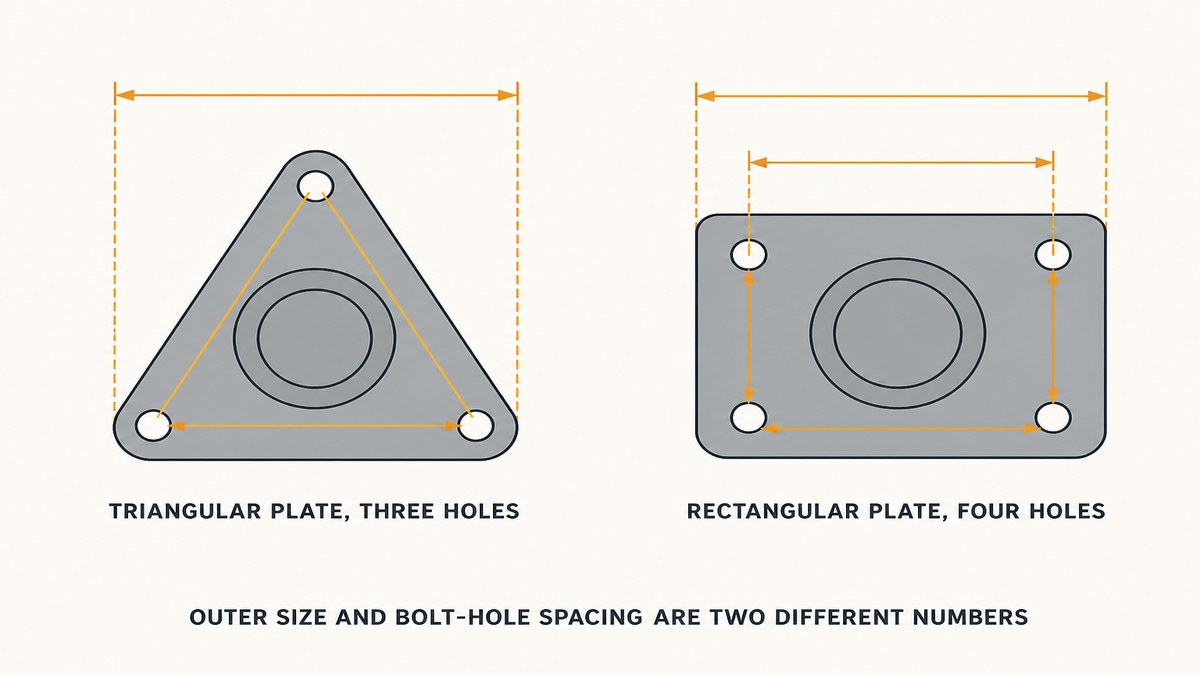
| Class | Plate, outside | Bolt-hole spacing | Bolt hole for | Wheel diameters it is built around |
|---|---|---|---|---|
| T41 | 75 × 75 mm | 55 mm | 6 mm bolt | 50, 63, 75/80, 100 mm |
| T42 | 115 × 115 mm | 80 mm | 8 mm bolt | 50, 63, 75/80, 100, 125 mm |
| T43 / T44 | 145 × 145 mm | 105 mm | 8 mm for T43, 10 mm for T44 | 63, 75/80, 100, 125, 150/160, 200 mm |
| T45 / T46 | 175 × 175 mm | 140 mm | 10 mm for T45, 12 mm for T46 | 125, 150/160, 200, 250, 300 mm |
| R41 | 75 × 60 mm | 55 × 40 mm | 6 mm bolt | 50, 63 mm |
| R42 | 115 × 85 mm | 80 × 60 mm | 8 mm bolt | 50, 63, 75/80, 100, 125, 150/160 mm |
| R43 | 145 × 110 mm | 105 × 80 mm | 10 or 12 mm bolt | 75/80, 100, 125, 150/160, 200, 250 mm |
| R44 | 175 × 140 mm | 140 × 105 mm | 10 or 12 mm bolt | 125, 150/160, 200, 250, 300 mm |
| R45 | 200 × 160 mm | 160 × 120 mm | 12 or 14 mm bolt | 200, 250, 300, 350, 400 mm |
| R46 | 255 × 205 mm | 210 × 160 mm | 14 or 16 mm bolt | 200, 250, 300, 350, 400, 500 mm |
Two things about that table are worth more than the numbers. The first is that the plate size and the bolt spacing are different measurements, and both get called "the size" in conversation. The standard even notes that the trade prefers the shorthand of an outer dimension plus a bolt spacing, which is exactly how the ambiguity starts: a "100 by 100" plate can mean an outer size, or a bolt spacing, or neither, depending on who is talking. Ask for the outer dimensions, the bolt-hole spacing and the bolt-hole diameter, and put all three on the order.
The second is that the plate is a formed metal part, and the tight tolerances on hole position are a stamping question rather than an assembly question. If you need a non-standard plate, it is a tooling conversation, and the decisions that make a stamped or machined bracket easy to produce are worth settling before the tool is cut rather than after the first samples arrive.
Beyond plates there are two other fixing systems, and both are specified against wheel size as well. A solid stem castor pushes a stem up into a tube on the equipment, and the standard fixes the stem diameter for each wheel size band and requires the stem to be at least one and a half times as long as its diameter, with the cross hole for a retaining fixing set at a fixed distance from the collar. A single bolt fixing replaces the plate with one central bolt. If your equipment uses either of those, the wheel size and the fixing are chosen together, not separately.
7. Bearings: What Changes, and When It Matters
The bearing decides how hard the trolley is to start moving, how much noise it makes, and how often you replace wheels. It is inside the wheel and invisible on most quotations, which is exactly why it is where two apparently identical wheels differ.
| Bearing | What it does | Right for | Wrong for |
|---|---|---|---|
| Plain bore | The wheel turns directly on the axle with no bearing at all. The cheapest option and the one that wears the hole oval over time. | Light loads, occasional movement, and equipment that is positioned rather than run. | Anything pushed regularly under load. The bore wears, the wheel starts to wobble, and the axle wears with it. |
| Bushing or sleeve | A sleeve of plastic or bronze between the wheel and the axle; a real bearing surface, still inexpensive. | Medium loads and moderate use, where the wheel is the part you expect to replace. | Heavy loads and any duty where you want low rolling effort. |
| Ball bearing | The wheel runs on sets of balls, giving a permanently low rolling effort. | Medium to heavy loads, quieter transport, and equipment pushed by hand that must start easily. | Wash-down, grit and heavy shock. Water and debris get in and the bearing fails long before the wheel does. |
| Roller bearing | Rollers instead of balls, so the contact area is larger and the load it can carry is higher for the same wheel. | The heaviest loads, rough floors, and hot or dirty environments where the wheel must survive anything. | High-speed towing, where a ball bearing is smoother, and applications where mud and grit are constant. |
The practical consequence is that the bearing sets the real load ceiling of the wheel, not the tyre. A wheel with a very high stated capacity and a plain bore is a light-duty wheel wearing a heavy-duty tyre, and it will fail at the bore while the tyre still looks new. When you compare quotations, compare the bearing line by line; when they are silent about it, that silence is the answer.
8. Brakes and Locks: Three Different Things
A wheel brake stops the wheel turning. A swivel lock stops the fork turning. A total lock does both at once. Buyers ask for "a brake" and get one of the three, which is why equipment that is supposed to stay put does not.
The distinction matters because the two movements are independent. A trolley parked on a slope with only wheel brakes fitted will hold its position along the slope and still swing sideways, because the castors are free to swivel, and a swinging castor moves the load. If what you need is for the equipment to stay in a fixed position while someone works on it, the requirement is a total lock, and the swivel is the half that matters.
Locking devices are also testable rather than a matter of opinion. The standard for industrial castors includes a fatigue test for braking and locking devices and separate efficiency checks for the wheel brake and the swivel lock, which means a supplier can tell you which test their claim rests on. That is worth asking, because a brake that holds the caster when it is new and a brake that holds it after ten thousand operations are different promises.
9. Stainless, Antistatic and Food-Plant Castors
Two environments change the product rather than the size: wet or corrosive ones, and ones where a spark or a static charge is a hazard. Both are covered by things the standard expects a caster to be tested and marked for, and both are worth specifying explicitly rather than hoping.
On stainless, the point is that stainless is not a coating. A caster with a stainless plate and a plated raceway will still rust at the raceway, because that is where water sits and where the plating is thinnest. So the specification has to say which parts are stainless, and the answer for a genuine wash-down caster is all of the metal, including the ball race, the axle and the fittings. If a supplier quotes "stainless castor" as a single line, ask for the parts list.
On static and conductive castors, the standard treats this as a property with its own test and its own marking requirement, which is a useful thing to know when a supplier claims their wheel is antistatic: the property is defined and it is marked, so it can be checked rather than believed. Solvent handling, dust-laden atmospheres and electronics assembly are the environments where this becomes a safety line rather than a nicety. Where the caster also touches food or a clean process, the materials question joins it, and the wetted or contacted parts need a listing rather than an adjective.
10. Who Makes Castors, and What a Cheap Quote Leaves Out?
A caster is three manufacturing jobs and one assembly. The bracket is a pressed or welded metal part, the raceway is a bearing assembly, and the wheel is a moulded tyre pressed onto a core with a bearing inside it. A maker who does all three can change anything you ask. A maker who buys two of them can only re-quote.
The questions that sort them out are the same ones that work when you are whether an industrial casters plant is a plant or a reseller, applied to this product: who presses the bracket and out of what gauge of steel; who makes the raceway and what is inside it; who compounds and bonds the tyre; whose bearing goes into the wheel; and which test the capacity figure on the datasheet came from. A quote that answers all five is a quote you can compare with another. A quote that answers only the wheel diameter and the load capacity is a catalogue entry.
Where the price actually sits is predictable. The bearing accounts for a wide spread on its own, because a plain bore and a roller bearing are different products at the same wheel size. The tyre compound is the next biggest variable, and after that the plate gauge, the raceway construction, and the finish. A capacity figure is nearly free to state, so it is the field least likely to be wrong and least likely to explain a price difference.
Then treat the first delivery the way you would treat any other component from a new supplier. Approve a sample by rolling it under your own load on your own floor, sample the production batch rather than trusting the drawing, and check the quality certificate against the issuing authority's own database rather than accepting a scan. Castors are cheap per unit and expensive per failure, because a failed castor usually means a load on the floor. That arithmetic is what justifies a normal the sampling plan for an industrial casters order on a part this small, and it is also why the landed cost of the order should include the spares you will actually need — with castors, buying four spare wheels with the original order is usually cheaper than buying one later.
11. What Are the Common Failures?
Five failures cover most of what a plant sees, and the first two are the pair that people mix up. One means the wheel is too soft, the other means it is too hard, and the fix for each is the opposite of the other.
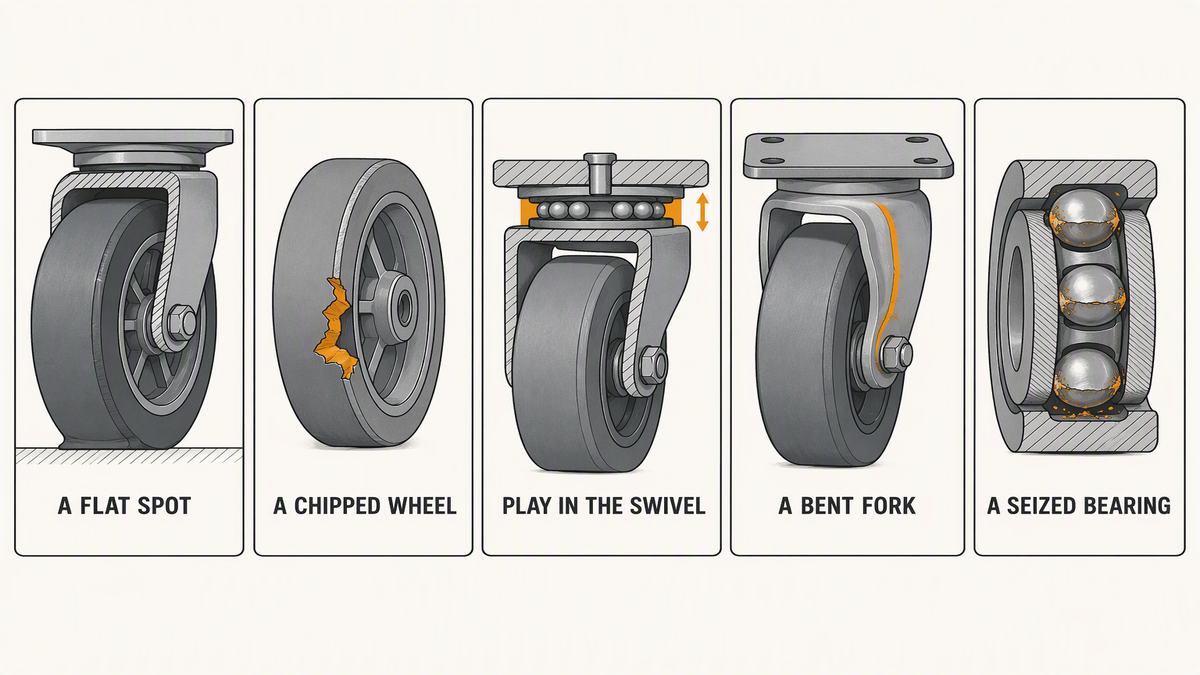
- The tyre wears flat, or chunks away
- A flat spot is a soft tyre skidding or being pushed over debris; a chunk is a hard wheel taking an impact it cannot absorb. Both are floor-and-load mismatches rather than manufacturing faults, and both get worse once the wheel is worn enough to stop rolling smoothly.
- The swivel develops play, or stiffens up
- Raceway wear. It is accelerated by side loads, by running over kerbs and door sills, and by towing above walking pace. Play that appears early usually means the raceway was undersized for the load rather than that the caster was abused.
- The bracket bends
- A side impact — a castor catching a kerb, a doorway, or the corner of a pallet. The bracket is a formed part and it has a limit, so if this keeps happening the answer is a heavier rig or a change in how the equipment is moved, not a different wheel.
- The wheel stops turning freely
- Bearing damage, usually from water or grit getting past the seal, or from a shock load flattening the balls in their track. It shows up as a rumble, then as free play, and then as a wheel that has to be dragged.
- The brake does not hold
- Usually the wrong device rather than a worn one: a wheel brake where a total lock was needed, so the trolley rolls nowhere and swings anyway. Or a lock that nobody applies because it needs two hands.
Frequently Asked Questions
How do I calculate the load capacity I need per caster?
Add the weight of the equipment to the weight of the load, then divide by three on a four-wheel trolley rather than by four, because on any real floor one wheel carries little or nothing. Add an allowance for shock, larger if the trolley is towed or crosses thresholds, and check the speed the application runs at. The figure you end up with is the load per caster, and that is the number to put on the inquiry along with a note saying how many wheels you counted.
What is the difference between a swivel castor and a rigid castor?
A swivel castor turns about a vertical axis so the wheel lines up behind the push, which is what lets a trolley steer. A rigid castor has no such axis and only rolls forwards and backwards. Two swivel and two rigid is the usual layout for a cart pushed straight down an aisle; four swivels suits short wheelbases and tight spaces where the trolley has to spin or move sideways.
Which wheel material is best for my floor?
Work from the floor first, because you cannot change it. A floor you must not mark wants a soft rubber or polyurethane wheel, and accepts the higher rolling effort that comes with it. A floor that can take a hard wheel, such as sealed concrete in a workshop, allows nylon or cast iron and rewards you with easier rolling and higher capacity. Polyurethane on a metal core is the usual middle-ground option for industrial work, with the one warning that its temperature ceiling rules it out of hot processes.
What does the hardness number on a caster wheel actually mean?
It is a control number, not a performance figure. Hardness is measured with a durometer, using one scale for softer materials and another for harder ones, and the standard that defines the method states plainly that no simple relationship exists between the value it gives and any fundamental property of the material, and that the method is intended mainly for control purposes. So use it to confirm a delivery matches your approved sample, and ask for rolling resistance, abrasion and temperature data when you want to predict how a wheel will behave.
What is the difference between a wheel brake, a swivel lock and a total lock?
A wheel brake stops the wheel rolling. A swivel lock stops the fork turning, which is what prevents a parked trolley swinging sideways. A total lock does both with one action. If the requirement is that equipment stays in a fixed position while work is done on it, a total lock is the specification, because a wheel brake alone still allows the castors to swivel and the load to move.
How do I make sure the mounting plate will fit my equipment?
Measure three things and put all three on the order: the outside dimensions of the plate, the centre-to-centre spacing of the bolt holes, and the diameter of the bolt the holes are meant to take. The first two are both called the plate size in conversation, which is how a "100 by 100" plate arrives with the wrong hole spacing, and the third is what decides whether the caster stays put under load or shifts. The standard defines plate classes that fix all three against wheel size, so if your equipment was built to it, the class is the fastest thing to quote.
Send us the load, the floor and the mounting holes
Tell us the total weight including the trolley, how many wheels carry it, whether it is pushed by hand or towed and how fast, what the floor is, and the plate dimensions or bolt-hole spacing you have to bolt onto. If you do not know the bolt spacing, measure hole centre to hole centre and send that. We will come back with the wheel material and hardness, the bearing type, the rig and the plate class in writing before anything is tooled.
Request an Industrial Caster Sourcing Quote
Questions & Comments
We read every one and reply within 24 hoursIf you have a caster on the bench and no drawing for it, measure three things and post them: the outside size of the mounting plate, the centre-to-centre spacing of the bolt holes, and the diameter of the bolt the holes take. If you are comparing quotations instead, say which of the three the supplier quoted and what they said about the bearing and the tyre compound, because those two lines explain most of the price gap before anyone opens a catalogue.