
Conveyor Belt Manufacturer Sourcing Guide: Carcass, Cover Grade and Splice Quality
 ·
Updated October 10, 2026
·
24 min read
A conveyor belt is three decisions, not one: the carcass that carries the tension, the cover that takes the wear, and the splice that joins the two ends. Buyers who send out an enquiry saying "EP belt, 800 mm, 3 ply" get quotations that differ by half, and the difference is always in the cover thickness, the fabric weight and who makes the joint. This guide covers how to read a belt the way a factory reads it, why a rating of EP 630 does not mean the belt will carry 630 newtons per millimetre in service, and how to check whether the supplier in front of you is a belt maker or a company that buys belt and cuts it.
What to Specify, by What the Belt Has to Carry
| If the belt carries | Specify this | Because |
|---|---|---|
| Sand, gravel, grain, packaged goods on a surface line | A fabric carcass and a wear-resistant cover, with the top and bottom cover thickness written in millimetres | On this duty the cover wears out long before the carcass does, so the cover thickness is what you are really buying. A quotation that names only the belt width and the ply count has left the main cost out. |
| Material over a long distance, or up a steep incline | A steel cord carcass, and the drum diameters it needs | Fabric plies stretch under sustained tension over long centres. Steel cord holds the tension, but it needs larger drums and stiffer handling, so the change reaches the whole conveyor and not just the belt. |
| Coal underground | A belt carrying an MSHA approval number, matched to the public approved-belt list | Underground coal belts must be flame resistant and approved, and the approval is tied to batch testing rather than to one certificate. The list of approved belts is public, so this is something you can check rather than trust. |
| Food, pharmaceuticals or anything washed down | A solid woven carcass in PVC or PU, or a belt with a food-grade cover | A cut rubber edge and a fabric-backed carcass hold water and material in the weave. A solid woven belt is one piece, which is why hygienic lines use it. |
| Clinker, coke, sinter or anything hot | A cover rated for the material temperature, with the temperature written as a number in the enquiry | Standard cover rubber hardens and cracks when it runs hot, and the cracking starts under the surface where you cannot see it. Ask for the temperature rating as a figure rather than as a word like "heat resistant". |
| Small parts, or a steep angle where the material slides back | Cleats, sidewalls, or a patterned cover — and the height of the cleat | A flat belt cannot hold a steep angle, and a cleated belt is a different moulding job. The cleat height and the belt width decide whether the material actually stays on the belt. |
1. What Does a Conveyor Belt Manufacturer Actually Build?
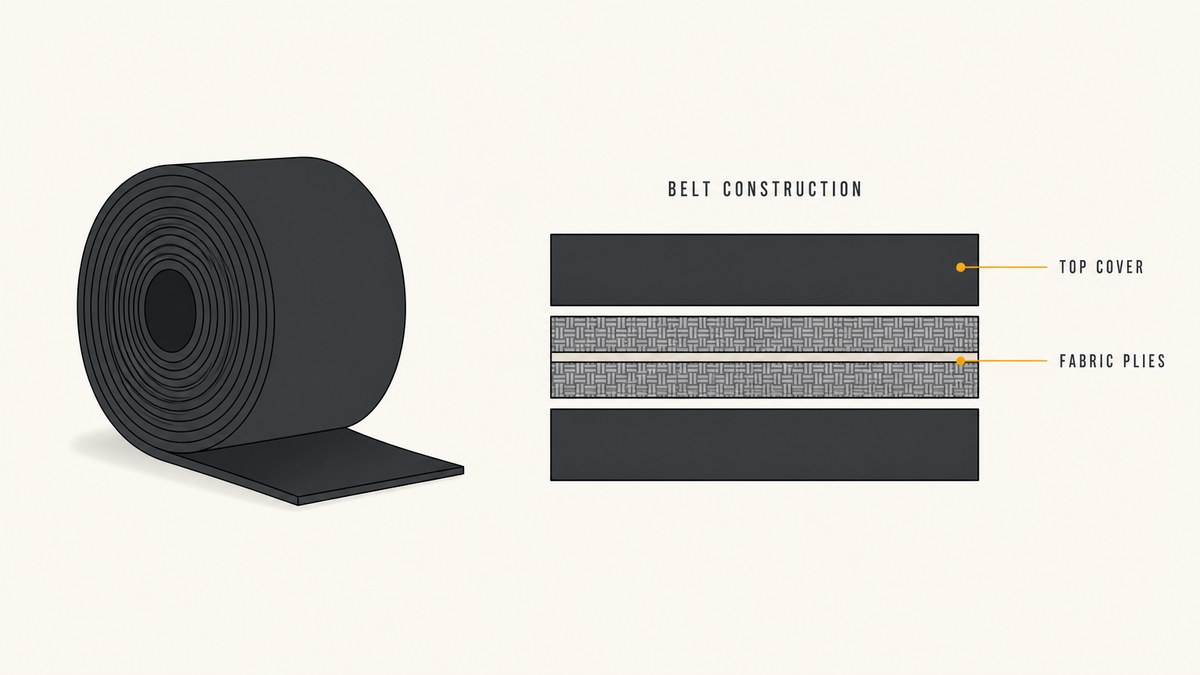
A belt factory builds a sandwich, and only one layer of it is designed to be seen. The carcass carries the load, the cover takes the wear, and two thin bonding layers hold the sandwich together. The bonding layers are the reason two quotations for the same description come back at different prices, because they are the cheapest thing on the belt to thin down and the hardest thing for a buyer to see.
- The carcass
- The load-bearing part, made either from woven fabric plies or from steel cords running lengthwise. Everything about the belt's strength and its stretch lives here. When a supplier says "3 ply", this is what the three refers to — three layers of fabric, each one bonded to the next.
- The skim and the friction coat
- Thin rubber layers between the plies and between the carcass and the cover. They do not carry load and they do not take wear, which is exactly why they get thinned down in a cheap quotation. A belt with weak bonding fails between the layers rather than through them, and that failure looks nothing like wear.
- The cover, top and bottom
- The top cover takes the abrasion and the impact, and the bottom cover runs against the idlers. They are quoted as two thicknesses in millimetres, and a quotation that gives one figure is giving you half of the answer. This is the single largest difference between an expensive belt and a cheap one of the same description.
- The edge
- Either cut from a wide slab or moulded as part of the belt. A moulded edge has a rounded, sealed profile that resists the edge stripping that a cut belt suffers when it mistracks against a structure. For a troughed belt carrying sharp material, the edge type is a specification line, not a detail.
A belt quoted at a given strength per millimetre width does not deliver that strength through the joint that holds it together. A vulcanised joint is a hand-made operation performed either at the factory or on site in whatever weather the site offers, and its strength depends on how the plies were stepped, how the rubber was cured and who did it. The steel cord standard family runs to four parts for exactly this reason: there is a separate part covering the design and dimensions of vulcanised joints, because the joint is its own engineering problem rather than a footnote to the belt. So when you compare quotations, compare the joint as well as the belt. Ask whether the joint is vulcanised or mechanical, who performs it, and whether the factory will send someone or expect your site team to do it. A belt that is perfect and a joint that is improvised is a belt that fails in month four.
2. Which Carcass Do You Need: Fabric, Steel Cord or Solid Woven?
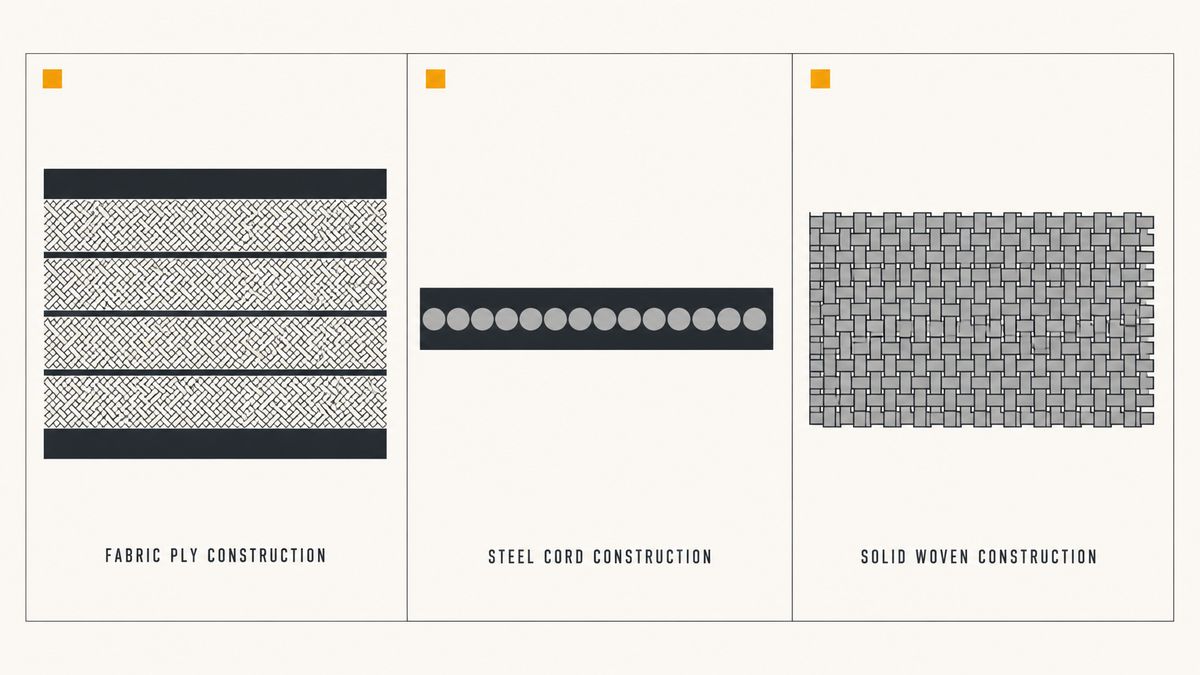
There are three carcass families, and the choice is made by the length of the run and the tension in the belt, not by the material being carried. The material decides the cover; the run and the tension decide the carcass.
| Carcass | What it is | Where it is the right answer |
|---|---|---|
| Fabric plies (EP, NN) | Layers of woven fabric, bonded with rubber and usually stacked two to five plies thick. | The default for most surface conveying: aggregate, sand, grain, boxes, plant waste. It tolerates small drums, it is easy to splice, and it is the cheapest of the three per metre. Its weakness is stretch over long runs, so it is the wrong choice when the centres are long and the belt is permanently under high tension. |
| Steel cord (St) | A single layer of steel cables running the length of the belt, held in rubber. | Long overland runs, high tonnage, deep mines and any duty where the belt tension is high for its whole life. It barely stretches, which is the whole point. It also needs larger drums and it cannot be spliced with a simple mechanical fastener, so it changes the conveyor rather than just the belt. |
| Solid woven (PVC, PVG) | A single woven carcass with the plastic or rubber compound pressed all the way through it, so there is no layer to separate. | Underground coal, and any line where the belt gets wet or washed. Because the compound goes into the weave rather than sitting on top of it, there is no edge for water to enter and no plies to come apart. Underground fire-safety requirements are the reason this family exists at all. |
Inside the fabric family, two short forms come up in every quotation and most buyers read them as interchangeable. They are not. EP means the lengthwise threads are polyester and the crosswise threads are polyamide, which gives a belt that stretches little in the direction of travel and absorbs impact across its width. NN means both directions are polyamide, which stretches more under load. For a conveyor, the lengthwise direction is the one under permanent tension, so EP is the common choice for a general-purpose belt and NN suits duties where impact matters more than stretch.
One practical consequence for the enquiry: state the carcass family, the number of plies for a fabric belt, and the lengthwise strength rating. Those three lines separate a belt that suits your conveyor from one that happens to share its width. The steel cord family carries its own published standard for design, dimensions and mechanical requirements, which is the document a serious mill quotes against.
3. What Do the Cover Grade Letters Actually Mean?
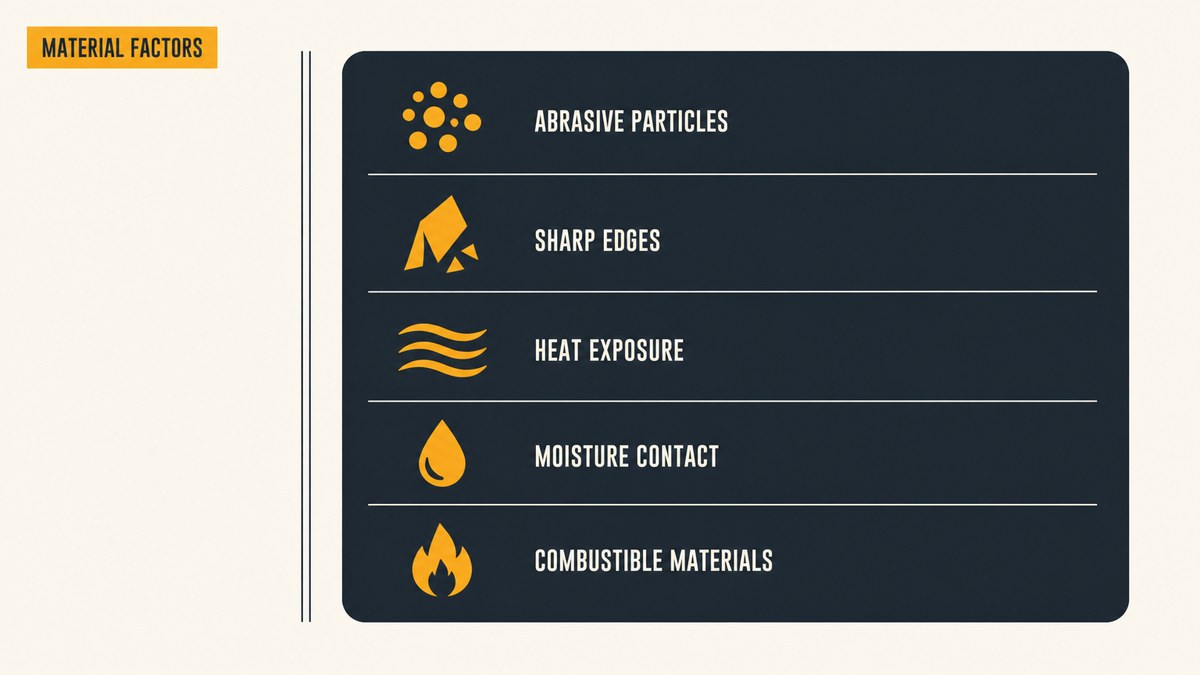
A cover grade letter tells you what the rubber was formulated to resist, and the letter on its own is not enough to buy on. Different belt standards use different letters, and two factories will describe the same duty with different letters, so the reliable move is to name the thing you need the rubber to survive and then ask for the figure that goes with it.
| What the cover has to resist | What to ask the factory for | Why the letter alone is not enough |
|---|---|---|
| Abrasion — sand, gravel, crushed rock, ash | The abrasion loss of the cover compound, as a figure, from a standard abrasion test | The most common duty by far, and the one where two covers both described as "wear resistant" can differ by a large factor. The number tells you how much rubber is lost per unit of wear, which lets you compare compounds instead of adjectives. |
| Cutting and gouging — sharp, heavy, lumpy rock | A cut-resistant compound, and the cover thickness you are willing to pay for | A cut is not gradual like abrasion, so an abrasion figure will not predict it. Once a cut reaches the carcass the belt's life is over, because water gets in and the plies start to separate. |
| Heat — clinker, coke, sinter, hot castings | The maximum material temperature the cover is rated for, as a figure | The failure is invisible from the surface: rubber hardens, then cracks under the surface, and the belt then fails from the inside. "Heat resistant" without a temperature is a word rather than a rating. |
| Moisture and washing — wet process lines, food plants, anything hosed down | A compound suited to wet service, and a belt construction with no open edge for water to enter | Water gets into a cut edge and then into the plies, and a belt that stays wet between shifts loses its bond to the carcass from the inside. On a wet line the belt construction matters as much as the compound. |
| Flame and combustible material — underground work and enclosed plants | A flame-resistant belt, and the test that backs the claim | Flame resistance is the one property here that is regulated rather than negotiated, and for underground coal it comes with an approval and a marking on the belt itself. It belongs in its own section, below. |
Cover thickness is quoted as two figures, top and bottom, and this is where a cheap quotation hides in plain sight. Two offers for what looks like the same belt — same width, same ply count, same strength rating — can carry a top cover of two millimetres on one and four on the other, with the bottom cover varying in the same way. The belt with the thicker cover costs more and lasts longer, and the belt with the thinner cover is not a bad belt so much as a shorter one. Put both thicknesses in the enquiry as numbers, and put them in the order as numbers, because a reorder that quietly comes back with a thinner cover will pass every check except the one that matters.
4. What Belongs in the Specification You Send a Factory?
Most buyers write four lines and then wonder why the quotations cannot be compared. There is a free template for the missing lines, and it comes from an unexpected place: the application form a belt maker has to complete to get a flame-resistant belt approved for underground coal mining. That form is a public document, and the list of what it asks for is the clearest available definition of what actually makes one belt different from another.
| Field | Example of what to write | What it changes |
|---|---|---|
| Belt width | 800 mm, 1,000 mm, 1,200 mm | The base of every other calculation. Price is usually quoted per metre of belt at this width, so a quotation without a width is not a quotation. |
| Carcass family and ply count | EP fabric, 3 ply; or steel cord; or solid woven PVC | Sets the strength, the stretch and the drum diameter the belt needs. This is the line that decides whether the belt suits the conveyor at all. |
| Lengthwise strength rating | EP 400, EP 630, or a steel cord designation | The carcass strength per millimetre of width. Read it as a design input, not as a load, and pair it with the joint you intend to use. |
| Top cover thickness | 4 mm | The wear allowance on the carrying side. This is the single biggest driver of service life on an abrasive duty, and the most common place for a quotation to be quietly reduced. |
| Bottom cover thickness | 2 mm | The wear allowance on the running side. Easy to forget, and it matters on any belt with a long return run or worn idlers. |
| Cover compound type and its designation | An abrasion-resistant compound, with the designation the factory uses for it | Names the rubber rather than describing it. Without this line, a reorder can arrive with a different compound wearing the same belt description. |
| Presence and type of skim coat | State that a skim coat is required, and ask which one | The thin layer between plies. It carries no load and takes no wear, which is why it is the first thing removed when a quotation needs to come down. Asking for it in writing is how it stays in. |
| Presence and type of friction coat | State that a friction coat is required, and ask which one | The layer bonding cover to carcass. Belts fail between layers rather than through them, and this is the line that prevents it. |
| Carcass fabric type and its weight | The fabric type, and its weight in ounces per square yard | The field almost nobody asks for, and the one that separates a belt maker from a company that resells belt. A fabricator cannot tell you the fabric weight of the belt it is cutting, because it did not make it. |
| Edge type | Cut edge or moulded edge | Decides how the belt behaves when it mistracks, and how much edge damage it survives on a troughed line carrying sharp material. |
| Joint method | Vulcanised, mechanical, or supplied in sections with field joints | The joint governs the strength the installed belt actually has. Asking for it in the enquiry means it is priced rather than improvised on site. |
| Roll length and roll weight per metre | 150 m roll, and the belt weight per metre at this width | Two belts of the same description can weigh different amounts because the carcass weight differs. The weight per metre is what your freight is priced on, so get it before you book anything. |
Twelve lines, and most of them take a minute to write. The point of the exercise is not formality: it is that a quotation can only be compared against another quotation if both were asked the same question. The fabric weight and the two cover thicknesses are the three fields that most often separate two prices, and they are the three fields buyers leave out.
5. Where Are Conveyor Belts Made, and Who Is Actually a Factory?
A belt is made in a plant that calenders rubber onto fabric or lays steel cord into a press, and that plant is a heavy, capital-intensive operation. Many of the companies you will meet in an enquiry are not that plant. They are fabricators: legitimate businesses that buy finished belt in wide slabs, cut it to your width, cut the length you need, add cleats or sidewalls, and make the joint. Both kinds of supplier are worth talking to, but they are not the same supplier and they should not be priced as one.
The quick way to tell them apart is the fabric weight question from the last section. A belt maker can state the fabric type and weight of its own carcass, the compound designation it uses, and the batch record for the flame test if the belt is an approved one. A fabricator can state the belt it buys and who makes it — which is a perfectly honest answer, but a different one. If the reply to "what is the carcass fabric weight in ounces per square yard" is a description of the cover, you are talking to a cutting operation rather than a mill.
Two more questions sort the two apart without any technical vocabulary. First, ask what the minimum is for a belt made to your width and ply count rather than cut from stock — a mill quotes in full production runs, a fabricator quotes in metres of what is already on its rack. Second, ask who makes the joint and whether they do it at the factory or send a team to your site. A mill usually has a field-splicing team; a small fabricator usually does not. Our guide to telling a factory from a trading company covers the same distinction for general products, and the logic carries over exactly; the belt version is simply easier, because the fabric weight question is one a reseller cannot answer.
There is a geographic angle worth knowing. Belt manufacturing clusters in China sit near heavy industry rather than near the consumer-goods cities. You will meet belt makers in Shandong, Jiangsu, Zhejiang and Anhui far more often than in Yiwu or Guangzhou, and the companies that appear on international approval lists are concentrated in those provinces. That matters commercially: a supplier in a belt-making province who can name its own mill is a different proposition from a trading office in a consumer-goods market that has to go and find one. Our overview of getting a product manufactured in China walks through how to work backwards from a specification to the right industrial province.
6. How Do You Check a Belt Maker Before You Pay a Deposit?
This is the part of belt sourcing that has an unusually good answer, because a large mining regulator publishes the list. If your belt is going anywhere near underground coal, flame resistance is not a marketing claim — it is an approval, it carries a number, and the list of approved belts is a public document you can open today and search by company name. The rule that creates the approval is 30 CFR Part 14, Requirements for the Approval of Flame-Resistant Conveyor Belts, and reading it takes twenty minutes.
The four checks, in the order they cost you least
| Check | Where it lives | What it proves, and what it does not |
|---|---|---|
| The approved-belt list | The Mine Safety and Health Administration publishes a list of flame-resistant conveyor belts approved under 30 CFR Part 14, updated periodically and searchable by company name. | It proves that a named belt, made by a named company, passed the flame test and holds an approval number. It does not prove the belt you are being sold is that belt, which is why the marking check below matters. Several Chinese belt makers appear on the list, alongside makers from the United States, Europe, India and Korea, so a Chinese supplier holding an approval is not unusual. |
| The marking on the belt itself | Physically, on the belt. The rule requires an approved belt to carry its approval number permanently, at least half an inch high, at intervals of no more than sixty feet and repeated at least once every foot across the width. | It proves that the belt in front of you is the approved article, because you can read the number off the belt and match it to the list entry. This is the closest thing in this industry to a cheque you can cash on the spot: a supplier who claims an approval but cannot show you the marking has not shipped an approved belt. |
| The batch flame-test record | From the factory. The rule requires the approval holder to flame test a sample of each batch, lot or slab of belts, or of the materials that carry the flame resistance. | It proves that the approval is being maintained rather than won once and filed. This is the difference most buyers miss: a certificate is a moment in time, and a batch record is a habit. Ask for the record covering the production window your order falls in, not for the oldest certificate in the folder. |
| The company behind the certificate | The national enterprise credit system, and the certificate registry. For ISO 9001 specifically, our guide to checking an ISO 9001 certificate on the CNCA database shows how to confirm that the certificate belongs to the company billing you. | It proves the legal entity exists, is in the business it claims and holds what it says it holds. It does not tell you the belts are good, but a certificate that belongs to a different company is worth finding out about before the deposit rather than after. Background checks on a Chinese supplier cover the same ground from the other direction. |
One more check belongs here even though it is not about flame resistance: ask for the two cover thicknesses on the belt that is actually shipped, in millimetres, on the packing list. You specified them, so the delivery either matches the order or it does not, and the person reading the packing list at your warehouse can settle it with a gauge. Our pre-shipment inspection guide covers how to write that brief so the inspection reports measurements rather than impressions.
7. Why Do Belts Fail Early, and What Does Each Failure Tell You?
Belts fail in four recognisable ways, and only two of them are the belt's fault. Knowing which is which saves you from changing supplier when the problem was a loading point, and from staying with a supplier when the problem was the compound.
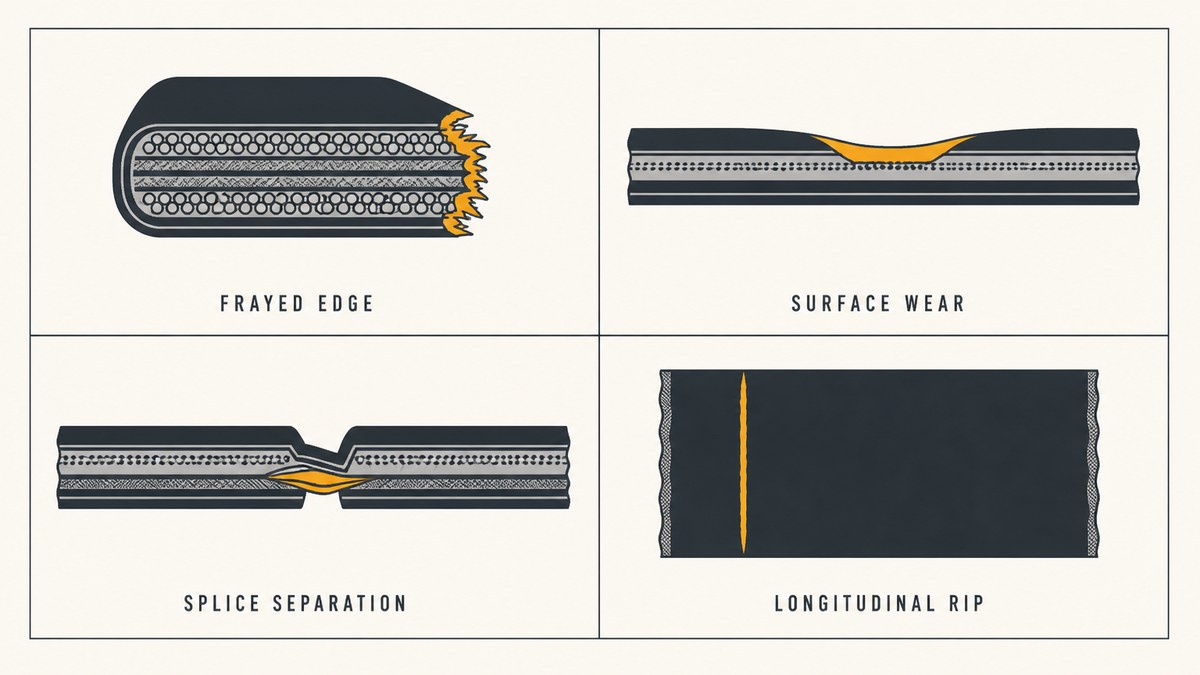
- The edge strips or frays along one side
- Almost always a training problem rather than a belt problem. The belt is running against a structure, and the edge is being machined away a few millimetres at a time. A moulded edge survives this longer than a cut edge, so the edge type is worth specifying — but the fix is at the conveyor, in the alignment of the idlers and the loading point. Changing the belt will buy you time and nothing else.
- The cover wears through in a strip and the carcass appears
- This is the specification being too light for the duty. The material is more abrasive than the compound assumed, or the loading point is dropping it from a height so the impact wears a channel rather than the whole width. The signal to watch is the wear rate: measure the cover thickness when the belt is new and again after a few months, and you will have millimetres of loss per month rather than an argument. That figure is what tells you whether to buy a thicker cover next time or a different compound.
- The joint comes apart
- The joint was made for a lower tension than the belt runs at, or it was vulcanised in conditions the rubber did not want — cold, wet, dusty or rushed. A joint that fails in the first weeks is a workmanship problem; a joint that fails after a year of service is a design problem in the joint, and the two need different conversations with the supplier. This is the failure that most often gets blamed on the belt and almost never is.
- A longitudinal rip runs the length of the belt
- Something sharp is trapped at a transfer point or a skirt, and the belt is being cut as it passes. No belt specification prevents this; a rip-detection system and a cleaner loading point do. If you specify a rip-resistant carcass to solve this problem, you will pay more and still lose the belt.
8. How Do You Ship a Belt Roll, and What Lands It?
A belt travels coiled, and it is heavy for its size. That single fact drives everything about the freight: belts are quoted and shipped by weight, they coil into a compact roll rather than a bulky pallet, and a container of belts will hit its weight limit long before it runs out of space. So the number you need before you book anything is the belt's weight per metre at your width, and it is a figure the factory can state and the packing list can confirm.
| What drives the cost | What it means for your order |
|---|---|
| The belt's own weight | The heaviest single line in the freight bill. Two belts of the same width, ply count and strength can differ in weight because the carcass and the cover thicknesses differ, so the weight per metre belongs in the enquiry next to the price. |
| Roll length limits | Very long belts are made in sections, because a roll has to be coilable, liftable and truckable. That means field joints, which brings the joint quality point back: you are choosing where the weak points will be. |
| Coil diameter and lifting | A coil is awkward rather than large. Confirm the coil weight on the packing list, because a coil nobody at the receiving warehouse can lift with the equipment on site is a problem you discover at the worst moment. |
| Full container or shared | Because belt is dense, the point where a shared container stops making sense arrives earlier than it does for light goods. Our guide to full container versus shared container shipping covers how the crossover is calculated. |
| Duty, clearance and the rest | The unit price is the smallest part of what you actually pay. Our walkthrough of landed cost from unit price to delivery covers the lines that sit between the quotation and the invoice, and belts add their own: heavy, so freight-dominant, and rarely the same commodity code as the machinery they run on. |
One ordering habit is worth building in for a heavy product. Ask for the weight per metre and the coil weight on the quotation, not at the shipping stage. If the supplier has to go and measure a belt to answer, the answer is more reliable than one produced instantly — and if the freight quote later contradicts the figure, you have a documented question to ask before you have paid the balance.
9. A Five-Step Sourcing Roadmap
- Decide the carcass from the run, and the cover from the material. Length and tension give you fabric, steel cord or solid woven; what the belt carries gives you the compound and the two cover thicknesses. Write both down before you contact anyone.
- Send the twelve-field specification, not four lines. Width, carcass and plies, strength rating, top and bottom cover thickness, compound designation, skim coat, friction coat, fabric type and weight, edge type, joint method, and roll length with weight per metre.
- Use the fabric weight question to sort mills from fabricators. A maker states its own carcass fabric weight and compound designation. A cutter cannot, and will tell you who makes the belt instead, which is still a useful answer as long as you price it as one.
- If the belt is for underground work, check the public approval list first. Search the company name, then require the approval marking on the shipped belt and the batch test record for your production window. A certificate is a moment; a batch record is a habit.
- Measure the cover on arrival and again in three months. That gives you a wear rate, which turns the next specification into arithmetic instead of opinion, and tells you in advance whether the next belt should be thicker, a different compound, or the same again.
10. Frequently Asked Questions
What is the difference between EP and NN conveyor belt?
The letters describe the threads in the fabric plies. EP means the lengthwise threads are polyester and the crosswise threads are polyamide; NN means both directions are polyamide. The practical difference is stretch. A conveyor belt is under permanent tension along its length, and polyester stretches much less than polyamide in that direction, so EP is the usual choice for a general-purpose belt. NN stretches more, which is not automatically bad — it absorbs impact better — but on a long run the extra stretch shows up as take-up travel and alignment problems. Neither is a quality grade: they are two constructions for two jobs, and a supplier who cannot tell you which one is in the quotation has left the belt undefined.
Does a higher strength rating mean a stronger belt in service?
Not by itself. The rating — the number in EP 630, for example — is the breaking strength of the carcass per millimetre of belt width, measured in a test on the carcass. It is a design input rather than a working load, and three things sit between it and your tonnage. The design applies a safety factor on top. The joint reduces the strength the installed belt actually has, and on a vulcanised joint that reduction is real and permanent. And a belt whose cover has worn thin is loading a carcass that was never sized for the abrasion it is now taking. So when a supplier offers a higher rating as an upgrade, the more useful question is what the joint achieves, because that is closer to the number you will run at.
How long should a conveyor belt last?
There is no honest fixed number, and a supplier who gives you one without asking about the duty is guessing. What determines it is the cover thickness divided by the wear rate, and the wear rate depends on the material, the drop height at the loading point, the belt speed and the compound. That is why the useful answer is not a lifespan but a rate: ask the factory what abrasion loss figure its compound achieves on a standard abrasion test, and measure millimetres of cover lost per month on your own installation. Once you have both, the belt's life becomes a calculation you can do rather than a claim you have to accept — and you can test a thicker cover or a different compound against a predicted number instead of a feeling.
Can a Chinese factory supply an MSHA-approved belt?
Yes, and you can check it yourself rather than take anyone's word for it. The approved-belt list published by the Mine Safety and Health Administration includes Chinese belt makers alongside makers from the United States, Europe, India, Korea and elsewhere, each with an approval number tied to a named belt. The list is public, updated periodically and searchable by company name. What makes this unusually strong for a buyer is the second half: an approved belt has to carry its approval number permanently on the belt itself, at least half an inch high and repeated at short intervals across the width. So you can read the number off the belt in your warehouse and match it to the list entry. If a supplier claims an approval but the belt carries no marking, the claim and the belt do not agree.
What cover thickness should I order?
Thick enough that the carcass is still protected when the belt is worn, and no more than that, because cover thickness is where most of the price difference between two quotations lives. The reason it is a real decision rather than a preference is that cover is your entire wear allowance on an abrasive duty: the carcass under it does not wear, and the moment the cover is gone the belt's life is over. So the question to answer first is how much rubber you expect to lose per month on that installation, and then how many months you want between replacements. Two quotations that look identical but carry four millimetres and two millimetres of top cover are not the same offer at two prices, and the thinner one is not cheaper so much as shorter.
What is the difference between a belt manufacturer and a belt fabricator?
A manufacturer makes the belt: it calenders rubber onto fabric or lays steel cord into a press, and it can state the fabric type and weight of its own carcass along with the compound designation it uses. A fabricator buys finished belt in wide slabs and turns it into what you need — cut to width, cut to length, cleats and sidewalls added, joint made. Fabricators are legitimate and often the right answer for short pieces or a fast replacement, and they usually work in metres of what is already on the rack rather than in production runs. The way to tell them apart is the fabric weight question: ask what the carcass fabric weighs in ounces per square yard. A mill answers with a number. A fabricator answers with who makes the belt, which is an honest answer and a different one, and it should be priced accordingly.
Get the Carcass, the Cover Thickness and the Joint Specified Before You Order
We write the twelve-field specification so quotations can actually be compared, ask the fabric weight question that separates mills from cutters, check any approval claim against the public list and the marking on the belt, and put the cover thickness and weight per metre on the order so the delivery matches the sample.
Request a Conveyor Belt Sourcing Quote
Questions & Comments
We read every one and reply within 24 hoursBeen quoted three different prices for what looks like the same belt? Paste the belt description your supplier sent and we will tell you which lines are missing from it. If you have already had a joint fail early, tell us how and when it went, because the timing usually says whether it was the joint or the duty.