
How to Get a Product Manufactured in China: Step-by-Step Guide for Brands (2026)
 ·
Updated September 23, 2026
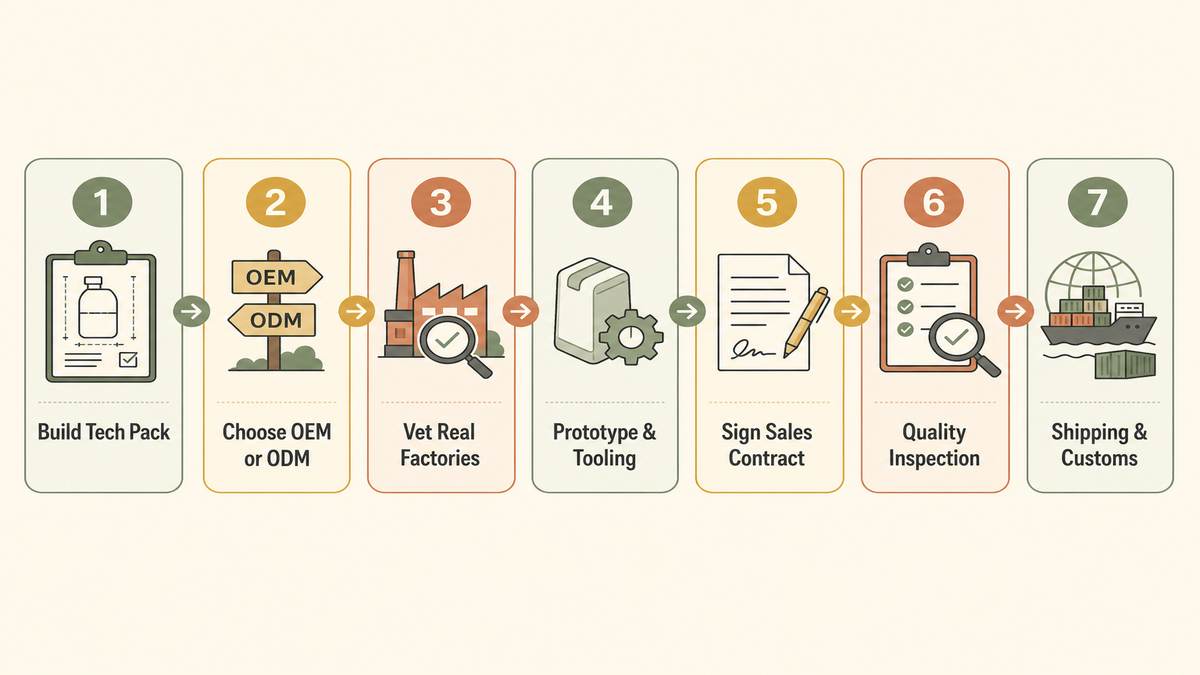
Getting a custom product manufactured in China successfully comes down to seven sequential steps: creating a precise technical specification pack (Tech Pack), choosing between OEM and ODM production models, finding and vetting direct factories, making and refining functional prototypes, signing an enforceable bilingual manufacturing agreement with tooling ownership terms, running on-site quality control during production, and managing container customs shipping.
For entrepreneurs, e-commerce brands, and growing hardware startups, turning a design sketch into thousands of sellable units in China offers massive scale and cost efficiencies. However, many first-time creators rush to contact factories without clear drawings, skip prototype sign-offs, or send full deposits upfront—leading to expensive delays, mold errors, or defective batches. This practical guide covers every stage of the manufacturing journey, provides actionable checklists, and explains how to protect your capital from initial quote to final delivery.
The 7-step China manufacturing roadmap at a glance
Before examining each technical milestone, here is the complete end-to-end production roadmap from raw concept to finished shipping container:
Step 1: Prepare a complete technical specification pack (Tech Pack)
The single biggest mistake new product creators make is sending factories a simple photo or rough 3D mockup and asking, “How much to make this?” Without exact specifications, factories must guess dimensions, resin grades, and tolerances. They will either quote high to cover uncertainty or quote unrealistically low and make poor-quality substitutions later.
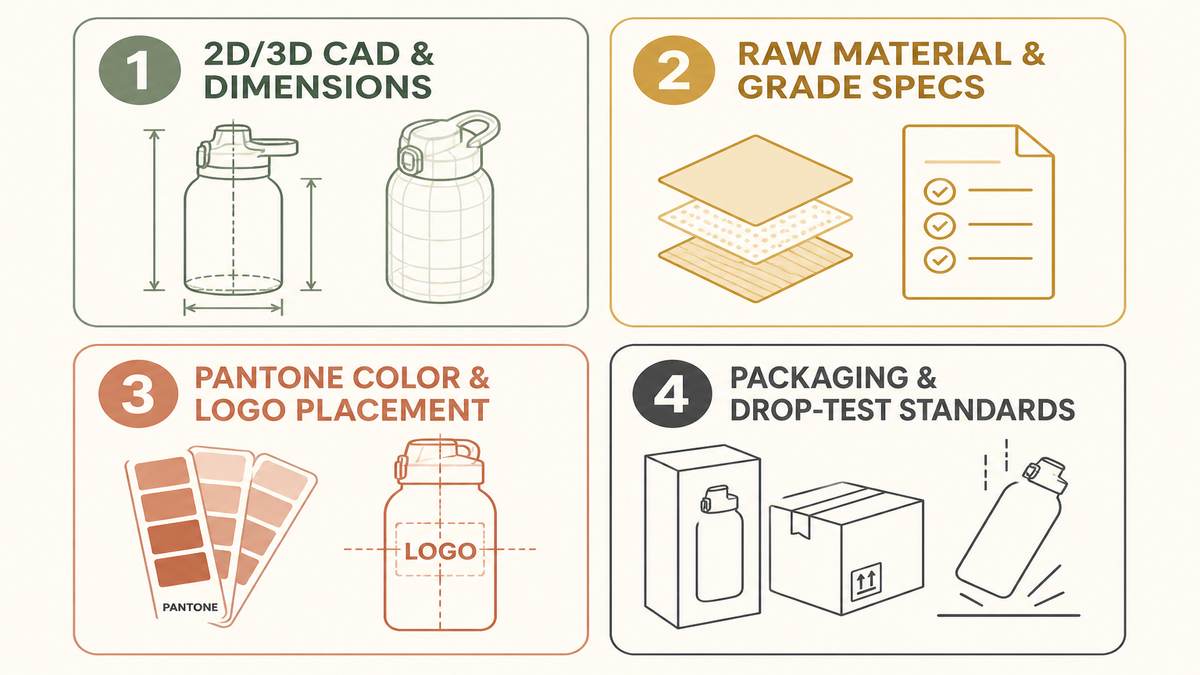
Before approaching any supplier, assemble a formal Tech Pack containing:
- 3D CAD Files: Provide standard
.STEPor.IGESfiles for plastic injection molding, CNC machining, or sheet metal stamping. - 2D Technical Drawings: Include exact millimeter measurements, critical tolerance limits (e.g., ±0.1mm), and cross-section views in PDF format.
- Bill of Materials (BOM): List every component, screw, gasket, electronic chip, and cable, along with specific material grades (such as ABS, Food-Grade 304 Stainless Steel, or Anodized 6061 Aluminum).
- Color & Surface Finishes: Specify exact Pantone (PMS) color codes, texture standards (e.g., SPI mold finishes or sandblast grit sizes), and logo printing methods (laser engraving, silk screen, or debossing).
- Packaging & Barcode Specs: Provide die-cut template files for retail boxes, master carton strength ratings, and barcode label placement rules.
Step 2: Choose your manufacturing model: OEM vs ODM
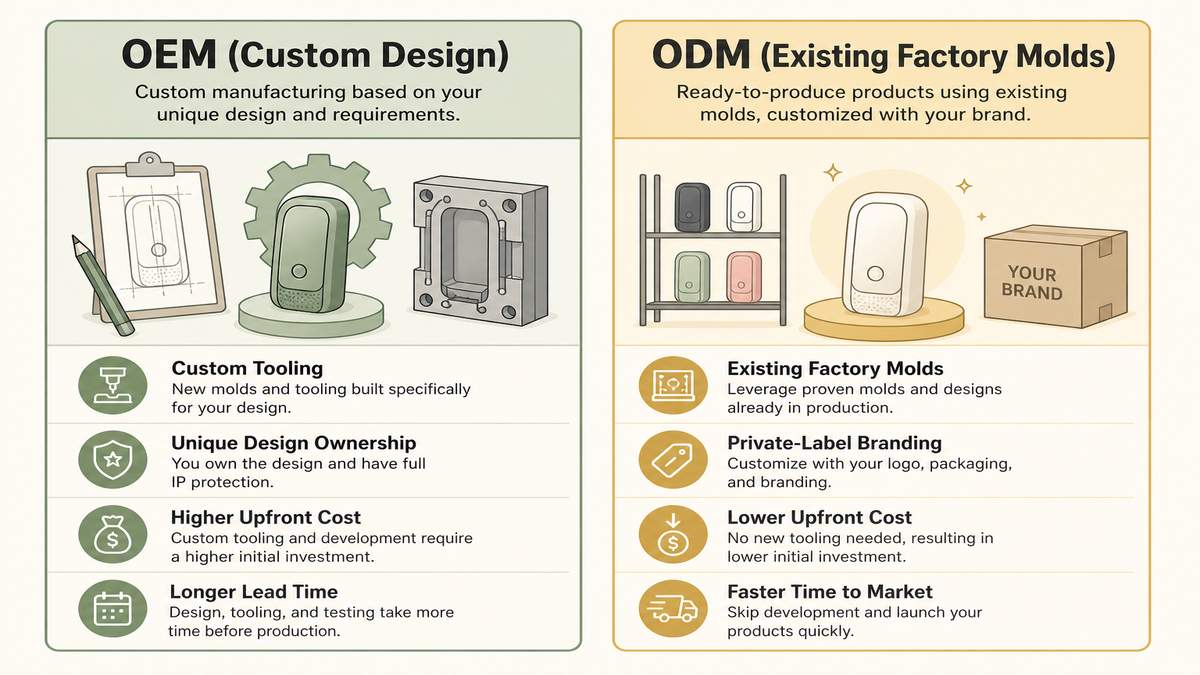
Understanding the difference between OEM (Original Equipment Manufacturing) and ODM (Original Design Manufacturing) dictates your mold costs, development timeline, and intellectual property control:
| Production Model | How It Works | Tooling & Mold Cost | Development Time | Best Fit For |
|---|---|---|---|---|
| OEM (Custom Manufacturing) | You provide proprietary CAD designs; the factory creates custom molds and builds exclusively to your spec. | Higher ($2,000 to $20,000+ for custom injection or die-cast tooling). | 3 to 6+ months (mold design, sampling, refinement). | Unique hardware, patented inventions, and distinct brand designs. |
| ODM (Private Labeling) | Factory owns existing product tooling; you apply your custom logo, colors, packaging, and minor tweaks. | Low to Zero ($0 mold fee; minimal logo plate setup costs). | 3 to 6 weeks. | Amazon FBA sellers, fast-to-market brands, and catalog products. |
If you are building an ODM private-label line with minimal upfront tooling investment, read our detailed tutorial on launching private label products in China.
Step 3: Finding and vetting direct manufacturing partners
China is organized by specialized geographic industrial clusters. Sourcing from the right manufacturing hub gives you lower component costs and faster turnaround times:
- Electronics & Smart Hardware: Shenzhen, Dongguan, and Huizhou (Guangdong Province).
- Plastic Injection & Molds: Ningbo, Taizhou, and Yuyao (Zhejiang Province).
- Hardware & Drinkware: Yongkang and Wuyi (Zhejiang Province).
- Textiles, Blankets & Home Goods: Shaoxing, Yiwu, and Nantong (Jiangsu/Zhejiang).
When searching suppliers on B2B directories, you must separate direct production plants from trading intermediaries. In China, review the company’s official business license via national credit registries. If the registered business scope states “manufacturing and processing” (生产, 加工), they operate real production lines. If it lists only “wholesale, sales, and export” (批发, 销售), they are a trading company. For a complete guide on checking supplier licenses, explore our breakdown on how to tell a direct manufacturer from a trading company.
Step 4: Prototyping, tooling trial runs, and the Golden Sample
Never commit to mass production without testing physical prototypes. Prototyping typically moves through three distinct phases:
- Looks-Like Prototype (3D Print / CNC Foam): Tests ergonomics, visual proportions, and component assembly without expensive steel tooling.
- Works-Like Prototype (Functional CNC / Silicone Mold): Uses real engineering-grade resins or metals to test mechanical load, battery life, button clicks, and heat resistance.
- Pre-Production Tooling Trial (T1 Sample): The first physical unit produced from the real mass-production injection mold or stamping die.
Expect to iterate on the T1 sample. Conduct a structured First Article Inspection (FAI) checking four physical factors:
- Dimensional Accuracy: Measure wall thickness, screw boss diameters, and snap-fit joints against CAD tolerances using pin gauges and digital calipers.
- Visual Surface Defects: Check for sink marks over thick ribs, weld lines near injection gates, flow marks, and burrs along parting lines.
- Material Performance: Test impact drop strength, thermal warping resistance, and snap-latch cycle life under actual operating stress.
- Color & Gloss Consistency: Compare resin pigmentation against the approved physical Pantone chip under standardized D65 daylight lamps.
Once all tooling adjustments are complete, create two identical signed physical units: keep one “Golden Sample” in your office and leave the duplicate with your local quality control team in China to serve as the benchmark for mass production inspection.
Realistic timeline: from CAD files to production delivery
Understanding the standard production timeline helps prevent stockouts and unrealistic sales launch dates. Here is how a typical custom OEM hardware run unfolds over 16 to 20 weeks:
| Production Milestone | Typical Duration | Key Operational Deliverable |
|---|---|---|
| 1. DFM & Mold CAD Review | Weeks 1 – 2 | Design for Manufacturing feedback, gate positions, and draft angle approvals. |
| 2. Steel Mold Machining | Weeks 3 – 6 | CNC milling, EDM spark erosion, and mold core heat treatment. |
| 3. T1 Sample & Tolerance Tuning | Weeks 7 – 9 | First-off plastic/metal shots, dimensional measurement, and color matching. |
| 4. Golden Sample Sign-off | Weeks 10 – 11 | Counter-signed physical sample retained as binding quality standard. |
| 5. Mass Production Run | Weeks 12 – 15 | Raw material feeding, automated assembly, and DUPRO in-line inspection. |
| 6. Final QC & Container Loading | Weeks 16 – 17 | AQL 2.5 Pre-Shipment Inspection (PSI) and customs export clearance. |
Step 5: Negotiating manufacturing contracts, tooling terms, and payment milestones
A handshake or email exchange is not a manufacturing contract. You need an enforceable, bilingual supply agreement that addresses the four major financial pressure points in overseas production:
- Standard 30/70 Payment Milestones: Pay a 30% deposit to start production, and release the remaining 70% balance only after passing pre-shipment quality inspection. Never pay 100% upfront.
- Mold & Tooling Ownership: Explicitly state that all custom injection molds, stamping dies, and printing plates paid for by the buyer remain your exclusive property. The factory cannot use your molds for other customers and must release them upon request.
- Clear Incoterms Delivery Terms: Define whether pricing is EXW (factory gate) or FOB (loaded on cargo vessel). For official global definitions, check the International Chamber of Commerce Incoterms rules.
- Lead Times & Delay Penalties: Define exact production timelines (typically 35 to 50 days) and include reasonable delay penalty clauses (e.g., 1% discount per week of unexcused delay).
If you are working with an on-the-ground agent to manage supplier quotes and mold contracts, review our detailed guide to China sourcing agent fees and quote comparison models.
Step 6: On-site quality control and regulatory safety rules
Quality control must happen while goods are still in the factory, not after containers arrive at your local warehouse thousands of miles away. Professional manufacturing oversight involves two critical checkpoints:
Additionally, make sure your product passes mandatory destination market safety testing, such as consumer safety directives regulated by the U.S. Consumer Product Safety Commission (CPSC). For a full breakdown of inspection tables, read our guide to third-party quality inspection services in China.
Step 7: Packaging, warehousing consolidation, and export logistics
Once your order passes final quality inspection, goods must be properly packaged and shipped. Fragile items require 5-ply double-wall corrugated master cartons, internal foam corner guards, and silica gel desiccant packs to prevent humidity damage during 30-day ocean voyages.
If you are sourcing accessories or packaging from different manufacturers, local warehouse consolidation allows you to combine multiple supplier orders into a single Full Container Load (FCL), cutting total ocean freight and port handling fees by 25% to 35%.
When deciding whether to manage this multi-step manufacturing process directly or partner with local ground specialists, review our objective analysis of the pros and cons of hiring a China sourcing agent.
5 common mistakes to avoid when manufacturing in China
- Rushing Into Mass Production Without a Tech Pack: Vague instructions lead to factory assumptions and ruined sample runs.
- Choosing the Lowest Bidder Blindly: Bids that are 30% below market average usually mean the factory plans to use reground recycled plastic, lower metal grades, or uncalibrated tooling.
- Skipping Mold Ownership Clauses: Without written tooling agreements, factories may hold your custom molds hostage or produce copies for domestic distributors.
- Paying 100% Upfront: You lose all leverage over production timing and defect repairs once full payment is transferred.
- Skipping Independent Quality Inspections: Never rely on factory-sent “self-inspection” photos. Always check finished goods with physical on-site inspections before releasing the final balance.
To understand the full operational scope of having dedicated local representation throughout this journey, read our complete guide on what a sourcing agent does and their core daily responsibilities.
Frequently asked questions about manufacturing in China
How much does it cost to get a product made in China?
Total production costs depend on tooling requirements and order volume. Simple ODM private label runs can start under $3,000 with zero mold fees, while custom OEM hardware requiring injection molds or CNC tooling typically requires $5,000 to $20,000+ for initial tooling and trial batches.
How long does custom product manufacturing take in China?
Standard production timelines range from 30 to 45 days after prototype sign-off. For complex OEM projects requiring custom mold fabrication and T1 sample iterations, budget 3 to 5 months from CAD approval to container departure.
How can I protect my product design and IP in China?
Sign an enforceable bilingual Non-Disclosure, Non-Use, Non-Circumvention (NNN) agreement under Chinese jurisdiction before sharing 3D CAD files, register your trademarks locally in China, and split production of proprietary components across different factories if necessary.
What is the standard payment term for China manufacturing orders?
The standard trade payment term is a 30% deposit to begin mass production, with the remaining 70% balance paid only after passing an independent pre-shipment quality inspection and receiving the official inspection report.
What is the Minimum Order Quantity (MOQ) for custom manufacturing?
Custom OEM orders usually carry MOQs between 1,000 and 3,000 units due to raw material batch minimums and machine setup times. Existing ODM products can often be ordered with lower MOQs of 200 to 500 units.
The bottom line
Manufacturing a product in China does not have to be an overwhelming gamble. When you follow a disciplined, milestone-driven approach—preparing detailed CAD Tech Packs, auditing direct factory capabilities, testing physical Golden Samples, and enforcing strict on-site quality inspections—you can manufacture premium products at competitive global margins.
Treat your manufacturing partners with clear expectations, put all commercial specifications in writing, and build local quality control checks into every production run to scale your brand with confidence.
Questions & Comments
We read every one and reply within 24 hoursAre you developing a custom hardware product or planning an OEM manufacturing order in China? Share your product category or what questions you have about tooling and quality control.