
Plastic Gears Sourcing Guide: Materials, Design, Tooling & Quality Checks
 ·Updated October 8, 2026
·14 min read
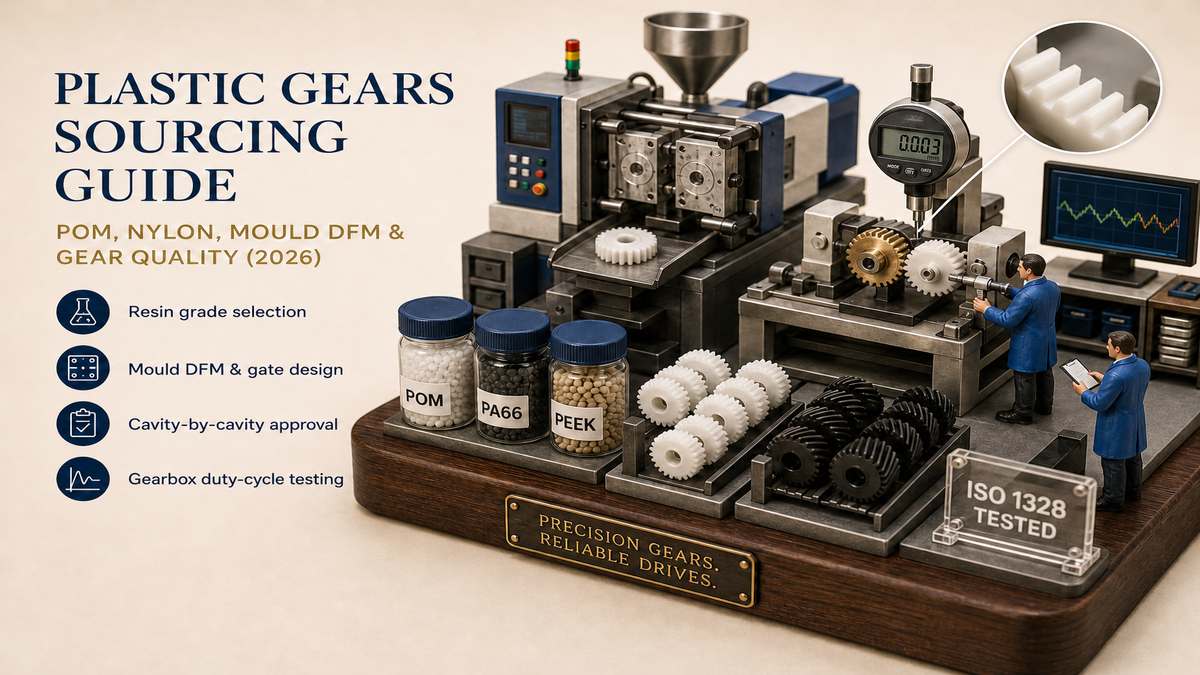
Direct answer: Choose POM for most molded precision gears that must hold their size in damp conditions. Choose nylon when shock absorption, toughness or dry running matters more, but allow for moisture-driven size change. Do not approve production from a resin name alone: lock the gear geometry, resin grade, moulding conditions, mating gear, lubricant and test method on the same drawing.
Quick Buying Rules
- POM is the usual starting point for molded gears because it absorbs little moisture and holds dimensions well.
- Nylon is useful for tough, quiet mechanisms, but the drawing must allow for size change caused by moisture.
- A good gear sample is not enough. Approve a matched gear pair inside the real housing, motor and lubricant system.
- Inspect each mould cavity separately. One cavity can make good parts while another makes gears with runout, flash or a poor bore fit.
1. What Makes a Plastic Gear Different from an Ordinary Molded Part?
A cosmetic housing can look good even when one wall is slightly thick or one corner cools slowly. A gear cannot hide those differences. Its teeth must share the load evenly while the centre bore, outside diameter and tooth flanks rotate around the same axis. A small change at the bore or one tooth can become noise, heat, wear or motor current once the gear is installed.
Plastic gears still offer strong reasons to replace metal. They are light, quiet, resistant to rust and able to damp vibration. Some grades need little lubricant. The trade-off is that plastics change more with temperature, moisture and time than metal, so the design and inspection plan must be built around the chosen polymer.
The useful starting point from the original competitor reference is simple: Sofeast’s plastic gear material guide treats nylon as a common choice for machined gears and acetal as a common choice for molded gears. That is a starting rule, not a final answer. Load, speed, housing temperature, water exposure, lubricant and annual volume can all change the choice.
2. Which Plastic Should You Choose for the Gear?
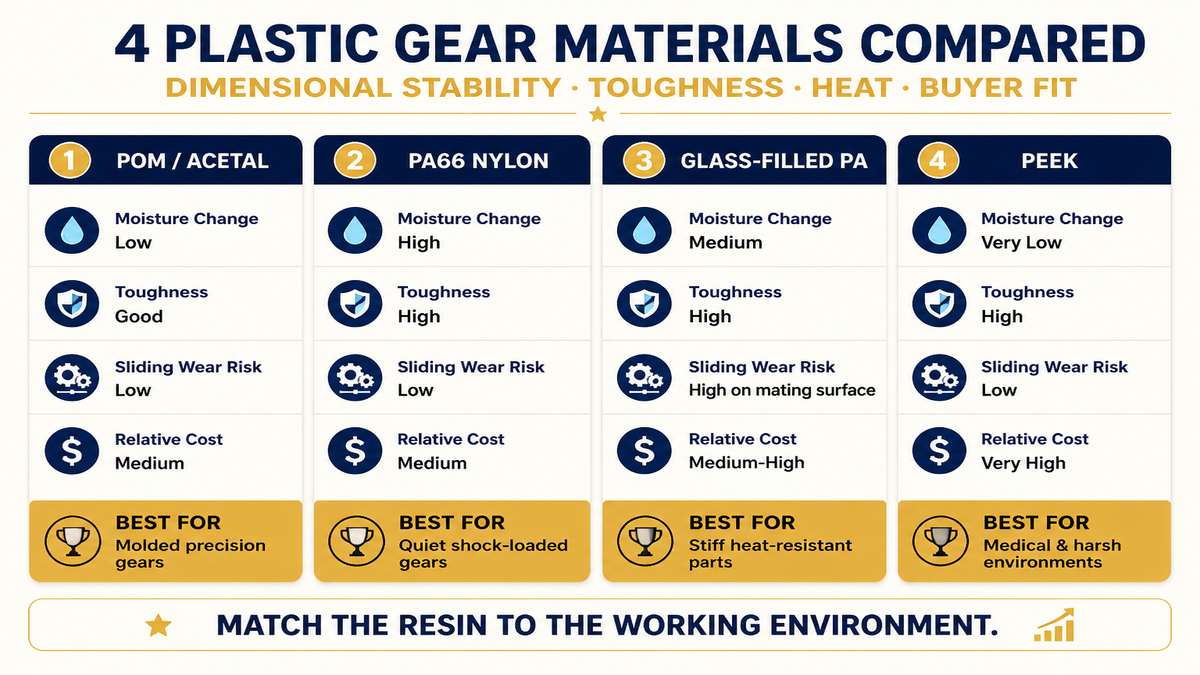
| Material | Main Strength | Main Risk | Good Starting Use |
|---|---|---|---|
| POM / Acetal | Low moisture uptake, good stiffness, clean molded detail | Needs a well-designed tooth pair and suitable lubricant for long life | Enclosed molded gearboxes, printers, locks and appliances |
| PA6 / PA66 Nylon | Tough, shock absorbing, quiet and wear resistant | Absorbs moisture, so size and stiffness can change | Larger gears, impact loads and mechanisms where noise matters |
| Glass-filled Nylon | Higher stiffness and heat resistance | Glass fibres may wear the mating surface | Static load parts where sliding wear is controlled |
| PEEK | High heat and chemical resistance | Very high resin and processing cost | Medical, aerospace and harsh industrial systems |
| PC or ABS | Easy colour or clear appearance | Not the first choice for continuous tooth wear | Light-load indicators and short-life mechanisms |
POM: the common choice for molded precision gears
POM is stiff, machines and molds cleanly, and takes on little water. Ensinger describes POM acetal as a low-water-absorption engineering plastic that supports precise machining and tight tolerances. That helps a molded gear keep its bore and tooth shape when the product moves between dry and damp places.
Low moisture uptake does not mean “no engineering needed.” A POM gear can still wear, heat up or make noise if the mating material, tooth load, shaft alignment or grease is wrong. Ask the factory to test the complete gearbox rather than a loose gear spun by hand.
Nylon: tough and quiet, but sensitive to water
Nylon can absorb shock and run quietly. It is often a good choice for larger gears or mechanisms that see impact loads. PA66 also offers useful wear resistance and low friction, as shown in Ensinger’s PA66 material description.
The buying risk is moisture. A nylon gear measured in a dry factory may be larger or softer after it spends time in a damp climate. Do not copy a POM drawing and merely change the resin name. Your engineer must review backlash, bore fit, centre distance and the conditioning state used for inspection.
Filled grades: stronger is not always safer
Glass fibre can make a polymer stiffer, but it can also turn one gear into an abrasive partner. Ensinger warns that glass fibres may have a marked abrasive effect on mating surfaces. If a supplier suggests a glass-filled grade, ask which gear it will run against and request a wear test with the real lubricant.
3. Which Gear Type Fits Your Mechanism?

Spur gears
Straight teeth make spur gears simple to model, tool and inspect. They are the normal starting point for low-cost appliances, toys and small actuators. Their weakness is noise at high speed because the full tooth width engages quickly.
Helical gears
Angled teeth enter contact more gradually, so a helical pair can run more smoothly. The angle also creates axial force along the shaft. That force must be carried by the housing and bearings, so a quieter gear can create a new housing problem if the design team ignores thrust.
Worm gears
A worm set can create a large speed reduction in a small space. Heat and sliding wear matter more than with a simple rolling gear pair. Material pairing and lubrication must be tested together. Do not approve the worm wheel from a dimensional report alone.
Planetary gearboxes
A planetary system packs several load paths into a compact housing. It can deliver high torque density, but the sun gear, planet gears, ring gear, pins and carrier all have to share the load. One off-centre pin or one poor cavity can make the gearbox noisy even when every loose gear looks acceptable.
4. What Must Be on the Drawing Before You Ask for a Quote?
A supplier cannot quote a reliable plastic gear from diameter and tooth count alone. Before sending an RFQ, provide a 2D drawing and a 3D model. Put the resin grade, colour, mating gear and working environment in writing.
For a custom mold, lock the steel, cavity count, tool life, maintenance duty and ownership terms before paying the deposit. The site’s guide to plastic injection mold costs and steel choices explains why two moulds that look similar on a quotation can have very different life and repair cost.
5. How Does Molding Change the Gear?
Shrinkage is a process setting, not one magic number
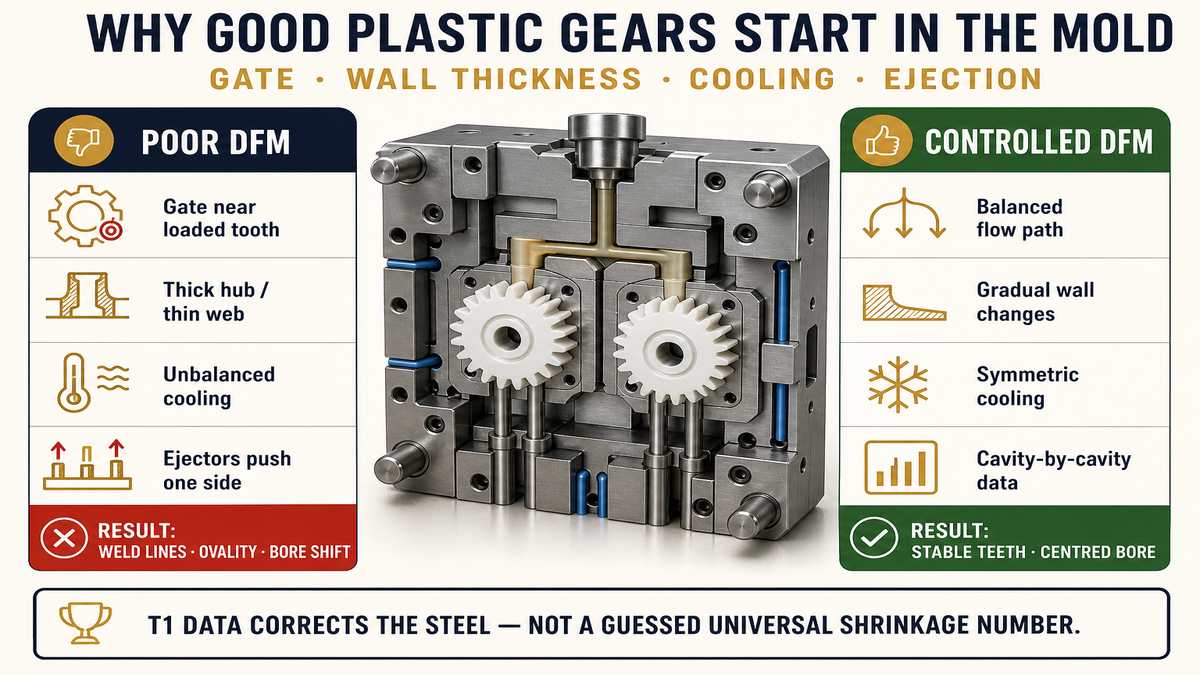
Polymer shrinkage depends on grade, filler, melt temperature, mold temperature, pressure, hold time and the direction of flow. A supplier who gives one shrinkage number without discussing these conditions is oversimplifying the job. The right path is to make the cavity from the resin supplier’s range, run T1 samples, measure them after a fixed conditioning period and correct the steel from real data.
Gate location can create weak or uneven teeth
The melt should fill the cavity in a balanced way. A poor gate can put a weld line at a loaded tooth or pull the part off-centre. Ask for a filling study or at least a DFM view that marks the gate, weld lines, venting and ejection points before steel is cut.
Thick hubs and thin webs cool at different speeds
A large solid hub next to a thin gear web can cause sink, ovality and bore movement. Core out unnecessary mass, keep wall changes gradual and review the ejection force around the hub. A gear that looks round on the outside can still have its bore shifted from the tooth centre.
Approve every cavity separately
A four-cavity mold makes four slightly different production streams. Mark cavity numbers on samples, record inspection data by cavity and keep the first approved parts as golden samples. The site’s first article inspection process is the right point to lock each cavity before mass production.
6. How Should a Buyer Inspect Plastic Gears?
Start with the bore, face and basic dimensions
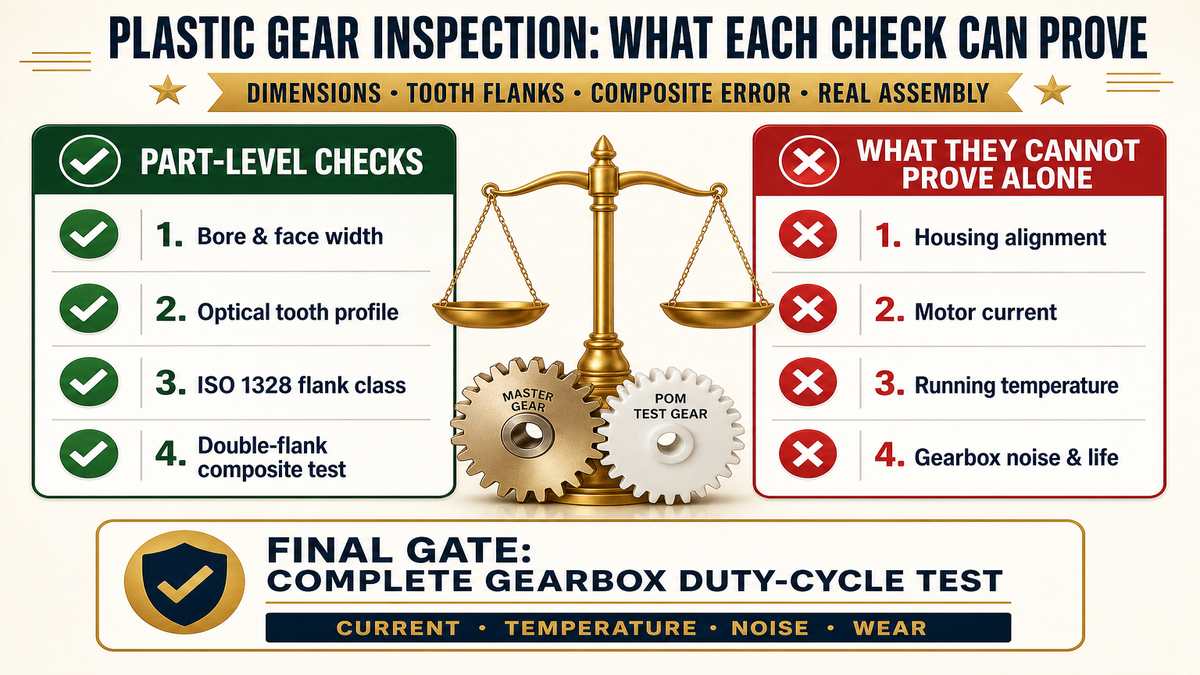
Check the bore with a plug gauge or suitable measuring tool, then check face width and outside diameter. These are fast controls, but they do not prove that the tooth profile is correct or that the gear will run quietly.
Check tooth flanks against an agreed system
ISO 1328-1:2013 provides a tolerance classification system for the tooth flanks of individual cylindrical involute gears. It applies to each gear taken on its own, not to a complete gear pair. That limit matters: an accurate loose gear can still run badly in a weak or misaligned housing.
Use double-flank testing for radial composite behaviour
ISO 1328-2:2020 covers double-flank radial composite deviations for individual cylindrical involute gears. In plain language, a master gear rolls against the production gear and the tester records changes in centre distance. This catches combined problems such as runout, tooth-to-tooth variation and shape error.
Finish with the complete gearbox
Measure motor current, temperature and noise through the full duty cycle. Test at the lowest and highest working temperature and, for nylon, after the conditioning state expected in use. Add a stall or overload check only when the product design calls for it; do not invent a universal load multiplier.
7. Factory Audit: What Equipment Should Be on Site?
A general molding factory may own good presses and still lack gear design or inspection knowledge. During an on-site factory audit, check the actual machines used for your part, not a showroom list.
- A controlled resin drying and handling area with batch records.
- Toolroom access to EDM, wire cutting, grinding and cavity repair.
- An optical projector or gear measuring equipment for tooth checks.
- A double-flank roll tester with the correct master gear for your part.
- Plug gauges, force gauges and fixtures matched to the drawing datums.
- A gearbox endurance rig that records current, temperature and noise.
- Cavity traceability from molding machine to inspection report.
Ask the engineer to show one recent gear report and explain a failed measurement. A factory that understands gears can explain the fault and the process change. A factory that only understands generic molding will repeat the sales brochure.
8. Common Failure Modes and What They Usually Mean
| What You See or Hear | Likely Areas to Check | Next Action |
|---|---|---|
| One click per revolution | Single tooth damage, gate vestige, cavity dirt or local pitch error | Mark the gear position, inspect the same tooth and compare by cavity |
| Steady high-pitch whine | Tooth contact, centre distance, alignment or surface finish | Run contact pattern and housing alignment checks |
| Gear jams after humid storage | Nylon conditioning, backlash, bore fit or housing movement | Condition parts, remeasure and repeat the real assembly test |
| Tooth root breaks | Overload, weld line, sharp root, weak resin or poor fibre direction | Review the load case, gate, root shape and raw material record |
| Fast grey wear dust | Material pairing, abrasive filler, lubrication or contamination | Inspect both mating surfaces and run a controlled wear trial |
| Loose shaft fit | Bore shrinkage, insert position, creep or wrong conditioning state | Measure bore by cavity and after the required conditioning time |
9. Five-Step Sourcing Process
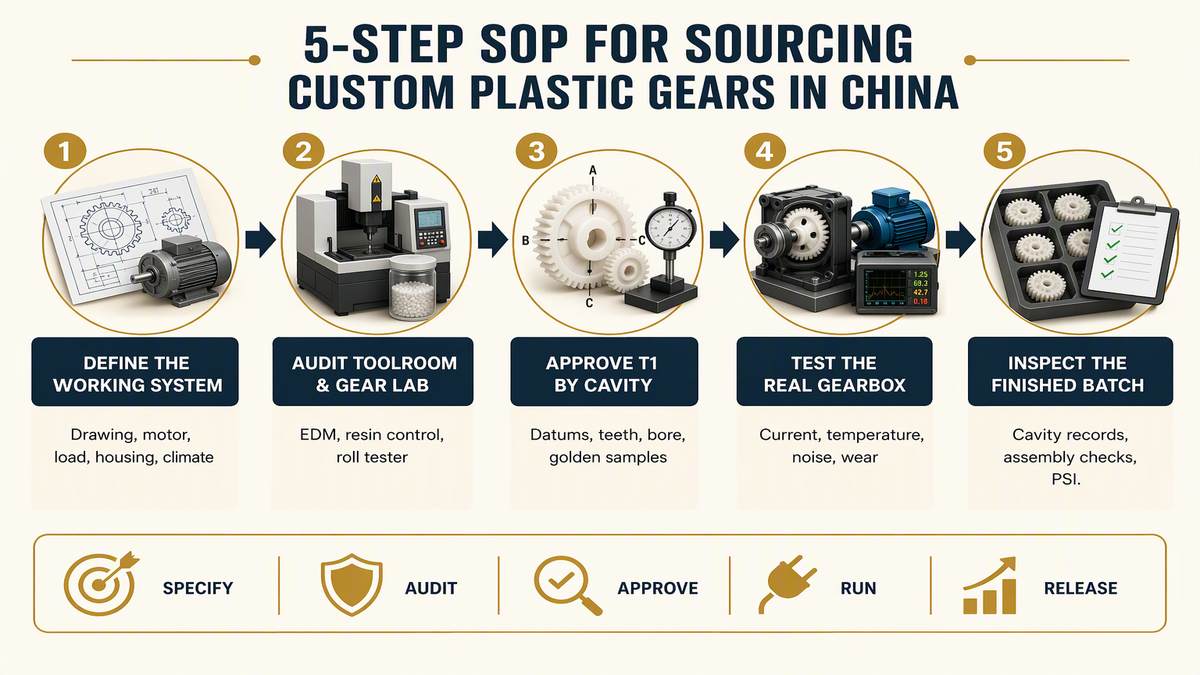
- Define the working system. Send the gear drawing together with motor speed, torque, duty cycle, housing, mating gear, temperature, moisture and lubricant.
- Audit the toolroom and gear lab. Check the equipment and the people who will make and inspect your part.
- Approve T1 parts by cavity. Measure the datums and teeth, then keep signed golden samples from every cavity.
- Run the real assembly. Record noise, current, temperature and wear through the duty cycle and environmental conditions.
- Inspect the finished batch. Use the approved samples and cavity records during the pre-shipment inspection before releasing the balance.
10. Frequently Asked Questions
Is POM always better than nylon for plastic gears?
No. POM is often easier to hold dimensionally in wet conditions, while nylon can be tougher and quieter under shock. The better choice depends on load, temperature, moisture, lubricant, manufacturing method and the mating part.
Can a factory inspect plastic gears with only calipers?
No. Calipers can check a few basic dimensions but cannot show the full tooth flank shape or combined radial error. A serious plan also uses suitable gauges, optical or gear measurement, double-flank testing where needed, and a complete gearbox run.
Should each mould cavity have its own inspection report?
Yes for critical dimensions and gear performance. Cavity-specific records help you find whether a problem comes from one cavity, the molding process or the whole tool.
Do plastic gears need lubricant?
Some mechanisms can run with little lubricant, but many POM gearboxes last longer and run quieter with a suitable grease. Check resin and grease compatibility, then test the complete gear pair at working temperature.
Check the Resin, Tooling and Gear Test Plan Before You Pay
We review drawings, audit the moulding factory, track each cavity, inspect T1 parts and test the assembled gearbox before bulk production starts.
Request a Plastic Gear Sourcing Review
Questions & Comments
We read every one and reply within 24 hoursNot sure whether your gear should be POM or nylon, or whether the factory’s inspection plan is enough? Post the gear type, resin, duty cycle and test question below.