
Hydraulic Fittings Sourcing Guide: Types, Flare Angles and Hose Assemblies
 ·
Updated October 10, 2026
·
25 min read
Two hydraulic fittings can share the same thread, the same hex, the same finish and the same part number format, and still not seal against each other. That is because a hydraulic fitting is defined by how it seals rather than by the thread it carries — and the two most common families, the 37° flare and the 45° flare, look almost identical on a bench. This guide covers the families and what each one seals on, why a hose assembly is rated at the lower of two numbers rather than the hose's own figure, what has to be written down for a crimped assembly, and where a cheap hydraulic quote is quietly reduced.
What to Specify, by Where the Joint Sits
| If the joint is | Specify this | Because |
|---|---|---|
| Replacing a fitting on a machine you already own | The fitting family and the flare angle, measured or sampled — never matched by photo | This is where almost every hydraulic fitting return happens. A 37° flare and a 45° flare are close enough to look right and different enough to leak, and no photograph shows the difference. |
| On the end of a flexible hose, assembled somewhere | The assembly rating, the crimp or swage specification, and who measures the result | A hose assembly is not a hose plus a fitting; it is one rated item. The rating is decided by the weaker of its two halves, and the crimp is the operation most often done without a measurement. |
| In a port on a manifold, pump or valve body | The port standard the machine was built to, and the stud end series that matches it | Ports come in straight-thread O-ring boss form and in face-seal form among others, and a port with the right thread can still be the wrong depth and the wrong sealing face. |
| Exposed to weather, wash-down or a corrosive process | The body material, and whether the mating half is the same material | Stainless solves corrosion and creates a second problem, because stainless threads can seize against stainless. Material is a decision about both halves of the joint, not one. |
| On equipment that moves, vibrates or cycles constantly | The seal type, the retention method, and a stated impulse or cycling test | Vibration loosens what pressure alone would hold. Fatigue is what retires a hose assembly in service, and it is a test rather than an opinion. |
| Part of a machine being built in volume | A single named standard for the whole machine, repeated on every drawing | Mixed families on one machine are how a maintenance team ends up with five fitting types on a shelf and the wrong one in hand. Standardising is a design decision that saves money for a decade. |
1. What Are the Fitting Families, and What Does Each One Seal On?
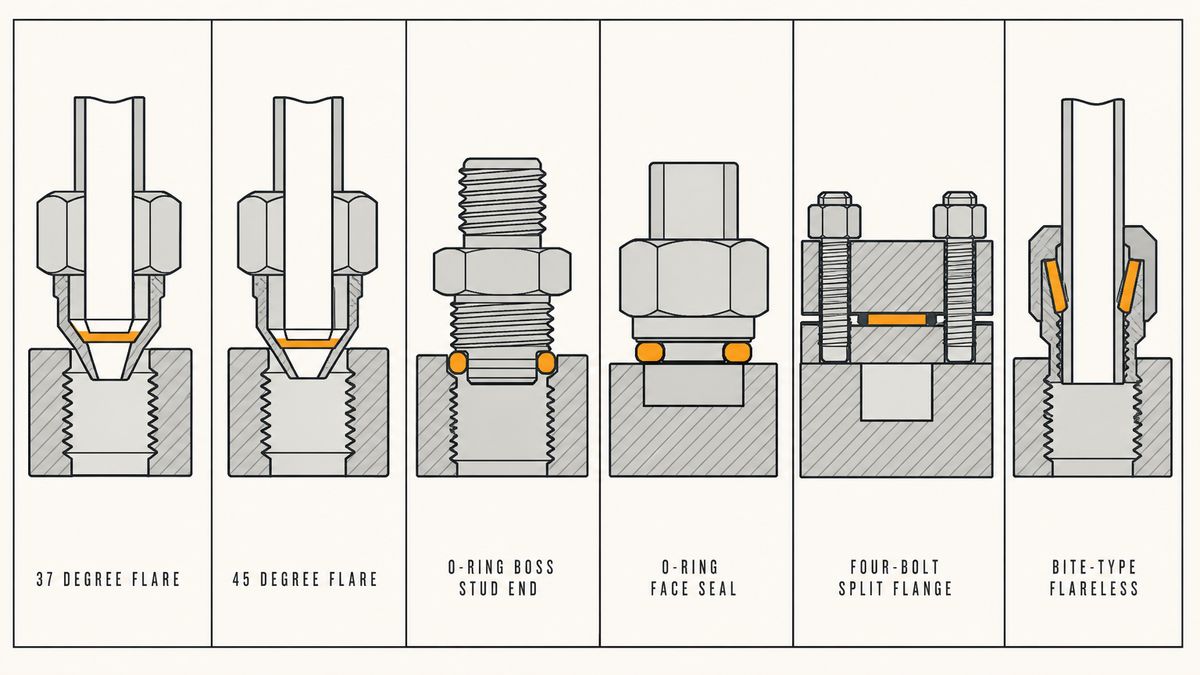
A hydraulic fitting seals in one of a small number of ways, and the family name tells you which. The thread is only the mechanism that holds the two halves together under pressure; the seal is what actually stops the oil. This is why two fittings with identical threads can be completely incompatible, and why a quotation that names only the thread has specified almost nothing.
| Family | How it seals | Where it belongs |
|---|---|---|
| 37° flare | A metal-to-metal cone seat: the flared tube end is pressed onto a matching cone and deforms slightly to seal. | The workhorse of mobile machinery and the most widely used family in the world. It needs no separate soft part, which makes it tolerant of heat, and it tolerates being re-made. Its weakness is that the seal depends on both cones being undamaged and on the flare being made to the right angle. |
| 45° flare | The same metal-to-metal cone principle, cut at a shallower angle. | Mainly encountered on older and lighter equipment and on specific regional designs. It is the family that most often gets mistaken for a 37° flare, because the two look the same until they are mated. |
| O-ring boss | A straight thread plus an O-ring trapped in a groove at the base of the stud end, sealing against the spot face of the port. | Ports on pumps, valves and manifolds. Because the thread is straight and the seal is an O-ring, it does not rely on the threads at all, which is why it copes with repeated assembly better than a tapered thread. |
| O-ring face seal | An O-ring in a groove on a flat face, compressed against a flat port or adapter face by a nut. | Higher-pressure and higher-vibration applications, and equipment where a leak is unacceptable. It is the family that answers the two weaknesses of a flare: no cone to damage and no metal-to-metal seating to be remade. |
| Four-bolt split flange | A flat flange face with an O-ring, held by four bolts. | Large sizes and high flows, where a threaded connection would need an impractical wall thickness. It removes the thread from the sealing path entirely. |
| Bite-type flareless | A ferrule bites into the tube as the nut is tightened, sealing on the tube surface. | Metal tube runs rather than hose. It holds well and it is unforgiving: the ferrule seats once, and the tube is effectively marked by it. |
2. Why Do 37° and 45° Flare Fittings Not Interchange?
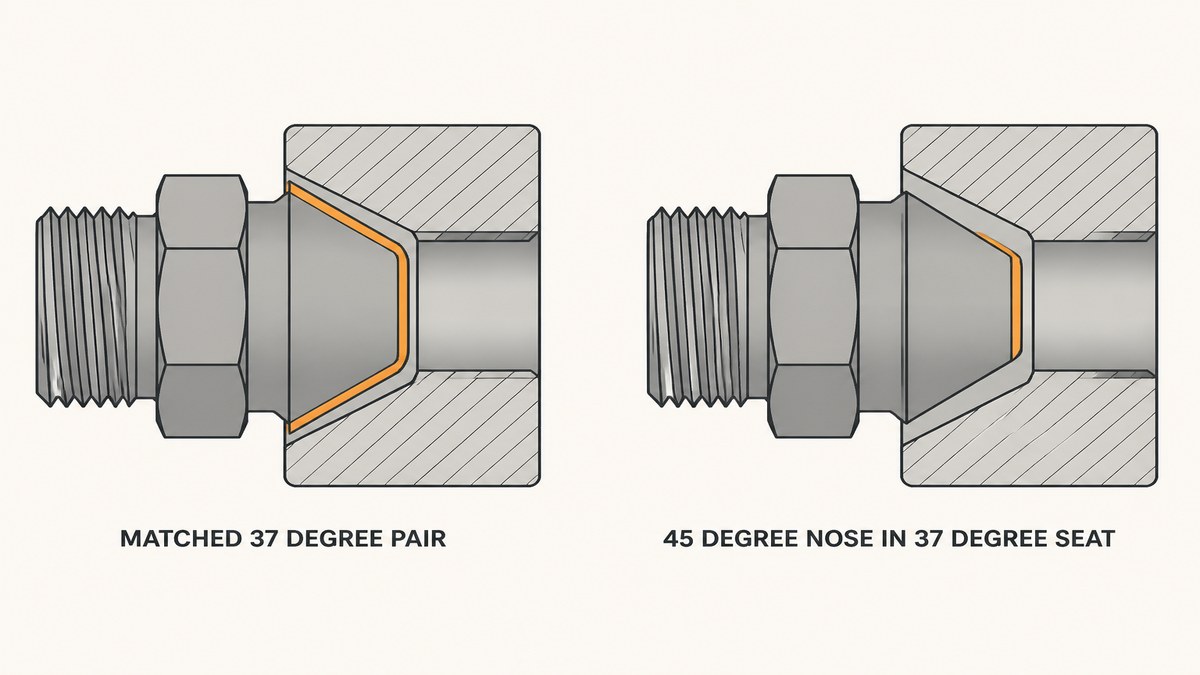
Because the sealing happens on a ground cone, and the cone angle is the specification. A 45° fitting started onto a 37° flare will thread on and tighten, and it will contact on a narrow band near the tip instead of across the whole face. It holds at low pressure, weeps as the machine warms up, and then leaks properly once the machine is working — which is why this failure is so often reported as intermittent and so rarely traced to the angle.
| How to tell them apart | What you get from it |
|---|---|
| Measure the seat angle with a flare gauge, or compare against a known fitting | A definite answer in seconds. If you are replacing fittings across a machine you do not have drawings for, this is the only reliable route, and a gauge costs less than one wrong shipment. |
| Match the marking and the part number, not the appearance | The reliable long-term answer. Once you know what the machine uses, put the family and the angle on every drawing and every reorder, and the question stops coming up. |
| Send a physical sample to the supplier | Removes the argument entirely. On low-value parts a sample is the cheapest piece of specification you can send, and a factory quoting from a sample is far more accurate than one quoting from a description. |
| Ask the supplier which standard each half is made to | Useful, and not enough on its own. A supplier can be entirely honest about the standard it works to and still ship you a 45° fitting into a machine built to 37°, because the enquiry did not say which the machine uses. |
The single most effective thing a maintenance or sourcing team can do in this category costs almost nothing. Take one of every fitting type on your machines, thread them onto a labelled board or into a labelled box with the family, the angle or seal type, and the thread written beside each one, and photograph the board. That photograph, plus the box, becomes the specification for every future order and the training material for every new maintenance hire. Without it, every order is a guess made by whoever happens to be holding the part, and the failure you get is an intermittent weep that takes a shift to find. With it, the enquiry is a part number and the argument is over. It also solves the reverse problem: when a supplier offers a cheaper alternative family, you can see immediately whether it mates with what you already have.
3. Why Is a Hose Assembly Rated at the Lower of Two Numbers?
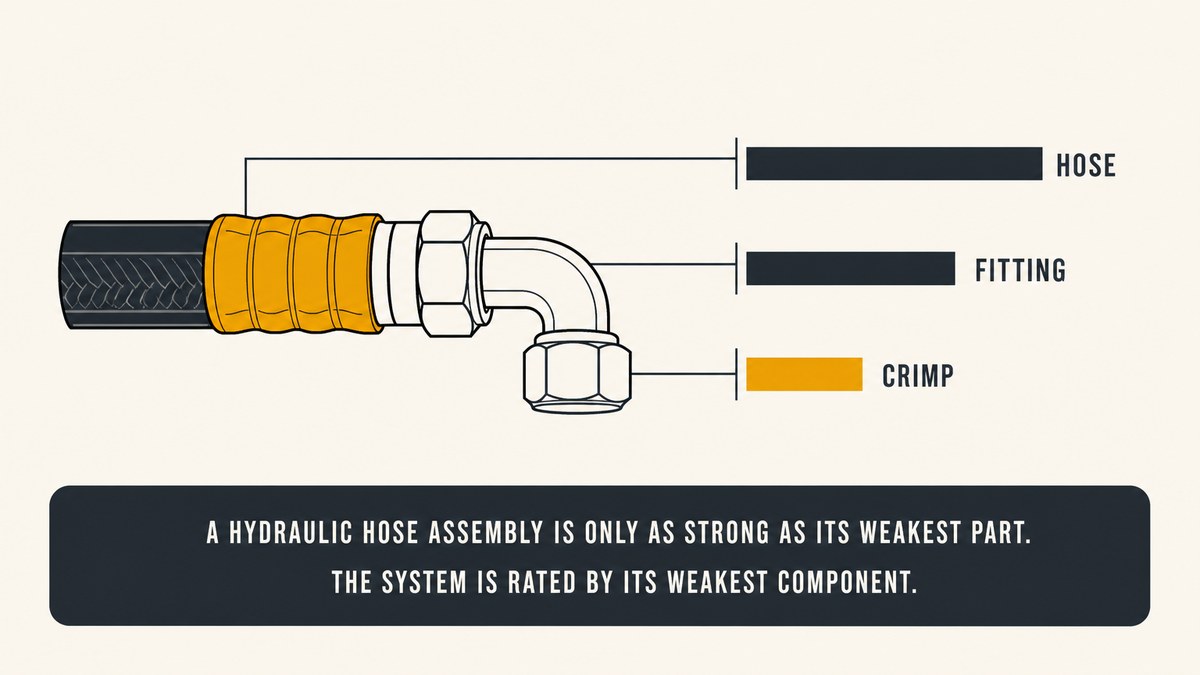
Because a hose assembly is one item with two halves, and the weaker half decides what the whole thing can carry. A four-wire spiral hose rated for the highest pressures in this category, fitted with a standard two-piece fitting that is not rated to the same figure, produces an assembly that is rated at the fitting's number. The hose did not become weaker. The system did, and the label on the hose no longer describes what is on the machine.
| Where the ceiling actually comes from | What it means for your order |
|---|---|
| The hose's own rating | The number usually quoted, and the one printed on the hose. It applies to the hose as a length of tube, before anything is attached to either end. |
| The rating of the fitting paired with it | The number almost never quoted, and the one the standard says to compare against the hose. Ask for the fitting's rating as a figure, in the same units, on the same quotation. |
| The strength of the crimp or swage that joins them | The number that is not on any datasheet at all, because it depends on the machine and the die used. This is why the assembly rating is established by testing the assembly rather than by reading two catalogues. |
The practical consequence is a line on the enquiry that most buyers never write and most suppliers never volunteer: state the assembly rating you need, not the hose rating. A supplier that answers with a hose figure has answered the question it prefers. A supplier that answers with the assembly figure, and can say which of the two halves set it, has answered the question you asked — and once you know which half is the limit, you also know what to upgrade when you need more.
One related point about ports, because it is where the same logic catches buyers a second time. A port and a stud end can carry the same thread and still be specified for very different pressures, because the port standard also fixes the depth of the female thread and the sealing face behind it. The international standard for hydraulic ports with straight G threads, for instance, carries a working pressure series that runs to very high figures with the appropriate seal type and stud end series, and the same stated thread in a different sealing system is a different pressure class entirely. So when a supplier quotes a pressure for a fitting, the useful follow-up question is which seal type and which series that figure was calculated for. A higher number attached to the wrong seal is not a safer part.
4. What Has to Be Specified for a Crimped Assembly?
A crimped assembly is made by deforming a metal ferrule onto the hose with a machine and a die. The result is not inspectable by looking at it, which is why the specification has to carry the numbers that make it measurable. Three lines do the work, and they are the three that are usually missing.
| Line | What to write | Why it decides whether the assembly survives |
|---|---|---|
| Crimp diameter, with its tolerance | The target crimp diameter in millimetres, and the band it may fall in | The single most important number on a crimped assembly, and the one nobody puts on the order. Under-crimped, the fitting weeps or blows off under pressure. Over-crimped, the ferrule cuts into the reinforcement and the hose fails at the crimp. The difference between the two failures is a fraction of a millimetre. |
| Which die and which machine | The die reference, and the machine it runs on | The crimp diameter is a result, not a setting: the same die on a different machine produces a different diameter. Specifying the die without the machine is a specification that cannot be repeated. |
| Measurement and record on every assembly | A crimp measurement recorded per assembly, or per batch with the batch size stated | Turns an invisible operation into a number someone can check. On a safety-relevant line this is the difference between an assembly that was made and an assembly that can be shown to have been made correctly. |
If you crimp in house rather than buying finished assemblies, the same three lines move to your own bench, and the equipment becomes part of the specification. A crimper is only as useful as the die set that goes with it and the maintenance of both, so it is worth asking what the machine's calibration record looks like before you trust its output on a high-pressure line. The economics usually favour buying assemblies crimped by the supplier at volume and keeping a bench machine for breakdown repairs, because the supplier's crimp is made against a documented die and machine combination and yours may not be.
5. When Do You Need Stainless Steel Fittings?
Stainless is chosen for two different reasons, and only one of them is corrosion. The first is the obvious one: a machine outdoors, a wash-down area, a food plant, a marine or coastal site, or a process where the fluid itself attacks carbon steel. The second is temperature and cleanliness, where a stainless body is specified because it behaves differently as the system heats and cools, or because a galvanised or plated surface is not acceptable in the process.
| What changes when you move to stainless | What to do about it |
|---|---|
| The price moves more than the material cost suggests | Stainless fittings are usually machined from bar rather than cast in volume, so the cost is driven by machining time as much as by the alloy. Expect a step change rather than a percentage, and expect to justify it by the application rather than by preference. |
| Stainless can seize against stainless | Threads of the same stainless grade can gall and lock during assembly, especially at high torque and after being left in place. The usual answers are a different grade on one half, a lubricant suited to the connection, or a design that seals without relying on the thread. This is worth raising with the supplier before the order, because it is a matching decision rather than a material decision. |
| The grade matters, and "stainless" is not a grade | Ask which grade, and ask it as a requirement rather than a preference. Two stainless bodies with the same shape can behave very differently in a chloride environment, which is exactly where coastal and wash-down machines live. |
| Mixed material joints need a decision | A stainless fitting into a carbon steel port is a common and workable arrangement, but it has to be a decision rather than an accident. Write both halves of the joint on the order, and the mating material question answers itself. |
6. Where Do Hydraulic Fittings Come From, and Who Is a Real Manufacturer?
Most hydraulic fittings are machined parts, so the same logic that applies to any machined component applies here: the maker buys bar, machines it, and can tell you what it bought. That question separates the supply chain cleanly, and on hydraulic fittings it is worth asking twice, because this is a category with a lot of genuine manufacturers and a lot of resellers, and both are legitimate in different roles.
| Type | What it can answer | Where it fits |
|---|---|---|
| Machining factory | The bar grade it machines from, the heat treatment or surface finish it applies, the dimensional tolerances it holds, and whether it makes its own hose insert or buys it in. | Custom or non-catalogue parts, and any order where the material and the tolerance are the point. This is the supplier to use when the fitting goes into a machine design rather than into a maintenance bin. |
| Assembler and stockist | The brands it carries, the assembly specification it works to, and its crimp equipment and records. | Standard catalogue parts bought in volume, and finished hose assemblies. Often the faster and cheaper route for consumable fittings, and the right partner for a maintenance operation — as long as it is priced and treated as an assembler rather than as a maker. |
| Trading company | The catalogue it sources from. | Buying standard parts at long range. It cannot change a material or a tolerance, so it is the wrong partner for anything that is not already a catalogue item. |
The two questions that sort these apart are the same shape as anywhere else in this category, and on fittings they are unusually effective: what bar grade is the body machined from, and what is the tolerance on the critical diameter? A machinist answers both with a figure and a range, because both are its own inputs and its own inspection. A reseller answers with the fitting's thread and hex size, which are the two things already printed in the catalogue. Our guide to telling a factory from a trading company applies the same test more generally, and once you have an answer worth acting on, checking the ISO 9001 certificate on the CNCA database confirms the company behind it is the company quoting you.
7. What Does the Specification Need Before You Order?
Twelve lines, and a fitting enquiry built from them can be quoted and compared without a second round. Most of the price difference between two quotations for the same description lives in the material line, the tolerance line and the finish line — the three that buyers most often leave out.
| Field | Example of what to write | What it changes |
|---|---|---|
| Fitting family | 37° flare, O-ring boss, O-ring face seal, split flange | The whole design. A family written wrongly makes every line below it irrelevant, because the part that arrives will be the wrong shape rather than the wrong size. |
| Flare angle or seal type, as a figure | 37°, or 45°; or the seal type where the family uses one | The single line that prevents the most common field failure in this category. Write the angle even when you think it is obvious. |
| Thread size and standard | The size with the standard it belongs to | A thread size alone is ambiguous across systems, and hydraulic work mixes inch and metric threads routinely. The standard is part of the specification. |
| Stud end or port configuration | Male or female, straight or elbow, and the angle if it is a shaped fitting | Decides whether the fitting can be routed at all in a crowded engine bay or manifold. A 45° elbow where a 90° was needed is a design problem, not a supply problem. |
| Body material and grade | Carbon steel, or a named stainless grade | The largest cost line and the one that decides corrosion behaviour. "Stainless" without a grade is not a specification. |
| Surface finish or plating | Zinc-nickel plating, zinc trivalent, or a specific finish with a stated thickness | Decides corrosion life, and plating thickness is the easiest line for a quotation to reduce without telling you. It also matters for a wash-down or outdoor machine. |
| Working pressure and the seal type it was calculated for | Both as figures, with the seal type named | A pressure figure means nothing without the seal it belongs to. Ask for both, and ask which half of an assembly sets the limit. |
| Crimp specification for any hose end | Crimp diameter with its tolerance, die reference and machine | Converts an invisible operation into a measurable one. Without these three, an assembly cannot be checked. |
| Tolerances on the critical dimensions | The sealing face, the seat angle and the thread, each with a range | The line that separates a machined part from a part that happens to be the right shape. These are the dimensions that decide whether the joint seals. |
| Adapters, if any, and what they convert | Family from, family to, thread from, thread to | Adapters are where families get mixed, and an adapter is a joint with two sealing faces rather than one — so both ends need specifying, not just the one you are thinking about. |
| Testing required | A pressure test at the working figure, held for a stated time, on a stated sample | Converts the rating into something measured on the goods you receive rather than on a catalogue page. |
| Marking and packing | The family and size marked on the part or its bag, and how they are packed by size | Mixed unmarked fittings cost more in sorting than they cost to buy, and in this category a sorted bin is the difference between a quick repair and a wrong assembly. |
The five-step order, in sequence
- Identify what you are replacing before you ask for a price. Measure the seat angle or the seal type, and record the thread with its standard. A flare gauge and a physical sample are the two cheapest tools in this category.
- Write the family, the angle or seal type, and the thread standard. These three lines are what make a quotation comparable and a delivery correct.
- State the assembly rating, not the hose rating. Ask the supplier which of the two halves set the figure it quotes you, because that tells you what to upgrade if you need more.
- Put the crimp specification and the tolerance on the critical dimensions. Then have the delivery crimp-measured and the critical dimensions gauged rather than compared to a photograph.
- Keep one known-good fitting of each type as your reference. Labelled with the family, the angle and the thread, it becomes the specification for every future order and the reference for every argument.
On freight, one note is worth having in advance: hydraulic fittings are small, dense and cheap per kilogram, so they sit in the same awkward band as other machined hardware — too heavy for parcel economics at volume and too low in value to justify air freight. The usual answer is to consolidate with other parts rather than ship often. Our walkthrough of landed cost from unit price to delivery covers the lines between the quotation and the invoice, and fittings add their own: many part numbers, low unit values, and a real risk of duty classification being spread across several lines.
8. What Are the Common Failures, and What Does Each Tell You?
Hydraulic fittings fail in four recognisable ways, and in three of them the fitting was never the problem. Knowing which is which stops you changing supplier when the fault came out of the design, and stops you keeping a supplier when the fault came out of the crimp.
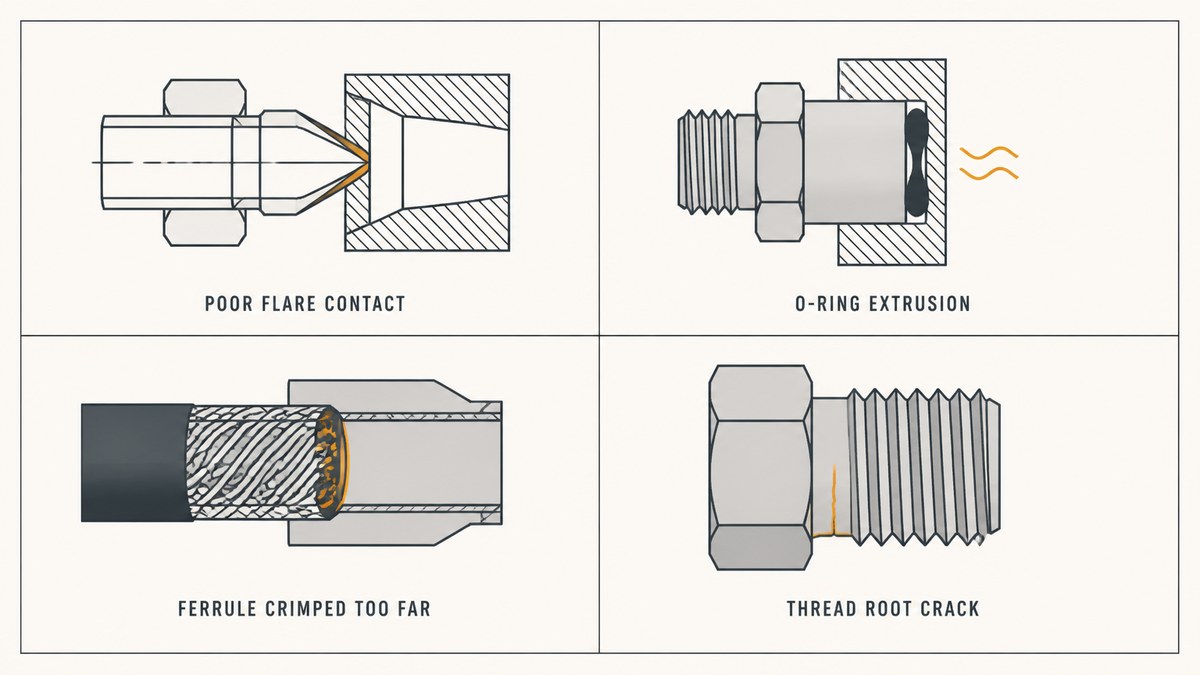
- The joint weeps when the machine warms up, then stops
- The classic wrong-flare-angle signature. The two cones are contacting on a narrow band that holds when cold and passes oil when hot and thin, so the fault looks intermittent and gets blamed on temperature. It is a specification failure and no amount of tightening will fix it: a metal-to-metal seat that contacts on the wrong band gets worse when it is over-torqued, not better.
- The joint leaks immediately from the port, not the thread
- The port seal, not the fitting. An O-ring boss or face seal that leaks at the seal point usually means a damaged O-ring, a scored sealing face, or the wrong stud end series for the port depth. This is the failure that most often gets a new fitting when what it needed was a new O-ring and a look at the face behind it.
- The hose fails at the crimp, or the fitting blows off
- The crimp. A ferrule pressed too far cuts into the reinforcement and the hose fails at the very point that was supposed to be strongest; pressed too little, the assembly weeps and eventually separates under pressure. Both are invisible in a photograph and obvious against a crimp gauge, which is why the measurement is the point.
- The fitting cracks at the thread root, or strips on assembly
- Over-torque, or a material that was not what the drawing asked for. A body cracked at the thread root is a load path failure, and on a part this small the torque window between sealed and broken is narrow. Ask for the material grade as a requirement, and check the mating face before blaming the part.
One habit ties the whole guide together and costs nothing: keep the known-good fitting and compare each new delivery against it. The family, the angle, the plating colour and the weight in the hand are all visible in a single comparison, and the comparison takes under a minute. It is the same logic that applies to any industrial consumable — a specification that names the shape and leaves out the seal is how industrial conveyor belting fails too, and for the same underlying reason.
9. Frequently Asked Questions
What is the difference between a 37° and a 45° flare fitting?
Both seal on a metal-to-metal cone, and the angle of that cone is the difference. A 45° flare is shallower, so when a 45° fitting is mated to a 37° flare the two faces contact on a narrow band near the tip rather than across the whole face. It threads on, it feels tight, and it holds at low pressure — then weeps as the system warms up and leaks properly once the machine is working. Because the difference is not visible in a photograph, the reliable ways to tell them apart are a flare gauge, a direct comparison against a known fitting of each type, or a sample sent to the supplier. Once you know which angle a machine uses, put it on every drawing and every reorder and the question stops recurring.
Why is my hose assembly rated lower than the hose?
Because an assembly is rated by the weaker of its two halves plus the crimp that joins them. A hose rated for a high working pressure, fitted with a standard fitting that is not rated to the same figure, produces an assembly rated at the fitting's number. The standard for hydraulic hose fittings states this directly: the rated working pressure of an assembly made from those fittings and the matching hose must not exceed the lower of the two rated values. So when a supplier quotes a pressure, ask whether it is the hose figure or the assembly figure, and ask which half set it — that answer tells you what to change if you need a higher rating.
Do I need stainless steel hydraulic fittings?
It depends on two separate questions. The first is corrosion: a machine outdoors, in a wash-down area, in a food plant, on a coast or in a process where the fluid attacks carbon steel will usually need stainless or a heavy plating. The second is cleanliness and temperature, where a plated surface is not acceptable or where the system runs hot enough that the material behaviour matters. Two cautions come with the decision. Stainless costs a step change rather than a percentage, because most stainless fittings are machined from bar rather than cast in volume. And stainless threads can gall and seize against stainless, so the mating half has to be considered at the same time — a lubricant suited to the connection, a different grade on one half, or a design that seals without loading the thread.
How do I identify a hydraulic fitting I have no drawing for?
Work through three things in order. First the sealing method, because that is what defines the family: look at whether the end has a cone, an O-ring in a groove on a flat face, an O-ring at the base of a straight thread, or a bite-type ferrule. Second the angle, if it is a cone, using a flare gauge or a comparison against known fittings. Third the thread, measured with a thread gauge or a caliper and matched to its standard rather than to its size alone. Once you have those three, write them on a label and attach the fitting to a board. A labelled board of every fitting your machines use is the single most useful asset in this category, and it turns every future order into a part number.
What causes a hydraulic fitting to leak only when it is hot?
Almost always a seal that is contacting on too small a band, which gets worse as the oil thins and the metal expands. The usual causes are a flare angle that does not match the mating seat, a scored or damaged cone face, or an over-tightened joint that has deformed the seat rather than seating it. Because it holds when cold, this failure gets misdiagnosed as a temperature problem or as a bad batch of fittings. The diagnostic step is to break the joint, examine the contact band on both cones, and compare them against a known-good pair — the band should run across the full face, not just at the tip. If it is narrow, stop tightening and fix the angle.
Should I buy finished hose assemblies or crimp them myself?
Most operations do both, and the split is usually economic. Buying assemblies crimped by the supplier makes sense at volume, because the supplier's crimp is made against a documented die and machine combination and comes with a measurement, which is difficult to match in a maintenance workshop. Keeping a bench crimper makes sense for breakdown repairs, where waiting for a delivery costs more than the assembly. If you do crimp in house, treat the crimper, the die set and their calibration records as part of the specification rather than as shop equipment — the crimp diameter is a result of the machine and the die together, so a perfect die on an uncalibrated machine produces an unmeasurable result. Whichever route you take, measure the crimp rather than looking at it.
Get the Family, the Angle and the Crimp Specification Written Down Before You Order
We write the twelve-line specification so quotations can be compared on material, tolerance and finish rather than on price alone, get the assembly rating quoted as an assembly rather than as a hose, ask the bar grade and tolerance questions that separate a machinist from a stockist, and have deliveries crimp-measured and gauged instead of photographed.
Request a Hydraulic Fitting Sourcing Quote
Questions & Comments
We read every one and reply within 24 hoursIf you have a fitting in your hand and no drawing for it, describe what you can see — a cone on the nose, an O-ring in a groove, a flat face, or a ferrule biting the hose — and we will tell you which family it is and what to measure next. If you have been quoted a pressure figure, say whether it was described as the hose rating or the assembly rating, because those are two different numbers and only one of them describes what is on your machine.