
Solenoid Valve Sourcing Guide: Types, Coil Ratings and Seal Materials
 ·
Updated October 10, 2026
·
26 min read
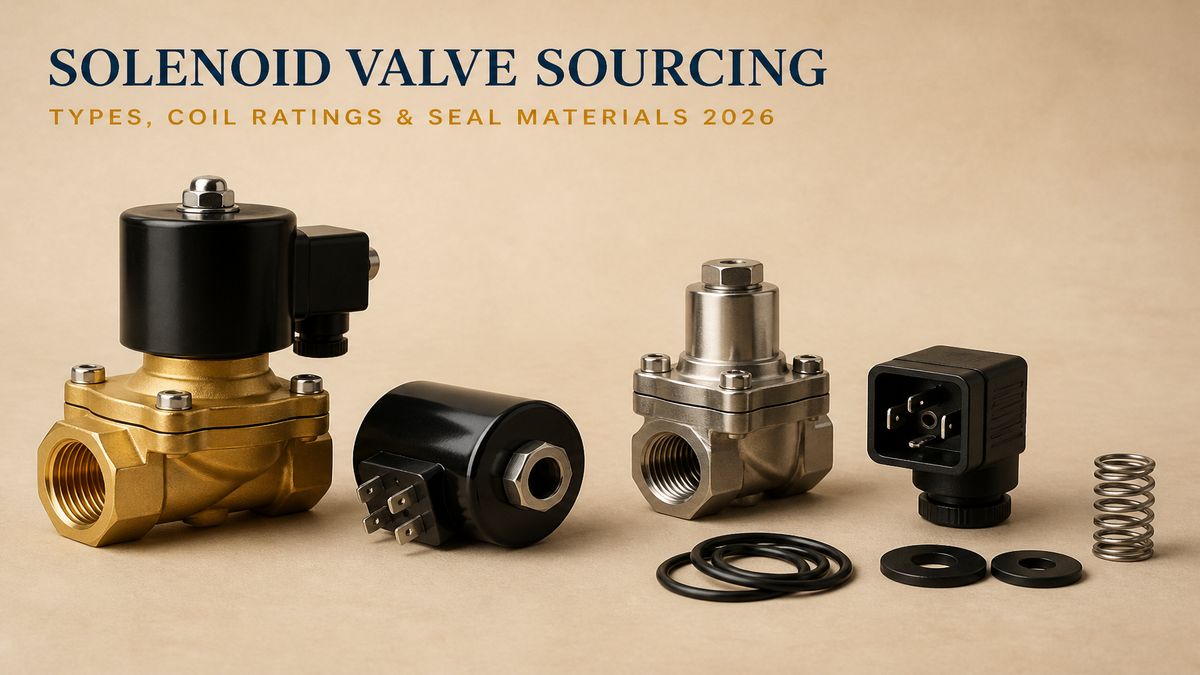
Two solenoid valves can share a part number format, a port size and a voltage and still behave nothing alike on your line. The reasons are all on the inside: a pilot-operated valve will not open on a gravity-fed tank, a coil built for short bursts will burn out if you hold it open all day, and the right body with the wrong rubber will seal clean water for years and fail on steam in a month. This guide covers how a solenoid valve works, which type suits which job, what to write down about the coil and the seal, where the price difference lives, and how to tell a maker from a trader before you order.
What to Specify, by What the Valve Sits On
| If the valve is | Specify this | Because |
|---|---|---|
| Fed from a pressurised line | A pilot-operated valve, with the minimum operating pressure difference written next to your actual line pressure | A pilot valve needs a pressure difference across it to open. On a healthy line the figure is never reached, which is exactly why nobody notices it is missing from the quotation. |
| Fed from a tank, a gravity line or a low-pressure dosing loop | A direct-acting valve, and the supply pressure stated as a range including zero | A pilot valve will not open when there is nothing to push with. Swapping a direct-acting valve for a cheaper pilot unit is the single most common way a first sample fails on the test bench. |
| Holding open for hours at a time | A continuous-duty coil, with the duty cycle and the insulation class both named | A coil sized for short bursts is cheaper and smaller. Held open continuously it runs hotter than it was built to and the winding is what gives out. |
| On water, food or drink | The seal and the wetted body material by grade, plus the drinking-water listing you are buying against | On these lines the seal is a regulated part, not a spare. A named rubber type is not the same as a material listed for contact with drinking water. |
| On steam, hot oil or a chemical | The seal for that medium and temperature, and the body for that chemistry | Each elastomer has a temperature and a chemical it does not survive. The right choice for cold water is the wrong one for steam, in the same body. |
| Metering rather than switching | A proportional valve, with its control signal and flow curve | An on-off valve is either open or shut. Asking a standard valve to trim a flow gives you one that hunts, overheats and wears out the seat. |
1. What Is a Solenoid Valve, and How Does It Actually Work?
A solenoid valve is a valve whose open and shut action comes from an electromagnet instead of a handle. Coil the wire, pass a current through it, and it becomes a magnet. The magnet pulls a steel plunger inside a sealed tube, the plunger lifts off a small hole the size of a pinhead, and flow starts. Cut the current and a spring puts the plunger back.
Two things follow from that design, and both of them matter when you buy one. The first is that the coil never touches the fluid. It sits outside the sealed tube, which is why a burnt-out coil can be unscrewed and replaced without opening the pressure boundary or draining the line. That is not a small convenience. On a machine that runs all day, the coil is the part most likely to need changing, and a valve that lets you change it in place is worth paying a little more for at the start.
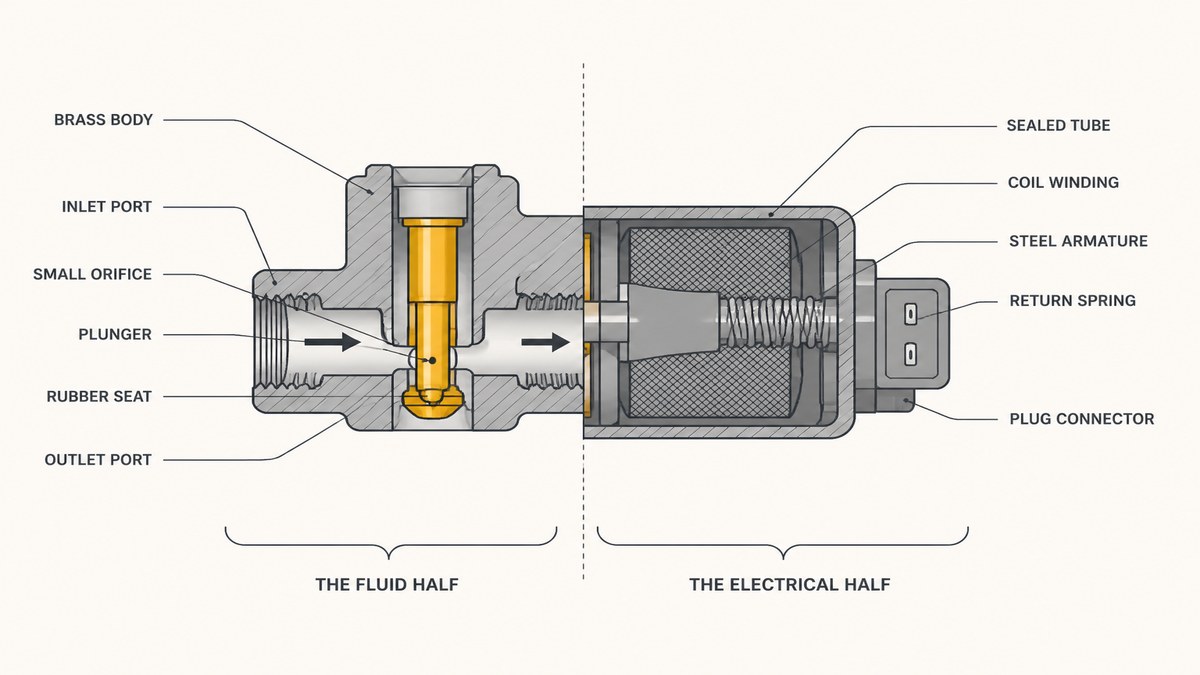
| Half | What it contains | What it decides | What to write in the inquiry |
|---|---|---|---|
| The fluid half | Body, ports, orifice, plunger, seat and seal, and on pilot valves a diaphragm or piston. | How much flows, at what pressure the valve opens, what the medium does to the rubber, and how long the seat lasts at your cycle count. | Port size and thread standard, orifice or flow figure, pressure range, medium by name, temperature at the valve, body material, seal material by grade. |
| The electrical half | Coil, armature, return spring, and the wiring: a plug connector, a terminal box or flying leads. | Whether it opens at your voltage and current, how hot the coil runs, and how long it survives being energised. | Voltage and AC or DC, frequency if AC, coil power in watts, duty cycle, insulation class, enclosure rating, connector type. |
Most inquiries compare the two things that are easy to see — port size and voltage — and leave out the four things that decide whether the valve works. Those four are the minimum pressure difference it needs to open, the duty cycle of the coil, the seal material, and the flow figure at your working pressure rather than at the maximum the valve can take.
2. Direct-Acting or Pilot-Operated — Which One Does Your Line Need?
Direct-acting if the valve has to work at low or zero pressure; pilot-operated if you need a bigger flow for a smaller coil on a line that already has pressure. That is the whole decision in one line, and it is the decision that most often goes wrong, because a pilot-operated valve is cheaper for the same port size and looks like the same product.
A direct-acting valve puts the coil's own pull straight onto the plunger that covers the orifice. The force available is whatever the coil can make, so the orifice has to stay small: this is why direct-acting valves sit in the lower flow brackets for a given port size. What you get in return is a valve that opens with nothing behind it. Tank feed, gravity feed, a line that has not been pressurised yet — all of these work, because the valve never needed help from the fluid.
A pilot-operated valve uses the coil for something much smaller. The coil opens a narrow pilot passage, and the fluid pressure that has built up on the inlet side then does the real work, pushing a diaphragm or a piston across a much larger opening. The forces involved are far greater than a coil could produce on its own, so a pilot valve moves more flow with a smaller and cheaper coil. The price of that trick is the pressure difference. With no difference between inlet and outlet there is nothing to push the diaphragm, and the valve stays shut no matter how long you energise the coil.
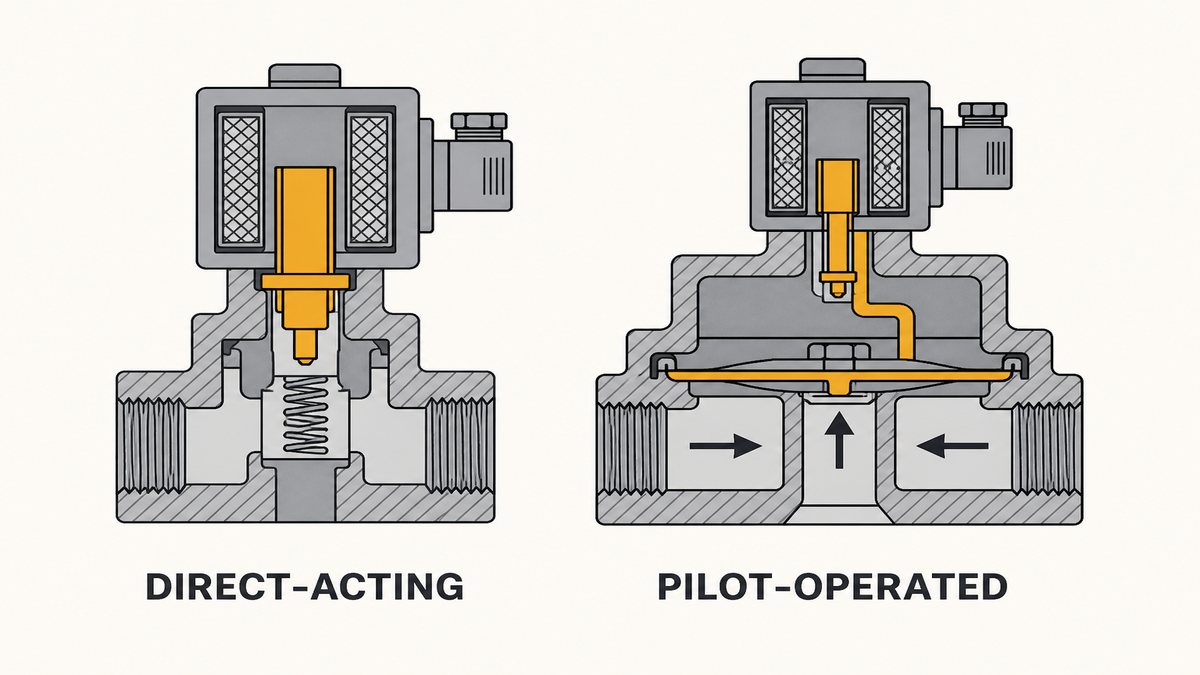
| Direct-acting | Pilot-operated | |
|---|---|---|
| How it opens | The coil pulls the plunger straight off the orifice. | The coil opens a small pilot passage; inlet pressure then pushes a diaphragm or piston across the main opening. |
| Pressure difference it needs | None. It opens from zero and works on a tank or gravity feed. | A stated minimum. Below that figure the valve will not open, however long it is energised. |
| Flow for a given port size | Lower, because the orifice is limited by what the coil can pull. | Higher, because the moving part is driven by line pressure rather than by the coil. |
| Coil size and heat | Larger and warmer for the same flow, because it does all the work. | Smaller and cooler, and usually cheaper. |
| Where it is the right choice | Low-pressure lines, dosing and metering loops, gravity feeds, small flows where reliability matters more than price, and anywhere the supply pressure can fall to nothing. | Compressed air systems, water lines with steady mains pressure, steam and gas lines, and any application where a larger flow is wanted from a compact and inexpensive coil. |
| How it fails when it is wrong | Costs more than it had to for a job a pilot valve could have done. | Does not open. The symptom looks like an electrical fault — the coil buzzes, the valve stays shut — so time gets spent on the wiring instead of on the pressure difference. |
This is worth putting on the order as one extra line. Write the minimum operating pressure difference you will accept, and your actual supply pressure next to it. A supplier quoting a pilot valve for a gravity-fed tank will then either correct the quotation or show you the figure that makes it work. Either answer is useful; silence is not.
The same trap has a compressed-air version. A pilot valve on an air line is normally fine, because a compressor keeps the line up. But the valve is often asked to open against a line already vented downstream, and at that moment the pressure difference across it is whatever the regulator is set to, not what the compressor can make.
3. Two Ports or Three — What Does 2-Way and 3-Way Actually Change?
A 2-way valve starts and stops a flow. A 3-way valve sends a flow one of two ways, or lets a flow in while letting another out. That is the difference, and it decides the shape of the whole circuit around the valve, not just the valve.
The two-port version is the one most people mean by the word. Fluid comes in one side, leaves the other, and the coil decides whether that path is open. It is used to fill a tank, feed a burner, release air into a cylinder line, or shut off a water supply. Everything else in this guide applies to it.
The three-port version exists because most real jobs are not simply on and off. A three-port valve has one shared port and two others, and it connects the shared port to one of them at a time. On a pneumatic line that gives you a way to both push and release a single-acting cylinder: pressurise the cylinder through one port, then switch and let the air out of the same cylinder through the other. A three-port valve is also how you divert a flow between two destinations without ever stopping it.
The confusion in this corner of the catalogue comes from the way ports and positions are counted. A valve described as three-way has three ports, and a pneumatic catalogue will name the same idea as a three-port two-position valve. Write only the shorthand into an inquiry and the supplier will guess, and a wrong guess here means a valve that cannot be wired into the circuit you have drawn.
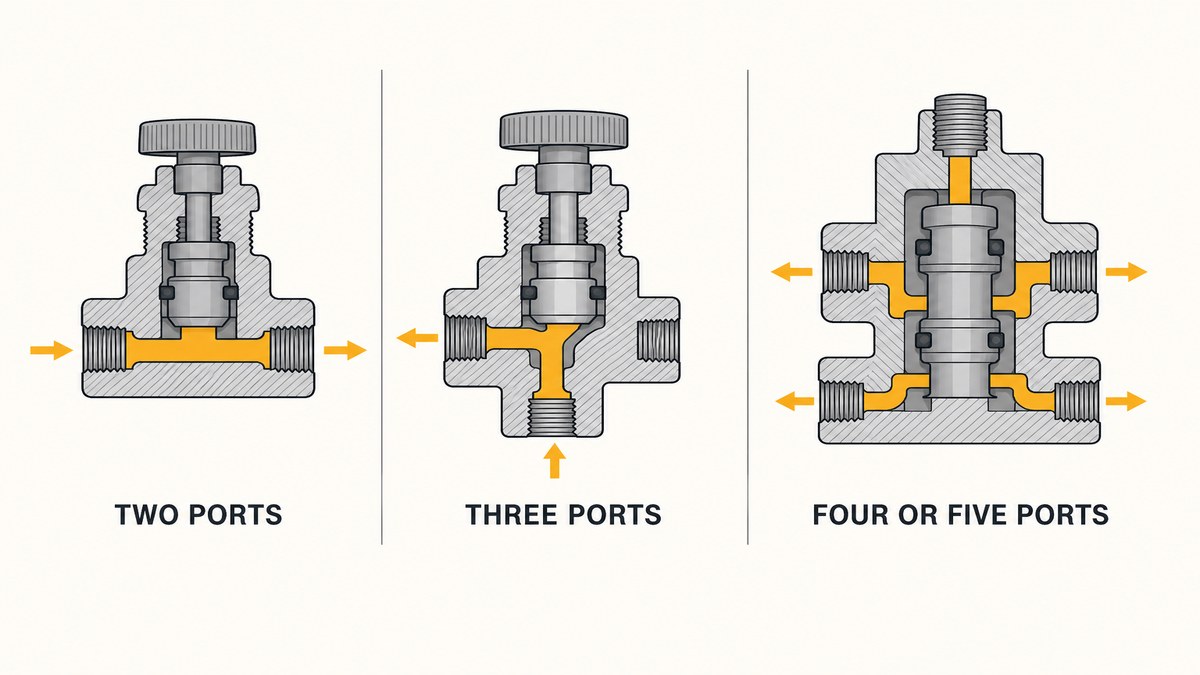
| What the listing calls it | Ports | What it does | Where you meet it |
|---|---|---|---|
| 2-way, 2-position | Two: inlet and outlet. | Opens and shuts a single path. | Almost everything. Water supply shut-off, burner feed, tank fill, air line isolation. |
| 3-way, 2-position | Three: one shared port and two others. | Connects the shared port to one of the other two, then switches to the other. Can also be used to pressurise and then exhaust the same port. | Single-acting cylinders on compressed air, diverting a flow between two outlets, alternate dosing between two tanks. |
| 4-way or 5-way | Four or five, depending on how the exhausts are brought back. | Drives a double-acting cylinder out and back, exhausting the opposite side each time. | Pneumatic actuators, packaging and assembly machines, anything that must push and pull. |
4. Normally Closed or Normally Open — Which Failure Do You Want?
Choose the position the valve takes when the power is gone, because that is the position it will take at some point. Normally closed means shut with no power, so you energise it to open. Normally open means open with no power, so you energise it to shut.
The reason this is a design decision rather than a preference is that power does fail. A fuse blows, a wire is nicked by a panel door, a controller reboots, and the plant loses supply for a second. At that moment the valve does exactly what its rest position says, and nothing in the wiring changes that. If the fluid is a fuel, the rest position should almost always be shut. If it is cooling water for a process that must not overheat, it should almost always be open, and closing it on a power cut is the failure you are trying to avoid.
Two practical points follow. The safe choice is usually the quiet one as well: if a line runs most of the day, a normally open valve sits de-energised and its coil stays cool, while a normally closed valve is energised for the whole shift. If safety and quiet point opposite ways, safety wins and you specify a continuous-duty coil.
The second is that a normally open valve is a less common product. Fewer sizes are held in stock, the price is usually a little higher, and lead time can be longer. That is not a reason to avoid one when the job needs it — but it is a reason to order earlier than you would for the closed version.
5. What Has to Be Written Down About the Coil?
Voltage and AC-or-DC, the frequency if it is AC, the power in watts, the duty cycle, the insulation class, the enclosure rating, the connector type and the coil's own part number. Voltage on its own is not a specification, and a quotation that answers only voltage has specified the coil the way a quotation that answers only the thread has specified a fitting.
Start with the electricity, because this is where an imported machine meets a local supply. An alternating-current coil and a direct-current coil are different windings that can share a voltage number; a DC coil on an AC supply will not produce the pull it was built for and will overheat, and the reverse does not work either. Frequency matters as much and is forgotten more often: a coil wound for fifty cycles pulls less on a sixty-cycle supply, and a sixty-cycle coil run on fifty cycles sits warmer than it was designed to. On equipment that travels between regions, the coil is the part most likely to be quietly wrong and the cheapest to correct — if you catch it before the order ships.
Then the power and how long it is held. The watt figure tells you how much heat the coil makes and how much current your supply must give it. On alternating current there is also a brief starting draw above the running draw, which only shows when several valves switch at the same instant from one small output. If that is your circuit, say so and ask for both figures.
| Field on the coil | Why it decides something | What to write |
|---|---|---|
| Voltage, and AC or DC | An AC coil and a DC coil are different windings. The same voltage number does not make them interchangeable. | The voltage and the type, always together. Never quote one without the other. |
| Frequency | A fifty-cycle coil on a sixty-cycle supply pulls less. A sixty-cycle coil on fifty cycles runs hotter than it was built to. | The supply frequency, especially on any machine built for a different region. |
| Power in watts | Sets the heat the coil makes and the current your supply must provide, including the higher brief draw on AC. | The watt figure, plus how many valves can be energised at the same moment from the same output. |
| Duty cycle | Decides whether the coil is built to be energised all day or only in short bursts. A burst-rated coil used continuously is the most common way a valve dies early. | Continuous, or the actual pattern if it is not. If the valve holds open for hours, say so plainly. |
| Insulation class | Sets how much heat the winding can take before its working life shortens. Two coils of the same wattage can have very different lives. | The class the application needs, or at minimum the class the supplier is offering, in writing. |
| Enclosure rating | Decides whether the coil survives wash-down, dust, or weather. A coil that fills with water fails in a way that looks like a wiring fault. | The rating the environment needs, not the one the cheapest variant has. |
| Connector type | A plug connector, a terminal box and flying leads are different wiring jobs and different spare parts. | The type you want, and whether the plug is included or bought separately. |
| The coil's own part number | If the coil can be bought on its own, a burnt coil is a small spare. If it cannot, every coil failure becomes a whole valve. | Ask for the coil part number as a separate line in the quotation, before you order. |
6. Body and Seal Materials — Where a Cheap Quote Is Quietly Reduced
The body has to survive the chemistry and the pressure; the seal has to survive the chemistry, the temperature and the number of times the valve cycles. Of the two, the seal is where the price difference usually sits, because two valves with identical bodies and identical coils can be quoted thirty per cent apart on nothing but the rubber.
On the body, the ladder runs from brass through the stainless grades to the plastics. Brass is the default for water, air and gas: cheap, easy to machine, and good until the medium is aggressive or the water carries chlorides. A 304 stainless body resists general corrosion; a 316 body is the one to ask for where chlorides, marine air, most food processes or genuine chemical duty are involved, and it costs noticeably more. The plastics — PVC, polypropylene and PVDF — handle chemicals that would eat a metal body but come with much lower pressure and temperature limits, so they are a different design rather than a better one.
On the seal, four elastomers cover most of what a buyer meets, and the differences between them are not small.
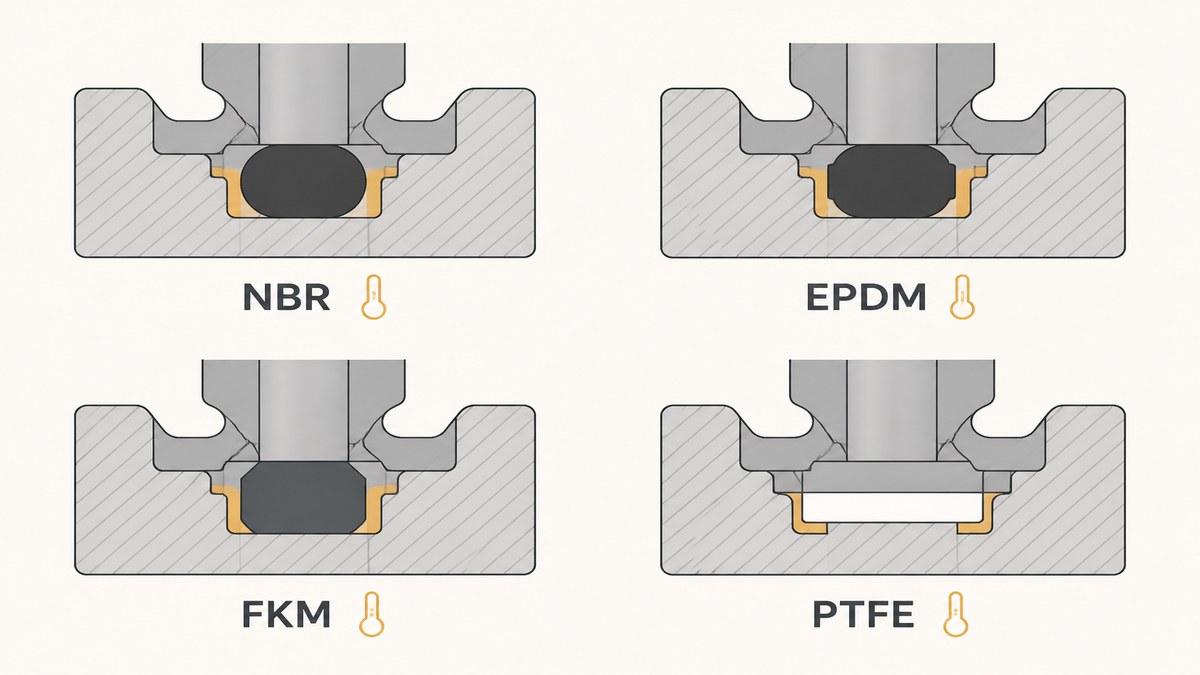
| Seal material | Good with | The temperature it takes | Where it fails |
|---|---|---|---|
| NBR, also written nitrile | Air, mineral oils, cold and warm water, most neutral gases. The cheap default. | Moderate — warm rather than hot. | Steam, hot water, ozone and sunlight. It hardens, takes a set, and then leaks. |
| EPDM | Water and hot water, steam, brake fluid, many water-based chemicals and detergents. | Higher than NBR, and it handles steam. | Mineral oils, greases and fuels. This is the mirror image of NBR and the reason the two are so often confused. |
| FKM, often sold under a brand name | High temperature, fuels, lubricating oils, many acids and solvents. | The widest of the four rubber types. | Steam, hot water and some strong bases. It also costs several times what NBR costs, which is why it is worth naming rather than assuming. |
| PTFE | Almost every chemical, and high temperature. Used as a facing, a disc or a gasket rather than as a soft sealing ring. | Very high. | Anywhere its lack of spring back matters. It does not recover the way a rubber does, so it is not a drop-in replacement for a soft seat in a fast-cycling valve. |
Temperature decides the material more often than chemistry does, and it has to be read as a whole-product figure. A valve's temperature limit is the lower of what the seal survives and what the coil survives, and the coil is often the limit. A coil bolted flat onto a hot body heats itself as well, so what matters is the combination. This is why steam and hot-oil valves often show the coil on a spacer or a bracket: the gap keeps the winding out of heat the seal is happy in. A high-temperature valve offered with the coil pressed against the body is worth a question rather than an order.
If the valve touches food or drinking water, the materials move from an engineering question to a regulated one, and the answer is a listing rather than a word. Rubber for repeated food contact is covered by 21 CFR 177.2600, the rule for rubber articles intended for repeated use, which covers both the rubber and the substances added to it. PTFE, often chosen for these duties, sits under a separate rule, 21 CFR 177.1550 on perfluorocarbon resins, with its own identity and extraction limits. For drinking water the listing to name is NSF/ANSI/CAN 61, drinking water system components. Name the listing in the inquiry and ask for the document with the goods: a supplier who can produce it was already working to it, and a supplier who offers a food grade without changing the material is offering a different sheet of paper for the same valve.
7. Water, Gas, Steam, Air or Metering — What Changes by Medium?
The medium changes the body material, the seal material and often the valve type, and it is the one field where a wrong answer cannot be fixed by adjusting the coil. Water is the easiest duty and the one most valves are designed around; steam is the hardest of the common four.
On water, brass with an EPDM or NBR seal covers most of what a buyer needs, and the choice between the two comes down to temperature: cold and warm water suits either, and anything approaching hot water wants EPDM. Where the water carries chlorides, brass is the wrong body and 316 stainless the right one, because chlorides pit brass rather than wearing it evenly. Where the water is drinking water, the listing in section six applies to every wetted part. And a solenoid valve is a shut-off device: using it to trim a flow, partly open all day, wears the seat and raises the coil temperature.
On gas, the deciding issue is tight shut-off rather than flow. A gas valve that weeps past the seat is a safety problem rather than a nuisance, so the rest position should be closed, the seal chosen for the specific gas, and the enclosure rating raised because gas plant is often outdoors or in a pit. Approvals enter here too: several markets require the valve and its coil to carry a recognised approval for the duty, which is part of the product rather than an optional extra. Ask early which approval the destination market wants, because a valve built without it cannot be approved afterwards.
On steam, three things change at once. The seal has to survive the temperature, which points at EPDM or PTFE rather than NBR. The body has to take the cycling without distorting. And the coil has to be kept off the hot body, usually on a spacer, because the winding almost always has the lower temperature limit. Condensate is the other steam problem: slugs of water travelling at speed hammer the seat, and a valve that fails early on a steam line has usually been hammered rather than worn out.
On compressed air, a pilot-operated valve is the normal choice because a compressor keeps the line up, seals are usually NBR, and three-port and five-port versions take over once a cylinder is involved. The one thing worth insisting on is dry air: moisture rusts steel parts inside the valve and swells some rubbers, and the failure then looks like a worn valve rather than a wet line.
Proportional control is a different product, not a variant. A standard valve is open or shut, and asking it to hold part-way gives you one that hunts, heats up and wears its seat. A proportional valve positions the plunger against a varying current, so what you specify changes: the control signal it expects, the flow curve across its range, and how repeatably it holds that curve.
| Medium | Body that suits it | Seal that suits it | The extra thing to write |
|---|---|---|---|
| Water, cold or warm | Brass. Stainless where chlorides are present. | EPDM, or NBR for cold water. | The listing you need if it is drinking water, and whether the valve is a shut-off or expected to trim flow. |
| Hot water and steam | Brass or stainless, depending on the condensate. | EPDM or PTFE. Not NBR. | That the coil must be spaced off the body, and the steam temperature at the valve. |
| Gas | Brass is usual; stainless for wet or aggressive gas. | Chosen for the specific gas. NBR is common. | The approval the destination market requires, and the rest position as closed. |
| Compressed air | Aluminium or brass. | NBR, chosen to suit the lubricant if the air is oiled. | Whether the air is dried, and the port count if a cylinder is involved. |
8. What Drives the Price — and What Is Missing From a Cheap Quote
Four things move the price of a solenoid valve more than anything else: the body material, the seal material, the coil, and the testing and paperwork. Brass with an NBR seal and a burst-rated coil is an inexpensive valve. The same casting in 316 stainless with a PTFE-faced seat, a continuous-duty coil and a test record is a different product at several times the price — and both can be quoted against the same drawing.
That is why a low quotation is worth reading closely rather than enjoying. The difference is almost never in the metal; it is in a field that was left off. The seal is quoted as a material family rather than a grade. The duty cycle is missing, so you cannot tell whether the coil suits your process. The test is described as done rather than as what was done at what pressure. And the coil has no part number, so every future coil failure is a whole valve.
The test is the field buyers ask about least and should ask about most, because it is where a real requirement and a marketing sentence look almost identical. There is an international standard for how metallic industrial valves are pressure tested: ISO 5208, the standard for pressure testing of metallic valves sets out the examinations and tests a maker works to in order to establish the integrity of the pressure boundary and to check the degree of closing tightness. Two details in it are worth carrying into your own order. It is meant to be used alongside the valve's own product standard, and where the two disagree the product standard wins — so "tested to the standard" is not a complete statement until you know which product standard applies. And the standard itself states that it does not cover the safety aspects of pressure testing, which makes a test a procedure to be agreed rather than a box that has been ticked.
The rest of the price sits in freight and in the spare-parts position, which is worth pricing at the start rather than at the first failure. The what a solenoid valve order costs once it has landed, and on a component like this the spare-parts decision changes that sum more than the unit price does.
9. Where Do Solenoid Valves Come From, and Who Is a Real Maker?
The short answer is that a solenoid valve is four separate manufacturing jobs bolted together, and almost nobody does all four in one building. The body is a machining job on brass or stainless. The coil is a winding job with its own materials and testing. The seal is a rubber moulding job. Assembly, adjustment and pressure test is a bench job. A company that does all four is a manufacturer in the full sense; one that buys three and assembles one is a maker of assemblies, the same way a hydraulic hose assembly becomes one rated item out of three sourced parts; and one that buys all four and puts its name on the box is a trader. None of the three is automatically wrong to buy from — what matters is knowing which you are talking to, because it decides what they can change for you and what they can still supply in two years.
- Who winds the coil?
- If it is in-house, ask for the coil's own data sheet and part number. If it is bought in, ask whose coil it is and whether you can buy spares from that maker directly.
- Where is the seal moulded?
- A maker who moulds their own seals can change material for you and can name the grade. A maker who buys seals can usually offer only what their supplier stocks. Elastomer parts for this duty are a moulded rubber component with its own material and tooling questions.
- Who machines the body?
- In-house machining means orifice and port changes are possible within the same casting. An outside machine shop means a change is a new tooling conversation, and the design choices that make a body easy to machine are worth settling before tooling rather than after.
- What exactly is the pressure test?
- Ask for the test pressure, the hold time and the acceptance. Ask whether a record accompanies each batch, and ask to see one.
- Can I have two samples from different production runs?
- This is the cheapest test available. Two samples made months apart tell you far more about consistency than five made in the same afternoon, and sampling is the first item on any the sample size table for a solenoid valve order you use later.
- What is the certificate position?
- A quality certificate is worth what the audit behind it is worth, and the certificate number can be checking a solenoid valve certificate at the issuing authority rather than accepted as a scan.
Then test the samples the way they will be used, not the way they were tested at the factory. Run the valve at the bottom of your pressure range rather than the middle, because that is where a pilot valve gives up. Hold it open for a full shift and then touch the coil. Cycle it a few thousand times before you approve the batch. And if it is going onto steam or hot water, test it hot at least once — bench figures are almost always taken with clean cold water, the kindest condition the valve will see.
10. What Are the Common Failures, and What Does Each Tell You?
Four failures cover most of what a plant sees, and in three of them the valve was the wrong choice rather than a bad one. Reading the failure correctly is what stops you buying the same wrong valve twice.
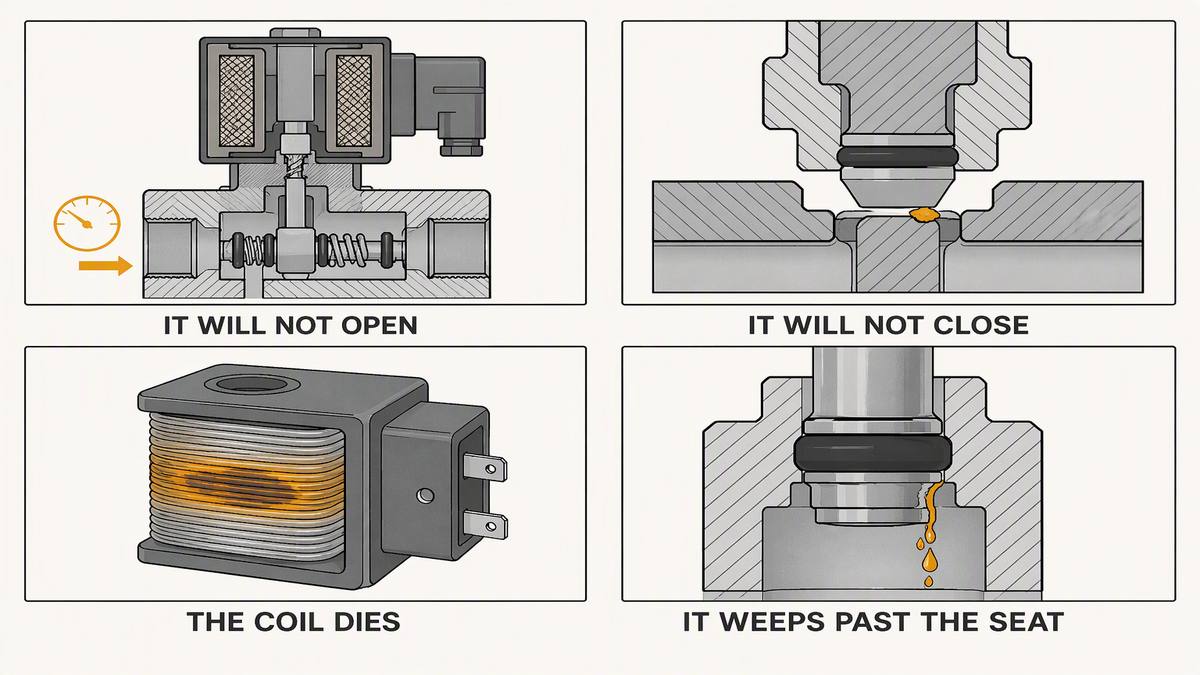
- The coil buzzes and the valve stays shut
- The most common cause is not enough pressure difference across a pilot-operated valve. The second is debris on the orifice, and the third is a coil that does not match the supply — direct current on an alternating supply, or a winding made for a different frequency. Check the pressure difference first, because it is the one that will still be wrong after you replace the coil.
- The valve opens and will not close
- A particle sitting on the seat, a seal that has swollen in the medium, or a return spring that has taken a set after a long spell in a hot coil. A swollen seal also tells you the material was wrong for the medium, which no amount of cleaning will fix.
- The coil dies in weeks or months
- A coil rated for short bursts energised continuously, a sixty-cycle coil running on fifty cycles, or an enclosure that has taken in water. The last usually shows as corrosion at the connector rather than at the winding.
- It weeps past the seat when it is closed
- A worn or chemically damaged seal, or a seat marked by water hammer or by debris carried through. On steam lines this is the normal end of a valve hammered by condensate rather than worn out by cycles.
One habit ties the guide together and costs nothing: keep a known-good valve of each type as a reference, and put the coil part number, the seal material and the test figures on a card inside the panel.
Frequently Asked Questions
How can I tell whether a valve is direct-acting or pilot-operated?
Look for a minimum operating pressure difference on the data sheet. If a figure above zero is stated, the valve is pilot-operated. A direct-acting valve is usually described with a range that begins at zero, because the coil alone opens it. If no minimum is stated, ask in writing rather than assuming — this is the one field that decides whether the valve opens on your line.
What is the difference between a 2-way and a 3-way solenoid valve?
A 2-way valve has two ports and opens or shuts a single path. A 3-way valve has three and connects a shared port to one of the other two at a time, which lets it divert a flow or pressurise and then release the same port for a single-acting cylinder. Name the port count and the number of positions as two separate numbers, because the shorthand differs between catalogues.
Which seal material should I choose for water?
EPDM is the usual answer, and the only sensible one once the water is hot. NBR works for cold and warm water and costs less, but it hardens with heat and takes a set. Where the water carries chlorides, use a 316 stainless body rather than brass. For drinking water the wetted parts and the seal must be listed for that contact, and the listing to name is NSF/ANSI/CAN 61.
Can I run an AC coil on a DC supply?
No. An alternating-current coil and a direct-current coil are different windings, and matching voltage numbers do not make them interchangeable. A DC coil on an AC supply will not produce the pull it was built for and will overheat. Frequency matters too: a coil wound for fifty cycles pulls less on a sixty-cycle supply, and a sixty-cycle coil on fifty cycles sits hotter than designed.
Why does my solenoid valve get hot?
A continuous-duty coil is meant to run warm, so warmth alone is normal. A coil too hot to touch after an hour is usually a burst-rated coil held energised continuously, a winding made for another frequency, or a coil mounted flat on a hot body with no spacer. Check the duty cycle first, then the frequency, then whether anything keeps the winding out of the body's heat.
How many cycles should a solenoid valve last?
There is no single figure worth quoting, because cycle life depends on the medium, the pressure, the temperature and how clean the fluid is. Ask your supplier for the figure at your conditions, in writing, and treat it as a starting point. Then cycle a sample a few thousand times at your own pressure and temperature before approving the batch — a valve that passes at room temperature with clean water has not yet been tested for the job it will do.
Send us the duty, and we will specify the valve
Tell us the medium, the supply pressure at its lowest point, the temperature at the valve, the port size and the voltage you have. If the line is fed from a tank or a gravity loop, say so — that one detail decides whether you need a direct-acting valve or a pilot-operated one, and it is the detail most quotations leave out. We will come back with the type, the coil specification including duty cycle and frequency, the seal material by grade, and the test figures agreed in writing.
Request a Solenoid Valve Sourcing Quote
Questions & Comments
We read every one and reply within 24 hoursIf you have a valve in your hand and a line that will not open, describe the two things that decide it: the pressure difference across the valve at the moment it is meant to open, and whether the coil is energised all day or in short bursts. If you are comparing quotations instead, say what voltage, what frequency and what seal material each one names, and whether the coil carries its own part number. Those four fields usually explain the price gap before anyone opens a catalogue.