
Screw Pump Manufacturer: Sourcing Screw Pumps From China
 ·
Updated October 12, 2026
·
27 min read
A screw pump is bought on two numbers, flow and pressure, and it is destroyed by three things those two numbers never mention: what the liquid does to the rubber stator, whether the pump is ever allowed to run dry, and what the shaft seal is asked to sit in. The rotor and the stator are the working parts, and the stator is a wear part that will be replaced several times over the life of the pump. Get the stator material wrong and it fails in weeks. Let the pump run dry for a minute and the stator is scrap. There is also a fourth thing that decides whether the pump may be sold into a food plant at all, and it is not a mechanical question: it is the American rule on what may be in contact with food, which puts numbers on how much a rubber part may give up and how much lubricant may be present.
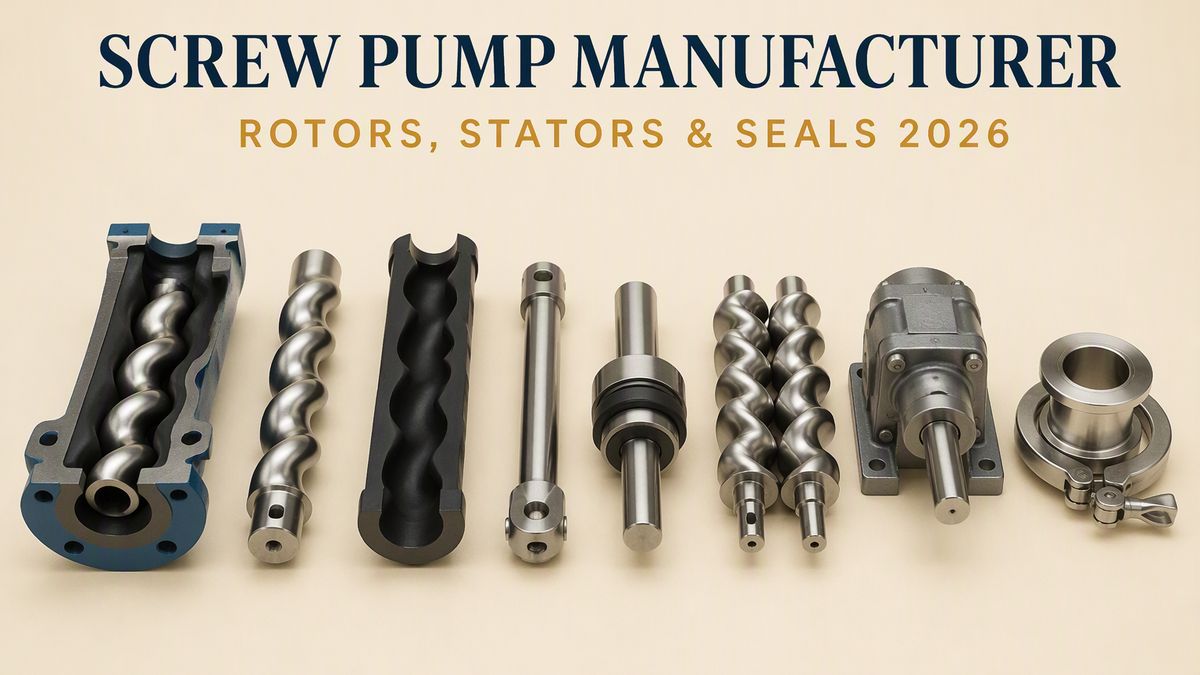
Six Lines That Decide Whether a Screw Pump Quote Is Complete
| What the buyer has to settle | Why it is not obvious | The line on your order that closes it |
|---|---|---|
| Which pump family it really is | Progressive cavity, twin screw, triple screw and rotary lobe are four different machines sold under one nickname | The pump type named properly, not just “screw pump” |
| What the pump will carry | How thick the liquid is, how much solid it holds and how much the pump tears the product decide the stator and the speed | The product data sheet, with thickness, solids size and temperature |
| How fast it may turn | Speed sets the flow and also sets how fast the rubber stator wears out | The running speed the factory will stand behind |
| How the shaft is sealed | Packed gland, single mechanical seal and cartridge seal look similar on a quote and behave very differently | The seal type, the face material and the flush arrangement |
| Whether it may run dry | The stator is lubricated by the liquid itself, so a dry minute can cost a stator | Run-dry protection stated as a device, not as a promise |
| What covers the coupling | The rotating coupling between motor and pump is treated as reachable, and the rule says so | A coupling guard drawing, and a guard as part of the supply |
What a Screw Pump Is, and the Four Names It Is Sold Under
A screw pump is a pump that moves liquid by turning one or more screws inside a close-fitting casing, so that the liquid is trapped between the screw threads and carried along the length of the screw from the inlet to the outlet. Nothing is thrown and nothing is centrifuged. The liquid is picked up, carried and set down, which is why this family of pumps will move things that a normal centrifugal pump cannot touch.
That single idea covers four machines that are all called a screw pump and are all different products. Buying the wrong one is the most expensive mistake in this whole category, so it is worth five minutes.
- Progressive cavity pump
- One twisted steel rotor turning inside a rubber tube that has a matching twisted bore. This is the pump most people mean when they say screw pump, and in Europe it is often called a mono pump after the company that first built it. It is the only pump in this family that handles thick sludge, chunks and abrasive solids well, because the rubber bore is soft and the cavities are large. Its limit is speed and dryness: the rubber needs the liquid to cool and lubricate it.
- Twin screw pump
- Two parallel intermeshing screws inside a close-fitting casing, turning in opposite directions. The liquid is carried in the spaces between the threads. It runs at higher speed than a progressive cavity pump, delivers a smoother flow, and handles thin liquids and large volumes. It is the pump of choice where the product must not be shaken or frothed.
- Triple screw pump
- Three intermeshing screws, one central driving screw and two flanking ones, all inside a very close-fitting casing. It is built for clean, thin, lubricating liquids such as fuel oil and hydraulic oil, at high pressure and high speed, and it depends on the liquid itself to keep the screws from touching metal to metal. Put gritty liquid through it and it destroys itself quickly.
- Rotary lobe pump
- Two figure-of-eight lobes that turn past each other without touching, driven by timing gears outside the casing. It is not a screw pump, but it is quoted alongside them constantly because it does a similar job on shear-sensitive and solids-bearing products. The giveaway is that the lobes never touch, so nothing rubs inside the pump.
Two boundaries are worth drawing before you go any further. A centrifugal pump is a completely different family, and if your duty is thin liquid at a steady flow and you want pressure from a small pump, that family is usually cheaper and should be quoted first; this is a different product line from the one described in this guide to sourcing a the pump that drives a screw pump, which works on oil in a closed circuit. A gear pump is different again, with two gears meshing inside a casing, and it is the family people confuse with a twin screw pump most often.
The test that separates a screw pump from all of them is simple. If the liquid is carried along the axis of a turning screw in the gaps between the screw and the casing, it is a screw pump. If it is carried around the outside of a turning part, it is not.
The Types You Will Be Quoted, and Where Each One Fits
The four families above are not alternatives at the same duty. Each one owns a different band of the same job, and a factory that makes all four will quote you the one that suits your product if you describe the product properly, and the one they have the most of in stock if you do not.
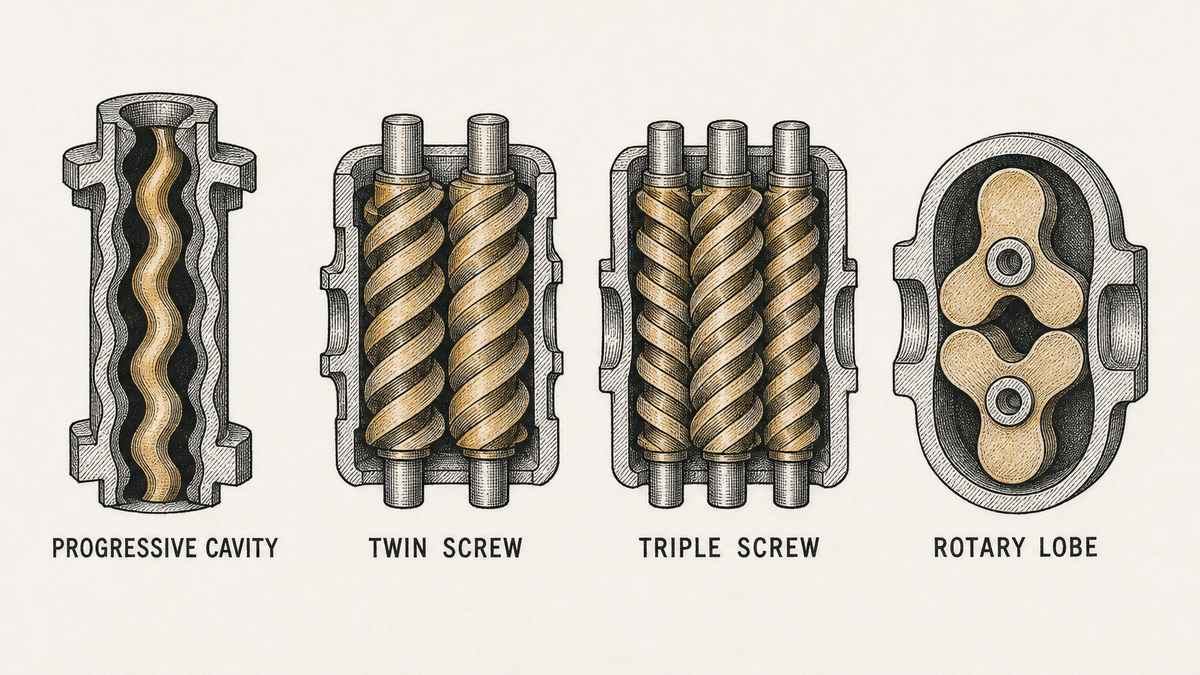
Choose a progressive cavity pump when the product is difficult to move. Thick sludge, sewage with rags in it, wet cement, jam with fruit pieces still in it, drilling mud, paint that will not pour. The reason it works is that the rotor turns slowly and the cavity is large, so the pump pushes rather than throws, and a solid object that fits through the inlet gets carried through rather than jammed. It is also the gentlest of the four on the product, because the parts that touch the liquid move slowly and there is very little churning.
Choose a twin screw pump when the product is thin and the flow has to be smooth. Large volumes of water-like liquid, fuel oil, and food products that must arrive at the filling head without being shaken. Two screws turning in opposite directions deliver a nearly steady stream rather than the pulses you get from a single screw or a piston pump, and because the screws are in metal, not rubber, it is unaffected by temperature in the way a rubber stator is. Its weakness is solids: a hard object between two steel screws will damage both.
Choose a triple screw pump when the liquid is clean, thin and slippery, and the pressure has to be high. This is the pump inside oil-fired burners, hydraulic power packs and fuel transfer skids. It is built to tight clearances and cannot tolerate grit at all. Where a twin screw pump has two screws and a cavity between them, a triple screw pump has a central screw that drives two flanking screws by contact, and the whole thing depends on the liquid film to keep the metal surfaces apart.
Choose a rotary lobe pump when the product must not be damaged. Yoghurt with fruit, potato salad, liquids with whole pieces, anything where the pump's job is to move the product without breaking it. The lobes do not touch each other and do not touch the casing, so nothing crushes the product between metal faces. It also runs dry for short periods far better than a progressive cavity pump, because there is no rubber stator to burn.
Two more variants turn up often enough to name. A single screw pump with an open hopper and a screw feeder is a progressive cavity pump fitted with a wide open mouth and an auger that pushes very stiff product down into the pumping element; it is how a bakery lifts dough and how a wastewater plant moves dewatered sludge. A twin screw pump with a timing gear is the version where the screws are kept apart by gears outside the casing rather than by touching each other, which allows it to run on thin liquids without wearing its own screws away.
One last point that decides money rather than function. Progressive cavity pumps and rotary lobe pumps are usually made in the same workshops, because both need a cast casing, a ground shaft and a rubber part. Triple screw pumps are made by a much smaller group of factories, because the clearances are tighter and the market is narrower, and the number of Chinese factories who will quote a real triple screw pump is small. If you send a triple screw enquiry to a general pump workshop you will often get a quote back for something else, and the drawing attached to it is the only way to find out.
Inside the Pump: Rotor, Stator and the Parts That Wear Out
A progressive cavity pump is a short list of parts, and only one of them is expected to wear out. Knowing which one that is, and what the rest are called, is most of what you need to buy the pump well.
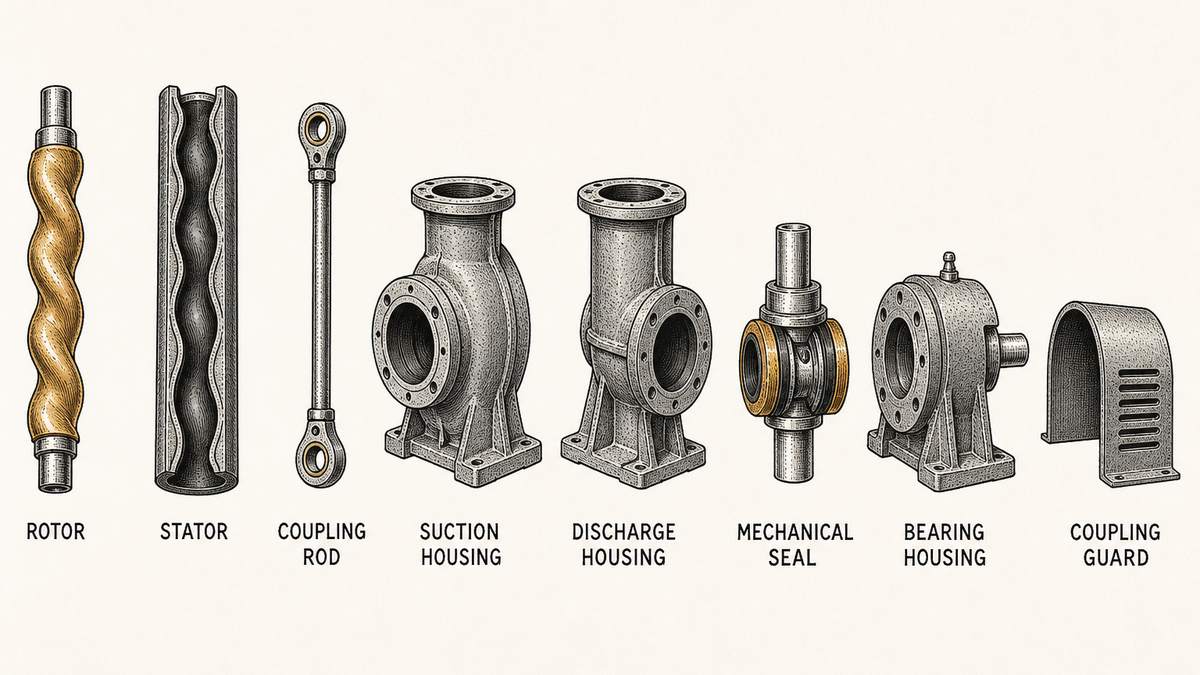
The rotor is a steel shaft machined into a single smooth helix, like a long twisted lozenge. It is usually turned from solid bar, hardened where the product is abrasive, and its surface is either hard chromium plated or coated with something harder. It is the part that does the work and, provided it is not run dry or against hard grit, it can outlast several stators.
The stator is a rubber tube whose inside is a double helix, so that the rotor and the stator touch along a continuous line that spirals down the pump. It is the part that wears out. It is made by moulding rubber round a metal former, and it sits inside a steel tube that holds its shape against the pressure. The stator is the pump's heart and its consumable at the same time, and that is not a contradiction: the rubber has to be soft enough to seal against the rotor and hard enough to survive the product, and those two demands fight each other for the whole life of the part.
The coupling rod is the slender shaft that joins the rotor to the drive shaft. The rotor does not turn on a fixed centre; it wobbles as it turns, because the geometry of a helix inside a double helix makes the rotor orbit. The coupling rod is what allows that orbiting motion while the drive shaft turns on a true centre, and it has a pin joint at each end to take the movement. It is a piece of steel with a joint at both ends, and when something in the pump jams, this is the part most likely to break.
The suction and discharge housings are the cast ends that take the pipework. The suction housing has the inlet and often a small inspection or clean-out opening, and the discharge housing has the outlet. Both are usually cast iron, and both carry the flanges or threaded ports that the pipework bolts to.
The shaft seal sits between the pumping chamber and the bearing housing, and it is the part that decides whether the pump may be used on a clean product. There are three kinds, and they are covered in their own section below.
The bearing housing carries the drive shaft on bearings and holds the seal and the drive end. It takes both the turning load and the side load that the belt or coupling imposes, and it holds the shaft in the exact position the seal needs.
The coupling and its guard connect the pump to whatever turns it, which is normally a geared motor. The coupling is the joint between two shafts, and the guard is the cover over it, and the guard is the one part of this list that a rule insists on rather than a manufacturer.
Everything above is a progressive cavity pump. A twin screw or triple screw pump has no stator at all, which changes the whole buying picture: there is no rubber to wear out, there is no temperature limit set by rubber, and there is nothing to burn if the pump runs dry for a moment. What those pumps have instead is very close metal clearances, and their own form of death is grit between two steel surfaces. A factory that mainly builds progressive cavity pumps may still quote you a twin screw pump, and the right question is one question: are the working clearances ground and measured, and what is the smallest hard particle the pump will tolerate?
How It Actually Pumps, and Why That Decides the Buying Questions
It is worth understanding the pumping action properly, because four of the buying questions in this article follow directly from it.
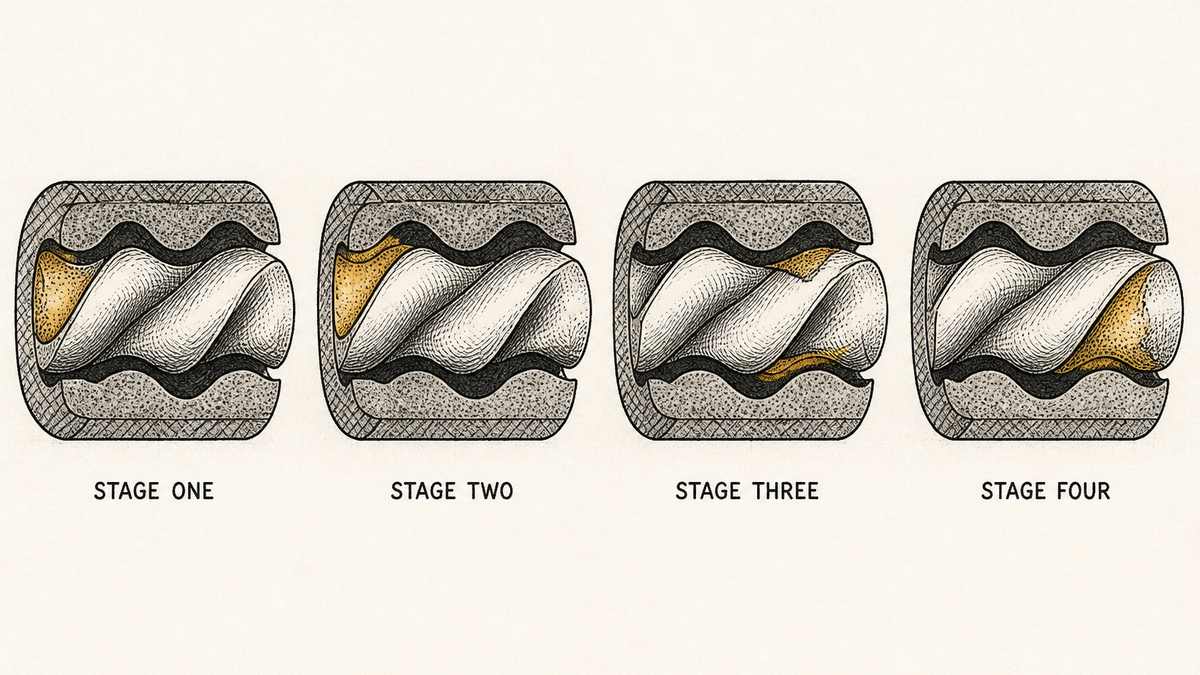
Inside a progressive cavity pump, the rotor touches the stator along one continuous spiral line. On one side of that line there is liquid; on the other side there is not. As the rotor turns, the touching line sweeps down the pump, and it drags a sealed pocket of liquid ahead of it. By the time the line has travelled the length of the stator, that pocket has been delivered to the outlet, and a new one has formed at the inlet. The pump is not squeezing the liquid; it is filling a moving space with it and carrying that space forward.
Nothing is thrown, so thick products move and delicate products survive. A centrifugal pump works by spinning liquid outward until it has enough speed to leave the casing under pressure, and that only works if the liquid will flow into the middle of the impeller in the first place. A screw pump does not need the liquid to flow into the middle of anything. A pocket opens, the product fills it because the product has nowhere else to go, and the pocket carries it away. That is why a progressive cavity pump will lift a product that will not pour.
The flow is steady, and that is a real advantage. A piston pump delivers in bursts and a single screw delivers in a gentle ripple. A progressive cavity pump's pockets arrive one after another in a continuous stream, so the discharge pressure stays almost flat. On a filling line that means no surge vessel and no splashing. On a dosing duty it means the flow follows the speed of the motor closely, which is the next point.
Flow follows speed, and pressure does not change it. This is the single most useful thing to know about a screw pump, and it is where buyers with centrifugal pump experience go wrong. A turning screw carries a fixed volume per turn, so if you slow the motor down you get less flow, and if you speed it up you get more. Closing a valve on the discharge does not reduce the flow much at all; it raises the pressure until something gives. That means a screw pump must never be controlled by a discharge valve, and it means the pump needs a pressure relief of some kind on the discharge, or a drive that stops when the pressure climbs. If nobody has told you that before you order, ask who is supplying the relief, and where it is going to be fitted.
The pump will also run backwards. Because the pockets are sealed and the geometry is symmetrical, a column of liquid pushing back down the discharge pipe will turn the pump into a motor and spin the drive backwards. On a vertical discharge line with a closed valve, that is exactly what happens when the motor stops, and it can undo the coupling or damage the gearbox. The answers are a non-return valve on the discharge, a brake on the drive, or a non-return arrangement built into the pump. This is a design decision, not an accessory, and it should be settled on the drawing. If the discharge line carries a shut-off valve of any kind, that valve is part of the pump system even if it was bought separately, and it is worth a look at a a ball valve in the same service that will hold against a liquid trying to run the pump backwards.
More stages means more pressure. A progressive cavity pump can be built with the same rotor-and-stator geometry repeated along its length, and each repetition adds pressure capability without adding much flow. So a builder can meet a high-pressure duty either by making the pump longer or by making it run faster, and those two answers have very different consequences for how long the rubber lasts. Longer and slower is kinder to the stator. Faster and shorter is cheaper and wears out sooner. When you compare two quotations for the same flow and pressure, ask how many stages each one has and what speed each one runs at, because that is where the difference in price came from and where the difference in life will come from too.
Matching the Pump to the Product
This section is the one that decides whether the pump you buy is right, and it is the section buyers most often rush, because it needs information that is not on the pump drawing. Four properties of the product set the answer, and all four should be written numbers on the specification rather than adjectives in a message.
How thick the product is. The trade calls this viscosity, and it is simply a measure of how easily the liquid pours. Thin liquids like water and diesel flow easily and can be pumped fast. Thick products like sludge, paste, jam and wet cement do not, and they have to be given more time inside the pump, which means a bigger pump running slower. A thick product also fills the pocket more slowly, so a pump that looks generous on paper can starve at the inlet. The rule of thumb that matters commercially is that the thicker the product, the slower the pump should run, and the more the stator will thank you for it.
What solids the product carries, and how big they are. Solids are the hardest part of this decision, and three separate things about them matter. Size decides whether they will pass through the pump at all, because a solid bigger than the gap will jam between rotor and stator. Hardness decides how fast they grind the rubber, and a little sharp sand does far more damage than a lot of soft fibre. Amount decides whether grinding is a slow background process or a constant sanding. This is why the same pump will last five years on sewage and one season on a slurry with fine grit in it, and why a factory that asks only what the product is called cannot possibly be choosing the right stator.
How much the pump damages the product. This is the property buyers forget until they have ruined a batch. A progressive cavity pump is gentle because the parts touching the product move slowly and the cavity opens and closes around the product rather than across it. A rotary lobe pump is gentler still and is the usual choice for products with whole pieces in them. A twin screw pump sits in the middle. A triple screw pump, and any pump with tight metal clearances, will break up anything soft that passes through the gap. If your product contains pieces that must arrive intact, say so in those words, because a factory told only the flow and pressure will optimise for flow and pressure.
How hot and how chemically aggressive the product is. The rubber stator sets a temperature ceiling on the whole pump, and the same rubber has to survive the product chemically. Oils, solvents, acids and alkalis each attack different rubbers, and a stator that is perfect for sewage may swell and fall apart in a food product containing oil. Temperature and chemistry have to be given together, because a rubber that is fine at a warm temperature in water may not be fine in the same product cold, and the other way round.
Four further questions turn up on real projects and each one changes the answer.
Does the product have to stay sterile or clean? If it does, the shaft seal and the inside shape of the pump become a specification rather than a detail, and the pump has to be built in a sanitary pattern. That is a big enough subject to have its own section below, because it is also where a legal rule lands.
Does the pump have to run when the product has stopped coming? If the pump is fed from a tank that can empty, or from a hopper that can bridge, or from a pipeline that can block, then the pump will one day run with nothing in it. That is the single fastest way to destroy a stator, and it is the subject of a section below as well.
Does the flow have to be adjustable while running? If it does, the drive has to be a variable speed one, because on this family of pumps flow is set by speed and by nothing else. If the flow is fixed, a fixed-speed geared motor is cheaper and perfectly adequate, and the money is better spent on a bigger pump run slower.
Will the pump ever be expected to move something other than the design product? Production lines get repurposed. A pump bought for one product is often asked to handle a thicker one, a hotter one or a gritter one two years later, and the stator is what suffers. If there is any chance the duty will change, buy the pump with a bigger frame and run it slower now, and note the alternative product on the specification so the factory chooses a stator that suits both.
Flow, Pressure, Speed and the Curve to Ask For
The numbers on a pump quotation look precise and are usually quoted in a way that flatters the pump. This section is about the four figures to ask for instead.
Ask for the flow at your working pressure, not the maximum flow. The headline flow on a screw pump is measured with the discharge open and no pressure against it. As soon as the pump has to push against a real discharge line, some of the liquid slips back past the rotor-and-stator seal, and the flow you actually get is lower. The gap between the two figures grows with pressure, and it grows faster on a worn stator. A quotation that states only one flow figure has stated the easy one. Ask for the flow at the pressure the line will actually run at, and ask for it in writing.
Ask for the speed that produces that flow. Two pumps can both deliver the same flow at the same pressure while running at very different speeds, and the slower one will last much longer, because the rubber is being rubbed past the rotor fewer times per minute. Speed also sets how much of the product's energy ends up as heat, so a slow pump running on a thick product warms it less. If a quotation does not state a speed, you cannot compare it with anything.
Ask how the pump is fed, and how far it can lift. A screw pump pulls liquid into its inlet by making a pocket open, which is why it can lift liquid from below. But it works on a pressure difference, and if the liquid has to be lifted too far, or the inlet pipe is too narrow, or the product is too thick to move quickly enough, the pressure at the inlet drops to the point where the liquid starts to boil and turn into bubbles. The trade calls this cavitation, and in plain words it is the liquid boiling inside the pump because the pump is asking it to move faster than it can. The bubbles collapse a moment later and hammer the surfaces. On a thick product this is the most common cause of a pump that "has no suction". Ask for the allowable suction lift for your product, not for water.
Ask about the temperature the product will gain. Every pump puts energy into the liquid as heat as well as moving it. On a thin product at high flow the rise is small and nobody notices. On a thick product being pushed hard through a small pump, the rise can be enough to change the product, and it is also heat that goes into the rubber stator. If the product is heat-sensitive, ask for the expected temperature rise, and if the answer is a shrug, ask for the shaft power instead and work it out.
One structural point belongs here because it is what makes the four figures above hang together. A screw pump delivers almost the same flow no matter what pressure it is working against, up to the limit of its casing and its drive, and the limit is not a gradual curve the way it is on a centrifugal pump. It is a wall. Past a certain pressure the liquid starts forcing its way back past the seal instead of moving forward, and the pump simply stops adding flow. So the honest way to specify this pump is: this flow, at this pressure, and no more. The flow figure and the pressure figure are a pair, and a quotation that gives you one without the other is not a specification.
The Shaft Seal, the Flush Plan and the Drive End
Two assemblies cause most of the trouble on a screw pump after the stator: the shaft seal, and the joint between the pump and its drive.
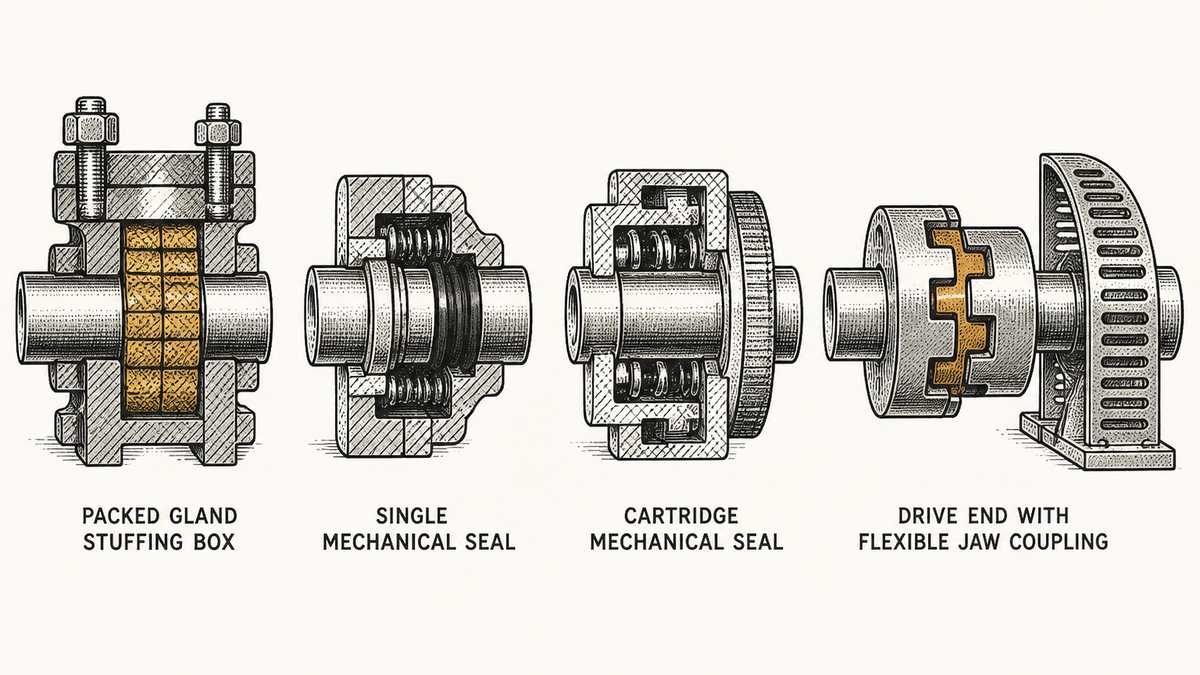
A packed gland is a box around the shaft filled with square rings of soft packing, squeezed by a bolted follower. It is the oldest and cheapest way to seal a pump shaft, and it works by design with a small leak, which is what keeps the packing cool and lubricated. It is the right answer for dirty, thick or abrasive products, because packing does not care much about what is in the liquid, and it can be repacked on site without any special skill. It is the wrong answer anywhere a drip cannot be tolerated, and it is the wrong answer for a clean product, because a dripping gland is an open path for contamination in both directions.
A single mechanical seal replaces the packing with two flat faces running against each other, one turning with the shaft and one fixed in the housing, pressed together by a spring. It does not leak the way a gland does, and it takes far less power. In exchange it is fussier: the faces must stay clean, they must not run dry, and they must not be asked to survive abrasive grit. When a single mechanical seal fails on a screw pump it is almost always because the product reached the faces. That is what a flush arrangement is for.
A cartridge mechanical seal is the same seal supplied as a self-contained unit with its own sleeve, faces, springs and a setting collar that fixes the working position before the seal is fitted. It costs more than a loose seal and pays it back at the first replacement, because nobody has to measure anything and the setting cannot be got wrong on site. On an imported pump, this is the version worth insisting on, because the person who fits it in your plant will never have seen that pump before.
The flush arrangement is the part buyers most often leave off the order, and it is the part that decides seal life. In plain terms, a flush is a small flow of clean liquid brought to the seal faces so that the product never sits between them. On a screw pump handling an abrasive, sticky or hardening product, a flush is not an upgrade, it is what makes a mechanical seal possible at all. The variants are worth naming so you can ask for the right one: a clean external flush where water is available, a recirculation from the pump's own discharge, a quench where a liquid or steam is applied to the outside of the seal rather than into the product, and a double seal with a barrier fluid where the product must not be contaminated at all or where it is hazardous. The line on the specification is not "mechanical seal". It is the seal type, the face material and the flush arrangement, together.
At the other end of the pump, three drive questions decide how long the whole assembly lasts.
What kind of coupling, and what does it tolerate? A screw pump is normally joined to a geared motor through a flexible coupling, most often the jaw type with an elastomer spider between two toothed hubs. It tolerates a small amount of misalignment, and a small amount is all it tolerates: if the pump shaft and the gearbox shaft are not lined up, the coupling works the pump's bearing and the gearbox's bearing continuously. Line the two up properly before the coupling is closed up, and check that the coupling spider is the right hardness for the load, because a soft spider in a hard-working drive will be replaced several times before the coupling is.
What takes the push along the shaft? A screw pump pushes the liquid along its axis, and the pump pushes back on itself in the other direction. That force has to go somewhere, and on most designs it goes into a thrust bearing in the pump's own bearing housing rather than into the gearbox. Ask who takes the thrust and what the limit is, because a pump mounted on a gearbox that was never meant to take an axial load will destroy that gearbox quietly and expensively.
What is between the coupling and the world? The coupling is a pair of toothed hubs turning at motor speed with a gap between them, and it sits at a height where a person can easily reach it. A pump delivered without its guard is a pump that will be guarded by whoever installs it, badly or not at all. Ask for the guard as part of the pump package, with a drawing, and treat a supplier who does not supply one as a supplier who has not read the rule that applies to it. The discharge pipe and the suction pipe are also part of the assembly, and a screw pump is hard on both of them, because a thick product needs a generous suction line and a suction line that is not flexible enough will move the pump rather than carry the product. Hose selection for that line is its own subject and is covered in this guide to the hose fitted to a screw pump, and the fittings that join it to the pump are covered in this one on the fittings on a screw pump.
Dry Running and Why the Stator Dies First
A progressive cavity pump has no mechanical lubrication between its two working surfaces. The only thing stopping the rotor from tearing the rubber apart is the film of liquid that the pump is carrying, which cools that contact line and keeps it slippery. Take the liquid away and the contact line becomes a rubbing block of steel on rubber turning at motor speed. The stator stops being a wear part and becomes a consumable, and it can go in a couple of minutes.
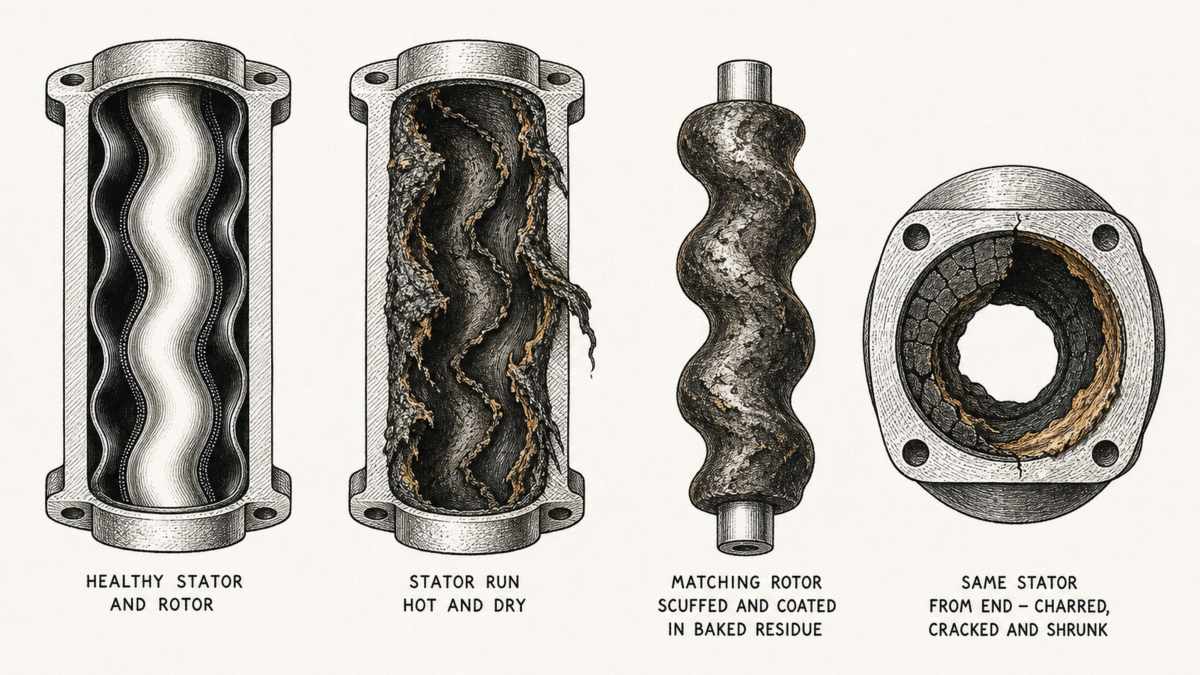
What happens is very predictable once you have seen it. The rubber surface heats up first and goes glossy, then it starts to smear, and a thin layer of rubber transfers onto the rotor and bakes there. The bore stops being a smooth helix and starts being a rough one, so it seals less well, and the flow drops. The operator reacts by running the pump faster, which generates more heat, and the stator tears. If it goes on long enough, the rubber shrinks away from its steel housing and cracks, and the stator is scrap in a way no repair can reach.
Dry running is not usually caused by somebody running the pump for fun. It has a short list of ordinary causes and every one of them is worth designing against.
The suction tank empties. The most common cause by far. A pump set to move liquid from a tank runs until the tank is dry, and unless something stops it, it carries on running with nothing in it.
A hopper bridges. On an open-hopper pump feeding stiff product, the product can arch across the mouth and stop falling while the pump keeps turning. The pump is then starved even though there is product in sight.
The suction line loses its prime, or a filter blocks. A screw pump can lift liquid, so it is often asked to pull it up from below. If the inlet strainer blocks, or a foot valve fails, or the suction line develops a leak, the pump is pulling at nothing and the stator is running dry.
A valve upstream or downstream is closed. On a suction valve, this starves the pump. On a discharge valve, on this family of pumps, it does something worse: the pressure climbs and the liquid is forced back past the rotor, which is both a dry contact and a scrubbing action at the same time.
The pump carries on during a cleaning cycle. When a plant is cleaned in place, water runs through the pump, and when the water drains away the pump is often still turning. A pump that is left running dry at the end of a wash is a stator replaced for no reason.
The answer is not an instruction to the operator, it is a device. Three are worth knowing about, and they are not equally good.
A temperature sensor in the stator measures the thing that is actually being destroyed. It is a probe set into the stator wall or into the metal housing next to it, wired to a trip, and it reacts to the heat that dry running produces before the rubber is ruined. It is the most direct protection available and it is the one to ask for.
A current or power monitor on the drive reacts to the change in load. It is cheap, it needs nothing added to the pump, and it works reasonably well on a pump whose normal load is steady. It is less useful where the product thickness varies, because the load then varies anyway, and the trip point has to be set high enough not to nuisance-trip, which makes it slow.
A flow or level switch reacts to the absence of liquid. A flow switch on the discharge catches an empty tank convincingly, provided the pump has been running long enough for the flow to stop. A level probe in the suction tank or the hopper is the simplest and the cheapest of all, and on a hopper-fed pump it is close to essential.
Two more habits prevent most of the rest. Never start a screw pump against a closed discharge valve, and make sure the line has somewhere to go before the motor turns. And prime the suction line before the first start on a pump that lifts from below, because the first few seconds of a screw pump's life are the ones most likely to be dry. If the pump is on a duty where none of this can be guaranteed, then the honest engineering answer is that a progressive cavity pump is the wrong pump and a rotary lobe pump, which has no rubber in it, will survive the same treatment. That is a decision to make before the order, not after the first stator.
Stator Elastomers, Rotor Coatings and Casing Metals
The stator rubber and the rotor surface decide how long the pump lasts, and they are chosen together, because the two rub against each other for the whole life of the part.
There is no best rubber. There are five or six rubbers in common use and each one wins on some products and fails on others.
Natural rubber is the toughest of them against rubbing and tearing, which makes it the default for abrasive duties like sludge, slurry and cement. It is also the worst of them against oil, which makes it useless on any product containing oil or fuel.
Nitrile rubber is the oil-resistant one. It handles oils, greases and fuels well and is the usual answer for a pump moving oily product or one whose seals and bearings are exposed to oil. Its weakness is weather and water-borne chemicals, and it is not the one to choose for a hot acid.
EPDM rubber is the water and chemical one. It is good with water, hot water, acids and alkalis, and it stands up to being cleaned, which makes it common on food and water duties. It is poor with oils and solvents, so a stator chosen for being food-friendly will fail quickly if the product contains oil.
Fluoroelastomer and similar high-performance rubbers handle a wide range of chemicals at higher temperatures, and are the answer when nothing else survives. They cost several times more than natural rubber and are usually only justified where the duty is genuinely aggressive.
Polyurethane resists abrasion better than natural rubber and is used in some heavy slurry duties. It is less forgiving at higher temperatures and it is harder, so it is less good on large solids.
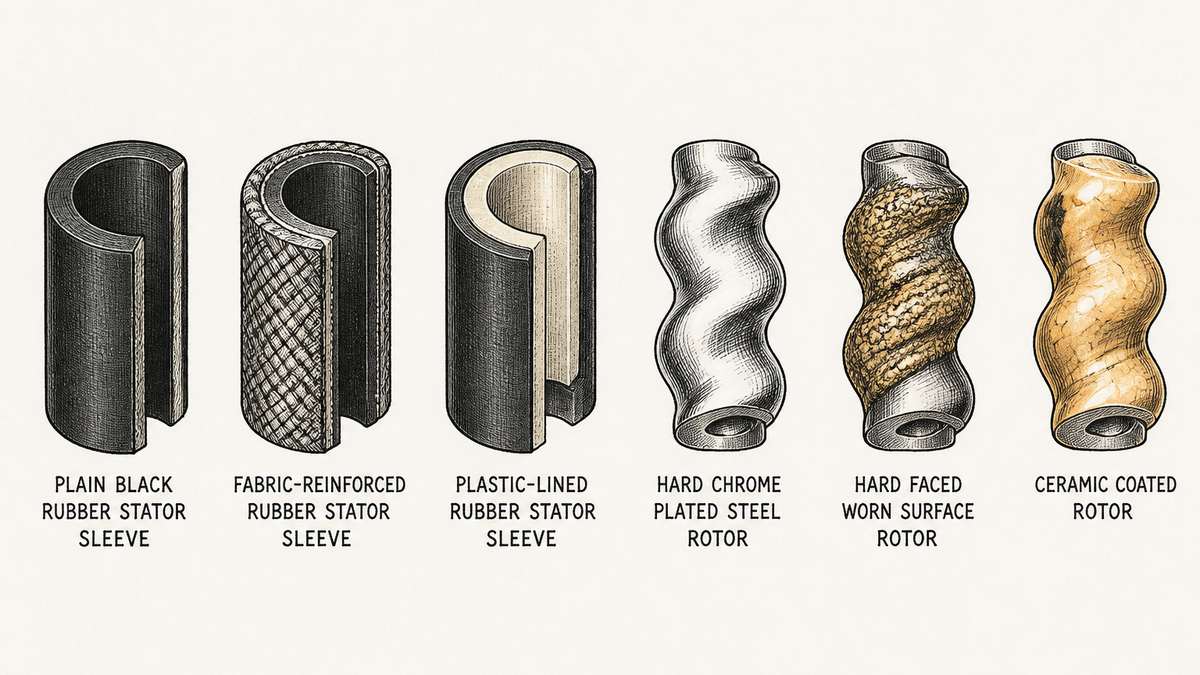
A plastic-lined stator takes the rubber out of the wetted surface altogether, with a smooth rigid lining, often a fluoroplastic, inside a rubber body. It is the answer where the product attacks every rubber and where nothing must stick to the bore. It is also less elastic, so it seals less forgivingly against the rotor and makes the pump fussier about solids.
Two further stator choices matter as much as the rubber itself. The first is hardness: a softer rubber seals better at low pressure and swallows solids more easily, while a harder rubber resists abrasion longer but needs a tighter fit and takes more power. The second is reinforcement: a fabric-reinforced stator holds its shape under higher pressure and is the version to ask for on a long, high-pressure pump, where a plain moulded stator would distort.
On the rotor side, the choice is about what happens when something abrasive gets in. A hard chromium plated rotor is the standard and handles ordinary duties. A ceramic coated rotor resists abrasion and chemical attack far better and is the usual upgrade on slurry. A rotor with a rough, grainy hard facing is for the hardest duties of all, and it is worth looking at twice on a quotation, because that kind of surface also rubs the stator harder. A rotor that has been turned and polished but not hardened at all is the cheap version, and it is the one that wears into a groove and lets the product slip past.
The casing and the housings come in three grades that turn up on almost every quote. Cast iron is the default and is right for water, sludge, sewage and most industrial products. Stainless steel is needed where the product is corrosive or where the pump has to be cleaned. A higher alloy is for the genuinely aggressive duties, and it is where a low quotation and a high one will differ by a factor rather than a percentage. The cheap substitution to watch for is a quotation that names stainless steel and delivers a painted cast iron housing with stainless wetted ends, which passes a quick look and fails on a corrosive product in a matter of months.
If the Pump Touches Food: The Rules Your Supplier Has to Meet
A pump that handles food is not simply a pump with a better finish. In the United States it is a pump whose food-contact parts are covered by a set of federal rules on what may be in contact with food, and those rules turn questions that sound like opinions into questions that have written answers. This is the section of this article worth reading twice, because it is where a supplier who has never been asked will be caught out, and where a supplier who has will answer without pausing.
The rule that covers the stator directly is 21 CFR 177.2600, which is the rule on rubber articles intended for repeated use. A stator is exactly that: a rubber article, reused for batch after batch in contact with food. The rule says such articles may be used in producing, manufacturing, packing, processing, preparing, treating, packaging, transporting or holding food, subject to what follows, and three of its provisions are the ones a buyer can actually use.
Nothing may be put into the rubber to do something to your food. The rule requires that the quantity of any substance used in making the rubber must not exceed the amount reasonably needed to do its job inside the rubber part, and must not be intended to have any effect in the food. In plain words, the rubber may contain what it needs to be rubber. It may not contain something added to make the food taste better, last longer or look different.
The rubber is limited in how much it may give off, and the limit is different for water-based food and for fatty food. For a rubber article used in contact with a water-based food, the rule sets the tested amount the surface may give up when it is boiled in distilled water: not more than 20 milligrams per square inch in the first seven hours of testing, and not more than 1 milligram per square inch in the two hours after that. For a rubber article used in contact with fatty food, the same kind of test with a solvent gives a much larger allowance, because fat dissolves more out of rubber than water does: not more than 175 milligrams per square inch in the first seven hours, and not more than 4 milligrams per square inch in the two hours after that. The two limits are the reason a stator for a dairy product and a stator for an oily sauce are not the same stator, and they are the reason a supplier's answer to "is it food grade?" is worthless unless it names which test was done.
The stator has to be cleaned before it goes anywhere near food. The rule states that finished rubber articles intended for repeated use in contact with food must be thoroughly cleansed before their first use in contact with food, in line with good manufacturing practice. That is a requirement on the thing that arrives in your plant, not on the thing you do afterwards. It is also the origin of the instruction you will see on a new stator, and a supplier who does not mention cleaning is a supplier who has not read the paragraph.
The second rule covers everything lubricated on the pump that could reach the food: 21 CFR 178.3570, on lubricants with incidental food contact. It allows such lubricants to be used on machinery for producing, processing, packing and holding food, on three conditions that matter to a pump buyer. The lubricant must be made from substances that are either generally recognised as safe for food use, or covered by an existing approval, or listed in the section itself with their own use limits. It is used in the places the rule names, including as a protective film against rust and as a lubricant for machine parts in positions where the lubricated part is exposed to food. And the amount used must be the minimum required to do the job on the equipment, with the amount that ends up in the food staying inside the limits. The section's own limits are small: one of the permitted antioxidants, as an example, may not exceed half a percent by weight of the lubricant.
The practical effect of that rule is one sentence long, and it is where food pump assemblies most often fail an audit. The bearing grease and the gearbox oil have to be named products, bought for the purpose, with a written statement that they are suitable for incidental food contact, and the workshop has to be told not to use the general-purpose grease gun on your pump. A pump built to a perfect specification and filled with whatever was nearest the bench is not a food pump, and the parts that decide that are not in the pumping chamber at all. If you want the wider picture of what the same family of rules covers on the product side, the food-contact rules that govern kitchenware and tableware are set out in this guide to FDA food contact testing.
Two more parts of the pump fall under the same family of rules and are worth naming so that the specification is complete. A plastic-lined stator, a polytetrafluoroethylene gasket or a fluoroplastic seal is covered by 21 CFR 177.1550, the rule on perfluorocarbon resins, which describes those resins and the conditions for their use. And a rubber gasket or a rubber seal anywhere in the pump is a rubber article intended for repeated use, so it answers to the same rule as the stator and should be named on the same statement.
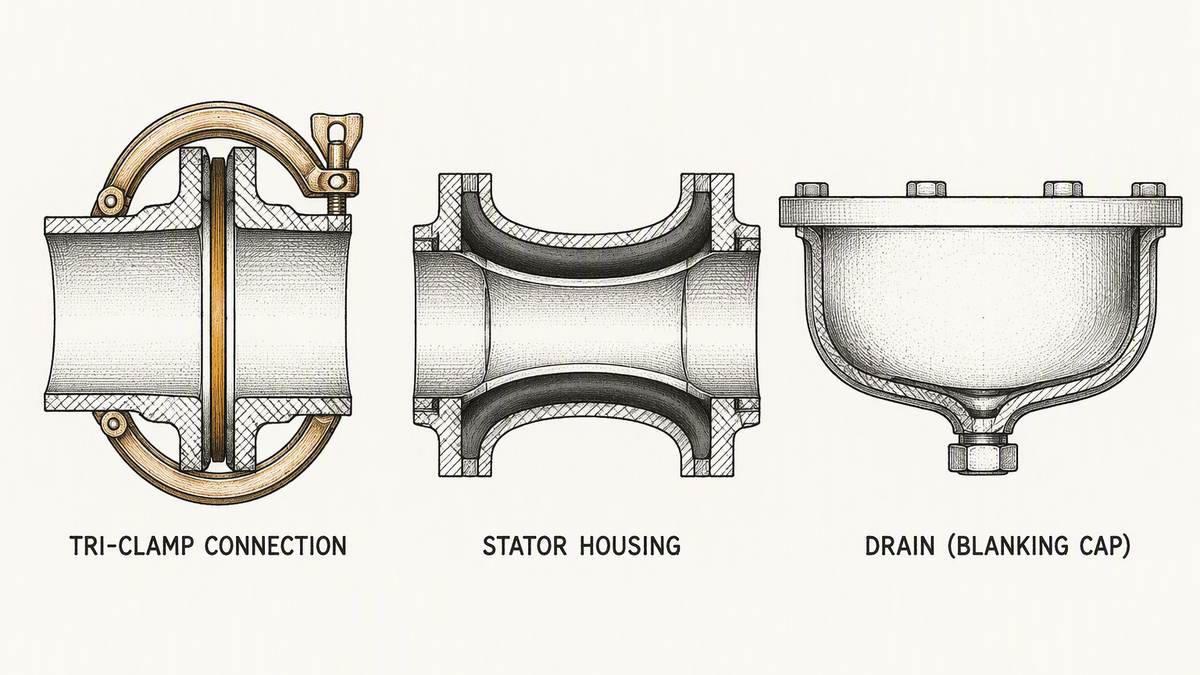
That leaves the part of a food pump that no rule can specify for you, because it is a matter of shape rather than material. A pump that can be cleaned has a smooth continuous bore with no shoulder, no dead pocket and no threaded hole breaking the wetted surface; it has joints that come apart and go back together with the inside flush, which in practice means clamp connections rather than screw threads; it drains completely, so it needs a low point and a drain; and it has no crevice where product can sit out of the flow and grow something. A supplier who talks about tri-clamp ends, about the stator butting up to the housings with no step, and about a drain at the low point is a supplier who builds food pumps. A supplier who answers the food question with a polished outside has not understood it.
One honest limit on this section. Both rules contain long lists of permitted substances with individual limits, and this article does not reproduce those lists. What it gives you is the part a buyer can put to a supplier and check: the two give-off limits and which test applies, the requirement that the stator be cleaned before first use, the requirement that the lubricant be a named food-contact product used in the minimum amount needed, and the demand for a written statement naming both. Those five things are enough to separate a food pump from a painted pump.
Coupling Guarding, and the Rule on Reachable Turning Parts
A screw pump is a quiet, slow-looking machine and the part of it that is genuinely dangerous is the small one nobody photographs. The coupling between the motor and the pump turns at motor speed, has open teeth or jaws, and sits at a comfortable working height. It is the subject of a specific federal requirement, and it is the one item on a pump that is regularly left for somebody else to deal with.
The rule is 29 CFR 1910.219, on mechanical power-transmission apparatus, and its provisions on couplings are short and unusually precise. A shaft coupling has to be built so that it presents no hazard from bolts, nuts, setscrews or anything else turning on its surface. Bolts, nuts and setscrews are permitted in a coupling where they are covered by safety sleeves, or where they run parallel to the shaft and are countersunk or do not reach beyond the flange of the coupling. Read as a buyer, that means a coupling with exposed bolt heads and projecting setscrews is not a coupling that will pass, and a supplier who quotes a jaw coupling with the spider exposed and no guard is quoting half a product.
The general rule that sits behind it is 29 CFR 1910.212, on machine guarding, which requires guarding to protect people from hazards including ingoing nip points, rotating parts and flying chips, requires a guard to be fixed to the machine where it can be and secured elsewhere where it cannot, and requires the guard itself not to be a hazard. The coupling on a pump is a rotating part with a nip point between its jaws, at reachable height, so it needs a guard, and the guard has to have no sharp edges of its own.
Three practical points follow, and they are all about who is responsible rather than about the rule.
Ask for the coupling guard as part of the pump package, with a drawing. On most projects the motor is bought by one party and the pump by another, and the guard falls into the gap between them. It then gets made on site out of whatever is to hand, and a guard made from a piece of thin sheet with a sharp cut edge is a hazard in its own right. One named party should supply it.
Ask what height the coupling will sit at in the installed machine. The same rule family treats a drive as reachable up to a stated height above the floor or working platform and out of reach above it, and the guarding conversation changes completely either side of that line. If the pump is going into a skid where the coupling ends up high above the deck, say so on the enquiry, because the drawing may then be able to lose a louvred cover that would otherwise be needed.
Ask that the guard be fixed with fixings that need a tool. A guard that lifts off by hand is a guard that will be off during a fault and back on after, except on the occasions when nobody remembers. A guard held by socket screws and washers, with a label saying what it is, is a guard that stays where it was put.
One further item belongs in this section because it is a turning part on some screw pumps, and it appears whenever the pump is fed by a hopper. An open-hopper progressive cavity pump has a visible screw or auger at the top of the pumping element, turning slowly in an open trough. It is not reachable by accident, because it is above the mouth of the hopper, but it is accessible by intent, and it is a rotating part with a nip where the auger meets the pumping element. On those pumps the guard question is about the top of the machine rather than the coupling, and it should be answered on the drawing too.
What to Put in the Specification Sheet
A screw pump is specified twice: once as a machine duty, and once as a list of parts. Most bad purchases come from doing the first and skipping the second, and a factory quoting from a duty alone will choose the parts that make the price look good. What follows is the list worth putting on one page. The general shape of the document is the same for any machined assembly out of a Chinese workshop, and it is set out in this guide to a the sheet a Chinese workshop can quote from.
The duty. The product, with its thickness, its temperature, and how much solid it carries and how big the pieces are. Then the flow you need, and the pressure it has to push against, as a pair. Add whether the flow has to be adjustable while running, and whether the pump may ever be run with nothing in it.
The pump type and the number of stages. Which family, named properly, and how many stages if it is a progressive cavity pump. The stages figure is what buys pressure without speed, so it belongs on the sheet rather than in the factory's own choice.
The stator. The rubber, named by its type rather than by the word food grade, and the hardness. If it is a food duty, add which of the two test limits it meets and the requirement that it be cleaned before its first use. If it is a plastic-lined stator, name the lining.
The rotor. The material, the surface treatment, and how hard that surface is. Say plainly whether the rotor is to be hardened at all, because the answer to that question is where a cheap quotation saves its money.
The casing and the housings. The material for each, and for the wetted parts in particular. If stainless steel is specified, say which stainless, and add that the wetted surfaces are to be stainless rather than the outside being painted to look like it.
The shaft seal and the flush. The seal type, the face materials, whether it is a loose seal or a cartridge, and the flush arrangement. If there is no flush, say so deliberately, so that the factory knows the seal faces will see the product.
The connections. Flange standards and sizes, or the clamp connection standard if it is a food pump, and the position and direction of the inlet and outlet. A pump that arrives with the outlet pointing the wrong way is a pump that arrives with a problem.
The drive end. Whether the motor and gearbox are included, the motor supply and speed, whether the drive is fixed or variable, the coupling type, and who takes the axial thrust. Add that the coupling guard is part of the supply.
Protection. The dry-run device and what it is wired to do, and the pressure relief on the discharge with its setting. Both should be named as supplied items with a responsible party, not as "to be provided by others".
The food-contact paperwork, if it applies. A written statement naming the rubber and its rule paragraph for the stator and the gaskets, and a written statement for the bearing grease and the gearbox oil. This is a delivery document, and it should be listed as one.
Spares. A spare stator, a spare coupling rod, a spare seal and a set of gaskets, priced with the pump. The stator is a consumable and the coupling rod is the part that breaks, so a spare of each in the first shipment is the cheapest insurance on the whole order, and buying them later costs more and takes longer.
Marking and packing. What is to be stamped or plated on the pump, the direction of rotation marked on the casing, how the unit is to be packed and whether it is to travel with its guard, its seal and its documents.
The last line is the one people leave off and later regret: what you will reject. Write down that a pump which will not turn by hand, a stator whose rubber is not the stated type, a rotor without its stated surface, a missing guard or a missing food-contact statement will be rejected. It is one line, it is easy to write, and it changes how the order is read at the other end.
Inspecting and Testing a Screw Pump Before It Ships
A screw pump can be checked almost completely at the factory with hand tools and a short run, and the checks are worth doing there rather than after the pump has been installed on a line. What follows is the order worth following. The wider sequence, and how much of a shipment to inspect, is set out in this guide to the shipment inspection step.
Turn it by hand first. With the pump empty and the coupling disconnected, the shaft should turn with firm, even resistance all the way round and no tight spot and no free spot. A pump that spins freely has a stator too loose to seal. A pump that locks or grinds has a stator too tight, a bent rotor or something inside. This is a thirty second check and it catches a surprising share of bad units before anything else is opened.
Open the stator end and look at the rubber. A new stator bore should be smooth, evenly coloured and free of the marks of a bad mould: no wrinkles, no visible seam line running down the bore, no soft patches and no bubbles. Check that the rubber is bonded to its steel housing with no gap you can push a fingernail into, because a stator that separates from its housing distorts under pressure and pumps badly for reasons nobody will find later.
Check the rubber is the rubber you ordered. Colour and hardness are a rough check. The real check is the paperwork: the stated grade on the stator or its packing, and the test report behind it. A stator made from the wrong rubber is the failure that arrives looking perfect and dies in three weeks, and it is the reason to retain one stator from the first delivery as a reference for the rest.
Look at the rotor surface. Plating or coating should cover the whole wetted helix evenly, with no bare patches at the ends, no flaking at the edges and no roughness that would sand the stator. Run a fingernail along it: it should feel smooth and hard, not soft and not gritty. Measure the rotor at both ends and in the middle, because a rotor that is not straight puts a permanent load on one side of the stator.
Check the coupling rod and its joints. The pin joints at both ends should have almost no play in them and should move smoothly through their full travel. A joint with visible slack will hammer itself apart. Ask what steel the rod is made from, because this is the part that breaks when the pump jams and it is an easy place to save money invisibly.
Confirm the seal is the one you ordered. Check the type, check the face materials, and check that the flush ports are drilled and open rather than cast in and blanked off. On a cartridge seal, check that the setting collar is in place and that nothing has been disturbed in transit.
Check the connections and the direction markings. Flange sizes and standards against the order, clamp sizes on a food pump, and the direction of rotation arrow cast or stamped on the casing. A pump run backwards on first start, even briefly, unseats things and can drive the rotor out of the stator.
Check the guard, the protection device and the spares. The guard should be present, should fit, and should have no sharp edges. The dry-run sensor should be fitted where it was specified and wired to something. The spare stator, coupling rod, seal and gaskets should all be in the crate, because a spare stator that arrives missing is a spare stator that costs another shipment.
Ask for a run test and a test report. A factory that builds pumps has a test bed, and a pump can be run against a valve to confirm its flow at pressure. Ask for the flow, the pressure, the speed and the current drawn, on paper. If there is no test bed, ask for the pump to be run briefly in water with the readings recorded, and treat a refusal as information about the supplier rather than about the pump.
Two habits make the whole list work.The first is a retained sample: hold one stator from the first shipment, in writing, because on a part where a substitution would be invisible that is the only reference you will have. The second is doing the checks before the crate is closed, because the difference between a correction and a claim is whether the pump is still in the factory.
The Defects That Show Up in the First Month
Screw pump problems split into two groups, and knowing which group a fault belongs to decides who pays. One group arrives with the pump. The other is built during the first weeks of running, usually by something that was decided at the order stage.
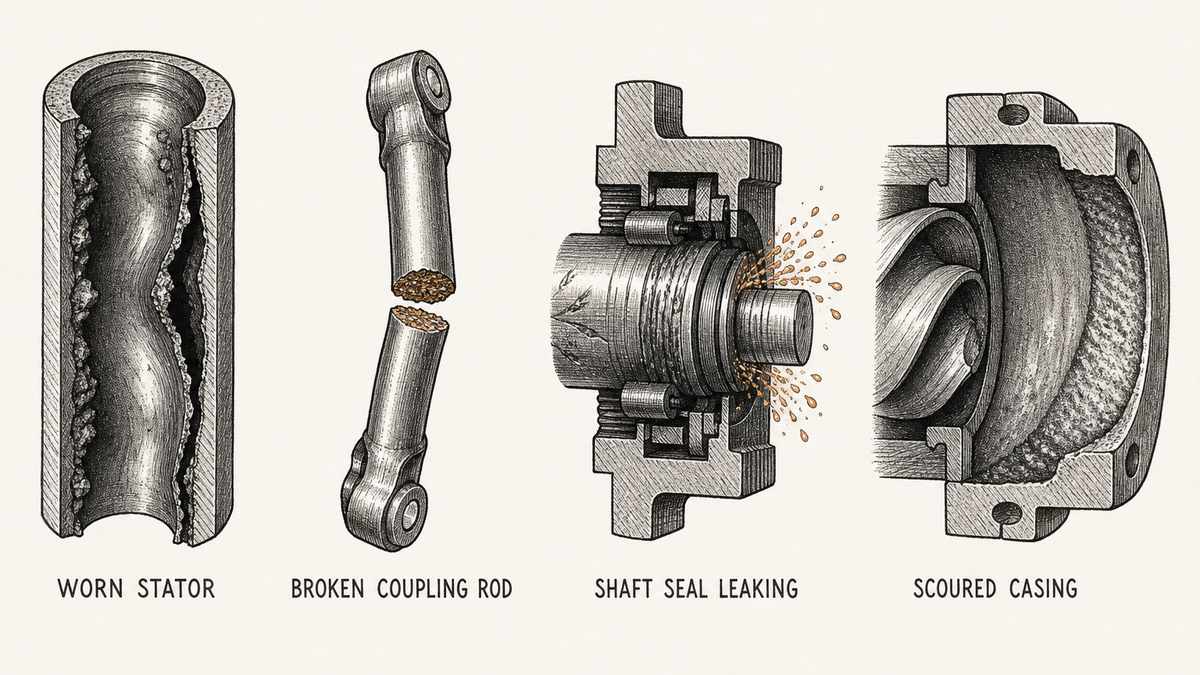
A stator made of the wrong rubber arrives with the pump, and fails like a service problem. This is the most damaging fault in the category because it spends three weeks looking like the plant's fault. A stator moulded from the wrong rubber swells, softens or hardens as soon as it meets the product, and by the time the flow drops the evidence is a torn stator that looks exactly like abrasion. The clues are in the paperwork and in the timing: a stator that fails in weeks rather than months, on a product that the specification named properly, points at the material. This is why the retained sample and the stated rubber grade matter more than they look.
A coupling rod that is not the specified steel arrives with the pump too. The rod is slender, it takes both the turning load and the orbiting movement, and it is where a jam shows up first. A rod made from an ordinary steel instead of the specified one looks identical and breaks at the neck behind a pin joint, with a fracture that is rough and grainy rather than stretched. If a rod breaks on a new pump and nothing jammed, ask what the rod is made from before you ask for a replacement rod.
A worn stator is built in service, and it is a speed and solids story. The bore opens out and goes smooth and polished in patches, then tears down one side, and the flow drops with it. The causes are the ones described earlier: too much speed for the product, more abrasive solids than the rubber was chosen for, or a stator that was chosen on price rather than on the product. The diagnostic detail is the pattern. Even wear all round points at speed and abrasion. Wear concentrated on one side points at a rotor that is not straight or a stator that is not sitting square in its housing, which is a build problem rather than a duty problem.
A seal that leaks is built in service, and it is usually a flush story. Liquid weeps past the sealing faces, the shaft beneath the seal ring galls and scores, and the leak gets worse quickly once the faces are scored. Three causes cover most cases: the seal was run dry, which is the same dry-running problem in a different place; the product reached the faces because there was no flush arranged and the product was abrasive or hardening; or the seal was set at the wrong working length, which is a fitting fault that a cartridge seal exists to prevent.
A scoured casing is the sign of a pump that has been eating itself. The metal is worn away in a crescent just downstream of the rotor, which is where liquid slips back past a stator that no longer seals, carrying abrasive product with it at speed. By the time the casing shows it, the stator has been worn for a long time and the pump has been run that way. It is the most expensive of these faults because it takes the casing with it, and it is the one that a flow reading would have caught months earlier.
Five Faults and Which Side Each One Is On
| The fault | What gives it away | Whose side it is on |
|---|---|---|
| Stator failed in weeks, not months | Failure timing far shorter than the duty should allow, on a product the specification named properly | The supplier's, if the rubber grade does not match the stated grade |
| Coupling rod broken with nothing jammed | A rough grainy break at the neck behind the pin joint, on a pump with no history of blockage | The supplier's, if the rod steel does not match the specified steel |
| Groove or scoring in the stator wall | Wear concentrated on one side rather than even all round | The supplier's, if the rotor is not straight or the stator is off square |
| Stator worn evenly and flow fallen away | Even polishing round the whole bore, on a duty with solids or a higher speed than agreed | The plant's, and the answer is a slower pump or a different rubber |
| Seal weeping and the shaft scored | Product found at the seal faces, or a pump that has been run with nothing in it | The plant's, unless the seal was fitted at the wrong working length |
| Casing scoured just downstream of the rotor | Metal worn away in a crescent where liquid has been slipping back past a stator that no longer seals | The plant's, and a flow reading would have caught it months earlier |
The way to use that table is to send a photograph and a description before sending a claim. A supplier who can tell the difference between a stretched break and a grainy one, and between even wear and one-sided wear, is a supplier worth keeping, and the answer arrives faster when the question is specific. A supplier who agrees to replace anything without asking a single question is not being generous; they are avoiding finding out what went wrong, and the next stator will fail the same way.
Price, MOQ and Lead Time: What Actually Moves the Number
This article does not quote prices, because a screw pump price with no duty, no material schedule and no drive attached to it is not information. What it can do is name the things that move the number, so that when two quotations differ by a factor you know which question to ask.
The stator rubber and the rotor surface. These two are the biggest single swing on a pump of the same size. A natural rubber stator with a plated rotor is the ordinary version. A fluoroelastomer stator with a ceramic rotor can multiply the cost of the pumping element alone, and it is worth it only when the product demands it. This is also the pair a keen quotation trims first, so the specification has to name both rather than leaving them to the factory.
The number of stages. More stages means a longer rotor, a longer stator, a longer casing and more machining, so pressure bought with length costs more than the same pressure bought with speed. That is the trade the price is telling you about, and it is worth taking the longer pump on a duty where the stator will be replaced more than once.
The seal and the flush arrangement. A packed gland is the cheapest option by a wide margin. A cartridge mechanical seal with a planned flush is several times that, and it is the right answer on a clean product or an abrasive one. Comparing two quotations without establishing which seal each contains compares nothing.
The casing material. Cast iron, stainless steel and a higher alloy are three different price bands, and the difference between the first two is a step rather than a slope. Say which wetted parts are to be which material, in writing, because this is where a quotation is easiest to make look cheaper than it is.
Whether the drive is included. A pump quoted without a motor, gearbox and coupling is not comparable with one quoted as a package. Neither is wrong, but the line has to be the same on both. The same applies to the guard, the dry-run device, the relief valve and the testing: each of them is an item somebody has to supply, and a quotation that leaves three of them out is cheaper rather than better.
The food-contact paperwork, if it applies. A stator with a test report behind it, gaskets with a statement, and a named food-contact grease all cost more than the equivalents bought without documents. On a food duty that difference is the product, not an overhead.
The spares. A stator and a coupling rod priced into the first order are the cheapest version of those parts you will ever buy, because they travel in the same crate under the same documents. Bought separately six months later they cost more and arrive after the pump has stopped.
Two commercial points are worth more than any price list. The first is to ask for the stator price separately, at three quantities: one, five and twenty. It tells you immediately what the stator really costs and how much of the pump price is the rubber, and it gives you a reference when you need a replacement in a hurry. The second is to ask what tooling a new stator size needs. A stator is moulded round a former, so a size the factory has never made needs a new former, and that cost sits on the first order whether it is itemised or hidden. A small order of an unusual size can look startlingly expensive for exactly that reason, and it becomes cheap once the quantity grows.
On lead time, the shape of the answer is simple and worth knowing before you strip a line. A standard pump built from parts the factory already has is quick. A pump needing a new stator mould is slower by the time it takes to make the former and prove the first moulding, which is the point at which a late order stops being a delivery problem and becomes a downtime problem. A pump needing a food-contact stator with documentation, or a special alloy casing, is slower again. Ask how long each of those steps takes at the enquiry stage, not after the order, and keep one spare stator on the shelf for the pumps you cannot afford to stop.
Questions Buyers Ask
How do I choose between a progressive cavity pump and a twin screw pump?
Ask what the product contains and what it must look like when it arrives. A progressive cavity pump carries a rubber stator, so it handles thick product, sludge and solids that will not pass through a tight clearance, and it is gentle because the parts touching the product move slowly. Its limits are a temperature ceiling set by the rubber and a strong dislike of running dry. A twin screw pump has no rubber in it, runs faster, gives a steadier flow and survives being run with nothing in it, but its steel screws run at a close clearance and a hard solid between them damages both. So: solids and thickness point one way, cleanliness and dryness the other. If the product has pieces that must not be broken, the third answer is a rotary lobe pump, where the two lobes never touch.
What does dry running actually do to a screw pump?
The rubber stator is cooled and lubricated by the liquid the pump is carrying, so with nothing in the pump there is nothing between a rotating steel rotor and a stationary rubber bore except friction. The contact line heats within seconds, the rubber surface goes glossy and then smears, a layer of rubber transfers onto the rotor and bakes there, and the bore tears. The pump then seals badly, the flow drops, and an operator who speeds it up makes it worse. A stator can be destroyed in a couple of minutes and cannot be repaired. The protection that works best is a temperature sensor in the stator wired to a trip, backed up by a level probe in the suction tank or the hopper, and the rule that the pump is never started against a closed discharge valve.
Why is my screw pump giving less flow than the figure on the quote?
Because the figure on the quote is almost certainly the maximum flow, measured with the discharge open and no pressure against it. As soon as the pump has to work against a real discharge line, some liquid slips back past the seal between rotor and stator, and the flow you get is lower than the headline number. The gap widens as pressure rises and widens faster as the stator wears. The figure to ask for is the flow at your working pressure, in writing. Two other things shave flow without anything being broken: a suction line that is too narrow for a thick product, which starves the pump at the inlet, and a pump running slower than the speed the flow figure was based on.
Which rubber should the stator be made from?
Three questions, asked together, decide it. What is the product chemically, because oils and solvents and acids each attack different rubbers. How hot is it, because the temperature ceiling is set by the rubber. And how abrasive are the solids in it, because that decides the hardness and the type. Natural rubber is the toughest against abrasion and the worst against oil. Nitrile is the oil-resistant one. EPDM is the water-and-chemical one and is common on food duties but poor with oil. Fluoroelastomer handles the widest range and costs several times more. A supplier who asks only what the product is called is guessing, and guessing is how a stator dies in three weeks. Ask for the rubber named by type on the order, not by the words food grade.
Is a screw pump self-priming?
Yes, in the sense that it will pull air out of a suction line and lift liquid up to itself, because the pockets it forms seal against each other and displace what is in front of them. That is a genuine advantage over a centrifugal pump, and it is why screw pumps are used on duties where the liquid is below the pump. Two conditions come with it. The suction line has to be the right size for the product, because a thick product cannot travel through a narrow pipe fast enough to fill the pocket, and a starved pump is partly running dry. And the pump has to be primed before its first start on a lift duty, because the first seconds of a screw pump's life are the ones most likely to damage a stator.
How do I check a screw pump supplier who says they are a manufacturer?
Ask four things and read the answers carefully. What steel is the coupling rod made from, and is the rotor hardened and how? Those two are the parts that save money invisibly and the ones a genuine builder knows off hand. Can they quote the stator separately at three quantities, which shows they know what their own rubber costs. Will they send a general arrangement drawing with the pump type, the number of stages, the stator rubber, the rotor surface and the seal arrangement on it before you order. And on a food duty, can they put the stator's rule paragraph and the food-contact statements for the grease and oil in writing. A factory that builds pumps answers all four from its own records. A trader answers the price and the delivery date and refers the rest upstream, which is a fine answer when it is given openly and a warning when it is not.
Send the product, the flow and the pressure — not just the pump size
Tell us what the pump has to move, then the lines that decide whether it will: the product and how thick it is, its temperature, and what solids it carries with their size; the flow you need and the pressure it has to push against, given as a pair, plus whether the flow must be adjustable while running; whether the pump may ever run with nothing in it, because that decides the protection rather than an accessory; the pump type and the number of stages, or the duty and let us settle the type; the stator rubber named by type and its hardness, and the rotor material and surface treatment with how hard it is; the casing and housing materials, and which wetted parts are to be stainless if that is what you need; the seal type, the face materials and whether it is a cartridge, together with the flush arrangement or a deliberate decision that there is none; the flange or clamp standard and the position of the inlet and outlet; whether the motor, gearbox, coupling and guard are in scope, and who takes the axial thrust; the dry-run device and the pressure relief with their settings; a spare stator, coupling rod and seal priced into the first shipment; and if the pump touches food, the stator's rubber grade with its rule paragraph, a written statement for the bearing grease and gearbox oil, and confirmation that the stator is cleaned before its first use. If a pump is already running and giving trouble, describe what happens and roughly when: whether the flow faded slowly or dropped at once, whether the wear on the stator is even all round or on one side, whether the stator failed in weeks rather than months, whether the coupling rod broke with nothing jammed, whether the seal weeps and what the shaft under it looks like. The pattern of the failure usually says which line of the specification was decided badly.
Request a Screw Pump Sourcing Quote
Questions & Comments
We read every one and reply within 24 hoursA progressive cavity pump is specified twice, once as a machine duty and once as a list of parts, and skipping the second is what produces a cheap pump that fails early. Tell us the fluid, the solids and the duty, and we will write both.