
Industrial Hose: Types, Ratings and Sourcing From China
 ·
Updated October 11, 2026
·
20 min read
Industrial hose is one of the few products where the whole specification is a single written line, and most buyers send two words of it. An enquiry that says “industrial hose, 1 inch, 50 metres” describes a shape, not a product. The same outside diameter can be built to carry air at low pressure with a textile braid, or fuel under a wire helix, or steam at temperature, or a food product through a lined bore — and the four are not interchangeable at any price. The gap between them lives inside the wall, where a buyer cannot see it, which makes hose unusually easy to buy badly and unusually easy to specify well. This guide covers the four hose families and what changes between them, what a hose is actually made of, how to write the specification line, why a hose fails at its end rather than in its middle, how the price is built, what goes wrong, how to check a supplier, and where a cheap quotation gets its money back.
What to Specify, by What Goes Through the Hose
| If the hose carries | Specify this | Because |
|---|---|---|
| Water or air on a general line | A rubber tube with a textile braid, and a working pressure given as a figure | This is the widest and most misused family, because “water hose” covers everything from a garden tap to a washdown line at pressure. The pressure figure is what separates them. |
| Fuel, oil or solvent | A tube made for that fluid, and a wire helix if the hose will be dragged or bent hard | The wrong tube is attacked from the inside by the fluid it carries, and the failure shows up as a hose that swells or collapses rather than one that leaks. |
| Steam or hot water | A temperature rating as a number, together with the pressure it holds at that temperature | A hose holds less pressure as it gets hotter, so a pressure figure quoted at room temperature is not the figure the hose runs at. The two numbers belong together. |
| A named chemical | The chemical, its concentration and the working temperature, written out in full | One hose survives one chemical and fails another, and the difference is not visible in the rubber. Nothing on a data sheet replaces naming the fluid you actually pump. |
| Food or drink | A liner made to the food-contact rule for the market you sell into, with the rule named | The bore is a food-contact surface, so the material question is a regulatory one rather than a preference, and the rule lists the materials rather than describing them. |
| Anything where a burst matters | Working pressure and burst pressure as two separate figures, plus the test pressure | The two numbers are usually stated in a fixed relationship, but only one of them is the pressure you run at. A quotation that says “high pressure” has told you nothing you can check. |
What Are the Four Hose Families, and What Changes Between Them?
The families are defined by the tube — the material on the inside, the one the fluid actually touches. Everything else follows from that choice: which reinforcement the tube needs, which cover protects it, and which end fittings hold it. Buyers who shop by outside diameter are shopping by the least important of the four layers.
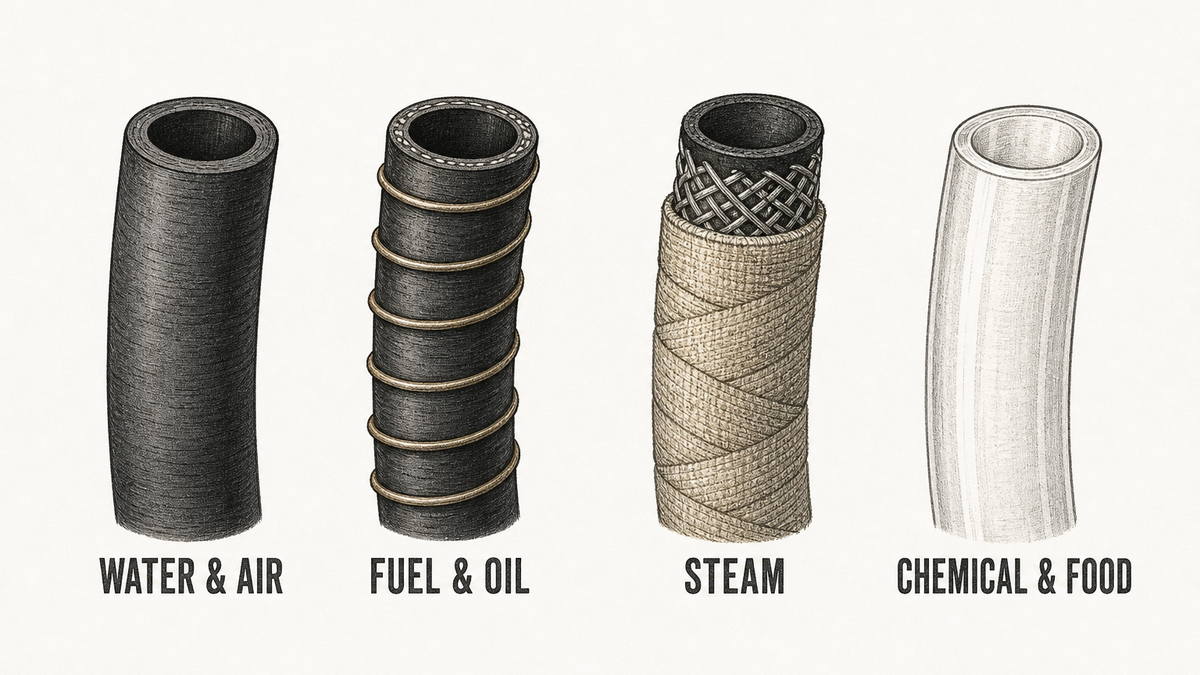
Water and air hose. The general-purpose family, and the one where most buyers start. A rubber tube with a textile braid for pressure and a rubber cover for wear. It is the cheapest of the four and the most forgiving, which is exactly why it is the family most often used outside its range — as a temporary fuel line, or on hot water, or at a pressure it was never made for. Nothing about the outside of the hose warns you that the tube inside is wrong for the fluid.
Fuel and oil hose. Here the tube is chosen for the fluid, and the common visible difference is a wire helix wound through the wall. The helix is what stops the hose flattening when someone drags it round a corner or runs a vehicle over it, and it is the feature buyers most often leave out of an enquiry because it cannot be seen in a photograph. Discharge hose is the sub-family to know about: it is built to let static and fluid out safely, and it is not the same product as a suction hose, which has to hold its shape against a vacuum.
Steam hose. Steam is the family that punishes loose language hardest, because the two ratings a steam hose has — temperature and pressure — are linked. Rubber softens as it heats, so the pressure a hose can hold falls as the temperature climbs. A supplier asked for a pressure without being given a temperature will quote the paperwork figure, and the hose will be run at a temperature where that figure no longer applies. This is also the family where a wrapped fabric cover shows up, because the outside is taking radiated heat rather than abrasion.
Chemical and food hose. The smallest and the most specified family. The tube may be a plastic rather than a rubber, and on food and drink lines the bore is a food-contact surface, so the material has to be one the market's rule allows. In the United States the relevant list for rubber articles intended for repeated use is 21 CFR Part 177, and the point for a buyer is that the rule names materials rather than describing performance — so “food grade” on a quotation is a claim, and a named material checked against the list is a specification.
If your hose has to carry pressure at the end of a machine rather than a fluid along a line, you are in the hydraulic family instead, and the specification logic changes enough to be worth its own treatment: hydraulic hose fittings are matched to a pressure system rather than to a fluid, and the fitting becomes the main decision rather than a detail.
What Is a Hose Actually Made Of?
Four parts, and only one of them is designed to be seen. A hose is a tube, wrapped in reinforcement, wrapped in a cover, and closed at both ends with a fitting. Each of the four has its own cost driver, its own failure mode and its own place in the specification, which is why a quotation that names only the diameter and the length has left three quarters of the product undefined.
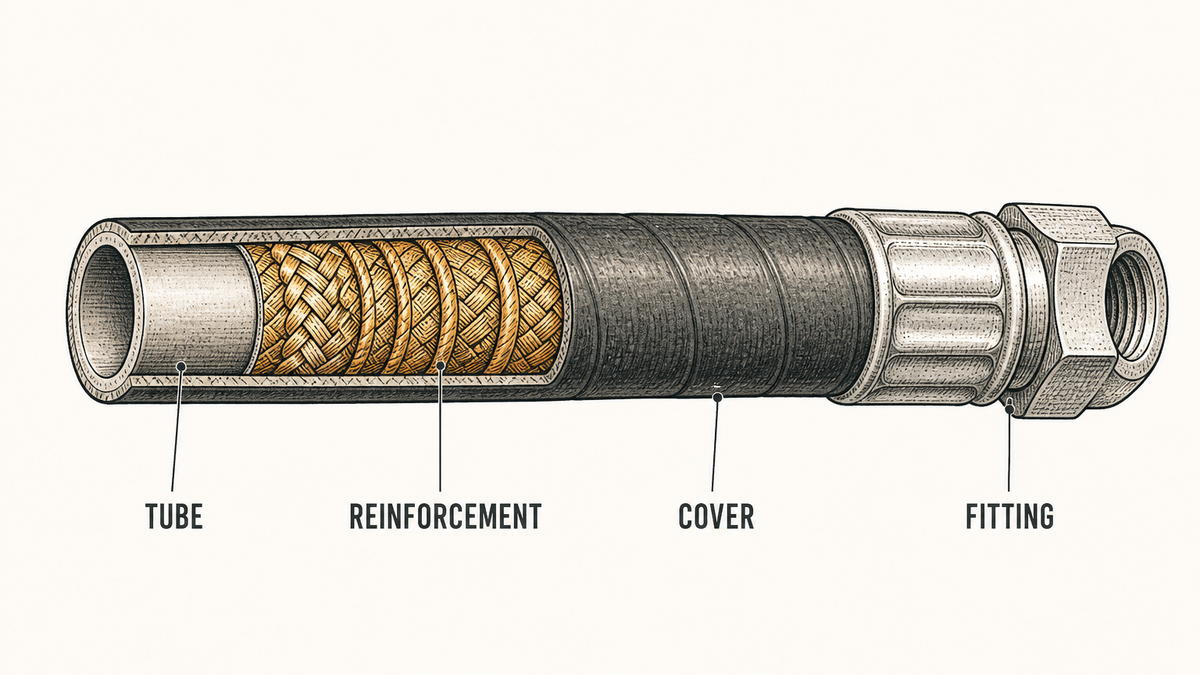
The tube is the inner layer, and it is chosen for the fluid, not for the pressure. This is the line that decides whether the hose is compatible with what you are pumping, and it is completely invisible from outside. When a hose fails from the inside out — swelling, softening, a bore that closes in — the tube was the wrong material for the job, and no amount of extra reinforcement would have saved it.
The reinforcement is the layer that holds the pressure, and it is the cheapest place to take something out of a hose. It can be a textile braid, a spiral of cord, or steel wire, in one layer or several. Its construction is not visible on the finished hose, and two hoses of the same diameter can carry quite different working pressures because of it. This is the line to ask about as a number: how many layers, of what, and what working pressure the finished hose is rated to.
The cover is the outer rubber, and it exists to protect the reinforcement from the world — abrasion, sunlight, oil on the floor, heat from outside. It carries no pressure and touches no fluid, which is exactly why a thin cover is an easy saving on paper and an expensive one in service. Cover damage matters more than it looks: once the cover is breached, the reinforcement underneath is exposed, and a hose whose reinforcement is exposed is a hose whose rated pressure is now an assumption.
The end fitting is the fourth part and the one buyers treat as an accessory. It is not. On a hose, the fitting is usually made by a different company from the hose, attached in a separate operation, and it is where a hose most often fails. That is the next section but one, and it is the single most useful thing to understand about this product.
One structural point is worth stating because it explains why hose sourcing behaves differently from hose buying. On a conveyor belt, the layers are flat and the weak point is the joint at the ends. On a hose, the layers are concentric and the weak point is the joint at the ends too — but on a hose the joint is a third-party part rather than an operation, so the quality of your hose depends on a supplier you never chose. The belt industry has its own approach to the same problem, which is why belt buyers end up asking about the splice in a way that the conveyor belt version of the same question looks familiar even though the two products share nothing else.
How Do You Write a Hose Specification?
Eight lines, and the first one is not the diameter you were about to write down. A hose that is bought on the outside diameter alone has been bought on the layer that carries nothing.
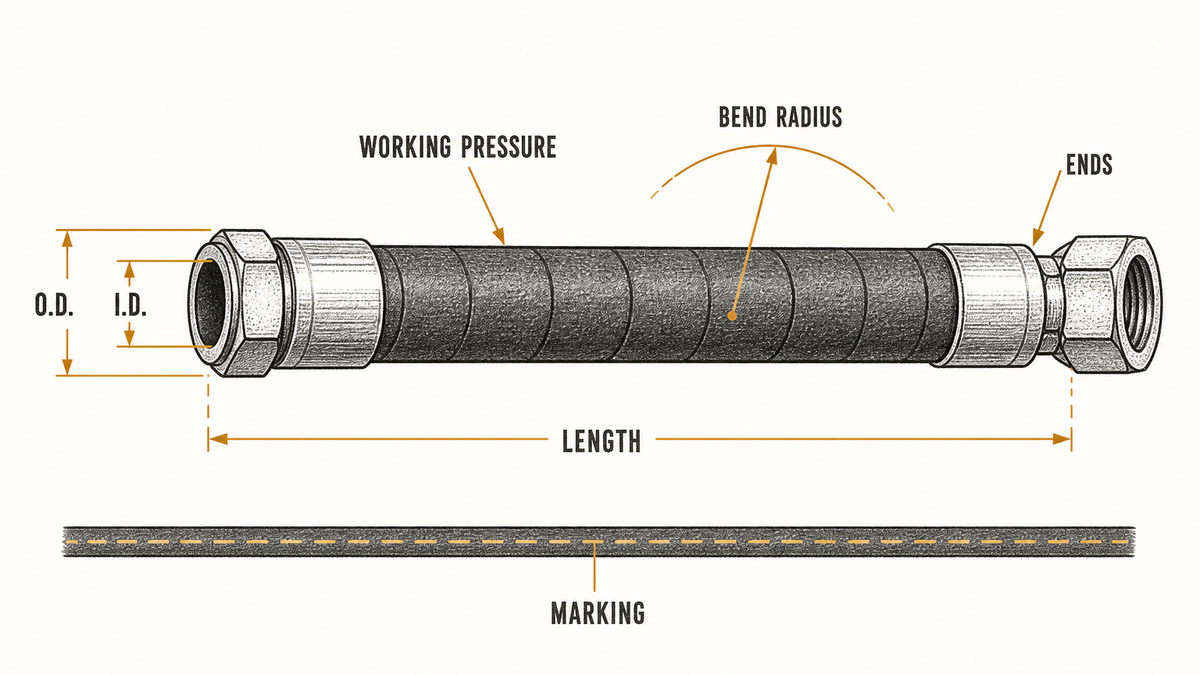
The inner diameter, not the outside. The bore is what your fluid flows through and what your fitting has to match. The outside diameter includes the wall, and it grows with the cover, so the same bore can measure differently outside depending on how the hose was built. Write the bore, and write it as the fitting size you need to connect to.
The tube material, or the family by name. Water and air, fuel and oil, steam, chemical, food — the family defines the tube. If the fluid is anything other than plain water or air, name it. A supplier told “oil” will choose a tube for oil; a supplier told “degreaser” needs the actual product, because two degreasers can sit at opposite ends of what a rubber tube tolerates.
The reinforcement. How many layers, of what. Textile braid, spiral cord and steel wire are different products at different prices and different pressures, and none of them is visible on the finished hose. Ask for the layer count and the material, and ask what working pressure the finished wall is rated to — the two answers belong together.
The working pressure, with a temperature attached. A pressure figure on its own is incomplete, because the pressure a rubber hose holds falls as the temperature rises. Write both, and if the hose sees more than one temperature in service, write the highest. Where the application involves people or equipment, this is also a safety line rather than a commercial one: the OSHA rule for fuel-gas and oxygen hose at work, 29 CFR 1910.253, treats the hose and its connections as part of the equipment rather than as a consumable.
The temperature range, as two numbers. Ask for the lowest and the highest temperature the hose is made for, not a phrase like “heat resistant”. A hose that is fine at working temperature can be ruined by a cleaning regime at a higher one, and washdown is the most common way a hose spends most of its life outside the range it was quoted for.
The minimum bend radius. Every hose has a tightest bend it can take before it flattens, and it is a figure rather than a judgement. A hose bent past that radius kinks at the fold, the bore closes, and the fold is now the weakest point on the whole length. If the hose has to run round a corner or follow a moving machine part, give the supplier the tightest radius in your installation and ask whether the hose is made for it.
The ends, described fully. Fitting type, material, size, and how it is attached to the hose. That is four decisions on the part that most often fails, and the next section is about why.
The length and the marking. Coil length, and what has to be printed along the hose. This last one is worth more than it looks. Hose is normally marked continuously along its length with its bore, its working pressure, the standard it was made to and who made it, and that marking is what allows you to inspect a delivery without cutting it open. A hose that arrives with no marking cannot be identified afterwards, which means a reorder cannot be matched to it and a failure cannot be argued. Put the marking on the order as a requirement with the date of manufacture included, and you have given yourself a permanent record that travels on the product.
Why Does a Hose Fail at Its End Rather Than in the Middle?
Because the middle is made by the hose factory and the end is usually made by somebody else. An end fitting is normally a bought-in part, fitted in a separate operation on a separate machine, and it is the place where a hose most often lets go. This is the same structural problem that runs through a lot of Chinese manufacturing: the part that decides whether the product works is not made by the company you are buying the product from.
There are three ways to attach a fitting, and they are not equally reliable. The permanent ones are crimped or swaged: the fitting has a metal collar, called a ferrule, which is squeezed onto the hose by a machine so that the hose wall is compressed between the ferrule and the fitting's insert. The reusable ones have an interlocking body that can be taken off and refitted. The field-fitted ones are held on with a band or a clamp. Crimped and swaged ends are the default for anything under pressure, reusable ends suit an application where the hose is changed often, and clamped ends belong on low-pressure lines only.
The ferrule is matched to the hose, and this is where it goes wrong. A ferrule is sized for a particular bore and a particular wall construction. Put a ferrule sized for one hose onto a hose with a thicker cover or a different braid and the crimp will hold on paper and fail in service, because the machine was set for a wall thickness that is not there. This is why a hose can be perfectly made and still blow its end off: the mistake was in the pairing, not in either part.
The assembly rating is the lower of two ratings. The hose has a working pressure and the fitting has a working pressure, and the assembly you install is only as strong as the weaker of the two. A high-pressure hose with a standard fitting is a standard assembly. So when a quotation gives you one pressure figure for the hose, ask what the finished assembly is rated to, because that is the number that applies to the product you are installing.
Then ask who does the crimping, and with what. The setting on the crimping machine — how far the ferrule is squeezed — is a number that has to be right for the hose and the fitting together, and it is usually taken from a table the fitting maker publishes. A supplier who crimps by feel, or who crimps in a different workshop from the one making the hose, is a supplier whose assemblies cannot be relied on to repeat. Ask for the crimp setting, and ask whether they keep a record of it per batch. The answer tells you more about a hose supplier than any certificate.
How Is a Hose Price Built?
Seven lines, and a single unit price hides all of them. The two that surprise buyers most are the fitting — a bought-in part that does not get cheaper because your hose order is bigger — and the packing, because a hose is bulky for its weight and awkward to stack.
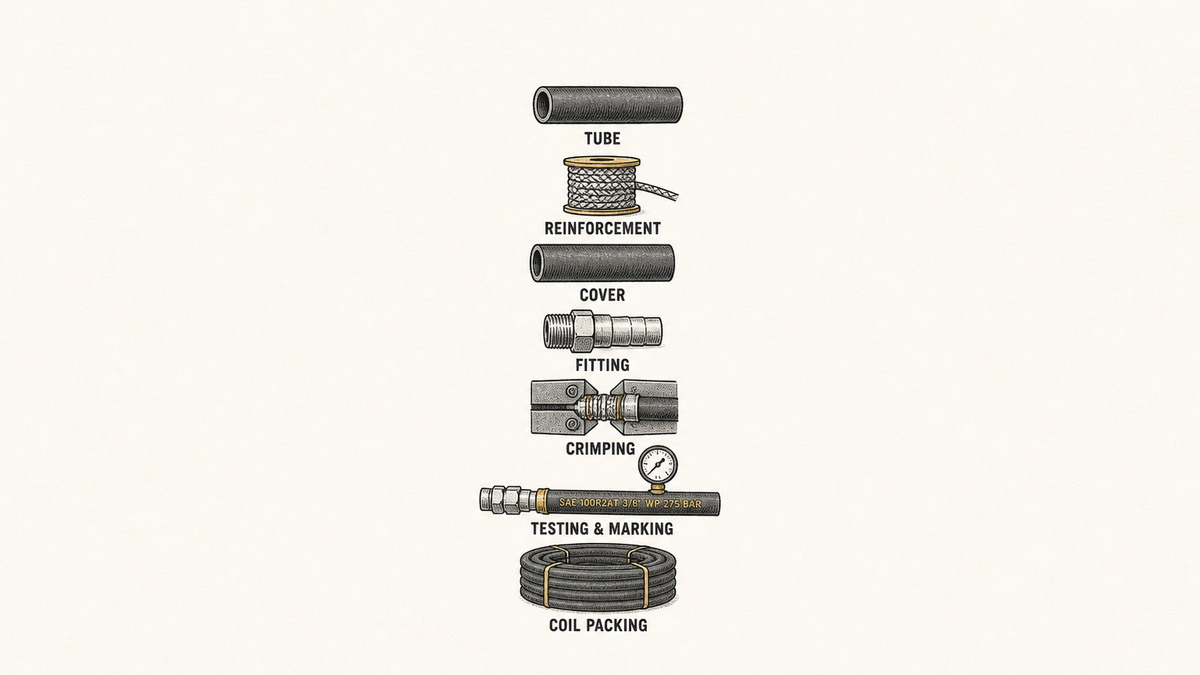
The tube. Priced by the material and by the wall thickness, and it scales with the bore and the length. A lined bore — a plastic liner inside a rubber tube for chemical or food duty — is a different line at a different price, not an upgrade on the same one.
The reinforcement. Priced by how many layers and what they are made of. This is the line that quietly changes the working pressure of the finished hose, and it is invisible on the product, which makes it the first line to move when a price has to come down.
The cover. Priced by material and by whether it is a plain rubber cover or a wrapped fabric one. A wrapped cover costs more and takes more labour, and it buys you resistance to heat and to rubbing rather than to pressure.
The end fitting. Typically a bought-in part from a fitting maker, so it carries its own minimum order and its own lead time, and it does not scale down with a small hose order. It is also the line where a cheap quotation finds room: the fitting can be swapped for a lighter grade or a different maker without the hose changing at all.
Crimping. Labour and a machine setting. Cheap to do, expensive to do wrong, and impossible to see afterwards — a bad crimp looks exactly like a good one until the assembly is under pressure.
Testing and marking. A proof test at a pressure above the working pressure, done on a sample or on every length depending on what you asked for, plus the printing along the hose. Ask which of the two you are buying, because a hose supplier who tests a sample per batch and one who tests every length are offering two different products at two different prices, and only one of them protects you against a bad crimp.
Coil packing. A hose is coiled, bound and often wrapped, and the coil diameter and the weight per coil decide your freight. Because hose is dense rather than bulky, a container of hose runs into its weight limit before it runs out of space, and the point at which a shared container stops making sense arrives earlier than it does for light goods — the crossover is calculated the same way as for any dense product, as set out in full or shared container for an industrial hose. And the unit price is only the start of what you actually pay; the lines between the quotation and the delivered invoice are worked through in what an industrial hose order costs once landed.
Two further points belong to the order rather than the hose. First, most of these lines carry a minimum run, so at low volume the tooling and setup sit on top of every metre and at high volume they disappear into it — which means a small order quoted without setup shown separately is a price you cannot compare with anything. Second, ask for the date of manufacture on the marking. Rubber ages, and hose that has sat in a hot warehouse for two years is a different product from hose made last month, even though nothing on the invoice has changed.
What Goes Wrong?
Four failures, and the order they happen in is instructive: two of them occur before the hose has carried anything, and one of them cannot be seen at all until the hose is cut open or put under pressure.
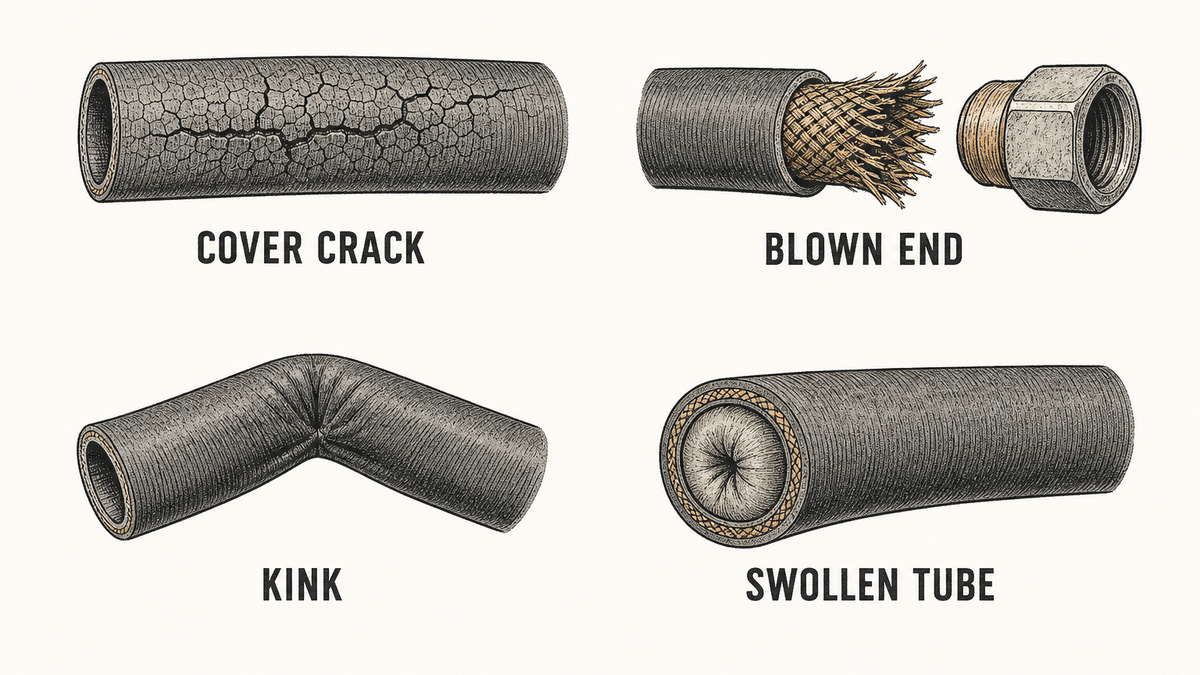
Cover cracking. The outer rubber splits into a network of fine cracks, usually starting at the point where the hose is coiled tightest, and it happens to hose sitting in storage as readily as to hose in service. Sunlight, ozone from nearby electric motors and simple age all contribute, which is why storage conditions belong on the specification and why the date of manufacture is worth asking for. A cracked cover has exposed the reinforcement, and an exposed reinforcement is a hose whose pressure rating you can no longer rely on.
A blown end. The fitting comes off under pressure, taking a length of reinforcement with it. This is the failure that injures people, and it is almost always one of three causes: a ferrule matched to a different hose, a crimp set for the wrong wall thickness, or an assembly put together on site without the right machine. Note that none of those three are a defect in the hose — which is why a hose certificate will not save you from this one, and why the crimping record is the document that matters.
A kink. The hose is bent past its minimum bend radius, the wall collapses at the fold, and the bore closes. A kink does two things at once: it starves whatever is downstream of flow, and it turns the fold into a fatigue point where the reinforcement works against itself every time the line is used. A hose that keeps failing at the same place on a machine is usually a routing problem rather than a hose problem, and the fix is a longer hose or a bend radius figure on the order rather than a stronger hose.
A swollen tube. The bore closes in, the flow drops, and the hose becomes stiff or spongy. This one is the tube being the wrong material for the fluid, and it is the failure that no amount of reinforcement, cover or fitting quality can prevent. It is also the failure that starts earliest and shows latest, because the attack happens on the inside where nobody looks, and the visible symptom — reduced flow — is usually blamed on a pump.
The fifth failure does not damage the hose and still costs you the order. It is a delivery that arrives with no marking, or with marking that rubs off in the first week of use. Without a readable marking line you cannot tell which hose this is, which pressure it was rated to, who made it or when, so you cannot match a reorder to it and you cannot make a claim against it. It is the cheapest requirement on the whole specification to write down and the most annoying one to have left out, and it belongs on the order rather than in a photograph of the sample.
How Do You Check a Hose Supplier Before You Commit?
Start with the question that sorts the makers from the resellers, and make it a specific one: what is the layer count and the material of the reinforcement in this hose, and what working pressure does the finished wall carry? A hose factory makes its own tube, applies its own reinforcement and its own cover, and can answer that from its own production record. A company that buys finished hose and cuts it cannot, and will answer with the hose's grade name instead. That is an honest answer and a different one, and it should be priced as what it is. The general method for telling the two apart is the same for any product and is set out in telling an industrial hose maker from a reseller.
Ask which of the four parts are made in house and which are bought in. A hose factory will usually be honest about the fitting, because fittings are a separate trade. What you are looking for is not that they make everything, but that they know who makes the rest and can name them. A supplier who cannot tell you who makes the fitting on their own hose cannot control the part that fails most often.
Ask who crimps the ends, and in which building. This is the single most useful question about this product. If the hose is made in one place and the ends are crimped somewhere else, then the assembly you receive is the output of two companies and neither one is responsible for the result. If crimping happens in house, ask what the machine setting is and whether it is recorded per batch. A recorded crimp setting means the supplier has an answer for a blown end; a supplier who crimps by feel has only an apology.
Ask what the proof test covers. Two very different products come out of this question. One supplier tests a sample from each batch. The other tests every finished assembly. Both will say “we test”, and only one of them catches a bad crimp on the hose you actually receive. Ask for the test pressure as a figure, and ask what happens to a length that fails — a supplier who scraps it and a supplier who reworks it are telling you two different things about their process.
Ask exactly what the marking line will say. Bore, working pressure, the standard the hose was made to, who made it, and the date of manufacture. Get a sample of the actual marking, not a description of it, because marking that rubs off in the first month is worse than no marking at all — it looks like a labelled hose and behaves like an anonymous one. This is also the line that lets you inspect a delivery without cutting the hose open, so it is worth more than any document that stays in an office.
Check the certificates against the issuers, not the scans. Where a supplier offers a management-system certificate or a material certificate, look it up in the issuer's own record rather than trusting the file, using the same approach as the industrial hose certificate, checked in the certifier's own register. A certificate that belongs to a different company is worth discovering before the deposit rather than after a failure.
Inspect before it ships, and treat it as a measurement job. What to check on a hose delivery is bore against the order, wall thickness, coil weight, whether the ends are crimped square to the hose, whether the marking is legible and complete including the date of manufacture, and whether the coiled hose has taken a set or kinked at the ties. Take a length from the delivery and put it under proof pressure yourself rather than trusting the batch record. None of that shows in a photograph, so a check that measures and pressure-tests is the only version that tells you anything, and the coil count settles how many coils to open. Measure first, photograph second.
Where Does a Cheap Hose Quotation Get Its Money Back?
A cheap hose quotation is usually a real price for less material, less testing or a cheaper end, and on this product the customer cannot see any of the three from outside. Seven lines go missing, and the last two are the ones that cost you the most because they are almost impossible to detect at the receiving dock.
- Reinforcement layers. One layer fewer, or a lighter cord, at the same outside diameter. The hose looks identical, coils the same way and has none of the pressure capability it was supposed to have. Because the reinforcement is the only layer that carries the load, this is the saving with the worst consequences per yuan saved.
- The cover. A thinner outer rubber at the same colour and finish. It wears through sooner, and once it is through, the reinforcement is exposed and the rated pressure becomes an assumption rather than a specification.
- The tube compound. Cheaper rubber, or more recycled material in the mix. This is the line that decides whether the hose survives your fluid at all, and the failure is invisible — a tube that swells from the inside shows up as reduced flow at the far end of the line, months later.
- The end fitting. A bought-in part, so it can be swapped for a lighter grade or a different maker without the hose changing at all. This is the equivalent of a cheap clasp on a piece of jewellery or a cheap magnet on a box: the small part that decides whether the product works, and the easiest one to change quietly.
- The crimp and the proof test. Crimping without a recorded machine setting, and testing a sample per batch rather than every assembly. You cannot see either from the outside, and both of them show up as a fitting that comes off under pressure rather than as a hose that looks wrong.
- The marking. The cheapest requirement on the whole specification to leave off and the hardest to spot until it matters. A hose with no readable marking cannot be matched to a reorder, and a failure cannot be argued against a batch, a pressure rating or a date.
- The coil packing and the date. Ties pulled too tight, no end caps, and stock that has been in a warm warehouse for a long time before it ships. Coiled too tightly, a hose takes a set and arrives with a kink waiting at the fold; shipped without a date, you have no way of knowing how much of its storage life is already gone.
The way to close those seven lines is to put them on the enquiry rather than argue about them afterwards, and to make the quotation show them: the bore and the wall construction, the tube material by name, the reinforcement layer count and material with the working pressure of the finished wall, the temperature range as two numbers, the minimum bend radius, the end fitting by type, material and size with the crimp setting and whether it is recorded, what the proof test covers and at what pressure, and what the marking line will carry including the date of manufacture.
One closing point about this product in particular. Hose is bought as an accessory and installed as equipment. It arrives coiled on a pallet, looking like a consumable, and then it sits on a machine where a failure can hurt somebody. That mismatch is why this category rewards a buyer who writes numbers on an enquiry more than almost any other, and why the two lines worth the most attention are the ones that are hardest to see: how many layers are in the wall, and who put the end on.
Frequently Asked Questions
What is the difference between a suction hose and a discharge hose?
Direction of load. A discharge hose pushes fluid out, so its wall has to hold pressure, and its reinforcement is designed for that. A suction hose is pulled on from the inside, so its wall has to resist collapsing under vacuum, which is a different structural problem and usually needs a wire helix or a rigid element. A hose built for one duty will often work for the other on a light, low-risk line and will fail early on a real one. If the hose has to do both on the same machine — suction on one side of a pump and discharge on the other — say so and expect two different hoses rather than one compromise.
How do I know what pressure a hose should be rated to?
Start from the highest pressure the line actually sees, not the normal running pressure, because pumps and valves produce short peaks that a gauge does not show you. Then ask the supplier for two figures rather than one: the working pressure and the burst pressure. The relationship between them is fixed by the maker and by the standard the hose is made to, so ask for both rather than assuming a rule of thumb, and ask what proof pressure was applied to the lengths you are buying. Then compare the working pressure against your highest peak and not against your average, because the average is the number that a hose appears to handle right up until the day it does not.
Can I use one hose for water and for fuel?
Not as a specification, even though it will often appear to work. The tube is chosen for the fluid, so a hose made for water has a tube that has not been selected for fuel, and the failure mode is an attack from the inside that takes weeks or months to become visible. The practical risk is not that the hose bursts — it is that the tube softens, the bore swells, flow drops and the fault gets diagnosed somewhere else entirely. If a line genuinely has to handle more than one fluid, list all of them on the enquiry with their concentrations and working temperatures, and let the supplier choose one tube that suits the worst of them rather than one that suits the most common.
Why did the end fitting come off my hose?
Almost always a pairing problem rather than a defect in either part. A ferrule is sized for a particular bore and a particular wall construction, so a ferrule made for one hose fitted to a hose with a thicker cover or a different reinforcement will crimp on paper and let go in service, because the machine was set for a wall thickness that is not there. The other two causes are a crimp set to the wrong dimension and an assembly put together by hand without the correct machine. None of the three is visible from outside, which is why the questions that prevent this one are asked before the order: who crimps the ends, and is the setting recorded per batch.
Does industrial hose have a shelf life?
Yes, and it is the reason the date of manufacture belongs on the marking. Rubber ages whether or not it is used, and the things that age it fastest are heat, sunlight and ozone from electrical equipment, so a coil that has spent two years in a warm warehouse near motors is a different product from one made last month even though the invoice reads the same. The practical consequence is twofold: store hose cool, dark and away from electric motors rather than high on a rack near the roof, and ask for the manufacture date so that what you are receiving is hose rather than stock. A supplier who cannot tell you when a batch was made is a supplier whose older coils will find their way into your order.
What should be printed along an industrial hose?
At a minimum the bore, the working pressure, the standard the hose was made to and who made it, with the date of manufacture as the line worth insisting on. The marking matters more than it appears to, because it is the only part of the specification that travels with the product and can be read without cutting the hose open. It lets the person receiving a delivery check what arrived against what was ordered, it lets you match a reorder to the hose already on the machine, and it lets you trace a failure back to a batch and a date rather than to a supplier who has moved on. Print quality is part of the requirement: marking that wears off in the first month is worse than none, because it looks like an identified hose and behaves like an anonymous one.
Send the fluid, the pressure and the temperature — not just the diameter
Tell us what the hose carries and how hard it is worked, and then the lines that decide whether it survives: the bore and the wall construction, the fluid by name with its concentration, the tube material or the family, the reinforcement layer count and material with the working pressure of the finished wall, the temperature range as two separate numbers, the minimum bend radius in your installation, the end fitting by type, material and size, who crimps the ends and whether the machine setting is recorded per batch, what the proof test covers and at what pressure, the coil length and weight per coil, and the marking line including the date of manufacture. Add your target volume and where the hose is used. Those answers settle the tube, the wall and the end before a price means anything. We will come back with the factories whose tube compound, reinforcement and crimping actually match your application, the specification written as figures rather than adjectives, the seven cost lines shown separately so quotations become comparable, a sampling plan built around measuring the bore and proof-testing a length rather than photographing the coil, and a clear statement of which part owns which failure on what you are buying.
Request an Industrial Hose Sourcing Quote
Questions & Comments
We read every one and reply within 24 hoursComparing industrial hose quotations that all say the same thing? Post the fluid, the working pressure with its temperature, and who crimps the ends, and we can usually say which lines are missing from them. If a hose has already let go, describe where it failed — at the fitting, at a fold, or from the inside out — and roughly how long it lasted, because the location and the timing together usually say whether it was the tube, the wall or the end.