
Hydraulic Pump Manufacturer Guide: Types, Displacement, Mounting and Testing
 ·
Updated October 10, 2026
·
21 min read
A hydraulic pump is the cheapest part of a hydraulic system to buy and the most expensive to get wrong, because most pump failures are not pump failures at all. The pump does not make pressure — it makes flow, and pressure is what the resistance of the system does with that flow. So a buyer who orders a pump by pressure rating has specified the vessel and not the duty. Three other things decide whether the part works: the displacement and the shaft speed that together set the flow, the mounting interface that decides whether it bolts on at all, and the cleanliness of the oil it will spend its life in. This guide covers which pump type suits your circuit, how displacement and speed set the flow, what has to match on the mounting flange and the ports, why a seal kit is not a rebuild, what a test actually proves, and where a cheap quotation takes its money back.
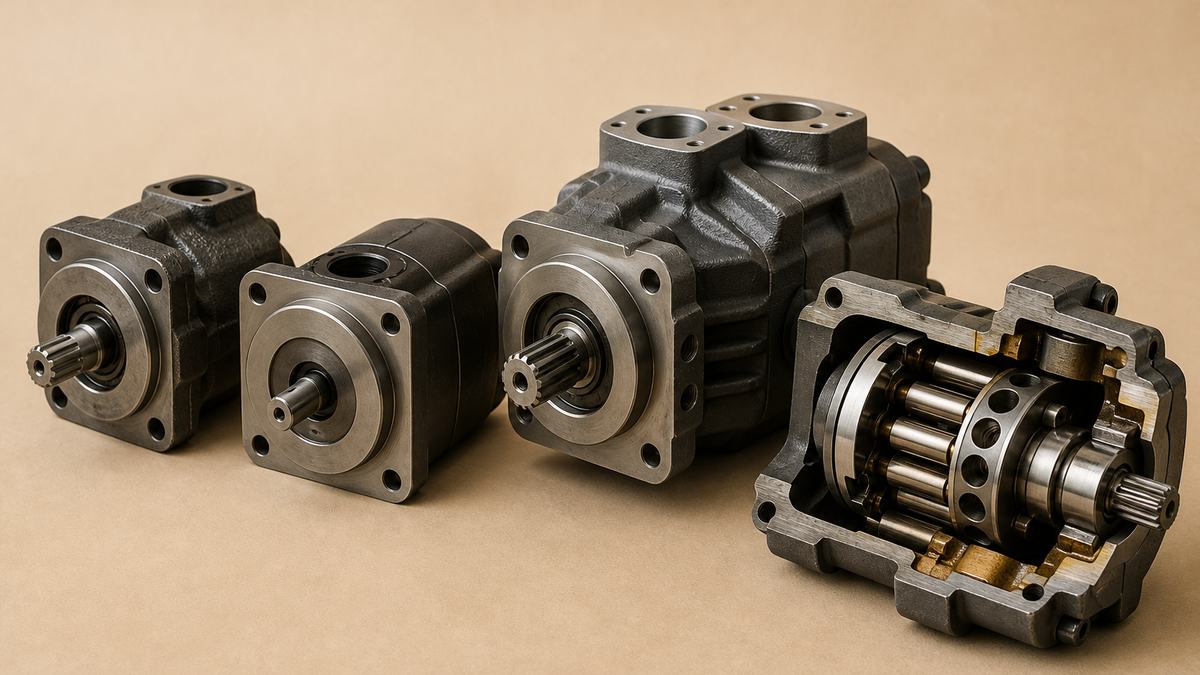
What Each Choice Actually Buys You
| If your situation is | The choice that follows | Why it is the right trade |
|---|---|---|
| Simple circuit, modest pressure, cost matters | External gear pump, fixed displacement | The cheapest and the most tolerant of rough handling, and a fixed flow is all a simple circuit needs |
| Quiet running at medium pressure | Vane pump | Smoother flow and less noise than a gear pump, and some designs can be made to vary their output |
| High pressure, or a flow that has to change with demand | Axial piston pump | The only family that reaches high pressure efficiently, and the one that can vary displacement to match the load |
| Several functions on one machine, all needing flow at once | Variable displacement, load sensing | The pump delivers what the circuit asks for at that moment instead of sending the surplus back through a relief valve as heat |
What Is a Hydraulic Pump, and What Actually Decides Its Price?
A hydraulic pump takes mechanical power from a shaft and converts it into flow. It moves oil; it does not create pressure. Pressure appears only because that oil meets resistance somewhere downstream — a cylinder holding a load, a valve that is nearly closed, a relief valve doing its job. This single fact is why pump sizing is done by flow and not by pressure, and why a buyer who asks for a pump by pressure alone has described the wrong half of the requirement.
What you pay for sits in four places:
- The family and its internal clearances
- Gear, vane and piston pumps cost different amounts because they are held to different internal clearances, and those clearances are what set both the pressure the pump can hold and how much it leaks internally. A piston pump is expensive because its parts fit closely, not because it contains more metal.
- The displacement and whether it can vary
- Displacement is the volume the pump moves in one revolution, and it is the number that sets the flow once you know the speed. A fixed pump always moves the same volume per turn; a variable pump can change it, which is a different and more expensive machine.
- The mounting interface
- The flange pattern, the shaft, the port threads or flanges and the direction of rotation all have to match your existing drive. The interface is not a detail: the same pump body is sold with several different mounting sets, and the wrong one is a pump that cannot be fitted.
- Testing and the internal parts
- Two pumps can look identical and differ in the grade of the internal parts and in whether the finished unit was run on a test stand with a recorded result. For a pump going into a production machine, that record is part of the product.
The useful habit is to treat the pump as the last decision rather than the first. The circuit decides the flow, the load decides the pressure, the machine decides the mounting, and only then does a pump family follow. If you are buying fluid-power parts from China, the same logic of fixing the interface before ordering is set out in hydraulic fittings sourcing, where a thread form that nobody wrote down is discovered by a fitter rather than by a drawing.
Which Pump Type Does Your System Need?
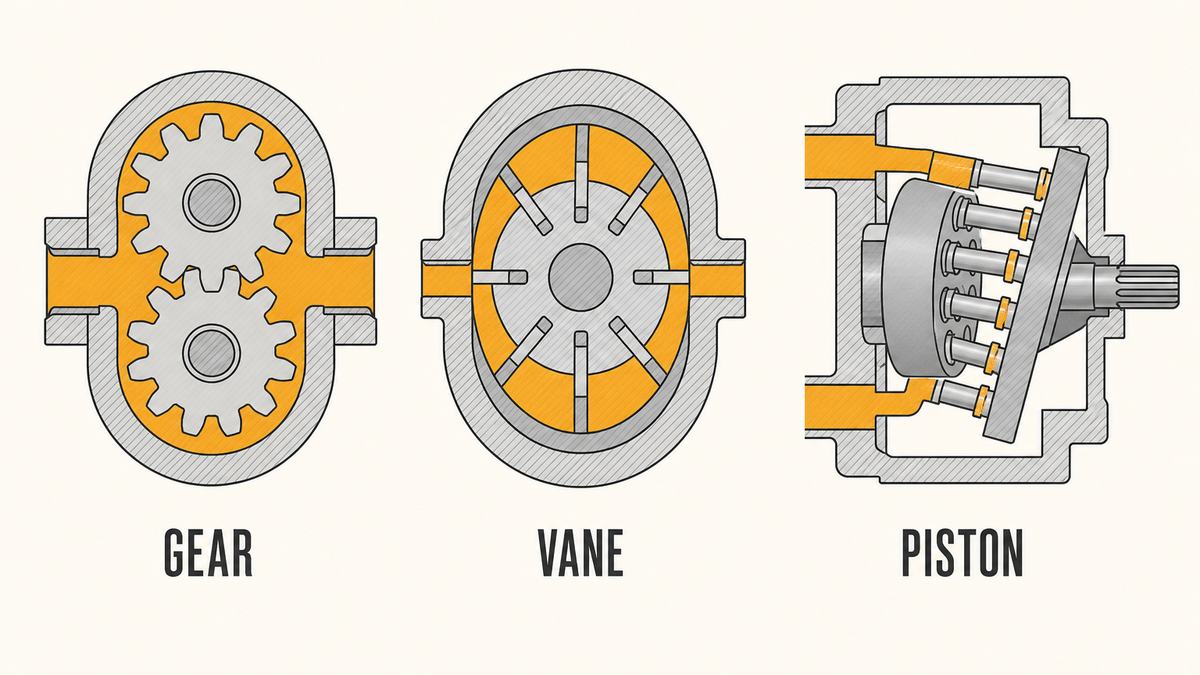
Three families cover almost everything you will be quoted, and they are separated by how tightly the moving parts fit and therefore by how much pressure they can hold.
- Gear pumps
- Two meshing gears turn inside a casing and carry oil around the outside of the teeth. There is nothing to adjust and very little to go wrong, which is why they are the cheapest and the most common. The trade is that the flow is fixed and the internal leakage rises quickly as the clearances wear, so the pressure ceiling is the lowest of the three. They also tolerate a dirty system better than the others, which makes them the usual choice where the machine is simple and the oil is not perfectly managed.
- Vane pumps
- Sliding vanes sit in slots in a rotor and are thrown outward against a ring as the rotor turns, trapping oil between the vanes. Flow is smoother and quieter than a gear pump, and pressure capability is higher. Because the ring can sometimes be moved, a vane pump can be built as a variable unit, which is where its real advantage appears.
- Piston pumps
- Pistons run in a cylinder block, driven either by a swashplate at an angle or by a bent axis, and each stroke moves a measured volume. This is the family that reaches high pressure efficiently, and the family where variable displacement is normal rather than special. It is also the most expensive, the least tolerant of contamination, and the one that most repays buying well.
The second decision is whether the displacement is fixed or variable, and it is often confused with the first. A fixed pump moves the same volume per revolution no matter what the machine is doing. If the machine needs less flow, the surplus goes back through a relief valve and becomes heat. A variable pump reduces its own displacement to match demand, so it spends less energy and makes less heat. For a machine with one function running at one speed, that difference is small. For a machine with several functions and a lot of idling, it is the difference between a warm system and a hot one.
Displacement, Pressure and Flow: the Three Numbers on the Datasheet
The datasheet gives three numbers and buyers regularly mix them up, so they are worth separating once.
Displacement is the volume of oil the pump moves per revolution, and it is a property of the pump's size. Flow is what you actually get, and it is the displacement multiplied by the shaft speed, less whatever leaks internally. Pressure is not produced by the pump at all — it is the resistance the circuit presents, and the pump's rating is the maximum it will survive.
Two consequences follow, and both cost buyers money:
- Speed sets flow, so a pump on the wrong shaft speed delivers the wrong flow. A pump rated at a given displacement produces its rated flow only at its rated speed. Drive it slower and you get less flow; drive it faster than its limit and you get cavitation, noise and a short life. If your machine has a fixed input speed, the displacement has to be chosen to suit that speed rather than the other way round.
- Buying a higher-pressure pump does not make the system stronger or faster. The pressure the pump sees is set by the load, and the flow it delivers is set by its displacement and speed. If the machine is too slow, the answer is more flow — a larger displacement or a higher speed — not a higher pressure rating. If the machine is too weak, the answer is usually in the cylinder or motor sizing and the relief valve setting. A bigger pressure number on the pump nameplate buys nothing until the rest of the circuit can use it.
There is one more number that belongs on the drawing even though it is easy to leave off: the pressure rating has a continuous value and a peak value, and they are not the same. A pump run continuously at its peak rating will not last as long as one run at its continuous rating. When you compare quotations, check that both suppliers are quoting the same rating, because one may be quoting the number the pump survives and the other the number it works at.
Mounting, Shaft and Ports: What Has to Match
The same pump body is sold with several different mounting sets, and the mounting set is what decides whether the pump can be fitted to your machine. Four features have to match, and every one of them can be got wrong while the pump looks correct on a bench.
- The flange pattern and pilot
- The pump bolts to a bell housing or a bracket through a flange with a set bolt pattern and a locating pilot diameter. Both dimensions matter: a flange with the right bolt holes but the wrong pilot will not centre, and a pump that is not centred will destroy its own shaft and the drive coupling. Flange families are standardised, so this is a dimension to copy from your existing pump rather than to describe in words.
- The shaft
- Keyed, splined or tapered, with a stated diameter and length. A shaft that engages too little of the coupling will wear the coupling; one that is slightly the wrong shape simply will not enter. Splined shafts are usual on piston pumps because they carry more torque in the same space, and a splined shaft quoted as keyed is a mismatch that only shows up at assembly.
- The direction of rotation
- A pump has a designated rotation, and running one backwards is not merely inefficient, it damages the pump because the internal parts are loaded in the direction they were not designed for. State clockwise or counter-clockwise as viewed from the shaft end, and be explicit about which end you are looking from, because that is exactly the sentence that gets misread.
- The ports
- Threaded ports, split flanges or a combination, in a named thread standard. The suction port is the one to watch, because a suction line that is too small or too long starves the pump and causes cavitation. If your existing machine uses one port style, copy it; mixing a flange and a thread on the same pump is a common and avoidable source of leaks.
One more feature only appears on some pumps. A variable piston pump has a case drain, which is a separate line that takes internal leakage back to the tank. That line has to run back without restriction, because a blocked or undersized case drain pressurises the pump housing and blows the shaft seal. It is the cheapest line on the machine and the one most often left to whoever is doing the pipework.
All of these are interface decisions rather than purchasing decisions, which is why they belong in a review before any quotation is requested. The discipline of fixing the interface before the part is ordered is the same one set out in a reviewing a hydraulic pump design before tooling, and a pump is exactly the kind of bought-in component where a late change costs a redesign rather than an afternoon.
Fluid, Filtration and Temperature: What Actually Kills a Pump
Most pumps that fail were not defective. They were run in oil that was wrong, dirty or too hot, and the pump took the blame because it was the part that stopped. Three properties of the fluid decide how long a pump lives.
Viscosity. The oil has to be thin enough to fill the pump on a cold start and thick enough to keep a fluid film at working temperature. Too thick when cold and the pump cannot draw it, which produces cavitation — the oil vaporises and the bubbles collapse against the metal, eating it away. Too thin when hot and the internal leakage rises, which costs flow and generates heat. This is why the operating temperature range belongs on the specification, not just the oil grade.
Cleanliness. The internal clearances in a pump are the whole reason it works, and they are small. Particles that are larger than those clearances do not pass through — they score the surfaces they are trapped between. This is the single largest cause of pump wear, and it is a property of the system rather than of the pump, which means it is also the one a buyer can control most cheaply:
- Filter the circuit, not just the pump. A suction strainer protects the pump from large debris but is not a filtration system; the working protection comes from pressure and return filters sized for the flow.
- Filter when filling. New oil is not clean oil. Filling a system through a filter is one of the cheapest habits in hydraulics and one of the most often skipped.
- Keep water and air out. Water destroys the fluid film that keeps metal off metal, and entrained air produces the same cavitation damage that thickened oil does. A breather and a correctly sized reservoir are part of the pump's working conditions.
Temperature. Heat in a hydraulic system comes mostly from the pump's own internal leakage and from oil pushed over the relief valve. Warm oil is thinner, thinner oil leaks more, and more leakage makes more heat — which is why an overheating system gets worse rather than settling down. If a machine is running hot, the answer is usually in the circuit design, not in the oil cooler.
The practical consequence for a buyer is that the pump specification includes the system it will live in. Two identical pumps in two different machines will have wildly different lives, and the difference is filtration and temperature rather than the pump.
New, Rebuilt or Remanufactured? And Why a Seal Kit Is Not a Rebuild
When a pump fails, three products are offered, and the words are used loosely enough that the price difference between them is not a guide to anything.
The distinction that matters most is not between those three words. It is between a seal kit and a rebuild. A seal kit replaces the parts that leak to the outside, which cures a weeping shaft seal or a leaking gasket. It does nothing about the internal clearances, which is where a worn pump loses its flow. A pump with worn internals will still deliver less flow and make more heat after a seal kit, and the owner will conclude that the kit was poor quality.
So the question to ask about any rebuilt pump is not what was replaced. It is what was measured. A proper rebuild decides what to replace from measurements — internal clearances beyond their limit, a scored surface, a worn shaft — and then proves the result on a test stand. If the answer to "what was measured" is "it does not leak any more", the pump has been re-sealed rather than rebuilt, and it has been sold at rebuilt prices.
What a Test Proves, and the One Number Worth Asking For
Pumps are tested on a stand, and a test result is more informative than a certificate of conformity, because it describes the actual unit rather than the process that made it. Three things belong in a test record.
- Flow at a stated speed and pressure. This is the pump's actual output, and it is the number the machine was designed around. A flow figure without a speed and a pressure attached is not a result.
- The pressure held without distress. A pump that reaches its rating and holds it is a different product from one that reaches it and becomes noisy.
- Case drain leakage, where the pump has one. This is internal leakage measured at a known pressure, and it is the most useful single number in the whole record, because it measures internal wear directly rather than by inference.
The reason case drain leakage deserves its own sentence is that it can be tracked. A new pump has a figure; as the pump wears, that figure climbs; and a pump whose leakage has risen to a defined share of its rated output is a pump that is due for replacement. That turns a pump replacement from an event that happens when the machine stops into a decision made on a reading, which is the difference between planned maintenance and an outage.
What a test does not prove is endurance. A stand test takes a unit that has just been assembled and shows that it works that day. It says nothing about how the internal parts will wear over a thousand hours, and no pump supplier can prove that on your behalf. What they can do is tell you which parts are inside the unit and to what grade, and that is the question that separates two quotes that both say the same pressure rating.
Then inspect what arrives, because a test record only has value if it belongs to the unit in your hands. Records should travel with the shipment and carry an identifier, and the same sampling logic used for any other bought-in component applies — a written how many hydraulic pump units to pull per batch keeps acceptable meaning the same thing to both sides.
Installation Rules You Inherit, and Why They Affect the Order
A hydraulic pump is a rotating machine that is bolted into a machine that holds fluid under pressure, so buying it means inheriting two sets of rules that have nothing to do with hydraulics and everything to do with the people who will service it.
The first is guarding. A pump shaft and its coupling are rotating parts, and in the United States the general requirement for machine guarding is set out in 29 CFR 1910.212, the general requirements for all machines. The reason this reaches back into the order is that the guard has to enclose the drive with clearance, so the space around the pump decides which coupling and which mounting arrangement will actually fit under a guard. Choose a pump that only just fits, and there is no room left for the guard that has to cover it.
The second is stored energy. A hydraulic system holds pressure in its lines and, if it has one, in its accumulator — and that pressure does not go away when the motor stops. Servicing a pump means isolating the drive and releasing the stored hydraulic energy, which is the subject of 29 CFR 1910.147, the control of hazardous energy. That is why the circuit design decides whether the pump can be serviced safely: a circuit with a clear isolation point and a bleed is one that can be worked on, and one without is a circuit where every pump change is a contest with a pressurised line.
The practical habit is to ask two questions at the specification stage rather than at the first breakdown. Is there room under the guard, and how is the stored energy released? A supplier who has never been asked those questions has been quoting you a part rather than a machine.
Who Makes Pumps, and What a Cheap Quote Leaves Out?
The suppliers you will meet fall into three groups, and the difference shows in what they can answer rather than in what they can quote.
- An established pump factory. Makes its own rotating group, tests on its own stand, and knows what its internal clearances are. It can tell you which parts are inside a unit because it makes them.
- A second-source or licensed maker. Builds a pump that is interchangeable with a well-known unit. Entirely legitimate and often excellent value, but its product is only interchangeable if the mounting set and the internal specification match, and that is the thing to check rather than assume.
- A rebuilder or reseller. Neither makes nor tests the pump. Useful for a spare that must fit an old machine, and the wrong source for a pump going into a new machine, because there is nobody in the conversation who can answer a question about clearances.
A cheap quotation is usually a quotation for less than you assumed. Six things get quietly dropped, and the first five are the same five that get dropped on any machined part, which is why a buyer who has been through this once recognises the pattern immediately:
- The internal part grades. A pump body is a body; the clearances and the surface finishes inside it are what you are buying, and they are the first thing a cheap unit reduces.
- The test record. Every serious factory runs a pump before it ships. Far fewer attach the result to the unit with an identifier.
- The mounting set. A quote that does not restate the flange, the shaft, the rotation and the ports has not confirmed that the pump will fit — it has assumed it.
- The case drain provision. On a variable piston pump this is a functional requirement, and a budget unit is sometimes offered without it.
- Documentation. For plant, mobile equipment or export markets, the paperwork is part of the deliverable rather than a courtesy.
- Rated versus peak pressure. Two quotes can carry the same number in different meanings. Ask which rating is being quoted, and at what speed the flow figure was measured.
Two checks make the comparison cheap. First, establish who you are actually dealing with, because a factory and a reseller answer a question about internal clearances completely differently — the method is described in sorting factories from traders. Second, check any certificate that carries weight against the issuer's own record rather than against a photograph, using the approach set out for looking the hydraulic pump certificate up at the certifier. Neither check costs anything, and both change the questions you ask.
Finally, price the pump where it lands. A pump is dense, it is often needed urgently to keep a machine running, and it is frequently air-freighted — so the the landed total on a hydraulic pump order. A pump that arrives right and tested is usually the cheaper pump.
What Are the Common Failure Modes?
Hydraulic pump failures are easy to read once you accept that the pump is usually the victim. Five cover almost everything a buyer meets.
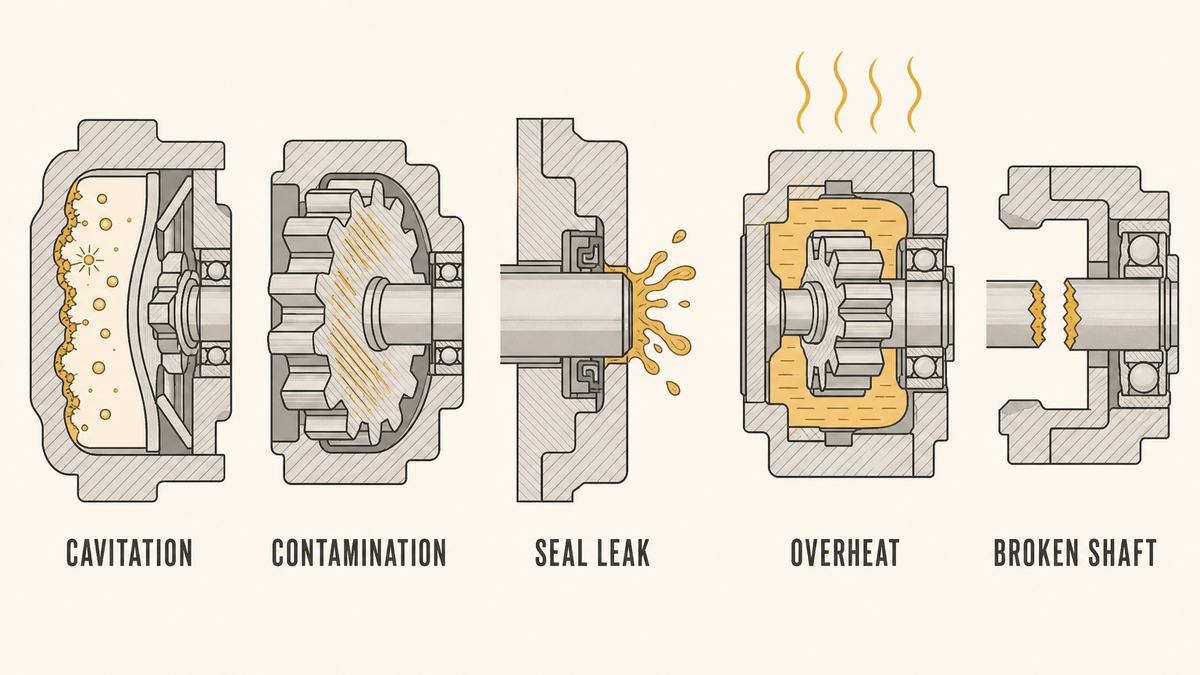
- Cavitation damage
- Where the pump cannot draw oil fast enough, the oil vaporises and the bubbles collapse against metal, eating pits into the internal surfaces. It is caused by a restricted suction, a suction line that is too long or too small, oil that is too thick on a cold start, or air entrained in the fluid. The signature is a pump that is noisy before it is worn — and by the time the flow drops, the damage is already done.
- Contamination wear
- Particles larger than the internal clearances do not pass through the pump, they score the surfaces they are trapped between. The result is not a sudden failure but a steadily opening clearance, which shows up as lost flow, more heat and a rising case drain leakage. It is the most common cause of pump wear and the only one on this list that is almost entirely a filtration decision.
- A failed shaft seal
- External leakage at the shaft, usually caused by heat that has hardened the seal, or by housing pressure that should not be there. On a pump with a case drain, a blocked or undersized drain line pressurises the housing and pushes oil past a seal that was never designed to hold pressure. The seal is the symptom; the drain line is the cause.
- Overheating
- A pump that runs hot is usually leaking internally, or spilling flow over a relief valve all day. Heat thins the oil, thinner oil leaks more, and more leakage makes more heat, so the problem accelerates instead of settling. By the time the housing is too hot to touch, the fault has usually been present for a long time at a lower level.
- A broken or worn drive
- A snapped shaft or a chewed coupling is nearly always a misalignment or an overload rather than a faulty pump. A pump that is not centred on its pilot, or driven through a coupling that is not aligned, loads its own shaft in a direction it was not designed for. It is the failure that is most often blamed on the pump and least often caused by it.
Four of those five were decided by the oil and the circuit rather than by the pump, which is the argument for spending the time on filtration, mounting and the fluid specification rather than on the last few per cent of the unit price.
Frequently Asked Questions
How do I size a hydraulic pump?
Start from the flow the circuit needs, not from the pressure. Work out the flow required by the fastest function that has to move, then choose a displacement that delivers that flow at the speed your drive will actually run. After that, check that the pump's continuous pressure rating is above the pressure the circuit will present, and that the mounting set matches. Sizing by pressure alone is the most common mistake, because the pump does not create pressure — the load does.
What is the difference between fixed and variable displacement?
A fixed pump moves the same volume per revolution whatever the machine is doing, so when the circuit needs less flow the surplus goes over a relief valve and turns into heat. A variable pump reduces its own displacement to match demand, so it uses less energy and makes less heat. Fixed is simpler and cheaper and is the right answer for a machine with one function at one speed. Variable earns its extra cost on machines with several functions and a lot of idle time, where the wasted flow would otherwise be paid for twice — once in fuel or electricity, and again in cooling.
How do I know which pump type my machine needs?
Work from pressure and duty rather than from preference. A simple circuit at modest pressure is a gear pump. Medium pressure where noise matters is a vane pump. High pressure, or a flow that has to change with demand, is a piston pump. If you are replacing a pump on an existing machine, match the family and the displacement of what is there unless you have a reason to change, because the rest of the circuit was sized around it and changing the family alone rarely improves anything.
Why did my pump fail if pressure is not what the pump makes?
Because the pressure the pump sees is created by resistance downstream, and a restriction is a load on the pump just as much as a heavy cylinder is. The three causes that account for most failures are contamination, cavitation and heat, and none of them is a defect in the pump. Before replacing a failed pump, find out which of those three was present. If the answer is none, the replacement will fail in the same way, and the pump will be blamed twice.
What should a pump test record contain?
The flow delivered at a stated speed and pressure, the pressure held without distress, and, where the pump has one, the case drain leakage at a known pressure. All three belong on the same record as the unit's identifier, so the record can be matched to the pump in your hand. A record without a speed and a pressure attached is not a test result, and a record without an identifier describes a factory's process rather than your pump.
Is a rebuilt hydraulic pump worth buying?
It can be, and the deciding question is what was measured rather than what was replaced. A seal kit cures external leaks and does nothing about worn internal clearances, so a pump that has been re-sealed is not a rebuilt pump — it is a pump that no longer weeps while still delivering less flow than it should. Ask which parts were replaced, what clearances were checked, and whether the unit was run on a stand afterwards. If those answers exist in writing, a rebuilt pump from a competent shop is a reasonable buy. If they do not, you are buying a used pump with an unknown condition.
Send the circuit and the old pump, not just the pressure rating
Tell us the flow the circuit needs and the drive speed it will run at, the working and peak pressure, the fluid and its operating temperature range, the flange, shaft, rotation and port details of the pump you are replacing, and whether the circuit has a case drain. Those answers settle the family, the displacement, the mounting set and the internal specification before a price means anything. We will come back with the configuration we recommend and why, the displacement and rated flow at your speed, the mounting set confirmed against your drawing rather than assumed, the internal part grades named, and a test record carrying an identifier so it can be matched to the unit you receive — with the testing and documentation lines shown separately rather than folded into the unit price.
Request a Hydraulic Pump Sourcing Quote
Questions & Comments
We read every one and reply within 24 hoursIf you are holding a hydraulic pump quotation and trying to work out whether two quotes describe the same pump, post three things and we can usually say: the flow the circuit needs and the shaft speed it will run at, the working and peak pressure, and the flange, shaft, rotation and port details of the unit you are replacing. If you already have drawings, add which internal part grades are inside the unit and whether it was run on a test stand with a recorded result. Those two lines explain most of the gap between two pump quotations, and they are the two lines a short quote tends to leave out.