
Rupture Disc Manufacturer: Sourcing Bursting Discs and Holders From China
 ·
Updated October 13, 2026
·
25 min read
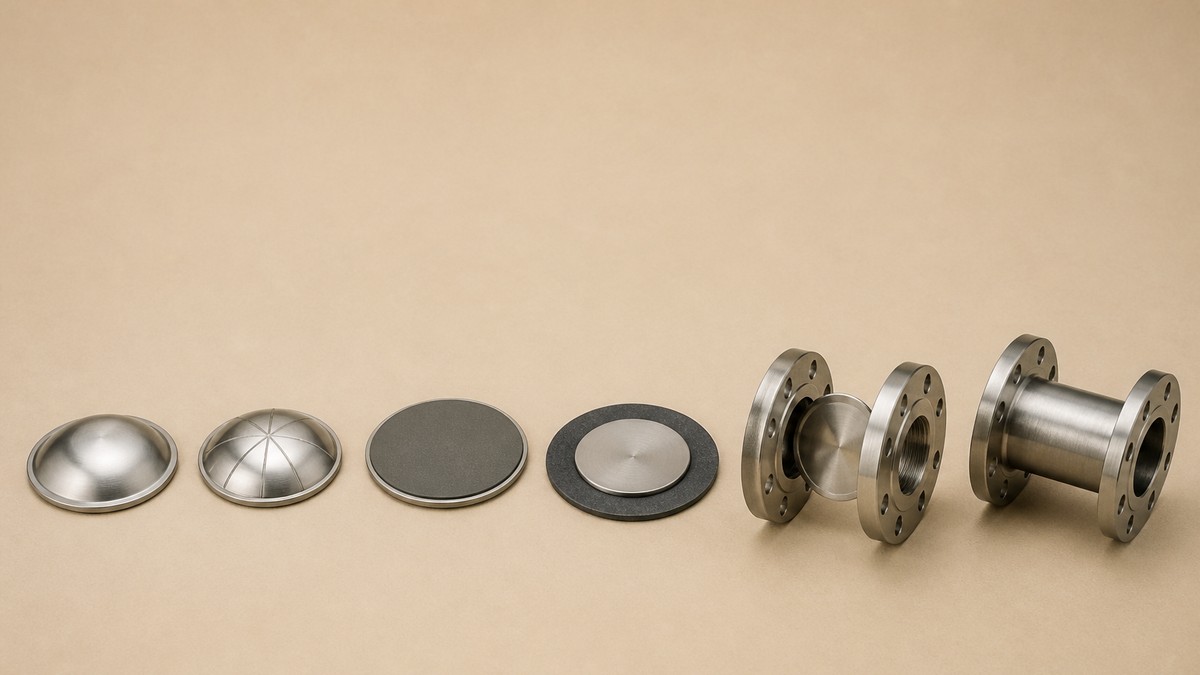
A rupture disc, or bursting disc, is a thin membrane of metal or graphite clamped into a pipe or a vessel branch, made to break at a set pressure so that pressure cannot build any further. It is the simplest relief device in a plant and the only one that works exactly once: a relief valve closes again after it lifts, and a disc does not. Buyers order one on a burst pressure and a size, and the two things that decide whether it does its job are the two they leave off — the tolerance band around that burst pressure, and the holder it will sit in. There is a third thing that decides how many discs a plant buys in a year, and it is written into a free federal rule in terms blunt enough to put on a stock list: a rupture disc fitted upstream of a pressure relief device takes that device out of a monitoring programme entirely, and the price of that exemption is a new disc within five calendar days of every release.
Six Lines That Decide Whether a Rupture Disc Order Is Complete
| What the buyer has to settle | Why it is not obvious | The line on your order that closes it |
|---|---|---|
| The marked burst pressure, and the tolerance around it | The disc does not burst at one pressure; it bursts inside a band, and the band is a choice | The marked pressure plus the tolerance band and the manufacturing range you will accept |
| Which form | Forward-acting, reverse-acting, graphite and composite behave differently and suit different duties | The form by name, and the reason for it |
| The operating temperature | A disc weakens as it gets hot, so the burst pressure at temperature is not the cold figure | The temperature, and a request for the disc's rating at it |
| The holder | A disc is rated in the holder it was tested in, and a mismatch moves the burst pressure | The holder by type and size, and whether disc and holder come as a matched set |
| What the disc has to seal against | In some duties the disc is bought to stop leakage long before it is bought to burst | Whether the disc sits upstream of a relief valve, and the leak-tightness you need |
| The spares you have to hold | On some duties the replacement interval is fixed by rule rather than by preference | The number of spares per device, so the shelf matches the obligation |
What a Rupture Disc Is, and the Words Around It
The part is a membrane in a clamp, and the vocabulary around it is small but used loosely. Seven words carry the subject, and getting them straight at the enquiry stage removes most of the arguments that follow.
- Rupture disc and bursting disc
- The same part, and both names are in common use. The spelling splits by region and by supplier, so a search that returns nothing under one word is usually worth repeating under the other. The trade also writes it as one word or two, and none of the variants means anything different.
- Marked burst pressure
- The figure stamped on the disc's tag, and the number the buyer thinks he is buying. It is a target rather than a guarantee: the disc is made and tested to burst within a band, and the band is agreed in advance.
- Burst tolerance
- The width of the band the disc is allowed to burst within, expressed as a percentage either side of the marked figure. It is one of the few things about a disc that a buyer can genuinely choose, and it is not free: a tighter band means more testing, more selection and more discs thrown away, so it costs more. It is also the number to put on the order, because a disc delivered to a wide band may burst outside the pressure your vessel is designed for.
- Manufacturing range
- The set of standard bands a factory offers for a disc, and the reason two quotations for what looks like the same disc differ. Wider ranges are cheaper because fewer discs have to be tested and selected to hit the mark. Where a plant's relief requirement is not tight, buying a wide range is a genuine saving; where it is tight, the band has to be narrower and the price follows.
- Non-reclosing
- The property that separates a disc from a relief valve, and the one buyers most often forget. A relief valve opens and closes again as pressure falls. A disc opens and stays open, and the plant is open to atmosphere or to the relief header until somebody isolates the branch and fits a new disc. This is why a disc is often installed together with a valve or a changeover arrangement rather than instead of one.
- Holder
- The clamp that grips the disc and seats it against two machined faces. It is not an accessory. A disc is rated in a particular holder and its burst pressure depends on how much of the disc the holder exposes and on the sharpness and size of its bore, so a disc fitted in the wrong holder, or in a holder that has been damaged, is a disc whose marked figure no longer applies to it.
- Bursting or fragmenting
- What happens to the membrane when it goes. Some discs open as a set of petals that stay attached to the rim, which is what a plant wants when there is anything downstream that could be damaged. Others break into loose pieces, which is acceptable on an open discharge and unacceptable anywhere the fragments can travel into equipment. A buyer who never asks which of the two he is buying has bought a question rather than a device.
Two comparisons are worth settling early, because they decide whether a disc is the right device at all.
A disc against a relief valve. A valve resets itself and a disc does not; that single difference drives most of the choice. A disc is cheaper to buy, instantaneous in action, unaffected by the stickiness or the corrosion that stops a valve from seating properly, and it holds zero leakage right up to the moment it goes. A valve is more expensive, needs maintenance and testing, and can leak quietly for years without anybody knowing. So a disc is chosen where the speed matters, where the product must not leak at all, where the fluid would foul a valve's internals, or where the pressure has to be relieved before a valve could reasonably respond.
A disc upstream of a valve, rather than instead of one. This is the arrangement the next section is about, and it exists for a reason that has nothing to do with pressure: the disc protects the valve from the process, and it does so completely, because a disc that has not burst is a solid barrier. That protection is worth a great deal on a corrosive or a polymerising fluid, and on some services it is the reason the disc is bought at all.
Why One Is Specified: the Five-Day Rule
Every page selling a rupture disc sells it as a safety device, and safety is not the only reason a plant buys them by the box. There is a second reason, it is commercial rather than protective, and it is written into a free federal rule in language specific enough to set a stocking level.
The problem the rule solves is leakage from relief devices. A pressure relief valve sitting on a process branch is sealed by a seat that closes against a nozzle. Over months that seat sees corrosion, fouling, thermal cycling and whatever the process can deposit on it, and it starts to pass a little. On a line carrying volatile organic compounds or hazardous air pollutants, a relief valve that weeps is an emission, and the regulator's answer is not to ban the valve but to make the owner watch it. Under 40 CFR 60.482-4, a pressure relief device in gas or vapour service has to operate with “no detectable emissions, as indicated by an instrument reading of less than 500 ppm above background”, and after every release it has to be brought back to that condition as soon as practicable and in any case no later than five calendar days, with a monitoring check inside the same five days to confirm it.
That is a monitoring obligation attached to a piece of hardware the plant cannot easily take off line. The same section then offers a way out, and it is the sentence a rupture disc buyer should read twice.
The exemption, and its price. The rule says that “any pressure relief device that is equipped with a rupture disk upstream of the pressure relief device is exempt from the requirements of paragraphs (a) and (b) of this section” — that is, exempt from both the no-detectable-emissions duty and from the five-day restore-and-monitor duty. The condition is set out immediately afterwards: “after each pressure release, a new rupture disk shall be installed upstream of the pressure relief device as soon as practicable, but no later than 5 calendar days after each pressure release”.
Read as a buyer, four things fall out of that pair of sentences.
First, the disc is being bought as a barrier, not as a relief device. In this application it is not there to burst at a set pressure — the valve behind it does that. It is there to be a solid, leak-free wall between the process and the valve's seat, so the valve never sees the process at all. Its leak-tightness matters more than its burst tolerance, because a disc that weeps defeats the whole purpose of fitting it.
Second, the disc is a consumable with a legal replacement interval. Five calendar days is not a maintenance preference; it is a deadline. A plant that fits discs to a hundred relief devices on this basis is not buying a hundred safety devices, it is buying a hundred consumables and a stocking policy to go with them. That is the single most useful thing a buyer can tell a supplier, because it changes the order from one disc to a box of discs and a conversation about how fast a repeat can be delivered.
Third, the tolerance band and the leak performance are two different orders. A disc specified only on burst pressure may be perfectly legal and still leak. A disc specified for this duty needs the sealing face, the gasket and the holder to be described as well, because that is what the exemption actually depends on.
Fourth, the exemption is conditional and can be lost. It holds only if the disc is fitted and only if it is replaced inside the window. A disc left in place after a release is a device that has already done its job and is no longer a barrier, and the obligation it was there to satisfy comes straight back. That is worth knowing at the enquiry stage, because it is the difference between buying one disc and buying a service.
What 40 CFR 60.482-4 Requires, and Where the Disc Fits
| The situation | What the rule requires | What it means for the disc order |
|---|---|---|
| A relief device in gas or vapour service with nothing upstream | No detectable emissions, taken as a reading below 500 ppm above background, and a restore-and-monitor duty inside five calendar days of every release | No disc is involved, and the whole obligation sits on the valve |
| The same device with a rupture disc fitted upstream | Exempt from the emissions duty and from the five-day restore-and-monitor duty | This is the buying case. The disc is a sealing barrier first and a relief device second |
| What the exemption costs | A new disc fitted upstream within five calendar days of every release | Spares held per device, and a repeat delivery that has to be fast enough to cover the window |
| A device routed to a process or fuel gas system, or fitted with a closed vent system to a control device | Exempt from the emissions and restore duties on its own account | No disc needed for this purpose, which is worth checking before ordering one |
The same pattern appears in other rule sets, which is worth knowing when a plant spans several rule sets. The eCFR full-text search returns a rupture disk provision in the vinyl chloride standard at 40 CFR 61.242-4 and again in the hazardous organic NESHAP at 40 CFR 63.165, and the marine pressure relief rules at 46 CFR 54.15-13 deal with the same devices from a different direction. The monitoring method that the five-day duty is checked against is specified in the same part as the exemption itself. A buyer dealing with a group that owns plants in more than one country should expect the interval and the reading to differ between rule sets while the principle stays the same: a disc upstream buys relief from monitoring, and it costs a replacement on a clock.
Two limits, said plainly. These rules sit in air standards that apply to particular source categories, so a plant outside their scope does not inherit the five-day clock; the section is quoted because it is the clearest written statement of why discs are bought in quantity, and the reasoning applies to any site that has an emissions obligation on its relief devices. And this is not legal advice for a particular plant. The section is free to read on the electronic Code of Federal Regulations, and the monitoring method it points to is in the same part.
The Four Forms
Rupture discs are made in four forms, and the choice is decided by the pressure, the temperature, whether the disc has to seal as well as burst, and how the fragments behave. The prices are closer than buyers expect, so the decision is usually technical.
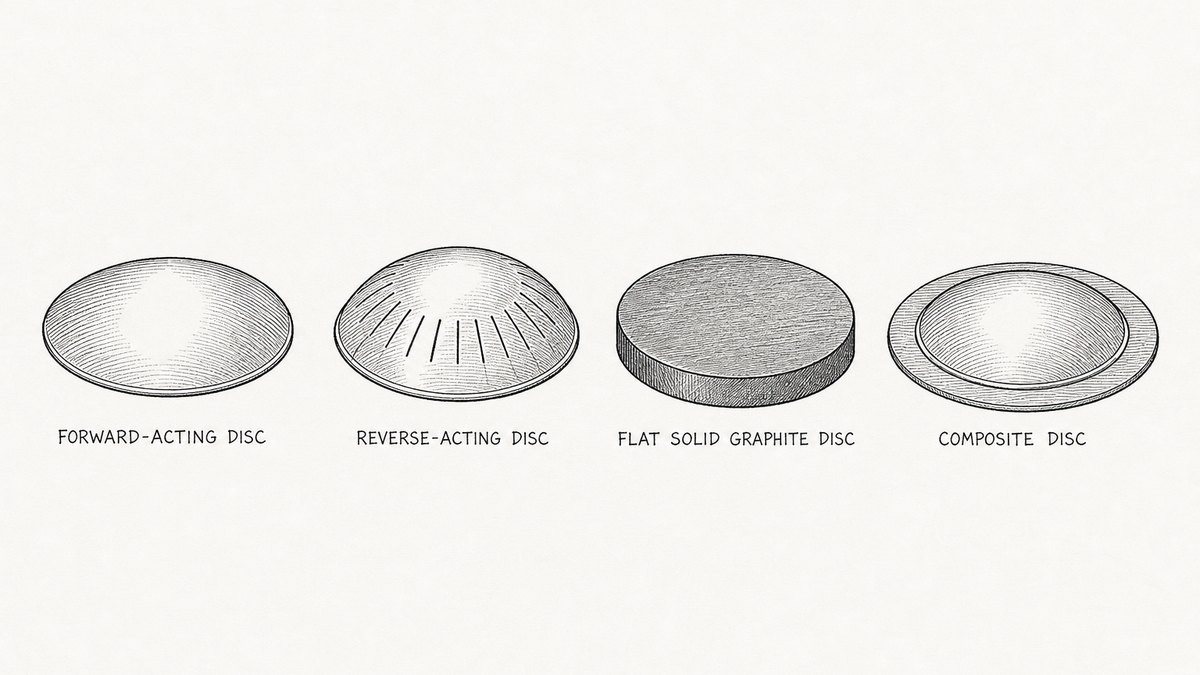
Forward-acting, also called tension type. A shallow dome of thin metal loaded on its concave side, so the pressure pushes the dome outward and the metal stretches until it splits. It is the oldest and cheapest form, it is made in a very wide range of sizes and pressures, and it opens at low pressures more reliably than anything else. Its weakness is fatigue: a disc that is loaded and unloaded repeatedly, or one that sits under a pressure that fluctuates, can crack before it should burst, and it is also the form most easily damaged by handling because the dome is thin and has no support.
Reverse-acting, also called compression type. A deeper dome turned toward the process, so pressure pushes inward and the dome flips before it opens, breaking along score lines cut into its face into a ring of petals that stay attached to the rim. It tolerates pressure cycling far better than a forward-acting disc because the metal is in compression rather than tension, it opens with no loose fragments, and it is available at higher pressures. Its weakness is that it must be made in the right way up and is easily fitted backwards, and a reverse-acting disc fitted the wrong way round is a device that will not relieve at all until the pressure is far above its mark.
Graphite. A flat plate of impervious graphite, thicker and more massive than a metal disc, which fractures when its support gives way. It is superb in corrosion service, because graphite resists most acids and does not stress-corrode, and it is the standard choice on chlorine, hydrochloric acid and many other aggressive duties. Its limits are mechanical: it is brittle, it is heavy, it is more easily damaged in handling and installation than a metal disc, and it fragments when it goes. Graphite is also the form most sensitive to how it is clamped, so it is usually supplied with its own holder arrangement.
Composite. A thin metal membrane with a liner, a gasket, or both, so that the sealing is done by a material chosen for the fluid while the bursting is done by metal chosen for the pressure. It is the form to reach for when the process attacks the metal, or when the disc has to seal tightly against a flange face that a plain metal disc would not satisfy. It costs more, and it introduces more parts that have to be assembled the right way round, which makes it a form where the drawing matters more than usual.
The one thing all four have in common, and it catches buyers out. Every form has a temperature limit beyond which its burst pressure drops, because the material gets weaker as it gets hot. The figure on the tag is a cold figure unless the order says otherwise. A disc chosen at the operating temperature but ordered without saying so arrives marked for a cold burst pressure and relieves at something lower in service, which on a vessel with a thin margin is the wrong direction to be wrong in. State the temperature, and ask for the burst pressure at it.
How Each One Opens, and Why the Fragments Matter
The way a disc opens decides what happens downstream of it, and it is the part of the subject that buyers think about least and regret most.
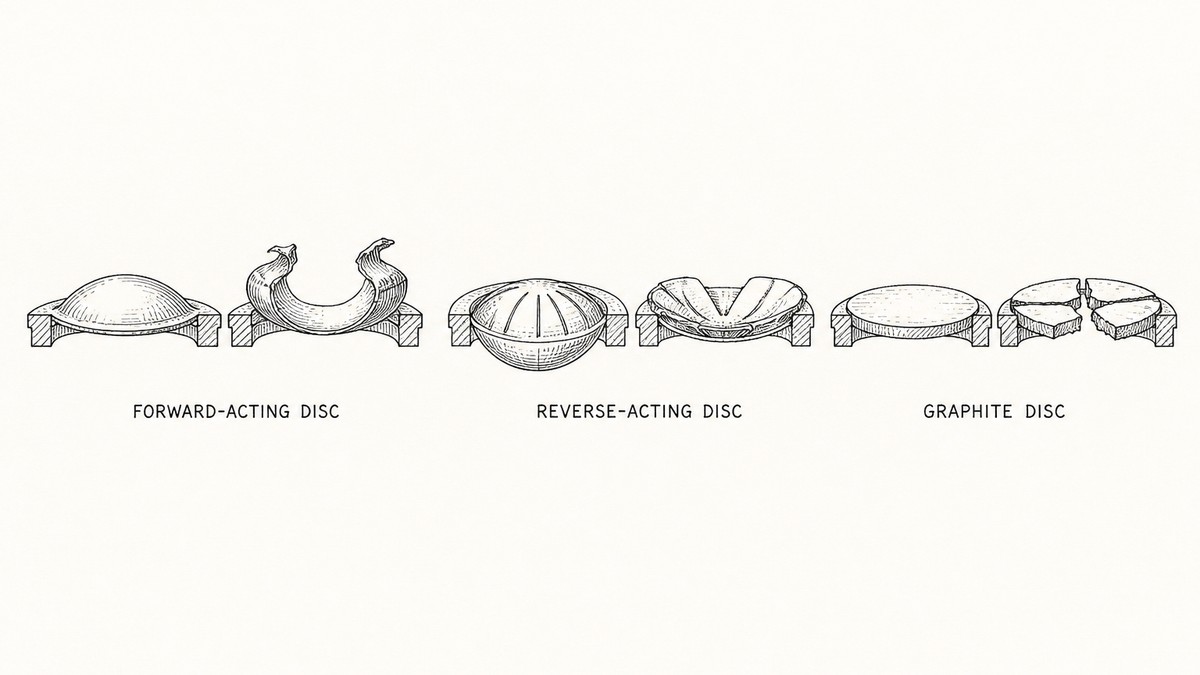
A forward-acting disc tears. The dome bulges, the metal thins at the crown, and it splits, usually opening outward in petals that curl back. The edges are torn rather than cut, so the opening is not a clean circle, and the flow area is less than the disc's full diameter. That matters when the relief capacity is being calculated: the effective area of a torn disc is smaller than the bore it sits in, and a plant that assumed a full-bore opening may find its relief path narrower than the calculation said.
A reverse-acting disc opens as petals that stay attached. The dome flips inward along its scores and folds back, and the petals remain part of the disc, held by the rim. Because the score lines are machined, the opening has a defined shape and a defined flow area, and because nothing comes loose, this is the form to choose when there is equipment downstream that fragments could damage — a compressor inlet, a catalyst bed, a valve, or a knock-out drum.
A graphite disc breaks into pieces. It fractures along the weakest path and the pieces fall or are carried away. On an open discharge to atmosphere this is of no consequence. Anywhere the discharge leads into pipework, into a header or into equipment, loose graphite is a real problem, and it is one of the reasons graphite discs are usually confined to open discharges or to installations that have a catcher or a tray beneath them.
Three questions belong with the opening behaviour. What is downstream, because that decides whether a fragmenting disc is acceptable at all. What is the required flow area, because a torn or petalled opening is smaller than the pipe bore and the relief sizing has to use the open area rather than the line size. And what pressure is left after the disc opens, because a disc provides no throttling control at all: it opens fully or not at all, and the plant then either relieves to atmosphere or relies on something behind the disc to limit the flow.
And the question buyers ask last, which should be asked first. Does the disc have to seal before it bursts? On a duty where the disc is a barrier against emissions or against a process that must not see air or moisture, the answer is yes, and the disc's seating design — flat seat or angled seat, plain membrane or composite with a gasket — becomes the specification rather than an accessory to it. A disc chosen only on burst pressure may hold a vacuum poorly, seal unevenly, or pass a small weep that nobody notices until an instrument is put on it.
The Holder, and Why It Is Half the Product
Buyers treat the holder as the thing the disc goes into. It is better understood as the other half of a matched pair, because the burst pressure of a disc depends on the holder it is tested in, and a disc rated in one holder is not rated in another.
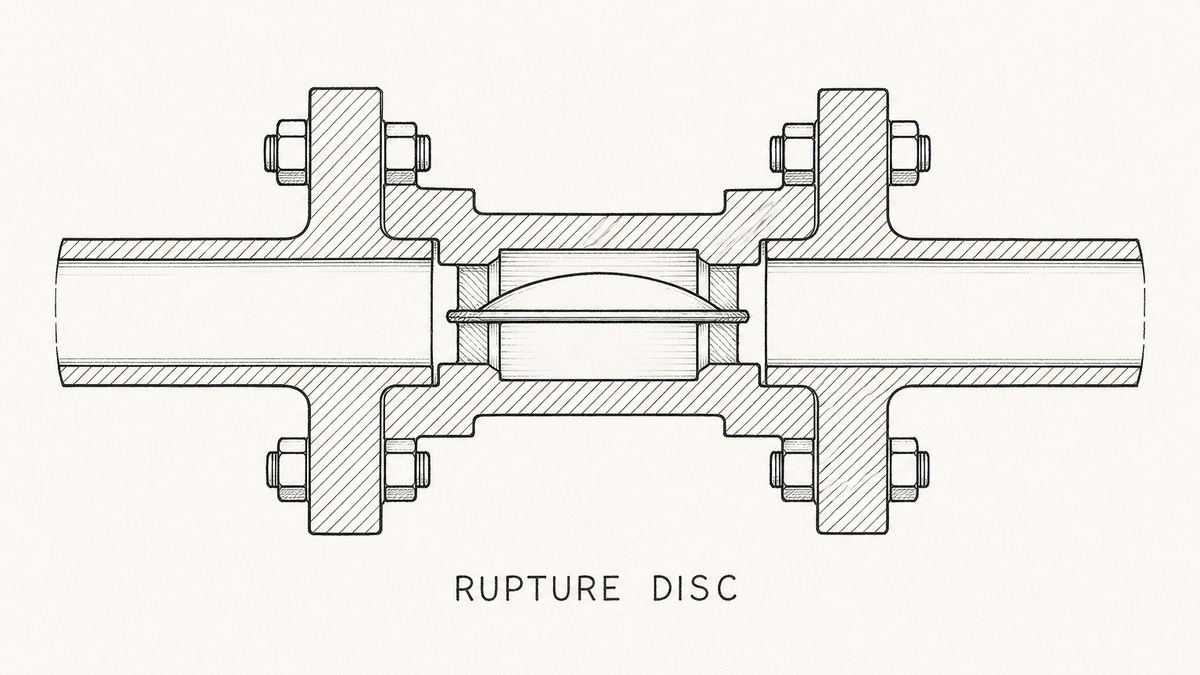
What the holder does, and why the geometry matters. The holder clamps the disc's rim between two machined faces and presents a bore to its underside. The diameter of that bore decides how much unsupported disc is exposed to pressure, and the size of the exposed area is one of the things that sets the force acting on the membrane. Change the bore and you change the burst pressure, even with the same disc. The sharpness and radius of the seating face matter too, because a disc is held by its rim and any damage to the edge where it is gripped changes how it opens.
Three practical rules follow. Buy the disc and the holder as a matched set wherever the disc maker offers one, because that removes the argument about which party is responsible for the burst pressure. If a holder already exists in the plant, give the supplier its make, model and bore rather than a pipe size, because a disc is rated against a holder and not against a line. And never swap a disc between holders of different manufacture, however similar they look, because the two holders are unlikely to present the same seating geometry.
Insertion direction, which is where the failures are. A forward-acting disc has a concave and a convex side and belongs in one way up. A reverse-acting disc has a dome that must face the process. Graphite and composite discs usually have a process side and a downstream side, and a composite disc's gasket ring only seals against the face it was made to seal against. Every one of these can be fitted backwards by somebody who does not know, and the consequence of a reversed disc ranges from a burst pressure well off the mark to no relief at all. This is why the marking on the disc's tag and the arrow on the holder matter, and why they are worth checking on arrival rather than trusting the installation.
And the holder is a pressure part, not a bracket. It sees the full process pressure on one side and the full relief pressure on the other, and on some designs it also has to hold the disc's reaction as it opens. A holder made to a lighter standard than the flange it sits between is a holder that can fail in the one moment it was installed for. Ask for the holder's pressure rating as a part in its own right.
Disc Upstream of a Relief Valve
This is the arrangement the rules section described, and it is worth looking at separately because the two devices in it are doing different jobs and each one constrains the other.
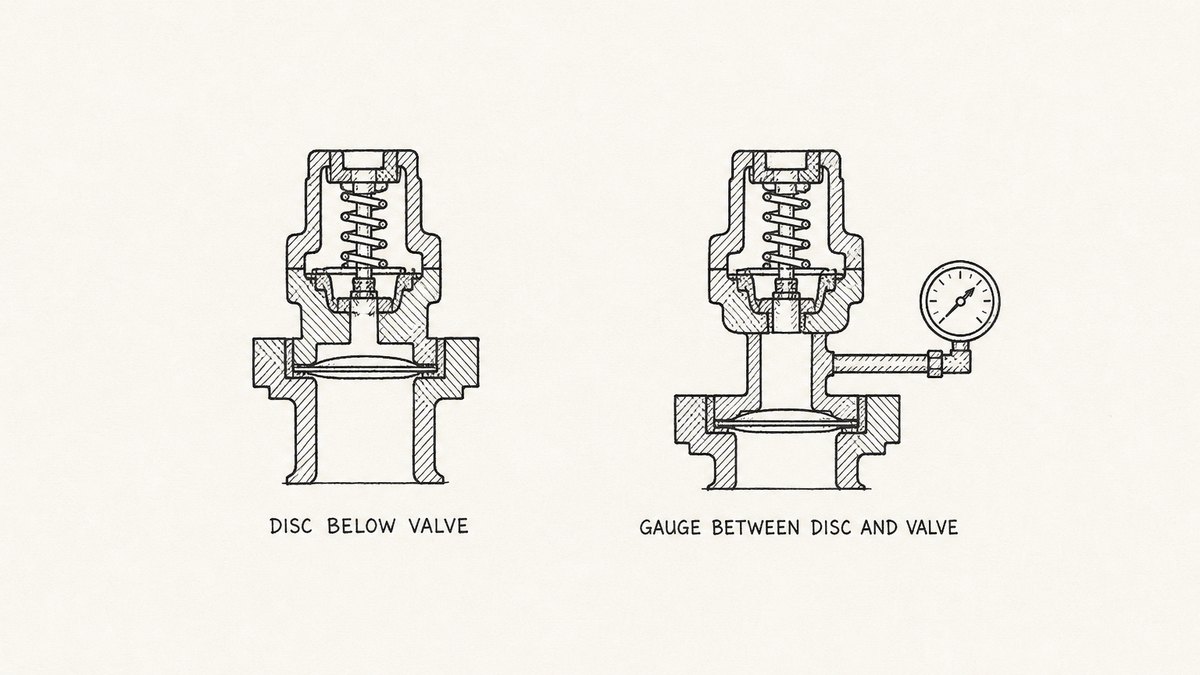
The valve does the relieving and the disc does the sealing. The valve is set to open at the vessel's relief pressure and it closes again when the pressure falls, which is what makes it reusable. The disc upstream of it is a solid wall that keeps the process away from the valve's seat, so the valve's internals see only whatever is trapped between the two devices. That trapped space is normally filled with something inert, and it is the space that has to be watched, because a disc that fails slowly or a valve that weeps into it will show up there and nowhere else.
Why anyone builds it this way. Five reasons, and they are all real. It isolates a valve from a corrosive or polymerising process so the valve's seat stays clean. It gives a leakage figure of zero up to the moment of relief, which is the property the emissions rules actually reward. It lets a plant change a disc without touching the valve, so the maintenance is on a cheap part rather than an expensive one. It lets the valve be set higher than would otherwise be possible, because the disc takes the process conditions. And on a duty with a fluctuating pressure it protects the valve from the cycling that wears its seat.
What it costs you, honestly. Four things. The pressure available to the valve is reduced by the disc's burst pressure, so the two devices have to be sized together rather than separately. The five-day replacement obligation applies after any release, as set out above. The space between disc and valve has to be monitored if the exemption is to be relied on, which is why the arrangement above shows an instrument on it. And there is a failure mode unique to the combination: a disc that bursts below the valve's set pressure leaves the valve carrying the whole duty on its own, with no indication except the instrument on the intervening space.
What to put on the enquiry for a combination. The vessel's design pressure and its relief pressure. The valve's set pressure if it is already chosen. The disc's marked burst pressure and the tolerance band. The size of the intervening space and how it is to be monitored. The fluid, its temperature and whether it is corrosive or prone to deposit. And the number of devices in the plant, because on this arrangement that number is the annual consumption.
Sizing It: Burst Pressure, Temperature and Tolerance
Sizing a disc comes down to four numbers and one decision, and the decision is the one buyers skip.
The normal operating pressure, and the margin above it. The disc must not burst in normal service, including on the worst day the process will ever have. A common approach is to set the disc's marked burst pressure comfortably above the highest pressure the vessel sees in normal operation and comfortably below the vessel's design pressure, and the gap between those two is what the tolerance band has to fit inside. Where that gap is narrow, the band has to be narrow, and the cost rises. Where the plant has been generous with its margins, a wide band is a genuine saving.
The operating temperature, and the disc's rating at it. Every disc loses strength as it gets hot, so the burst pressure at the operating temperature is below the figure stamped for a cold disc. The difference is not small on some materials, and it goes the wrong way: a disc chosen from the cold figure relieves earlier in service than the plant expects. State the temperature on the order and ask for the burst pressure at the temperature, and on a duty that also has a cold start-up, ask about both ends.
The tolerance band, and the manufacturing range. This is the decision. A manufacturer makes discs and tests them, and not every disc bursts exactly where the drawing says, so a band is agreed in advance within which the disc is accepted. The factory offers a set of standard bands, and a narrower band means more testing, more selection and more rejects, which is why it costs more. The buyer's job is to state the band the vessel allows, and to understand that a quotation for a wide band and a quotation for a narrow band are quotations for two different products.
Which brings us to the question buyers type into a search engine most often, and the honest answer. The question is asked as the eight and five rule, and it relates to how the tolerance band and the pressure margin are handled together on a disc that sits upstream of a relief valve, where the disc and the valve have to share the same relief pressure. The specific figures that convention uses are defined in the industry standards for rupture discs and pressure relief, and those are paid documents that this article does not reproduce and does not paraphrase. What a buyer can do instead is more useful than remembering a number: ask the supplier which band and which marked burst pressure he proposes for your vessel, ask him to state it in writing against the valve's set pressure, and ask which standard his figures come from. A supplier who works in this duty every day will answer immediately and in writing. A supplier who does not will answer with a burst pressure and nothing else, which is exactly the quotation that leaves the buyer carrying the risk.
Then the two numbers that decide whether the device does anything. The required relief area, taken from the open area of the disc rather than the pipe bore, because a torn or petalled opening is smaller than the line. And the disc's own flow performance, because a disc relieves fully or not at all and the plant's ability to handle the released flow depends on what is behind it. On a disc upstream of a valve, the valve does the sizing and the disc has only to open far enough and fast enough not to interfere; on a disc alone, the disc is the relief path and its open area is the whole calculation.
What to Put in the Specification Sheet
A disc enquiry that gives a size and a burst pressure will produce a price for a membrane, and it will not produce a device that fits the duty or the holder. The discipline for any part made to a drawing is set out in this guide to the sheet a workshop can be held to; a rupture disc adds its own short list on top.
The duty first. What the disc protects, and the fluid, with its phase and whether it is corrosive, toxic or flammable. The normal operating pressure and the highest pressure the process will ever see, because that pair sets the margin the disc has to live inside. The design pressure of the vessel or the line. The operating temperature, with the cold start-up temperature if it differs. Whether the disc sits alone or upstream of a relief valve, because the two duties size it differently. And whether the space downstream is open to atmosphere, piped to a header, or closed, because that decides whether a fragmenting disc is acceptable at all.
The disc. The form by name. The size, and the size of the holder bore rather than the pipe size. The marked burst pressure with the tolerance band, and the manufacturing range you will accept. The material of the membrane, and of the liner and gasket if it is a composite. The temperature rating at the operating temperature. The marking the tag has to carry, including the marked burst pressure, the size and the date. And whether the disc opens as attached petals or as loose fragments, stated as a requirement rather than discovered afterwards.
The holder, drawn. Whether the disc comes with one or is to fit an existing pattern. The holder type, the bore, the flange size and rating, the face-to-face length and the bolt pattern. The pressure rating of the holder as a part in its own right. The insertion direction, shown on the drawing as well as by the arrow, because a drawing that only shows a disc in a clamp has not told anybody which way up it goes.
The documentation and the commercial lines. The burst pressure record for the batch, and on a narrow band the individual test figure rather than a statement that the batch passed. A material certificate. A drawing carrying its revision number, with no changes permitted without written agreement including the marked burst pressure and the band, because those are the two figures a substitution would hide.A first article for a new form or a new supplier, because on a disc the difference between the right membrane and the wrong one is invisible on the bench and appears as a burst at the wrong pressure. And the packing, because a disc is a thin membrane with a defined dome, and a disc that has been stacked under a box in transit has a crease that changes its burst pressure.
Then the line most enquiries leave out, and on some duties it is the whole order. How many devices the plant has, how often it expects to replace them, and therefore how many discs you want to hold. On a duty where a disc sits upstream of a relief valve, the replacement interval is fixed by rule rather than by preference, so the stocking level is a number the rules set rather than a matter of convenience. Give the supplier that number, and ask what he can commit to on a repeat delivery inside the window, because a disc that cannot be restocked inside five calendar days is a disc whose exemption is not worth relying on.
Sourcing From China: Factory, Trader, and What to Ask
A rupture disc is a stamped or formed membrane, a machined seat and a tag, and the difficult part is not the making. It is the testing, because a disc is sold on a burst pressure and a tolerance band, and holding both means measuring every disc or selecting from a tested batch. That is where Chinese suppliers differ from each other, and it is where the useful questions sit.
Four questions a works answers from its own floor.
How do you test the discs, and on what rig? A maker of discs has a burst test rig and can describe it: how the disc is held, how the pressure is raised, whether the test is hydraulic or pneumatic, and what the record looks like. The answer also tells you whether the factory tests every disc or samples the batch, which is directly relevant to the tolerance band you are paying for.
What bands do you offer, and which of your own discs actually meet the narrow ones? A supplier who claims to hold a narrow band across everything he makes is either testing a great deal or overstating it. A works will explain which of its ranges are routine and which are special, and will be specific about what testing a narrow band requires.
Do you make the holder as well? The best single question in this subject, for the reason set out earlier: a disc's rating depends on the holder's bore and seating geometry, so a factory that makes both can rate a matched pair and stand behind the figure. A factory that makes only the membrane will rate the disc in a borrowed holder and the figure will be conditional.
What is the membrane material, and is there a certificate? The membrane is thin, it is the pressure-retaining element and it is fully wetted, so its grade and its thickness matter more than anything else about the part. Ask for the grade in writing and for a certificate with the delivery. On a corrosion duty, ask what the factory recommends and why, because a supplier who has supplied chlorine or hydrochloric acid service before will have a view.
Then five commercial questions. Which sizes and burst pressures are held as stock, because a disc in a standard size is a different proposition from one made to a narrow band. Whether the factory can supply discs and holders together. What the minimum order is for a non-standard size or a narrow band. What the lead time is for an exact repeat, and this one matters more on a disc than on most parts, because on a duty with a five-day replacement obligation the repeat lead time is the thing that decides whether the exemption can be relied on. And whether the factory will accept your inspection before shipment, which is the next section.
Two commercial realities worth carrying into the conversation. First, the disc and the holder are one product and the trade sells them as two, so the buyer who negotiates the membrane price and buys the holder separately has optimised the smaller number. Second, China's strength on this product is at the middle of the range: standard sizes, standard materials, ordinary bands, and sensible quantities. Asking for the tightest band on a large diameter in an exotic alloy in single pieces is asking a factory to compete where it is weakest, and the answer will show in the lead time rather than the price. That pattern holds for any device whose performance is set by a measured property rather than by an assembly, which is why a progressing cavity pump bought to an odd geometry behaves the same way.
Inspection Before Shipment
A disc is a thin, flat, highly measurable part with one property that cannot be checked in the hand, and the whole inspection list follows from that. The wider routine, and how much of a shipment to inspect, is set out in this guide to checking a batch before it ships; the disc-specific list is short.
Check the tag against the drawing, and check the marking is legible. The marked burst pressure, the size, the material, the manufacturer and the date belong on it, and the marking should be permanent rather than a paper label. A disc whose tag has been printed on a sticker will lose its identity the first time it sits in a humid store, and an unmarked disc is scrap because nobody can safely fit it.
Look at the membrane in raking light, and photograph it. What you are looking for is a crease, a dent, a scratch or a scuff, and none of them is visible when the disc is looked at straight on. A crease in a dome changes the burst pressure and can do so in either direction. Take a photograph of the crown and the rim of the first disc of the batch and keep it with the record.
Measure the dimensions that touch the holder. The outside diameter, the rim thickness and the dome height, and on a composite disc the thickness of the gasket ring. Check the seating face for nicks and burrs, because the seat is what seals. And check flatness on the rim, because a rim that is not flat will not clamp evenly and the disc will not hold the pressure it was rated for.
Inspect the holder. Bore diameter, seating face condition and finish, the flange size and bolt pattern, the face-to-face length, and the pressure rating. Look for damage to the seating faces from earlier use, because on a disc duty a scored holder face is a leak path and it is the part that gets re-used. Check the insertion marking on both the disc and the holder and confirm they agree.
Check the burst pressure record, and the number of discs in it. On a narrow band, ask for the individual test figure for each disc rather than a statement that the batch passed, and check that the records cover the discs in the box rather than a sample of another batch. A batch certificate with no disc count against it is a document that says something was tested, not that these were.
And check the packing, which on this part is not a formality. A disc is a membrane with a defined curvature and it arrives damaged when it has been allowed to move, when discs have been stacked, or when something has been laid on top of a carton. Look for discs touching each other without separators, for a domed disc stored face down on a flat surface, and for a graphite disc with a chipped rim. A disc that has travelled badly can pass every dimension and burst at the wrong pressure, and that is exactly the failure worth catching in a factory rather than on a vessel.
Failure Modes, and Which Side Each One Is On
A rupture disc fails in four recognisable ways, and the split between them is worth knowing because two of the four are made before the crate is closed and two happen on site.
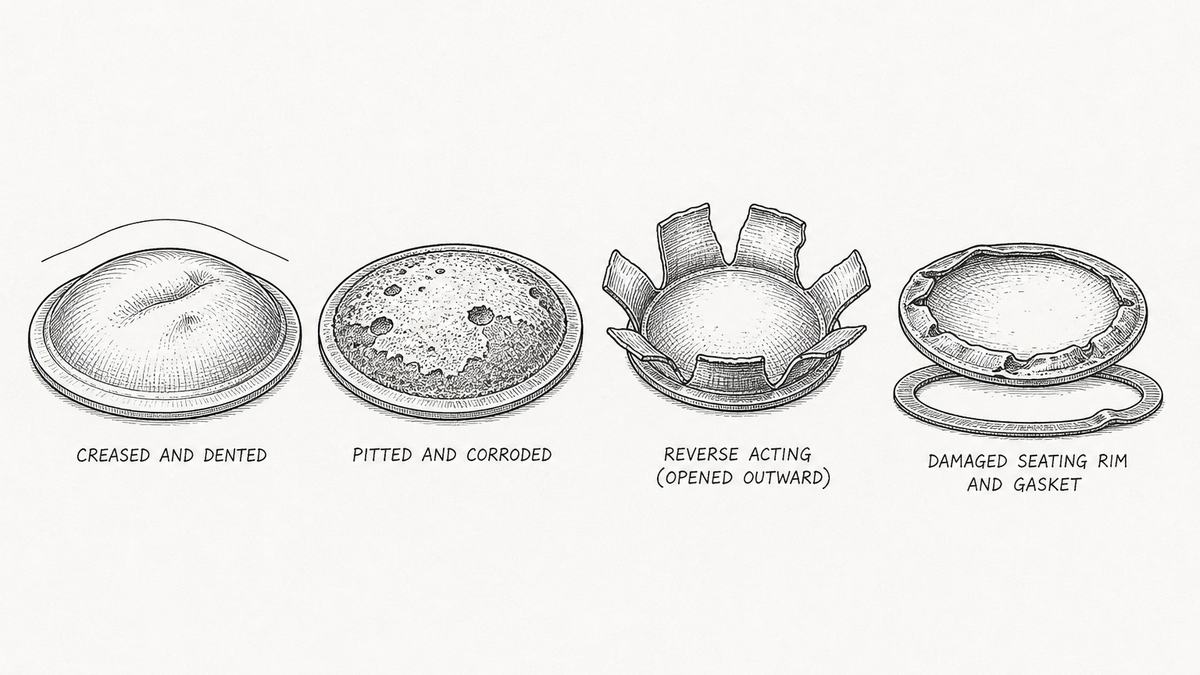
A creased or dented dome, which arrives that way. A shallow crease across the crown or a dent at the rim is handling damage, and it is the most common defect on a delivered disc because a thin dome is easily deformed and hard to see. Its effect on the burst pressure is not predictable from looking: a crease can weaken the crown and lower the burst, or stiffen it and raise the burst, and which one you get depends on where it is. There is no way to re-qualify a creased disc, so the only answer is to reject it, which makes the incoming inspection and the packing worth more than they cost.
A pitted or discoloured face, which can arrive that way or grow in service. Corrosion of the membrane is a slow loss of thickness, and because the burst pressure depends on thickness, a disc that has been sitting in a wet store or on a mildly aggressive line is a disc whose burst pressure has already changed. Look for scattered craters, for a matt etched appearance, and for discolouration that follows one side, which usually means the process side. A disc is a one-time device with a shelf life in the wrong conditions, and a stock of discs in a damp corner is a stock of discs with an unknown burst pressure.
Petals that opened the wrong way, which happens on site. On a reverse-acting disc the petals fold back inside the dome as the disc inverts. Petals bent outward and upward away from the dome mean the disc was fitted backwards, so the pressure pushed on the wrong side and the disc opened by a mechanism it was never designed for. The disc has done something, so the plant has relieved, but the burst pressure it relieved at is not the one on the tag. Every disc found this way is a signal that the whole plant's installation practice needs checking, not just that one device.
A folded, nicked or crushed seating rim, which can be either. The rim is the sealing surface and the clamping surface, and it has one job. A rim that is folded will not clamp flat, a nick is a leak path, and a crushed rim has lost the profile the holder needs to grip. This is an on-site failure more often than a delivery failure, because a rim gets damaged when a disc is fitted with the wrong tool, forced into a holder that does not match, or re-used after a holder has been opened and not cleaned.
Six Symptoms and Which Side Each One Is On
| The symptom | What the evidence looks like | Whose side it is on |
|---|---|---|
| A disc bursts below its marked pressure | The test record shows a figure inside the agreed band, but the device opened at a lower pressure in service | The plant's, if the disc was fitted backwards or in the wrong holder. The supplier's only if the tag and the record disagree |
| A disc bursts above its marked pressure | The device did not relieve until well past its mark, with a crease or a dent visible on the crown | Usually the plant's, because a stiffened dome means handling or installation damage after delivery |
| A disc weeps without bursting | A reading above background on the space between the disc and the valve, or visible staining at the rim | The supplier's if the seating face or the rim is faulty; the plant's if the holder face is scored or the disc was re-used |
| The valve behind a disc is found fouled anyway | Deposit inside the valve, with the disc still intact | Yours. Something reached the valve, which means the space between them is not sealed or not purged as designed |
| A disc corroded in the store before use | Pitting or etching on the face of an unused disc, with the storage conditions damp or the shelf life expired | Yours. A disc is a part with a shelf life, and it belongs in a dry store with its documentation |
| A repeat order bursts at a different pressure from the last | Two batches with the same part number but test records that cluster differently inside the band | The supplier's if the band was not stated on the order; yours if it was stated and the record shows it was missed |
Two habits make the diagnosis reliable. Keep the test record with the disc it belongs to, in the store rather than in an office file, because the record is what separates an argument from a comparison. And photograph the disc as it comes out, before it is cleaned or handled, because the petals' direction and the position of a crease are the two pieces of evidence that tell you whether the disc was fitted correctly, and both are destroyed by the act of taking it off.
Price, MOQ, Lead Time, and the Spares You Have to Hold
A rupture disc is a cheap part with an expensive property, and the price of the property is the tolerance band. What follows is the list of things that move the number, and the one stocking decision that a rule may already have made for you.
The tolerance band, which is the largest single driver. A wide band means the factory tests a sample, accepts most of what it makes and ships. A narrow band means it tests more, selects harder and rejects more, and every rejected disc has been made and paid for. The price gap between a wide band and a narrow one on the same size and material can be several times, and it is not a markup. This is also the line to test first in a quotation, because a price that looks low for a narrow band is almost always a price for a wider one.
The size, and not in proportion. A large disc is a larger membrane, but more importantly it is a larger testing job and a larger press or forming tool, and the number of discs that fit on a test rig goes down as the size goes up. Two discs at one size and at double the size do not differ by two in price.
The form and the material. A forward-acting metal disc is the cheapest to make. A reverse-acting disc costs more because the dome is deeper and it has to be scored, and the scoring is a separate operation with its own tooling. A graphite disc costs more in material and far more in handling, because it is brittle. A composite disc costs more again, because it has more parts and they have to be assembled in the right order. And any disc in a high alloy, nickel or titanium costs more in material that is thin and expensive by the sheet.
The holder. A machined holder is a machined part, and on a small order the holder can cost more than the disc it protects. This is worth knowing, because it changes the way an order is built: buy holders once and discs repeatedly, and put the holders in the budget line for the installation rather than the consumables.
Whether the disc and the holder are rated together. A matched pair carries a rating the supplier can defend, and defending it costs him testing. That is a real difference in the product rather than a premium, and it is the difference between a burst pressure that is a property of your device and one that is a property of a test rig somewhere else.
The test record. A disc with a batch certificate is one product; the same disc with an individual figure for each piece is another, because somebody tested and recorded each one. On a narrow band or a hazardous duty that record is part of what is being bought, and it should be priced rather than assumed.
MOQ follows the tooling and the band. A standard size in a standard material in a wide band may be available in small quantities, because it is stock. A special size or a narrow band carries a minimum that reflects the trial and the rejects, and a supplier who quotes one piece of a narrow-band disc with no test content is a supplier who intends to ship you something from the middle of a wide band.
Lead time is the number to press on, and the reason is a rule rather than impatience. On a duty where the disc sits upstream of a relief valve, a new disc has to be fitted within five calendar days of a release. That window covers the release, the isolation of the branch, the identification of the right spare and the fitting. If the repeat lead time from the factory is measured in weeks, the exemption the disc was bought to obtain is not one the plant can actually rely on, and the honest answer is to hold a spare per device and to buy on a repeat interval rather than on demand. Ask for the repeat lead time in writing. For a stock size that is a figure a factory can commit to; for a special band it is a figure you need to know before the plant is designed around it.
One further point is worth the space, because it is the arithmetic a plant does after the first year. The consumable cost of this arrangement is the number of devices multiplied by the number of releases multiplied by the disc price. The saving is the monitoring labour and instrument cost the exemption removes, plus the cost of the emissions themselves on a leaking valve. On a plant with few releases the disc is essentially a fixed cost and a stock item. On a plant with a valve that cycles often, the discs become a running cost and the better answer is usually to fix whatever is causing the cycling, because no disc is cheaper than a process that stops lifting its relief devices. The same logic applies to any consumable bought on a clock rather than on condition, and it is the reason a plant that measures what it replaces spends less than one that only replaces what breaks, from a rupture disc to a hydraulic power unit.
Questions Buyers Ask
What is the eight and five rule for a rupture disc?
It is the shorthand buyers use for how the tolerance band and the pressure margin are handled together on a disc that sits upstream of a relief valve, where the disc and the valve have to share one relief pressure. The specific figures that convention uses come from the industry standards for rupture discs and pressure relief devices, and those are paid documents, so this article names the question and does not paraphrase the numbers. What is more useful than remembering a figure is to make the supplier commit in writing: which marked burst pressure and which tolerance band he proposes for your vessel, how that sits against the valve's set pressure, and which standard his figures come from. A supplier who works in this duty daily will answer immediately and in writing. One who does not will give you a burst pressure and nothing else, and that is the quotation which leaves you carrying the risk.
Does a rupture disc have to be replaced after it bursts?
Yes, always, and this is the property that separates it from a relief valve. A valve reseats and re-uses itself; a disc opens once and stays open, leaving the branch open to atmosphere or to the relief header until somebody isolates it and fits a new disc. On some duties the interval is not even a maintenance choice. Where a disc is fitted upstream of a pressure relief device to take that device out of an emissions monitoring programme, the rule requires a new disc within five calendar days of every release. That makes the disc a consumable on a legal clock, which changes the order from a single piece to a stocking level and a repeat delivery arrangement.
Why fit a disc in front of a relief valve instead of just using the valve?
Because the disc stops the process ever reaching the valve. A valve's seat is the part that wears, fouls and starts to weep, and a disc that has not burst is a solid, leak-free wall in front of it, so the valve only ever sees whatever is trapped in the space between the two devices. That gives you five things at once: a valve that stays clean on a corrosive or polymerising process, a leakage figure of zero right up to the moment of relief, maintenance that happens on a cheap membrane rather than an expensive valve, the ability to set the valve higher because the disc takes the process conditions, and protection from the pressure cycling that wears a valve seat out. What it costs is that the disc and valve have to be sized together, the replacement obligation on a release, and a monitoring point on the space between them.
Which way round does a rupture disc go?
It depends on the form, and getting it wrong is the most common serious installation error. A forward-acting disc is a shallow dome loaded on its concave side and must be fitted so pressure pushes the dome outward. A reverse-acting disc is a deeper dome that must face the process, because it opens by flipping inward along its score lines and folding back as petals. Graphite and composite discs have a process side and a downstream side, and a composite disc's gasket only seals against the face it was made to seal against. A reverse-acting disc fitted backwards is the worst case, because it still opens but by the wrong mechanism and at the wrong pressure, and the petals come out bent the wrong way, which is the evidence to look for. Check the arrow on the holder and the marking on the tag, and if you find a disc in a plant whose petals are bent outward, treat it as a signal that every installation on that site needs checking.
Does the holder matter, or can I use the one already on the vessel?
It matters more than most buyers expect. A disc's burst pressure is established in the holder it was tested in, and the holder's bore decides how much unsupported membrane is exposed to pressure, while its seating face decides how the rim is gripped and how the disc seals. Change the holder and you change two of the things the figure on the tag depends on. So if the holder already exists, give the supplier its make, model and bore rather than a pipe size, and let him rate the disc in that holder. Do not swap discs between holders of different manufacture, however alike they look, and do not re-use a holder whose seating face is scored or burred, because on a disc duty that face is a leak path and it is the part that gets re-used. Where you can, buy the disc and holder as a matched pair, because that is the only way the burst pressure becomes a figure the supplier can stand behind rather than a figure borrowed from a test rig.
How do I choose a rupture disc supplier in China?
Ask four questions and listen to whether the answers come from the factory floor. How do the discs get burst-tested, on what rig, and is every disc tested or a sample of the batch, because that answer is what your tolerance band is actually buying. What bands are offered routinely and which of them the factory can genuinely hold, because a supplier who claims a narrow band across everything he makes is either testing a great deal or overstating it. Does the factory machine its own holders, because a maker of both can rate a matched pair and stand behind the figure while a maker of membranes alone can only rate a disc in a borrowed holder. And what membrane material is recommended for your fluid and why, with a certificate to match. Then add the commercial half: which sizes and pressures are stock, the minimum for a special size or a narrow band, the repeat lead time in writing because on a five-day replacement duty that figure decides whether the exemption is usable, and whether the supplier will accept your inspection before shipment.
Send the tolerance band and the holder — the burst pressure alone is not a specification
Tell us what the disc protects, then the lines that decide whether it works: the fluid, its phase, and whether it is corrosive, toxic or flammable; the normal operating pressure and the highest pressure the process will ever see, because that pair sets the margin the disc has to live inside; the design pressure of the vessel or line; the operating temperature, with the cold start-up temperature if it differs; whether the disc sits alone or upstream of a relief valve; and whether the space downstream is open to atmosphere, piped to a header or closed, because that decides whether a fragmenting disc is acceptable at all. Then the disc itself: the form by name; the size and the holder bore rather than a pipe size; the marked burst pressure with the tolerance band and the manufacturing range you will accept; the membrane material and, on a composite, the liner and gasket; the rating at the operating temperature; the marking the tag has to carry; and whether the disc opens as attached petals or as loose fragments, stated as a requirement rather than discovered afterwards. Add the holder, drawn if it is to be made: the type, bore, flange size and rating, face-to-face length, bolt pattern, and the holder's pressure rating as a part in its own right, with the insertion direction shown on the drawing as well as by the arrow. Then the documentation: the burst pressure record for the batch, and on a narrow band the individual figure for each disc; a material certificate; a drawing with its revision number and no changes without written agreement, including the marked burst pressure and the band; a first article on a new form or supplier; and packing that separates the discs so no dome arrives creased. Two lines decide whether the order is commercial or merely correct: give us the number of devices in the plant and how many releases you expect, so the stocking level matches the five-day replacement window rather than a preference, and ask for the repeat lead time in writing, because a disc that cannot be restocked inside the window is an exemption the plant cannot rely on. If a disc has already failed, photograph it before anything touches it — the direction the petals bent and the position of any crease are the two pieces of evidence that say whether it was fitted correctly — then check the tag against the test record and check the holder's seating face for scoring.
Request a Rupture Disc Sourcing Quote
Questions & Comments
We read every one and reply within 24 hoursMost rupture disc problems trace back to a tolerance band that was never stated on the order, or to a disc rated in a different holder from the one it was fitted into. Tell us the vessel, the fluid and whether the disc sits upstream of a relief valve, and we will pin both down before you buy.