
Sintered Metal Filter Manufacturer: Sourcing Porous Metal Elements From China
 ·
Updated October 13, 2026
·
26 min read
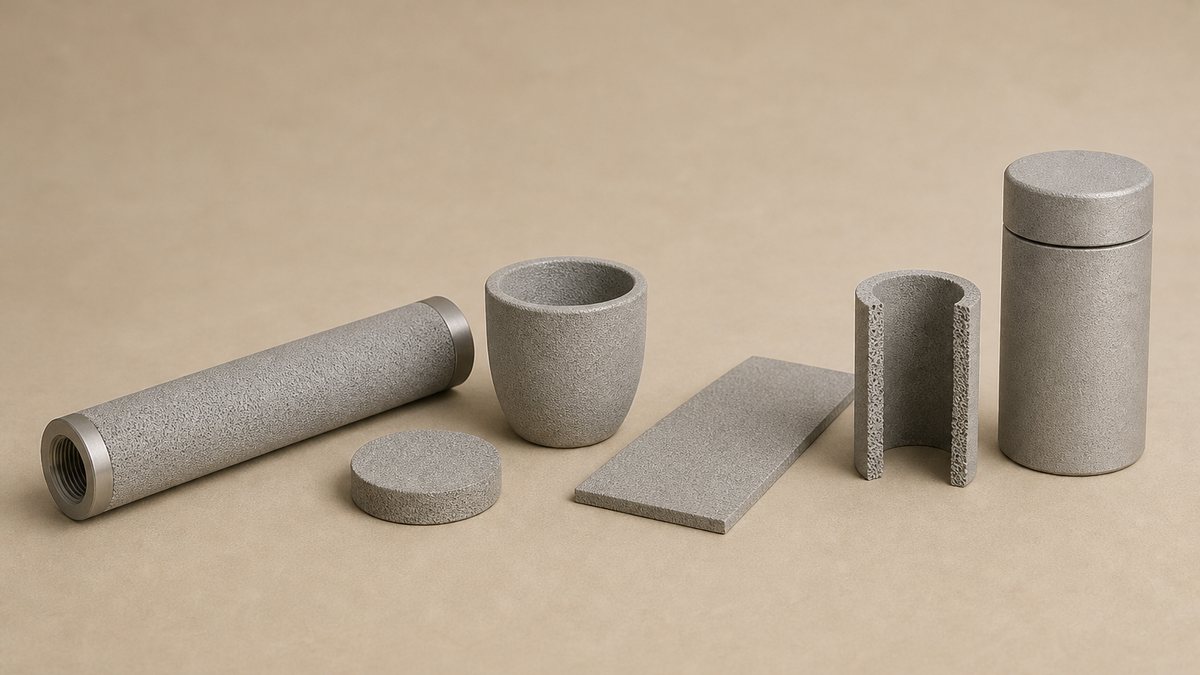
A sintered metal filter is a filter made of metal powder that has been pressed into shape and then heated until the grains fuse to each other, leaving a maze of small connected gaps between them. The fluid goes through those gaps and the dirt stays behind. What makes the part worth its price is not the metal and not the pore size. It is what the element is not made of: there are no fibres to shed and no resin to leach, because the whole structure is fused grain against grain. That single property is why metal elements are specified in two duties that are otherwise served by far cheaper filters, and both duties are written into free federal rules. A filter for an injectable drug product must not release fibres into the product, and a resin-bonded filter used on food has to be built from permitted fibres and permitted binder resins and must stay inside an extractives limit that changes with the food and the temperature. Buyers order a sintered element on a micron rating and a shape, and those two rules, which decide whether the element is even allowed in the line, are the two things the quotations never mention.
Six Lines That Decide Whether a Sintered Element Order Is Complete
| What the buyer has to settle | Why it is not obvious | The line on your order that closes it |
|---|---|---|
| Which medium: powder, mesh or fibre felt | All three are called sintered metal, and they behave differently on dirt and on cleaning | The medium by name, plus the layer build if it is a mesh or felt laminate |
| The pore size and the test that proves it | A micron figure with no method behind it cannot be compared between two suppliers | The rating, the grade, the test method and whether a test record comes with the part |
| Whether the duty is regulated | Filters for injectables must not shed fibres, and food-contact filters have extractives limits | What the fluid is, and whether the filter touches food, drink or an injectable product |
| Flow direction | Which side the dirt lands on decides whether the element can be cleaned at all | Inside-out or outside-in, and how the dirt will be removed |
| The end fitting and the joint | The welded or machined joint between the element and its fitting is the usual leak path | The fitting type, the joint method, and whether the joint will be pressure tested |
| When to clean and when to replace | Cleaning extends life up to a limit, and past that limit cleaning simply hides the end | The pressure drop at which you will replace, and the cleaning cycle you expect to use |
What a Sintered Metal Filter Is, and the Words Around It
The part is a porous metal body, and the vocabulary around it is small but used loosely. Seven words carry the subject, and getting them straight at the enquiry stage removes most of the arguments that follow.
- Sintering
- The step that gives the part its name. Metal powder is pressed into shape cold, and then heated to a temperature below the metal's melting point. At that temperature the grains do not melt; they diffuse into one another where they touch, and the touching points grow into a solid metal skeleton. The gaps that were between the grains stay open, and so does the network they form. Nothing is added to hold the structure together, which is the whole point.
- Porosity
- The share of the body's volume that is empty space rather than metal. It is set mostly by how hard the powder was pressed and by how the grains were sized before pressing, not by the heating step. A more porous body passes fluid more easily and holds more dirt, and it is also weaker. Porosity and strength are the trade the buyer is really making when ordering an element.
- Pore size and micron rating
- The size of the openings between the grains, usually quoted in microns, where one micron is a thousandth of a millimetre. A rating is a claim about what the element will retain, and it is not a physical hole you can measure with a rule: the gaps are a winding three-dimensional network of varying size, so a single figure is always a summary. That is why the test method matters as much as the number.
- Permeability and pressure drop
- How easily fluid passes through, and the pressure it costs to push the flow through the element. Pressure drop is the number an operator feels, because it climbs as the element loads up, and it is the number that decides when the element is taken out. A filter specified on pore size alone can be perfectly capable and still unusable because the pump cannot afford the pressure.
- Depth filtration and surface filtration
- A depth filter traps particles all the way through the thickness of the medium; a surface filter traps them in a thin cake on the face. A sintered powder element does a bit of both, because the outside face is finer than the inside, and how much of each depends on the medium. The distinction matters commercially, because a depth filter holds more dirt but is harder to clean back to new.
- Backwash and regeneration
- Cleaning the element by pushing fluid through it in the reverse direction, and more generally restoring its performance. Metal elements are sold on being cleanable hundreds of times, and that claim is true up to a point. Every cleaning cycle removes the dirt the reverse flow can reach and leaves whatever has worked its way into the depth of the structure. Regeneration is therefore a curve, not a reset.
- Cake
- The layer of collected solids that builds on the face of the element. A cake is not simply a nuisance: a stable, even cake becomes part of the filter and often does some of the finest work, which is why some sintered elements are deliberately given a coarse outer support layer to hold a cake without blinding the fine layer beneath.
Two comparisons are worth settling early, because buyers arrive at sintered metal from different directions.
Metal against a cartridge filter. A pleated fibre cartridge is cheaper to buy, lighter, and available in finer ratings. What it cannot do is survive being cleaned back into service. It is replaced rather than regenerated, it cannot operate at high temperature, it cannot be welded into an assembly, and it introduces fibres and binder resin into the line. Those last two properties are the reason metal exists in the duties described in the next section.
Sintered metal against plain wire mesh. A woven mesh is a grid of wire, and its openings are as regular as the weave. A sintered part made from mesh layers looks similar but is bonded: the layers and the crossing points are fused, so it cannot unravel, it can be cut and machined without the weave running, and it can be welded into a housing. Plain mesh is a screen; sintered mesh is a structural element.
Why Metal: the Rules That Actually Decide
Every page advertising sintered elements lists the same advantages: strong, reusable, high temperature, corrosion resistant, weldable. All true, and none of them explains why a plant pays several times the price of a cartridge for a metal element. The real answer is written into two free federal rules, and neither appears anywhere in the pages that rank for this subject.
The first rule is about fibres, and it is one sentence long. 21 CFR 211.72 is headed Filters, and it says that filters for liquid filtration used in the manufacture, processing or packing of injectable drug products intended for human use “shall not release fibers into such products”. The same section then deals with what to do when the duty cannot be met any other way: a fibre-releasing filter may be used when it is not possible to make the product without one, and in that case a further non-fibre-releasing filter with a maximum pore size rating of 0.2 micron, or 0.45 micron if the manufacturing conditions so dictate, must be fitted after it to pull the particles back out. And one more sentence closes the door completely: the use of an asbestos-containing filter is prohibited.
Read that against a pleated cartridge and the commercial argument appears. A fibre cartridge is made of fibres held together by a binder, and both the fibres and the binder are foreign material sitting in the line. The rule does not ban them, and it does allow them with a second filter behind. But it makes the filter's own construction a regulated property of the product, and it means a plant making injectables has to be able to say, on paper, what its filter can shed. An element made of fused metal grains has nothing to shed, and that is what is being bought.
The second rule is about what a filter may be made of, and it is remarkably specific. 21 CFR 177.2260 covers resin-bonded filters for food. It says such filters may be used safely in producing, manufacturing, processing and preparing food, subject to what follows, and then it sets out three things: the fibres that may be used, the binder resins that may be used, and an extractives limit that has to be met.
The permitted fibres are a short list. The permitted binder resins are likewise a short list, and it reads like a chemistry syllabus: acrylic polymers, melamine-formaldehyde and its chemical modifications, phenol-formaldehyde, polyvinyl alcohol, polyvinyl acetate with melamine formaldehyde, and one toluenesulfonamide-formaldehyde resin. Anything not on the list is not a resin-bonded filter for food.
Then comes the part with real buying consequences. The limit is not one number. It is measured as the share of the filter's own weight that comes out when it is soaked in a stated liquid at a stated temperature for two hours, and the liquid and the temperature change with the food. The table below is read straight from the section.
What a Resin-Bonded Filter May Give Up, and to Which Food
| What it is soaked in | Limit on what comes out | The food and temperature it goes with |
|---|---|---|
| Distilled water at 100 F, two hours | Not more than 2.8 per cent by weight of the filter | Filtering milk or potable water at up to 100 F |
| Distilled water at 145 F, two hours | Not more than 4 per cent | Milk or potable water at up to 145 F |
| n-hexane at reflux, two hours | Not more than 0.5 per cent - the tightest of the set | Filtering edible oils |
| Distilled water at 212 F, two hours | Not more than 4 per cent | Milk, coffee, tea and potable water at up to 212 F |
| Distilled water at or above the filtration temperature, two hours | Not more than 4 per cent | Nonalcoholic aqueous foods at a pH above 5.0 |
| 5 per cent acetic acid, two hours | Not more than 4 per cent | Aqueous foods at a pH of 5.0 or below |
| 8 per cent ethyl alcohol in water, two hours | Not more than 4 per cent | Alcoholic drinks up to 8 per cent alcohol |
| 50 per cent ethyl alcohol in water, two hours | Not more than 4 per cent | Alcoholic drinks above 8 per cent alcohol |
| Distilled water at 100 F, two hours, on an acrylic-based filter | Not more than 1 per cent | Milk or potable water at up to 100 F |
| Distilled water at 145 F, two hours, on an acrylic-based filter | Not more than 1.2 per cent | Milk or potable water at up to 145 F |
Three things come out of that table for a buyer. Edible oil is the hardest duty on the list, at half a per cent against four per cent everywhere else, so a filter that passes for water may be nowhere near passing for oil. The temperature matters as much as the food, with limits set at 100, 145 and 212 degrees Fahrenheit as separate cases. And the tighter limits attach to a particular resin family, which is why a supplier's choice of binder is not a manufacturing detail but a property of the finished filter that a customer may have to defend.
What sintered metal does with both rules. A sintered element contains no fibres, so nothing in it falls under the fibre rule. It contains no binder resin, so nothing in it falls under the resin list or the extractives limits. It is, in the plainest terms, exempt from both by not being the thing they describe. That is the honest commercial case for metal, and it is a case no page ranking for this subject makes. It is also the reason the price difference is not simply a supplier being greedy: a metal element is bought where a cheaper filter would raise a question the buyer cannot answer on paper.
Two limits, said plainly. The fibre rule governs injectable drug products for human use, and the resin-bonded filter rule governs filters used on food. A plant making neither inherits neither, so read them as the clearest written statement of what a filter has to be in those two duties rather than as a rule that binds every line. And the rule for food applies to resin-bonded filters; a metal element is outside it, which is a statement about which rule applies, not an approval of any particular element for any particular duty. The two sections take about ten minutes each to read on the electronic Code of Federal Regulations, and both are free.
Two more sections are worth knowing about because they cover the parts around the element rather than the element itself. If the housing seals and gaskets touch the food, they are governed as rubber articles for repeated use, and if the line is lubricated where food could meet the lubricant, that is governed the rule for food-contact lubricants. On a food-contact filter assembly the element is only one of three things that have to be able to answer a question.
Powder Sinter, Wire Mesh or Fibre Felt
Three different things are sold under the name sintered metal filter, and a quotation that names only a micron rating has not told you which one you are being offered. They stand up against dirt differently, they clean differently, and they cost differently.
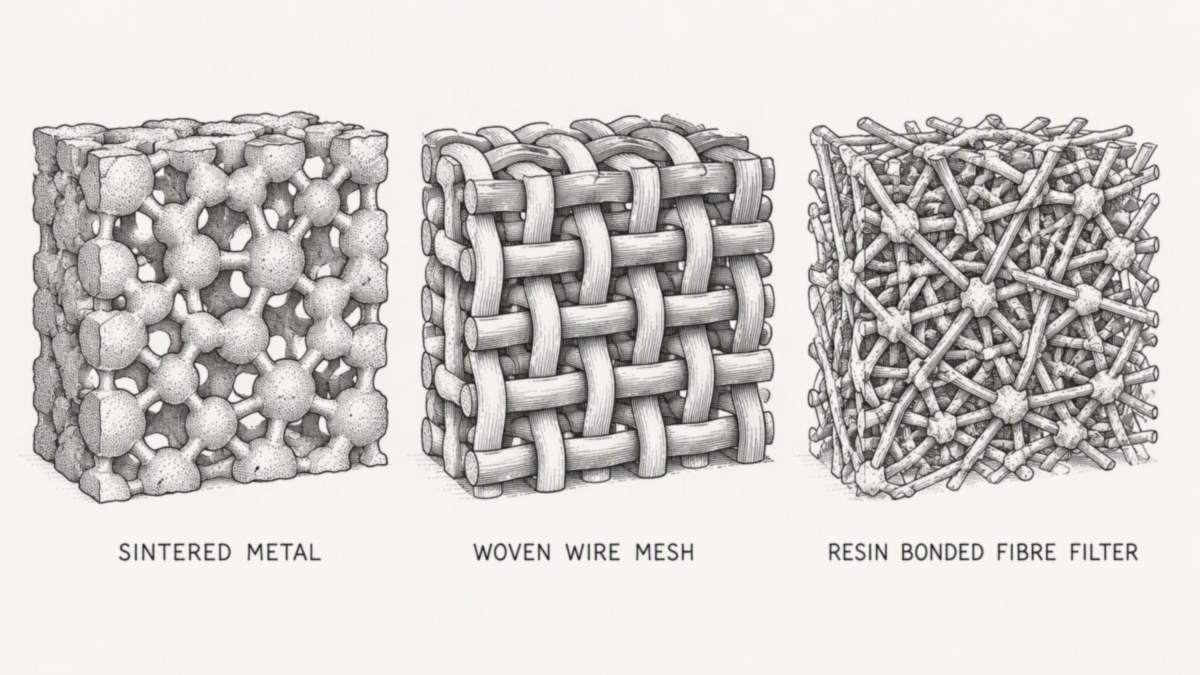
Powder sinter. Metal powder is pressed and fused into a body whose openings are the gaps between grains, so the pore network goes all the way through in three dimensions. This makes it a depth filter: particles are caught on the surface and inside the wall, and the element holds a large amount of dirt for its size. It is strong, it can be machined, it can be welded, and it can be made in almost any shape from a flat disc to a long seamless tube. Its weakness is cleanability, because the dirt that has worked into the depth of the wall is the dirt a reverse flow struggles to reach.
Sintered wire mesh, and laminates of it. Woven wire cloth is stacked in layers and fused so the layers and the crossings bond. The result is a sandwich that can be designed: a fine layer does the filtering, coarser layers above and below protect it from damage and from being crushed, and a perforated plate can be added underneath for rigidity. Because each layer is a weave with a regular opening, the finest rating is set by the finest cloth in the stack rather than by a statistical spread of grain sizes, so a mesh element is often the more precise of the two on a stated cut-off. It is also the more easily cleaned, because the fine layer sits on the surface where a reverse flow can reach it.
Sintered metal fibre felt. Instead of grains or woven wires, the medium is made from metal fibres of very fine diameter, laid into a mat and fused. The result is the highest porosity of the three with a fine rating, which makes it the choice where flow matters as much as retention, and it is often built as a graded stack so the pore size changes through the thickness. It is also the most easily damaged of the three, because fine fibres carrying the load have less metal behind them than a pressed powder body does.
Three practical consequences. Ask which medium, and ask for the layer build in writing if it is a laminate, because the number of layers and their order change both the rating and the pressure drop, and a quotation that says only five layer mesh has told you a marketing phrase rather than a construction. Match the medium to the cleaning method. If the element will be backwashed in place many times, the surface-loading mesh has the advantage. If it will be run to a pressure limit and then cleaned offline less often, the powder body holds far more dirt between cleanings. And check the claim against the duty. A fibre felt element rated at a fine micron figure sounds like the best of everything, and the sentence to look for is what thickness and what support it has, because a felt with nothing behind it will not survive the first reverse flow that actually moves the cake.
How the Part Is Made, and Why Porosity Is Fixed Before Heating
The process is four steps, and knowing them explains most of the quality differences between suppliers.
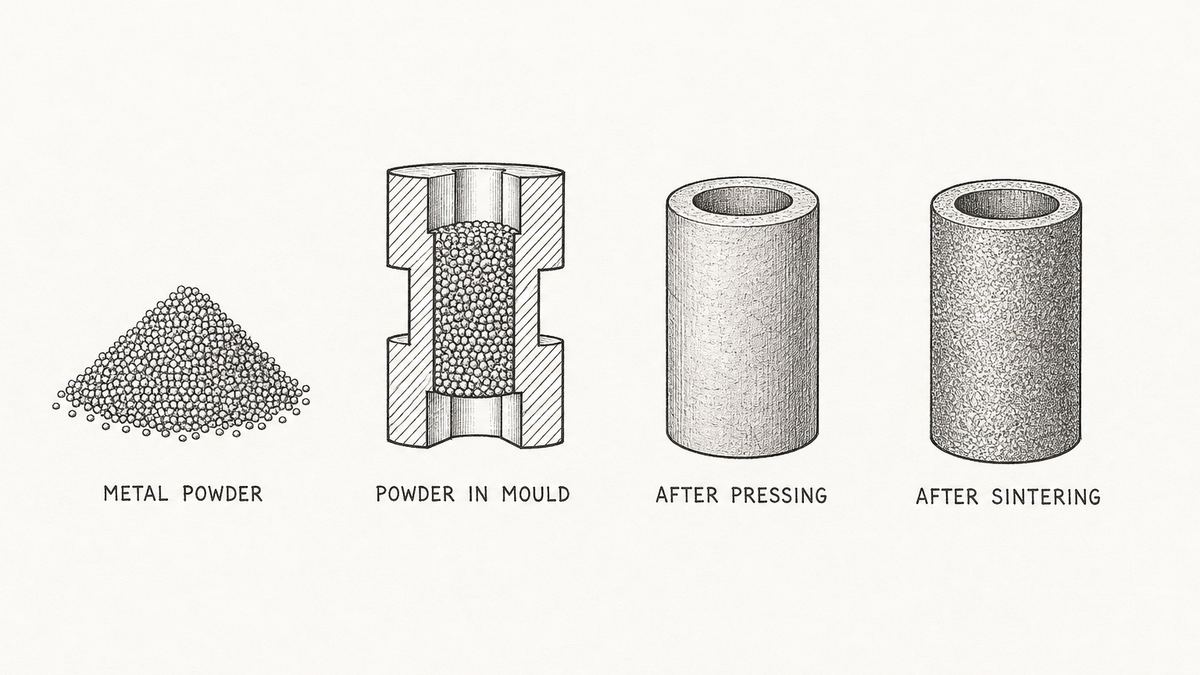
Powder. The starting point is metal powder made by atomising a melt into droplets that freeze into roughly round grains, then sieving those grains into narrow size bands. The band chosen sets the pore size that will result, so a factory that can hold tight powder bands can hold tight pore sizes. A factory that buys powder by a coarse grade name and mixes what it has will produce elements whose pore size varies between batches, and no amount of care later in the process will bring it back.
Pressing. The powder is poured into a die and pressed cold, usually with a mandrel in the middle to form the bore of a tube. The pressure decides how much empty space survives: press harder and the grains pack tighter, which gives a finer pore and a stronger body with a lower porosity. This is the step that sets the personality of the finished element, and it is also the step where thickness and wall uniformity are won or lost. A wall pressed unevenly is thin on one side, and the thin side is where the element will fail.
Heating. The pressed part, still fragile enough to crumble between the fingers, goes into a furnace. The temperature is high but deliberately below the melting point, and the atmosphere is controlled so the metal does not oxidise. At that temperature the touching points between grains grow into necks and eventually into a continuous metal skeleton. The pores do not close, because nothing has melted to fill them, and that is why porosity is fixed at the pressing step rather than at the furnace.
Finishing. The sintered body is then machined, welded, or both. Ends are turned flat, threads are cut, fittings are added, and the assembly is cleaned. This is where most of the cost and most of the risk in a filter order actually sit, because sintered metal machines like a difficult material: it is abrasive to tooling, it can crumble at an edge, and a machining operation that generates heat can close the pores at the surface it is cutting, which quietly changes the rating of the finished part. A factory that has made sintered elements for years will talk about how it machines without smearing the surface. A factory that makes them occasionally will not know the question.
One detail is worth asking about by name, because it is invisible afterwards. The pressing step leaves a wall whose density varies slightly from the surface inward. Some factories machine or chemically treat the outer skin so the finished element has a finer face than its interior, and some do not. If a supplier advertises a rating that is finer than the powder band could produce, that is the explanation, and it is a legitimate technique rather than a trick — but a buyer who wants it should ask for it, because a graded element and a uniform one can carry the same catalogue number.
Pore Size, Micron Rating, and the Test That Proves It
A micron rating is the first number every buyer asks for and the last one that can be taken at face value. The gaps in a sintered body are not holes drilled to a size; they are a connected network with a spread of widths, so a single figure is always a summary of a distribution rather than a dimension. Two elements described as five micron can retain visibly different particles and can behave differently on the same duty, and neither supplier has to be lying for that to happen.
The figure depends on the test behind it. There are two ways of arriving at a rating, and they answer different questions. One is to challenge the element with a fluid or a gas and measure the pressure at which bubbles first pass through a wetted element; that measures the largest opening in the network, because the bubbles find the easiest path through it. The other is to challenge the element with a suspension of particles of a known size distribution and measure how many of each size get through; that measures actual retention. These are not the same measurement, and the same element can honestly be described by two different numbers from the two methods. So the useful thing for a buyer is not the number at all. It is the number with the method named beside it, because that is what makes two quotations comparable.
Three qualities of rating are sold, and buyers confuse them. The first is a summary figure, often the point at which most particles of that size are held. An absolute rating is a claim that essentially nothing larger than the figure gets through. And a beta rating comes from counting particles before and after the element at several sizes, which gives a curve rather than a single number. If a quotation offers an absolute figure without a method, the word absolute is doing no work. Ask what test produced the figure and at what conditions, and ask for a record for the batch if the duty is regulated or the element is expensive.
What actually changes the rating on the machine. Three things, and they all point one way. Loading with dirt makes the element progressively finer, because the cake on the face becomes part of the filter; so an element that is slightly coarser than the target when new often settles into the right behaviour once it has a cake. High flow rates make it effectively coarser for fine particles, because the fines follow the flow instead of adhering. And chemical or thermal exposure can change the surface, usually toward a rougher and more open structure as material is leached away. An element is therefore not a fixed rating in service, and a plant that specifies a rating and then never checks the fluid is trusting a figure that has moved.
Pressure drop is the second number, and it is the one the operator lives with. For the same flow and the same rating, a thicker wall costs more pressure, a higher porosity costs less, and a larger element face costs less. Pressure drop also rises non-linearly as the element loads, so the useful question is not what the drop is when new but how much clean pressure head the plant has left to spend. Ask for the flow against pressure drop at the duty conditions, ask whether the figure is for water or for the actual fluid, and ask what the recommended replacement pressure drop is. A supplier who cannot give a flow and pressure figure has described a filter, not sized one.
Forms, Housings and How the Element Is Held
Elements are made in a small number of standard forms, and the form is chosen by the housing rather than by the filtration duty. That is worth saying out loud, because buyers often begin by choosing between a disc and a tube on filtration grounds when the real constraint is what the vessel will accept.
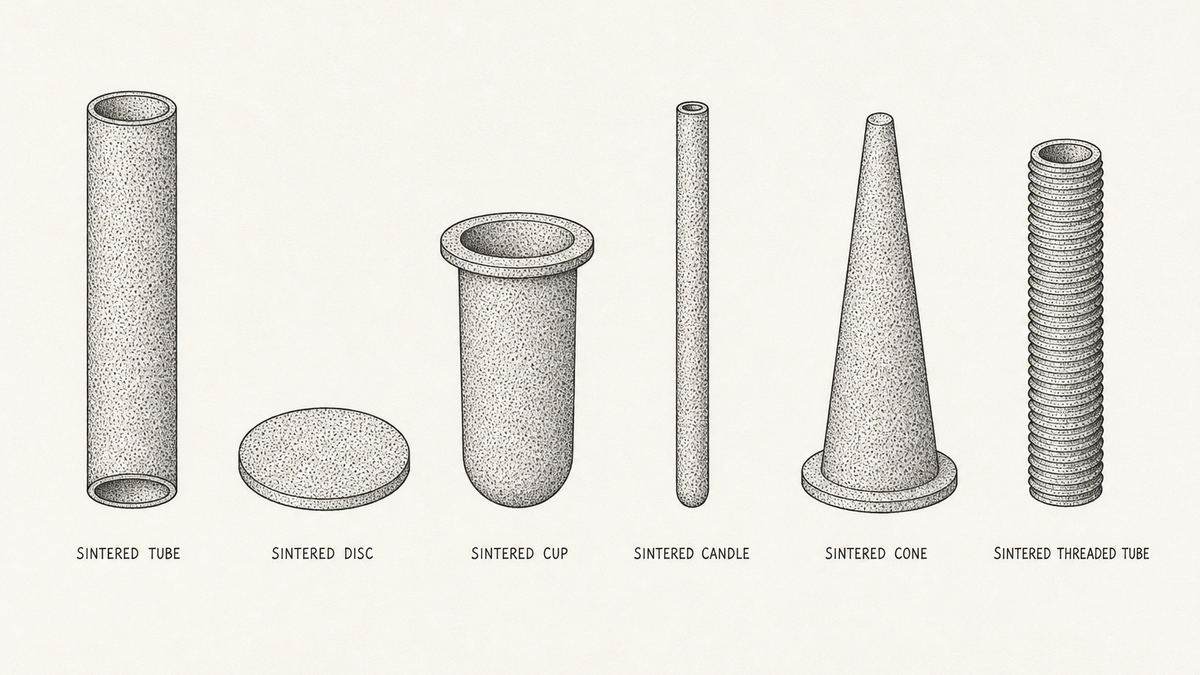
Tube. The workhorse. A straight cylinder open at both ends, mounted between two plates or into a fitting at one end. Because the tube is long and thin, it gives a large surface area in a small vessel, which is why most industrial metal elements are tubes. A tool that shapes thousands of them is a press tool, so tube sizes are semi-standard and a buyer asking for an unusual diameter is asking for a new tool.
Disc and plate. A flat round element, usually clamped between two flanges or seated in a recess. Discs are used where the vessel is short and wide, and they are common in gas and steam service and in small instrument-protection filters. They are also the easiest form to inspect, because both faces are visible with the element out of the housing.
Cup. A tube closed at one end and flanged at the other, so fluid can be fed to the inside and forced out through the wall or the base. The closed end removes a joint and a potential leak path, which is why cups appear in small high-purity assemblies where a joint is unacceptable.
Candle. A long thin tube closed at one end, hung from a single fitting at the top, often several to a vessel. Candles give the largest area per unit of vessel volume and are used where a lot of element has to sit in a narrow housing. Cleaning them individually is the price.
Cone. A tapered element on a wide flanged base, used where the flow area has to change smoothly or where the element must be self-supporting against a differential pressure across a wide face.
Threaded body. A short cylindrical element with a thread machined on it, so it screws directly into a housing or a manifold with no separate retaining parts. This is the form that turns a filter into a component, and it is the one where the thread itself becomes a specification, because a thread cut into a sintered body is being cut into a porous material.
Three questions belong with whichever form you choose. How is the element sealed against bypass? If fluid can go round the element instead of through it, the rating means nothing, and on a metal element the seal is usually a flat face, an O-ring or a weld. A welded element eliminates bypass at the cost of not being replaceable. What is the fitting made of, and how is it joined? A carbon steel fitting welded to a stainless element is a corrosion site, and a joint that is brazed rather than welded is a joint whose filler metal may not be acceptable in a food or pharmaceutical duty. And how much of the element surface will the housing blank off? An element that is a good fit for the flow but is clamped over a third of its area has lost a third of its capacity, and that is a common and entirely avoidable mistake.
Flow Direction, Cleaning, and When to Stop Cleaning
A sintered element is sold on being reusable, and the promise is real. What the promise does not include is a limit, and the limit is where most of the money is lost, because an element kept in service past its useful life costs more in lost production and in damage to what is downstream than a new element costs to buy.
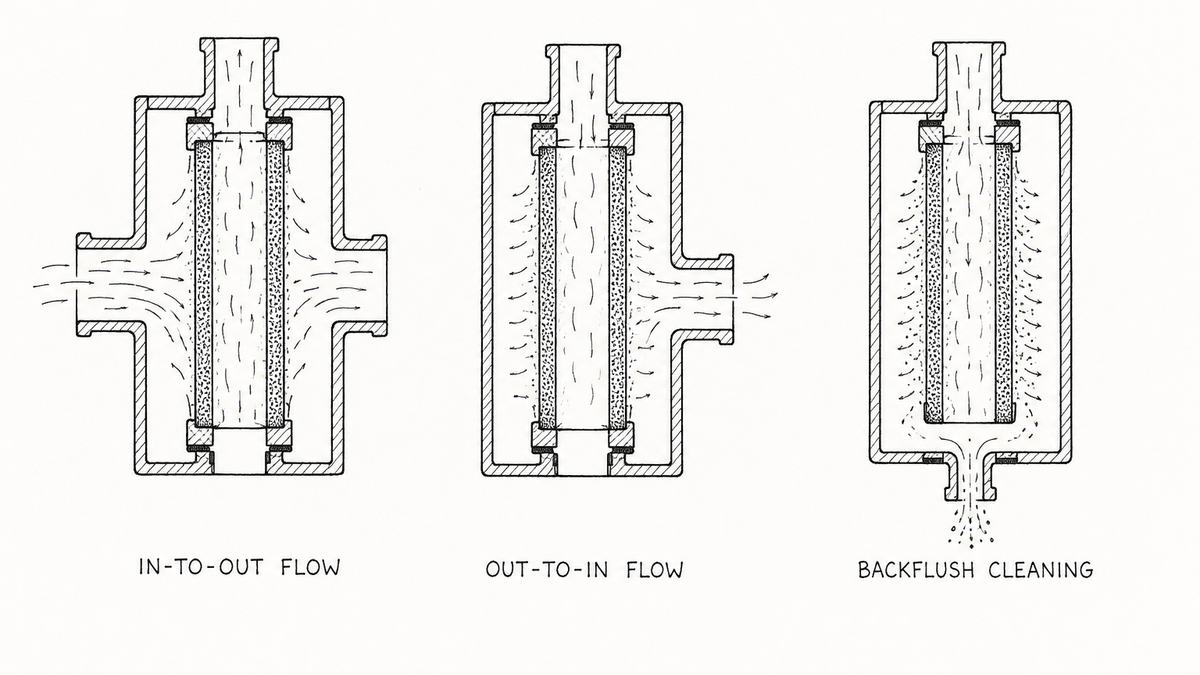
Outside-in is the default for a reason. Fluid enters the housing and passes inward through the tube wall, so the dirt lands on the outside surface where it forms a cake. That is the arrangement to choose whenever the dirt is to be removed, because the cake is on the surface that a reverse flow can reach. Almost every backwashable metal element is built this way.
Inside-out is for the duties that cannot be cleaned anyway. Fluid is fed to the bore of the tube and passes outward, which loads the inside of the wall. The advantage is that the whole outer surface of the element is available as the clean side, so the housing does not have to be drained and the element can be inspected from outside. The disadvantage is that the dirt ends up in a place a reverse flow reaches badly, so an inside-out element tends to be cleaned by chemical or thermal means rather than by backwashing. Choose it deliberately, not by accident, because an element installed the wrong way round in a housing that was designed for the other direction will load up in the wrong place and appear to fail early.
Backwash, and how it is actually done. A backwash is a reverse flow through the wall that lifts the cake and carries it away. The effective version is not a gentle reversal: it is a short, sharp pulse of reverse differential pressure, produced by pressurising the clean side with gas and then opening a discharge valve quickly so the pressure is released through the element in one go. A slow reverse flow mostly rearranges the cake instead of removing it. This is why the design of the backwash line and the valve matters as much as the element, and why a plant that complains its metal elements do not clean well often has a backwash that never produced a sharp enough pulse.
Offline cleaning buys back more than backwashing does. When backwash stops being enough, the element comes out and is cleaned by one of three routes. Heating in a controlled atmosphere burns off organic material, and the temperature has to be chosen so the metal is not harmed. Ultrasonic cleaning in a bath loosens material both on the surface and inside the wall. And chemical cleaning dissolves or lifts what the others cannot, with the choice of chemical limited by the material of the element. All three have the same requirement: they must be matched to the material and to what is being removed, and a cleaning regime that is too aggressive will remove metal along with dirt and leave the element thinner and coarser than it was.
The limit, and how to set it. An element is finished when its pressure drop at the duty flow no longer comes back after cleaning. Three measurements settle it, and all three are cheap. Measure the pressure drop at a stated flow when the element is new, and write it down. Measure it again after each clean, at the same flow. And watch the trend rather than the single number: an element whose clean pressure drop has climbed by a fifth or a quarter over its first several cycles is not going to last many more, however well it cleans today. This is the single habit that turns a metal element into a genuine long-life element instead of a cartridge with extra steps, and the same logic applies to any consumable whose life is judged by a measured figure rather than by a calendar, which is how condition-based replacement works for a component like a the pump that drives a sintered metal as much as for a filter.
Two mistakes end elements early and are worth naming. Backwashing too hard, because a reverse pulse that is stronger than the element can take will split a tube or open a seam, and a split element passes dirt permanently while looking perfectly serviceable from outside. And cleaning by a method the element was never specified for, because a strong caustic that is fine on stainless can destroy a sintered nickel element, and a heat treatment chosen to burn off organics can oxidise a material that needed a protective atmosphere.
What to Put in the Specification Sheet
A sintered element enquiry that gives a shape and a micron rating will produce a quotation for a porous metal part, and it will not produce an element that works. The general discipline for any part made to a drawing is set out in this guide to a the part-sheet format Chinese suppliers expect; a sintered element adds its own lines on top.
The fluid and the duty first, because they decide everything downstream. What the fluid is, its viscosity, and whether it is liquid or gas. The normal and maximum flow rate. The operating pressure and temperature, with the maximum temperature the element could see during cleaning as a separate figure, because a cleaning temperature can be the highest number in the whole specification. Whether the fluid is corrosive, and whether it is abrasive. And the one question that changes the material more than any other: does this filter touch food, drink, or an injectable drug product, because a metal element is chosen in those duties specifically for what it does not shed.
Performance, stated as a pair. The rating you need, with the test method beside it, and whether a batch record is required. And the flow against pressure drop at the duty conditions, with the fluid named, so the element can be sized rather than guessed at. Ask for the recommended pressure drop at which the element should be cleaned, and ask for the clean-element pressure drop at the design flow so you have the baseline to compare against later.
The element itself. Which of the three media, and for a mesh or felt laminate the layer build in writing: how many layers, of what, in what order. The material and its grade. Overall dimensions: outer diameter, bore, wall thickness, and length, with tolerances rather than a single figure alone. Pore size and porosity if it can be declared. Surface finish if the duty calls for one. And flatness on a disc or a plate.
The ends and the joints, drawn. The fitting type, the thread if there is one, the method of joining, and the filler metal if the joint is brazed. This is where most element failures live, so it belongs on the drawing rather than in a note. State whether the joint has to be pressure tested and how. State the maximum differential pressure the element must withstand in service, and the maximum it must survive in a reverse pulse, because those two numbers size the metal behind the joint.
Then the requirements that only exist in a regulated duty. If the element touches food or drink, say so, and ask the supplier to confirm what the element is made of in terms that let you answer the question a customer may ask. A metal element has no binder resin and no fibres, which is the whole advantage, and a supplier who can state that clearly is worth a premium over one who cannot. If the housing seals touch the product, those belong in the same conversation, because the rules reach them as well. And if the duty is an injectable drug product, ask the supplier whether he understands why the fibre rule exists, because the answer tells you whether he has supplied that duty before.
Documentation and commercial lines. A material certificate. A pore size or bubble point record on any element where the rating matters, with the method named. A drawing carrying its revision number, with no changes permitted without written agreement.A first article for a new form, a new medium or a new supplier, because a sintered element is exactly the case where a substitution is invisible from outside and only shows as a dirt breakthrough weeks later. And the packing, because a sintered element is fragile in a way it does not look: the wall is thin, the surface is porous, and a tube that has been dropped or rested on its edge will have damage you cannot see and will not pass a bubble point test.
Sourcing From China: Factory, Trader, and What to Ask
Worth saying plainly at the start: a Chinese factory page ranks second for this very phrase, and that page is long, well organised and covers types, materials, accuracy ranges, the process and cleaning in more detail than most Western suppliers do. So the question for a buyer is not whether Chinese suppliers make sintered elements. It is how to tell one that does it well from one that does it occasionally, and the questions that separate them are technical rather than commercial.
Four questions a real works answers from its own process.
What powder does it buy, and how does it control the band? The powder grade sets the pore size, so a works will talk about grain size bands, suppliers and how it checks incoming powder. A works that buys powder by a generic description and blends what it has will produce elements whose rating drifts between batches, and no finishing operation can correct that.
How does it press, and how does it check wall uniformity? Pressing sets porosity, thickness and wall evenness, and a wall pressed unevenly fails at the thin side. A works will describe its dies, its mandrels and how it checks a pressed part before it goes into the furnace.
How does it machine without smearing the pores? This is the best single question in the whole subject, because it is the one an occasional maker cannot answer. Cutting a sintered body can close the pores at the cut face, and a factory that has solved it will describe the tooling, the speeds and the cooling. A factory that has not will say the parts are machined to drawing.
How does it measure the finished rating, and with what? A rating claim is worth only as much as the test behind it. A works will name the method, describe the rig, and know what a bubble point test does and does not tell you. A reseller will quote a catalogue figure.
Then five commercial questions. Which forms and sizes are held as production tooling, because a form with a press tool behind it is a different proposition in price from one that needs a new die. Whether the factory makes its own powder or buys it, which matters because it changes what can be adjusted. What the minimum order is for a new die. What the lead time is for a repeat of an identical element. And whether the factory will accept your inspection before shipment, which is the next section.
Two commercial realities worth carrying into the conversation. First, this is a part where the engineering is in the tooling and the measurement rather than in the material, so a cheaper quotation usually means a die that is worn or a rating that is not checked, and neither shows in the delivered part. Second, and this is the honest counterpoint, China is strong on this product at the middle of the range: standard tubes and discs, common stainless grades, and ratings that come with a declared method. Asking the same factory for an unusual form in an unusual alloy with a tight rating in single pieces is asking it to compete where it is weakest, and the price and the lead time will say so. The same is true of any flow component whose performance depends on internal geometry rather than on assembly, which is why a the screw pump used in this service bought to a special size behaves the same way.
Inspection Before Shipment
A sintered element is a part where nearly everything that matters is measurable, and where almost nothing that matters is visible. That combination is what makes inspection worth doing, and it is also why an inspector who only looks at the part will pass a bad one. The wider sequence, and how much of a shipment to inspect, is set out in this guide to inspecting the batch before shipment; the element-specific list is short.
Start with the dimension that decides the wall. Measure the outer diameter, the bore and the wall thickness at several points along the length and at more than one angle around it. Wall thickness is the number that matters and the number that is easiest to get wrong, because a mandrel that has drifted produces a tube that passes a diameter check and fails in service at its thin side. A wall that varies noticeably around one circumference is a rejection however good the rest of the part looks.
Check the length and the ends. Overall length, and on a tube, that both ends are square and parallel, because an element that is not square will not seat and will bypass. On a threaded body, check the thread with a gauge rather than by eye. On a flanged form, check the flange face for flatness and for a raised burr left by machining.
Then test the rating, and insist on a method. A bubble point test on a wetted element is the standard check and it is quick: the pressure at which the first bubbles pass tells you the largest opening, and comparing that figure with the value for a known good element of the same type tells you whether the part in your hand is what was ordered. If the supplier claims a rating without a method, ask for the method and the record, and if neither exists, treat the rating as unproven. On a batch of elements, test a sample at minimum, and test every piece on a regulated duty.
Pressure test the joint. The welded or brazed joint between the element and its fitting is the failure point on an assembled element, and it can be tested in seconds. Hold pressure on one side and look for a drop, or immerse the joint and look for bubbles. A joint that weeps under a static test is one that will leak dirt under a reverse pulse.
Look at the surface under light, and photograph it. What you are looking for is not dirt but damage: a bruised patch where the element was rested on an edge, a bright rubbed area from handling, a scratch, or a spot where the surface has been smeared by a cutting tool and looks glazed rather than grainy. A smeared patch has closed pores, which means that piece of the element is not filtering, and it will not show up in a dimension check.
Confirm the material and the paperwork. Check the grade against the certificate, check any marking against the drawing, and check the count. If a bubble point or flow record was ordered, confirm it is in the box and that the figures relate to the elements in that box rather than to a sample of a different batch. Records that are correct but unattached are records that will be lost before the elements reach a plant.
And check the packing, which on this part is not a formality. A sintered element has a thin wall and a fragile surface, and it arrives damaged when it has been allowed to move inside its carton. Look for elements touching each other without separation, tubes resting on an edge, and fittings left with their threads unprotected. A part that has travelled badly can pass every dimension and fail a bubble point, and that is exactly the kind of failure that is worth catching in a factory rather than in a plant.
Failure Modes, and Which Side Each One Is On
A dead sintered element shows one of four things, and the four split into three that the way the plant runs the filter produced and one that belongs to whoever welded it.
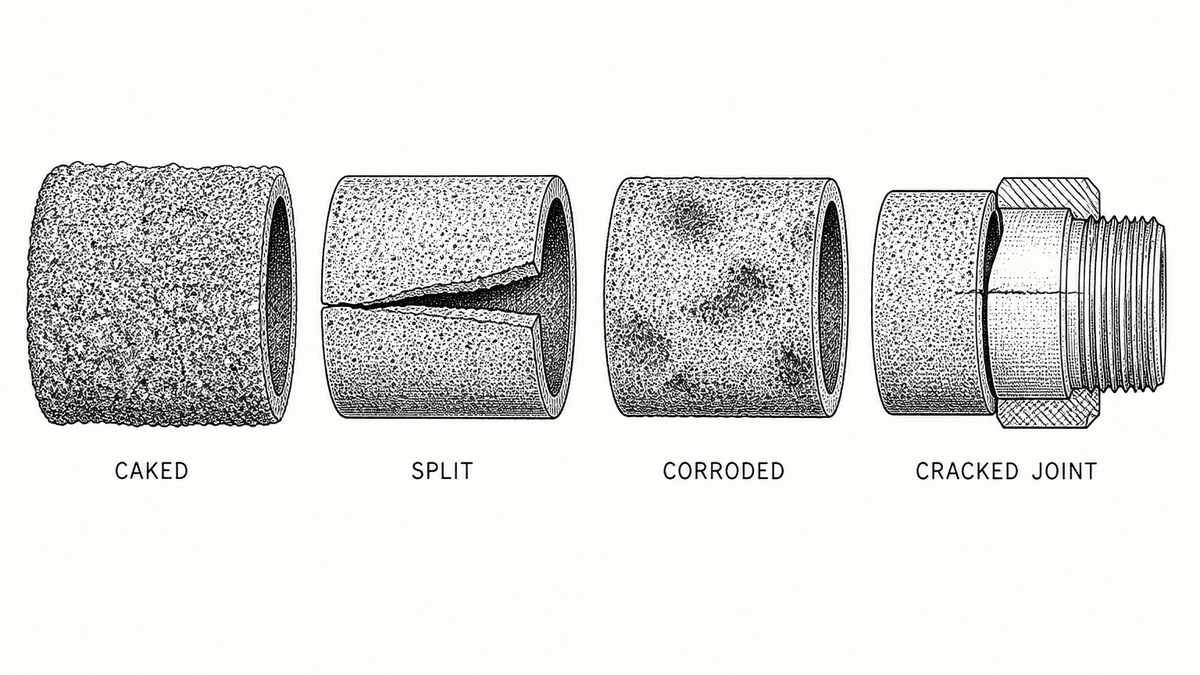
A thick even cake on the outside. This is not a defect, it is a filter doing its job, and it becomes a problem only when the pressure drop it creates is more than the plant can afford or more than the element can be cleaned back from. The pattern to look for is an even cake, because an even cake is stable and does some of the fine work. A cake that is thick on one side and thin on the other is telling you about the flow distribution in the housing, which is a housing problem rather than an element problem.
A longitudinal split. A ragged crack running along the length of a tube, with the torn edges pulled apart, is a mechanical failure, and its cause is almost always a reverse pulse stronger than the element was built for, or a differential pressure across the wall that exceeded what the wall can carry. It is the most dangerous of the four because it is often invisible from the outside of a housing, and an element that has split stops filtering entirely while continuing to pass flow. A plant that fits metal elements specifically to catch a fine particle and never notices a split has changed the filter into a pipe.
A rough, pitted, discoloured surface. Shallow craters and patches of discoloured metal are corrosion, and corrosion of a sintered body is worse than corrosion of solid metal because the surface area is enormous. Small pits grow into connected pits, and material is removed from the very grains that carry the load, so a corroded element gets coarser and weaker at the same time. The cause is a fluid the material was never suited to, a cleaning chemical that was too aggressive, or a shutdown period with the wrong fluid left standing in the housing.
A cracked or weeping end joint. A hairline crack or a visible gap where the fitting meets the element is the one failure of the four that belongs to the maker. It comes from a weld that did not penetrate, a brazed joint with the wrong filler, a mismatch between the materials of the fitting and the element, or heat from the joining operation that damaged the sintered structure right beside the joint. This failure is the reason a pressure test on the joint belongs in the incoming inspection, because it is cheap to find and expensive to miss.
Six Symptoms and Which Side Each One Is On
| The symptom | What the evidence looks like | Whose side it is on |
|---|---|---|
| Clean pressure drop higher than the figure quoted | A new element does not reach the stated flow at the stated pressure, measured on the bench | The supplier's, and ask for the bubble point record and the wall thickness measurements |
| Dirt getting through a new element | A bubble point test on the wetted element passes air at a lower pressure than a known good piece of the same type | The supplier's. The rating is not what was ordered, and the method used to claim it is the question to ask |
| A leak at the fitting with no other damage | A pressure drop on the joint in a static test, or bubbles at the joint when immersed | The supplier's, and it is a weld or brace fault rather than a filter fault |
| An element that stops holding dirt after months of cleaning | Clean pressure drop climbing cycle on cycle, with a surface that looks intact | Yours. It is the end of the element's life, reached because it was run past its measurable limit |
| A split running along the wall | A ragged longitudinal crack with the edges pulled apart, often on the side facing the backwash inlet | Yours. The reverse pulse or the differential pressure exceeded what the element was specified to take |
| A rough, pitted, discoloured surface | Shallow craters, lost metal and a surface that has gone coarser than it was | Yours, unless the fluid was declared in full and the material was recommended against it |
Two habits make the diagnosis reliable rather than a matter of opinion. Write down the clean pressure drop of the first element of every new type, at a stated flow, and keep the figure. Without that baseline every later conversation about performance is an argument, and with it most of them are a single measurement. And keep one new element of each common type in the stores as a reference, so a bubble point result, a surface appearance and a wall thickness can all be compared against something known rather than against memory.
One further point is worth making because it decides which of the two sides pays. On three of the four failures above the element did what it was asked to do and the plant ran it outside what it was specified for, which means the fix is in the specification and the operating envelope rather than in the next order. A buyer who replaces a split element with an identical one and changes nothing about the backwash has bought the same failure again on a later date.
Price, MOQ and Lead Time: What Actually Moves the Number
A sintered element has no meaningful catalogue price, because the part is made to a form and a rating and the price depends on tooling that either exists or does not. What can be given is the list of things that move the number, so that when two quotations differ by a factor you know which question to ask.
Whether a die already exists. This is the largest single line and the one buyers underestimate most. Pressing a tube or a disc needs a die and a mandrel, and a factory that already runs your diameter and wall has that tooling amortised across years of production. A new diameter means a new die, and on the first order the whole cost of it lands on the pieces you buy. The practical consequence is worth acting on: ask which forms and sizes the factory holds as production tooling, and see whether the design can move to one of them. A change of diameter decided before the first order saves more than any amount of negotiating after it. The same logic applies to any part whose cost is dominated by tooling rather than by material, from a sintered element to a the sprocket that drives a sintered metal cut on a hob that has to exist before the first tooth is cut.
The medium. Powder sinter, mesh laminate and fibre felt are three different manufacturing routes with three different cost structures. A mesh laminate is assembled from cloth that is itself expensive, and a five layer build costs more than a two layer one because there is more cloth in it. A fibre felt costs more per unit of area than powder, because fine metal fibre is dearer than powder by weight. And a powder body costs more as it gets thicker, because thickness is material and pressing time.
The material. Stainless in a common grade is the baseline. A higher alloy, a nickel or titanium element, or anything with a specific corrosion story behind it costs more in material and more in process, and the difference is real rather than a markup. On an element that will be cleaned repeatedly in a plant, the material is the line not to shave, because a cheap alloy that corrodes takes the element out of service long before its structure is worn out.
The rating, to a point. Holding a tighter pore size means tighter control of the powder band and tighter control of the pressing, which means more scrap and more inspection. But unlike some precision parts the cost does not climb without limit, because a finer rating is often achieved by choosing a finer powder rather than by working the material harder. The line that does climb without limit is the combination of a fine rating with a large element, because holding a tight pore size over a long tube is harder than doing it over a short one.
The ends and the joints. On an assembled element, machining the ends, cutting a thread, and welding or brazing a fitting are separate operations on a material that is awkward to machine. This is frequently a larger share of the price than the porous body itself, and it is where a quotation that looks low has most likely taken something out. Ask specifically whether the joint is welded or brazed, and ask what filler is used if it is brazed.
How the rating is proven. An element sold with a declared rating is one product. The same element sold with a bubble point record for each piece is another, because somebody has to run the test, record it and keep the record with the part. On a duty where the rating is the reason the filter exists, that record is part of what is being bought rather than an extra, and it should be priced rather than assumed.
MOQ and lead time both follow the tooling. A form the factory already runs may be available in small quantities, because it is production. A new die carries a minimum that reflects setting it up. On the schedule, the steps that queue are the powder if it has to be ordered, the furnace, and the machining and welding after sintering. Ask which of those is the bottleneck for your form, and ask whether the rating will be tested on every piece or sampled from the batch. A delivery date given for a production form and applied to a new die is how a project slips three weeks with nobody having lied to you.
Questions Buyers Ask
What is a sintered metal filter made of, and is anything added to hold it together?
Nothing is added. A sintered element is metal powder, or metal fibre, or woven metal cloth, heated until the grains or the wires fuse to one another where they touch. The temperature is deliberately held below the melting point, so the metal never becomes liquid and the gaps between the grains stay open. That is why a sintered element has no fibre content and no binder resin - there is no separate material in it at all, only fused metal. This is not a marketing point: it is the reason the part is specified in duties where a fibre cartridge would be a problem, and it is what makes a metal element different from every other kind of filter medium in the same catalogue.
Which is better, powder sinter or sintered wire mesh?
Neither is better; they load and clean differently, and the choice comes down to how you will remove the dirt. A powder element is a depth filter, so it holds a large amount of dirt for its size, but some of that dirt works into the wall where a reverse flow reaches it badly, so it is the better choice when the element is run to a pressure limit and then cleaned offline. A sintered mesh laminate puts its finest layer on the surface, so the dirt cakes where it can be washed off, which makes it the better choice for an element that is backwashed in place many times. A mesh laminate is also easier to design precisely, because the rating is set by the finest cloth in the stack rather than by a spread of grain sizes. Ask which medium is being offered, and if it is a laminate, ask for the layer build in writing.
Does a micron rating mean the same thing from every supplier?
No, and that is the single most common misunderstanding in the whole subject. The openings in a sintered body form a connected network with a range of widths, so a single figure is always a summary rather than a dimension. On top of that, the figure can come from two quite different tests: a bubble point test measures the largest opening in the network by finding the pressure at which air first passes through a wetted element, while a particle challenge test measures how much of each particle size actually gets through. The same element can honestly be described by two different numbers from those two methods. So the number that matters is not the rating on its own but the rating with the method named beside it, because that is what makes two quotations comparable and what tells you whether a supplier measures his own product at all.
How many times can a sintered element be cleaned before it has to be replaced?
There is no honest count, and any supplier who gives you one without knowing your duty is guessing. An element is finished when its pressure drop at the duty flow no longer comes back after cleaning, and that point depends on the fluid, the dirt, the cleaning method and how hard the reverse pulses are. What you can do is measure: record the clean pressure drop at a stated flow when the element is new, measure it again after every clean at the same flow, and watch the trend rather than the single figure. An element whose clean pressure drop has climbed by a fifth or a quarter over its first several cycles is near the end however well it cleans today. Two things end them early: backwashing harder than the element can take, which splits the wall, and cleaning with a chemical or a temperature the element was never specified for.
Why would I pay several times a cartridge price for a metal element?
Three reasons, and only one of them is about money. The first is what the element does not contain: a fibre cartridge is fibres held by a binder resin, and in a duty where the filter's own construction is regulated - an injectable drug product, or a food or drink line - that construction becomes something you have to be able to answer for on paper. A fused metal element has no fibres and no binder, so the question does not arise. The second is temperature: a metal element can be cleaned by heat, which a polymer cartridge cannot. The third is service life, and here the arithmetic is worth doing properly. An element that is cleaned and reused many times costs more once and less over years, and the saving is real only if the plant records its clean pressure drop and replaces the element when that figure stops coming back. Without the record, a metal element is an expensive cartridge.
How do I choose a sintered metal filter supplier in China?
Ask four technical questions and listen to whether the answers come from a process or from a catalogue. What powder grade is bought, and how is the grain band checked on arrival? How is the part pressed, and how is wall uniformity checked before the furnace? How does the factory machine a sintered body without smearing the pores, which is the question an occasional maker cannot answer? And how is the finished rating measured, with what rig, and is a record kept with the part? Then add the commercial half: which forms and sizes have tooling already, what the minimum is for a new die, what the lead time is for an exact repeat, and whether the factory will accept your inspection before shipment. A works answers all eight from its own floor. A reseller answers the price and the delivery date and refers the rest upstream, which is a fine answer when it is given openly and a warning when it is not.
Send the fluid and the duty — the micron rating alone tells us nothing
Tell us what the element has to do, then the lines that decide whether it works: the fluid, its viscosity, and whether it is a liquid or a gas; the normal and maximum flow; the operating pressure and temperature, with the highest temperature the element could see during cleaning stated separately; whether the fluid is corrosive or abrasive; and the one question that changes the material more than any other — whether the filter touches food, drink or an injectable drug product, because that is where a metal element earns its price. Then the performance, stated as a pair: the rating you need with the test method beside it, and the flow against pressure drop at the duty conditions with the fluid named, so the element can be sized rather than guessed. Add the construction: which of the three media, and for a mesh or felt laminate the layer build in writing; the material and grade; outer diameter, bore, wall thickness and length with tolerances; pore size and porosity if the supplier can declare them; and the ends, drawn, with the fitting type, the thread, the joining method and the filler metal if the joint is brazed, plus the maximum differential pressure in service and the maximum the element must survive in a reverse pulse. Then the requirements that only exist in a regulated duty: ask the supplier to confirm in writing what the element is made of, ask for the housing seals to be covered in the same conversation if they touch the product, and ask whether he understands why the fibre rule exists, because the answer tells you whether he has supplied that duty before. Add a material certificate, a bubble point or pore size record with the method named where the rating matters, a drawing with its revision number and no changes without written agreement, a first article on a new form or medium, and packing that separates the elements so a thin wall does not arrive bruised. Two lines save trouble later: ask for the clean element pressure drop at the design flow so you have a baseline to compare against, and fix your spare holding at the same time as the first order. If an element has already failed, photograph the surface under light before anything is cleaned, measure the wall all round, run a bubble point test against a known good piece of the same type, pressure test the end joint, and check the clean pressure drop trend across its cleaning history. The pattern says whether the fault was made in the factory or by the way the element is run.
Request a Sintered Metal Filter Sourcing Quote
Questions & Comments
We read every one and reply within 24 hoursMost sintered element problems trace back to a micron rating that arrived with no test method behind it, or to a duty where the filter's own construction mattered and nobody checked. Tell us the fluid and the duty, and we will tell you which of those two you are exposed to.