
Screw Conveyor Manufacturer: Sourcing Auger Conveyors and Flights From China
 ·
Updated October 13, 2026
·
23 min read
A screw conveyor, or auger, is a helical flight turning inside a trough so that bulk material is pushed along by the blades rather than carried on a belt. It is the cheapest way to move powder, grain, pellets, sludge or mash over a short distance, it works at any angle including straight up, it can be made dust-tight, and it has almost no parts that wear out except the ones that rub. Buyers order one on diameter, pitch and length, and the three things that decide whether it survives are the ones they leave off: the flight form the material actually needs, the clearance between the flight and the trough, and what the covers are made of. That last one is not a preference. It is written into a free federal rule in words that read like an order form.
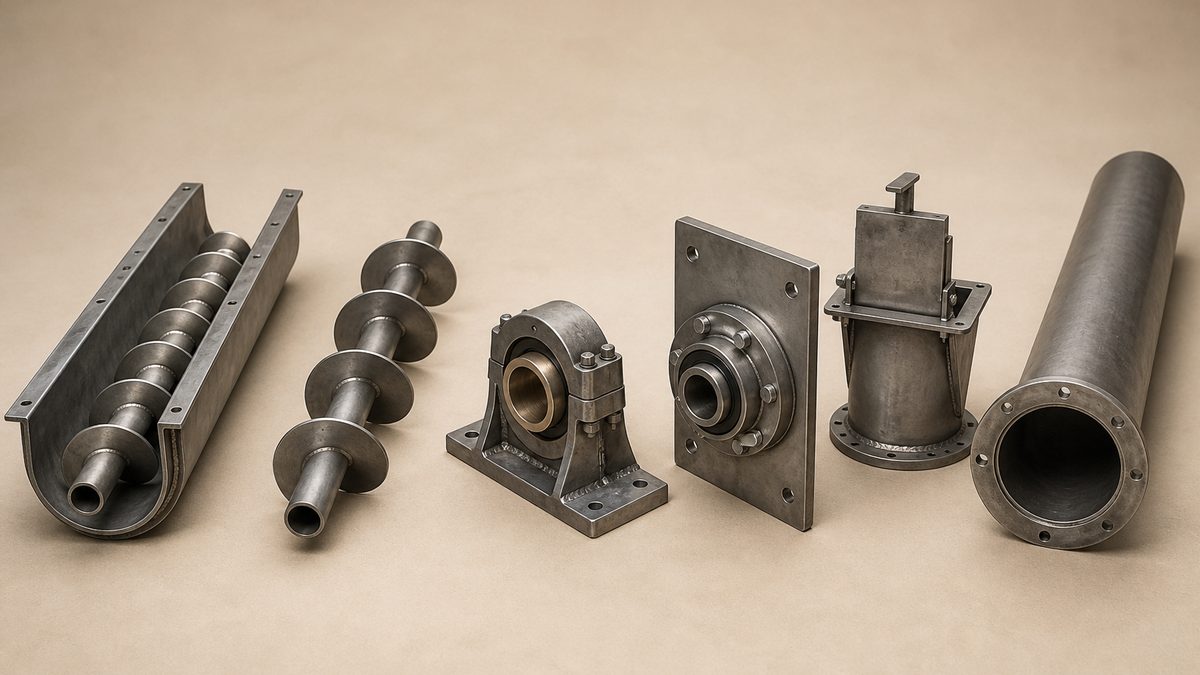
Six Lines That Decide Whether a Screw Conveyor Order Is Complete
| What the buyer has to settle | Why it is not obvious | The line on your order that closes it |
|---|---|---|
| The flight form, not just the diameter | Six standard forms move six different materials, and the price is similar | The flight form by name, with the material and its bulk density |
| The clearance between flight and trough | It sets how much material is left behind and how much gets crushed | The trough form and the clearance you will accept |
| What the covers are like | On some duties a screw conveyor is required by rule to have covers, in a specified form | The cover sections, the clamping, and whether the line has to be dust-tight |
| Whether the run must be interlocked | Where an operator can reach the flight, the rule asks for more than a lid | Whether an interlock is required, and what it must stop |
| The hanger bearings | Every support in the trough is a place material packs and a place the shaft wears | The bearing material, the spacing, and whether the run can be supported at both ends instead |
| The thrust arrangement at the drive end | The screw pushes itself along as it pushes the load, and something has to hold it | The thrust bearing type, the end plate, and the seal or gland at the shaft |
What a Screw Conveyor Is, and the Words Around It
The machine is a spiral blade on a shaft inside a casing, and the vocabulary around it is small but used loosely. Seven words carry the subject, and getting them straight at the enquiry stage removes most of the arguments that follow.
- Screw conveyor, auger, screw feeder
- Three names for closely related machines, and the trade uses them inconsistently. A screw conveyor moves material along a run and is usually filled to a modest depth. A screw feeder is the same hardware doing a different job: it measures material out of a hopper at a controlled rate, and it is normally flooded at its inlet, which changes the loads completely. An auger is a colloquial name used for both and for hand tools. The distinction matters because a screw sized as a conveyor and used as a feeder will be overloaded at its first flights, and the failure appears as wear near the inlet rather than in the middle.
- Flight
- The helical blade. Its outside diameter and its pitch are the two numbers that set the machine's capacity, and its form is what decides whether a given material will move or will pack. The flight is also the part that wears, because its outer edge is what rubs against the material and, on a badly aligned machine, against the trough.
- Pitch
- The distance between one turn of the flight and the next. A standard-pitch screw has a pitch equal to its diameter, and it is the reference against which every other form is described: short pitch, half pitch and so on. Reducing the pitch reduces the volume carried per turn, which is how a screw is made to handle a material that would otherwise not flow, and it also reduces the machine's capacity for the same diameter and speed.
- Clearance
- The gap between the outer edge of the flight and the inside of the trough. A small clearance leaves less material behind and moves it more positively, at the cost of rubbing and of crushing anything friable that gets trapped. A large clearance is gentler and more forgiving of a bent flight or a warped trough, but it leaves a layer of material to be dragged along and it makes the machine less effective at emptying itself. British, American and European practice differ in the usual figures, and the number belongs on the drawing rather than in a conversation.
- Hanger bearing
- The support that carries the screw at a joint in the middle of a long run. It is an intermediate bearing hung from the trough, and it sits in the path of the material, which is why it is the part that fails first on an abrasive or a sticky duty. A run can avoid hanger bearings altogether by being short, or by using a heavier pipe with fewer supports, and the choice is one of the real design decisions on a screw conveyor rather than a fixed rule.
- Thrust
- The force the screw generates along its own axis as it pushes material. It is reacted at the drive end, and on a screw conveyor the thrust can be substantial, which is why the end plate carries an arrangement of bearings rather than a single radial one. A machine whose thrust is not properly taken will have its screw walk along its axis until the flight touches an end plate, and by then the damage is done.
- Angle of repose, and why a screw can go uphill
- The steepest slope a pile of a given material will stand at without sliding. It matters because a screw conveyor does not rely on the material sliding along the trough; the flight pushes it, so the machine can be inclined far more steeply than a belt, and on many materials it can run vertically. What changes with the angle is how much of the capacity is available: an inclined screw loses throughput because material falls back between the flights, and on a vertical run the machine becomes a different design altogether, with a shorter pitch and a much higher power demand.
Two comparisons are worth settling early, because they decide whether a screw conveyor is the right machine at all.
A screw against a belt. A belt is gentler, handles far larger tonnages, tolerates large lumps, and can run for kilometres. What it cannot do is turn a corner, be made genuinely dust-tight, run up a steep incline, or be built for the price of a short screw. Where a run is short, where the material must be enclosed, or where the layout has no room for a belt's radius, the screw wins on ground that the belt cannot occupy at all.
A screw against a pneumatic line. A pneumatic conveying system can follow any route at all, which no mechanical conveyor can, and it is often the only answer on a congested plant. What it costs is compressed air, a filter at the destination, and a real risk of attrition and of dust explosion on the wrong material. A screw conveyor is the cheaper and calmer answer wherever the route is simple and the run is short, and on many plants the two are used together: a screw to move the material, and a pneumatic line for the last awkward leg.
Why the Cover Is Not Optional: the Rule That Names the Machine
A screw conveyor has one property that no other bulk conveyor has to the same degree: the moving part is the load-carrying surface, and it is exposed wherever the trough is open. That combination has produced a body of federal rule that names screw conveyors directly, and it is worth reading before the machine is ordered rather than after it is installed, because several of the requirements are things the buyer has to specify.
The cover rule is written as a construction requirement. 29 CFR 1910.263 covers bakery equipment, and one of its paragraphs deals with conveyors. The sentence about covers is unusually specific and reads like a clause in an order form: “the covers of all screw conveyors shall be made removable in convenient sections, held on with stationary clamps located at proper intervals keeping all covers dust-tight”. Three requirements sit inside that one sentence. The covers must be removable, because somebody has to get at the flight for cleaning and for a blockage. They must come off in convenient sections, because a single cover the length of the run cannot be handled by one person. And they must be held by stationary clamps at proper intervals, which is a way of saying that a cover resting on the trough under its own weight is not a cover.
Two further requirements in the same paragraph are worth having in front of you. Where a ladder or a walkway is fitted, it has to end clear of the moving screw conveyor, which is the rule that stops a person climbing down onto the flight. And the paragraph calls for an interlock so that the feed screw and the unloading screw cannot run while the cover is open. That last one has a direct consequence for the order: an interlocked cover needs a switch, a wiring route and a terminal box, and none of those belong to a trough section that was ordered without them.
On agricultural equipment the guarding requirement is stated with numbers. 29 CFR 1928.57 covers guarding of farm field equipment, farmstead equipment and cotton gins, and it deals with exposed auger flighting in terms a buyer can put on a drawing. Where a grating is used to guard an exposed auger, the rule puts limits on the openings: a maximum opening dimension of about four and three quarter inches, a maximum area of about ten square inches for any single opening, and a minimum distance of about two and a half inches between the guard and the rotating flighting. Where the guard is a solid panel pierced with slots instead, the slots are limited to about one and a half inches in width and must be kept about three and a half inches from the flighting. The same section also requires that all accessible screw conveyors be guarded by substantial covers or gratings.
What those numbers are really doing. They are sizing the gap between a guard and a moving edge so that a hand cannot reach the flight, and they are drawing a distinction that a buyer will meet again in the general machine guarding rules: a guard can be a solid cover with no openings, or it can be a grid with openings small enough and far enough away that nothing can get through. The second kind is what a plant needs where the material has to be visible or where air has to move, and it is the kind that is most often specified badly, because a coarse grid that looks solid is not a guard.
One standard sits behind both of those. The general machine guarding standard requires one or more methods of machine guarding to protect people in the machine area from hazards including rotating parts and ingoing nip points. On a screw conveyor both hazards exist in the same place: the flight is a rotating part, and the clearance between the flight edge and the trough is an ingoing nip point running the whole length of the machine. The cover that answers the cover rule answers this one at the same time, which is why the cover is the cheapest safety measure in the whole design and the one most often left to the site.
What the Rules Require of a Screw Conveyor, and What It Costs on the Order
| The requirement | What it says, in plain words | What it adds to a quotation |
|---|---|---|
| Covers, removable in sections | Every screw conveyor must have covers that come off in manageable pieces rather than as one length | More sections, more clamps, and a joint detail that has to stay aligned |
| Stationary clamps at proper intervals | The covers must be held down positively, spaced closely enough to keep the joint dust-tight | Clamp count and spacing specified on the drawing rather than left to the works |
| Dust-tight joints | The cover joint must not leak the material, which on a dusty product is also an emissions question | Gaskets or a machined land, and a flat trough rim to seal against |
| Interlock on the feed and unloading screws | Where the rule applies, the machine must not run while the cover is open | A switch, a wiring route, a terminal box and an interlock in the panel |
| Guarding dimensions where a grating is used | Openings must be small enough and far enough from the flighting that a hand cannot reach it | A specified grid rather than a coarse one, and the distance called up on the drawing |
| Ladder and walkway positions | A ladder must end clear of the moving conveyor | Layout, not hardware, but it has to be settled before the supports are made |
Two limits, said plainly. The cover paragraph sits in the bakery equipment standard, so a screw conveyor in a chemical plant does not inherit that exact wording; and the guarding dimensions are written for agricultural equipment. They are quoted here because they are the clearest written statements of what a screw conveyor cover and guard have to be, and because the reasoning behind them applies to any screw conveyor a person can reach. Neither is legal advice for a particular plant, and both are free to read on the electronic Code of Federal Regulations.
The Flight Forms, and Which Material Each One Moves
The flight is the whole machine as far as the material is concerned, and the six standard forms exist because bulk materials behave in six different ways. The prices are close, so the decision is technical rather than commercial.
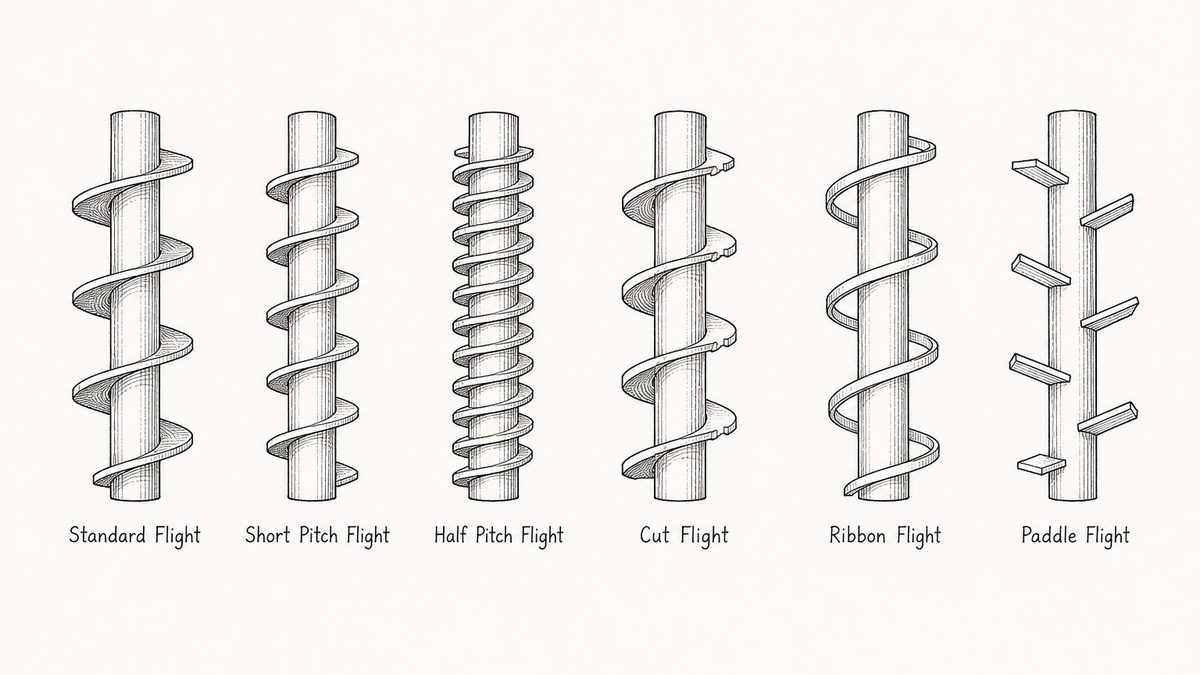
Standard single flight. Pitch equal to diameter, one continuous helix on a pipe. It is the default, it is the cheapest to make, and it handles free-flowing powders, grains and pellets that slide easily and will not pack. Most screw conveyors in the world are this one, and most of the mistakes are made by choosing it for a material that needed something else.
Short pitch and half pitch. The same blade with the turns brought closer together, so each turn carries less and pushes more gently. These are the forms for materials that flood, that aerate, that are being fed at a controlled rate rather than conveyed, or that would be carried round with the flight instead of being pushed along it. A half-pitch screw at the same diameter and speed as a standard one moves roughly half the volume, which is a capacity decision as well as a material decision.
Cut flight. Notches are cut away from the outer edge of each turn, leaving gaps that let material fall forward and remix rather than being pushed in a solid plug. This is the form for a material that has to be agitated as it moves, or one that tends to bridge, and it is a common choice where a single screw has to do both a conveying job and a blending job. The notches reduce the machine's capacity, and they cannot be cut into a flight that is already thin, so a cut flight is usually made from heavier stock.
Ribbon flight. Each turn is a narrow strip separated from the central shaft by an open gap, so the machine has an annular passage instead of a solid screw. It is the form for sticky, pasty or heat-sensitive materials, because there is no shaft for the material to cling to and no pocket for it to set in, and it is also used where the material has to be cooled or dried as it travels, because air can pass through the centre. It is the most expensive of the six to make, because the blade has to be formed as a strip and welded to short radial arms rather than wound onto a pipe.
Paddle flight. Scattered short flat blades at an angle instead of a continuous helix, so the machine mixes and advances a little rather than conveying in the normal sense. It is a blender's flight rather than a conveyor's, and it appears on screw conveyors mainly where a short section has to break up a lump or blend an additive in as the material passes.
Three further choices sit on top of the flight form, and all three belong on the drawing. The flight thickness, because the outer edge is what wears and a thin flight on an abrasive material is a machine that arrives at its wear limit in months. The material of the flight, which on an abrasive duty may be a hardfaced or a hardened strip rather than the same steel as the trough. And the direction of the helix, because a screw conveyor can be built right-handed or left-handed, and a pair of them feeding a common discharge from two hoppers is built with one of each. That last detail is the one most often left off, and it is discovered when the machine is bolted down and runs the material the wrong way.
The Six Parts That Carry the Cost and the Failures
A screw conveyor looks like one helical blade in a box, and it is really six parts doing six jobs. Knowing which is which is what lets a buyer read a quotation and see what has been left out.
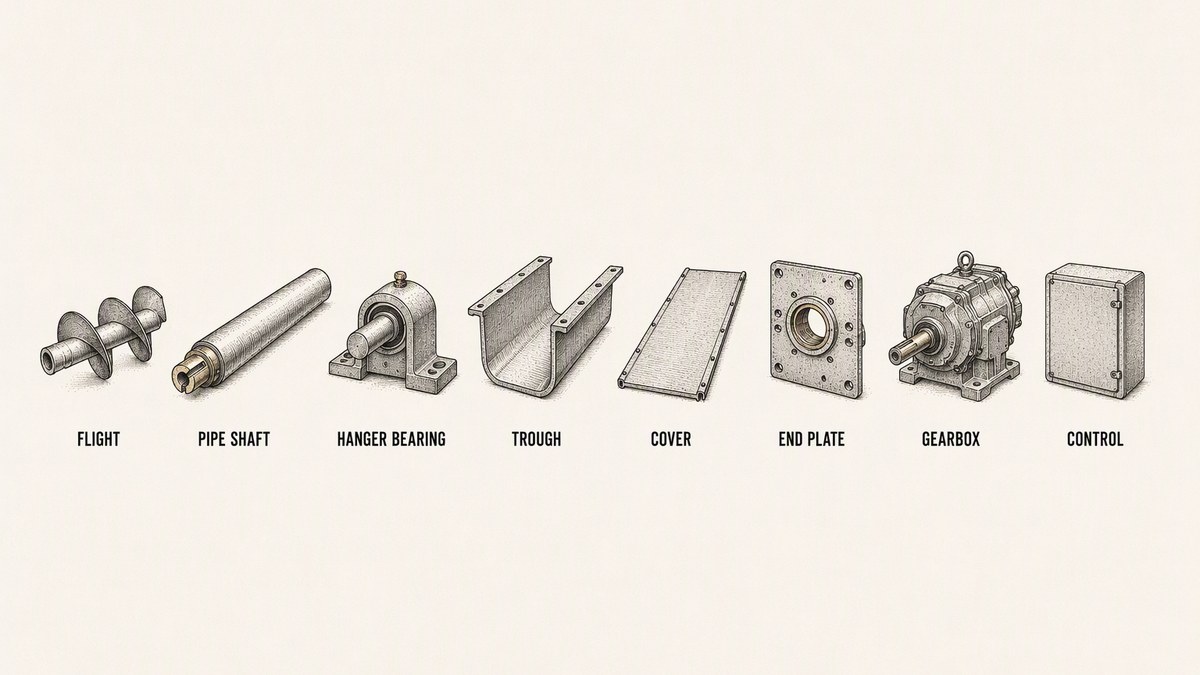
The flight and its pipe. The pipe is the shaft, and it is doing more work than its size suggests: it carries the torque, it carries the screw's own weight between supports, and on a long run it has to stay straight enough that the flight edge does not close on the trough. A thin-walled pipe saves weight and money and is the first thing to suffer on a heavy or a hot duty. The pipe's diameter is also a capacity decision, because material sits between the pipe and the flight as well as being pushed by it.
The coupling shaft and the joints. Long screws are made in sections because they cannot be machined, handled or shipped in one piece. The sections are joined by a coupling shaft, keyed and pinned into the pipe ends. The joint has to transmit the running torque and it has to stay aligned, because a joint that works loose puts a kink in the screw and the kink then rubs the trough. This is the part of a screw conveyor most sensitive to assembly quality, and it is invisible once the covers are on.
The hanger bearing. An intermediate support hung from the trough on a bracket, carrying a bushing for the shaft to run in. It sits in the material stream, so it obstructs the flow and it wears, and on a sticky material it is where the packing starts. Its material is a genuine choice: bronze or a bronze alloy for general work, a hard iron or a hardened sleeve for abrasive material, and a polymer or a ceramic for a corrosive or a very abrasive one. Ask how many hanger bearings the run needs, where they fall, and what they are made of, because a quotation that omits them has costed a screw that will not stay straight.
The end plate and the trough ends. The plates close the ends of the trough, carry the bearings, and take the thrust. On the drive end they have to be rigid enough not to flex under the thrust, because a plate that flexes lets the screw move along its axis and the flight then touches the end. On a run that has to be sealed, the point where the shaft passes through the plate is the place a seal or a gland is fitted, and that is a separate specification rather than an accessory.
The trough. The casing, made as a U section or as a round tube, and cut into sections for manufacture and shipping. Its rim is what the cover clamps to, so a trough whose rim is distorted cannot be made dust-tight however good the clamps are. Its inside surface is one side of the clearance, so its straightness is a quality feature rather than a cosmetic one.
The inlet, the discharge and the gates. An inlet is an opening with a lip; a discharge is an opening, often with a slide gate or a rotary valve. Both are places where the machine either floods or empties unevenly, and both are places where a buyer has to say something: the size of the opening, the direction, the type of gate, and whether the gate has to be interlocked with the drive. On a machine being used as a feeder rather than a conveyor, the inlet is the whole design.
Trough or Tube, and Why the Clearance Matters
The casing is the cheapest part of a screw conveyor to vary and the one that changes its behaviour most, because the gap between the flight edge and the casing is set by it.
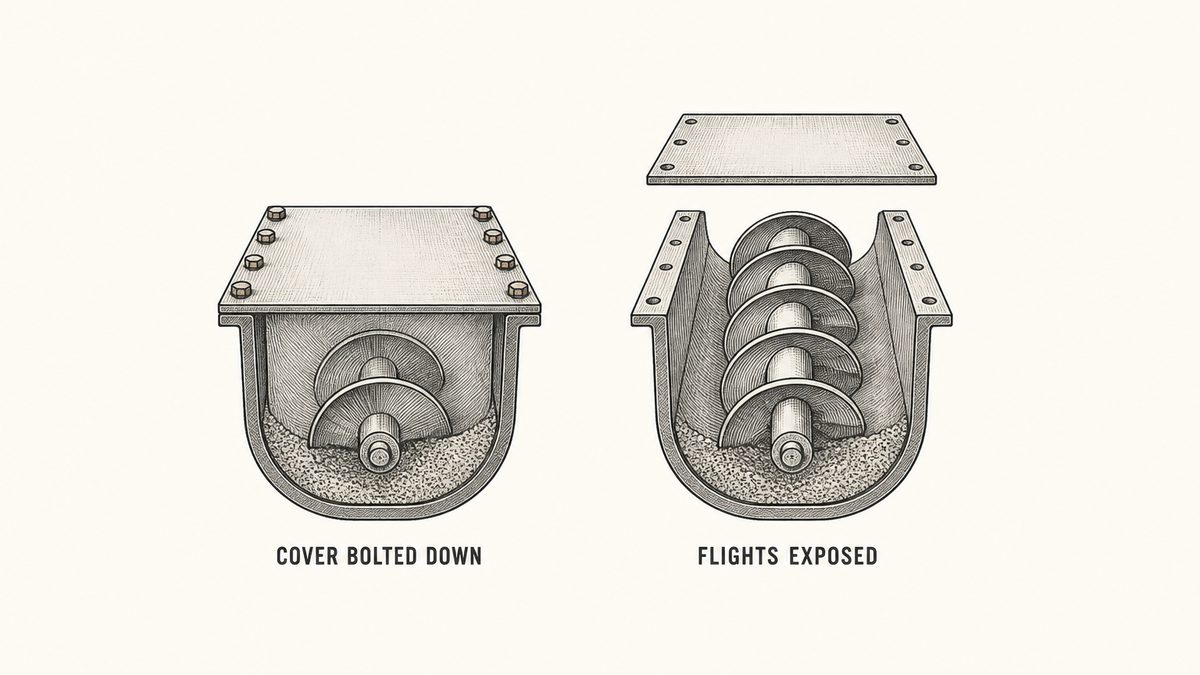
The U trough. An open-topped half-round casing with flat sides and a bolted cover. It is the standard form, because it can be opened along its whole length for cleaning and for clearing a blockage, it can be made in sections with flanged joints, and it can be fitted with inlets and discharges almost anywhere. Its weakness is the cover joint, which is also where the dust escapes, so a U trough is only as dust-tight as its rim is straight and its clamps are spaced.
The round tube. A closed pipe with the flight inside it. It is genuinely dust-tight by construction, it is stronger for the same weight, and it is the form to choose for a dusty, toxic or hygroscopic material and for a run that goes up steeply. What it gives up is access: a tube cannot be opened along its length without cutting it, so a blockage in a tube is a maintenance job rather than a ten-minute task. It also tends to have a larger running clearance than a U trough, because the flight has to be made small enough to go into a circular bore, and the material left in the bottom of the tube is material that will sit there.
How the clearance is actually chosen. Three pulls act on the number. A tight clearance empties the machine better, moves a higher proportion of the material rather than dragging a layer of it, and yields a more accurate feed where the screw is being used as a feeder. A loose clearance is more forgiving: it tolerates a slightly bent flight, a slightly oval trough, thermal movement on a hot duty, and it crushes less of anything friable. And on an abrasive material the clearance sets how fast the flight edge wears, because the edge that touches is the edge that goes.
The practical instruction. Put the clearance on the drawing as a dimension with a tolerance, and ask what the factory's standard figure is for your trough form and diameter. Then ask what it does with the flight edge: whether it is left square, given a hardfaced strip, or tipped with something harder. A quotation that names a trough form and a diameter but not a clearance has left the machine's emptying behaviour and its wear rate to the works, and the works will choose the number that is easiest to build.
The Drive End, the Thrust, and Where the Hanger Bearings Go
The drive end is where the machine's own forces are reacted, and it is the part of a screw conveyor most often under-specified because it is the part that is not a screw.
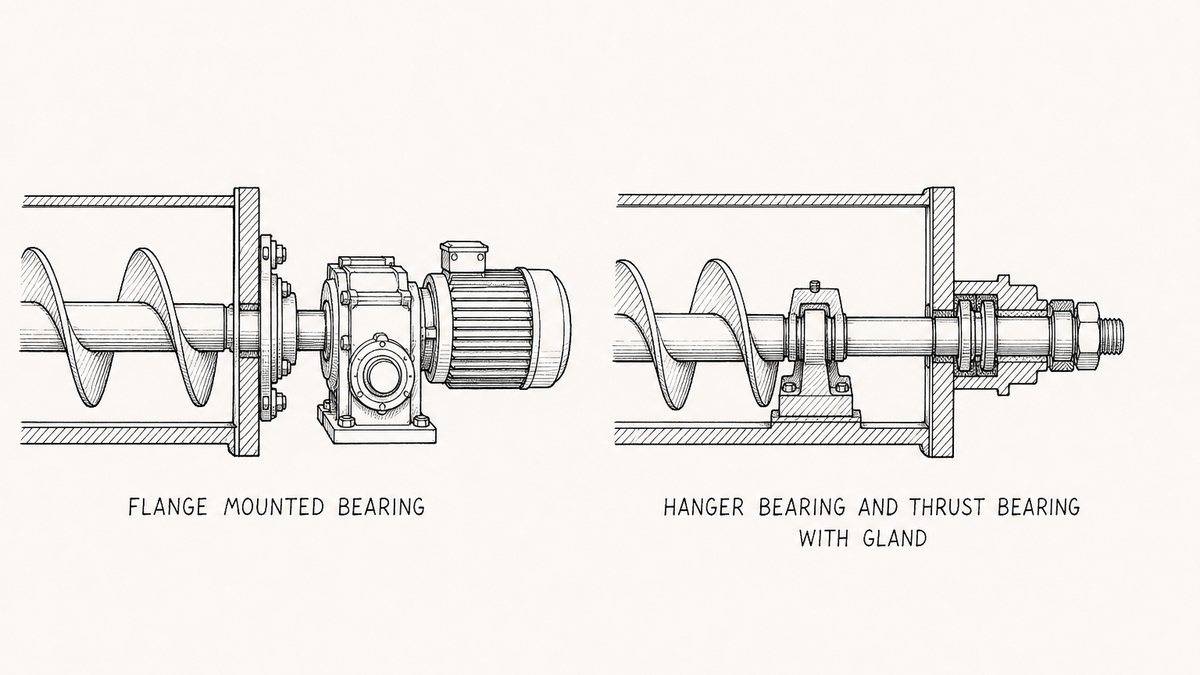
The thrust is the number buyers never ask for. A screw pushing material along its trough experiences an equal and opposite push along its own axis, and on a loaded machine that figure can be large. It has to be carried by bearings at the drive end, because the screw is otherwise free to slide. A bearing arrangement sized only for the shaft's weight and the drive's torque has no answer to thrust, and the symptom is a screw that walks: the flight edge closes on an end plate, the drive current rises, and by the time anybody looks the end plate and the first flight are worn.
What to specify at the drive end. The thrust bearing type and its capacity. The end plate's thickness and stiffness, because a plate that flexes under thrust has the same effect as a bearing that is too small. The coupling between the gearbox and the screw, and whether it tolerates the small misalignment that always exists. And the gearbox ratio, which sets the screw speed and therefore the capacity, so the same screw at two speeds is two different machines.
Where the shaft passes through the end plate, which is where the seals are. On a dry material in a closed trough, a simple bearing and a close-fitting plate are enough. Where the machine is enclosed, where the material is dusty or toxic, or where the trough is purged, the shaft entry is a leak path and has to be treated as one: a gland with packing, a lip seal, a purge connection, or on the harshest duties a sealed bearing housing. This is the same class of decision as on any machine where a shaft leaves a closed volume, and the same judgment about what the leak would cost applies.
Supporting the screw between its ends. A short run can span from one end plate to the other with no intermediate support at all, which is the strongest arrangement because there is no bearing in the material stream. As the run gets longer the screw needs help, and a hanger bearing is hung from the trough. Every one of them is an obstruction and a wear point, so the design aim is always the fewest that will keep the screw straight. Three legitimate ways to avoid them: keep the run short, use a heavier pipe so the unsupported span can be longer, and split a long run into two shorter machines with a transfer point between them instead of one long screw with four hangers in it. On a sticky or a fibrous material the third is often the right answer, and a factory that proposes it is a factory thinking about the duty.
Sizing It: Capacity, Diameter, Speed and Power
A screw conveyor is sized from the material rather than from the tonnage alone, and four numbers get you to a machine.
The material, described properly. Bulk density, in the loose state rather than the packed state. Particle size and shape, including the largest lump the machine will ever see, because a lump that does not fit under the flight is a jam. Whether the material is free-flowing, sluggish, or prone to packing or bridging. Whether it is abrasive, corrosive, friable, sticky, hot, or capable of giving off dust or vapour. And whether it must not be crushed or must not be degraded, because a screw conveyor works by pushing, and pushing crushes some materials.
The capacity, with the fill and the gradient allowed for. The published capacity of a screw conveyor assumes a stated fill of the trough, and every material has its own realistic fill: a free-flowing powder fills more of the trough than a lumpy or a clingy one. Capacity also falls away as the machine is inclined, because material slides back between the flights on the uphill side. So a screw that is said to carry a given tonnage on the level carries less at an incline, and less again on a material that does not fill. Ask for the capacity at your incline and your material, in your units, rather than reading a figure off a table for a horizontal screw in free-flowing grain.
The diameter, pitch and speed together. These three trade off against each other, and the supplier will move them to reach the capacity. A larger diameter at lower speed is gentler, quieter and kinder to the material, and it costs more steel. A smaller diameter at higher speed is cheaper and moves the same tonnage, at the cost of more wear, more attrition and a real risk of a material that starts to tumble rather than be conveyed. Where the material is friable or fragile, the right answer is the largest diameter and the slowest speed that still meets the capacity, and it is worth saying so rather than letting the quotation optimise the price.
The power, and how it was arrived at. The drive has to overcome the friction of the material against the flight and the trough, the work of lifting it on an incline, the losses in the bearings and the gearbox, and the extra load of starting a machine that is already full. That last one is why a screw conveyor is almost never started loaded without a larger drive or a controlled start, and why the figure to ask for is the starting condition as well as the running one. A drive sized on running power alone will trip on the first attempt to restart a full machine.
Then the four physical constraints, which are as important as the capacity. The inlet, its size and whether the machine floods at it. The length, and therefore where the hanger bearings fall. The angle, and whether the run is straight or has a bend, because a screw conveyor cannot turn a corner. And the discharge, its size, its position and whether it needs a gate that can be interlocked with the drive.
What to Put in the Specification Sheet
A conveyor enquiry that gives a diameter, a length and a tonnage will produce a price for a screw, and it will produce a machine that may or may not move the material. The discipline for any part made to a drawing is set out in this guide to writing the order out as a document; a screw conveyor adds its own lines on top.
The material and the duty first. What it is, its loose bulk density, its temperature, its moisture and whether that changes. The largest lump size. Whether it is abrasive, corrosive, sticky, friable or dusty. The required capacity in tonnes per hour, with the incline and the fill stated. The hours a day the machine runs. And whether the machine is a conveyor or a feeder, because a flooded inlet changes the flight forms and the drive.
The screw. Diameter, pitch, and the flight form by name. The direction of the helix. The pipe diameter and wall thickness. The flight thickness and material, and whether the outer edge is hardfaced. The number of sections and where the joints fall. And the clearance between the flight and the casing, as a dimension with a tolerance rather than as a hope.
The casing and the covers. Trough or tube. The section length and the flange pattern for the joints. The cover arrangement: how many sections, the clamp type and spacing, and whether the joint has to be dust-tight or gasketed. Any inlet, outlet, inspection hatch or drain, with its position, size and direction. The supports and their spacing. And on a run where a person can reach the flight, the guarding arrangement with the opening dimensions and the distance from the flighting to the guard stated on the drawing.
The ends and the drive. The end plate thickness and the bearing arrangement at each end. The thrust bearing type and capacity. What seals or glands the shaft entries have, and whether they need a purge connection. The hanger bearing count, positions and material, or a statement that the run is unsupported between end plates. The gearbox ratio and the screw speed. The motor power, with the starting condition stated. And whether the drive has to be interlocked with a cover, an access hatch or a downstream machine.
Then the documentation and the commercial lines. A material certificate for the flight and the trough. A drawing with its revision number, and no changes permitted without written agreement, including the flight form, the pitch and the clearance, because those are the three figures a substitution would hide.A first article for a new flight form or a new supplier, because a change of flight thickness or helix direction is invisible once the machine is assembled and shows only as a machine that moves the wrong amount in the wrong direction. And the packing and the shipping splits, because a screw conveyor is long and thin and a section that bends in transit has lost its straightness permanently.
One line is worth adding that most enquiries leave out. Ask for the maximum running clearance that can develop before the machine stops conveying, and ask for the flight edge thickness at which the flight should be replaced. Both are simple numbers, both can be answered from the factory's own experience, and together they turn the machine's wear into something a plant can watch rather than discover. The same habit applies to any machine whose life is set by a rubbing surface rather than by a bearing, which is why a plant that measures what it replaces spends less on a screw pump on a continuous duty than one that waits for it to stop.
Sourcing From China: Factory, Trader, and What to Ask
A screw conveyor is fabrication: pressed and formed flights, welded pipe, folded trough sections, and a bolted-together assembly. Almost any steel fabricator can build one that turns. The differences between suppliers show up in the three places where a screw conveyor actually fails, and all three are visible before the machine is paid for.
Four questions a works answers from its own floor.
How is the flight formed, and on what? A flight is a continuous helical blade and it can be wound, pressed or cut from plate and pulled. A works will describe the process and the tooling, and will know what pitch and thickness it can form without distortion. A factory that buys flights in and welds them to a pipe is an assembler rather than a conveyor maker, which is not disqualifying but does change what can be corrected when a duty does not run.
How is the pipe straightened, and how is the screw checked for straightness? This is the best single question in the subject, because straightness is what keeps the clearance even along the run and it is invisible once the machine is assembled. A works will describe how it straightens the pipe, how it checks the finished screw, and on what length. A factory that answers with a tolerance and no method has answered with a wish.
What is the clearance and how is it held? The trough has to be straight and the flight has to be concentric, or the clearance closes on one side. Ask what the factory holds as standard for your diameter, and how it measures the gap. On a machine used as a feeder this figure is the accuracy of the whole installation.
What do you use for hanger bearings, and how do you decide how many? The bearing material is a duty decision and the count is a design decision, and a factory that builds conveyors for a living will have a rule for both. A factory that builds them occasionally will put in whatever is in the store.
Then five commercial questions. Which diameters and pitches have flight forming tooling, because a formed flight is tooling-dependent and a standard size is a different proposition in price from a new one. Whether the factory can supply the complete machine with motor, gearbox and drive, or only the screw and trough. What the minimum order is for a non-standard diameter or a special flight form. What the lead time is for an exact repeat. And whether the factory will accept your inspection before shipment, which is the next section.
Two commercial realities worth carrying into the conversation. First, the screw is the engineering and the trough is the steel, and a quotation that prices them together without separating them cannot be compared with another quotation. Ask for the screw, the trough, the drive and the hanger bearings as separate lines. Second, China is strong on this machine at the middle of the range: standard diameters, standard pitches, carbon and common stainless steels, ordinary fabrications, and sensible quantities. Asking for an unusual diameter in an exotic alloy with a hardfaced flight in single pieces is asking a factory to compete where it is weakest. The same pattern holds for any fabricated component whose performance comes from geometry rather than from assembly, which is why a toothed wheel cut to a profile behaves the same way when the profile is not one the works already runs.
Inspection Before Shipment
A screw conveyor is a large, simple, measurable assembly, and almost everything that matters can be checked in the factory. What cannot be checked is how it will run, so the inspection is built around the dimensions that decide that. The wider routine, and how much of a shipment to inspect, is set out in this guide to checking a load before it leaves; the conveyor-specific list is short.
Measure the flight, not just the pipe. Outside diameter at several points along the length, pitch between several pairs of turns, and flight thickness at the outer edge. A flight that measures right at the drive end and small at the tail is a flight formed unevenly, and it will run with an uneven clearance. On a hardfaced flight, check that the hardfacing covers the outer edge all the way round rather than only where somebody could reach.
Check the concentricity of the finished screw. Put the screw on rollers or in V blocks and measure the runout of the flight edge along its length. This single measurement catches the two defects that matter most: a bent pipe and a flight welded on off-centre. A screw with visible runout will rub the trough in one place along its whole length, and the plant will blame the trough.
Check the trough's straightness and its rim. The trough has to be straight, or the clearance closes. Its rim, where the covers clamp, has to be flat, or the joint will not be dust-tight however many clamps are fitted. Look along the trough with a straight edge, and check the rim for distortion around the welded joints, because the rim is where a fabricator's heat input shows.
Check the covers, the clamps and the count. Count the cover sections against the drawing, check that each is light enough to be handled by one person, check that the clamps are present, stationary and spaced at the intervals the drawing states, and check that the joint has the gasket or the land the order asked for. This is the part of the machine the rules section above is about, and it is the part most often shipped short.
Check the drive end and the thrust arrangement. The end plate thickness against the drawing, the bearing arrangement, the presence of the thrust bearing rather than a plain radial one, and the coupling between gearbox and screw. If a seal or a gland was ordered at the shaft entry, check it is there and that it is the type specified. Check the gearbox ratio on its plate against the order, because the ratio is the machine's speed and a substitution is invisible until it runs.
Check the hanger bearings and their brackets. The count and positions against the drawing, the bushing material against the specification, and the bracket's fit in the trough. A bracket that does not sit flat distorts the trough when it is bolted up, which closes the clearance exactly where the support is.
And check the marking, the splits and the packing. Each section should be marked so it can be identified on site and assembled in the right order, especially on a multi-section machine where the sections are not interchangeable. Check that the shipment splits into lengths that can be handled and that the screw sections are supported along their length rather than resting on their ends. A screw section that has been allowed to bend in transit has lost the straightness the whole inspection was about, and no dimension check will catch it after the fact.
Failure Modes, and Which Side Each One Is On
A screw conveyor fails in four recognisable ways, and the split between them is worth knowing because two belong to the plant and two belong to whoever built the machine.
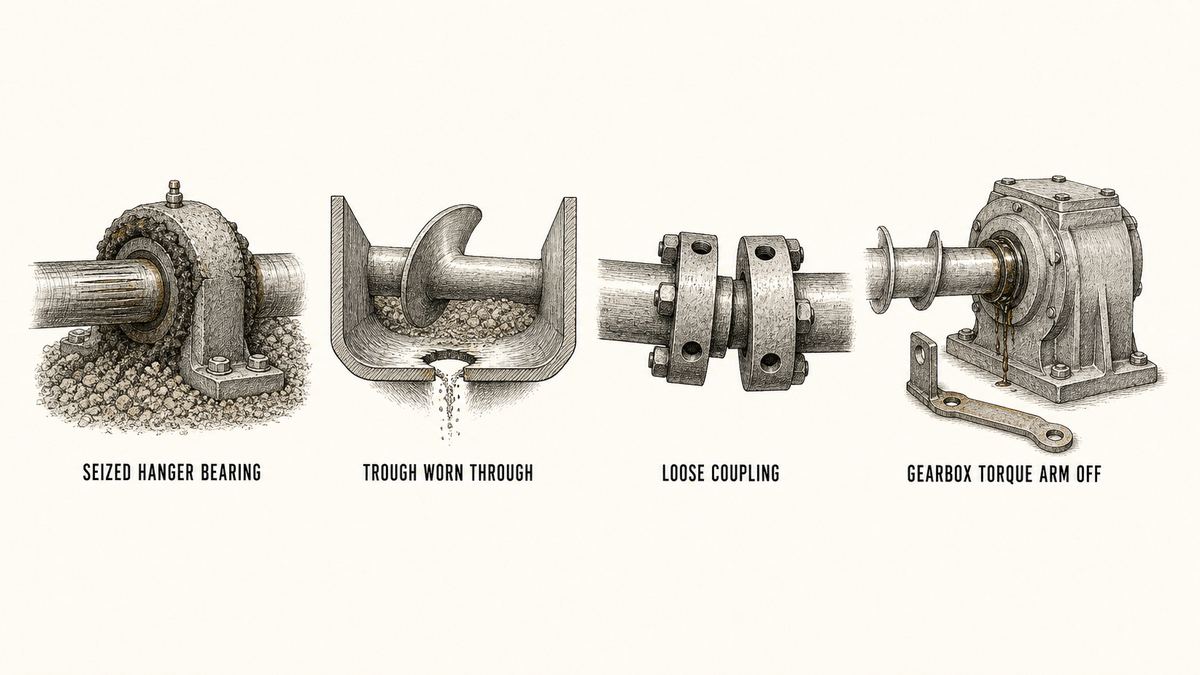
A worn flight edge, which the duty causes and the specification can postpone. The outer edge of the flight is the part that rubs, and on an abrasive material it wears into a rounded profile that no longer pushes cleanly and no longer holds the clearance. The process is gradual, so the machine loses capacity slowly and nobody notices until the tonnage falls. The answer is not a harder material alone: it is the right clearance, the right flight thickness, and on a genuinely abrasive duty a hardfaced or a hardened edge. Measuring the flight edge thickness at intervals along the run tells you both the rate of wear and whether it is even, and an edge that has worn faster at one point than another is telling you about the screw's straightness rather than about the material.
A bent screw, which usually arrives that way or is made that way. A screw that is bowed rubs the trough in one place along its whole length, closes the clearance there, and loads the hanger bearings unevenly. It comes from a pipe that was not straight, a flight welded off-centre, a joint that was not aligned, or shipping without support along the length. The evidence is a bright rubbed band inside the trough on one side, and the way to find it before installation is to measure the runout of the flight edge as described above. This is a supplier's failure and it is the most expensive one to discover late, because the machine has to come apart.
A worn or oval hanger bearing, which is a design and a duty question. A bushing in an abrasive or a sticky material wears into an oval, the shaft then runs against a bigger gap, and the wear accelerates. The evidence is a scored, bright shaft at the bearing position and a bushing that is no longer round. On a sticky material the same bearing is where material packs and starts to bind. The fix belongs in the design: fewer hangers, a harder bushing material, or a different machine arrangement. A plant that replaces the bushing repeatedly without changing the count or the material has bought the same failure on a schedule.
A bridged or blocked inlet, which is the material's doing and the plant's problem. Material arches across the inlet opening or packs solid against it, and the machine runs empty while the hopper above sits full. This is a feeder problem as much as a conveyor problem, and it comes from an inlet that is too small for the material, a machine running at the wrong speed for the flow, a flight form that does not pull the material down, or a material whose moisture has changed. The evidence is the blockage itself and, on the machine, an unworn flight under the blockage and a worn one beyond it, because the section downstream has been running on nothing. Changing the flight form near the inlet or fitting an agitation device is usually the answer, and it is a design conversation rather than a spare part.
Six Symptoms and Which Side Each One Is On
| The symptom | What the evidence looks like | Whose side it is on |
|---|---|---|
| Capacity below the figure quoted | A machine that moves less than specified at the stated speed, with an even flight and an even clearance | The supplier's, and the question is whether the figure was given for a horizontal screw in a filling material |
| A bright rubbed band inside the trough on one side | Wear concentrated along one line, with the flight edge bright on one side only | The supplier's. It is a bent pipe or an off-centre flight, and the runout measurement settles it |
| The drive trips when restarting a full machine | Trips on start-up with a full trough, no trip when running | Shared. The drive was sized on running power, and the plant is restarting loaded. Both need correcting |
| Dust escaping from the cover joints | A trail of material along the cover line, with clamps spaced wider than the drawing or the rim distorted | The supplier's if the sections or clamps were short; yours if the covers were left unclamped on site |
| The flight edge worn round in months | An even, rapid wear of the outer edge across the whole run | Yours. The flight thickness, material or clearance was wrong for an abrasive duty |
| Material arching over the inlet | A bridged opening above an unworn flight, with normal wear downstream | Yours. It is an inlet geometry or flight form problem, and it belongs in the specification |
Two habits make the diagnosis reliable rather than a matter of opinion. Measure the flight edge thickness when the machine is new, at several points along the run, and write the figures down. That baseline turns a conversation about wear into a rate, and a rate tells you when to order a replacement rather than whether to argue. And photograph the inside of the trough before the covers go on for the first time, because a rubbed band takes months to appear and the clean trough is the reference that proves where the contact started.
Price, MOQ and Lead Time: What Actually Moves the Number
A screw conveyor is priced as steel plus forming plus welding plus a drive, and the list of things that move it is shorter than buyers expect. Knowing them is what makes two quotations comparable.
The flight forming, which is the largest single driver and the least visible. A flight is a continuous helix formed from plate, and a works that already runs your diameter and pitch has the tooling and the setup amortised. A new diameter or a new pitch means new tooling, a forming trial and a first article before anything ships, and all of that lands on the first machine you buy. The practical consequence is worth acting on before the layout is fixed: ask which diameters and pitches the factory forms routinely, and see whether the design can use one of them. A change of one step in diameter decided at the enquiry stage saves more than any negotiation after the order.
The flight form and the material. A standard flight is the cheapest. A cut flight needs heavier stock and more cutting. A ribbon flight is the most expensive of the six, because the blade is a narrow strip welded to radial arms rather than a helix wound onto a pipe, and the labour is a large part of it. A hardfaced edge adds a welding operation and a consumable, and on an abrasive duty it is the line that pays for itself.
The trough, and the covers. A U trough in carbon steel is the baseline. A round tube costs more because it is a closed formed section. Stainless costs more again in material and in welding, because stainless moves more when it is welded and the trough has to come out straight. And the covers are a separate line that grows with the number of sections and the clamp count, which is exactly the part the rules require and the part a quotation is most likely to understate.
The hanger bearings and the end bearings. Each hanger is a bracket, a bushing and a fitting operation, and their material matters: a bronze or a hardened bushing costs a multiple of a plain one and lasts a multiple longer on an abrasive material. At the ends, a thrust arrangement costs more than a plain radial bearing, and it is the difference between a screw that stays put and one that walks. Neither shows in a price comparison unless the quotation names them.
The drive package. A gearbox, a motor and a coupling are bought-in items, and two quotations for the same machine can differ by the brand of the gearbox alone. On a screw conveyor this is worth paying attention to, because the drive is where the starting torque is carried and a gearbox chosen purely on price is a gearbox sized on running torque. Ask for the service factor the gearbox was selected on, and ask for the make and model rather than accepting a description.
MOQ and lead time both follow the forming tooling. A standard diameter and pitch may be available in single machines, because the flight tooling exists. A special diameter or a ribbon flight carries a minimum that reflects the tooling and the trial, and a supplier who quotes one special machine with no tooling content is a supplier who intends to form it the hard way. On the schedule, the steps that queue are the flight forming, the trough folding and the welding of the flight to the pipe. Ask which of those is the bottleneck for your size, and ask whether the runout of the finished screw will be measured before it ships. A delivery date given for a standard machine and applied to a special one is how an installation slips three weeks with nobody having lied to you.
And the shipping, which on this machine is a real cost line rather than a detail. A screw conveyor is long, light for its length, and easily bent. It ships in sections, needs support along its length, and on a long run the freight can be a meaningful share of the price. Ask for the shipping splits in advance and ask how each screw section is supported in its crate, because the cheapest quotation that bends a screw in transit is not the cheapest machine.
Questions Buyers Ask
How do I work out the diameter, pitch and speed I need?
Start from the material, not the tonnage. You need its loose bulk density, its largest lump size, whether it is free-flowing or sluggish or sticky, and whether it must not be crushed. From those the supplier picks a realistic fill of the trough, because a free-flowing powder fills more of it than a lumpy or a clingy material does, and the fill plus the density gives the volume per hour. Then diameter, pitch and speed trade off against each other to reach that volume: a large diameter at low speed is gentler, quieter and kinder to the material, and costs more steel, while a small diameter at high speed is cheaper and moves the same tonnage with more wear and more risk of a material that tumbles instead of being conveyed. Two corrections are always needed. Capacity falls as the machine is inclined, because material slides back between the flights, and the drive has to be sized for starting a full machine as well as for running an empty one.
Does a screw conveyor have to have covers?
Where anyone can reach the flight, yes, and on some equipment the requirement is written as a construction rule rather than a guarding suggestion. In the bakery equipment standard, the covers of all screw conveyors must be removable in convenient sections, held on with stationary clamps located at proper intervals, and must keep the covers dust-tight. Those three requirements are worth reading as an order specification: removable, because somebody has to clear a blockage; in convenient sections, because one cover the length of the machine cannot be handled; and clamped at intervals, because a cover lying on the trough under its own weight is not closed. The general machine guarding rule sits behind it, since the flight is a rotating part and the gap between flight and trough is an ingoing nip point that runs the whole length of the machine. Where a guard is a grid rather than a solid cover, the openings have to be small enough and far enough from the flighting that a hand cannot reach it.
How many hanger bearings should the screw have?
As few as the design allows, and the aim is often none. Every hanger bearing is a bracket and a bushing sitting in the path of the material, so it obstructs the flow, it wears, and on a sticky material it is where packing starts. A short run can span from one end plate to the other with no intermediate support at all, which is the strongest arrangement. As the run gets longer the screw needs help, and there are three legitimate ways to avoid adding supports: keep the run short, use a heavier pipe so the unsupported span can be longer, and split a long run into two shorter machines with a transfer point between them rather than one long screw with four hangers in it. That last option is often the right answer on a sticky or a fibrous material, and a factory that proposes it is thinking about the duty rather than about the steel.
Which flight form should I choose?
Start from how the material behaves. A free-flowing powder or pellet that slides easily is the standard single flight with pitch equal to diameter, which is the cheapest and by far the most common. A material that floods, aerates, or would be carried round with the flight rather than pushed needs a shorter pitch, so that each turn carries less and pushes more gently; the same change also reduces the capacity for a given diameter and speed. A material that bridges or that has to be broken up as it travels suits a cut flight, where notches in the outer edge let material fall forward and remix, at the cost of some capacity and a heavier blade. A sticky, pasty or heat-sensitive material suits a ribbon flight, which is a narrow strip separated from the shaft so there is no pocket for the material to set in and air can pass through the centre; it is the most expensive of the six. A paddle flight is a blender's flight rather than a conveyor's and appears only where a short section has to blend or break a lump.
Why does my screw conveyor leave material behind?
Clearance. The gap between the outer edge of the flight and the inside of the casing sets how much material is dragged along rather than pushed, and a large gap leaves a layer that never quite empties. A round tube tends to run a larger clearance than a U trough, because the flight has to be made small enough to go into a circular bore, so a tube conveyor that will not empty is often behaving exactly as built. The other cause is a screw that is not straight or not concentric, which closes the clearance on one side and opens it on the other, so the machine rubs in one place and leaves material in another. Check the runout of the flight edge along its length before blaming the clearance figure, and check the clearance measured at several points rather than one, because an even figure all the way round and an uneven one with the same average behave completely differently.
How do I choose a screw conveyor supplier in China?
Ask four questions and listen for whether the answers come from a factory floor. How is the flight formed and on what tooling, because the flight is the product and an assembler who buys flights in cannot correct a machine that does not run. How is the pipe straightened and how is the finished screw checked for straightness, because straightness is what keeps the clearance even and it is invisible once the machine is assembled. What clearance the factory holds as standard for your diameter and how it measures the gap, because that figure is the machine's emptying behaviour and its wear rate. And what it uses for hanger bushings and how it decides how many, because that is both a duty decision and a design one. Then the commercial half: which diameters and pitches have forming tooling, whether the factory supplies the complete machine with drive or only the screw and trough, the minimum for a special diameter or a ribbon flight, the repeat lead time, and whether it will accept your inspection before shipment, including a runout measurement on the finished screw.
Send the material and the clearance — the diameter and length are not enough
Tell us what has to move, then the lines that decide whether the machine runs: what the material is, its loose bulk density, its temperature, its moisture and whether that changes; the largest lump it will ever contain; whether it is abrasive, corrosive, sticky, friable or dusty; the capacity you need in tonnes per hour with the incline and the fill stated; the hours a day it runs; and whether it is a conveyor or a feeder, because a flooded inlet changes the flight forms and the drive. Then the screw: diameter, pitch, and the flight form by name; the direction of the helix; the pipe diameter and wall thickness; the flight thickness and material and whether the outer edge is hardfaced; the number of sections and where the joints fall; and the clearance between flight and casing as a dimension with a tolerance rather than a hope. Add the casing and covers: U trough or round tube; section length and flange pattern; how many cover sections, the clamp type and spacing, and whether the joint must be dust-tight or gasketed; every inlet, outlet, hatch and drain with its size, position and direction; and on a run a person can reach, the guarding arrangement with the opening dimensions and the distance from the guard to the flighting on the drawing. Then the ends and the drive: end plate thickness, the bearing arrangement at each end, the thrust bearing type and capacity, what seals or glands the shaft entries have and whether they need a purge, the hanger bearing count and positions and material or a statement that the run is unsupported between end plates, the gearbox ratio and screw speed, the motor power with the starting condition stated, and whether the drive must interlock with a cover, a hatch or a downstream machine. Add a material certificate, a drawing with its revision number and no changes without written agreement including the flight form, the pitch and the clearance, a first article on a new form or supplier, and packing that supports each screw section along its length instead of letting it bend. Two numbers are worth asking for at the same time because they turn wear into something a plant can watch: the maximum running clearance that can develop before the machine stops conveying, and the flight edge thickness at which the flight should be replaced. If a machine has already failed, measure the flight edge thickness at several points and compare it with the figure taken when it was new, measure the clearance all the way round rather than at one place, put the screw on rollers and measure the runout of the flight edge, and photograph the inside of the trough before anything is cleaned, because a rubbed band on one side is the evidence that separates a bent screw from a worn one.
Request a Screw Conveyor Sourcing Quote
Questions & Comments
We read every one and reply within 24 hoursMost screw conveyor problems come down to two numbers that never made it onto the drawing: the clearance between the flight and the trough, and the flight edge thickness the machine started with. Tell us the material and the incline, and we will pin both down before the order.