
Dropshipping Branding: The Rule Your Packaging Triggers
 ·
Updated October 13, 2026
·
15 min read
Advice about branding a dropshipping store tends to be about identity: pick a name, choose colours, be consistent. That part is free and takes an afternoon. The part that costs money and creates obligations is the physical one, because branding a product you never touch means ordering objects from a supplier and putting them in a parcel. There is also a marking rule that starts to apply the moment your own name and address appear on the packaging, and it is not widely discussed.

What Branding Costs, and What It Triggers
| Element | What it really is |
|---|---|
| Insert card | Cheapest to change, and it arrives when the customer opens the parcel. |
| Printed mailer or box | A fixed setup cost you pay before the first unit exists. |
| Hang tag or seal | A small object with the same setup cost as a large one. |
| Your name and address on the pack | This is where a country-of-origin marking rule begins to apply. |
What this guide covers
1. What Does Branding Actually Mean Here?
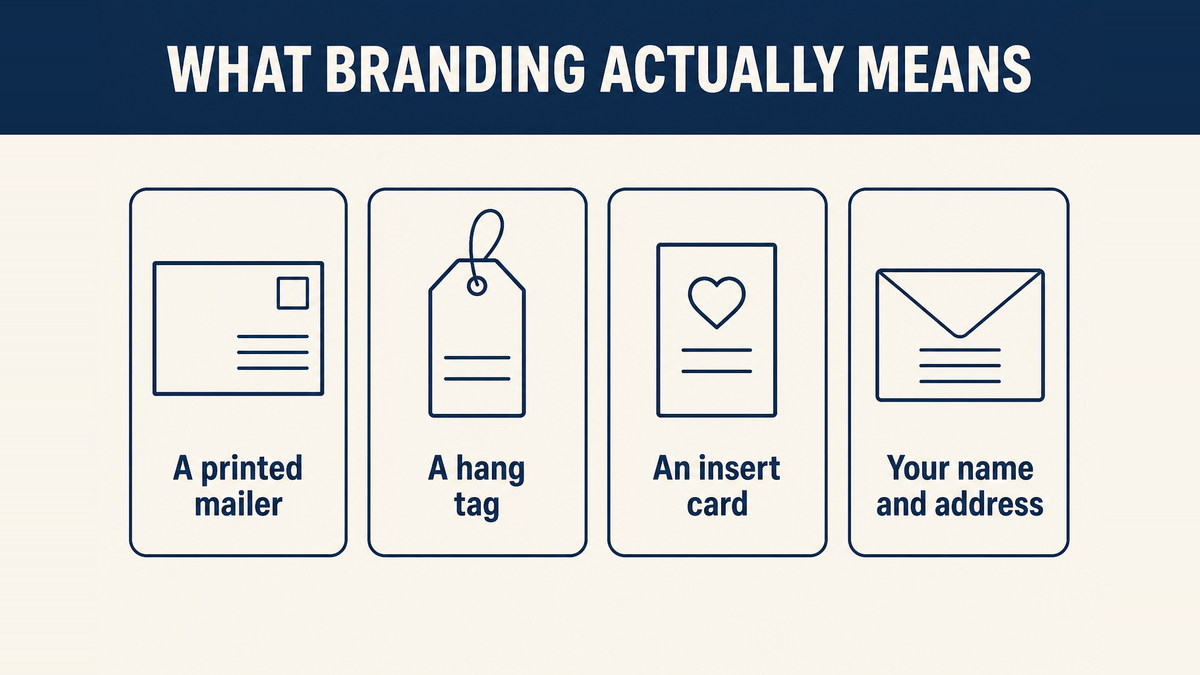
On a product you never handle, branding is not a design exercise. It is an order you place with a supplier. Everything that carries your name has to be made by somebody, shipped to whoever packs the parcel, and applied at a point in the process you do not control. That list is short and worth naming precisely, because each item behaves differently.
There is the thing the product travels in, which may be a printed mailer, a rigid box, or simply a sticker sealing a plain bag. There is whatever is attached to the product itself, which is usually a hang tag or a small woven or printed label. There is whatever is placed inside, normally an insert card. And there is the information you add to the outside, which in practice means your brand name and often an address.
The reason to separate them is that they are not interchangeable, and the order in which people usually do them is the reverse of the order in which they make sense. The visible, expensive item gets bought first, and the cheap one that actually reaches the customer gets left until later.
2. Why Do Printed Items Have Minimums?
Not because of the material. A hang tag is a small piece of card, and the card is nearly free. The minimum comes from the setup, and understanding that is what lets you judge a quote rather than just react to it.
Before the first unit can be printed or cut, somebody has to prepare the thing that prints or cuts it. That might be a plate for printing, a die for cutting a custom shape, or a mould for a plastic seal. The preparation work is the same whether you eventually order two hundred pieces or twenty thousand, so it is a cost that has to be spread across the run. The minimum order quantity is simply the run size at which spreading it across the units stops being painful.
- Fixed cost first, unit cost second
- Always ask for the two numbers separately. A quote that only gives a unit price hides the setup, and the setup is what decides whether a small first order can be run at all.
- The same setup for a small object as a large one
- A custom-cut seal and a printed box may carry a similar preparation cost even though one is a fraction of the size. Small branded items are often surprisingly expensive to start.
- Colour reduces your options
- A single-colour design can often be produced on equipment with a lower setup than a full-colour one. If your first order is small, a simpler design can be the difference between a workable minimum and an unworkable one.
- A stock item with your label can be cheaper than a custom one
- A plain box plus a printed sticker is a lower-commitment route than a custom-printed box, and for a first order it is often the better buy. The relevant judgement is what the customer notices on opening, not what the catalogue offers.
This is why it is worth asking a supplier for the breakdown before you ask for a price. Our guide comparing silkscreen, laser engraving and heat transfer works through the same fixed-cost structure from the printing side, and our notes on the methods available for putting a logo on a product are the companion piece if the product itself rather than its packaging is what you want to mark.
3. When Does Branding Pay, and When Does It Not?
The test is whether the product repeats. Branded packaging is money spent before the first unit sells, and it only comes back through customers who buy again or through orders that convert better because the parcel looked considered. If neither of those is happening, the spend is decoration.
That gives a fairly clean line. On a product you are still testing, branding converts a cheap experiment into an expensive one, because you have added a fixed cost to something whose only purpose is to tell you whether it sells. On a product that has already proven it repeats, the fixed cost is spread across orders you were going to receive anyway, and the same spend starts to look reasonable.
The second test, which is easier to overlook, is whether the branding changes anything the customer can perceive. An insert card inside the parcel is seen by every buyer at the moment of opening, which is the highest-attention moment in the whole transaction. A hang tag that a customer removes and discards before they use the product is seen once and remembered barely. Spending on the second while skipping the first is a common and entirely avoidable mistake.
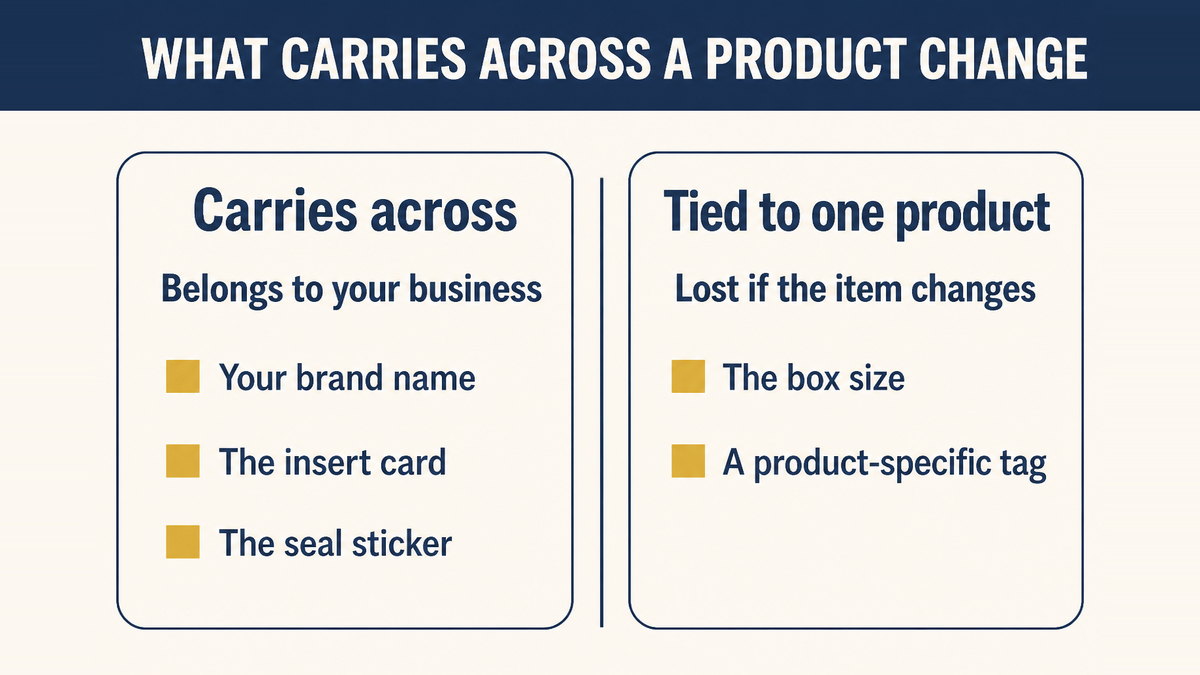
There is a third test that is easy to miss, and it is about what happens when the product changes rather than when it fails. Branded packaging is tied to a particular product in a way that branding itself is not. A printed box is cut to a size, which means it fits the item you designed it for and nothing else. A hang tag usually names the product. If you replace the item in six months, which is a normal thing for a dropshipping store to do, those purchases are not transferable and the money is gone rather than reused.
The useful distinction is between branding that belongs to your business and branding that belongs to one product. Your name, an insert card and a seal can all carry across to whatever you sell next. A box dimension and a product-specific tag cannot. When money is limited, buying the business-level items first means that a change of product costs you nothing in branding at all.
4. What Rule Does Your Own Name Trigger?
Here is the part that does not appear in branding guides. Imported goods carry a country-of-origin marking obligation, and adding your own branding does not replace that obligation — in some circumstances it creates a further one.
Start with the base rule, which applies whether or not you brand anything.
Unless excepted by law, section 304, Tariff Act of 1930, as amended (19 U.S.C. 1304), requires that every article of foreign origin (or its container) imported into the United States shall be marked in a conspicuous place as legibly, indelibly, and permanently as the nature of the article (or container) will permit, in such manner as to indicate to an ultimate purchaser in the United States the English name of the country of origin of the article, at the time of importation into the Customs territory of the United States.
19 CFR 134.11, Country of origin marking required
Then comes the rule that your branding decision can bring into play, and it is triggered by something as ordinary as a brand address on a pack.
In any case in which the words “United States,” or “American,” the letters “U.S.A.,” any variation of such words or letters, or the name of any city or location in the United States, or the name of any foreign country or locality other than the country or locality in which the article was manufactured or produced appear on an imported article or its container, and those words, letters or names may mislead or deceive the ultimate purchaser as to the actual country of origin of the article, there shall appear legibly and permanently in close proximity to such words, letters or name, and in at least a comparable size, the name of the country of origin preceded by “Made in,” “Product of,” or other words of similar meaning.
19 CFR 134.46, Marking when name of country or locality other than country of origin appears
Read the trigger carefully, because it is broad. It is not only the word "United States" that starts it. A US city name, or the name of any location anywhere other than where the goods were made, brings it into play where that wording could mislead a buyer about origin. A private-label brand whose address sits on the packaging is squarely within that description, and the requirement is not merely that the origin appears somewhere on the pack but that it appears in close proximity to the brand address and in at least a comparable size.
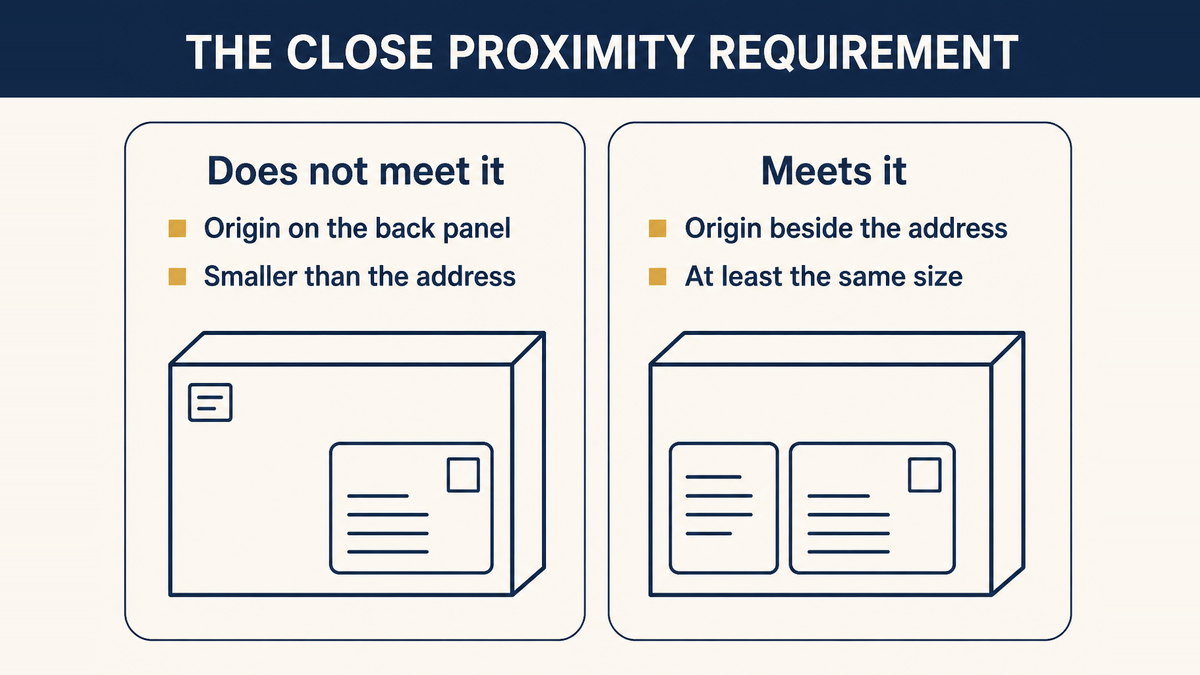
Two practical consequences follow. The first is design: if the layout you commissioned puts your address in the corner and the origin line in small type on the back panel, it does not meet the requirement even though both facts are printed. Give the designer this rule before they start. The second is timing: the artwork is approved before the boxes are printed, and correcting printed packaging afterwards is a full reprint rather than an edit. Our notes on what the different origin wordings mean in practice are worth reading before that artwork is signed off, and our guide to what belongs on the outside of an export carton covers the outer packaging side of the same question. This is a regulatory area where the specifics matter, so treat this section as a pointer to the rules rather than as the advice itself.
5. What Order Should You Do Things In?
Cheapest and most visible first, most expensive and least visible last. That ordering is the opposite of how branding is usually sold, and it follows directly from the two tests above.
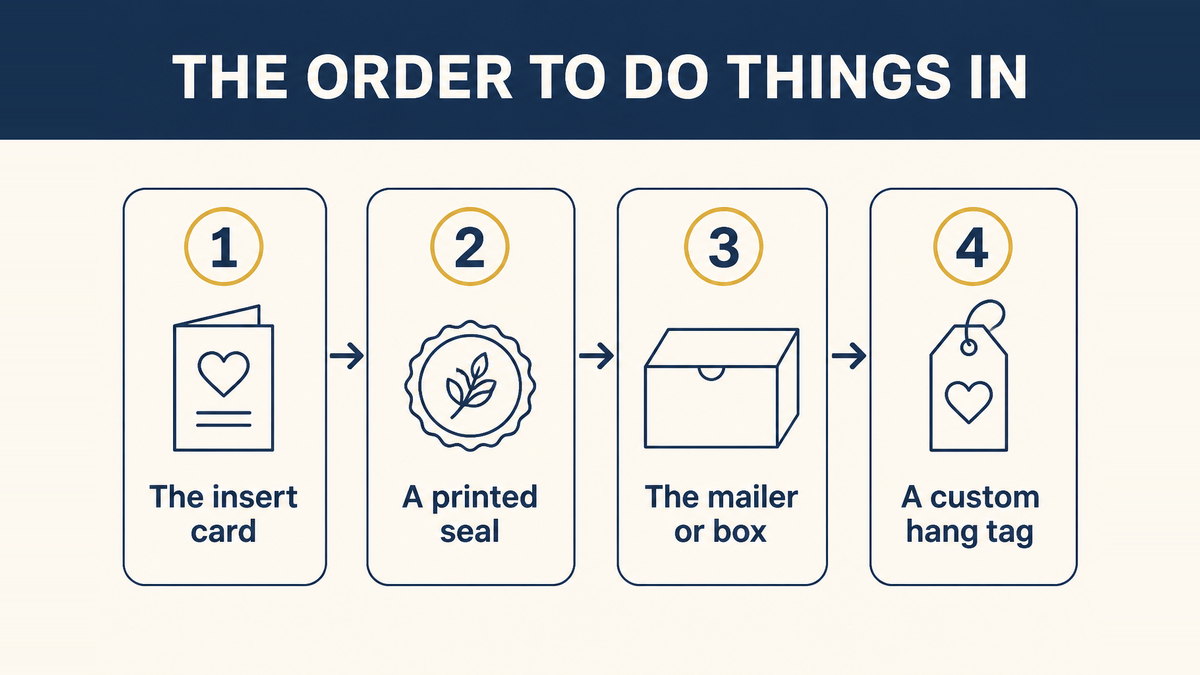
- First: the insert card
- The lowest setup cost, the highest attention moment, and no effect on the product itself. It is the cheapest honest test of whether branding does anything for your customers at all.
- Second: a printed seal or sticker
- It converts a plain parcel into a branded one without committing you to a print run of custom boxes, and the artwork usually carries across if you later change the packaging.
- Third: the mailer or box
- A meaningful fixed cost, so it belongs after a product has proven it repeats. Our guide to how corrugated mailers are specified covers what to decide before asking for a quote, and our notes on which packaging materials do which job are the reference for the choice.
- Last: a custom hang tag or label
- Smallest object, similar setup cost, and the item customers most often discard without reading. It is the last thing to buy, not the first.
Three guides that go deeper on the individual pieces. If the product itself rather than its packaging is what needs your mark, our notes on wovens, embroidery and heat press compared cover the methods and their cost structures. If you are branding a rigid box rather than a mailer, our guide to how rigid boxes are specified and ordered applies well beyond jewellery. And if the packaging needs to satisfy a material claim rather than only look right, our notes on what recyclable and biodegradable claims actually require are the piece to read before choosing a material.
6. Frequently Asked Questions
What does branded dropshipping actually involve?
Mostly objects rather than identity. It means the things that travel with the product: a hang tag, a printed box or mailer, an insert card and a seal. Each one is ordered separately, each carries a setup cost, and together they are usually the first branding decision a store makes.
Why do printed items have minimum order quantities?
Because of the setup rather than the material. A printer has to prepare a plate or a die before the first unit can be produced, and that preparation costs the same whether you order two hundred pieces or twenty thousand. The minimum exists to spread that fixed cost across enough units to be worth running at all.
When is branding worth doing on a dropshipped product?
When the same product is going to be reordered rather than replaced, and when a customer is likely to come back. Branded packaging is a fixed cost paid up front, so it only pays on something that repeats. On a product you are still testing, it converts a cheap experiment into an expensive one.
Does putting my own brand on the packaging affect the country of origin marking?
It can. If your label or packaging carries the name of a US city or location, the rules require the country of origin to appear legibly and permanently in close proximity, and in at least a comparable size, preceded by wording such as Made in. A brand address printed on a pack is exactly the situation that rule addresses.
What should I brand first?
The insert card, then the mailer or box, then the hang tag. The insert costs least to change, reaches the customer at the moment they open the parcel, and does not touch the product itself, so it is the cheapest way to test whether branding changes anything for you at all.
The Order to Do These Things In
We return the sequence with the unit cost at each step, plus the origin duty your own name triggers once it is on the carton.
Order My Steps
Questions & Comments
We read every one and reply within 24 hoursBeen quoted a minimum you did not expect, unsure which branded item to buy first, or wondering whether your packaging artwork satisfies the country of origin marking rule? Post the product, the items you want branded and the artwork if you have it, and our team will help you read the quote and check the layout before it goes to print.