
Custom Jewelry Box Manufacturer: Rigid Boxes From China
 ·
Updated October 11, 2026
·
19 min read
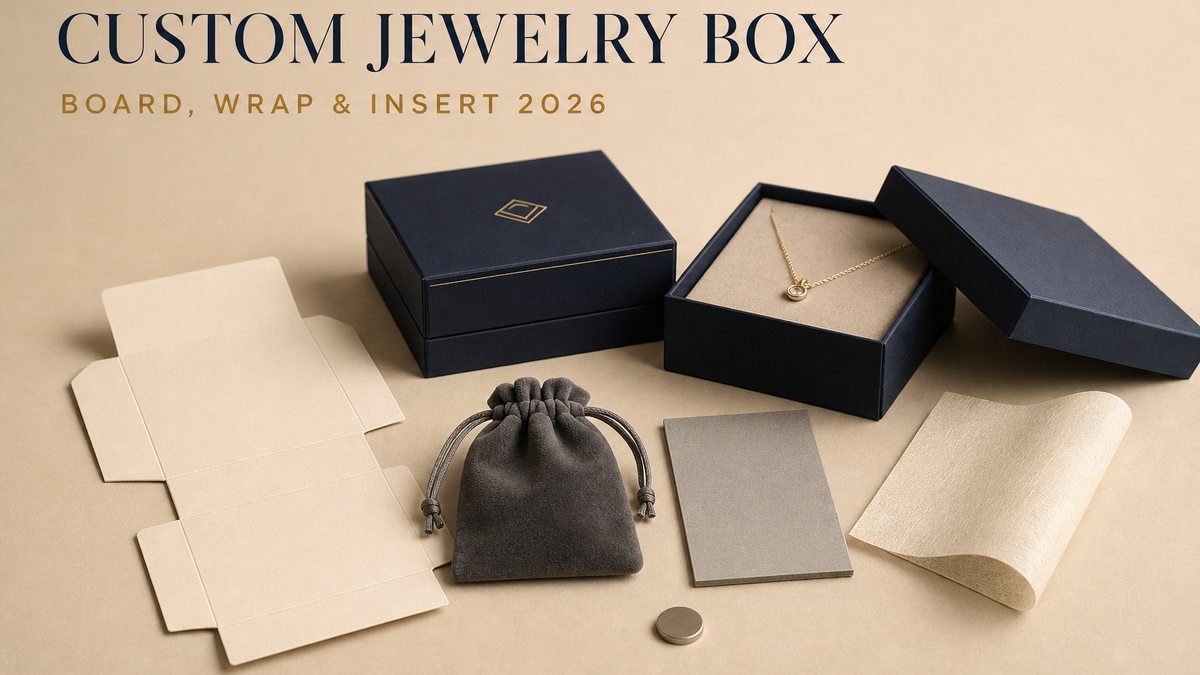
A jewellery box is the cheapest thing in the order and the first thing the customer touches. That gap is where most buyers get caught out. The piece has a drawing, a specification, a sample and an inspection plan. The box usually has a photograph of somebody else's box and a price. And yet the box is what carries the brand promise at the one moment the customer is paying full attention — when they open it. It is also the part that is most easily made cheaper without anything looking different in a picture. This guide covers the four ways to pack jewellery and what each one really costs, what decides the quality of a rigid box, how to measure a box against the piece that goes inside it, how the price is built, what goes wrong, how to check a supplier, and where a cheap quotation gets its money back.
What You Are Buying, and the Line That Decides It
| If you want | What it means in practice | The line on your order that decides whether it works |
|---|---|---|
| A box that feels expensive in the hand | The weight of the lid is doing the work, not the design | The board weight and the wrap material, both written as numbers |
| A box that still looks right after a humid warehouse | The wrap stays stuck flat to the board instead of lifting | The wrap, the glue and the storage condition specified together |
| A piece that does not rattle or sit loose | The insert holds the item still, not just the lid closed | The cavity size, the insert material and how hard it is |
| Boxes that survive the export carton | The boxes have to not crush each other in transit | The carton-out count and the inner packing, both as numbers |
| A colour that matches your other packaging | Two print methods will not give you the same colour | The print method and the paper named, plus a physical reference |
| A price you can actually compare | One unit price hides which line each supplier is competing on | The six cost lines asked for separately on the enquiry |
What Are the Four Ways to Pack Jewellery, and Which Should You Buy?
Rigid box, folding carton, drawer box and pouch. They are not four versions of the same thing at four prices — they solve four different problems, and picking the wrong one is the most expensive mistake in the category because it is the one you cannot fix by paying more for the same design.
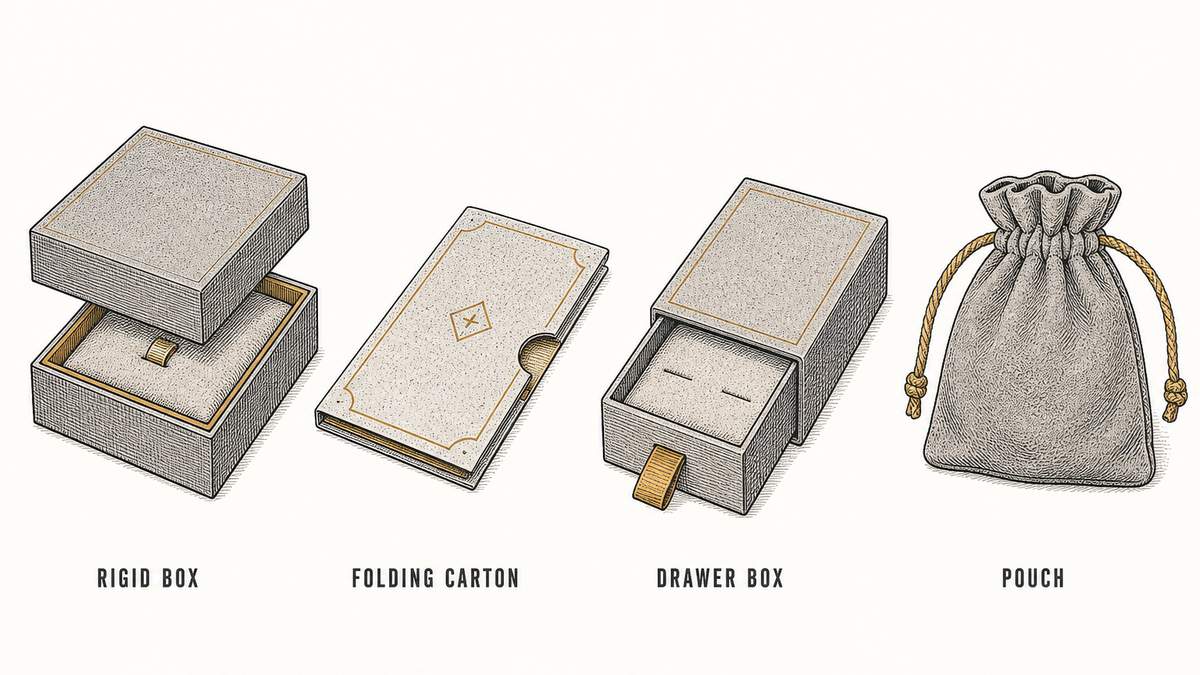
The rigid box is a thick board core wrapped in paper, sometimes called a set-up box because it arrives already made up rather than flat. It cannot be shipped flat, so you pay to move air. What you get back is weight and a lid that closes with a soft, solid sound. This is the default when the box is part of the gift and the customer is meant to keep it. Its two failure modes are both physical: it crushes, and its wrap lifts.
The folding carton is die-cut from a single sheet, printed before it is folded, and ships flat. It is by far the cheapest of the four, it prints beautifully, and it takes up almost no space until it is filled. It feels light in the hand, which is a real cost if your pieces sell on how substantial they look. Best used where the box is a label rather than a gift, and where shelf or mailer volume matters more than the moment of opening.
The drawer box is two parts: an inner tray that slides into an outer sleeve. It reads as engineered rather than luxurious, and it gives you a free brand detail, because the ribbon or tab that pulls the tray out can carry a logo or a colour. That same second part is the catch: two pieces means two wraps, two sets of board, and a fit tolerance between them that has to be held, or the tray slides out on its own or jams.
The pouch is velvet or microfibre with a drawstring. It is not a display box and should not be sold as one. What it is good at is transit protection and a soft touch at almost no cost, which makes it a useful second layer inside a rigid box, or the whole pack for a price point where a box would eat the margin.
The verdict is simple enough. If the piece is the gift, buy rigid. If the box is there to carry a label and protect the item on a shelf, buy folding carton. If you want the unboxing moment without the rigid-box freight, buy drawer. And treat the pouch as an addition rather than a pack. If you are still deciding what the outer pack should be made of, the wider options are set out in wholesale packaging materials.
What Actually Decides the Quality of a Rigid Box?
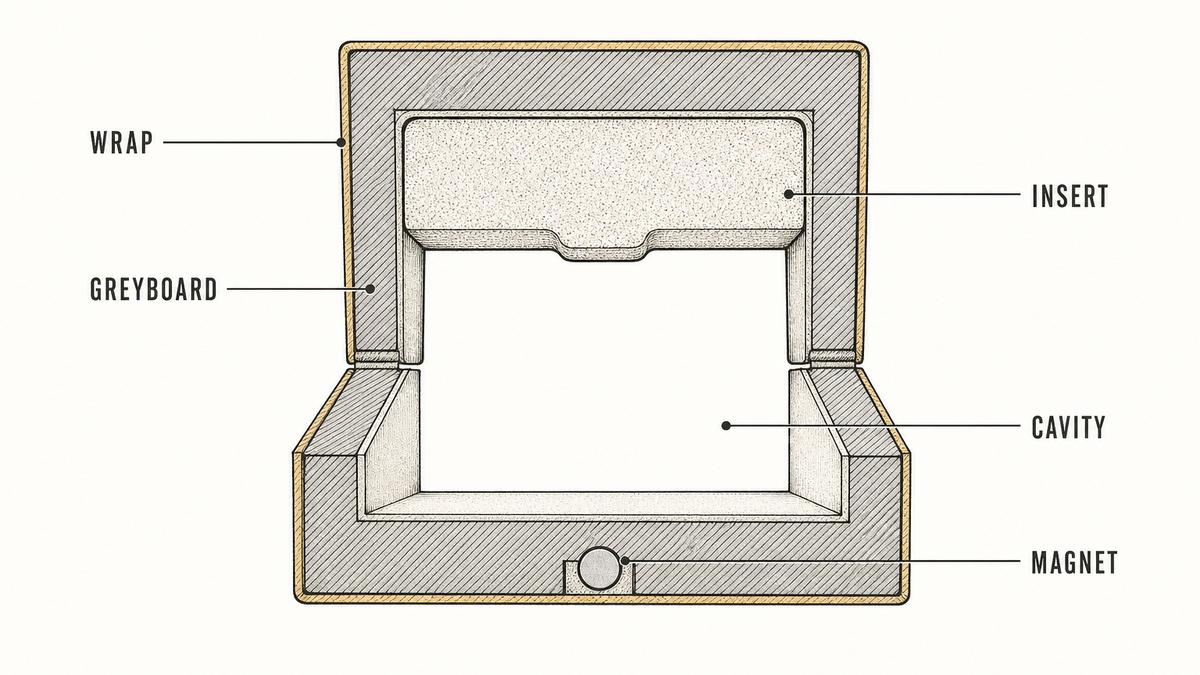
Six things, and only one of them is visible in a photograph. This is the reason box quotations are so hard to compare: two suppliers can send you pictures of what looks like the same box, and one of them has built something that will be in a bin within a month.
Board weight. Ask for the board weight in grams per square metre. The same outside size can be built from very different board, and the difference does not show in a picture — it is felt in the hand and heard in the lid. When a price has to come down, this is the first number that moves, and it moves silently.
The wrap. Art paper, textured specialty paper, printed film and PU are all called “paper” in a quotation. They cost differently, they print differently, and they wear differently. The wrap is what the customer sees and touches, and it is also the layer that lifts.
Who wraps the corners. Hand-wrapped corners are folded and tucked so the pattern runs continuously around the edge. Machine-wrapped boxes show a seam, and the seam is exactly where the wrap starts to lift. Ask which one you are being quoted, because a photograph taken straight on will not tell you.
Wrap adhesion. This is the failure that appears three weeks after arrival in a humid warehouse rather than at the factory, which is why it is the line most often left off an order. Wrap, glue and storage condition have to be specified together. Where the paper is sourced responsibly and you intend to say so on the pack, the claim sits with FSC-certified paper and has to be backed by the supplier's chain of custody, not by a logo file.
The insert. Foam, a flocked tray, moulded pulp or a folded card platform. The insert is what actually holds the piece, and the question is not what it is made of but how hard it is. Too soft and the piece settles and rattles; too hard and the item cannot be pressed in without being forced. The insert also sets the inside height, which is where most size mistakes begin.
The closure. A magnet is a bought-in part, like a clasp on a piece of jewellery, which makes it another place where a quotation can change without the design changing. Ask for the magnet grade and how the closure was tested — how many times it was opened and closed, and whether the box still shut properly afterwards.
None of those six appear on a photograph. All six are visible on an order that states them, which is why the inspection that matters here is the one that checks the whole export batch rather than the one that approves a single sample; the structure for that is in export packaging quality control.
How Do You Measure a Box Against the Piece Inside It?
Five numbers, and in most quotations only one of them has been given to you. The other four are where a box that looked right on screen arrives as a box the piece does not fit into, or fits into loosely enough to move.
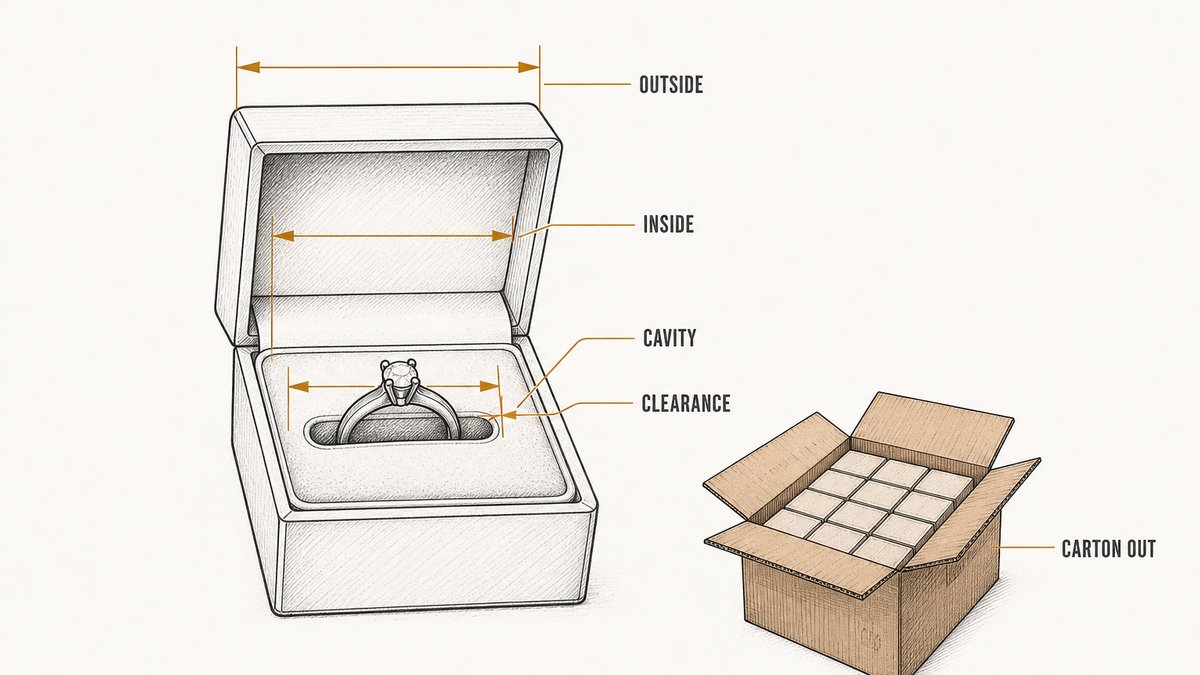
Outside size and inside size are not the same number. The figure a supplier quotes is almost always the outside size, because that is what the customer sees. Cut it open and you lose the board thickness on every side, plus the wrap. On a large box that loss is nothing; on a small jewellery box it is a real share of the space, and it is the reason a piece that fits a sample can be tight in production.
The cavity is smaller again. The insert sits inside the box and its opening is where the piece actually rests. On a rigid box with a tray, the cavity is the only dimension the customer will ever notice, because it is the one the piece touches. Specify it directly rather than letting it fall out of the outside size, the board weight and the insert thickness.
Clearance is the number nobody writes down. Too little and the insert presses on the piece, which marks soft finishes and can put a strain on a thin chain or a set stone. Too much and the piece slides. For a necklace or a bracelet the right clearance is smaller than most buyers assume, because a chain that can move will find the gap.
Match the insert to the weight of the piece. This is the pairing decision in this category. A heavy item on soft foam sits at the bottom of its own cavity by the time it has crossed an ocean, which is why a box that held the piece perfectly on the factory bench arrives with the piece rattling. Ask the supplier to state the item weight the insert was chosen for, in writing. If the answer comes back as a range, ask for the top of it and test it with the heaviest variation in your range.
Then ask for the carton-out. How many made-up boxes fit into the export carton decides your freight, and it also decides whether the boxes reach you in one piece. Made-up rigid boxes are hollow, so they can carry very little weight on top of them, and the count that looks efficient on paper is often the count that crushes the bottom layer. The carton itself is a separate specification from the box — flute, board grade and stacking strength all matter, and the same labels mean different things in different grades, as set out in corrugated shipping box flutes. How much load a carton can take before it gives is measured rather than guessed, which is what the box compression test is for. Order both numbers, and then check them against a real stacked pallet rather than against a nice picture of one.
Then ask whether the box has to travel made up at all. A rigid box can be built to fold flat and be put together at the destination, with the board scored so the corners meet and an adhesive strip or a magnet holds them. It is the same box in the customer's hands and a fraction of the volume in the container, because you are no longer paying to ship air. The trade-offs are real and worth stating plainly: an extra assembly step at your end, and a fold that has to hold its tolerance or the corners will not close cleanly. Where the volume is large enough for the freight line to matter, this is usually the single largest saving available on this product, and it is worth asking about before you accept a quote for boxes that arrive made up.
How Is a Box Price Actually Built?
Six lines, and a single unit price hides all of them. Ask for the six separately. It is the fastest way to make two suppliers comparable, and it usually tells you which line each one is actually competing on.
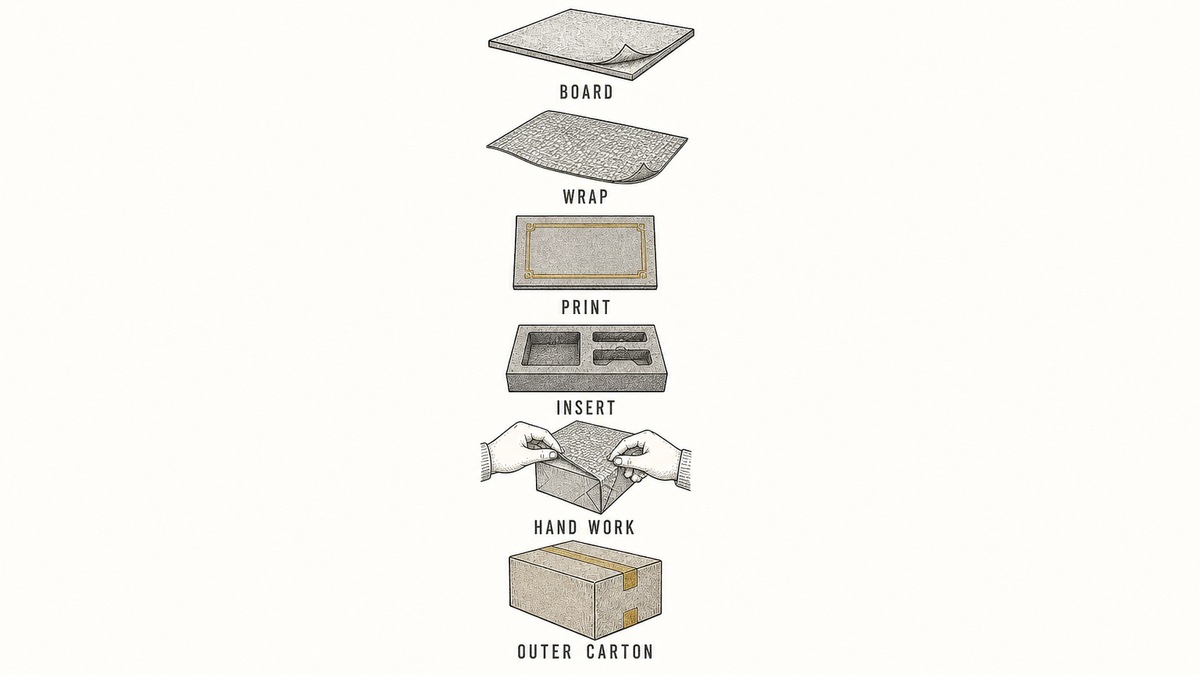
Board. Priced by weight and by area, so it scales with the size of the box and with the board weight you specified — and it is the line that quietly shrinks when a price has to come down.
Wrap. Priced by material and by area, the same way. Art paper, textured specialty stock, printed film and PU sit at very different points, and the difference between them is not visible in a photograph of the outside of the box.
Print. Here you are buying a method and a tool. Offset printing carries a die plate or a set of plates; digital printing carries none but costs more per piece; foil stamping and embossing each need their own die. That is why a small order can be dominated by the print tool rather than by the paper.
Insert. A cut foam block, a flocked tray, moulded pulp or a folded card platform. The tray tool is a one-off cost like the print die, and it is the line that most often decides your minimum order quantity, because the supplier has to spread the tool over enough pieces to make the order worth running.
Hand work. Wrapping the corners, gluing, setting the magnet, fitting the ribbon. This is the line that separates a box that still looks right in a year from one that does not, and it is the first line to be cut when a supplier is asked to match a competitor's price. It is also, by design, the hardest line to see in a sample you were sent by post rather than picked up yourself.
The outer carton and the inner packing. Made-up rigid boxes need protection from each other, or the bottom layer arrives dented and the corners arrive lifted. A divider, a sleeve or a layer of board between rows costs real money and shows up nowhere in the unit price of a box. When you see the carton-out number, ask how the boxes are held apart inside it.
Two further points belong to the order rather than the box. The print die and the insert tool are paid once, so at low volume they dominate the unit price and at high volume they disappear into it — which means a low-volume order quoted without tooling separated out is a price you cannot compare with anything. And everything above is the factory gate; the air you are paying to ship made-up boxes, the duty and the delivery to your door are separate lines again, worked through in what a custom jewelry order costs once landed. On this product the freight line is unusually large, because you are paying to move empty space.
What Goes Wrong?
Four failures, and only one of them happens at the factory. The other three happen between the factory gate and your warehouse, which is why they are the ones a sample review never catches.
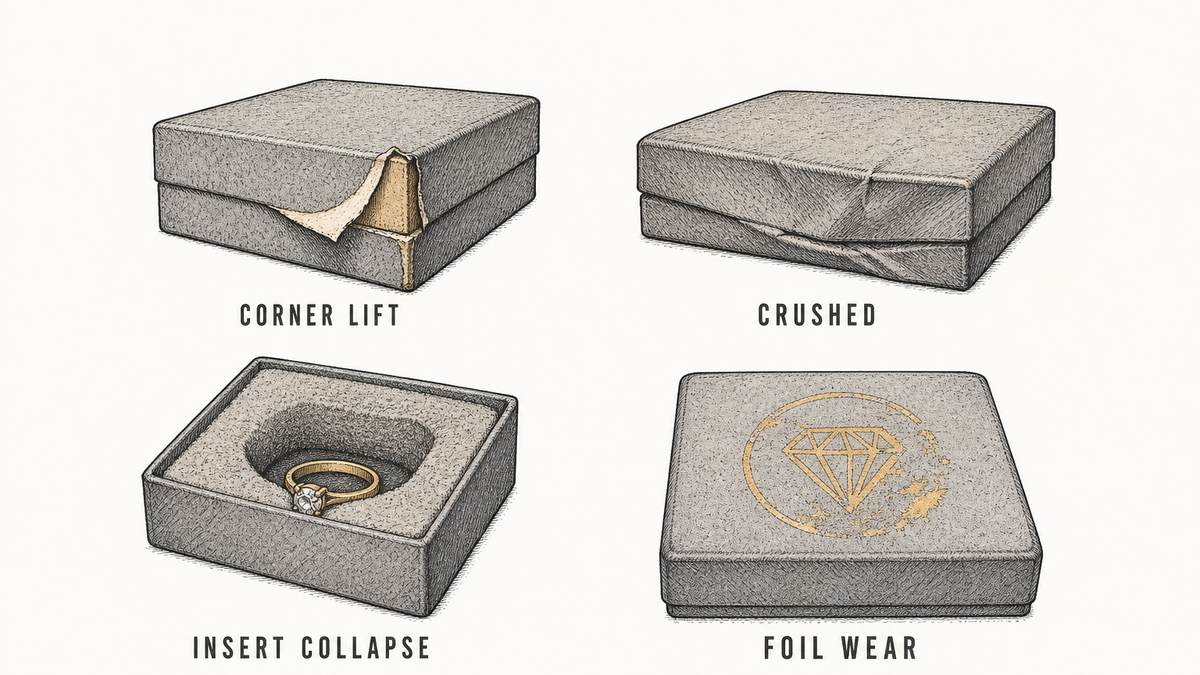
Corner lift. The wrap comes away from the board along an edge, most often after the box has spent time in warm, humid air. It is the single most common complaint in this category and it is decided entirely by the wrap, the glue and the storage condition — three lines that have to be specified together on the order rather than checked after the fact.
Crushing. Made-up rigid boxes are mostly air. Pack them too tightly in the export carton, stack the pallet too high, or leave out the dividers, and the bottom layer arrives flattened. Nothing in the unit price of the box tells you this will happen; the carton-out count and the inner packing do. How much a packed carton really takes before it gives is something you measure rather than estimate, and the transit test procedures published by the International Safe Transit Association are the ones most factories can be asked to run — the drop height and the sequence of orientations are the two numbers to write into the order.
A collapsed insert. The foam compresses under the weight of the piece, or under the weight of everything stacked on the box in a warehouse, and the cavity that held the piece tightly is now a hole. The piece arrives loose, scratched, or with the finish marked at the point where it was moving. This is why insert hardness has to be matched to the item weight rather than chosen by look.
Foil wear. A foil-stamped logo that rubs off is not usually a print problem. It is a handling problem: the boxes were packed face to face, or the foil was set down without a protective layer. It is also worth knowing that a foil area that is too large is harder to keep clean at the edges than a small one, so the simplest fix is often the design rather than the process.
The fifth failure does not damage the box at all and still costs you the order. It is a colour that does not match the rest of your packaging, because the box was printed by a different method or on a different stock from your label or your mailer. Two pieces of packaging that were meant to look like one brand, sitting side by side and clearly not matching, is a worse outcome than either of them being slightly off on its own. Name the print method and the paper on every component of the pack, and hold one physical reference that all of them are checked against.
How Do You Check a Box Supplier Before You Commit?
Start with one question, because the answer decides how many of the rest you need to ask: which parts of this box do you make, and which do you buy in? A box factory is usually three workshops wearing one name. The board comes from a board mill, the printing often comes from a print house, and the insert comes from a foam cutter. A supplier who tells you that straight away is easier to work with than one who claims the whole box. The general method for sorting the real maker from the middleman is set out in telling a custom jewelry maker from a reseller.
Ask for the board weight and the wrap by name. “High quality paper” is not a specification. You want the board in grams per square metre and the wrap by its trade name, and you want both of them written on the order rather than agreed in conversation. This single step removes most of the room a quotation has to move later.
Ask who wraps the corners, and how many people do it. If the answer is a person, you can talk about corner quality. If the answer is a machine, the seam is coming, and you need to decide whether you can live with it before the order rather than after. The number of people on that line is also a rough read on how much capacity the factory really has.
Ask for the carton-out and the inner packing in the same reply. Not the carton size alone — the count, plus how the boxes are held apart inside it. A supplier who has never been asked this is a supplier who has never had a customer complain about crushed boxes, which usually means they have not shipped many.
Put the sample somewhere warm and damp for a week. A bathroom, a shed in summer, or a warm storeroom will do. This is the only test that reproduces the failure that matters most in this category: wrap lifting at the corners. A sample that still looks flat after a week in humid air was glued properly. A sample that has started to lift tells you what your warehouse will do to a whole shipment.
Cycle the closure. For a magnetic box, open and close it by hand a hundred times and then check that the lid still sits flush with the base and the magnet still holds. It takes two minutes and it separates a magnet that was chosen for the drawing from one that was chosen for the customer.
Check the certificates against the issuers, not the scans. Chain of custody for paper, recycled content claims, and anything else you intend to print on the pack. Look the certificate up in the issuer's own record rather than trusting a file, using the same approach as the custom jewelry certificate, checked in the certifier's own register. Where the box is imported into the United States, the marking rules for the container and its packaging sit in 19 CFR Part 134; read them for your own product rather than assuming a box is exempt because it is “just packaging”. This is a good moment to put your brand on the pack properly, which is the same exercise described in how private label works on a custom jewelry order.
Inspect before it ships, and treat it as a box inspection rather than a print inspection. What you are checking is board weight and wall thickness, outside and inside size, cavity size against the piece, wrap adhesion at every corner, closure function, insert hardness against the item weight, colour against your physical reference, and the packing inside the export carton. Every one of those is a function test rather than a look, so opening and closing a box from the shipment is the only way to judge them, and the order size settles how many boxes to pull. Function and adhesion first, photography second.
Where Does a Cheap Box Quotation Get Its Money Back?
A cheap box quotation is usually a real price for less board, less hand work or less protection, and on this product the customer is holding the result in their hands at the exact moment they decide what they think of your brand. Seven lines go missing, and six of them are invisible until the box is in use.
- Board weight. Thinner board at the same outside size. The box still measures right and still closes; it just feels light, and it takes far less stacking before it dents. This is the first line to move because it is the biggest material line and the hardest to see.
- The wrap. Textured specialty paper swapped for thin art paper, or a heavier stock swapped for a lighter one. The box photographs identically and wears completely differently, and the lighter the wrap the sooner it lifts at a corner.
- Hand work. Corners wrapped by machine instead of by hand. There is a seam now, the pattern breaks at the edge, and the seam is where the wrap starts to come away. The saving is real; so is the visible difference.
- The print method. Offset swapped for a cheaper process, or the foil area quietly reduced. Both are hard to argue about after the fact unless the order named the method and the sample was approved against it.
- The insert. A flocked tray replaced by a card platform with a slit cut in it. It holds the piece on the factory bench just well enough to be approved, and it holds it far worse once the box has travelled.
- The closure. A lighter magnet, or one fewer of them. Like a clasp on a necklace, the magnet is a bought-in part, so it can change without the design changing and without anyone noticing until customers start returning boxes that will not stay shut.
- The packing inside the export carton. Dividers, sleeves and layers of board all cost money and none of them appear in the unit price of a box. This is the cheapest line to delete and the most expensive one to have deleted, because the damage happens after the factory has been paid.
The way to close those seven lines is to put them on the enquiry rather than argue about them afterwards, and to make the quotation show them: board weight, wrap by name, who wraps the corners, the print method with the tooling named separately, the insert material with its hardness matched to the item weight, the magnet grade, and the carton-out with the inner packing described. A supplier who can answer all seven is quoting on your box rather than on a picture of one.
One closing point about this product in particular. The box is the cheapest component and the one with the shortest useful life — it is thrown away within minutes of doing its job. That makes it tempting to treat as a cost line and nothing else. But those minutes are the only ones in which the customer is holding your brand, looking at it closely, and forming an opinion. Spend the money where the customer's hand goes: the board, the wrap and the corner. Everything else on the box can be argued about later.
Frequently Asked Questions
How much does it cost to have custom jewelry boxes made in China?
It breaks into six separate costs, and a single unit price hides all of them: board by weight and area, wrap by material and area, printing with its tooling, the insert with its own tool, the hand work of wrapping and gluing, and the outer carton with whatever holds the boxes apart inside it. Ask for those six as separate lines rather than one figure. On a small order the tooling lines dominate and can make the unit price look alarming; on a large order they disappear into it. Freight is also unusually significant here, because a made-up rigid box is mostly air and you are paying to move it.
What is the difference between a rigid box and a folding carton?
A rigid box has a thick board core wrapped in paper and arrives already made up, so it feels substantial and it cannot be shipped flat. A folding carton is die-cut from a single sheet, printed before folding, and ships flat, which makes it far cheaper and far lighter. The practical difference is not the price but the impression: a rigid box is designed to be kept and a folding carton is designed to carry a label. If the piece is a gift, that difference is the product. If the box exists to get the piece onto a shelf, it is not.
What is the minimum order quantity for custom jewelry boxes?
The honest answer is that the minimum is set by the tooling rather than by the factory's preference. A print die for foil stamping or embossing, and the tool for a flocked or moulded insert, are one-off costs that the supplier has to spread over the run. So the question to ask is not “what is your MOQ” but “what does each tool cost, and how many pieces is it being spread over”. Once you have both numbers you can work out whether a smaller run at a higher unit price is cheaper for you than a larger run you cannot yet sell.
Why is the paper lifting off the corners of my jewelry boxes?
Almost always humidity and glue rather than the paper itself. A wrap that was glued for a dry factory floor will start to come away once the box has spent time in warm, damp air, and the corner is where it shows first because that is where the paper is folded under the most tension. Fix it on the order rather than in the warehouse: specify the wrap and the glue together, state the storage condition the box has to survive, and test a sample by leaving it somewhere warm and damp for a week before you approve the run.
Can I put my logo on the box, and how?
Yes, and there are several ways: offset printing for full colour, digital printing for short runs and photographs, foil stamping for a metallic finish, embossing or debossing for a raised or recessed mark with no colour at all, and screen printing for heavy single-colour coverage. They differ in what they cost, in whether they need a tool, and in how they survive handling. Foil is the one to watch, because a large foil area rubs and dulls more easily than a small one, and because boxes packed face to face will wear it in transit. Name the method on the order and approve the sample against it.
Should the box be made in the same factory as the jewelry?
Usually not, because they are different trades — a jewellery factory works in metal and a box factory works in board and paper, and very few do both well. What matters is not that one supplier owns both but that the two are coordinated, because the piece's finished dimensions decide the cavity and the cavity decides whether the piece rattles. Measure the finished piece yourself and send that number to the box supplier, rather than sending the jewellery drawing and letting the box supplier guess at a finished size.
Send the finished piece, not just the box size
Tell us what goes in the box and how you want it presented, and then the lines that decide the result: the box construction and the outside size, the finished dimensions of the piece with its weight, the clearance you want around it, the board weight and the wrap named by material, whether corners are wrapped by hand, the insert material with the hardness matched to the item weight, the print method with any foil or emboss area, the closure and how it was tested, the carton-out count with the inner packing described, and the storage and shipping conditions the box has to survive from factory to shelf. Add your target volume and the market you sell into. Those answers settle the board and the corner before a price means anything. We will come back with the factories whose board source, print line and insert cutting actually match your pack, the specification written as numbers rather than adjectives, the six cost lines shown separately so quotations become comparable, a sampling plan built around measuring and a humidity test rather than photographs, and a clear statement of which supplier owns which failure on what you are buying.
Request a Jewelry Box Sourcing Quote
Questions & Comments
We read every one and reply within 24 hoursComparing jewellery box quotations for the same design? Post the board weight, the wrap by name, and who folds the corners, and we can usually say which lines are missing from it. If a box has already arrived with the paper lifting at the corners, crushed in the carton, or with an insert that no longer holds the piece, describe what happened and roughly how long it took, because the timing usually says whether it was the glue, the packing or the insert that was wrong.