
Custom Shipping Boxes: Corrugated Flute Types (A, B, C, E, F) & Wall Thickness Guide (2026)
 ·
Updated October 1, 2026
·
20 min read
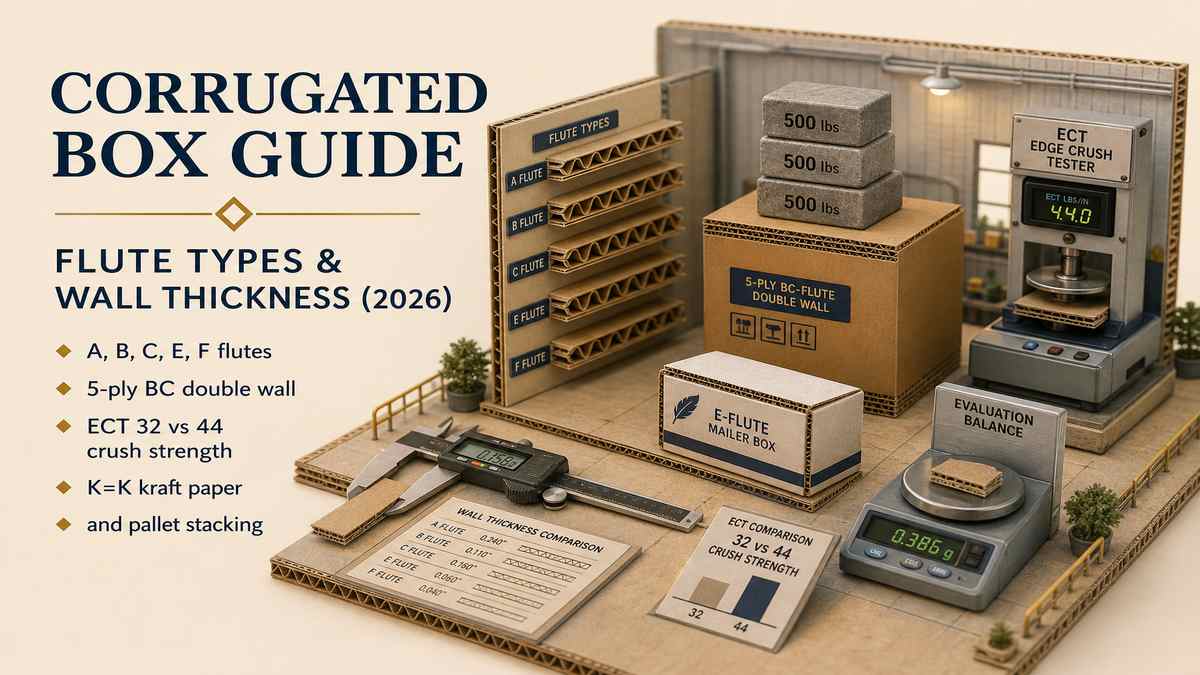
Direct Answer: In 2026, selecting the right Corrugated Flute Type (A, B, C, E, F, or BC Double Wall) and Wall Thickness is the single most important technical decision in preventing shipping damage while controlling international freight costs. The 10-second rule for e-commerce brands and wholesale importers is simple: (1) E-Flute (1.5 mm thickness, 90 flutes/ft) is the undisputed champion for custom printed DTC e-commerce mailer boxes (\$0.25–\$0.65/pc), providing an ultra-smooth surface for photorealistic CMYK graphics with high crush stiffness; (2) B-Flute (3.0 mm, 47 flutes/ft) is ideal for retail canned goods, inner packaging packs, and puncture-resistant die-cut cartons; (3) C-Flute (4.0 mm, 39 flutes/ft) is the global standard for single-wall domestic parcel shipping boxes; and (4) Double-Wall 5-Ply BC-Flute (6.5 mm, 44–48 ECT) is the mandatory gold standard for ocean export master shipping cartons (\$0.80–\$2.20/pc), engineered to withstand 30 kg payload stacking in humid maritime containers without crushing.
Corrugated cardboard is an engineering marvel. By forming paper into wave-like arched flutes glued between flat linerboards, it creates a rigid, lightweight sandwich structure with immense vertical load-bearing capacity.
To understand where corrugated cardboard fits within your complete supply chain architecture, review our comprehensive overview of the types of packaging materials for wholesale products across corrugated, rigid, poly, and kraft options.
However, many overseas buyers make costly mistakes: specifying thin E-flute for heavy 20 kg wholesale products causing side burst-outs, or ordering single-wall cartons with cheap recycled straw fluting that absorbs maritime moisture and collapses on warehouse pallets.
In this technical 2026 packaging engineering guide, we break down the 5 single-wall and 3 double-wall corrugated flute profiles, compare ECT crush strength vs. Mullen burst ratings, decode Chinese paperboard grade codes (K=K, K=A), expose 3 common factory shortcuts, and share a 5-step SOP to source custom shipping boxes in China with zero transit defects.
Corrugated Flute Types: A, B, C, E, F & BC Cross-Section Profiles
To evaluate these flute profiles side by side, review this comparative engineering matrix:
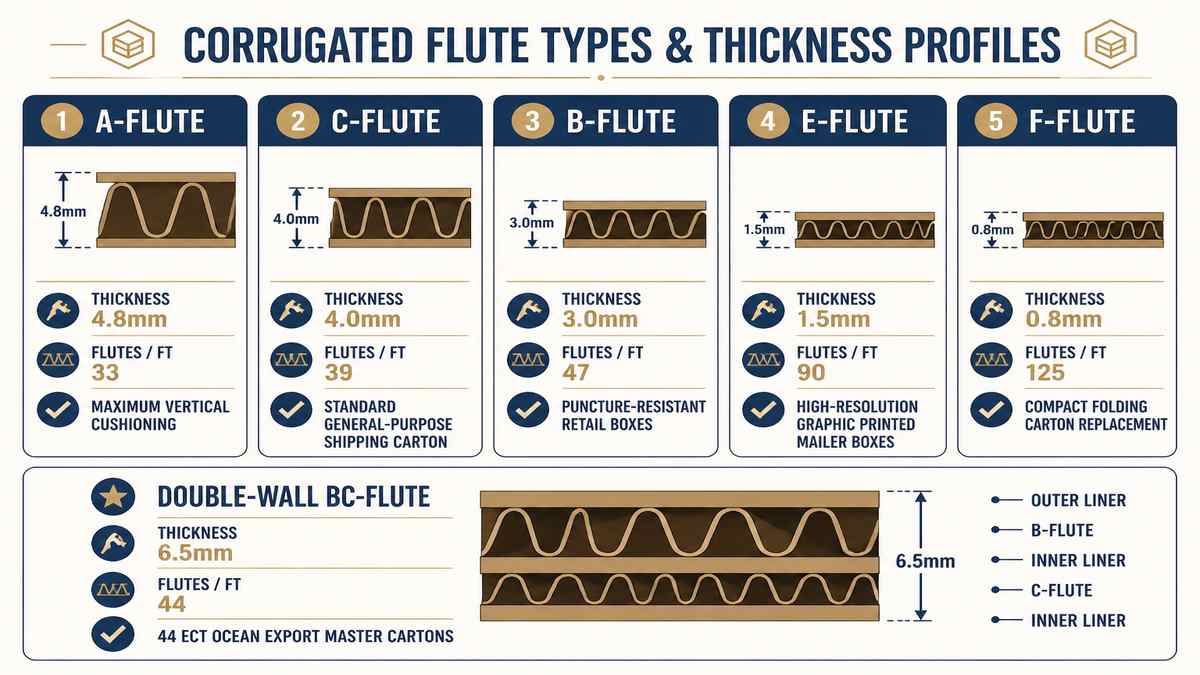
| Flute Type | Flute Thickness (mm) | Flutes per Foot (ft) | Primary Structural Strength | Best Packaging Application |
|---|---|---|---|---|
| A-Flute | 4.8 mm | 33 ± 3 | Maximum vertical shock cushioning. | Fragile glass, ceramic sets, heavy electronics. |
| C-Flute | 4.0 mm | 39 ± 3 | Balanced cushioning and stacking load. | Standard single-wall shipping boxes (up to 15 kg). |
| B-Flute | 3.0 mm | 47 ± 3 | High puncture resistance & flat surface. | Retail display boxes, canned food packs, hardware. |
| E-Flute | 1.5 mm | 90 ± 4 | Superior printing surface & crush stiffness. | DTC subscription mailers, cosmetic boxes, apparel. |
| F-Flute | 0.8 mm | 125 ± 5 | Ultra-thin rigid card alternative. | Fast food takeaway, jewelry boxes, small pharma. |
| BC-Flute (Double Wall) | 6.5 mm | 86 combined | Maximum 44+ ECT pallet stacking strength. | Export master cartons, heavy machinery, furniture. |
In-Depth Technical Breakdown of the 5 Flute Profiles
To choose the right flute profile for your custom box CAD dielines, examine the physical properties of each wave geometry:
Single Wall, Double Wall & Triple Wall Corrugated Architecture
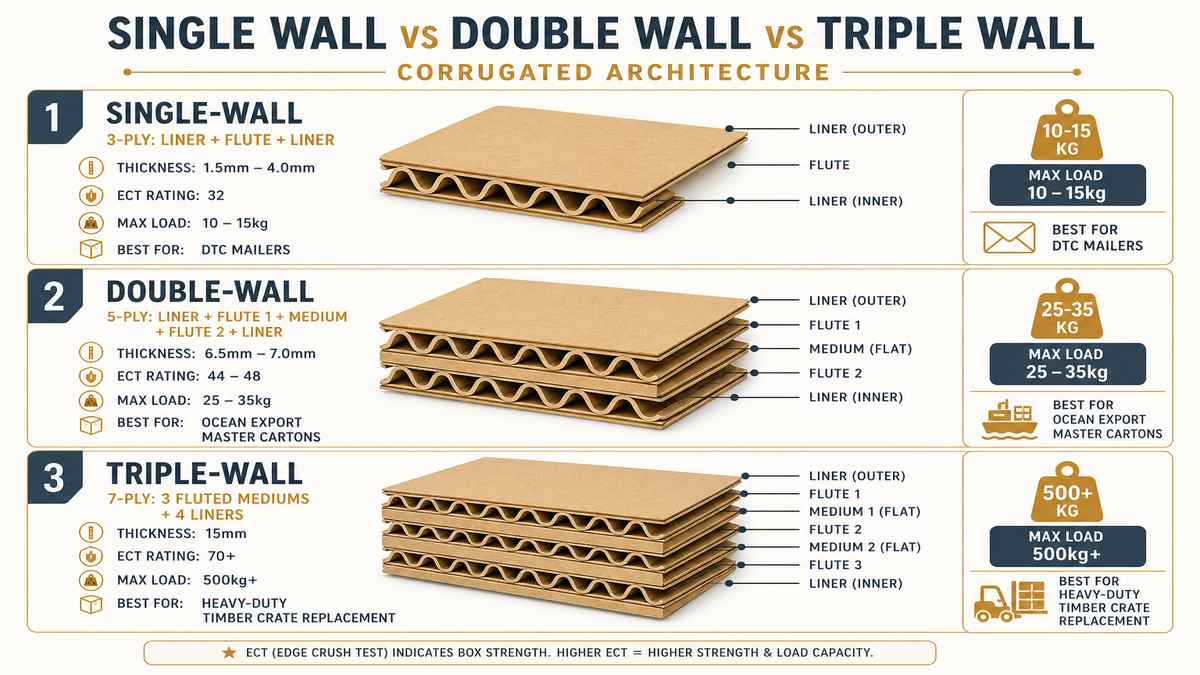
Corrugated board architecture is classified by the number of fluted paper mediums and flat linerboard layers glued together:
When engineering high-volume custom shipping boxes, applying brand artwork cleanly across your selected flute material is essential, as detailed in our guide on how to put your logo on products from China across silkscreen, flexo, and offset printing.
Decoding Chinese Paperboard Grade Codes: K=K, K=A & Fluting Mediums
When communicating with Chinese packaging suppliers in Zhejiang and Guangdong, specifications are written in standardized letter codes indicating the outer liner, fluting medium, and inner liner grades:
For high-volume export packaging, choosing the correct printing method ensures crisp barcode scannability and brand fidelity, as explored in our comparison of silkscreen vs laser vs heat transfer printing methods on diverse substrate packaging.
Quality Assurance: ECT Edge Crush Test & Mullen Bursting Test Protocol
To check that your custom corrugated shipping cartons comply with international shipping regulations, mandate these laboratory test standards:
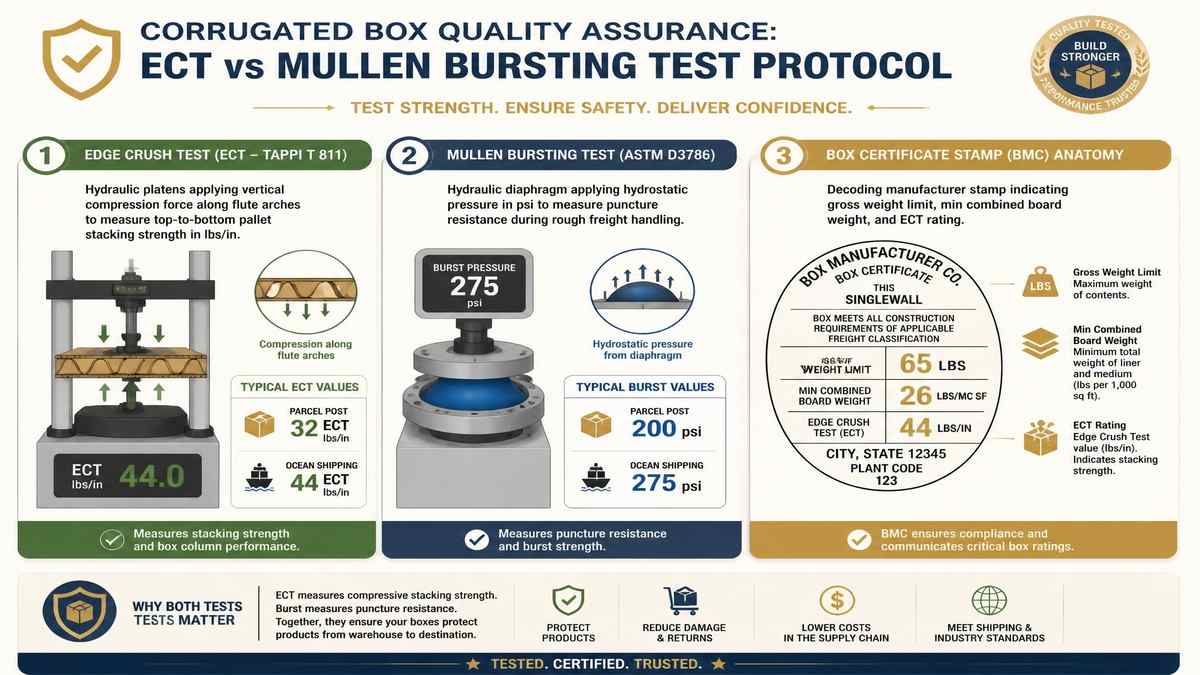
Testing must be certified under official paperboard testing protocols published by the Technical Association of the Pulp and Paper Industry (TAPPI) Standards to ensure repeatable laboratory precision.
3 Dirty Tricks in Corrugated Box Sourcing & How to Prevent Them
Low-cost packaging factories cut corners on raw paper stock to lower manufacturing quotes. Guard your brand against these three common practices:
5-Step SOP for Sourcing Custom Shipping Boxes in China
Follow this standard operating procedure to design and source custom corrugated shipping packaging with zero transit defects:
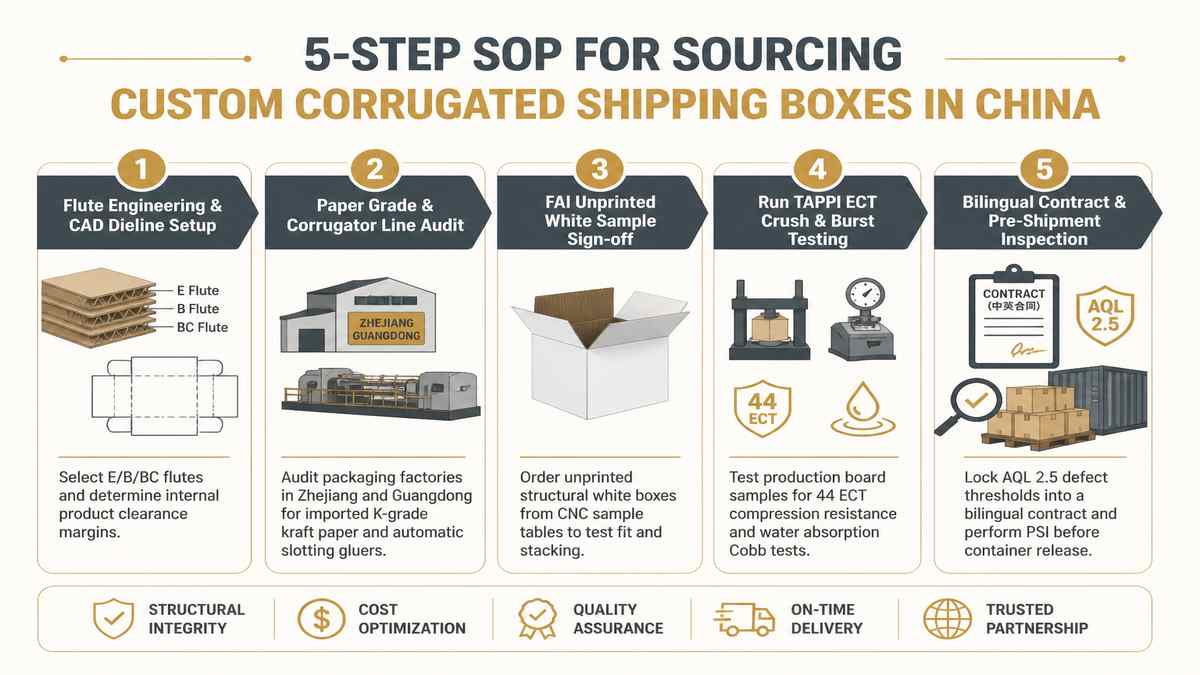
Before issuing production orders to packaging converters, audit their factory corrugators and automated gluing lines using our comprehensive China factory audit checklist review to check machinery capacity.
- Select Flute Profile & Build Vector CAD Dielines: Choose E-flute for retail mailers or BC-flute for export master cartons, adding 3 mm to 5 mm internal clearance tolerances around primary product packaging.
- Audit Packaging Converter & Corrugator Quality: Audit bidding corrugated box factories in Ningbo, Yiwu, or Dongguan under ISO 9001 Quality Management Standards, checking automated corrugating lines, slotter-gluers, and flexo printing machinery.
- Sign Enforceable Bilingual Packaging Contract: Lock exact paper grades (e.g., K=A), fluting grammage, ECT burst minimums, and pallet loading rules into an enforceable bilingual manufacturing sales contract under PRC law.
- Inspect Unprinted Structural White Mockups with FAI Sign-off: Order CNC plotter-cut unprinted structural sample boxes to test physical product fit and pallet stacking alignment during a formal first article inspection (FAI) sample review before full production.
- Execute TAPPI ECT Testing & Pre-Shipment Inspection (PSI): Conduct laboratory edge crush tests and perform a comprehensive pre-shipment inspection (PSI) in China under AQL 2.5 standards for score line alignment, glue bond strength, barcode scannability, and shipping mark clarity.
Illustrative Scenario: How a Seattle Brand Eliminated 8.4% Transit Breakage
To see how professional corrugated packaging engineering protects product margins and customer satisfaction, review this smart pet appliance case study:
A smart pet products company in Seattle, Washington developed a custom automatic ceramic pet water fountain (Weight: 2.8 kg per unit, 8 units per master carton, \$180,000 order value).
- The Crushed Carton Nightmare: The supplier initially packed the goods in standard single-wall C-flute cartons (32 ECT, B=B grade). During ocean shipping and container devanning, humid sea air softened the straw fluting. The bottom 25% of master cartons crushed under the 4-tier pallet load, causing an 8.4% ceramic bowl breakage rate and over \$15,000 in unsellable inventory.
- The Double-Wall BC-Flute Engineering Overhaul: Sourcing Pioneer redesigned the entire packaging structure: (1) Upgraded master shipping cartons to heavy-duty 5-ply BC-Flute with imported K=A virgin kraft liners and 140gsm high-strength chemical fluting (44 ECT crush rating), (2) Upgraded inner unit boxes to E-Flute corrugated board with custom molded pulp end-caps, and (3) Mandated full H-taping on all top and bottom master carton flaps.
- Zero Breakage A Check: Production master cartons underwent certified TAPPI ECT testing (achieving 46.2 ECT) and ISTA 1A 10-orientation drop tests from 76 cm with zero internal ceramic damage.
- The Commercial Outcome: Across a 10,000-unit production run shipped across the Pacific, the brand achieved 100% zero carton collapse and a 0.0% transit breakage rate at Amazon FBA warehouses, saving tens of thousands of dollars in replacement and freight chargebacks.
Frequently Asked Questions (FAQ)
What is the difference between E-flute, B-flute, and C-flute corrugated cardboard?
E-flute is 1.5 mm thick with 90 flutes per foot, offering a smooth, flat surface for high-resolution color graphic printing on e-commerce mailer boxes. B-flute is 3.0 mm thick with 47 flutes per foot, offering high puncture resistance for retail cans and hardware. C-flute is 4.0 mm thick with 39 flutes per foot, serving as the standard single-wall shipping carton.
What corrugated flute type should you choose for ocean export master cartons?
For ocean freight master cartons, double-wall 5-ply BC-flute (6.5 mm thick, combining B-flute puncture resistance with C-flute vertical cushioning) with a 44 ECT or 48 ECT crush rating is the global standard to prevent bottom-tier cartons from collapsing on shipping pallets.
What does K=K and K=A mean in Chinese corrugated box specifications?
In Chinese packaging terminology, the letters denote the paper grades for the outer liner, middle fluting, and inner liner. K represents imported virgin kraft paper (175gsm to 250gsm), while A represents domestic virgin kraft (140gsm to 175gsm). Therefore, K=K is a heavy-duty 5-ply double-wall box with imported kraft outer and inner liners, while K=A has an imported outer liner and domestic inner liner.
What is Edge Crush Test (ECT) and how does it differ from Mullen Burst Test?
Edge Crush Test (ECT, measured in lbs/in) evaluates the top-to-bottom compression and stacking strength of a box under pallet load. Mullen Bursting Test (measured in psi) tests the force required to puncture the side wall of the carton during rough courier handling.
How can brands prevent corrugated shipping boxes from crushing during ocean transit?
Brands should specify virgin kraft paper (K=A or K=K grade) with high-strength chemical fluting medium (140gsm), require 44 ECT minimum double-wall BC-flute for export master cartons, mandate full H-taping on all top and bottom flaps, and ensure pallets are packed with zero box overhang.
Engineer Heavy-Duty Corrugated Shipping Boxes That Never Crush in Transit
Our China packaging engineering team audits corrugated fluting mediums, checks TAPPI ECT crush strength ratings, inspects slotting crease lines, and oversees container loading.
Get Free Corrugated Flute & Box Consultation
Questions & Comments
We read every one and reply within 24 hoursComparing E-flute mailer boxes, B-flute retail cartons, double-wall BC-flute export master boxes, or need on-site TAPPI ECT crush testing in Ningbo, Yiwu, or Dongguan? Post your corrugated packaging questions below — our on-the-ground manufacturing specialists will guide your packaging engineering decisions.