
Silkscreen Printing vs. Laser Engraving vs. Heat Transfer: Choosing the Right Logo Method (2026 Guide)
 ·
Updated October 1, 2026
·
20 min read
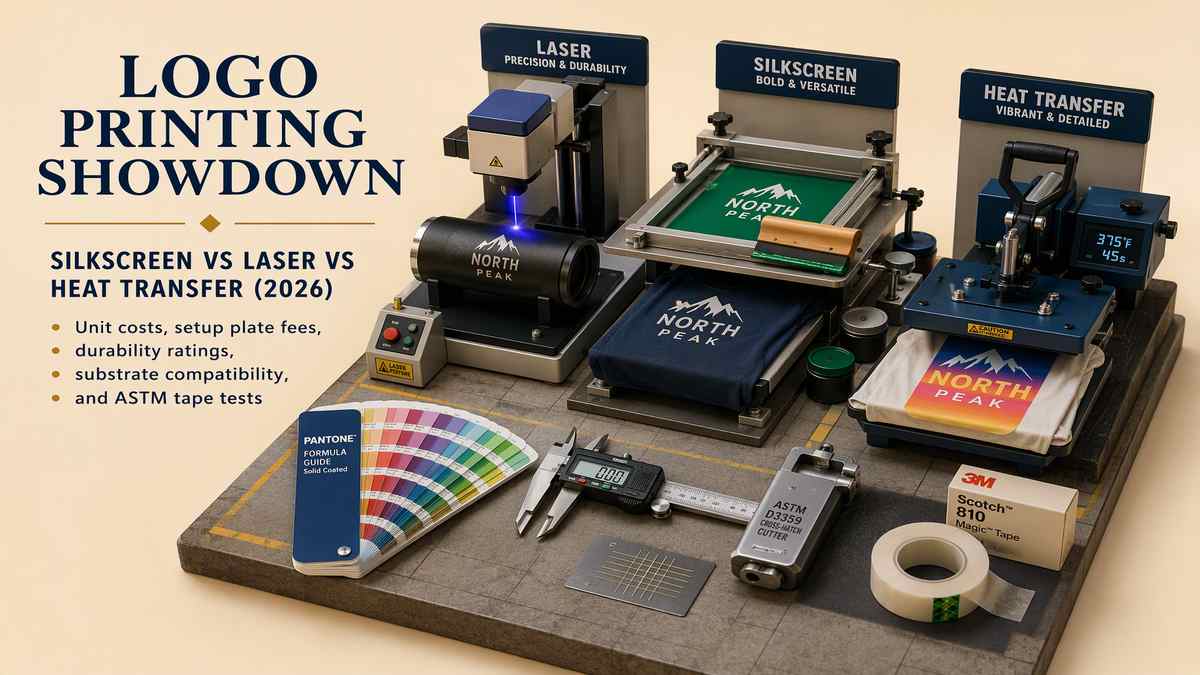
Direct Answer: Choosing between Silkscreen Printing, Laser Engraving, and Heat Transfer comes down to a direct trade-off between unit cost, material durability, color complexity, and setup tooling fees. In 2026, the 10-second decision rule is straightforward: (1) Laser Engraving is the best choice for metals (stainless steel, aluminum), bamboo, wood, and leather—it has $0 setup plate fees, ultra-low MOQs (50–100 pcs), and creates a 100% permanent mark that will never peel, scratch, or fade in a dishwasher; (2) Silkscreen Printing is the champion for high-volume production (1,000+ pcs) with 1 to 2 solid Pantone spot colors on flat plastic, canvas bags, and cardboard packaging, offering the lowest unit cost (\$0.03–\$0.10/pc) and a modest \$15–\$30 setup fee per color; (3) Heat Transfer Printing is the go-to solution for complex multi-color photorealistic graphics, vibrant color gradients, and all-over textile prints (\$0.10–\$0.40/pc, \$50–\$100 plate fee), though it requires careful heat-setting to pass ASTM D3359 cross-hatch tape adhesion tests.
When manufacturing custom private label products in China, applying the wrong branding method can ruin a great product design. A silkscreen logo printed on coated metal without the proper primer will flake off under friction, while attempting heat transfer on a rigid 3D curved plastic housing will cause ugly wrinkling and bubbling.
In this comprehensive 2026 engineering guide, we put Silkscreen Printing, Laser Engraving, and Heat Transfer into a head-to-head showdown across 7 key manufacturing dimensions, build an intuitive substrate decision tree, explain essential ASTM quality control adhesion tests, and share a 5-step SOP to source flawless custom branded merchandise from Chinese factories.
Silkscreen vs. Laser Engraving vs. Heat Transfer: Head-to-Head Comparison
To evaluate these three dominant branding technologies side by side, review this comparative engineering matrix:
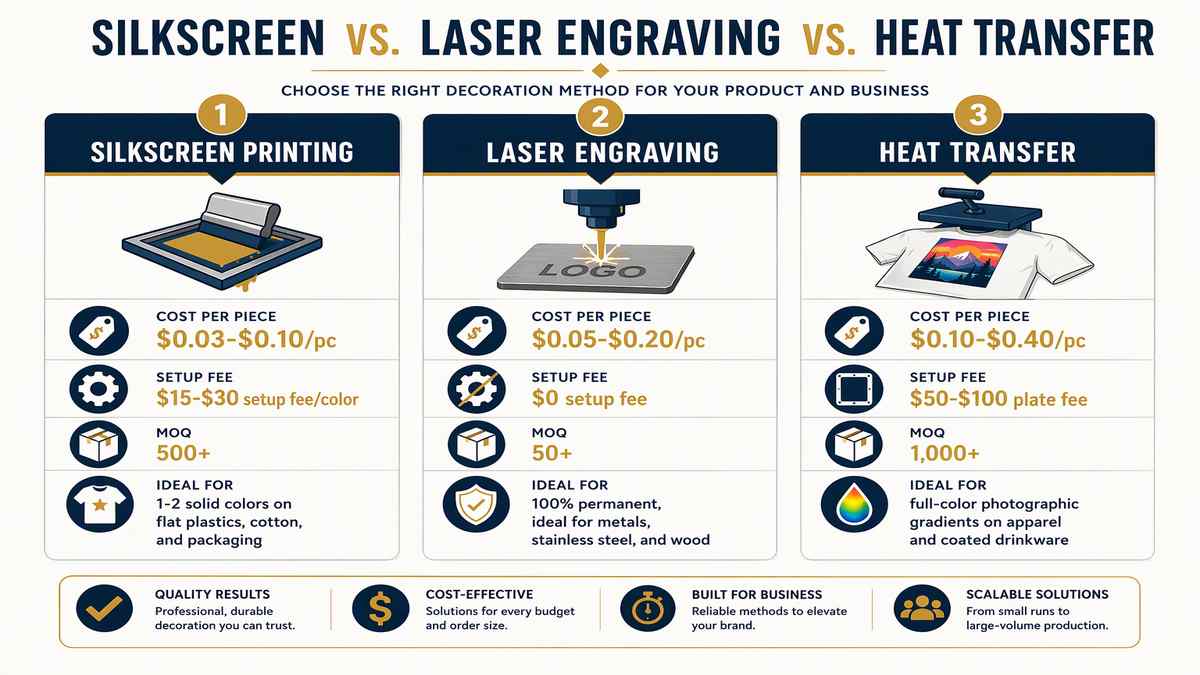
| Evaluation Criteria | 1. Silkscreen Printing (丝网印) | 2. Laser Engraving (激光雕刻) | 3. Heat Transfer (热转印) |
|---|---|---|---|
| Unit Cost (USD) | $0.03 – $0.10 (Lowest for bulk) | $0.05 – $0.20 (Moderate) | $0.10 – $0.40 (Highest) |
| Setup & Tooling Fees | $15 – $30 per color mesh frame | $0 (Zero Plate / Tooling Fee) | $50 – $100 per plate cylinder / film |
| Typical Minimum Order (MOQ) | 500 – 1,000 pcs | 50 – 200 pcs (Flexible) | 1,000 pcs |
| Color Capabilities | 1 – 4 solid Pantone spot colors; no fine gradients. | Monochrome only (Reveals base substrate color). | Unlimited full-color, photo gradients & halftones. |
| Best Substrate Materials | Flat plastic, cotton tote bags, paper packaging, flat metal. | Stainless steel, aluminum alloys, wood, bamboo, genuine leather. | Polyester athletic apparel, nylon, coated ceramic mugs, drinkware. |
| Durability & Wear Rating | High on porous surfaces; moderate on coated metals. | 100% Permanent (Indestructible, dishwasher safe). | Moderate to High (Can peel if overheated or aged). |
| Production Sampling Speed | 2 to 3 days (Requires screen burning). | Same-Day / 1 Day (Direct digital vector input). | 4 to 7 days (Requires film engraving & proofing). |
In-Depth Analysis: How Each Logo Printing Method Works
To choose the right method for your bill of materials (BOM), let us examine the mechanical engineering principles behind each technology:
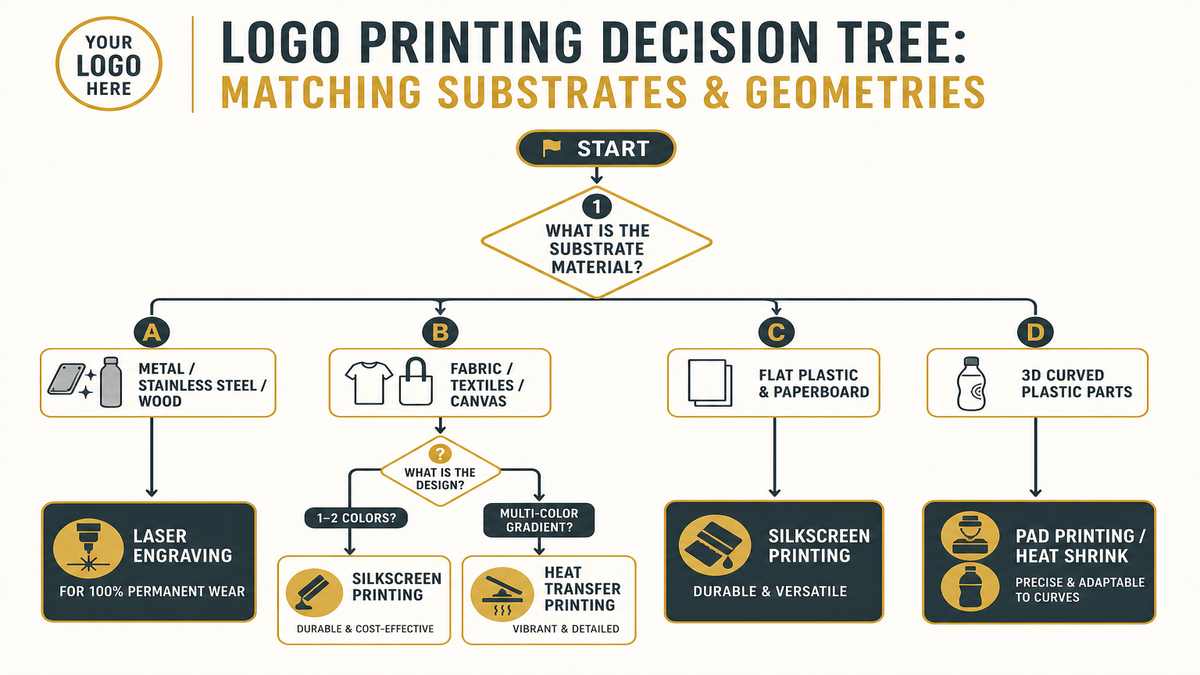
Decision Framework: Matching Substrates & Geometries to Logo Methods
Use this structured decision tree to match your product’s material chemistry and physical shape to the correct branding technology:
3 Hidden Cost Traps in Factory Logo Quotes
When reviewing initial supplier quotes for custom branding in China, watch out for these three hidden line items:
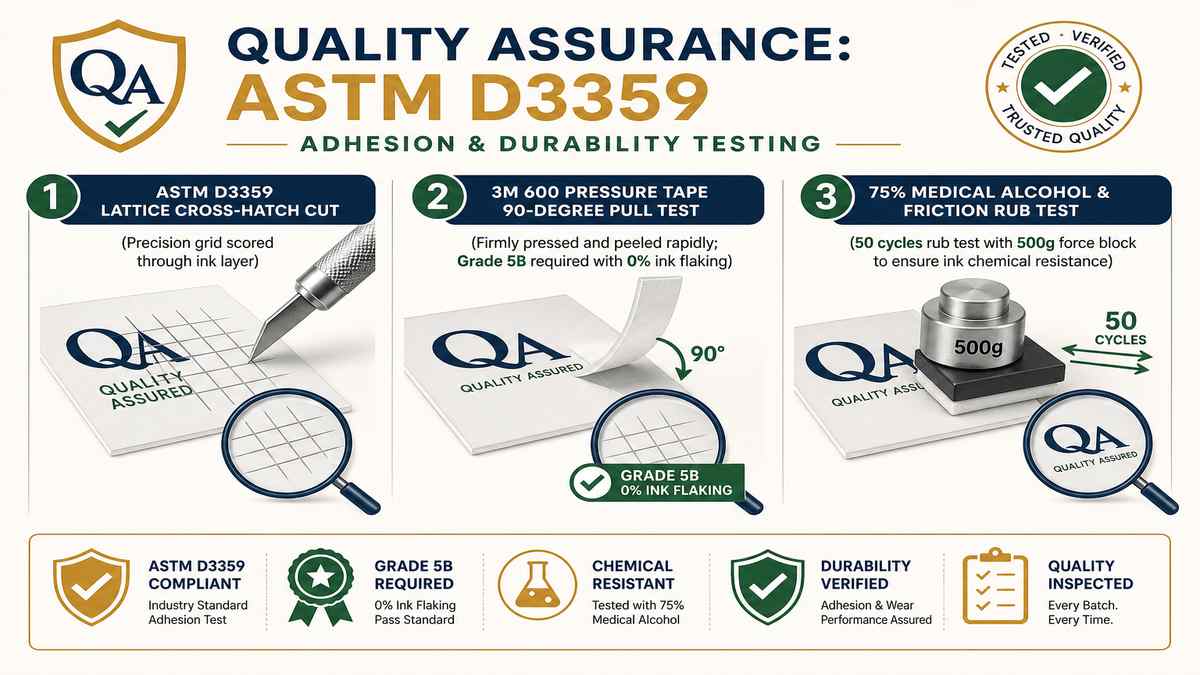
Quality Assurance: ASTM D3359 Adhesion & Durability Testing
To guarantee that your product logos do not peel during international freight or customer use, mandate these three testing protocols:
5-Step SOP for Sourcing, Testing & Inspecting Custom Product Logos
Follow this end-to-end standard operating workflow to execute flawless branding with Chinese manufacturers:
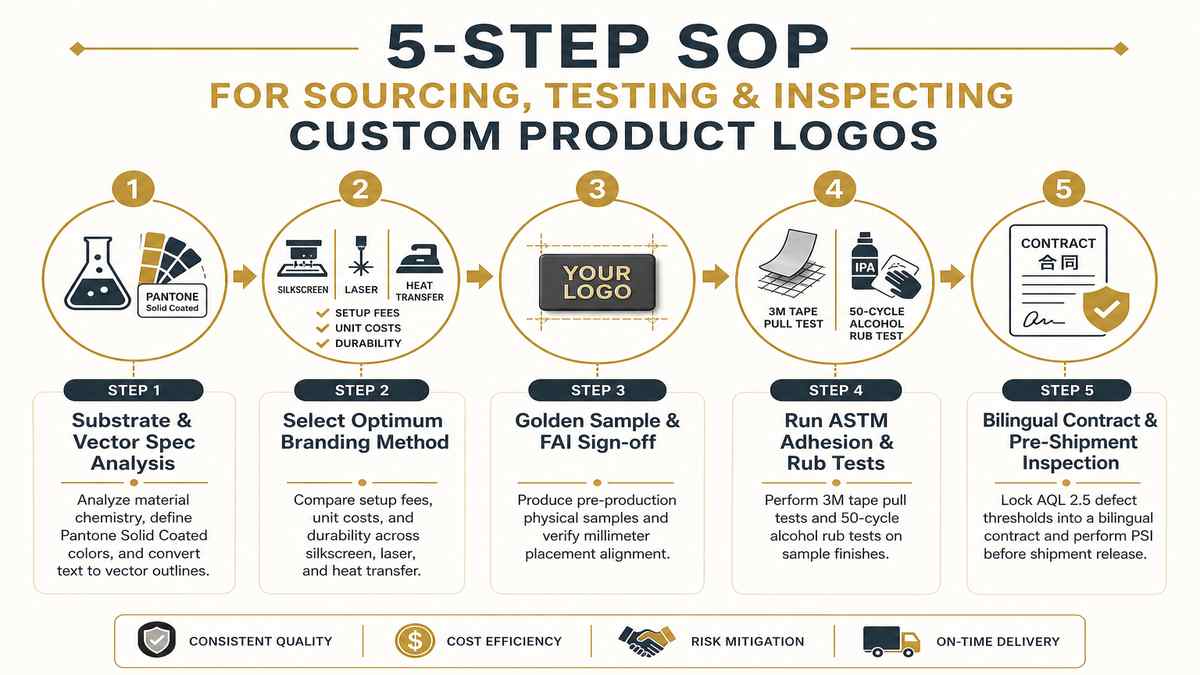
- Analyze Substrate Chemistry & Prepare Vector Outlines: Convert all brand typography to vector paths in Adobe Illustrator (.AI/.PDF) and specify exact Pantone Formula Guide Solid Coated (C) codes, as detailed in our comprehensive guide on how to put your logo on products from China.
- Select Optimum Method Based on Volume & Durability: Match your substrate and order quantity to silkscreen, laser engraving, or heat transfer.
- Order & Sign Off on Physical Pre-Production Samples (FAI): Never authorize mass printing from digital renders. Pay for physical pre-production samples and execute a formal first article inspection (FAI) sample sign-off checking millimeter alignment and color accuracy with calipers and spectrophotometers.
- Conduct On-Site Factory Audit & Lock Bilingual Contract: Conduct an on-site factory audit checklist review and draft an enforceable bilingual sales contract under PRC law that binds the supplier to ASTM D3359 5B adhesion standards, AQL 2.5 defect limits, and full supplier-funded rework penalties.
- Gate Final 70% Balance on Pre-Shipment Inspection (PSI): Dispatch an independent quality control inspector to perform a comprehensive pre-shipment inspection (PSI) in China, testing tape adhesion and visual registration before container loading.
Printing on 3D Curves: When to Use Pad Printing
If your product has compound curves, spherical surfaces, or recessed buttons where flat silkscreens and laser focal lenses cannot reach, pad printing (tampography) is the essential alternative:
| Surface Geometry | Best Recommended Logo Method | Key Production Benefit |
|---|---|---|
| Flat Surface (Totes, Boxes, Panels) | Silkscreen Printing | Lowest unit cost ($0.03–$0.10) with rich, saturated solid Pantone spot colors. |
| Cylindrical Metal / Wood (Drinkware, Pens) | Rotary Laser Engraving | Permanent 360-degree etching with zero plate setup charges. |
| Compound 3D Curve (Mice, Helmets, Balls) | Pad Printing (Tampography) | Flexible silicone pad deforms over 3D curves without graphic distortion. |
| All-Over Full-Wrap Art (Mugs, Bottles) | 360° Rotary Heat Transfer Film | Smooth photorealistic full-color graphics covering entire product body. |
Illustrative Scenario: How a California Outdoor Brand Perfected Mug Branding
To see how selecting the right printing method protects profit margins, review this custom drinkware case study:
An outdoor lifestyle brand in San Diego, California ordered 5,000 custom matte black powder-coated 32oz stainless steel camp mugs (\$32,000 total order value) for their fall retail release.
- The Silkscreen Flaking Trap: The factory initially quoted 1-color white silkscreen printing (\$0.06/pc, \$50 setup fee). However, during Sourcing Pioneer’s initial FAI sample testing, the silkscreen ink failed the 3M tape test on the rough powder-coated texture, peeling off along the edges.
- The Precision Laser Engraving Switch: Sourcing Pioneer recommended switching to high-precision fiber laser engraving. The laser cleanly vaporized the matte black powder coating, exposing the gleaming 304 stainless steel base metal. Setup fees dropped to \$0, while unit cost increased by only \$0.08 per mug.
- Zero-Defect Mass Production: Sourcing Pioneer conducted ASTM D3359 tape tests and 10 dishwasher cycles on production samples, confirming 100% permanent adhesion. On-site pre-shipment inspection verified zero print flaws across all 5,000 units.
- The Commercial Outcome: The camp mugs launched across 40 outdoor retail stores with a 4.9-star rating, zero customer peeling complaints, and generated over \$140,000 in seasonal revenue.
Frequently Asked Questions (FAQ)
Which logo printing method is best for stainless steel water bottles?
Laser engraving is the premier method for stainless steel bottles because it has $0 plate setup fees, permanently removes the exterior powder coating to reveal the shining steel base, and will never peel, scratch, or fade in a dishwasher. If a vibrant multi-color design is required, heat transfer is the alternative.
What is the unit cost difference between silkscreen printing and heat transfer in China?
Silkscreen printing costs only $0.03 to $0.10 per unit for 1-2 solid spot colors with a low setup plate fee of $15 to $30 per color. Heat transfer printing costs $0.10 to $0.40 per unit with plate fees of $50 to $100, but allows photorealistic full-color gradients.
Does laser engraving support multiple colors?
No. Laser engraving is a monochromatic (single-color) subtractive process that vaporizes surface material. The color of the logo is determined by the underlying substrate (e.g., silver raw stainless steel, dark charcoal on wood, or pale gold on brass).
How do you ensure silkscreen print colors match your brand guidelines?
Always specify exact Pantone Solid Coated (C) color codes rather than screen RGB or CMYK values. Chinese ink technicians use physical Pantone Formula Guide swatch books to formulate custom ink batches.
How do quality inspectors test logo adhesion on manufactured goods?
Inspectors perform the ASTM D3359 Cross-Hatch Tape Adhesion Test by scoring a 1mm x 1mm lattice grid into the print, firmly pressing 3M 600 tape, and pulling rapidly at 90 degrees (Class 5B requires 0% flaking), followed by a 50-cycle 75% alcohol friction rub test.
Select the Perfect Logo Printing Method for Your Custom Products
Our China sourcing engineers review your CAD artwork, evaluate substrate compatibility, check Pantone color inks, and conduct on-site ASTM cross-hatch adhesion testing before mass production.
Get Free Logo Sourcing & Tech Pack Review
Questions & Comments
We read every one and reply within 24 hoursComparing silkscreen printing, laser engraving, and heat transfer for your product BOM, wondering about setup plate fees, or need on-site ASTM cross-hatch adhesion testing in China? Post your product questions below — our on-the-ground manufacturing engineers will guide your branding decisions.