
Types of Packaging Materials for Wholesale Products: Corrugated, Rigid, Poly & Kraft (2026 Guide)
 ·
Updated October 1, 2026
·
20 min read
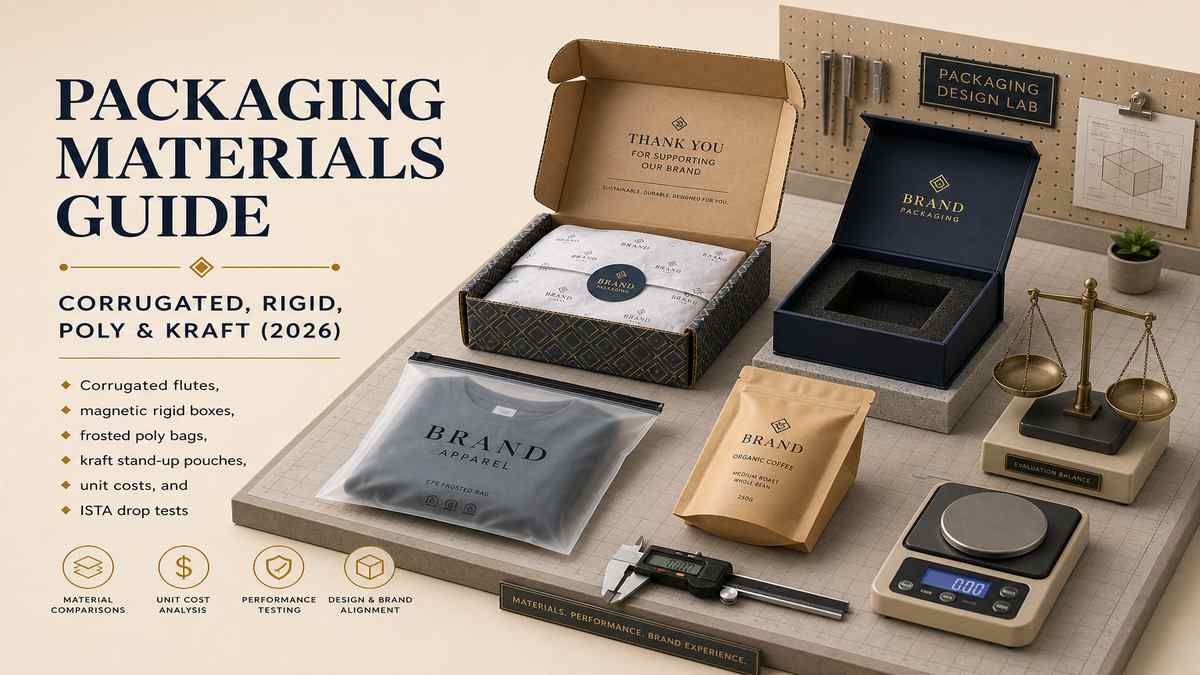
Direct Answer: In 2026, selecting the right Types of Packaging Materials for Wholesale Products is a strategic balancing act between unit packaging cost, structural crush protection, shipping deadweight volume, and consumer unboxing experience. The 10-second rule for global importers is clear: (1) Corrugated Cardboard (\$0.25–\$1.50/pc) is the undisputed champion for e-commerce mailer boxes (E-flute) and ocean export master cartons (5-ply BC-flute), offering 32 to 44 ECT crush strength and 100% recyclability; (2) Rigid Paperboard Setup Boxes (\$0.80–\$3.50/pc) are the premier choice for luxury consumer electronics, jewelry, and high-ticket gifts, built with 1.5–3.0 mm dense greyboard wrapped in specialty art paper for maximum retail perceived value; (3) Polyethylene Bags & Frosted CPE Zipper Pouches (\$0.03–\$0.18/pc) are the gold standard for apparel, swimwear, and soft textiles, providing 100% waterproof protection with zero shipping deadweight; and (4) Kraft Paper & Stand-Up Pouches (\$0.06–\$0.45/pc) deliver FSC-certified organic, biodegradable branding for gourmet foods, coffee, and eco-friendly wellness goods.
Packaging is the very first physical touchpoint your customer experiences. When sourcing custom packaging from printing hubs in Zhejiang (Yiwu, Cangnan) and Guangdong (Dongguan, Shenzhen), choosing the wrong material leads to disastrous supply chain failures: crushed shipping boxes that damage internal electronics, rigid gift boxes that consume expensive ocean container air, or non-compliant polybags flagged by Amazon for missing legal warnings.
In this comprehensive 2026 wholesale packaging guide, we compare Corrugated, Rigid, Poly, and Kraft materials side by side across 7 core dimensions, break down the 3-tier packaging hierarchy, review ISTA 1A drop testing protocols, expose 3 common factory shortcuts, and share a 5-step SOP to source custom product packaging in China with zero defects.
4 Major Wholesale Packaging Materials: Head-to-Head Comparison
To evaluate these four packaging material classes side by side, review this comparative manufacturing matrix:
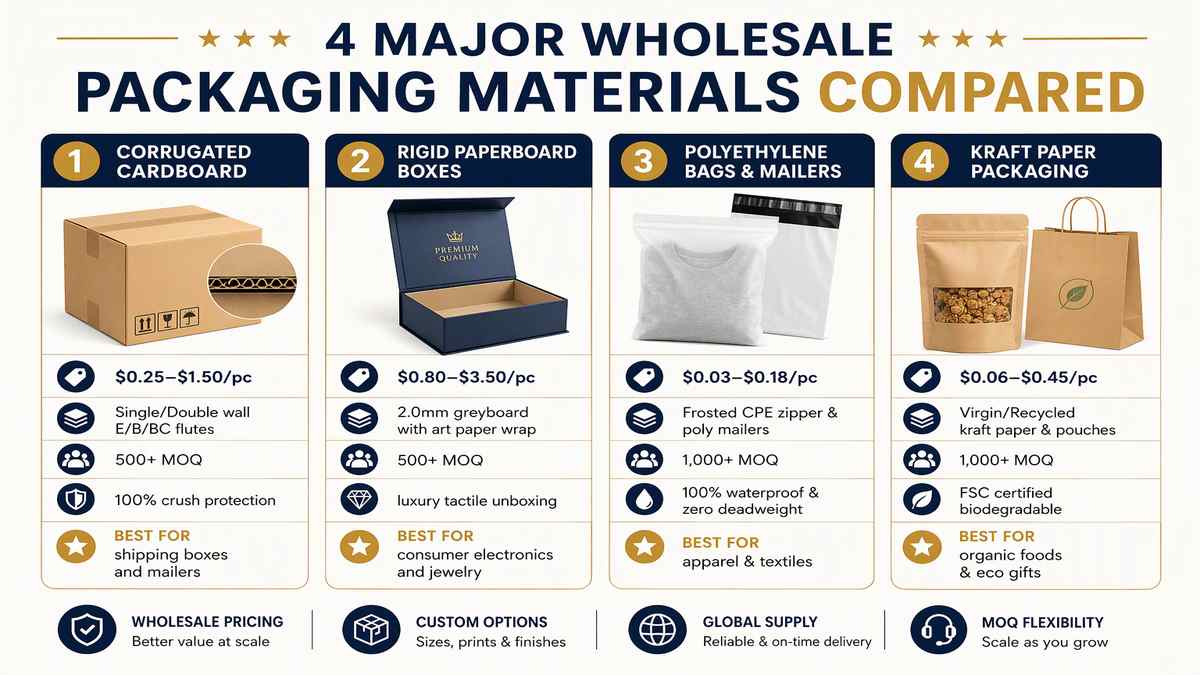
| Evaluation Dimension | 1. Corrugated Cardboard (瓦楞纸板) | 2. Rigid Setup Boxes (精装硬板礼盒) | 3. Polyethylene & CPE (塑料拉链/快递袋) | 4. Kraft Paper (天然牛皮纸袋/盒) |
|---|---|---|---|---|
| Unit Cost Range (USD) | $0.25 – $1.50 (Mailer to Master). | $0.80 – $3.50 (High-end luxury). | $0.03 – $0.18 (Lowest cost). | $0.06 – $0.45 (Eco-friendly). |
| Typical Minimum Order (MOQ) | 500 – 1,000 pcs (Flat shipped). | 500 – 1,000 pcs. | 1,000 – 5,000 pcs. | 1,000 – 3,000 pcs. |
| Structural Crush Protection | High (32 – 44 ECT rating). | Maximum (Non-deformable 2mm board). | None (Flexible film protection). | Moderate (Tensile tear strength). |
| Moisture & Water Resistance | Moderate (Requires coated varnish). | Moderate (Requires matte lamination). | 100% Waterproof & Airtight. | Low (Requires PE/PLA inner lining). |
| Unboxing Perceived Luxury | High (Custom printed mailer). | Ultimate (Magnetic flip & foam). | Utilitarian to Premium Frosted. | Organic, Artisan, Minimalist. |
| International Shipping Volume | Low (Ships 100% flat). | High (Unless Collapsible design). | Zero Deadweight / Zero Volume. | Low (Flat pouches & folded boxes). |
| Best Wholesale Product Fit | DTC subscription boxes, master cartons. | Smartphones, luxury jewelry, perfume. | Apparel, hoodies, activewear, bedding. | Coffee beans, organic teas, soap, gifts. |
In-Depth Technical Breakdown of the 4 Packaging Materials
To choose the right material specification for your product packaging dielines, examine the physical properties of each option:
The 3-Tier Packaging Hierarchy: Primary, Secondary & Tertiary Design
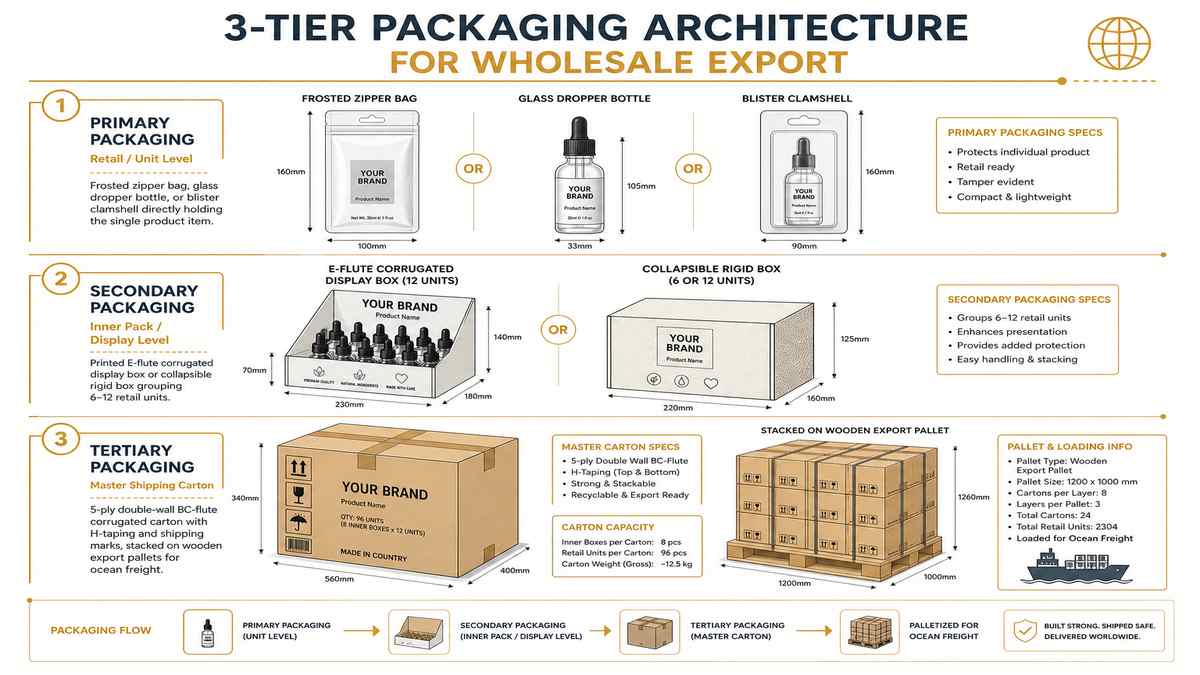
A professional supply chain packaging architecture combines three coordinated layers:
Quality Assurance: ISTA 1A Drop Test & ECT Crush Strength Protocol
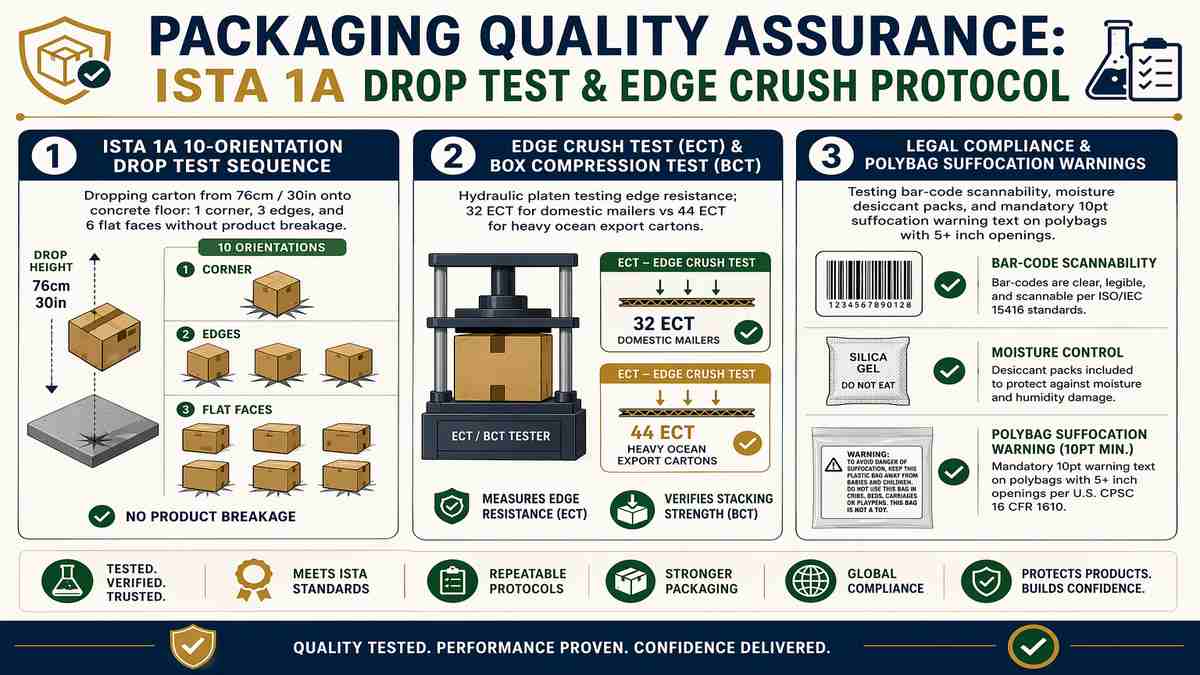
To guarantee that your packaging withstands international ocean freight and rough courier handling, mandate these three testing protocols:
3 Dirty Tricks in Packaging Sourcing & How to Prevent Them
Low-cost packaging printers in China cut corners on paper stock to win bids. Watch out for these three practices:
5-Step SOP for Sourcing Custom Wholesale Packaging in China
Follow this standard operating procedure to design and source custom packaging with zero quality defects:
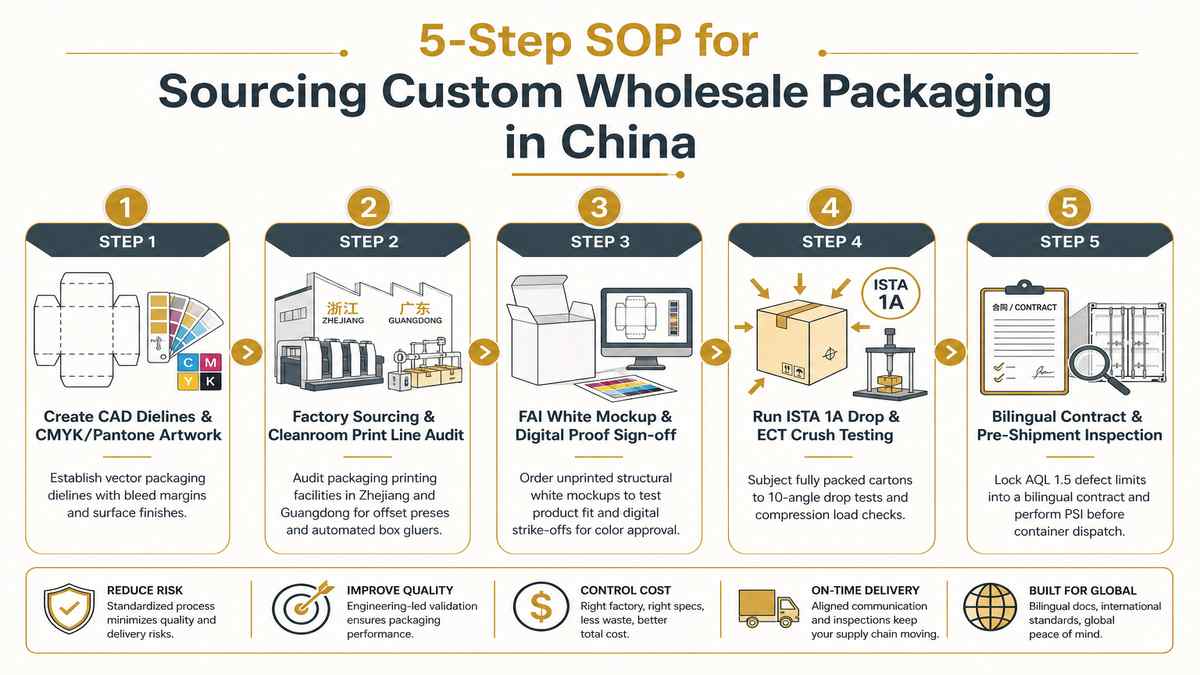
- Create Vector CAD Dielines & CMYK/Pantone Artwork: Build Adobe Illustrator vector dielines specifying cut lines, fold scores, 3 mm bleed margins, and exact Pantone Matching System (PMS) color codes, as detailed in our guide on how to put your logo on products from China.
- Audit Packaging Factory & Automated Gluing Lines: Audit bidding printing facilities in Guangdong and Zhejiang under our China factory audit checklist review, checking Heidelberg 5-color offset presses, auto-die-cutters, and rigid box assembly machines.
- Sign Enforceable Bilingual Packaging & Trim Contract: Lock paper grammage (gsm), ECT burst ratings, and defect thresholds into an enforceable bilingual manufacturing sales contract under PRC law, applying insights from our guide on silkscreen vs laser vs heat transfer printing methods.
- Inspect Unprinted Structural White Mockups with FAI Sign-off: Order an unprinted white structural mockup from the CNC sample plotter to test product fit, followed by a digital color strike-off for a formal first article inspection (FAI) sample review before full production run.
- Execute ISTA 1A Drop Testing & Pre-Shipment Inspection (PSI): Perform 10-orientation drop tests and execute a comprehensive pre-shipment inspection (PSI) in China under strict AQL 1.5 standards for print registration, glue adhesion, barcode scannability, and shipping mark accuracy before dispatch.
Illustrative Scenario: How a New York Brand Cut Freight Costs by 72%
To see how smart packaging engineering drives profitability and customer delight, review this lifestyle brand case study:
A premium wellness brand in New York developed a luxury organic bamboo yoga wear and silk eye mask gift set (5,000-unit initial production run, \$125,000 total order value).
- The Bulky Rigid Box Problem: The founder initially selected traditional rigid setup gift boxes (32x24x10 cm). Because traditional rigid boxes ship pre-assembled as empty air, the 5,000 boxes occupied 38 CBM of ocean container space, costing over \$14,000 in international shipping freight alone.
- The Collapsible Packaging Redesign: Sourcing Pioneer re-engineered the packaging architecture into a 3-tier system: (1) Primary: FSC-certified 150gsm frosted white kraft envelope bags with printed suffocation warnings (\$0.14/pc), (2) Secondary: Collapsible Foldable Rigid Gift Boxes with magnetic closure and hidden corner adhesive strips (\$1.65/pc), which ship 100% flat and assemble in 5 seconds, and (3) Tertiary: Heavy-duty 44 ECT 5-ply BC-flute corrugated master shipping cartons.
- Massive Freight & Damage Savings: Flat-packing the collapsible rigid boxes reduced the shipping volume from 38 CBM down to 10.6 CBM, saving \$10,200 in ocean container freight (a 72% volume reduction). ISTA 1A drop testing confirmed 100% zero corner crushing.
- The Commercial Outcome: The gift sets launched at \$128 retail, selling out in 4 weeks with a 4.9-star unboxing rating and a transit damage return rate of less than 0.1%.
Frequently Asked Questions (FAQ)
What are the 4 main types of packaging materials used for wholesale products?
The four dominant packaging materials in wholesale and e-commerce supply chains are: (1) Corrugated Cardboard (shipping cartons and mailer boxes), (2) Rigid Paperboard Boxes (luxury gift and electronic setup boxes), (3) Polyethylene Plastic & Frosted CPE Zipper Bags (apparel and soft goods), and (4) Kraft Paper (eco-friendly stand-up pouches and folding cartons).
What is the difference between single-wall and double-wall corrugated cardboard?
Single-wall corrugated (3-ply: E-flute or B-flute) has one fluted medium between two linerboards, offering 32 ECT strength ideal for retail mailer boxes up to 10 kg. Double-wall corrugated (5-ply: BC-flute) has two fluted mediums, offering 44 to 48 ECT crush strength designed for heavy export master cartons up to 30 kg.
How can brands reduce high ocean shipping costs for rigid gift boxes?
Traditional rigid setup boxes ship as empty rigid volumes, consuming massive ocean freight CBM space. Brands should switch to Collapsible Foldable Rigid Boxes with magnetic corner flaps, which ship 100% flat and assemble in 5 seconds, reducing international shipping volume by up to 75%.
What testing standard confirms wholesale shipping packaging can survive courier transit?
The ISTA 1A transit test is the global standard. It subjects fully packed master cartons to a 10-orientation drop sequence from a height of 76 cm (30 inches) onto solid concrete (1 corner, 3 edges, 6 flat faces) plus 1 hour of mechanical rotary vibration to ensure zero product breakage.
What legal warning text is required on plastic polybags for Amazon and US retail?
Under US consumer safety regulations and Amazon FBA packaging rules, any clear or frosted polybag with an opening of 5 inches (12.7 cm) or wider must feature a printed Suffocation Warning in a minimum 10-point font stating that the bag is not a toy.
Engineer Premium Wholesale Packaging That Protects Cargo & Elevates Brand Value
Our China packaging engineering team audits carton dielines, tests corrugated ECT crush strength, inspects greyboard box alignment, and supervises on-site ISTA 1A drop testing.
Get Free Packaging Dieline & Material Consultation
Questions & Comments
We read every one and reply within 24 hoursComparing corrugated flutes, rigid gift box greyboard specifications, frosted zipper bags, or need ISTA 1A drop testing and on-site packaging inspection in Yiwu, Ningbo, or Dongguan? Post your wholesale packaging questions below — our on-the-ground manufacturing specialists will guide your packaging engineering decisions.