
OEM vs. ODM vs. OBM: What Are the Real Differences for Packaging & Branding? (2026 Guide)
 ·
Updated October 1, 2026
·
20 min read
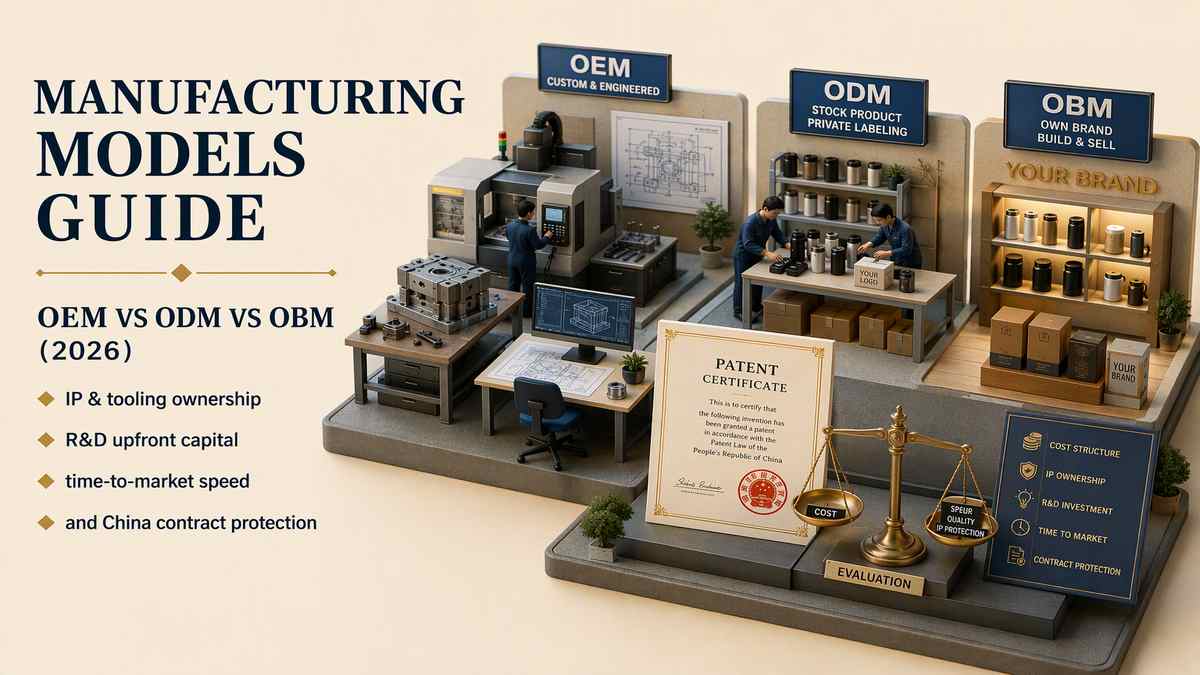
Direct Answer: The core difference between OEM, ODM, and OBM lies in who owns the design, who pays for the tooling molds, and who controls the intellectual property (IP). In 2026, the 10-second rule is clear: (1) ODM (Original Design Manufacturer / White Label) means the factory created the product and owns the open mold; you simply select their stock model, pick a Pantone color, and print your custom logo and retail packaging (\$2k–\$5k upfront, 2–4 weeks speed, but zero IP moat); (2) OEM (Original Equipment Manufacturer / Custom Tooling) means you design the product, provide 2D/3D CAD blueprints, pay for custom steel injection molds, and legally own 100% of the tooling and utility patents (\$20k–\$100k+ capital, 6–9 months development, creating a defensible multi-million-dollar brand); (3) OBM (Original Brand Manufacturer) means the factory develops, produces, and markets products under its own brand name (like DJI or Anker) directly to global consumers, eliminating third-party brand owners entirely.
When sourcing custom products from China, mixing up these manufacturing models can lead to devastating business outcomes. Importers who believe they “own” an ODM product are often shocked to see 15 competing Amazon sellers selling the exact same item from the same factory. Conversely, first-time entrepreneurs attempting full-custom OEM tooling frequently run out of cash before their first production batch is finished.
In this comprehensive 2026 engineering guide, we break down OEM, ODM, and OBM across 8 critical dimensions, expose the hidden traps of ODM manufacturing, outline the 4 signs that tell you when to transition from ODM to OEM, detail the 3 legal defenses to protect tooling assets under Chinese law, and provide a 5-step SOP to execute product customization smoothly.
OEM vs. ODM vs. OBM: 8-Dimensional Comparison Matrix
To clearly see the financial, operational, and intellectual property trade-offs, review this side-by-side manufacturing matrix:
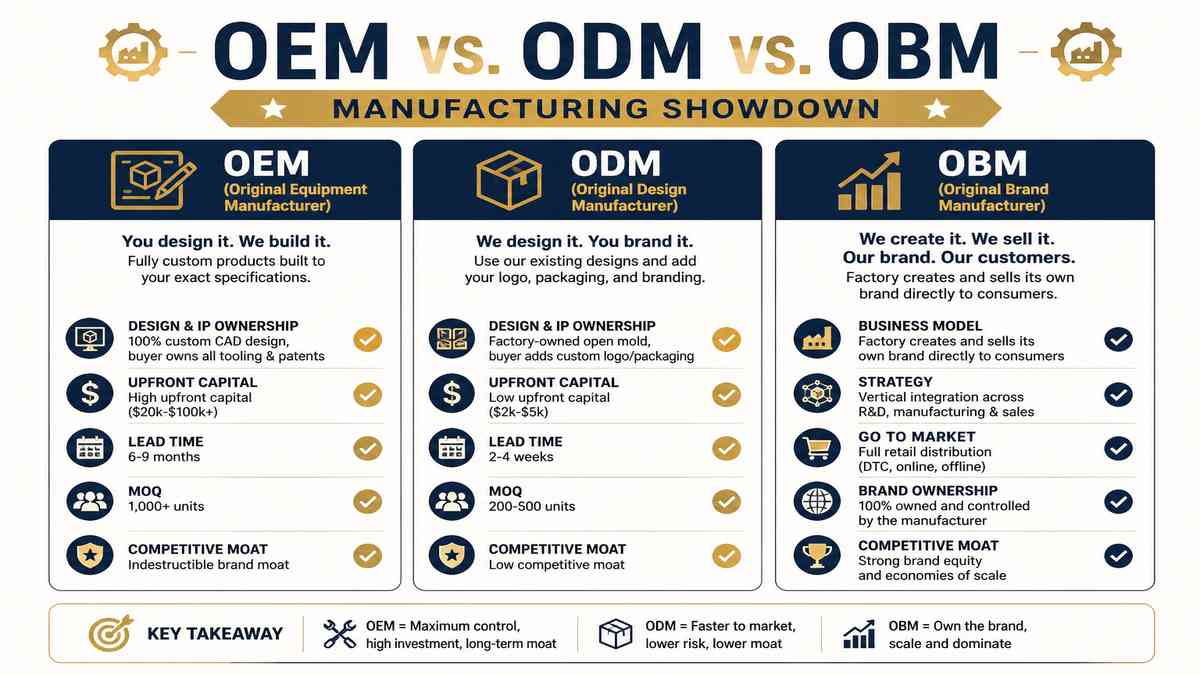
| Evaluation Dimension | 1. ODM (White Label / Private Label) | 2. OEM (Custom Manufacturing) | 3. OBM (Brand Owner Factory) |
|---|---|---|---|
| Design & CAD Ownership | Factory owns 100% of internal structure & PCB. | Buyer owns 100% of proprietary 2D/3D CAD. | Factory owns 100% of product and branding. |
| Tooling & Mold Asset Ownership | Factory owns molds; shared across all buyers. | Buyer owns steel mold (Exclusive private mold). | Factory owns all production assets. |
| Upfront Capital Required | Low ($2,000 – $5,000); sample & logo fees only. | High ($20,000 – $100,000+); CNC tooling & DFM. | N/A (Factory funds own brand operations). |
| Time to Market (Speed) | Ultra Fast (2 to 4 Weeks). | Moderate (6 to 9 Months from CAD to T1). | Continuous (Factory handles retail inventory). |
| Minimum Order Quantity (MOQ) | Low (200 – 500 pcs) for logo printing. | Moderate to High (1,000 – 5,000 pcs). | N/A (Distributor buys finished inventory). |
| Customization Depth | Cosmetic only (Pantone color, logo, packaging). | 100% Complete Freedom (Dimensions, electronics). | None (Buyer sells factory’s standard models). |
| Competitive Moat & IP Defense | Very Low; competitors can copy instantly. | Very High; protected by patents & private molds. | High (Factory controls full vertical supply chain). |
| Supplier Switching Cost | Very Low (Can move to another factory easily). | Very High (Requires physically moving molds). | N/A (Distributor relationship). |
Deep-Dive: How OEM, ODM, and OBM Work in Chinese Factories
To choose the right operational path for your e-commerce business, let us examine the mechanical reality of each manufacturing model:
The Product Evolution Path: When & How to Transition from ODM to OEM
Most successful hardware brands do not start with expensive OEM tooling on Day 1. Instead, they follow an intelligent 3-stage evolution path:
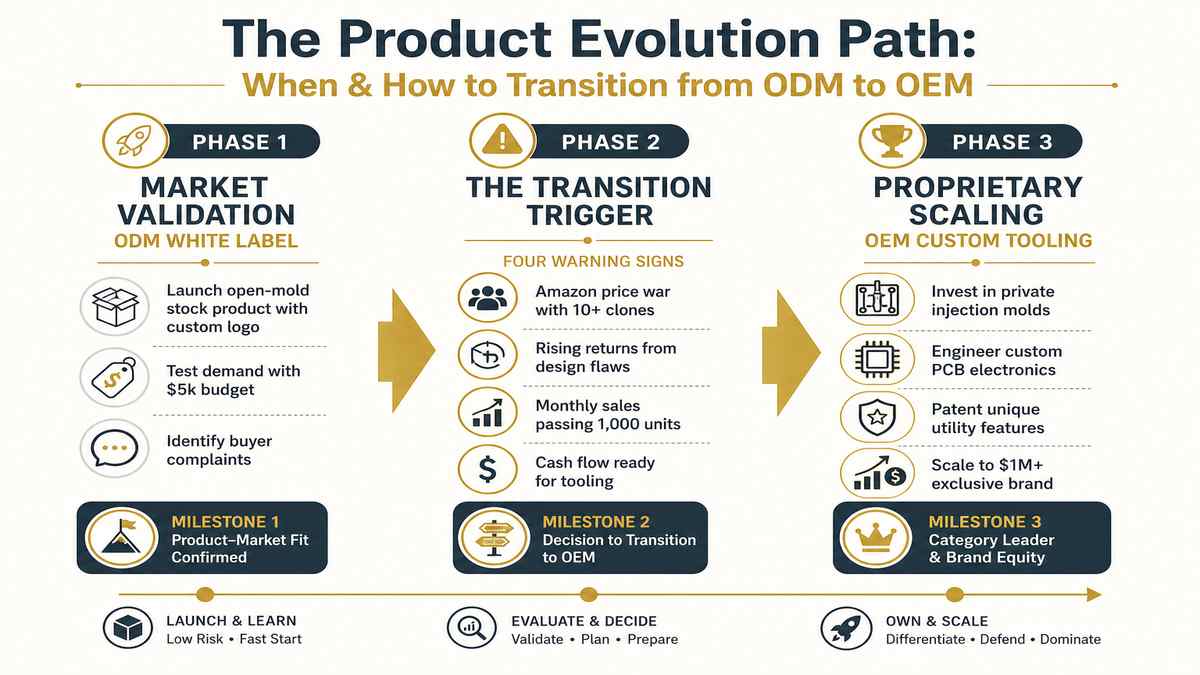
2. Chronic Engineering Flaws: The factory’s generic mold has design weaknesses (e.g., weak hinges or poor waterproofing) that the factory refuses to redesign.
3. Consistent Monthly Volume: Your product consistently sells 1,000+ units per month, generating reliable operating cash flow to fund mold tooling.
4. Patentable Proprietary Innovation: You engineered a novel mechanical latch or electronic feature that can be patented under international IP law.
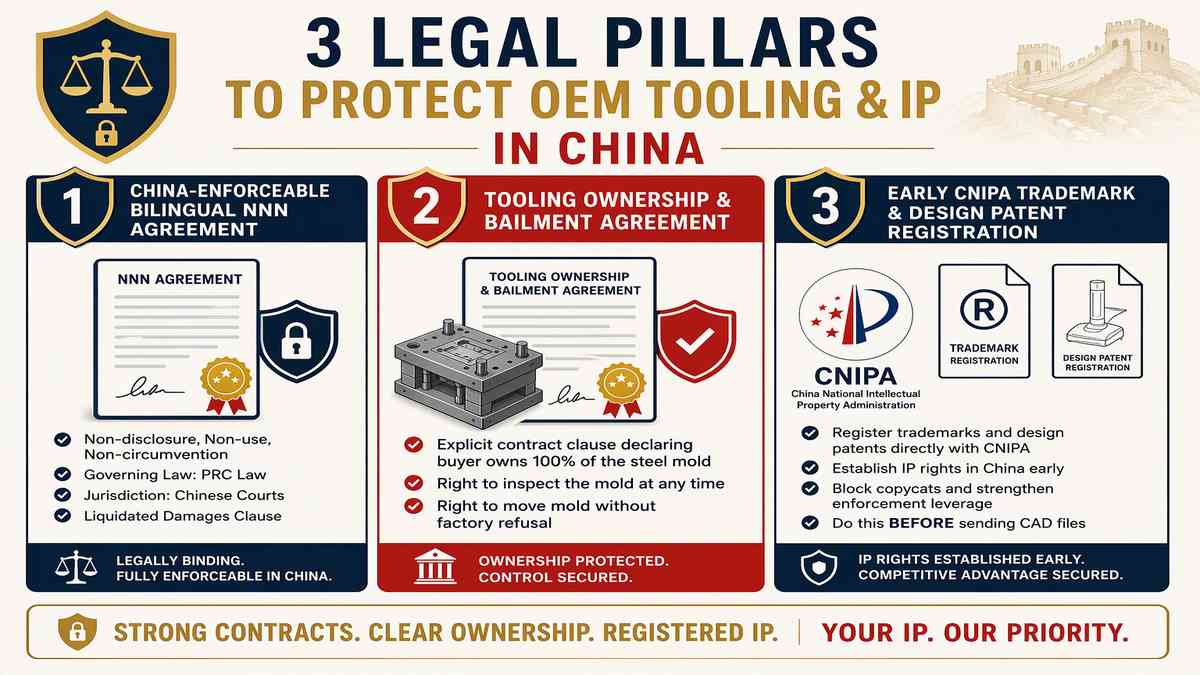
3 Legal Pillars to Protect OEM Tooling & IP in China
The biggest fear Western importers face with OEM manufacturing is that the Chinese supplier will steal the CAD files and sell identical units to other buyers. Build these three legal defenses:
5-Step SOP for Sourcing, Tooling & Inspecting OEM/ODM Products in China
Follow this end-to-end standard operating workflow to execute your custom manufacturing project with zero defects:
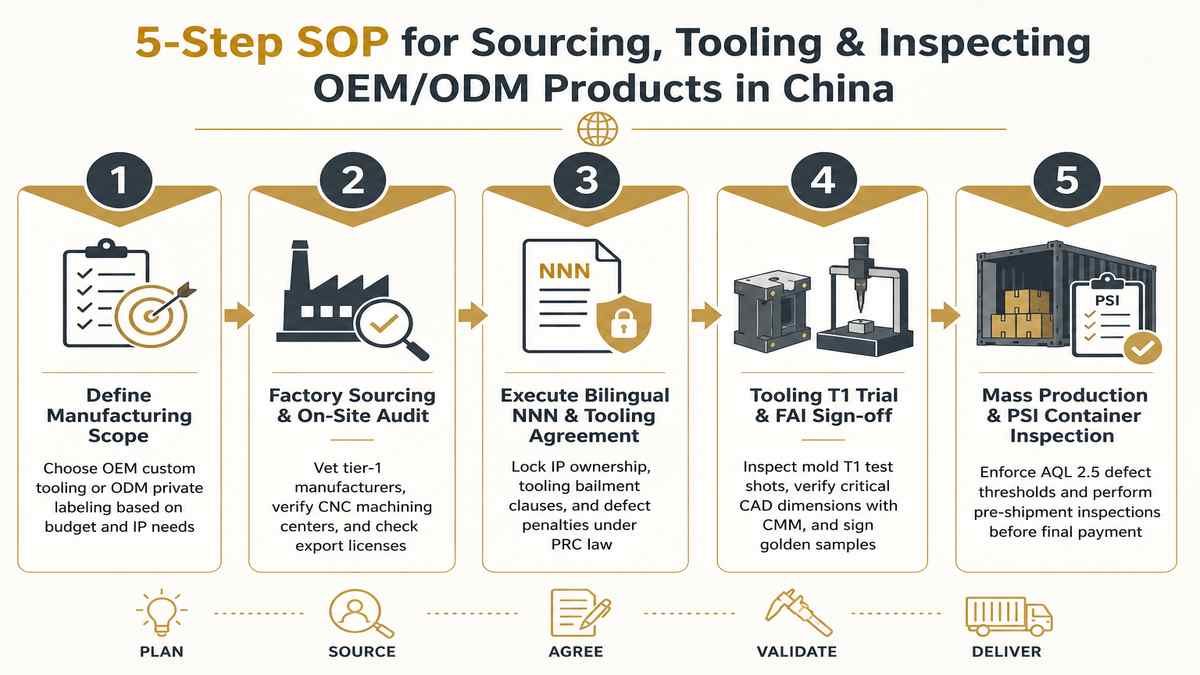
- Define Manufacturing Scope (OEM Custom vs. ODM Private Label): Evaluate your startup capital and engineering complexity to determine whether to start with an ODM open mold or invest in OEM custom tooling.
- Vet Factories & Perform On-Site Technical Audits: Audit bidding manufacturers on-site using a structured China factory audit checklist, checking CNC machinery, cleanroom assembly lines, and ISO9001 certified quality systems under ISO 9001 Quality Management Standards.
- Execute Bilingual NNN & Dedicated Tooling Agreements: Lock IP ownership, mold bailment rights, and pricing tiers into an enforceable bilingual sales contract under PRC law.
- Inspect Tooling T1 Trial Shots & Sign Off on FAI Golden Samples: When the steel mold is complete, order T1 test shots and conduct a comprehensive first article inspection (FAI) sample sign-off with digital calipers and CMM coordinate measuring machines to check CAD tolerances.
- Enforce 30/70 Trade Terms & Pre-Shipment Inspection (PSI): Structure payments under ICC Incoterms Rules (FOB Ningbo / FOB Shenzhen) with 30% deposit and 70% balance payable only after passing a formal pre-shipment inspection (PSI) in China under AQL 2.5 standards.
How to Prevent Factory “Mold Hostage” Extortion in China
A common disaster in OEM manufacturing occurs when a buyer attempts to move their custom mold to another supplier. Disgruntled factories frequently hold the steel mold hostage, demanding arbitrary “engineering fees” or “maintenance charges”:
Illustrative Scenario: How a Seattle Brand Scaled from ODM to OEM
To see how evolving from ODM to OEM builds massive corporate enterprise value, review this smart consumer hardware case study:
A smart pet technology startup in Seattle, Washington wanted to launch an automated cat feeder.
- Phase 1 (The ODM Launch): The founder initially launched using an existing factory ODM open mold (\$6,000 investment for 1,000 units with custom silk-screened logos). The product launched quickly and sold out in 60 days on Amazon. However, within 4 months, 12 other Amazon sellers launched the exact same plastic body from the same factory, driving prices down by 35% and wiping out profit margins.
- Phase 2 (The OEM Custom Tooling Pivot): Customer reviews complained that the ODM feeder frequently jammed with large kibble. The founder designed a proprietary anti-jam dual-rotor dispensing system and raised \$38,000 to build custom OEM injection molds.
- Phase 3 (Sourcing Pioneer Sourcing & Protection): Sourcing Pioneer helped the founder execute an enforceable bilingual NNN agreement, registered a design patent with CNIPA, audited a tier-1 electronics manufacturer in Shenzhen on-site, and inspected T1 sample shots with CMM equipment.
- The Commercial Outcome: The proprietary OEM feeder launched on Kickstarter raising \$320,000, became an Amazon Best Seller with a 4.8-star rating, and generated over \$1.8 million in annual revenue with zero counterfeit competition.
Frequently Asked Questions (FAQ)
What is the main difference between OEM and ODM manufacturing?
In OEM (Original Equipment Manufacturing), the buyer supplies proprietary 2D/3D CAD designs and owns 100% of the custom tooling and IP patents. In ODM (Original Design Manufacturing), the factory supplies an existing open-mold product, and the buyer simply adds their custom logo, color, and packaging.
What does OBM stand for in manufacturing?
OBM stands for Original Brand Manufacturer. In this business model, the factory develops, designs, produces, and markets products entirely under its own proprietary brand name (e.g., DJI or Anker) directly to retail consumers.
Who owns the injection mold in OEM manufacturing in China?
The buyer owns the mold legally if they paid for tooling and signed an explicit Tooling Ownership & Bailment Agreement under PRC law. Without a formal contract, Chinese factories may claim mold ownership and produce identical products for competing buyers.
Is it cheaper to start with ODM or OEM for a new brand?
ODM is significantly cheaper to launch ($2,000 to $5,000 upfront) with lower MOQs and 2 to 4 weeks turnaround. OEM requires heavy upfront capital ($20,000 to $100,000+ for steel tooling and engineering) and 6 to 9 months development, but builds long-term proprietary defensibility.
How can buyers prevent Chinese OEM factories from copying their product designs?
Buyers must execute a China-enforceable bilingual NNN agreement (Non-disclosure, Non-use, Non-circumvention) before sharing CAD files, register design patents directly with CNIPA (China National Intellectual Property Administration), and sign an explicit tooling ownership agreement.
Develop Proprietary OEM Products with 100% IP & Tooling Protection
Our China engineering and legal team conducts DFM reviews, audits OEM injection mold tooling, drafts enforceable bilingual tooling agreements under PRC law, and supervises pre-production FAI trials.
Get Free OEM & Tooling Sourcing Consultation
Questions & Comments
We read every one and reply within 24 hoursDeciding between OEM custom tooling and ODM private labeling, wondering about mold ownership agreements under Chinese law, or need on-site tooling inspection in China? Post your hardware and sourcing questions below — our on-the-ground manufacturing engineers will guide your product development.