
Plastic Pallet Sourcing Guide: Designs, Load Ratings and Sizes
 ·
Updated October 10, 2026
·
23 min read
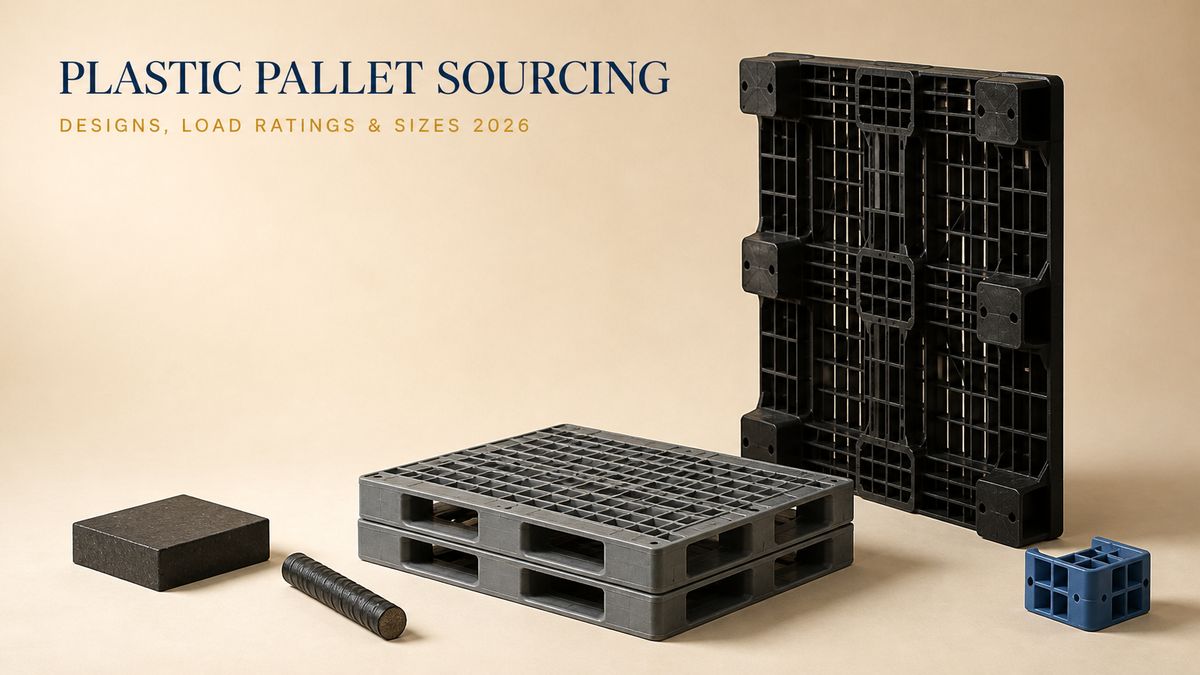
A plastic pallet is sold on one number — its load capacity — and that is the number buyers get wrong most often. The same pallet carries one weight sitting on a floor, a lower weight when it is lifted, and a much lower weight when it spans a rack without support underneath. Three figures, one pallet, and a quotation that gives a single weight has told you which number it chose rather than which number you need. This guide covers the four base designs, the three footprints that actually matter, how the load ratings really work, and where a cheap pallet quote is quietly reduced.
What to Specify, by How the Pallet Is Used
| If the pallet will | Specify this | Because |
|---|---|---|
| Sit on the floor under a stacked load, and be moved by pallet jack | A stackable or nestable design, and the dynamic load figure | The pallet is supported underneath whenever it carries weight, so the floor-contact rating is the one that applies. This is the cheapest duty and the one most cheap pallets are actually built for. |
| Span a warehouse rack with nothing underneath the middle | A rackable design, and the racked load figure, taken at the rail spacing you use | A pallet in a rack is a bridge, not a platform. The rating drops sharply the wider the rails are set, which is why the racked figure has to be quoted together with the rack's beam spacing rather than on its own. |
| Go into a truck, a container or a forklift repeatedly | Impact resistance, and the dynamic load figure — plus the base design that fits your fork entry | Each lift is a shock rather than a slow load. Fork entry has to suit both the pallet and the truck, and a pallet that only fits a two-way entry when your forklift approaches from the side is the wrong pallet. |
| Carry food, pharmaceuticals or anything unpacked | The resin the pallet is moulded from, and a statement about the additives in it | The food-contact question is about the polymer and what has been added to it, not about the colour of the pallet. A blue pallet is not a food-grade pallet; it is a blue pallet. |
| Be stored outside or washed down | The resin, the UV stabiliser, and whether the design drains | Plastic does not rot, but it does become brittle under sunlight and it does hold water in a closed deck. Both are material and design choices rather than afterthoughts. |
| Replace timber for hygiene or export reasons | The footprint your racking, truck and existing timber pallets already use | Switching material without keeping the footprint breaks everything the pallet touches. The size is the constraint, not the material, and it is the first thing to fix in an enquiry. |
1. What Are the Four Base Designs, and Which Did You Actually Order?
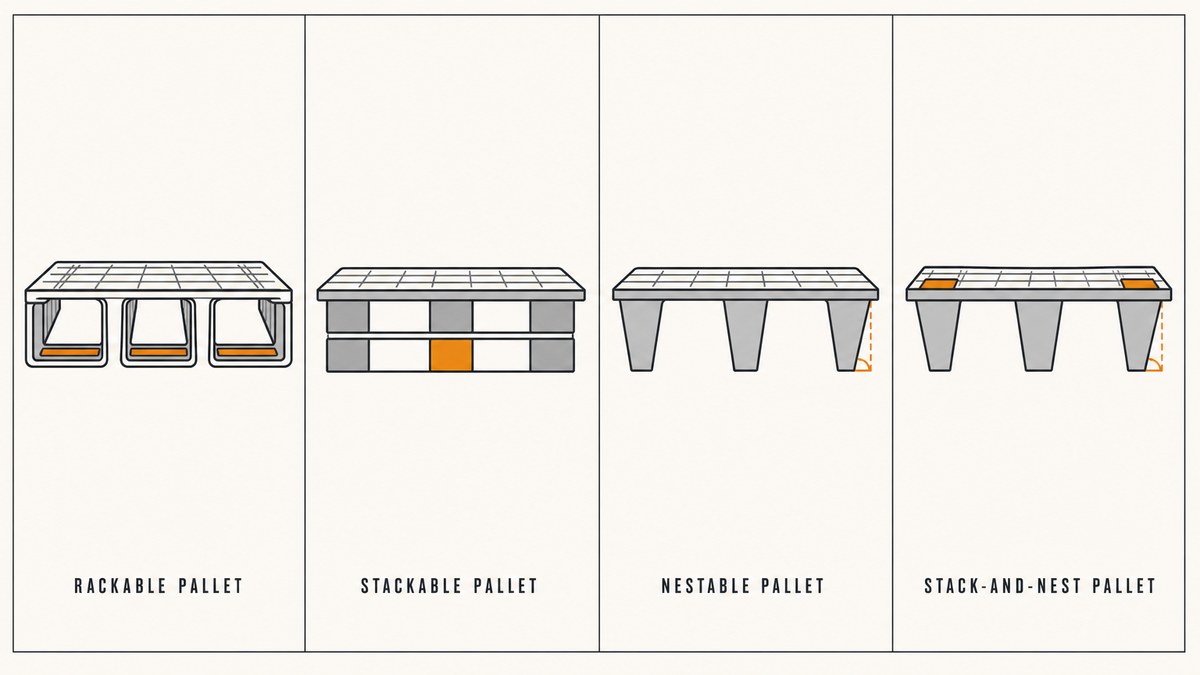
The base is the underside of the pallet, and it decides how pallets behave when they are not carrying anything. Four designs cover almost everything sold, and two of them are routinely confused because both get described as "stackable" on a supplier's website.
| Base design | How it behaves when empty | Where it belongs |
|---|---|---|
| Rackable | Rigid, with reinforcing runners or rods running underneath so the deck resists bending. Empty pallets sit on top of each other and take the full height of a stack. | Anywhere the pallet goes onto a rack. This is the design with a meaningful racked load rating, and it is the design that costs more because of the extra material and the reinforcement. If a supplier quotes a racked figure for a pallet without runners, ask where the stiffness comes from. |
| Stackable | Rigid, sits flat on the pallet below. Blocks or a solid base carry the load down to the floor. | Floor stacking and truck loading, where nothing has to span a gap. Cheaper than rackable for the same footprint because there is less material in the base — and it will sag if you put it in a rack anyway, which is the single most expensive mistake in this category. |
| Nestable | Legs are tapered, so empty pallets drop into each other and a stack of twenty takes the height of a few. | Where the empty pallet movement is the real cost: returnable loops, closed distribution, anywhere pallets come back and have to be stored or trucked empty. The trade is that a nestable pallet cannot be stacked with a load on it, because the tapered legs do not give a flat top face. |
| Stack and nest | Runs one way to stack and ninety degrees the other way to nest, so the same pallet does both depending on how it is turned. | Operations that need both behaviours but cannot afford two pallet types. It is the most flexible design and the one that most often gets specified wrongly, because the nesting direction has to be written into the handling instruction or warehouse staff will not use it. |
One practical consequence follows from this table. If a supplier's page offers "stackable plastic pallets" with no further word, you cannot tell whether you are looking at a stackable or a nestable design, and the two are not interchangeable in use. Ask for the base in the same words this table uses, and ask for a side-view drawing, because the drawing settles it in five seconds.
2. Which Size Does Your Racking and Your Truck Need?
Three footprints cover most of the world's pallet traffic, and choosing the wrong one breaks the racking, the truck plan and every carton built around it. The size is not a preference — it is a constraint inherited from everything the pallet has to touch.
| Footprint | Where it dominates | What to check before ordering |
|---|---|---|
| 1200 × 800 mm | The European standard footprint, and the one most European racking, trucks and retail distribution systems are built around. | Whether your racking beams are set for this footprint. Because it is narrower than the alternatives, a rack designed for it wastes depth if you later switch, and a rack designed for a wider pallet may not support it properly across the beams. |
| 1200 × 1000 mm | The industrial and UK-standard footprint, common in manufacturing, chemicals and heavier distribution. | The direction the pallet is loaded. A non-square pallet has a long side and a short side, and it only enters a rack or a truck the right way round. Fork entry and racking orientation both follow from that. |
| 48 × 40 in (about 1219 × 1016 mm) | The North American grocery and general-distribution footprint, and what most existing timber pallets in that market already are. | Whether you are matching existing timber pallets. If the plastic pallet is meant to run on the same racking and trucks as timber pallets already in the system, the footprint has to match them, and an approximate match is a mismatch once the pallet meets an automatic conveyor. |
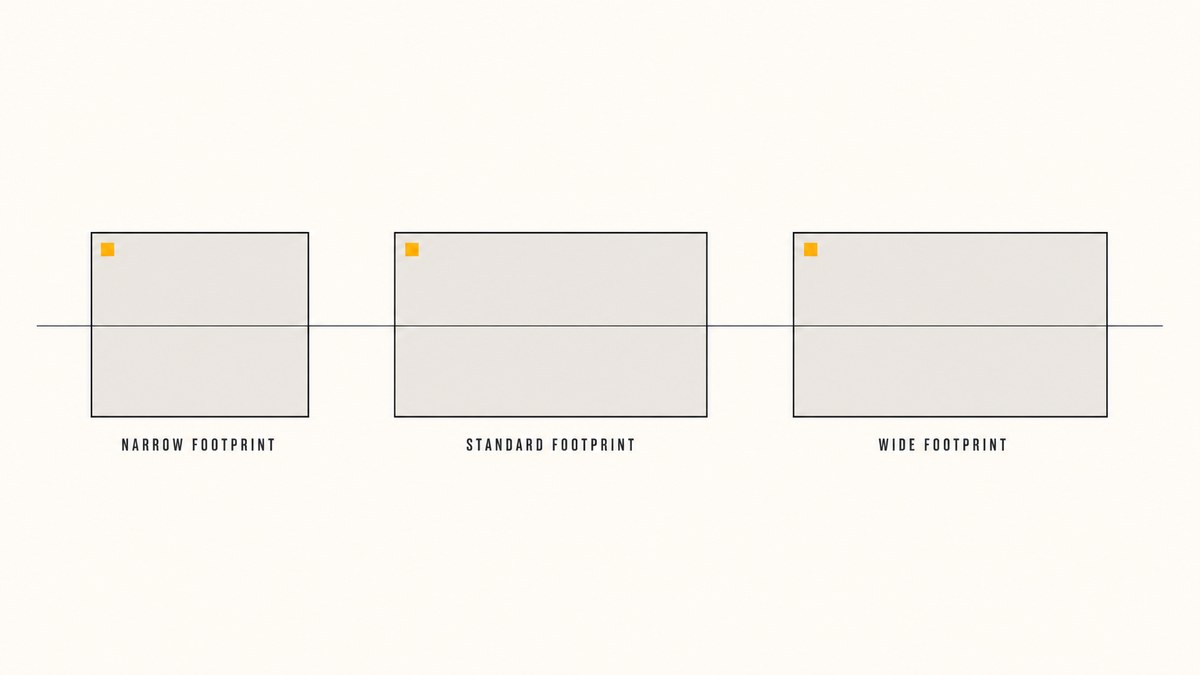
Two details on the footprint cause most of the returns in this category. The first is height: the overall height of a pallet varies between designs and between suppliers, and once you stack pallets or load a container, a few millimetres per pallet becomes a shipping problem rather than a cosmetic one. Ask for the overall height as a figure, and remember it can change when the pallet is loaded. The second is fork entry: a pallet may offer two-way or four-way entry, and a four-way pallet that is not reinforced in the direction your forklift approaches can be damaged in normal use. Draw the approach direction on the enquiry rather than describing it.
If your operation already runs timber, the switch is easier than it looks — the constraint is the footprint and the entry, not the material. Our guide to palletizing and load-unit standards for ocean freight covers the loading side, and it is worth reading before you fix the pallet size rather than after.
3. Why Does One Plastic Pallet Have Three Different Load Ratings?
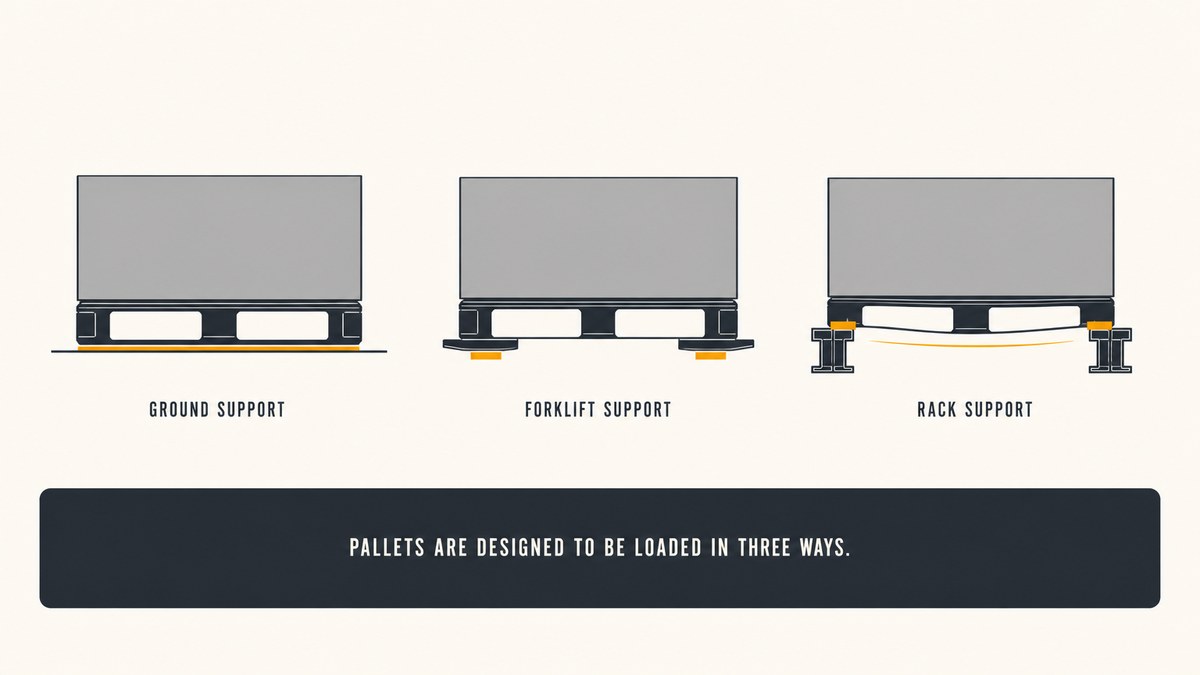
Because a pallet is loaded in three physically different ways, and the number on a datasheet is whichever one the supplier chose to print. Sitting on a floor, the load is spread over the whole base. Being lifted, the load concentrates at the forks and gains the shock of every movement. Spanning a rack, the pallet becomes a bridge and the middle is unsupported. The same pallet can carry more than twice as much in the first case as in the third.
| Rating on the datasheet | What it describes | What happens if you use the wrong one |
|---|---|---|
| Static | The load a pallet carries standing on the floor, evenly supported underneath, not moving. | Nothing — until the moment the pallet is lifted. This is the largest of the three figures and therefore the most attractive one to print, which is why it should make you ask what the other two are. |
| Dynamic | The load it carries while being lifted and moved, forks underneath and the load moving with it. | This is the figure that belongs on a quotation for a pallet that goes on and off trucks and racks all day. A pallet chosen on the static figure and used dynamically will deform at the base, and the deck will stop sitting flat. |
| Racked | The load it carries spanning two rack rails, with the middle unsupported and the load resting for a long time. | The most expensive failure in this category: a pallet that sags into the rack bay. It is also the figure that is meaningless on its own, because it depends on how far apart the rails are set. A racked rating quoted without a rail spacing is half a specification. |
Two practical asks follow. On the enquiry, request all three figures and the rail spacing the racked figure was measured at. On the first delivery, load one pallet exactly as the worst case in your operation — heaviest product, longest storage, your rail spacing — and inspect the underside of the deck afterwards. A pallet that survives a week in your own rack has told you more than any certificate, and it costs one pallet rather than a shipment.
4. Plastic Versus Wooden Pallets: Which One Actually Costs Less?
Wooden pallets win on the price of one pallet and lose on almost everything that follows. Plastic pallets cost more per unit and repay it over a life of many trips, so the comparison only makes sense as cost per trip rather than cost per pallet — and the answer changes with how many trips you actually get.
| What you are comparing | Wooden | Plastic |
|---|---|---|
| Price of the first pallet | Much lower. Timber is cheap, and used pallets are traded in volume. | Several times higher per unit, because the pallet is a moulded part made on a large press. |
| How many trips it survives | Short, and variable, because boards split and blocks work loose. Repairable, which stretches the life. | Long and predictable, because a moulded part does not come apart the same way. Not really repairable, so the end of life is an end rather than a repair. |
| Export and treatment | Export packaging made of wood has to be heat treated or fumigated to the international plant-health rule that governs solid-wood packing material, and the treatment has to be marked and evidenced. | Not wood, so the treatment rule does not apply to the pallet itself. For export programmes this is often the single reason plastic gets chosen. |
| Hygiene and damage to goods | Splinters, nails and loose boards damage bags and cartons, and wet timber holds moisture against the load. | Smooth and washable, with no fixings to work loose. This is why food and pharmaceutical lines move to plastic first. |
| Weight | Heavier for the same size, which costs money on every air or parcel movement and on manual handling. | Lighter, so it carries a small freight benefit on every trip as well as being easier for staff to move. |
| What is left at the end | Firewood, repair stock, or a small scrap value. | Regrind value, and a used-pallet market. A plastic pallet that is still serviceable has resale value, which is a line most buyers leave out of the comparison. |
The honest answer is that the comparison is decided by the number of trips, and the number of trips is decided by whether you control the pallet. In a closed loop, where pallets come back to you and get reused, plastic wins on arithmetic within a modest number of trips. In a one-way flow, where pallets leave with the goods and are never seen again, the cheaper pallet wins and plastic is hard to justify on cost alone — it has to be justified on hygiene, export treatment or product protection instead. Ask yourself which of those two operations you are running before comparing prices at all, because the two operations have different answers and neither supplier will tell you which one you are in.
5. What Are Plastic Pallets Made Of, and When Does "Food Grade" Matter?
Most plastic pallets are moulded from high-density polyethylene, with polypropylene used where stiffness matters more than impact resistance. That part is simple. What is not simple is the difference between a pallet that is blue and a pallet that is genuinely suitable for contact with food, and suppliers use the colour to answer a question about chemistry.
The food-contact question is about the polymer and everything added to it. In the United States, the rule that governs plastic articles intended to touch food is a permitted list of olefin polymers with composition limits attached to each entry: 21 CFR 177.1520, olefin polymers sets out what polyethylene and polypropylene are for this purpose, and the proportions of the monomers and modifiers they may contain. That is why a colour is not an answer. A pallet is suitable because the resin is on the permitted list and the colourants, release agents and any regrind content are accounted for — not because it was moulded in white or blue.
First: what resin grade is this pallet moulded from, and does that grade carry a food-contact statement? Second: what percentage of the material is regrind, and is the regrind from your own closed loop or bought in? A moulder answers both with a grade and a figure, because both are inputs it buys and records. A reseller answers with the pallet's colour and the word "food grade". Regrind is not a dirty word — it is entirely normal in general-purpose pallets and it reduces cost and waste — but it has to be declared, because the question is what went into it. Regrind from an unknown source is the one thing that turns a pallet that was fine into an unknown one, and no colour test will find it.
6. Where Do Plastic Pallets Come From, and Who Is a Real Manufacturer?
A plastic pallet is made on a very large press, and that single fact separates the real manufacturers from everyone else. A pallet mould is a big steel tool that has to be mounted in a machine with enough clamping force to fill it, and the capital cost of one pallet design is measured in tens of thousands rather than hundreds. That has two consequences a buyer should plan around.
| Consequence | What it means for your order |
|---|---|
| Designs are catalogue items rather than bespoke | Because a new tool is a serious investment, most manufacturers run a fixed family of pallet designs and offer the customer the variables that do not need a new tool: the resin, the colour, the marking, sometimes the reinforcement set and the deck surface. If a supplier offers unlimited custom geometry at a modest price, the geometry is coming from a catalogue the price does not reflect. |
| The press size is a fact a manufacturer knows | Ask what tonnage machine the pallet is moulded on and how many pallet moulds the factory runs. A moulder answers immediately, because the press is the constraint it plans production around. A trading company answers with the pallet's dimensions — it has never seen the machine, and it cannot tell you whether the press is big enough for the pallet it is quoting. |
| Minimum order quantities are set by the press | A press that makes four pallets per cycle needs a run long enough to be worth setting up, so low order quantities are absorbed by running an existing design rather than by making a small batch specially. If you need a small quantity of an unusual variant, expect to wait for it to be scheduled alongside other work. |
The practical test is the same one that works on machined parts and on everything else in this category: ask a question only the maker can answer. On a pallet, the two best questions are the press tonnage and the resin grade. Our guide to telling a factory from a trading company sets out the same method for general products, and beyond the pallet itself, how to get a product manufactured in China covers what a moulding project looks like when the tool is yours rather than a catalogue item.
7. What Does the Specification Sheet Need Before You Order?
Fourteen lines, and a pallet enquiry that answers all of them can be quoted and compared without a second round of emails. The first five are constraints you already have; the rest are the choices that decide the price.
| Field | Example of what to write | What it changes |
|---|---|---|
| Footprint, in millimetres and in inches | 1200 × 1000 mm, or 48 × 40 in | The constraint everything else inherits from the racking, the truck and any existing pallet fleet. Write both units so a factory working in the other system cannot misread it. |
| Overall height | The height of the pallet itself, unloaded | Sets how many fit in a container and how many stack in your warehouse. A few millimetres per pallet becomes a whole layer across a shipment. |
| Base design | Rackable, stackable, nestable or stack-and-nest | Decides whether the pallet can go in a rack at all, and how empty pallets are stored and returned. This is the line most often left off, and the one most expensive to get wrong. |
| Fork entry | Two-way or four-way, with the approach direction drawn | Two-way entry from the wrong side damages the pallet in normal use. A drawing takes a minute and removes the question. |
| Deck type | Closed deck, open deck, or a specific surface | Open decks drain and are lighter; closed decks protect small or unstable loads and are easier to wash. It also changes the weight and therefore the freight. |
| Resin and grade | High-density polyethylene, with the grade named | The main material cost line. Grade decides stiffness and impact behaviour, and it is the first thing a cheaper quotation changes without saying so. |
| Regrind content | A percentage, and whether it is closed-loop or bought in | Reduces cost and is normal in general use; not acceptable undeclared where food contact is claimed. A figure here tells you whether the supplier knows its own material. |
| Colour and whether it is a requirement | Black, blue, grey, or a specific colour for your own loop | Colour is mostly a logistics tool for identifying ownership. Say whether it is a requirement or a preference, or you will pay tooling-like setup for nothing. |
| Load requirements, all three figures | Static, dynamic and racked, with the rail spacing the racked figure applies to | The three ratings only mean something together. A racked figure without a rail spacing cannot be compared between suppliers. |
| Reinforcement | Steel rods, reinforcing profiles, or none | What makes a racked rating possible. Ask whether the reinforcement is moulded in or inserted afterwards, because an inserted rod can work loose. |
| Marking | Your logo, a serial, or a moulded-in ownership mark | Moulded-in marking lasts as long as the pallet; a printed or stuck label does not. For a returnable loop, the mark is how pallets come home. |
| Load unit and how it will be handled | The product, its weight, whether it is strapped or shrink-wrapped, and the equipment used | Explains the real duty, which is how a supplier decides whether the load figures you gave are achievable or optimistic. |
| Test required, and on how many units | A load test at the working figure, on a stated number of pallets from the production run | Converts the ratings into something measured on the goods you receive. Our pre-shipment inspection guide covers how to write the brief, and the AQL sampling tables cover how many to pull. |
| Rounding and packing for shipment | Nested, stacked, or banded in a stated quantity per bundle | Pallet packing is the largest lever on freight in this category. Nested pallets of a nestable design occupy a fraction of the volume of stacked ones, and that difference shows up in the landed cost rather than the unit price. |
The five-step order, in sequence
- Measure the constraint before choosing the pallet. The racking beam spacing, the truck or container interior, and the footprint of any pallet you already run. These four measurements decide the size and the base design, and no supplier can do this part for you.
- Write the three load figures with the rail spacing. Static, dynamic and racked, with the spacing the racked figure applies to. If a supplier can only give one, that is information about the supplier.
- Ask the two questions only a moulder can answer. Press tonnage and resin grade. Both are the factory's own inputs, and both are things a trading company cannot restate.
- Send the fourteen lines, and ask for the packing method. Nested or stacked is a freight decision as much as a warehouse decision, and it should be quoted rather than chosen later.
- Load one pallet to your worst case before accepting the batch. Heaviest product, your rail spacing, a realistic storage period — then inspect the underside. It is the only test that uses your operation as the variable.
8. What Drives the Price, and What Hides in a Cheap Quote?
The unit price of a plastic pallet is set by how much material is in it and which grade that material is, so every meaningful cost reduction is a reduction in material or in grade. That is the whole logic of comparing pallet quotations: two prices for the same footprint are almost always two different amounts of plastic, or two different resins wearing the same product name.
| What moves the price | How to see it in the quotation |
|---|---|
| Weight of the pallet | The most honest single indicator. Ask for the pallet weight as a figure and compare it between quotations for the same footprint: a lighter pallet at a lower price is usually less material rather than a smarter design. |
| Resin grade | Named or unnamed. "HDPE" alone is not a grade, and the difference between a general-purpose grade and one chosen for impact at low temperature is a real cost that does not appear in a specification line unless you put it there. |
| Regrind percentage | A figure, or silence. Undeclared regrind is the most common way a pallet quotation comes down, and it is legitimate in general use provided the figure is on the paper and the source is known. |
| Reinforcement | Steel rods or profiles, stated as part of the design. A pallet that claims a racked rating without reinforcement is either a very heavy moulding or an optimistic datasheet. |
| Packing method | Nested, stacked or banded. This is where a cheap unit price becomes an expensive shipment: stacked pallets consume container volume that nested ones do not. |
| Everything between the factory and your door | The unit price is the smallest part of the landed figure. Our walkthrough of landed cost from unit price to delivery covers the lines in between, and pallets add an unusual one: because they are bulky rather than heavy, freight is driven by volume, so the packing method can matter more than the price. |
9. What Are the Common Failures, and What Does Each Tell You?
Plastic pallets fail in four recognisable ways, and the timing of the failure usually says more than the failure itself. A pallet that fails in the first month was the wrong specification; a pallet that fails after two years in a rack has told you the racked figure was optimistic.
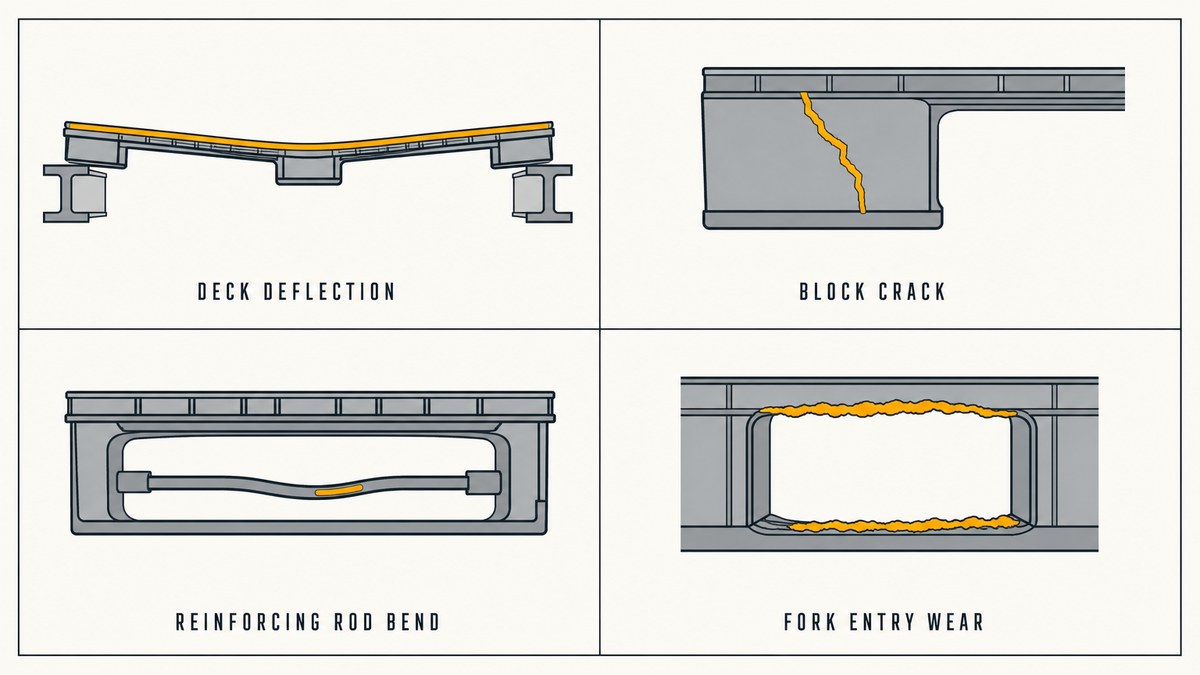
- The deck sags in the rack, and stays sagged
- The racked load figure was exceeded, or the rails are further apart than the figure assumed. Plastic creeps under a long load, so the sag appears gradually and then does not recover — which is why a racked rating has to be quoted with a rail spacing and why a trial pallet in your own rack is worth more than a datasheet. This is the failure that a lighter pallet produces first, because stiffness in bending is mostly about how much material is resisting it.
- A block or a runner cracks at the base
- Impact rather than load. The pallet is being dropped, or the forks are going in at speed and hitting the base rather than the entry. It tells you about handling and about the resin grade's behaviour at your operating temperature, since a grade that is fine in a warm warehouse can be brittle in a cold one.
- A reinforcing rod works loose, or bends and stays bent
- Either the reinforcement is inserted after moulding rather than moulded in, or the pallet has been overloaded past the point the rod can resist. Ask how the reinforcement is fixed into the pallet, because that answer predicts whether this happens at all.
- The fork entry is chewed up while the deck is fine
- The entry direction or the fork height is wrong for the equipment, not the pallet. A four-way pallet approached from an un-reinforced direction will always suffer here, and it is worth walking the route your equipment actually takes rather than the one the rack layout assumes.
One habit is worth building in, and it costs nothing. Number or mark your trial pallets, keep a note of when each went into service, and check them against a new one every few months. A pallet that has sagged, or a base that has cracked, is a specification input for the next order — and a pallet that has done three years without changing tells you the specification was right and you can buy the same one again with confidence. The same logic applies to the industrial parts that ride on pallets as much as to the pallet itself; a specification that names the shape and leaves out the duty is how industrial conveyor belting fails too, for exactly the same reason.
10. Frequently Asked Questions
What is the load capacity of a plastic pallet?
There is no single answer, because a plastic pallet carries three different loads and the highest number is the one usually quoted. Standing on a floor with the whole base supported, it carries the most. Being lifted by a forklift or pallet jack, it carries noticeably less, because the load concentrates at the forks and gains the shock of movement. Spanning two rack rails with nothing underneath the middle, it carries the least by a wide margin. So the useful question is not "what is its capacity" but "which capacity, and under what conditions" — ask for all three figures, and for the rack rail spacing that the racked figure applies to.
Plastic or wooden pallets — which should I use?
It depends on whether you get the pallet back. In a closed loop, where pallets return and are reused many times, plastic usually wins on cost per trip despite costing several times more per unit, and it also removes the export treatment requirement that applies to solid-wood packing. In a one-way flow, where pallets leave with the goods and are never seen again, the cheaper timber pallet wins on arithmetic and plastic has to be justified on hygiene, product protection or export rules instead. Plenty of operations run both: plastic in the internal loop, timber for one-way despatch. Decide which operation you are running before comparing prices, because the two have different answers.
What size are plastic pallets made in?
Three footprints cover most of the trade: 1200 × 800 mm, which is the European standard and what most European racking and trucks are built around; 1200 × 1000 mm, the industrial and UK standard; and 48 × 40 inches, which is the North American grocery and general-distribution footprint and matches most existing timber pallets in that market. Manufacturers usually offer these as catalogue sizes rather than making a new mould for a new size, so a footprint outside the common ones is a tooling conversation rather than an order. Start from the racking and truck you already have, not from the pallet.
How do I know if a plastic pallet is food grade?
By the resin and its additives rather than by its colour. A pallet is suitable for food contact when the polymer it is moulded from is on the permitted list for food-contact use and everything added to it — colourants, release agents, any regrind — is accounted for. In the United States the permitted list for these polymers sits in the food-contact rules for olefin polymers, which set composition limits for polyethylene and polypropylene. So ask the moulder what resin grade the pallet is made from, whether that grade carries a food-contact statement, and what percentage of regrind is in it and where that regrind came from. A supplier who answers with the pallet's colour has answered a different question.
How much does a plastic pallet cost?
The honest answer is that the price follows the weight and the resin, so the useful number to compare is the pallet weight rather than the headline price. Two quotations for the same footprint in the same material by name are almost always two different amounts of plastic — the lighter pallet has less material in it, which is why it is cheaper, and that is not automatically the wrong choice but it should be a choice. Ask for the weight, the resin grade and the regrind percentage as required lines on the quotation, then compare. Also compare the packing method, because pallets are bulky and freight is priced on volume, so nested pallets can land cheaper than a lower-priced stacked quotation.
What should I check when the pallets arrive?
Three things, in this order. Weigh a sample pallet and compare it with the quoted weight, which catches a change in material before you put a load on it. Measure the footprint and the overall height, because a small dimensional change compounds once pallets stack or a container is loaded. Then load one pallet to your worst case — heaviest product, your rack rail spacing, a realistic storage period — and inspect the underside of the deck afterwards, looking for sagging or stress marks at the base. That last test uses your operation as the variable, which is the one thing a laboratory figure cannot do, and it is the reason the test standard itself notes that load testing does not replace field testing on a specific pallet design.
Get the Base Design and All Three Load Figures Written Down Before You Order
We write the fourteen-line specification so quotations can be compared on weight and resin rather than on price alone, ask the press tonnage and grade questions that separate a moulder from a reseller, get the rail spacing attached to the racked figure, and confirm the packing method because it decides the freight more than the unit price does.
Request a Plastic Pallet Sourcing Quote
Questions & Comments
We read every one and reply within 24 hoursIf a supplier has given you a single load figure for a pallet, paste it here with the footprint and we will tell you which of the three ratings it is. If you already run plastic pallets in a rack and something has sagged or cracked, describe what happened and how long it took, because the timing usually says whether the pallet was under-specified or the rack was wider than the figure assumed.