
Print on Demand vs Dropshipping: What You Actually Own
 ·
Updated October 14, 2026
·
16 min read
The comparison is usually framed as a choice between two ways of selling without holding stock, and that framing is why the articles written about it are so unhelpful. Both models do avoid inventory, and having established that, they differ in almost every other respect. The one that matters most is rarely mentioned on either side of the argument: print on demand sells a design you created, printed onto blanks somebody else owns, while dropshipping sells a product that already existed before you arrived. One of those is an asset and the other is an opportunity, and confusing them is how people spend a year doing the wrong one properly. This guide sets out what each model actually owns, what is fixed and what can be negotiated, and where the two connect.
What Differs Once You Stop at "Neither Holds Stock"
| Print on demand | Dropshipping | |
|---|---|---|
| What you own | A design file | The customer relationship and the listing |
| The unit cost | Published and identical for every seller | Negotiable, which is the sourcing job |
| Catalogue limit | Whatever the platform's blanks cover | Anything, if you can find and check a supplier |
| Cost before first sale | Nothing beyond your own time | Usually a sample, plus the agent's work |
| Who fixes a bad print | The platform | You, against the supplier |
| What scales | The number of designs | The size of the order |
What this guide covers
1. What Does Each Model Actually Own?
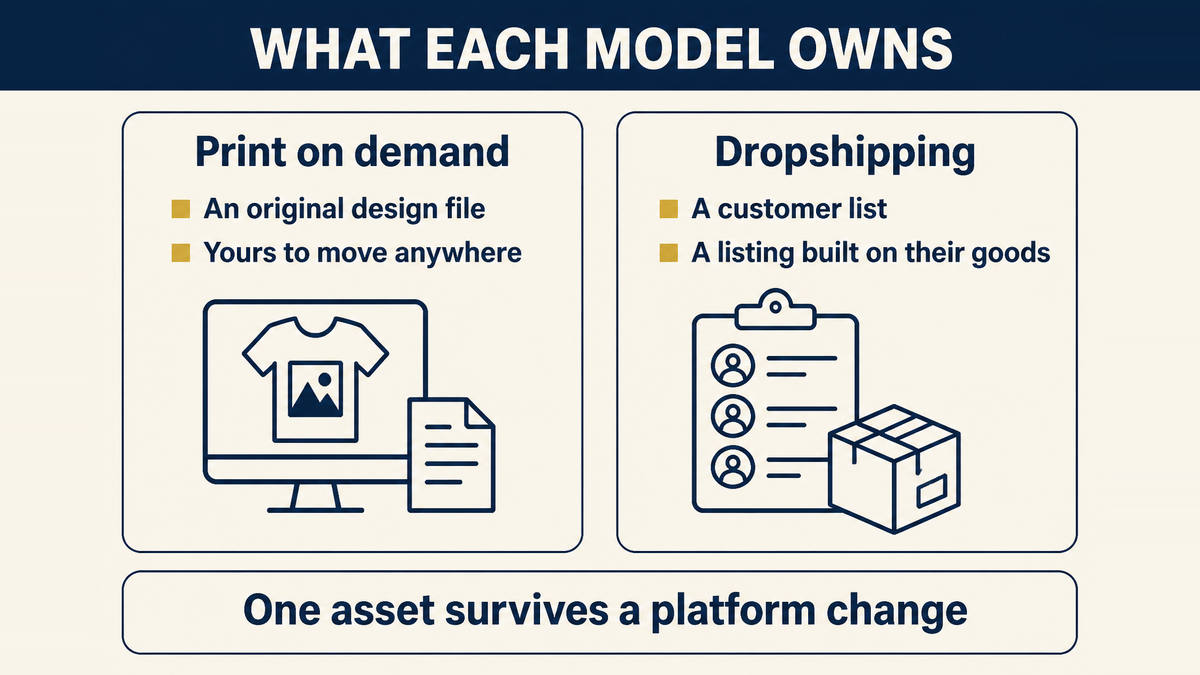
A design in one case and nothing you can hold in the other. That is the difference that decides everything downstream, because it determines what survives if the platform changes its terms, and what you can take elsewhere.
In print on demand the product is a blank that somebody else buys, stores, prints and ships, and the thing you bring to the transaction is the artwork. When that artwork is an original work you made, it is an asset in the ordinary sense: it exists independently of the platform, it can be moved to a different platform, and it can be printed onto goods you buy yourself once the volume justifies it. When it is not yours, nothing in the arrangement belongs to you at all, and that is the first place the model goes wrong. It is worth being precise about what makes a design yours, because the two relevant rights work differently and people conflate them.
Copyright, a form of intellectual property law, protects original works of authorship including literary, dramatic, musical, and artistic works … Copyright does not protect facts, ideas, systems, or methods of operation, although it may protect the way these things are expressed.
U.S. Copyright Office, What Does Copyright Protect? (read 14 October 2026)
A trademark can be any word, phrase, symbol, design, or a combination of these things that identifies your goods or services. It's how customers recognize you in the marketplace and distinguish you from your competitors.
USPTO, What is a trademark? (read 14 October 2026)
Read the two together and a practical split appears that most sellers never notice. Copyright protects the way something is expressed rather than the idea behind it, so the drawing of a cat is protectable while the concept of a cat is not. A trademark is different in kind: it identifies where goods come from, which means a short phrase can be a trademark even where copyright would protect nothing, and printing somebody's mark on a product is a different problem from copying their picture. For a print on demand seller the consequence is concrete. Original artwork is an asset you can rely on, a slogan lifted from somewhere is not, and a design that copies a brand's identifying mark fails for a reason that has nothing to do with whether the drawing was your own.
In dropshipping the position is the reverse and it is worth stating without euphemism. You do not own the product, the supplier does; you do not own the design, the brand does; and what you hold is the customer relationship and the listing that brought them. That is a real asset and it can be valuable, but it is a different kind of asset, and it behaves differently when things go wrong. A supplier who stops supplying leaves you with a customer list and no product. A designer who stops designing leaves a print on demand seller with a catalogue that still sells, because the artwork does not expire.
Our guide to putting your own brand and design onto a product covers the point at which the design becomes something a factory can produce, and it is the natural next step once a design has proved it sells. Our notes on the methods available for applying artwork to a product are the practical companion, because the method decides what the design has to be built as rather than simply what it has to look like.
2. What Is Fixed, and What Can You Negotiate?
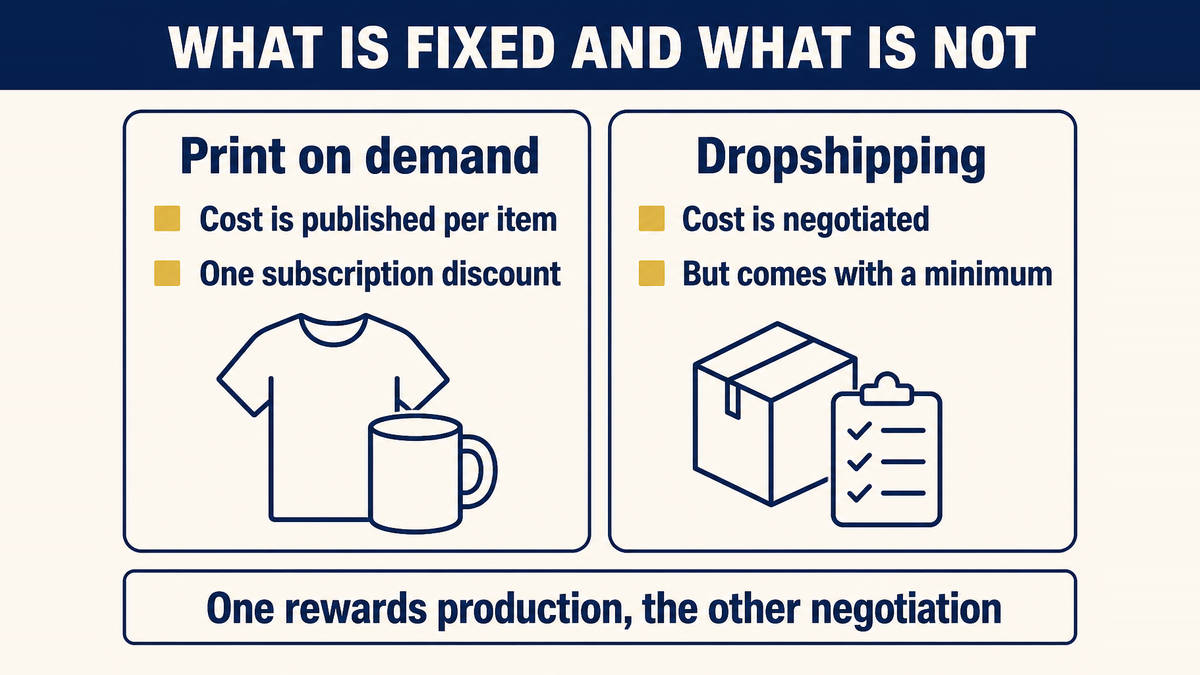
In print on demand almost nothing is negotiable, and in dropshipping almost everything is. This is the clearest practical difference between the two, and it explains why they attract different kinds of people: one rewards production and the other rewards negotiation.
The platform publishes a production cost per product and charges it to everyone at the same rate, which means a seller cannot improve their margin by becoming a better buyer. There is exactly one lever, and the platform describes it plainly: a subscription that reduces the cost of production.
2,000+ products, 70+ Print Providers, and no upfront costs. Start free and upgrade only when the discounts outearn the fee. … Free $0/month … 5 stores per account … Unlimited product designs … Premium From $39/month
Profit calculator — Fulfillment cost*: $8.77 — Sell it for: $35 — Daily sales: 1 — Your monthly earnings: $813.13 … *The production cost includes the fulfillment price of one item with one print. It doesn't include shipping fees, taxes, and other possible storefront expenses.
With Printify Premium, sellers save up to 20 percent on production costs
Printify, published pricing and profit calculator (read 14 October 2026)
The worked example in that quote is more useful than any general statement about margin, because it shows the shape of the business. A printed item with a published production cost of eight dollars and seventy-seven cents is sold for thirty-five, and the difference has to cover shipping, tax, advertising and the platform's share before it becomes anything. The production cost is the same for every seller of that product, so the only ways to improve the outcome are to charge more, to sell more, or to pay the subscription and buy the discount. None of them involves becoming a better buyer, because buying is not part of the job.
Dropshipping inverts this. The unit cost is whatever you can agree with a supplier, which means it improves with skill, volume and patience, and it is the reason sourcing is a profession rather than a task. What it costs you is time and a different kind of inflexibility: most suppliers have a minimum order quantity and a production or handling time, so the freedom to negotiate is paired with a commitment to buy a certain amount and to wait. Our breakdown of how a quoted unit price becomes a landed cost is where that negotiation is actually won or lost, because a headline price that looks lower frequently is not once the extras are counted.
There is a second fixed-versus-negotiable difference that matters more than it first appears, and it concerns who carries the cost of being wrong. In print on demand the platform prints the item, so a misprint, a wrong size or a damaged blank is theirs to replace, and the seller's exposure is the customer conversation rather than the goods. In dropshipping the supplier makes the item, and a problem with it is a problem between you and the supplier while the customer waits. Our guide to what a pre-shipment inspection covers exists precisely because that exposure is real, and it is a cost that a print on demand seller never incurs.
3. What Limits the Catalogue in Each?
The platform's blank range in one case, your own capacity to find and check suppliers in the other. Neither limit is better; they fail in different ways and at different moments, and knowing which one you are living with is more useful than knowing which is larger.
Print on demand constrains you to the products the platform has blanks for. The figure published by Printify is over two thousand products across more than seventy print providers, which is a large catalogue and still a closed one: your design can go on anything in that range and on nothing outside it. The failure mode is therefore a design that would work beautifully on a product nobody offers, which is not a rare situation and cannot be solved by working harder. The compensating advantage is that everything in the range is already tested, priced and known to ship, so the discovery work has been done for you.
Dropshipping constrains you by your own labour instead. There is no catalogue limit in principle, which sounds like freedom and functions as work: every new product means finding a supplier, checking whether they are a factory or a reseller, agreeing a price, ordering a sample and confirming the item is what it was described as. Our notes on the things suppliers say that need checking describe what that check actually involves, and the reason it is worth doing carefully is that the catalogue's openness is also its risk. A print on demand seller cannot list a product that does not exist; a dropshipping seller can, and finds out when the order arrives.
The two limits also tighten at different speeds. A print on demand catalogue is fixed, so adding designs costs nothing but is capped by the blanks available, and a seller with fifty designs is doing five times the work of a seller with ten for the same product range. A dropshipping catalogue is unbounded but every addition carries a fixed cost in time, so a seller with fifteen products has paid for fifteen verifications and a seller with two has paid for two. The practical reading is that print on demand scales by design and dropshipping scales by process, and a business that has neither is a person doing repetitive work.
4. Where Does the Risk Sit When Something Goes Wrong?
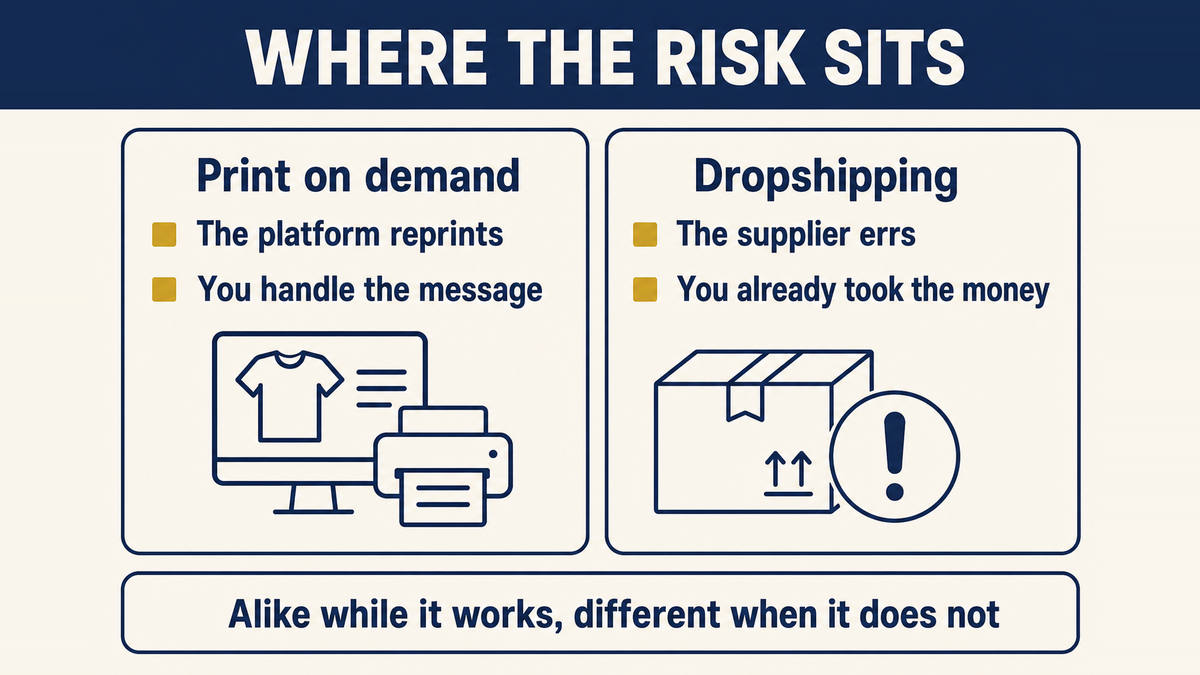
On the platform in one model and on you in the other, and the distinction holds for every kind of failure rather than only for damaged goods. This is the section that most often changes a decision, because the two models feel similar while everything is working and behave very differently when it is not.
In print on demand the failure modes are largely operational and largely somebody else's. The blank is out of stock, so the platform routes the order to another provider or the listing goes temporarily unavailable. The print is misaligned, so the platform reprints. The parcel is late, so the platform's carrier is late. In each case the seller's work is the customer conversation, which is real work and not nothing, but the goods and the printing are not their exposure. What a seller can lose is time and reputation rather than money already spent.
In dropshipping every one of those failures lands on the seller's side of the table. If the supplier's shelf is empty, the order cannot be fulfilled and the cancellation is recorded against the seller, which is a point we set out in detail in our guide to why a marketplace takes a listing or an account down. If the item is wrong, the seller owns the claim against the supplier while the customer waits. If it is late, the seller is the one who promised a date. The reason is structural rather than unfair: the buyer paid the seller, so the seller owes the buyer, whatever the supplier does.
There is a financial version of the same split that is easy to miss until it happens. Because the seller collects the money and pays the supplier, a failure can mean paying twice: once for the item that went wrong and once for whatever fixes it, with the recovery from the supplier arriving later if it arrives at all. That asymmetry is why our notes on moving from per-order buying to holding stock treat the change as a risk decision rather than a cost decision. Holding goods increases the money at risk and reduces the number of things that can go wrong, and which of those effects dominates depends on the failure rate you actually have.
5. How Do the Two Models Connect?
They are sequential more often than they are alternatives, and the connecting piece is the design. That is the most useful conclusion in this comparison and it is almost entirely absent from the articles written about it, because the platforms publishing them have an interest in one side of the question.
The mechanism is straightforward. A design printed on a blank by a platform carries a production cost that includes somebody else's printing service, and the seller cannot renegotiate it. The same design printed onto goods the seller buys in bulk carries a cost that is the blank plus the printing, without the platform's share, and that cost falls as the order grows. So the same asset produces a lower unit cost in the second arrangement, and the only question is whether the volume justifies buying the goods. Our guide to which packaging and print materials are worth specifying is the practical side of that move, and our comparison of the methods used to apply artwork to a product covers what changes when the printing is yours to specify rather than chosen from a menu.
That gives print on demand a role that is more valuable than the usual framing suggests: it is a low-cost way to find out whether a design sells, using production somebody else has already set up. Nothing is bought before the answer arrives, and the answer arrives with real customers rather than with a survey. Our article on how to tell a product that sells from one that does not is about the same problem approached from the product side, and the two methods answer it differently: one tests a design against known blanks, the other tests a product against known demand.
It is worth being honest about the limit of this sequence. A design that sells on a garment does not automatically sell on a different product, and the move from platform printing to your own production brings minimum quantities, lead times and quality risk that the platform was absorbing on your behalf. The transition is worth making when the volume is predictable, and premature when it is not, which is the same conclusion our breakdown of how an order's cost adds up once extras are included reaches from the other direction.
6. Which One Should You Start With?
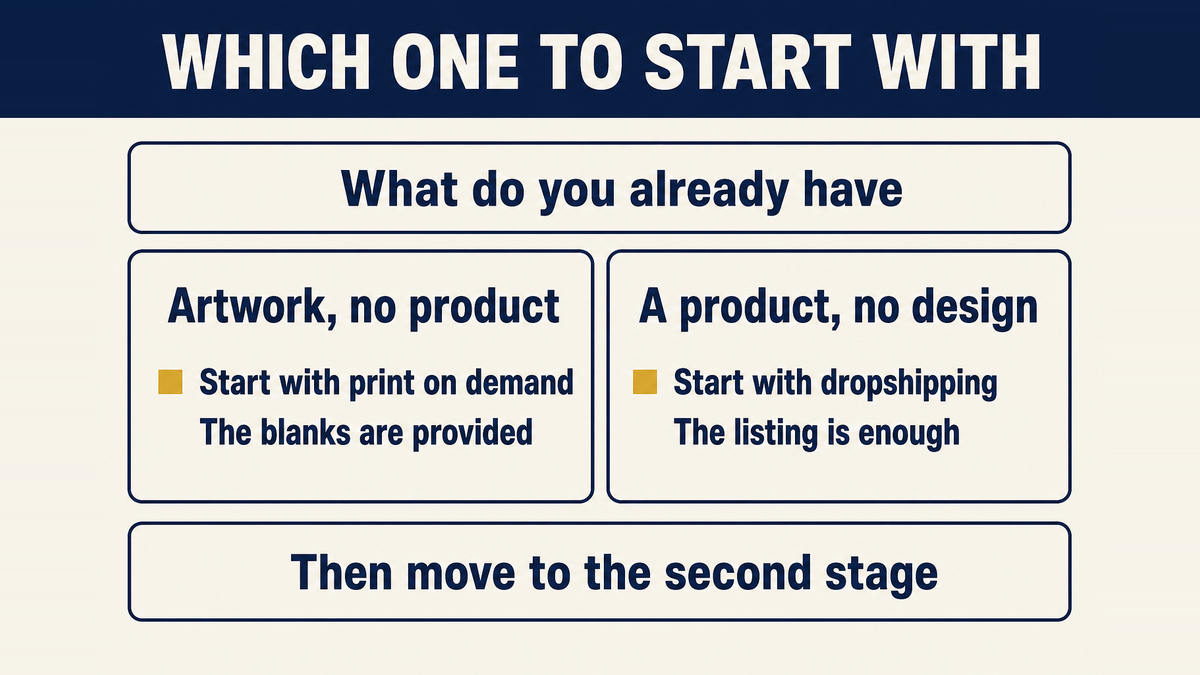
The one that matches the thing you already have. If you have artwork and no product idea, start with print on demand, because the artwork is the asset and the blanks are provided. If you have identified a product that people want and no design of your own, start with dropshipping, because the product is the asset and the platform only needs a listing. Starting with the model that requires something you do not have is the most common way to spend three months and finish with nothing.
Three practical points belong with that advice, and each of them is a place where the two models are usually compared wrongly.
The first is that the cost of starting is not the same, and the difference is not only money. Print on demand begins with nothing to buy at all, so the first experiment costs time. Dropshipping usually begins with a sample, which is a real cost paid before the first sale, and our notes on how an inbound sample or small shipment is cleared cover why that cost is slightly larger than the sample price suggests. Neither is expensive, but only one of them leaves you holding an object you can photograph.
The second is that the two models reward different abilities, and this is often the deciding factor in practice. Print on demand rewards product selection and design output, because the only levers are which blanks you use, what you put on them and what you charge. Dropshipping rewards supplier work, because the margin comes from what you can agree and the reliability comes from who you chose. A person who enjoys the second will find the first frustrating, and the reverse is equally true.
The third is that the choice is not permanent and the asset is not lost either way. A design carries across; a supplier relationship carries across; and the customer list carries across if it is captured properly rather than left inside somebody else's platform. What does not carry across is a business built entirely on an arrangement you did not negotiate and a design you did not make, and that is worth checking before committing to either.
7. Frequently Asked Questions
Is print on demand the same as dropshipping?
They share one property and differ in almost everything else. Neither requires you to hold stock, but print on demand sells a design you created on blanks somebody else owns, while dropshipping sells a product that already exists in somebody else's catalogue. The first depends on an asset you own and the second depends on an asset you find, which is why the two are usually not alternatives but sequential stages.
Which is cheaper to start, print on demand or dropshipping?
Print on demand, because there is nothing to buy before you sell. Printify publishes a free plan at zero per month with no upfront costs, and the production cost is charged per order when it comes in. Dropshipping also avoids stock, but a supplier relationship usually starts with a sample, and buying a sample is a cost that exists before the first sale.
Can I negotiate the unit cost in print on demand?
Not per item, because the production cost is published per product and is the same for every seller. There is one lever, which is a subscription that reduces the production cost, and Printify states that Premium sellers save up to 20 per cent on production costs. In dropshipping the unit cost is negotiable, which is the whole job of sourcing, but it comes with minimum order quantities and lead times.
Can I use the same design for both?
Yes, and that is the most useful thing about starting with print on demand. The same artwork can be printed on blanks through a platform and later printed on goods you buy in bulk, which reduces the unit cost because you are buying the blank rather than renting a printing service. The design is the asset in both cases; only the production arrangement changes.
Do I own the design I upload?
Only if you created it or have rights to it, and the two relevant rights work differently. The Copyright Office states that copyright does not protect facts, ideas, systems, or methods of operation, although it may protect the way they are expressed, so a concept is not protectable while specific artwork can be. USPTO describes a trademark as a word, phrase, symbol or design that identifies the source of goods, which is why printing somebody else's mark is a different problem from copying their picture.
Where the Risk Sits When It Goes Wrong
We return the risk owner for a misprint, a wrong size and a lost parcel under each model, with the catalogue limit each imposes.
Chart My Risk
Questions & Comments
We read every one and reply within 24 hoursTrying to decide whether you have a design to sell or a product to find, unsure whether your artwork is actually yours to use, or wondering at what volume it becomes cheaper to print on goods you buy rather than on blanks a platform provides? Post what you have in hand and what you want to sell, and our team will help you work out which stage you are at.