
How to Transition from Dropshipping to Bulk Wholesale Sourcing: Profit & Risk Model (2026 Guide)
 ·
Updated October 1, 2026
·
20 min read
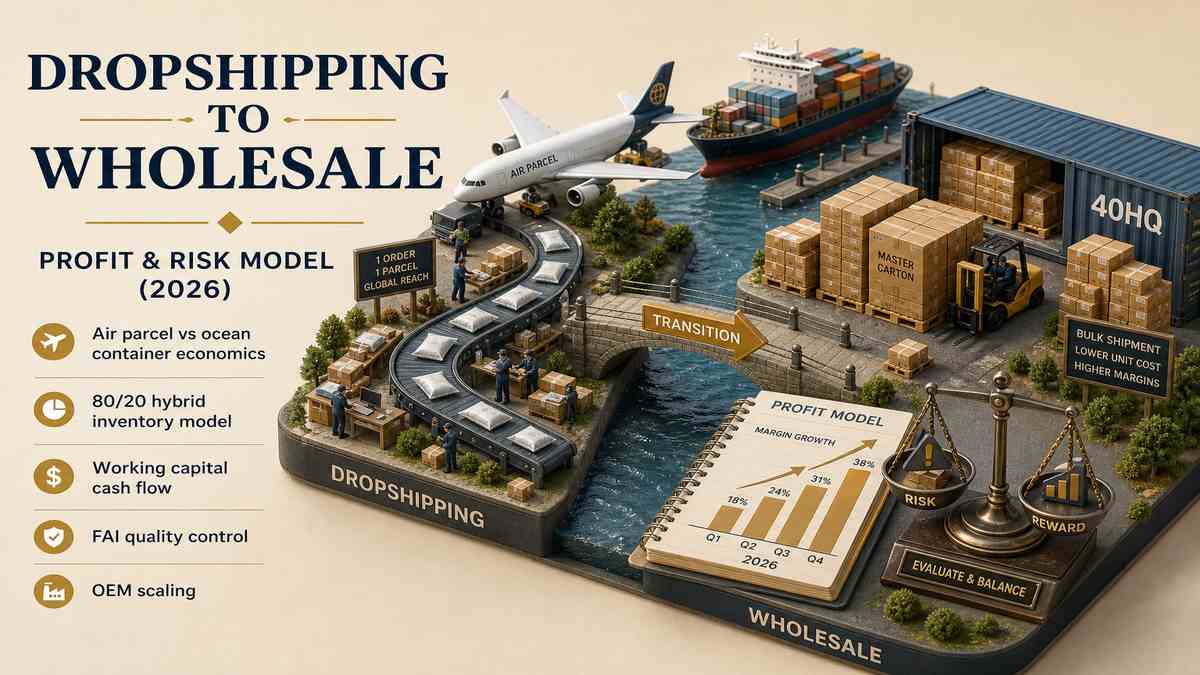
Direct Answer: In 2026, Transitioning a proven dropshipping winner to Bulk Wholesale OEM Sourcing in China is the single most lucrative milestone in e-commerce—more than doubling net profit margins from ~20% up to 50%–65%. While individual air dropshipping is perfect for validating product demand with zero inventory risk, scaling past 30 to 50 orders per day on a single SKU creates massive financial leakage: paying \$5.50–\$8.00 per unit in individual air courier freight and inflated 1688 wholesale prices. Bulk wholesale manufacturing unlocks five transformative levers: (1) Direct Tier-1 Factory OEM Pricing (slashing unit costs by 45%–60%); (2) Ultra-Low Ocean Freight (\$0.30–\$1.20 per unit via container shipping vs. \$6.80 via air); (3) Domestic 2-Day Delivery via US/EU 3PLs or Amazon FBA (lifting ad conversion rates by 35%); (4) Full Custom Mold Tooling & Premium Retail Packaging; and (5) The 80/20 Hybrid Supply Chain Model (bulk sourcing core winners while dropshipping new test SKUs). Moving from dropshipping to bulk wholesale transforms a fragile ad-arbitrage store into an enterprise asset worth millions.
To understand how direct fulfillment centers manage buffer inventory before committing to container loads, review our guide on China 3PL warehousing and order fulfillment rates across key logistics hubs.
However, many merchants leap into bulk buying prematurely, only to face devastating cash flow shortages when 30% factory deposits, 70% bill-of-lading balance payments, and 35-day ocean transit times trap all their working capital.
To automate store order fulfillment across both direct air parcels and bulk domestic channels, consult our guide on Shopify order fulfillment from China and ERP integration for tracking synchronization.
In this comprehensive 2026 transition guide, we compare dropshipping vs. bulk wholesale across 7 core pillars, analyze unit economics on a \$60 retail product, decode the 80/20 hybrid inventory framework, evaluate 4 major financial risks, and share a 5-step SOP to transition your winning products to bulk manufacturing with zero cash flow risk.
Dropshipping vs. Bulk Wholesale Sourcing: 7-Pillar Comparison
To evaluate whether your winning product is ready for bulk manufacturing, review this comparative operational matrix:
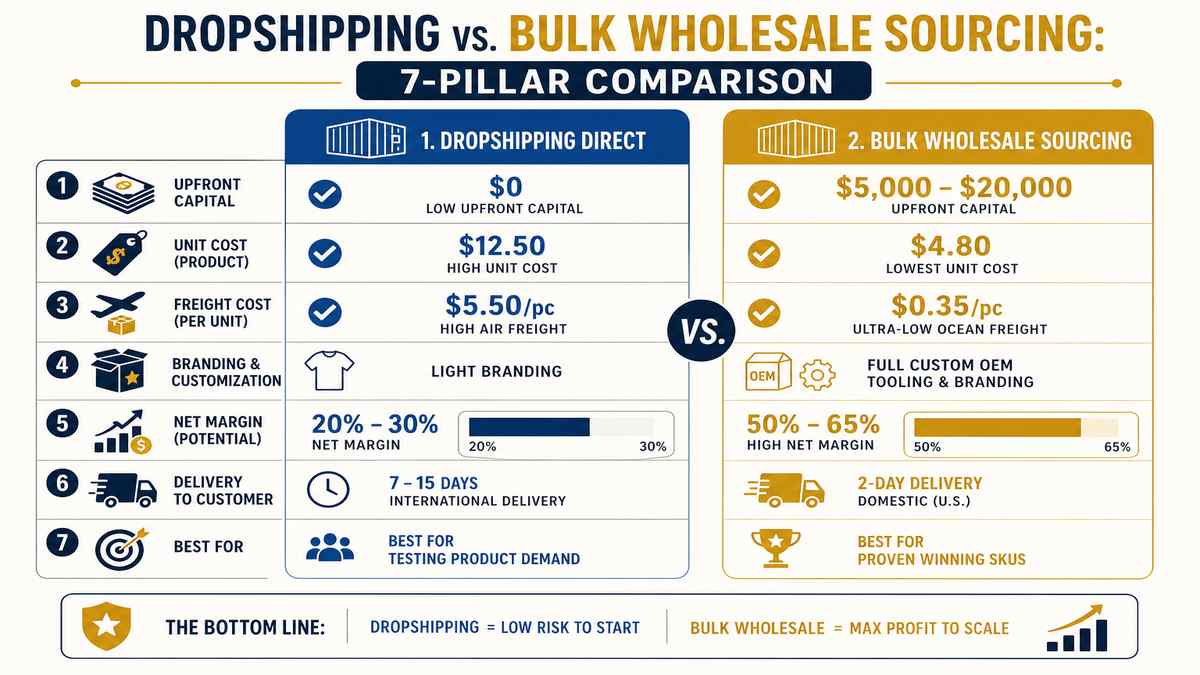
| Evaluation Pillar | 1. Air Direct Dropshipping | 2. Bulk Wholesale OEM Sourcing |
|---|---|---|
| Product Unit Cost | Higher (\$12.00–\$18.00 / 1688 off-the-shelf). | Lowest (\$5.00–\$8.00 / Bulk OEM factory cost). |
| Inbound Shipping Cost / Unit | Expensive (\$5.50–\$8.50 / individual air parcel). | Ultra-Low (\$0.35–\$1.20 / ocean container). |
| Upfront Working Capital | Zero ($0 Upfront inventory capital). | Higher (\$5,000–\$25,000 initial production run). |
| Doorstep Customer Delivery | 6 – 10 business days (Air direct injection). | 1 – 2 business days (Domestic US/EU 3PL / FBA). |
| Custom Branding & Tooling | Light (Custom EVA bags & thank-you cards). | Full OEM (Custom molds, rigid boxes, manuals). |
| Inventory Stockout Risk | Moderate (Dependent on factory daily stock). | Controlled (Guaranteed 60–90 day local stock). |
| Net Profit Margin (%) | 18% – 28% (Vulnerable to ad cost spikes). | 48% – 65% (Highly resilient, double profit). |
Unit Economics Model: Air Dropshipping vs. Ocean Bulk Wholesale
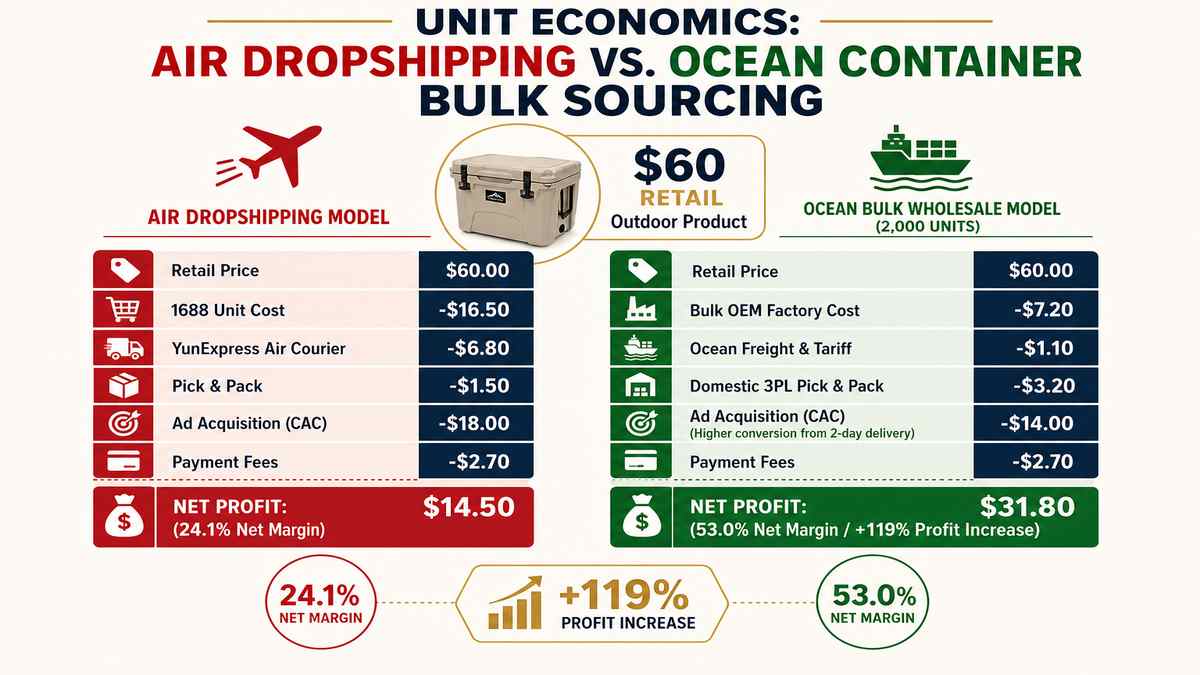
To see how bulk container shipping and direct OEM manufacturing transform profitability, review this unit economics breakdown on an illustrative \$60.00 retail outdoor product:
To understand how private sourcing agents negotiate bottom-dollar wholesale pricing with Chinese factories, explore our guide on how to find reliable private sourcing agents for dropshipping in China.
- Retail Customer Sale Price: \$60.00
- – 1688 Unit Product Procurement Cost: \$16.50
- – YunExpress Direct Air Courier Shipping: \$6.80
- – Pick, Pack & Quality Check Handling Fee: \$1.50
- – Facebook / TikTok Ad Acquisition Cost (CAC): \$18.00
- – Payment Processing & Shopify Fees (4.5%): \$2.70
- = NET PROFIT PER ORDER: \$14.50 (24.1% Net Profit Margin)
- Retail Customer Sale Price: \$60.00
- – Bulk OEM Direct Factory Manufacturing Cost: \$7.20 (56% factory savings)
- – Ocean Freight (FCL/LCL) + Customs Tariff Duty: \$1.10 (84% shipping savings)
- – Domestic US/EU 3PL Pick, Pack & 2-Day Ground Delivery: \$3.20
- – Facebook / TikTok Ad Acquisition Cost (CAC): \$14.00 (Lower CAC from 2-day delivery badge)
- – Payment Processing & Shopify Fees (4.5%): \$2.70
- = NET PROFIT PER ORDER: \$31.80 (53.0% Net Profit Margin / +119% Profit Increase)
The 80/20 Hybrid Supply Chain Architecture
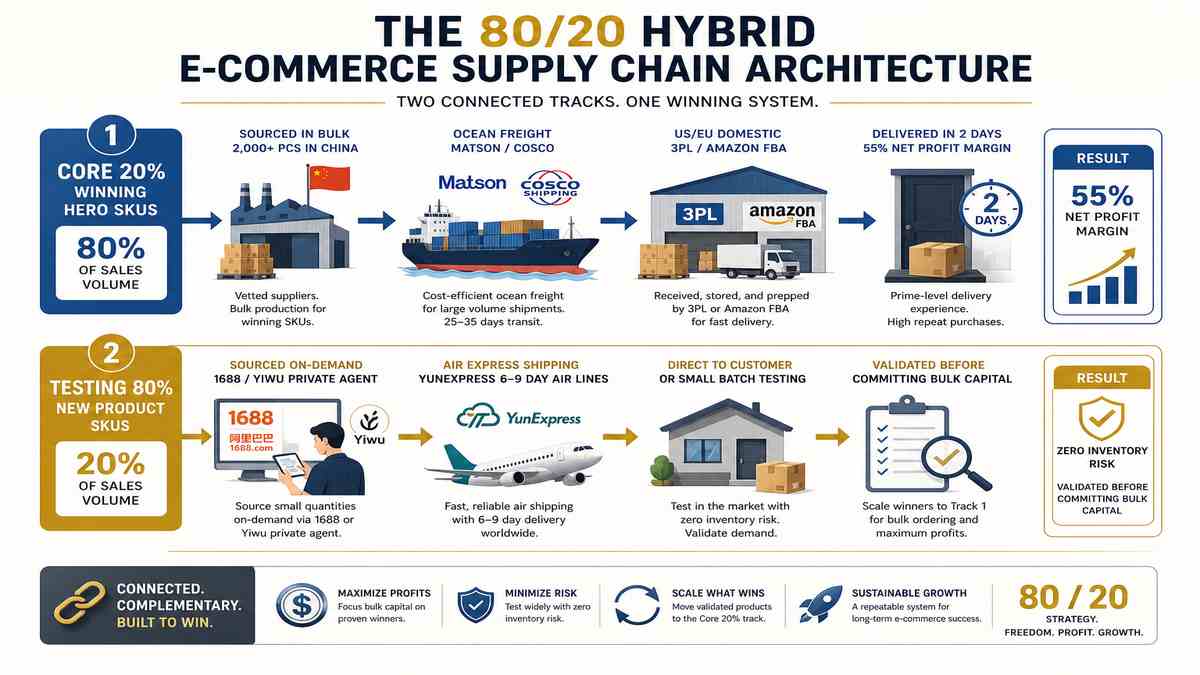
Smart e-commerce brands do not switch 100% of their business overnight. They set up an 80/20 Hybrid Inventory Model:
To inspect maritime container shipping regulations and carrier tariff rules, consult published guidelines from the Federal Maritime Commission (FMC) Ocean Freight Guidelines.
4 Major Financial & Supply Chain Risks in Bulk Wholesale
Transitioning to bulk manufacturing introduces capital commitments that must be actively managed:
To ensure imported bulk container cargo complies with entry filing and duty classification rules, review the official U.S. Customs and Border Protection (CBP) Trade Entry Guidelines.
5-Step SOP for Transitioning from Dropshipping to Bulk Wholesale in China
Follow this standard operating procedure to execute a smooth, risk-free transition to bulk OEM manufacturing in China:
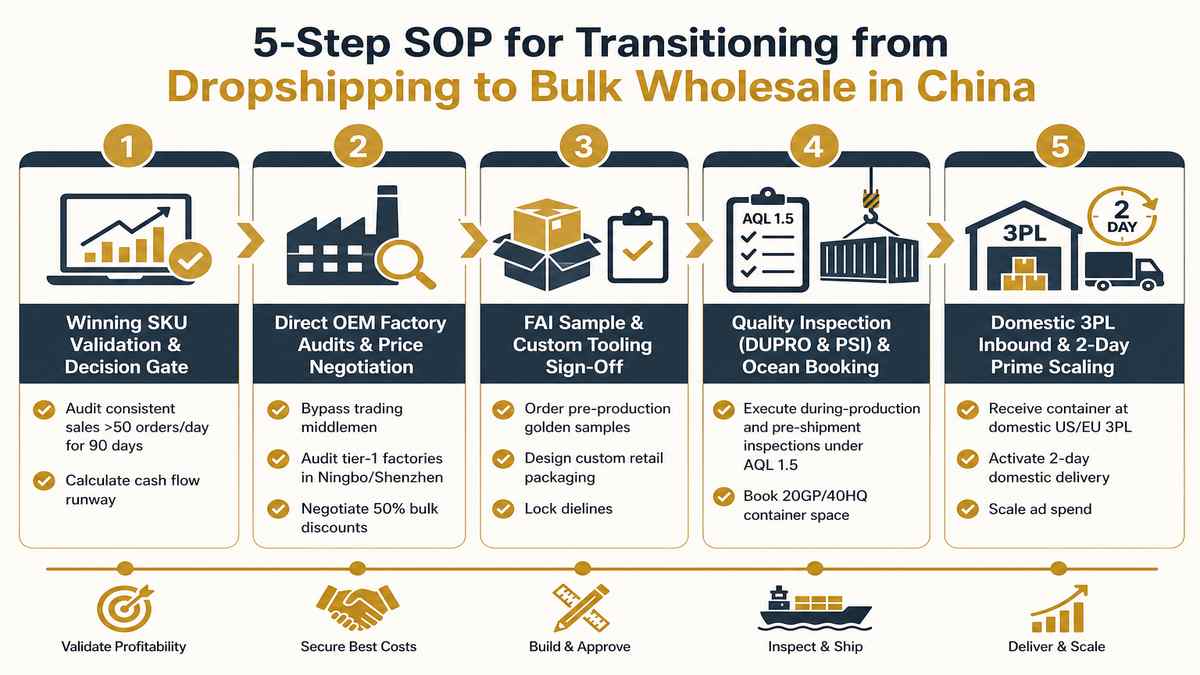
To inspect physical production samples and lock tooling dielines before authorizing bulk manufacturing, execute a formal first article inspection (FAI) sample review.
To confirm that factory quality control systems operate under calibrated international standards, audit manufacturing facilities certified under ISO 9001 Quality Management Standards.
- Winning SKU Validation & Decision Gate Audit: Check that your product maintains 30–50+ steady daily orders for 60 consecutive days with an advertising return on ad spend (ROAS) > 2.2.
- Audit Tier-1 OEM Factories & Negotiate Bulk Pricing: Bypass trading middlemen and audit primary manufacturing plants in Ningbo, Shenzhen, or Yongkang using our China factory audit checklist review.
- Sign Enforceable Bilingual Contract & Golden Sample: Lock 30/70 payment terms, AQL 1.5 defect tolerances, and custom packaging dielines into an enforceable bilingual manufacturing sales contract under PRC law.
- Execute Pre-Shipment Inspection (PSI) & Release Balance: Conduct an on-site pre-shipment inspection (PSI) in China under AQL 1.5 standards before container departure.
- Receive Container at Domestic 3PL & Scale Paid Ads: Inbound your container at a domestic US/EU 3PL, activate 2-day delivery badges on your store, and scale advertising spend profitably.
Ocean Freight Economics: 20GP vs. 40HQ vs. LCL vs. Air Dropshipping
To evaluate the massive freight savings of bulk ocean shipping, review this comparative breakdown of international freight modes from Ningbo or Shenzhen to the US West Coast (Long Beach):
| Freight Shipping Mode | Cargo Capacity & Volume | Total Freight Cost (USD) | Landed Freight Cost per Unit | Average Port-to-Door Transit Time |
|---|---|---|---|---|
| Individual Air Dropshipping | Single parcel (<500g) | $5.50 – $8.50 / parcel | $5.50 – $8.50 / pc | 6 – 9 business days |
| Ocean LCL (Less than Container Load) | 1 – 15 CBM (Palletized cargo) | $180 – $260 / CBM | $0.80 – $1.80 / pc | 25 – 35 calendar days |
| Ocean 20GP Container (FCL) | 28 CBM (~3,500 units) | $2,400 – $3,200 / container | $0.70 – $0.95 / pc | 22 – 30 calendar days |
| Ocean 40HQ High Cube Container (FCL) | 68 CBM (~8,500 units) | $3,600 – $4,600 / container | $0.42 – $0.55 / pc | 22 – 30 calendar days |
Illustrative Scenario: How an Outdoor Brand Scaled to \$1.2M in Wholesale Profits
To see how transitioning from dropshipping to bulk wholesale creates generational e-commerce wealth, review this outdoor gear case study:
An outdoor lifestyle brand in Seattle, Washington launched an ultralight titanium camping cookware set (\$85 retail price, generating 75 dropshipping orders per day).
- The Dropshipping Profit Bottleneck: The founder fulfilled orders via direct China air dropshipping. The unit product cost was \$24.50 on 1688 + \$8.20 YunExpress air shipping = \$32.70 fulfillment cost per set. Despite generating \$190,000 in monthly sales, net profit margins were squeezed to 18.5% (\$35,000/month) due to rising TikTok ad costs.
- The Sourcing Pioneer Bulk Wholesale Transition: Sourcing Pioneer executed a full bulk supply chain transition in Zhejiang: (1) Audited primary titanium tooling factories in Yongkang, cutting manufacturing cost from \$24.50 down to \$11.80 per unit for a 2,500-unit bulk OEM run, (2) Upgraded the product with a custom laser-etched brand logo, custom mesh carry bag, and rigid full-color retail box (\$1.40), (3) Shipped a 20GP container via Matson Fast Sea directly to Long Beach port (\$1.25 per unit ocean freight + tariff), and (4) Inbounded stock at a domestic California 3PL for 2-day domestic FedEx Ground delivery (\$4.80 pick-and-pack/shipping).
- Total Unit Landed Cost Slashed by 41%: Total fulfillment cost dropped from \$32.70 down to \$19.25.
- The Commercial Outcome: Net profit per cookware set surged from \$15.70 to \$46.50 (+196% profit increase), ad conversion rates jumped by 40% due to the 2-day US delivery guarantee, and the brand generated over \$1,240,000 in clean annual net profit.
Frequently Asked Questions (FAQ)
When should an e-commerce store transition from dropshipping to bulk wholesale sourcing?
An e-commerce business should transition a winning product to bulk wholesale when it achieves: (1) Consistent sales of 30 to 50+ units per day for at least 60 consecutive days, (2) Proven customer product-market fit with low return rates, (3) A minimum working capital reserve to cover a 30% factory deposit plus ocean freight, and (4) An opportunity to lift net profit margins by over 25% through direct OEM manufacturing.
How much money can you save by switching from air dropshipping to ocean bulk freight?
The savings are massive: (1) Product manufacturing unit costs drop by 40% to 60% when buying in bulk production runs of 1,000 to 5,000 units, and (2) Shipping costs drop from $5.50-$8.00 per unit via individual air express down to $0.30-$1.20 per unit via ocean container shipping (FCL/LCL), more than doubling net profit margins from 20% to over 50%.
What is the 80/20 hybrid dropshipping and wholesale inventory model?
The 80/20 hybrid model divides your catalog into two strategic tracks: (1) Bulk Wholesale Track (20% of your catalog): Your core proven winning hero SKUs representing 80% of sales volume are sourced in bulk in China and shipped via ocean freight to domestic 3PLs or Amazon FBA for 2-day delivery and 50%+ margins; (2) Dropshipping Track (80% of your catalog): New, unproven test products are fulfilled on-demand via direct China air lines with zero inventory risk.
What are the biggest financial risks when transitioning to bulk wholesale sourcing?
The primary risks include: (1) Working capital cash flow lockup (paying 30% upfront deposit and 70% before bill of lading release during a 35-day ocean transit), (2) Sudden product trend fatigue resulting in unsold dead inventory, and (3) Large-scale batch manufacturing defects, which must be prevented through strict First Article Inspection (FAI) and Pre-Shipment Inspection (PSI).
What payment terms should you negotiate with Chinese factories for bulk wholesale orders?
Standard international OEM payment terms are 30% T/T deposit upon buy contract signing to start production, and 70% balance payment strictly after an independent on-site Pre-Shipment Inspection (PSI) passes under AQL 1.5 standards and before the original Bill of Lading (B/L) is released.
Double Your Profit Margins with Direct OEM Factory Sourcing & Ocean Container Logistics
Our China engineering team audits tier-1 factories in Ningbo and Shenzhen, negotiates 50%+ bulk wholesale discounts, conducts FAI and pre-shipment inspections, and manages container shipping.
Get Free Bulk Sourcing & Container Feasibility Audit
Questions & Comments
We read every one and reply within 24 hoursAuditing whether your dropshipping winning SKU is ready for bulk ocean container manufacturing, calculating working capital cash flow requirements, or setting up an 80/20 hybrid inventory model? Post your wholesale transition questions below — our on-the-ground manufacturing and logistics specialists will guide your scaling roadmap.