
Dropshipping Products in 2026: How to Pick One That Sells
 ·
Updated October 12, 2026
·
17 min read
There is no list of winning products. There is a filter, and the lists leave out the part of the filter that decides whether you can still sell the product next quarter. A product does not work because it is trending. It works because demand is steady, the price survives a return, the parcel is cheap to move, and you can order it again at the same specification.
The Four Tests a Product Has to Pass
| Test | What it asks | What fails it |
|---|---|---|
| Demand | Do people search for this in ordinary weeks, not just trend weeks? | A spike that came from one video and left with it. |
| Margin | Does the price survive the landed cost, the fee and one return? | A thin price defended by a low unit cost. |
| Shipping | Can it travel cheaply and arrive intact? | Weight, bulk, glass or a battery. |
| Sourceability | Can you reorder the same specification at the same price? | A one-off listing with no factory behind it. |
What this guide covers
- Why product lists fail you
- The four tests a product has to pass
- The sourcing check most lists skip
- Which product types break in production
- How to check demand without paid tools
- What the numbers have to look like
- How to test a product without losing money
- Why products die after a good start
- Frequently asked questions
1. Why Do Product Lists Fail You?
Because a product list is a snapshot of one moment, and a product only works while you can still source it and still sell it at a price that holds. Most lists are compiled from the same public sources, which means the readers arrive at the same product in the same week.
Three things then happen at once. The first is saturation: hundreds of stores list the same item at a similar price, so the only lever left is discounting, and discounting a thin product is how a store loses money while growing revenue. The second is decay: trends in these lists are usually measured after the peak, so the buyer enters on the way down. The third is silence about supply, which is the one that actually ends businesses. A list will tell you a product sells. It will never tell you whether you can order it again.
None of that makes the lists useless. They are a good place to collect candidates, and a bad place to make the decision. The decision belongs to the filter, and the filter runs on your numbers rather than someone else's.
2. What Makes a Product Work for Dropshipping?
Four tests, and the order matters: is demand steady, does the margin survive a return, is it cheap and safe to ship, and can you reorder it repeatably. A product that fails the last test only works until your first good week.
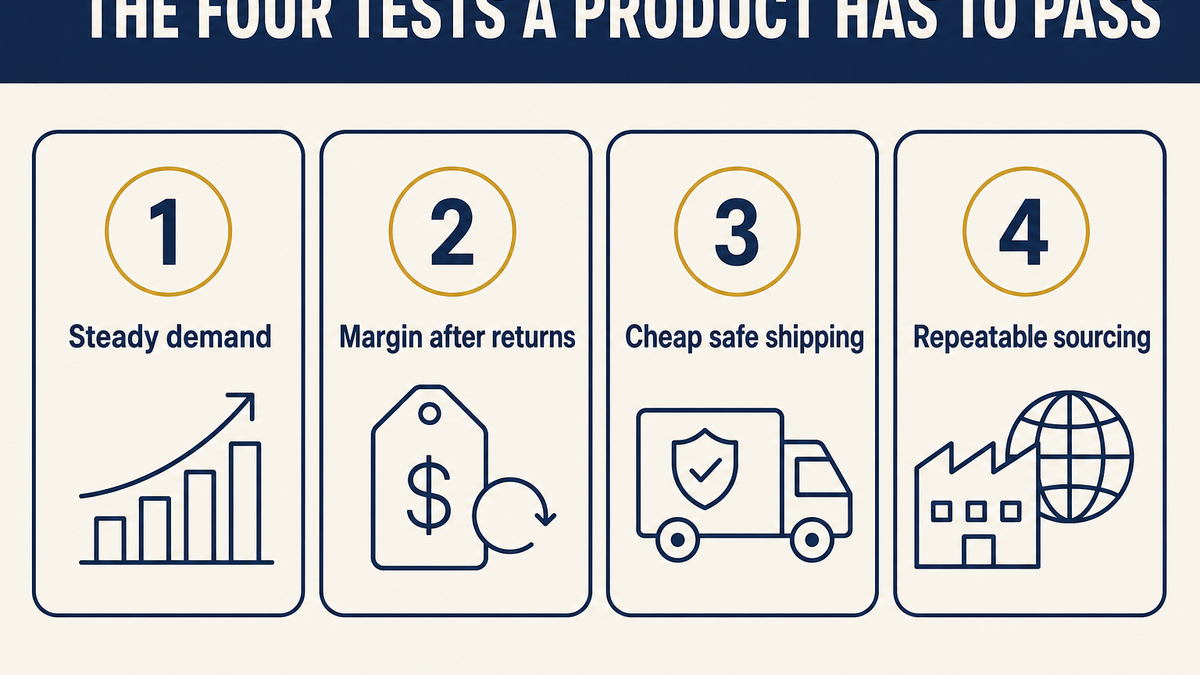
- Demand has to be ordinary, not viral
- A product that sells because a video went out is a product you cannot restock fast enough to profit from. Look for steady demand across ordinary weeks, because that is the demand you will actually serve and the demand that decides whether you can reorder with confidence.
- Margin has to survive a return
- The useful number is not the gross margin, it is what is left after the landed cost, the shipping you pay, the payment fee and your share of returns. A product with a wide gross margin and a high return rate can leave you with less than a thin one that never comes back.
- Shipping has to stay cheap and dull
- Weight and volume decide your cost more than distance does, and anything that can break, leak or need a battery adds a handling problem to every parcel. The best dropshipping products are the ones nobody has to think about after the order.
- Sourceability decides whether it lasts
- Ask whether you can order the same specification again next quarter, and who would make it. A product you can only find on one listing is a product with a shelf life, no matter how well it sells this month.
Notice where the four tests point. Three of them are about the product, and the fourth is about the supplier, which is also the test with no answer in any list you will read.
3. The Sourcing Check Most Lists Skip
Before you list a product, answer four questions about its supply: who makes it, what the minimum order is, what is allowed to change between production runs, and what the product needs in order to enter the destination country. If you cannot answer all four, you have a product idea rather than a product.
This is the part that separates a store that grows from a store that spikes. Everything else in a product decision can be renegotiated later. The supply cannot, because by the time you notice, you already have customers waiting and no stock to send them.
- Who actually makes it
- Ask for the factory rather than the listing. A product you buy from a trading company is fine, as long as you know that a change in the trading company's own sourcing does not become a change in your product.
- What the minimum order is at each stage
- Ask separately for stock units, for your own branding and for a custom specification. The three numbers are different, and knowing them tells you how far you can scale before you must commit real money.
- What is allowed to change between runs
- Materials get substituted, moulds wear and colour drifts. A supplier who names what may vary, and the range it may vary within, is a supplier who has run this product more than once.
- What it needs to enter the country
- Certification, labelling, a battery declaration or a restricted-material check. Any of these can stop a product at the border, and all of them are cheaper to discover before you have sold the first unit than after.
Run this check on the product and the supplier together, because a good product behind a weak supplier behaves like a bad product. If you want to see how the questions are scored against a named supplier, our Doba review walks through the same list.
4. Which Product Types Break in Production?
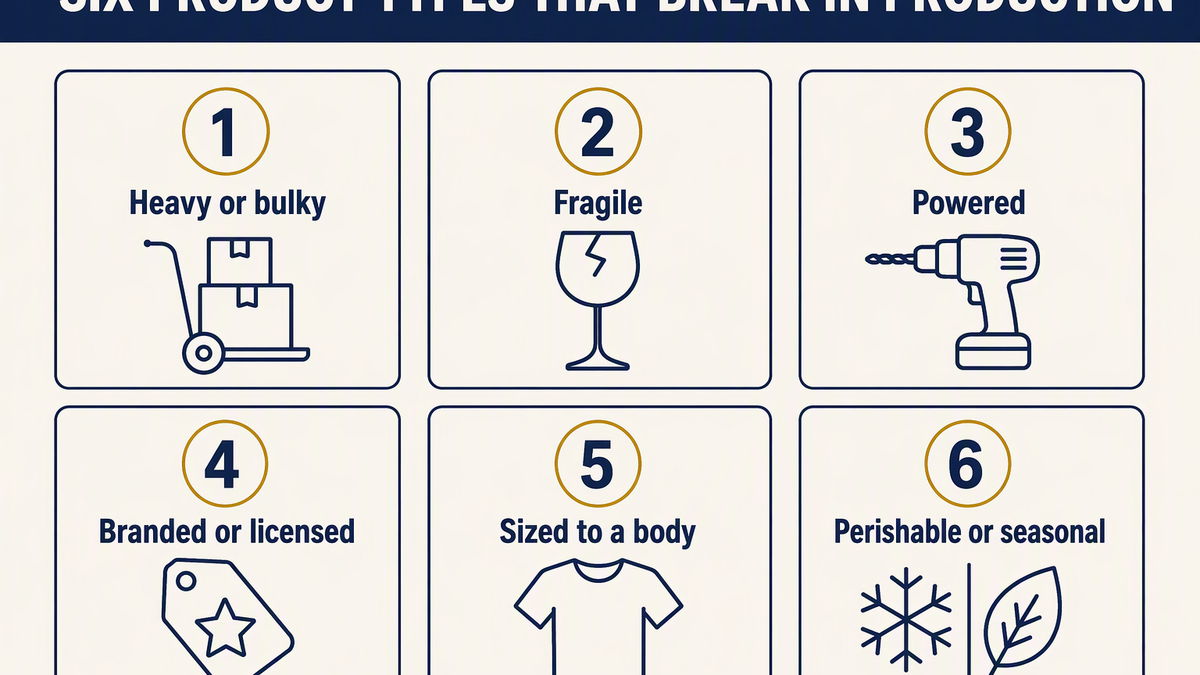
The types that break are the ones that add a cost per parcel or a rule per country. Heavy, fragile, powered, branded, body-sized and seasonal products each break in a different place, and a low unit price cannot cover any of them.
| Type | Where it breaks | What it costs you |
|---|---|---|
| Heavy or bulky | Freight is priced by weight and volume, not by value. | Your shipping cost per parcel, on every order. |
| Fragile, such as glass or ceramic | Breakage in transit and at the door. | A replacement, a refund and a customer who tells people. |
| Powered, with a battery or a plug | Certification and transport rules differ by destination. | Following the rules before you are allowed to sell at all. |
| Branded or licensed | Intellectual property takedown risk. | The listing, the stock, and in a bad case the account. |
| Sized to a body | Fit is a distribution rather than a fact. | The full return stack, repeatedly. |
| Perishable or strictly seasonal | The selling window closes on a fixed date. | Discounting whatever is left to clear it. |
That does not mean avoiding all six. It means pricing them honestly, and knowing which cost you have taken on. A store that sells fragile goods and prices for breakage is doing something different from a store that sells fragile goods and discovers the cost later. The border has become less forgiving as well: low-value parcels that once cleared without duty no longer do for goods of China and Hong Kong, as the Federal Register notice implementing Executive Order 14256 records.
5. How Do You Check Demand Without Paid Tools?
Use the marketplace, the search results and the reviews. Each answers a different question, none of them costs anything, and together they tell you more than a trend score does.
- Read the sales rank as a direction, not a number. A rank that moves up and stays up means steady demand. A rank that jumped once and fell back means a moment, and you would be entering after it.
- Look at who holds the search results. If the first page is mostly large brands, you are competing on trust. If it is mostly small stores with thin pages, the demand exists and the bar is low.
- Read the two and three star reviews of the closest product. The complaint in those reviews is the product you should be selling, described by the people who wanted to buy it.
- Check whether the product appears in ordinary weeks. A product that only shows up around a holiday or a viral moment is a campaign, not a store.
The strongest demand signal in this whole guide is a complaint you can fix. When a review says the product is good but the strap breaks, or the size runs small, or the lid leaks, that is a product with proven demand and a known defect. Fix the defect at the factory and you have a product with a reason to exist, which is worth more than any trend score.

6. What Do the Numbers Have to Look Like?
Work backwards from the selling price rather than forwards from the unit cost. Subtract the landed cost, the shipping you pay, the payment fee and your share of returns, and look at what is actually left. If that number is not worth your time, the product is too thin no matter how popular it looks.
| Layer | Where it comes from | Why it is easy to miss |
|---|---|---|
| Selling price | What the market already pays for this product. | It is set by the market, not by your cost. |
| Landed cost | Unit price, plus freight and duty to your customer's country. | Duty is charged on every parcel, not once per supplier order. |
| Shipping you pay | The delivery you promised at checkout. | It does not fall when the order value falls. |
| Payment fee | A percentage of the transaction. | Many providers keep the fee on a refunded order. |
| Returns | One return spread across every few orders. | It arrives as a spike, so it is budgeted as a surprise. |
| What is left | Your actual margin, per order. | This is the only number that matters, and the one nobody prints. |
Classification is part of this arithmetic rather than a detail after it, because two similar products can carry very different duty. Check the code you would declare under on the USITC Harmonized Tariff Schedule, and treat the result as an input to the product decision. How the rest of the landed cost is built, and where it goes wrong, is set out in our dropshipping from China guide.
7. How Do You Test a Product Without Losing Money?
Sell it per order for a few weeks before you buy anything. Per-order fulfilment costs you only the units that actually sell, and it returns the two numbers no research tool can give you: your real return rate and the complaints your customers write in their own words.
- List it with an honest price. Test the price you intend to keep, because a launch discount teaches you about the discount rather than about the product.
- Sell per order rather than in stock. You are buying information, not inventory, and per-order sourcing buys it in the smallest possible size.
- Read the returns, not the rate. The reasons tell you whether to change the description, the packaging, the specification or the product.
- Check the second order before the bulk order. How a supplier behaves once you are routine is the fact that decides whether scaling is safe.
- Only then commit to stock or a custom run. By that point you are scaling something you have measured rather than something a list named.
Two things make this test more trustworthy. Have the goods checked before they ship, so a good result is a fact about the product rather than about the sample the supplier picked for you, using an independent quality inspection. And work with a partner who can source per order and hold a small buffer, which is what a private sourcing agent in China is for.
8. Why Do Products Die After a Good Start?
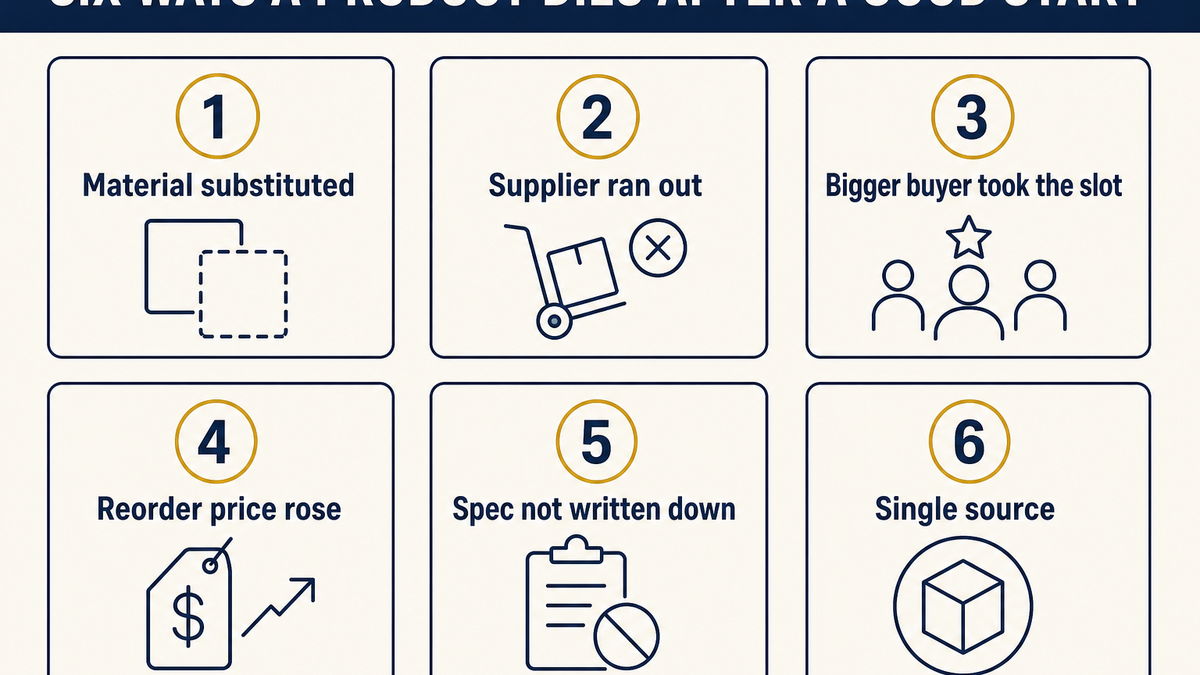
Usually because of supply rather than demand. The factory substituted a material, the supplier ran out and shipped something close, a larger buyer took the production slot, or the reorder price rose and nobody repriced the product to match.
The pattern is that the product was never the asset. The repeatable order was, and it was the one thing nobody wrote down.
Never accept a substitute without a written change notice. A supplier that swaps a material, a colour or a component and mentions it in passing has changed your product without changing your price, and the difference will surface as returns that you will blame on marketing.
The rest of the list is short. Ordering the same product from a second supplier without checking that the specification matches. Letting a single supplier become your only source. Treating a rising landed cost as a temporary problem rather than a permanent change in the product's economics. Restocking from a listing instead of from the factory that made the original. And reading a month of flat sales as a demand problem when it is usually a supply or a price one.
The practical defence is boring and cheap: keep the specification, keep the sample you approved, and compare every delivery against them. When the product has proved itself far enough to justify owning the tooling or the specification outright, the levers and the timing are covered in our guide to moving from dropshipping to wholesale.
9. Frequently Asked Questions
What are the best dropshipping products in 2026?
There is no fixed list, because a product that works is one you can still source at the same specification and the same price three months later. Use four tests instead: is demand steady rather than spiking, does the margin survive a return, is it cheap and safe to ship, and can you reorder it repeatably.
How do I know if a product will sell before I buy stock?
Run it per order first. Selling a small number of units through per-order fulfilment costs you nothing except the units themselves, and it tells you the real return rate and the real delivery complaints instead of a research tool's estimate of them.
What margin do I need for dropshipping to work?
Enough to absorb a return. Work backwards from the selling price and subtract the landed cost, the shipping you pay, the payment fee and one return spread across every few orders. If what is left is not worth your time, the product is too thin no matter how popular it looks.
Why do copied product lists stop working?
Because everyone reads the same list in the same week. The margin closes once hundreds of stores list the same product at the same price, and the only defence left is the source, which the list never tells you.
Which products should I avoid for dropshipping?
Avoid anything heavy, anything fragile, anything with a battery or a plug that must be certified for the destination country, anything carrying a brand or a licensed character, and anything sized to a body. Each one adds a cost or a risk that a low unit price cannot cover.
Free Signals, Read Before You Buy Stock
We return the free demand signals available per candidate, the production risk by product type, and the sourcing check lists skip.
Read My Demand
Questions & Comments
We read every one and reply within 24 hoursGot a product you cannot decide on, a margin that keeps shrinking after shipping, or a reorder that arrived different from the first batch? Post the product, the price you sell at and what changed, and our team will help you work out which of the four tests it is failing.