
Expansion Joint Manufacturer: Sourcing Expansion Joints From China
 ·
Updated October 12, 2026
·
26 min read
An expansion joint is bought on bore size and price, and it fails for three reasons that neither of those numbers touches. The first is that it was asked to absorb a kind of movement it was never built for. The second is that the pipe around it was never anchored, so the joint did not absorb the movement at all — it just moved the whole run along until something hit a wall. The third is that it was bolted in at the wrong length, and a bellows that was stretched on the day it was fitted has already used up part of the life it was bought for. There is also a rule that most buyers never see, written for ships rather than factories, which says an expansion joint is a last resort, that it must be a bellows type, and that it must not be covered.
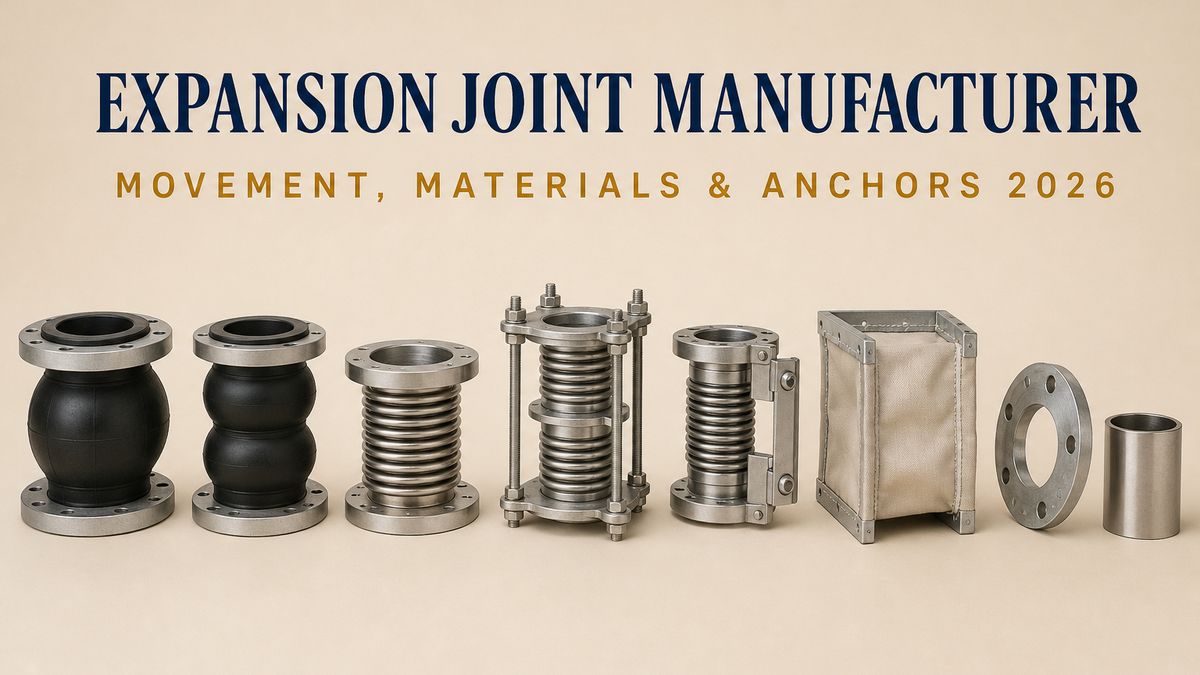
Six Lines That Decide Whether an Expansion Joint Order Is Complete
| What the buyer has to settle | Why it is not obvious | The line on your order that closes it |
|---|---|---|
| Which movement it has to absorb | Each type absorbs one kind of movement well and most absorb no other kind at all | The movement type and the amount, on the drawing |
| The face to face length | The joint has to match the gap in the pipe exactly, or it is installed already stretched or squashed | Face to face length, and the installed length it is built for |
| Where the pipe is held | The joint absorbs nothing on its own; it moves the movement to wherever the pipe is anchored | Anchor and guide positions, marked on the pipe layout |
| What the moving part is made of | Rubber, metal bellows and fabric each have a different temperature, pressure and chemical window | The elastomer grade, or the bellows material with its ply count |
| Whether an inner sleeve is needed | A bare bellows erodes, fills with debris or hums in some duties and is fine in others | Inner sleeve yes or no, with the direction of flow marked |
| Who supplies the tie rods | Tie rods change the part from something that absorbs movement into something that carries load | Tie rods or limit rods named as supplied, with their settings |
What an Expansion Joint Is, and the Four Words It Is Sold Under
An expansion joint is a short, deliberately flexible piece of pipe that goes into a rigid pipe run so that the run has somewhere to give. Pipework moves. It gets longer when it heats up, it shakes when a pump runs, it settles when the ground settles, and it is never built to exactly the length the drawing says. A rigid pipe run has nowhere to put any of that, so the movement goes into the nearest weak point, which is usually a flange or a weld. The expansion joint is the deliberately weak point, placed where somebody can watch it.
Four words describe this part and they are not interchangeable, which matters because a supplier who is asked for one and quotes another will produce something that fits the flange but does not do the job.
- Expansion joint
- The general term, and the safest one to use. It covers every flexible pipe element in this article. If you are not sure what you are holding, call it an expansion joint and describe the two things it does: what it is bolted between, and what movement it has to take.
- Bellows
- Strictly, the flexible metal element itself — a thin-walled metal tube pressed or rolled into a stack of ring-like folds. In everyday use the word is used for the whole assembly, which is why a quotation for a “bellows” and a quotation for an “expansion joint” can describe the same part or two different parts. When you are specifying, use bellows for the flexible element and expansion joint for the finished assembly.
- Flexible connector
- A short flexible piece used mainly to stop vibration travelling along a pipe and to allow two pipes to be joined when they do not line up perfectly. It is usually a rubber part with a single bulge, and it is often sold as a pump connector or a vibration eliminator. It does some of the same work as an expansion joint, but it is not normally built to absorb the movement of a whole pipe run.
- Compensator
- The word used across much of Europe and Asia for the same part, and the word that appears on a great many Chinese drawings and quotations. If your quotation says compensator and your drawing says expansion joint, they are the same thing — but check the movement it is built for, because the word alone tells you nothing about that.
The split that matters commercially is not the name. It is what the flexible part is made of, because that decides who can make the part at all. A rubber expansion joint is a moulded rubber body — one bulge or two — bonded to two metal flanges, and it is made by a rubber moulder who buys in the flanges. A metal expansion joint is a thin stainless bellows welded between two pipe ends, usually with an inner sleeve and often with tie rods, and it is made by a fabricator who forms and welds thin sheet. A fabric expansion joint is a sewn cloth belt on a metal frame, made by somebody who sews industrial fabric. Those are three different workshops with three different machines, and a factory that makes one of them is not automatically able to make the others. Asking one supplier to quote all three is how you get two prices that are real and one that is invented.
The Types You Will Be Quoted, and What Each One Will Not Do
There are four families in common use and each one exists because it solves a problem the others cannot. The trap is that three of them look almost identical in a photograph, so a buyer comparing prices is often comparing parts that do different jobs.
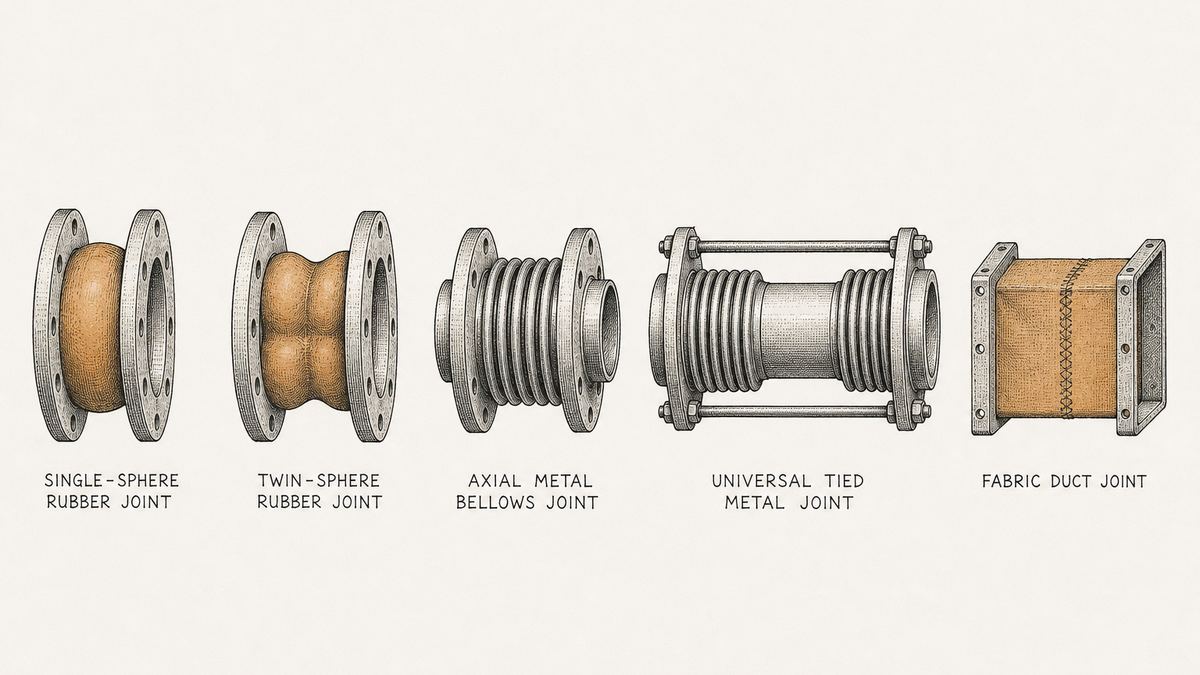
A single sphere rubber joint is one moulded rubber bulge with a flange at each end. It takes movement in any direction, which is its great strength, and it does it with no metal moving parts to fatigue. It is the cheapest way to give a pipe run some give, and it is the right answer for water, air, mild chemicals and the suction and discharge of pumps. Its limits are set by rubber: a temperature ceiling, a pressure ceiling, and a tendency for the rubber to swell or harden in the wrong product. It also does not tolerate being used to pull two misaligned pipes together, because the rubber will hold the strain for years and then split.
A twin sphere rubber joint has two bulges and is the version to choose when the movement is larger or when the two pipes do not line up. The second bulge roughly doubles how much the joint can move for the same length, and it lets the joint take a sideways offset without putting the whole movement into one thin section of rubber. On a pump connection where the pipework will never be perfectly set out, a twin sphere joint is often the honest engineering answer even though it costs more.
An axial metal bellows joint is a stack of thin metal folds between two pipe ends, almost always with a smooth sleeve running through the middle. It is built to move along its own axis — to get slightly longer and shorter — and that it does extremely well, at high temperature and high pressure, for a very long time. What it will not do is bend sideways or take an angle without damaging itself, because a bellows absorbs movement by flexing its folds, and folds that are asked to bend are being worked in a way they were not designed for. If your pipe run needs sideways movement on a metal joint, the answer is a different joint, not a longer bellows.
A universal tied metal joint is the answer to that problem. It has two bellows separated by a length of pipe, and long tie rods run between the two end flanges. Because the rods hold the ends at a fixed distance apart, the joint can bend and shift sideways in the middle instead of stretching, and it does so with the rods taking the pressure load rather than the bellows. That last point is important and easy to miss: a tied joint does not push the pipe apart, because the rods carry the force. A joint without rods does push the pipe apart, with a force that is the pressure inside it multiplied by its area, and somebody has to design the anchors for that force. Alongside the tied version there are the hinged and gimbal types, one of which allows movement in a single plane by using a pin as the pivot, and the other movement in two planes by using a ring, and which are used in sets of two or three to let a whole pipe run move in a controlled way.
A fabric expansion joint is a sewn belt of industrial cloth in a metal frame, and it exists for the jobs where nothing rigid would survive: the huge rectangular ducts of a boiler, a furnace or a dust system, where the ducting expands by a great deal and weighs tons. It is not a pressure part in the usual sense, it is often several metres across, and its whole design problem is heat and the fabric. It is a completely different product from the other four and it is made by a different workshop, so it belongs in a different enquiry.
Two buying consequences follow from that list. The first is that movement type is the specification, not the price. If two quotations differ by a factor of three for the same bore size, the reason is usually that one of them is a rubber joint and the other is a tied metal joint, and the two are not alternatives at any price. The second is that the accessories are part of the product. Tie rods, limit rods, inner sleeves, gimbal rings and reinforcing rings are not extras added to make a quotation look full; they are what makes one joint able to do a job and another unable to. A quotation that lists a joint and nothing else is a quotation for the simplest possible version of that joint.
Inside the Joint: the Parts That Move and the Parts That Stop It Moving Too Far
An expansion joint is a small number of parts, and only one of them is meant to flex. Knowing the names is what turns “one expansion joint, 200 mm” into something a factory can build and you can inspect.
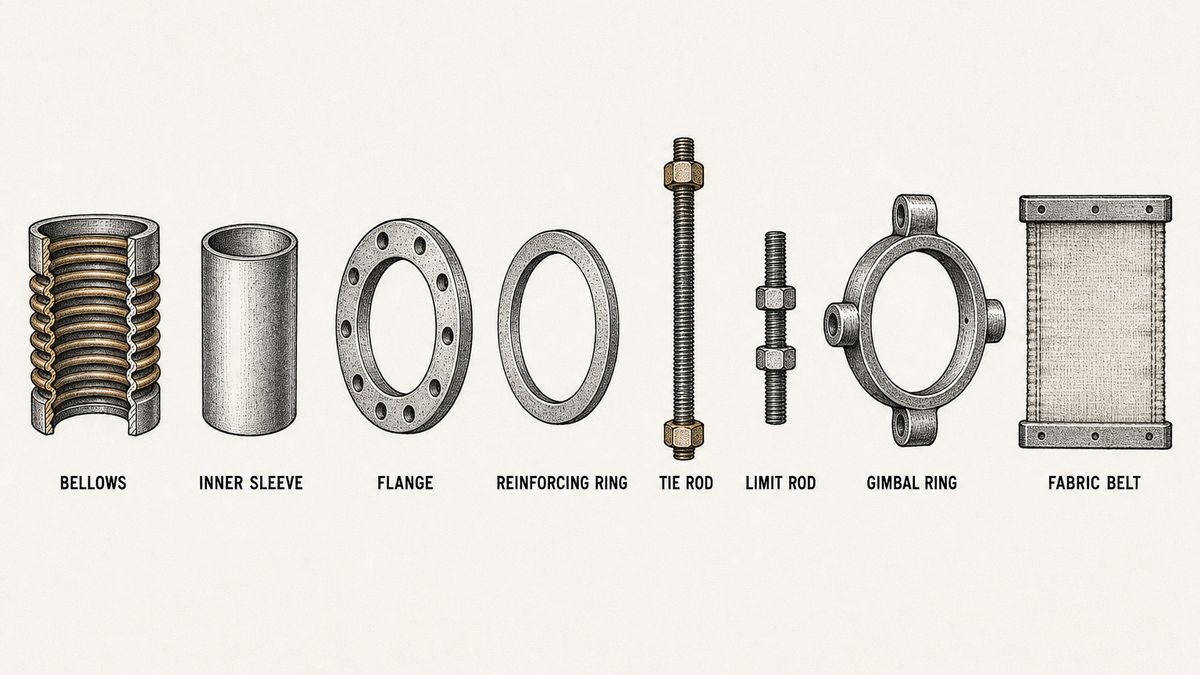
The bellows is the flexible element, and on a metal joint it is a thin-walled tube formed into a stack of folds. Each fold is a hinge, and the joint moves by opening and closing the folds rather than by bending. On a rubber joint the equivalent part is the moulded rubber body, and the way it moves is completely different: rubber stretches, so a rubber joint absorbs movement by its whole body deforming. That difference is why a rubber joint takes movement in every direction and a bellows only takes it in one.
The inner sleeve is a smooth tube inside the bellows. It does two jobs. It keeps the flowing product away from the folds, so an abrasive or fast-moving fluid cannot erode the thin wall, and it stops the space between the folds filling with solids, which would lock the joint solid. A sleeve also cuts down noise and vibration. It is not universal: a sleeve restricts how far the joint can compress, so on a joint that has to move a long way the sleeve is shortened or left out. It also has a direction, and a sleeve fitted the wrong way round will either block the movement or catch the flow.
The flanges are the end connections, and on a rubber joint they are usually separate metal rings that the rubber body is moulded around rather than being welded to it. That construction is worth understanding because it is what makes the part strong in tension: the rubber laps over a metal ring, and the pressure trying to push the joint apart is resisted by the rubber pulling against that ring. On a metal joint the flanges are welded to the ends of the bellows or to short pipe stubs, and the weld is a place a joint can fail if the bellows wall is thin and the weld is done badly.
Reinforcing rings are flat metal rings fitted into the outside of some of the folds on a bellows. They stop the folds from bulging outward under pressure, which is what lets a thin bellows hold a high pressure without making the wall thicker and therefore stiffer. A bellows with reinforcing rings on alternate folds can take considerably more pressure than the same bellows without them, and the rings are one of the things a cheap quotation quietly leaves out.
Tie rods are the long threaded rods that run between the two end flanges of a tied joint. They hold the ends at a fixed distance apart and carry the pressure load, which means the joint does not push the pipework apart and the anchors do not have to be designed for that force. They also convert the joint from an axial one into a lateral one, because the ends can no longer move closer together. A limit rod is a shorter version of the same idea with two lock nuts on it, and its job is to stop the joint travelling too far rather than to carry a continuous load. Both are set to a length, and the setting is part of the specification: a limit rod set too long does nothing, and one set too short takes the movement the joint was bought for.
A gimbal ring is a heavy ring with two pairs of pivots set at right angles to each other, and it is what allows a metal joint to take movement in two planes instead of one. Gimbal joints are used in sets, usually three or four of them along a pipe run, with each one allowed to pivot. They are the parts that let a long, hot pipe run move without any single joint being asked to do more than it can.
The fabric belt is the flexible element of a fabric joint: layers of woven cloth, often with a heat barrier and a gas-tight layer, sewn into a belt and clamped into metal frames at each end. There is no bellows and no rubber, and the whole part is designed around the temperature of what is inside the duct and the movements of a very large, very light structure.
The Movements a Joint Has to Absorb, and Why Most Only Do One
This is the technical heart of the whole job, and it is where the cheapest mistake gets made, because a joint that is asked to take the wrong kind of movement does not fail immediately. It fails after a year, in the middle of a production run, and by then nobody remembers what was specified.
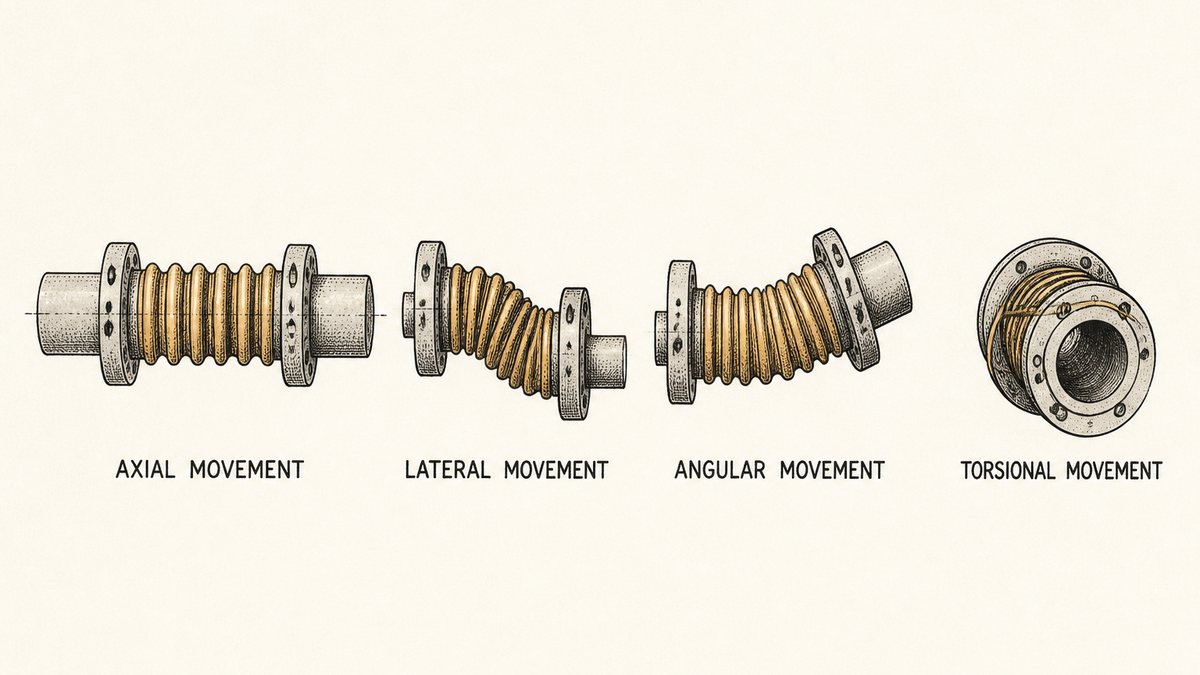
Axial movement is the joint getting longer and shorter along its own axis. It is what a pipe run does when it heats up and what a bellows is built for. A metal bellows takes a large axial movement and almost nothing else, which is exactly why the plain axial bellows is the most common metal joint and also the one most often misused.
Lateral movement is the two pipe ends staying parallel but shifting sideways relative to each other. A single rubber joint does this comfortably by deforming, and it is why rubber joints are the usual answer where the pipework was never going to line up. A metal joint needs two bellows with a length of pipe between them to do the same thing, because one bellows cannot shift sideways without bending its folds.
Angular movement is one pipe end tilting relative to the other, so the two flanges are no longer parallel. A rubber joint takes a surprising amount of this. A metal joint needs a hinge or a gimbal to do it safely, because the alternative is a plain bellows bending, and bending folds is what tears them.
Torsional movement is the joint being twisted about its own axis, and it is the one buyers forget exists. Rubber takes some of it. A metal bellows takes almost none and will crack if a fitter uses the joint as a coupling to rotate a pipe into line. If a joint is on a run where anything might rotate, say so on the drawing, because the honest answer may be that a metal joint is the wrong part.
Four questions turn that description into something a factory can build to.
How much movement, in which direction, and how often? A joint is sold with a movement rating, and the rating is not a single number — it is a number in each direction, and it comes with a number of cycles attached. Those two figures are tied together and the tie is brutal: a bellows that will take a large movement a thousand times will take a small movement a million times. So “it has to move 20 mm” is not a specification. “It has to move 20 mm axially, about once a day, and it has to last twenty years” is a specification, and it lets the factory choose a bellows with the thickness and the fold shape that will actually do it.
What length is it installed at? Every joint has a free length, which is the length it sits at with nothing pulling or pushing it, and an installed length, which is the gap in the pipe it is bolted into. If the two are the same, the joint can move equally in both directions. If the pipe gap is shorter than the free length, the joint is installed already squashed and has lost compression travel; if the gap is longer, it is installed already stretched and has lost extension travel. That is the single most common installation error on this part, and it is measured with a tape before the bolts are tightened.
Is the joint allowed to be pre-set? On a hot pipe run the run will grow in one known direction, so a joint can deliberately be installed pre-compressed, which gives it more room to extend as the pipe heats. Doing that doubles the available travel in the direction that matters. Doing it on a run where the direction is not known is worse than not doing it at all, because it halves the travel that is available the other way.
Will the joint be used to pull anything into line? The answer must be no. Two flanges have to be set parallel and close enough together that the joint goes in without being forced, and the pipework has to be supported until the joint is bolted up. A joint that was stretched or twisted to reach its flanges is a joint that starts its life with an internal load, and that load is taken out of the movement it was bought for. It is worth looking at this from the buyer's side as well: a run that does not line up is a fabrication problem, and the cheapest place to fix it is at the pipe shop, not at the joint. If the run also has to connect to a pump, the alignment question gets more serious still, and it is worth reading alongside this guide to sourcing a a screw pump on the same duty, where the drive alignment and the suction line are treated as part of the machine rather than as pipework.
Anchors, Guides and Why the Pipe Has to Be Held
This is the section to read twice. More expansion joints are destroyed by the pipework around them than by anything the factory got wrong, and the mechanism is simple: a flexible part only moves if the rigid parts on either side of it are held still.
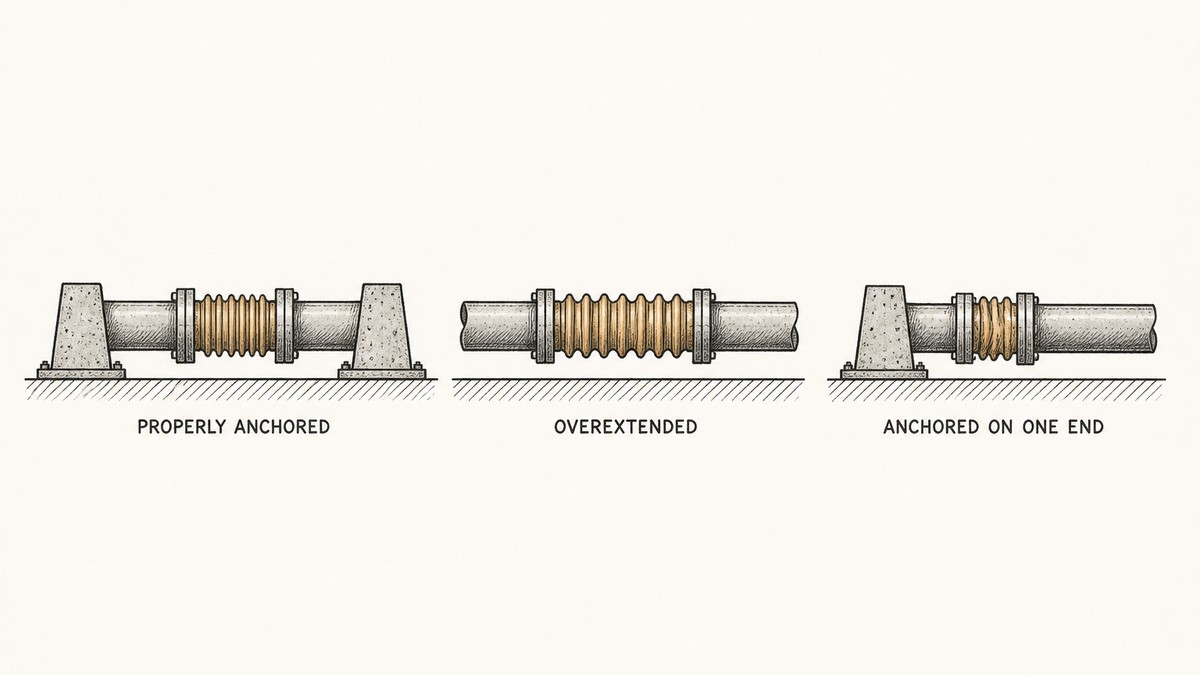
An anchor is a point where the pipe is fixed to the structure and cannot move. A run with a joint in the middle and an anchor at each end behaves: the pipe on each side of the joint grows toward the joint, the joint closes up a little, and nothing else happens. Take the anchors away and the whole run grows and shoves against whatever is at the far end — if there is a joint in the line, the run simply travels along and the joint is stretched or squashed into a shape it was never built for. The joint did not fail to absorb the movement. It was never given the movement to absorb.
A guide is a loose collar that lets the pipe slide but stops it wandering. The first guide belongs close to the joint, on the same side as the anchor, and its job is to stop the pipe bending sideways right next to the joint. Without it, the first thing to give under any side load is the flexible part itself, and the joint starts doing a bending job instead of an axial one. The second guide goes further along the run, and additional guides follow after that. The distances depend on the bore, the pressure and the joint, so the honest instruction is to ask the joint supplier for the guide spacing for the specific joint rather than to copy a number from another line.
The pressure thrust is the force most buyers have never heard of, and it is the one that breaks steelwork. A bellows is a pressure vessel with a soft middle. The pressure inside it pushes the two ends apart with a force equal to the pressure multiplied by the area the bellows acts on, and on a large bore at ordinary working pressure that force is measured in tonnes. On an untied joint, those tonnes have to be carried by the anchors. If nobody designed the anchors for them, the anchors bend, the pipe walks, and the joint is blamed. The number grows fast with bore size, which is why a small joint on a low-pressure line can be anchored with a bracket and the same joint at a bigger bore on a higher pressure needs real structural steel.
A tied joint changes the anchor design completely, and this is where buying the joint and designing the pipe must be done together. If the tie rods carry the pressure load, the anchors do not have to. If the rods are omitted, added later or set wrongly, the whole pressure load lands back on the anchors, which were sized on the assumption that it would not. That is why the tie rod decision belongs on the same drawing as the anchor detail, and why a buyer who changes a joint type after the pipework is designed is creating a structural problem rather than a purchasing one.
Three habits keep all of this straight. Draw the anchors and guides on the pipe layout, not in a note. Ask the joint supplier to confirm the anchor and guide arrangement for the joint they are quoting — a real manufacturer will do this and a trader will not. And never let the joint be the thing that pulls a run into position, because the one force it cannot take is the force of a fitter with a spanner teaching a pipe run to be straight.
Rubber Joints: What the Elastomer Has to Do
A rubber expansion joint is a composite: a rubber body, usually with fabric layers buried inside it, moulded around two metal flanges. Its behaviour is set almost entirely by things you cannot see from outside, which is why the specification has to name them.
The elastomer decides what the joint can carry. There is no best rubber; each one wins on some products and fails on others, and choosing the wrong one produces a joint that swells, hardens or dissolves over a few months.
EPDM is the water rubber. It handles hot and cold water, steam at moderate temperature, and a wide range of acids and alkalis, and it is the default for heating, cooling and water treatment. It is poor with oils and solvents, which is the mistake most often made when a plant standardises on one joint type and then uses it on an oil line.
Nitrile is the oil rubber. It handles oils, greases, fuels and many solvents, and it is the right answer on a fuel line or anywhere oil might reach the joint. Its weaknesses are weather and heat, and it is not the one for a hot acid.
Neoprene sits between the two. It has reasonable oil resistance and reasonable weather resistance, which makes it the general-purpose choice where nothing is extreme.
Butyl is chosen for hot water and steam service and for some chemicals, and it holds up better than EPDM where the temperature is high and the medium is not friendly.
Silicone and fluoroelastomer cover the hard cases: silicone for high temperature with low strength demands, fluoroelastomer for aggressive chemicals and higher temperatures. Both cost several times more, and both are usually specified for a reason rather than as an upgrade.
White nitrile and EPDM for food and drinking water are grades made without the ingredients that would taint a product, and they come with the paperwork described in the following section. A joint on a food line is not simply a clean joint; it is a joint made from stated ingredients.
How the body is built matters as much as the rubber. The pressure rating of a rubber joint is set mainly by the fabric layers buried inside the rubber, and by how many of them there are. Each layer of reinforcing cloth adds strength, and the number of layers is what a factory counts when it decides what pressure a joint is good for. It is also invisible from outside and it is the easiest thing in this whole product to reduce without the buyer noticing, so ask for the ply count in writing.
Whether the flanges turn is a small detail that saves an afternoon. A rubber joint can be supplied with fixed flanges or with floating flanges that rotate freely before the bolts are tightened. A rotating flange lets you line up the bolt holes without twisting the rubber body, which is exactly the kind of force that damages the part. On a retrofit, floating flanges are worth asking for.
Vacuum service needs its own part, and this is the trap that catches people. A rubber joint on a suction line is being squeezed inwards by the atmosphere rather than pushed outwards by the product, and a plain rubber bulge will collapse inward and fail. The answer is a joint with a vacuum support ring — a metal ring moulded into the body — and it must be asked for by name. A joint bought for a pressure duty and installed on a suction line will fail, and it will look like a manufacturing fault when it does.
Metal Bellows: Folds, Plies and the Fatigue Life Nobody Asks About
A metal expansion joint is a much more precise part than a rubber one, and almost all of its behaviour is decided by three numbers that are printed on any proper quotation and missing from most cheap ones: the wall thickness of the bellows, how many layers that wall has, and the movement the joint is rated for at a stated number of cycles.
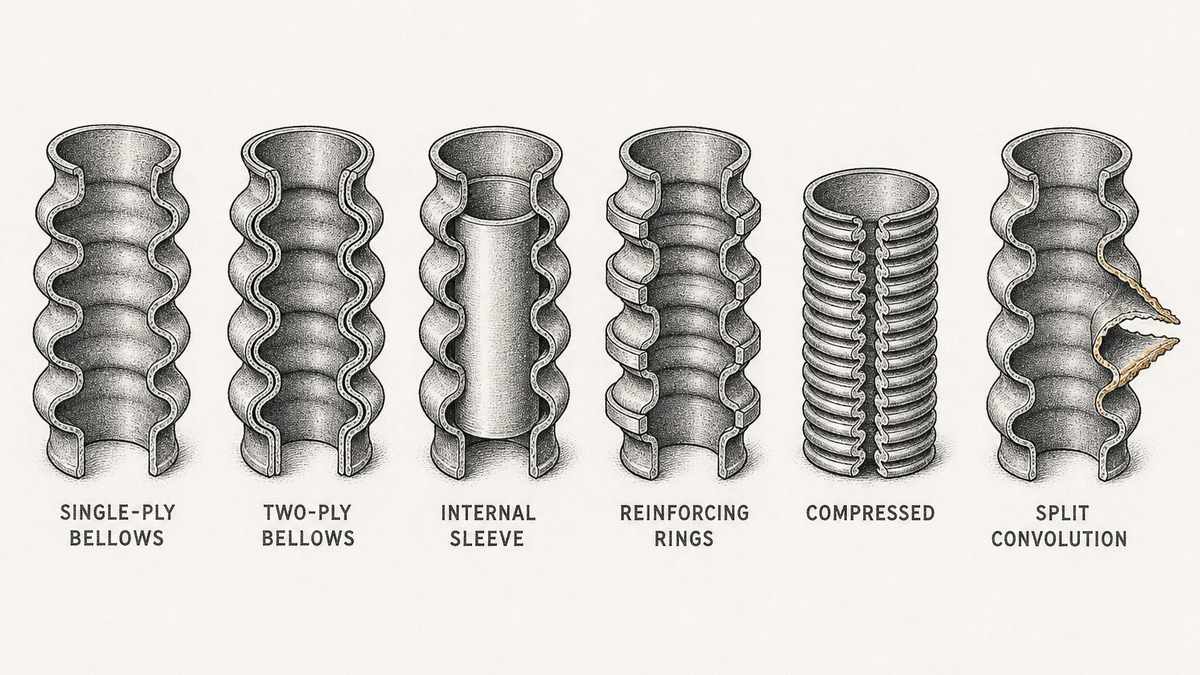
The material is chosen for temperature and corrosion, and the usual list runs from ordinary stainless through to the heat-resistant and high-nickel grades. Ordinary stainless covers the great majority of industrial duties. Where the temperature is high or the medium is aggressive, the bellows material moves up to one of the stabilised or nickel-rich grades, and the price moves with it. What matters to a buyer is that the material is named as a specific grade on the quotation rather than as “stainless”, because stainless covers a very wide range of behaviour and cost.
Single-ply and multi-ply is the decision that most directly trades strength against flexibility. A single layer of metal is more flexible for a given thickness, which is good for movement but limits the pressure it can hold. Two or more thin layers bonded into one wall give more pressure capability while staying flexible, because each layer is thin and the stack is strong. A thicker single wall is the cheapest way to reach a pressure rating, and it is also the stiffest, which means it takes more force to move and fatigues faster for the same movement. This is why a joint that meets the pressure figure on a cheap quotation may have a fraction of the fatigue life of the one it is being compared against.
Fatigue life is the real specification and it is barely ever asked for. A bellows does not fail because the pressure bursts it — it fails because the folds are opened and closed enough times to crack. The number of cycles it will take depends steeply on how far it is moved each time, and the relationship is unforgiving: a joint pushed to its full travel every hour will not last a year, while the same joint moving a tenth of that distance may last decades. So the useful question is not “how much movement will it take” but “how much movement will it take, how many times, at my pressure and temperature”. A supplier who can answer that from a table is a manufacturer. A supplier who answers with a single travel figure has given you the number that sells joints.
The inner sleeve, the cover and the reinforcement are the three optional parts that decide how long the joint lives in an awkward duty, and they were described in the components section. The one to remember here is that a bellows wall is the thinnest thing in the pipe run. It can be destroyed by a weld spatter during installation, by a careless knock with a scaffold tube, and by the grit that a bare fold will collect. That is what the cover is for, and on an outdoor or construction-site installation it is money well spent.
Fabric Joints: a Different Product Made by a Different Workshop
A fabric expansion joint is worth its own short section because buyers include it in the same enquiry as metal and rubber joints, and it does not belong there. It is a sewn belt of industrial cloth clamped into two metal frames, and it exists for the jobs where the ducting is enormous, the temperature is high, and the structure around it is light.
The typical duty is the flue or exhaust duct of a boiler, a furnace, an incinerator or a large dust system. The duct may be a metre or two across and rectangular, it may run at several hundred degrees, and it grows by a startling amount when it gets hot. Nothing rigid survives that, so the joint is a belt that simply folds out of the way. It is not a pressure part, so it is not sold on pressure; it is sold on temperature, on the size of the opening, on the movement it has to take, and on what is in the gas.
Four things set the specification. The temperature decides which cloths can be used and how many heat barriers go into the belt. The gas decides whether the belt needs a chemical-resistant layer and whether condensation will form in it, because a fabric that is fine dry can rot quickly when wet with an acidic condensate. The movement decides how much slack the belt is given and how it is folded, since a belt absorbs movement by having spare material rather than by stretching. The frame decides how the belt is clamped, and a clamping bar with a sharp edge will saw through the fabric at the fold line over a few hundred cycles.
The buying point follows from the same logic as the rest of this article. A fabric joint is specified by temperature and duct size, not by bore and pressure, so it should be enquired for separately and from a workshop that sews industrial fabric. If a metal joint factory quotes you a fabric joint, expect a price for a metal joint with cloth on it.
The Rules a Marine Expansion Joint Must Meet, and What They Teach a Land Buyer
An expansion joint is one of the few industrial parts with almost no federal safety rule written for it on land. The piping codes that govern it in a factory — principally the ASME pressure piping codes — are sold rather than published free, and this article does not quote figures from them. But there is one place where an expansion joint is regulated in hard, readable detail, and it is not a factory. It is a ship.
The United States Coast Guard writes the rules for piping on inspected vessels, and two of their provisions cover expansion joints closely enough to be genuinely useful to anybody buying one. They are worth reading for three reasons: they are free to read, they are unusually specific, and they answer questions that a land buyer would otherwise have to guess at.
The first rule says an expansion joint is a last resort. 46 CFR 154.506 deals with mechanical expansion joints in a piping system outside a cargo tank, and it sets three limits. Such a joint may be installed only if offsets, loops or bends cannot be installed because of limited space or the arrangement of the piping. It must be a bellows type. And it must not have insulation or a cover unless that is necessary to prevent damage.
Read those three lines the way a buyer should. The first says that a pipe run which can be laid out with a bend in it does not need a joint at all, and that is true on land as much as at sea — a loop of pipe is free, never wears out and has no seals. If a joint is being bought because the layout was never given room to move, the honest fix may be at the pipe shop. The second says that where a joint is used, the flexible element is expected to be a formed bellows rather than something improvised, which is a useful line to hold when a supplier offers a fabricated flexible section. The third is the one that surprises people most. A cover on a bellows has two effects: it hides the joint from the person who is supposed to be looking at it, and it traps whatever is in the space around the folds. The rule allows a cover only where it is there to stop physical damage, which is exactly the trade a land buyer should make deliberately rather than by accident.
The second rule is a maintenance regime, and it is the most useful thing in this section. 46 CFR 61.15-12 covers nonmetallic expansion joints, which is the marine name for a rubber joint, and it requires them to be examined externally at each inspection for certification and each periodic inspection for a specific list of faults: excessive wear, fatigue, deterioration, physical damage, misalignment, improper flange-to-flange spacing, and leakage. It then says that a complete internal examination must be carried out whenever the external examination finds excessive wear or other signs of deterioration or damage. And it sets a hard life limit: a nonmetallic expansion joint must be replaced ten years after it was placed in service if it is in a system which passes through the side of the vessel and both the joint and the opening are below the deepest load waterline, with the Officer in Charge able to extend that only to the vessel's next drydocking.
Three things come out of that, and all three transfer to a factory. First, that list of seven faults is as good a pre-commissioning check as you will find — wear, fatigue, deterioration, physical damage, misalignment, wrong spacing between the flanges, and leakage cover essentially everything that goes wrong with a rubber joint, and the two entries that a buyer would never think of are the last two. Second, the rule treats “wrong flange to flange spacing” as a defect in its own right, which tells you how seriously the wrong installed length is regarded by people who watch these parts for a living. Third, it puts a calendar limit on a rubber joint regardless of how it looks, and while ten years in a submerged seawater system is not the same duty as ten years in a plant room, the principle is worth adopting: a rubber joint that has been in service for many years is a planned replacement, not something to be discovered.
The third rule is about paperwork, and it is the one to copy straight into an order. 46 CFR 56.60-1 sets out which material specifications are acceptable for piping components on a vessel. Materials have to be selected from an adopted list of published specifications — among them particular ASTM pipe and tubing standards and the ASME piping and boiler codes — or from a small number of named alternatives. Anything conforming to a specification that is not on the list requires the specific approval of the Marine Safety Center. And the rule states plainly that materials listed in a certain table of the ASME piping code are not accepted unless the section permits them.
That is a long way of saying something a buyer can use in one line: name the specification, not the material. “Stainless steel” is not a specification, it is a family. “Stainless, according to this named standard, with a certificate” is a specification. A rule that demands a specific approved standard, and sends everything else for individual approval, is telling you that the difference between two parts made of what looks like the same metal can be the difference between accepted and rejected — and on land it is the difference between a joint that lasts and one that cracks.
One honest limit belongs at the end of this section. These are United States Coast Guard rules for inspected vessels. They do not apply to a factory on land, and this article does not pretend that they do. What they give a land buyer is a free, specific and unusually practical view of the same part, written by an authority with no interest in selling joints — and, if the joint is going into a marine or offshore system, they are not guidance at all but the rule.
Flanges, Materials and the One Line That Decides Whether It Fits
The most common way an expansion joint fails on arrival is not a defect. It is that it does not bolt up, because the flange on the joint and the flange on the pipe are drilled to different standards.
The flange standard has to be named and matched. A pipe flange is a standardised part with a defined outside diameter, a defined bolt circle, and a defined number and size of bolt holes, and the standards differ by region and by industry. Two flanges of the same stated bore from two different standards will not bolt together, and the fact that both are described as the same size makes the problem worse rather than better. So a joint order should state the standard as well as the bore, and on a retrofit it should also state the bolt hole count and the bolt circle, because the safest way to specify a flange you already own is to measure it.
The facing has to match too. A flange can be flat faced or have a raised face, and the two are not interchangeable; a rubber joint usually seals against a flat or raised face with its own rubber face, while a metal joint has a raised face or a plain face that expects a gasket. Getting the facing wrong produces a joint that will not seal however hard the bolts are pulled, and pulling harder is what distorts the flexible element. If your pipe flanges and your joint come from different places, this is the detail to check with a photograph before the order is placed. The standards, facings and drillings that pipe flanges are made to are set out in this guide to a pipe flange.
The wetted materials are three separate decisions: the flexible element, the flanges, and anything the product touches inside. A rubber joint has a rubber body with metal flange rings, and the flange rings are often plain carbon steel with a paint or plating finish. A metal joint has a stainless bellows, and its flanges and pipe ends may be carbon steel, which is cheaper and perfectly adequate for many duties but which will rust where it is not painted. On an aggressive product the answer is stainless throughout, and that is a line on the order rather than an assumption.
Bolting and gaskets are part of the delivery. Bolts can be the wrong length, the wrong grade or the wrong material, and on a stainless flange a carbon steel bolt is a corrosion point waiting to happen. Ask whether the joint is supplied with its bolts and gaskets, and if it is not, decide who is buying them before the crate arrives. On a metal joint the joint itself is the gasket, so the answer is different from a rubber one — which is the sort of small mismatch that strands an installation for a day. Where the joint sits next to a valve or a fitting, the same matching question applies to those parts, and the connection standards for fluid power fittings are covered in this guide to the fittings on an expansion joint.
Surface finish and marking are the last practical lines. A metal bellows should arrive unpainted, because paint in the folds hides cracks and can itself crack and hold moisture. The flange faces should be clean and free of paint for the same reason. And the joint should be marked with its size, its material and its movement or pressure rating, so that the person who takes it out of the crate in five years has some chance of knowing what it is.
Installing It So It Lasts, and the Five Things Fitters Do Wrong
An expansion joint is one of the few parts where the installation decides more than the manufacture. The faults below are made in ten minutes by somebody who is not being careless, and each one takes a year to show up.
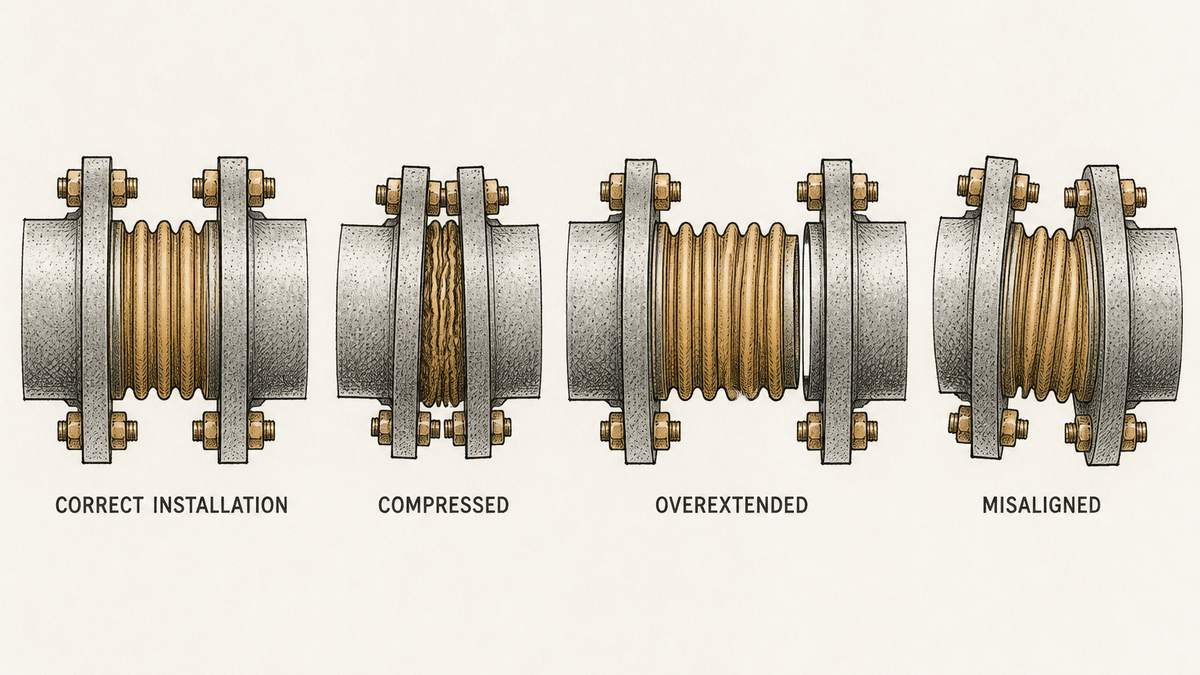
The joint is used to pull the pipes together or push them apart. This is the worst of the five and the most common. The pipe ends are too far apart, so the fitters draw them up with the bolts and let the flexible element take the strain. The joint holds it, because it is strong, and it holds it for years while it quietly loses the travel it was bought for. The pipework has to be set to the right gap and supported before the joint is offered up, and the joint has to go in with the flanges parallel and the bolt holes lined up. If it will not go in without force, something upstream is wrong and the joint is not the tool to fix it.
It is installed at the wrong length. Every joint is built for a particular gap, and a gap that is too wide stretches it while a gap that is too narrow squashes it. Either way the travel in that direction is gone before the pipe has even warmed up. The check takes a tape measure: measure the gap between the pipe flanges before the joint goes in, measure the joint, and compare with the face to face length on the order. This is also the moment to record the installed length, because it is the number you will want in two years when it is time to decide whether the joint has moved.
The transit restraint is left in, or taken out when it should not be. A rubber joint is usually shipped with metal bars or blocks holding it at its built length so it does not get knocked out of shape in transit, and those must come off before the joint goes into service, or the joint is effectively a rigid spool. A tied metal joint is the opposite case: its tie rods are load rods and they stay. Getting these two the wrong way round produces either a joint that cannot move at all or a pipe run whose anchors are carrying a pressure load nobody designed for.
It is welded near, painted, or insulated. A bellows wall is thin, and weld spatter from a nearby joint will burn a hole in it. The joint belongs out of the pipe while the surrounding welds are made, or protected. Paint in the folds hides cracks and should not be there. Insulation over a bellows has the same problem plus a worse one, which is that it traps moisture against thin stainless steel and can corrode it from the outside until it fails without ever having been moved hard. The marine rule described above forbids a cover on a bellows unless it is there to prevent physical damage, and the reasoning is exactly this.
The bolts are tightened in the wrong order, or not re-checked. Bolts on a flange are tightened in a cross pattern in stages so that the flanges come down evenly, and the flexible element is not twisted as the load comes on. A joint bolted up one side first is being twisted by its own flange, and every joint in this article is weaker in torsion than in any other direction. Then, after the line has been commissioned and has been through a full temperature cycle, the bolts should be checked again: a joint that has settled and left four loose bolts will leak at the flange and be blamed for a manufacturing fault. Pipework next to a pump is the awkward case and worth treating as part of the machine rather than as pipe, and on a run where a valve sits close to the joint, a ball valve is the neighbour whose bolts are most often disturbed, so this guide to a the ball valve on the line is worth reading alongside it. Where a flexible connector is being used to isolate vibration rather than to absorb movement, the material question is different again and is covered in this guide to the hose fitted to an expansion joint.
Inspecting and Testing an Expansion Joint Before It Ships
An expansion joint is a part where the two things that decide its life — the wall thickness of the bellows and the number of fabric layers in the rubber — are both invisible once the part is finished. That makes the paperwork as important as the visual check, and it makes the sample worth keeping. The wider sequence, and how much of a shipment to inspect, is set out in this guide to checking a shipment before it leaves.
Measure the face to face length first. This is the dimension that decides whether the joint will go into the gap that exists in your plant, and it is the one a factory is most likely to deliver differently from the drawing, because it is easy to make a joint a little longer or shorter and assume nobody will notice. Measure it relaxed, with any transit restraint off if you are allowed to remove it for the check.
Check the flange against the standard you ordered, not against the size. Measure the outside diameter, count the bolt holes, measure the bolt circle and the hole size, and check whether the face is flat or raised. A joint that is the right bore and the wrong drilling is scrap for your project, and it is the single most common reason an imported joint will not bolt up.
Look at the bellows with the part out of the crate and on a bench. The folds should be even, with a consistent pitch and no dents, no tool marks, no scratches deep enough to catch a fingernail, and no weld spatter. Look closely at the welds where the bellows meets the end fittings, because a thin wall welded badly is where a metal joint fails first. If the joint is supplied with a cover or an inner sleeve, check that the sleeve is present, that it is the length ordered, and that it does not block the movement the joint is supposed to have.
Confirm the material and the ply count from the certificate, not from the surface. A bellows that is one layer of thin metal and a bellows that is two layers of the same total thickness look identical from outside and behave nothing alike. The way to check is to ask for the material certificate with the wall thickness recorded per layer, and for the same certificate to name the grade of the bellows material and of the flanges. If the supplier can produce that document quickly, the ply count is almost certainly what was ordered. If the answer is a verbal assurance, treat the joint as the cheaper of the two possibilities.
On a rubber joint, look at the rubber and at the bond. The body should be smooth and evenly coloured with no wrinkles, no visible seam running across the working part, no soft patches and no bubbles. The metal flange rings must be firmly bonded into the rubber with no gap you can push a fingernail into, because a joint whose rubber has separated from its ring will leak at pressure and cannot be repaired. Ask for the elastomer grade in writing and, where the duty is food, drinking water or a chemical, for the certificate behind it. Ask for the ply count in the same document, since the fabric layers inside are what set the pressure rating and they cannot be counted from outside.
Check the accessories against the order, item by item. Tie rods present in the right number, with nuts that turn freely and a stated setting. Limit rods present with their lock nuts. Vacuum support ring present if the joint is for a suction line. Transit restraint fitted for shipping, and documented, so that the fitter who opens the crate in your plant knows it is there to be removed rather than part of the joint.
Ask for a pressure test report. A metal joint is normally pressure tested at the factory, and the report should state the test pressure and whether the joint was tested with the bellows restrained, because testing a bare bellows without restraint overloads it. A rubber joint is usually tested at a lower pressure and inspected visually. A factory that can produce a test report is a factory with a test rig, and that is worth knowing about a supplier before the batch is loaded rather than after.
Measure the movement by hand before you accept it. A small joint can be gently worked through part of its stated travel on the bench to confirm it moves freely and returns. It is a crude check, it cannot confirm the rating, and it will not tell you anything about fatigue life — but it catches a joint that has been delivered locked solid by a mis-fitted inner sleeve or a transit bar nobody meant to leave in.
Two habits make the rest of the list work.Retain one sample from the first delivery, in writing, as the reference the rest of the order is measured against — the only check that catches a substitution you cannot see. And put the invisible items on the specification sheet rather than in a message, because ply count, wall thickness and elastomer grade are exactly the details that drift when they are agreed by chat. The structure of that document is set out in this guide to a the part-sheet walkthrough.
The Defects That Show Up in the First Month, and What They Really Mean
An expansion joint that fails early is nearly always telling you something about either a specification that was decided badly or an installation that was done badly, and the visible damage is usually a consequence rather than the cause. Four faults cover most cases.
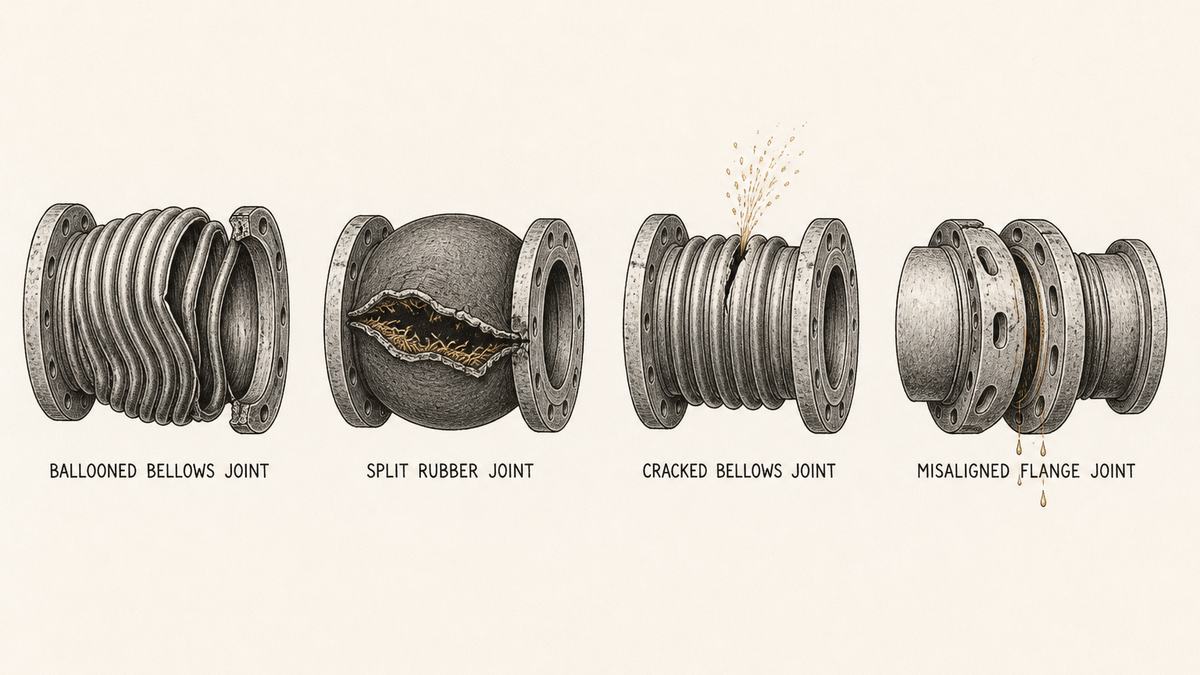
A ballooned bellows, distorted unevenly, is the picture of a joint that was pushed apart. The folds on one side have opened wider than the others and the whole body has lost its regular shape. There are three usual causes and they are worth separating before anybody accuses anybody. If the joint was installed at too short a gap it was already stretched on day one, and the first thermal cycle took it further. If the run has no proper anchors, the pipe has walked and dragged the joint with it. And if the bellows is carrying a pressure well above its rating, whether through a system change or a wrong part, the folds open permanently. The first two are installation and pipe design faults; the third is either a specification error or a supplier who delivered a lower-rated joint than the one ordered, which is where the material certificate settles the argument.
A rubber joint split by a long crack round its middle is usually a material or an age story. A rubber body fails by cracking when the rubber has gone hard or brittle, and that happens for four reasons: the wrong elastomer grade for the product, a temperature above what the grade can take, ozone and sunlight on an outdoor installation in a grade that was not made for it, or simply years of service. The clue is the timing. A rubber joint that splits within weeks on a product the specification named properly points at the grade, and that is a supplier issue with paperwork behind it. The same crack after several years is an expected end of life, and the useful change is to the material rather than to the supplier.
A single convolution cracked clean through is a fatigue failure and it is almost always an installation fault. A bellows fails at the crest of a fold, where the metal is worked hardest, and it fails because that fold has been opened and closed more times, or by more distance, than it was built for. The common causes are an installed length that was wrong in the direction that mattered, a joint being used to take a movement it was not rated for, and a fitter using the joint as a coupling to rotate a pipe into line. That last one leaves a very characteristic mark on the bolt holes, which brings the next fault.
A leaking flange with the two faces out of parallel is the signature of a bolted joint that never mated. The gap is wedge-shaped rather than even, the leak is at the open side, and the bolt holes are often worn oval from bolts being forced through mismatched holes. There are only two ways this happens. Either the two flanges are drilled to different standards, which is a purchasing error made before the order, or the pipe ends were never set parallel and the joint was pulled into position, which is an installation error. Both are avoidable in ten minutes with a tape measure at the right moment, and both are called a leaking joint when they reach the maintenance log.
Six Faults and Which Side Each One Is On
| The fault | What gives it away | Whose side it is on |
|---|---|---|
| Joint arrives longer or shorter than ordered | Face to face length measured against the drawing before installation | The supplier's, plainly, and it is worth rejecting rather than fitting |
| Flange will not bolt to the pipe flange | Bolt hole count or bolt circle differing from the stated standard | The supplier's if the order named the standard; yours if it only named the bore |
| Bellows ballooned unevenly | Folds opened wider on one side, with no history of over pressure | The plant's, unless the certificate shows a lower rating or wall than ordered |
| Single convolution cracked at the crest | A clean crack at the fold crest with the surrounding folds undamaged | The plant's: wrong installed length, wrong movement, or torsion during fitting |
| Leak at the flange, faces not parallel | A wedge-shaped gap and bolts that had to be forced through the holes | The plant's, unless both flanges were supplied to the wrong standard |
| Rubber body split or gone hard | Failure measured in weeks rather than years, on the product named on the order | The supplier's if the grade does not match the stated grade; otherwise age |
The way to use that table is to measure before you accuse. Three of the six rows are settled with a tape measure and the order paperwork, which is a much shorter conversation than a claim. And the row that matters most commercially is the second one, because it is the only failure on the list that the buyer can easily cause alone — by ordering a joint by bore size and forgetting that a flange is a standardised part with a bolt pattern that has to match.
Price, MOQ and Lead Time: What Actually Moves the Number
This article does not quote prices, because an expansion joint price without a size, a material and a movement rating attached to it is not information. What it can do is name the things that move the number, so that when two quotations differ you know which question to ask.
The flexible element and its hidden specification. On a metal joint the price is driven by the bellows material, the diameter, the wall thickness and above all the ply count. A joint with a two-ply bellows can cost several times what a single-ply joint costs at the same size, and the difference is invisible from outside. On a rubber joint the price is driven by the elastomer grade and the number of reinforcing layers, and the same is true: the difference between a general-purpose rubber and a chemical-resistant one does not show in the shape. This is the first place a keen quotation saves money, and it is why the ply count and the grade belong on the order in writing.
The accessories, which are most of the functional difference. An inner sleeve, a cover, reinforcing rings, tie rods, limit rods and a gimbal ring are each a separate line. A quotation that includes none of them is quoting the simplest possible version of the joint, and it may be perfectly correct for your duty. The way to compare properly is to ask for the price with and without each accessory, which also tells you what the supplier thinks each one is worth.
The flange material and the flange standard. A carbon steel flange and a stainless one are different price bands, and an unusual drilling or a non-standard facing adds machining. On a retrofit where the existing flanges are unusual, expect the first order to cost more than the repeat, because the factory is setting up for a one-off.
The movement rating. A joint built to take a larger movement has more folds, or thinner walls, or both, and it costs more. Two quotations for the same size at visibly different prices are often a joint rated for a small movement against one rated for a large one, and the cheaper of the two will fail first on a run that actually moves. Ask for the rated movement in each direction, and for the number of cycles it is rated at.
Testing and paperwork. A pressure test with a report, a material certificate naming the grade and the ply count, and for rubber joints a statement of the elastomer grade, all cost money and all appear as lines on a good quotation. On a joint going into a critical line, that paperwork is the product. On a joint going into a plant room, it may be optional — and asking which of the two you are buying is a fair question to put to a supplier.
Quantity, and how the joint is made. A rubber joint is moulded, so a size the factory has never made needs a mould and that cost sits on the first order whether it is itemised or not. A metal joint is fabricated from tube and sheet, so there is far less tooling and small quantities are much more normal. That is why a single rubber joint in an unusual size can look startlingly expensive while a single metal joint at the same size does not, and it is worth knowing before you conclude that one supplier is much dearer than another.
Three commercial habits are worth more than any price list. Ask for the price at three quantities, because it reveals the mould or setup content immediately and gives you a reference for the spare. Ask what the certificate and the test report add, so that the paperwork is a decision rather than a surprise. And keep one spare of any joint you cannot afford to wait for, because the lead time on a made-to-order metal joint with a certificate is the lead time on a line being down, and the joint itself is a small fraction of what an unplanned stop costs.
Questions Buyers Ask
How do I choose between a rubber and a metal expansion joint?
Start with the movement and the temperature, not the price. A rubber joint takes movement in every direction, tolerates a pipe run that does not line up perfectly, and is the cheaper answer, but it is limited by a temperature ceiling and by the chemistry of the product, and it will collapse inward if it is used on a suction line without a vacuum support ring. A metal bellows takes a large movement along its own axis, survives high temperature and high pressure, and does not care about the chemistry of the fluid, but it takes almost no sideways or twisting movement unless it is built as a tied, hinged or gimbal type. So: misaligned and cool points to rubber, hot or high pressure in a straight run points to metal, and sideways movement on a hot line points to a tied or gimbal metal joint rather than to a longer bellows.
What actually happens if the joint is installed at the wrong length?
It starts its life part way through its travel. A joint has a free length and it is built to be installed at a particular gap; if the gap is narrower than that it is installed already squashed, and if it is wider it is installed already stretched. Either way the travel in that direction is partly used up before the pipe has done anything, so the joint reaches its limit sooner, and the folds that are already open or already closed are the ones that crack first. It costs nothing to avoid: measure the gap between the pipe flanges, measure the joint, compare both with the face to face length on the order, and record the installed length so you can check it again later.
Do I really need anchors and guides, or is that over-engineering?
You need them, and skipping them is the most common reason a joint fails early. A flexible part only absorbs movement if the rigid parts either side of it are held still; that is what anchors do. Without them the whole pipe run simply grows and travels along, and the joint is dragged with it into a shape it was never built for. Guides are the second half of the same idea: a loose collar close to the joint stops the pipe bending sideways right next to the flexible element, which is where it would otherwise bend instead of moving axially. The added complication is pressure thrust: an untied bellows pushes its two ends apart with a large force, and the anchors have to be designed for it. A tied joint carries that force in its rods instead, which is why the joint type and the anchor design have to be decided together.
Why did my expansion joint fail after a year when it was new?
The shape of the damage usually says which of three things happened. A bellows with a single convolution cracked clean through at the crest is a fatigue failure, and the cause is nearly always the installed length being wrong in the direction that mattered, or the joint being asked to take a movement it was not rated for. A bellows ballooned out of shape with its folds opened unevenly has been pushed apart, which means over pressure, missing anchors or a joint installed at too short a gap. A rubber body split by a long crack has gone hard or brittle, which points at the wrong elastomer grade for the product or at a temperature above what that grade can take. And a leak at the flange with the two faces visibly out of parallel is a joint that never mated, usually because the pipe ends were not parallel or because the two flanges are drilled to different standards.
Can I use an expansion joint to pull a misaligned pipe run into position?
No, and it is the single worst thing that can be done to one. A joint fitted while stretched or twisted into line begins service with an internal load already in the flexible element, and that load is taken straight out of the travel it was bought for. Rubber joints hold the strain for years and then split; metal bellows crack a fold. The pipe ends should be set to the right gap with the flanges parallel and supported, and the joint should go in without being forced. If it will not go in, the pipe run needs correcting, and the cheapest place to correct it is at the pipe shop rather than at the joint. A second consequence: a joint is weaker in twisting than in any other direction, so never use it as a coupling to rotate a pipe into line, and check the bolt holes line up before a bolt is started.
How do I check a supplier who says they are a manufacturer?
Ask four things and read the answers. Can they give the ply count of the bellows or the number of fabric layers in the rubber, in writing, and back it with a material certificate naming the grade and the wall thickness per layer. Can they state the movement the joint is rated for in each direction, and the number of cycles that rating is good for. Can they produce a pressure test report from their own test rig. And will they send a drawing before you order showing the face to face length, the flange standard with the bolt hole count and bolt circle, and every accessory they are quoting. A factory answers all four from its own records and sends the drawing quickly. A trader answers the size and the price and refers the rest upstream, which is a perfectly good answer when it is given openly and a warning when it is not.
Send the movement and the pipe gap — not just the bore size
Tell us what the joint has to do, then the lines that decide whether it will: what movement it must absorb and how much, in which direction, and how often it happens over the life you expect; the face to face length of the gap in the pipe, and whether the joint is to be installed at its free length or pre-set one way on purpose; the product, its temperature, its pressure and whether the line can ever be under vacuum; where the pipe is anchored and guided, marked on the layout; whether you want a rubber, metal or fabric joint, or the duty and let us settle the type; the elastomer grade and the fabric layer count on a rubber joint, or the bellows material, wall thickness and ply count on a metal one; the flange standard with the bolt hole count and bolt circle, the facing, and whether the flange material is to be carbon steel or stainless; which accessories are in scope — inner sleeve, cover, reinforcing rings, tie rods, limit rods or gimbal ring — and what length the tie or limit rods are to be set to; the requested marking, packing and transit restraint; and whether you need a pressure test report and a material certificate with the shipment. If a joint is already in service and giving trouble, describe what you see and roughly when it started: whether the bellows has ballooned evenly or on one side, whether a single fold has cracked at its crest, whether the rubber has split in a long crack or gone hard, whether the leak is at a flange and whether the two faces are parallel, and what the bolt holes look like. The pattern of the damage usually says whether the fault is in the part, in the pipe design or in the day it was fitted.
Request an Expansion Joint Sourcing Quote
Questions & Comments
We read every one and reply within 24 hoursMost expansion joint failures come down to ply count, wall thickness and elastomer grade, three things that are invisible once the bellows is built. Tell us the movement, the pressure and the fluid, and we will get those three into writing before the order.