
Pipe Flange Manufacturer: Sourcing Flanges From China
 ·
Updated October 12, 2026
·
17 min read
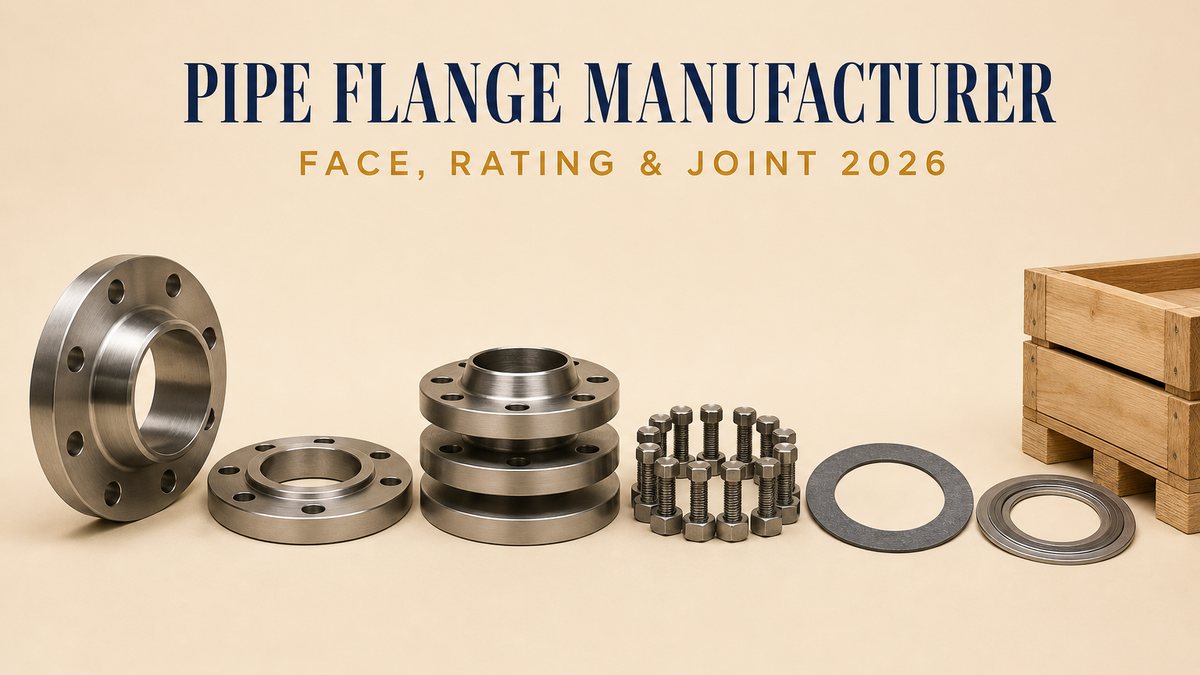
A pipe flange is the one joint in a line that is designed to be taken apart, and that single fact decides everything about buying one. A welded joint does not leak because there is no joint left to leak; a flanged joint exists precisely because somebody has to be able to open the line, and the price of that convenience is a face, a gasket and a ring of bolts that all have to work together. Almost none of that is visible in a photograph, and almost none of it appears on a quotation. What appears is a diameter, a class number and a price. The class number is the part buyers most often get wrong, because a flange class is not a pressure — it is a pressure at a temperature, and the number people quote is the one that applies to the easiest condition. This guide covers the four flange bodies, why the face decides whether the joint holds, what the class number really means, why a correctly made flange still leaks, what the rules require and what the phrase “or the equivalent” lets through, how the price is built, what goes wrong, and how to test a supplier before you commit.
What You Are Buying, and the Line That Decides It
| If you want | What it means in practice | The line on your order that decides whether it works |
|---|---|---|
| A joint that seals at working temperature, not just at ambient | What a flange can hold falls as the temperature rises, and the class number alone does not say by how much | The material, the class, and the maximum operating temperature it is rated for |
| A joint that bolts up without a fight | Bolt holes, the bolt circle, the face type and the face finish all have to match the other side | Dimensions, drilling, face and gasket design — stated, not assumed |
| A joint that passes a leak test | Face finish and flatness are what the seal actually depends on | The face finish and the flatness figure, with the measurement method |
| A flange that is legally usable in a monitored plant | A flanged joint counts as a leak source that gets measured, and a welded one does not | Whether the joint will be monitored, and to what leak level |
| To know that the flange is what you ordered | The steel grade and the heat treatment decide the rating, and neither is visible | The material certificate, and the marking that ties it to the flange |
| A price that survives a second quote | On a flange the money is steel plus machining time, and machining is what gets shaved | The cost lines shown separately, with the blank weight and the machining hours |
What Are You Actually Buying? Four Bodies, and One of Them Has No Hole
The bodies look similar from across a workshop and behave completely differently in a line. The type decides how the flange is joined to the pipe, and that in turn decides how much of the joint the flange itself carries.
Weld neck. The hub tapers into a neck that is butt-welded to the pipe end. Because the material transitions gradually from pipe wall into flange, this is the body that handles pressure, temperature cycling and vibration best, and it is the one specified wherever the joint has to survive repeated thermal movement. It is also the most expensive to make, because it needs a forging with a formed neck and both ends machined.
Slip-on. The pipe slides through a plain hub and is welded on both the inside and the outside of the hub. It is cheaper than a weld neck, easier to fit, and shorter, which matters where space is tight. Its weakness is that both the strength and the sealing depend on the welds rather than on the flange body, so the finished joint is only as good as the welding, and it is a poor choice where the line sees a lot of bending or cycling.
Blind. A solid disc with no bore, bolted onto a flange to close the line. It is the product that exists purely to shut something off, and it is the one that appears in the rules by name, because closing a line with a blind is how the rules expect an open end to be dealt with.
Lap joint. The flange is a loose ring that backs onto a stub end which is welded to the pipe. It rotates, so bolt holes can always be lined up, and the flange can be reused. It is the practical answer where alignment is awkward, and the reason to be careful is that the loose ring carries no pressure at all — the stub end does, and therefore the stub end is the part whose material and thickness matter.
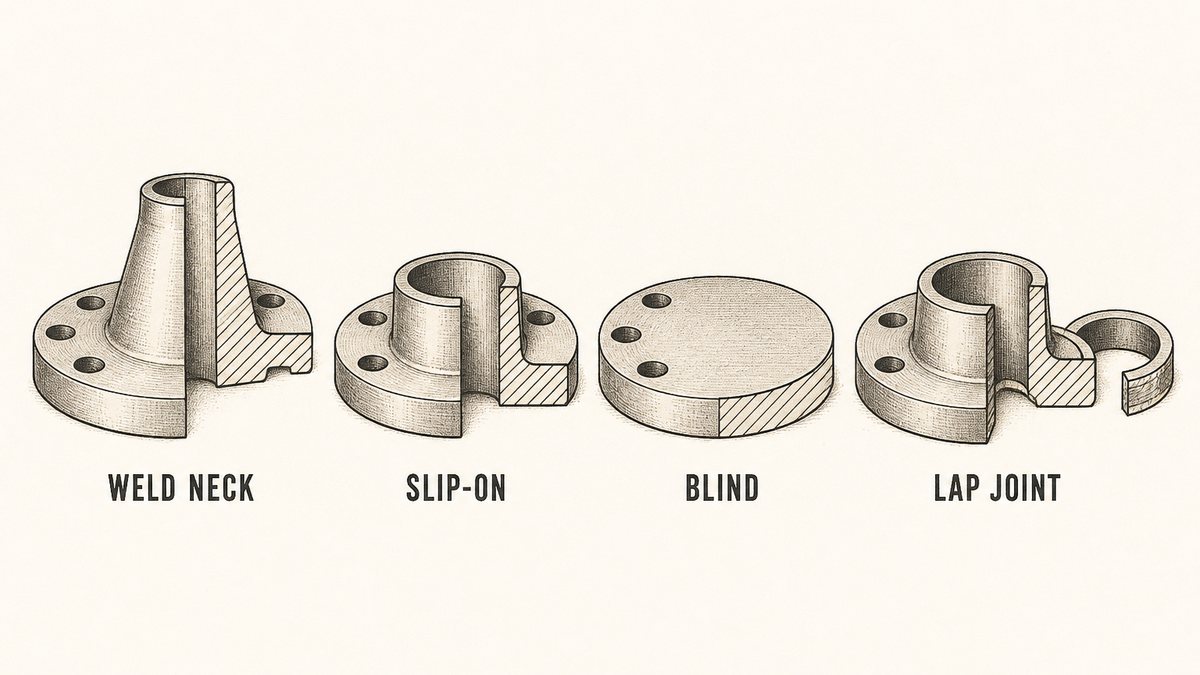
The commercial point is that the type is chosen by the line, not by the price, and that a supplier who offers to “do the same flange cheaper” without asking which type you need has misunderstood the order. A slip-on substituted for a weld neck will bolt up perfectly and will be the wrong product on a line that cycles. If your quotation names a type, check it against the drawing; if it does not name a type at all, that is the first thing to fix.
Why Does the Face Decide Whether the Joint Leaks?
Because the seal is not made by the flange. It is made by the gasket being squeezed between two faces, and the faces are what hold that squeeze even and complete.
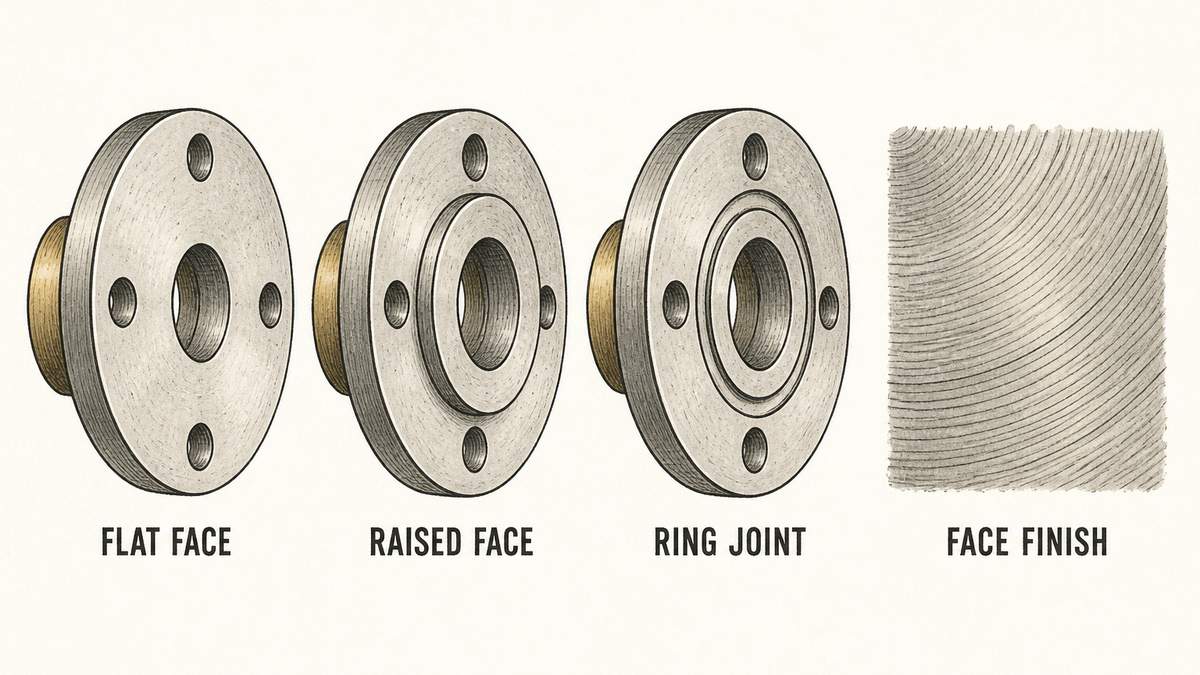
Three face designs cover most of what you will be quoted.
Flat face. A completely flat surface, used with a full-face gasket that covers the whole flange including the bolt holes. It needs almost no bending force to seal, which is why it suits low-pressure work and the brittle materials where a raised face would risk cracking the flange. Its weakness is that the gasket extends across the bolt circle, so it is exposed to the environment and to the bolting load in a way a contained gasket is not.
Raised face. A shallow ring stands proud of the flange face, and the gasket sits on that ring alone. Bolt load is concentrated on a smaller area, which seals higher pressures with the same bolts and which keeps the gasket away from the bolt holes and the outside air. It is the most common design in process piping, and the thing buyers get wrong is pairing it with a flat-faced flange on the other side — a mismatch that puts all the load on the outer edge of the raised ring and tips the joint.
Ring joint. A metal ring sits in a machined groove cut into each face, so the seal is metal against metal in a confined groove. It is the design for high pressure and high temperature, and it is unforgiving about alignment, because the groove has to be cut accurately and the two grooves have to line up.
Under all three sits the detail that decides more joints than any of them: the face finish. Both faces are finished by machining, and the machining leaves a pattern of fine grooves. Those grooves matter in two opposite directions. Too rough, and the gasket cannot fill them, so the joint leaks past the surface. Too smooth, and there is nothing to grip the gasket, so it can be pushed out of the joint under pressure. The finish is therefore a specification with a number attached — a roughness figure — and it belongs on the order next to the face type. It is also the property most easily damaged between the factory and the plant: a face that has been scratched by a badly made crate, or by somebody sliding a flange across a concrete floor, is no longer the face that was machined.
Two protective points follow, and both cost nothing to write down. First, ask for the faces to be protected for shipment — a fitted cover or a coating that comes off cleanly, not a paper wrap that lets the faces grind against each other in the container. Second, write the face finish as a figure with its measurement method, because “smooth” and “fine” are not specifications and no inspector can measure them.
What Does the Class Number Actually Mean?
It means a set of dimensions and a relationship. It does not mean a pressure, and treating it as a pressure is the most expensive mistake in this category.
The relationship is stated plainly in the rules that govern pipeline flanges, and it is worth reading because it is the exact requirement your flange has to meet. The rule says that each flange assembly must be able to withstand the maximum pressure at which the pipeline is to be operated, and to maintain its physical and chemical properties at any temperature to which it is expected to be subjected in service. Both halves matter, and the second half is the one that gets left out of quotations.
Here is why that matters in practice. The pressure a flange is allowed to carry is not fixed by its class. It falls as the temperature rises, because steel loses strength as it gets hot, and the amount it falls depends on the material. Two flanges of the same class, the same size and the same face — one in carbon steel and one in a stainless grade — do not have the same allowable pressure at the same temperature. The class fixes the geometry so that any flange of that class will bolt to any other. The material and the temperature fix what it will hold.
Three practical consequences follow, and they are all fixable on the order form.
Ask for the rating at your temperature, not at room temperature. A supplier can only answer that if you tell them the material and the maximum operating temperature. If you quote a class and nothing else, you have bought the geometry and left the performance undefined.
Name the material by grade, not by family. “Stainless” is a family, and different grades inside it have different allowable pressures and different behaviour at temperature. The grade is also what the material certificate will be checked against, so a vague material on the order becomes an argument at delivery.
Be careful about cast flanges. The rules treat cast iron separately from other materials and require a cast iron flange on a flanged joint to conform in its dimensions, its bolt-hole drilling, its face and its gasket design to a named standard, and to be cast integrally with the pipe, valve or fitting. That last phrase is the one to remember: a cast flange that has been welded onto a spigot is not the same product, and it is a difference nobody can see from the outside.
Then there is the sentence that gives a buyer the most room to be disappointed and the least room to complain: the rule accepts a named dimensional standard, a named industry standard, or the equivalent. “Or the equivalent” is a sensible piece of drafting, because it stops a rule freezing technology in place. It is also the loophole through which a flange that meets no published standard arrives, described as equivalent. You can read the requirement, and the alternative it allows, in 49 CFR 192.147.
The way to close that gap is not to argue about the word. It is to state that the flange must be made to a named standard, and to say how that will be shown: a dimensional report for the flange, and a material certificate for the steel, both naming the heat and the grade. A supplier who can produce those two documents has answered “or the equivalent” with evidence. A supplier who cannot has answered it with a sentence.
Why Does a Correctly Made Flange Still Leak?
Because the seal is held by the bolts, and the bolts are usually the part nobody specified.
A bolted joint works by squeezing a gasket between two faces until the gasket fills every small imperfection in both surfaces and the load on it stays high enough to resist the pressure inside. Four things break that squeeze, and only one of them is the flange's fault.
The tightening pattern. Bolts are tightened in a sequence, working around the circle so that the load goes on evenly. Tighten one side first and the flange tilts, the gasket is compressed unevenly, and one side of the joint is now doing all the work. The flange is not damaged and the bolts are not faulty; the joint was simply built crooked. This is the single most common cause of a leak on a new joint, and it is also the cheapest to prevent, because the sequence costs nothing.
Too little, or too much, load. Too little and the gasket never reaches its sealing stress. Too much and the gasket is crushed, or extruded out of the joint, or the flange face is bent — and a bent flange cannot be fixed by tightening it. The right figure comes from the gasket maker, and it changes with the gasket type, so the gasket choice and the bolting figure are one decision, not two.
The bolting hardware itself. A bolt only delivers the load it is asked for if the thread is clean and lubricated as the figure assumed, and the washer under the nut does its job of spreading the load. A soft washer deforms and the load leaks away; a bolt of the wrong grade stretches; and a bolt reused after it has already been stretched will not hold the same load again.
Temperature cycling. When a joint heats and cools, the flange, the bolts and the gasket expand and contract by different amounts, and the load on the gasket changes. On a line that cycles, bolts can need retightening, which is why the joint design and the bolting figure have to suit the service rather than only the start-up condition.
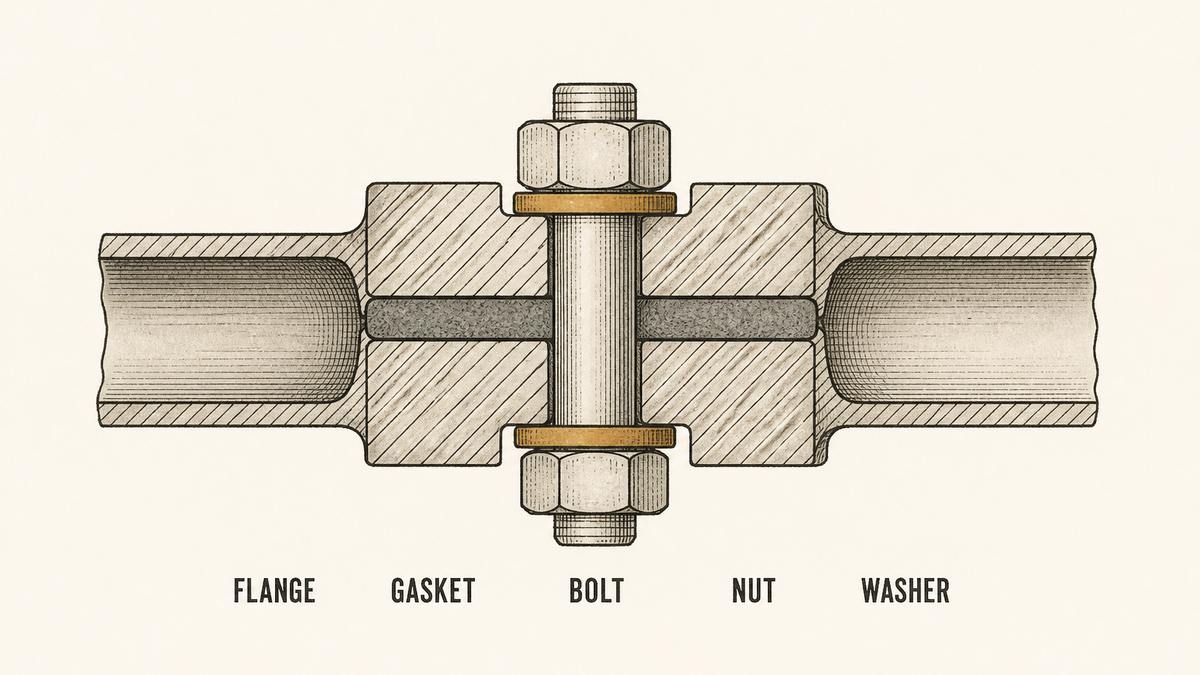
Two buying points come out of this. First, decide whether your order includes the bolts and the gasket at all. A very large share of flange quotations are for the flange alone, and a buyer who assumes otherwise discovers the omission when the shipment lands and the plant asks where the rest of the joint is. If you do supply them, specify the bolt grade and the coating, and ask for the bolts to be sized to the flange's own bolt holes. Second, pass on the gasket maker's tightening figure and sequence with the goods, because the person who assembles the joint in the plant will otherwise use their own habit, and their habit may be the reason the first joint leaks.
What Does the Rule Require, and What Does “or the Equivalent” Let Through?
The rules that matter to a pipe flange come from two directions, and understanding both is what separates a flange order from a flange guess.
The design requirement, which is written around standards. A flange or flange accessory must meet the minimum requirements of a named dimensional standard or an equivalent, and the assembly must hold the maximum operating pressure while keeping its physical and chemical properties at the temperature it will see in service. That is the whole design requirement in two sentences, and it hands the buyer a clear job: name the standard, name the material grade, name the maximum temperature, and say what evidence comes with the goods.
The leak requirement, which is written around a different word. In the rules that control emissions from process plants, the equipment that has to be monitored for leaks is defined by a term that includes flanged fittings. The definition is worth reading closely: a connector means flanged, screwed, or other joined fittings used to connect two pipelines, or a pipeline and a piece of process equipment, or to close an opening in a pipe that could be connected to another pipe — and, crucially, joined fittings that are welded completely around the circumference of the interface are not considered connectors. You can read that definition where it is used to control leaks at chemical plants, in 40 CFR Part 60 Subpart VVa.
Read that definition as a buyer and a whole category of your customers changes shape. A welded joint is not a leak source, because there is no joint left. A flanged joint is one, by definition, and it is monitored with an instrument. The rules that govern connectors in gas and vapour service set the reading at which a leak is treated as a leak: the standards that apply to this equipment define a leak for connectors as an instrument reading of 10,000 ppmv at an existing source and 500 ppmv at a new source. Both figures appear in the connector rules, which also cover the monitoring method and the record keeping. The part that matters to a flange buyer is the second number. A new plant is allowed a very small reading indeed at every flanged joint in a monitored service, and a joint that is assembled crooked or finished badly will not stay under it. You can read the standards for connectors, and the readings that count, in 40 CFR Part 63 Subpart H.
One more requirement is worth knowing because it is a product, not a practice: where a line or valve is left open-ended, the rules require it to be equipped with a cap, a blind flange, a plug or a second valve, and that closure is to seal the open end at all times except during operations that need flow through the line. A blind flange is therefore not just a spare part in the warehouse. It is the specified way to close a line, and it is one of the few flange products whose regulatory purpose can be stated in a single sentence.
Put the two halves together and the commercial conclusion is short. A flange is bought against a standard, a grade, a temperature and a leak level — and the last one is the new part for most buyers. If your flange is going into a plant where joints are monitored, the face finish and the flatness are not finishing details, they are what the leak reading will be made of.
How Is the Price Built?
A flange quotation is a steel price plus machine time, and the machine time is where the surprises live. Two suppliers quoting the same size and class are almost never disagreeing about the steel.
The blank. A rough disc or a forged shape, bought by weight and priced against the steel market. Ask for the blank weight, because it is the figure that shows whether the flange has the wall thickness the class calls for.
Forging or forming. A weld neck needs a forging with a formed neck; a blind can be cut from plate. The process decides the grain flow and the price together.
Machining. Turning the outside diameter, boring the bore, and facing both sides. This is the largest line on most flanges and the one that quietly shrinks when a quotation needs to come down, because a faster cut with a heavier pass removes metal faster and leaves a different surface.
Drilling. The bolt holes, the bolt circle and the raised face ring. The hole count, the diameter and the position come from the standard, and drilling is where a cheap flange most often stops matching the standard exactly.
Face finishing. The pass that produces the roughness the gasket needs. It is fast to do properly and faster to skip, and skipping it produces a face that looks machined and seals badly.
Marking and paperwork. The grade, the size, the class and the heat identifier stamped or cast into the flange, plus the material certificate that ties the steel to a heat. Cheap as a line item, and the line whose absence stops the flange being usable in a plant that audits its paperwork.
Packing. A crate that holds the faces off each other and off the floor. On a heavy steel part the freight matters too, and the arithmetic that surprises buyers on dense goods is actual weight against volumetric weight.
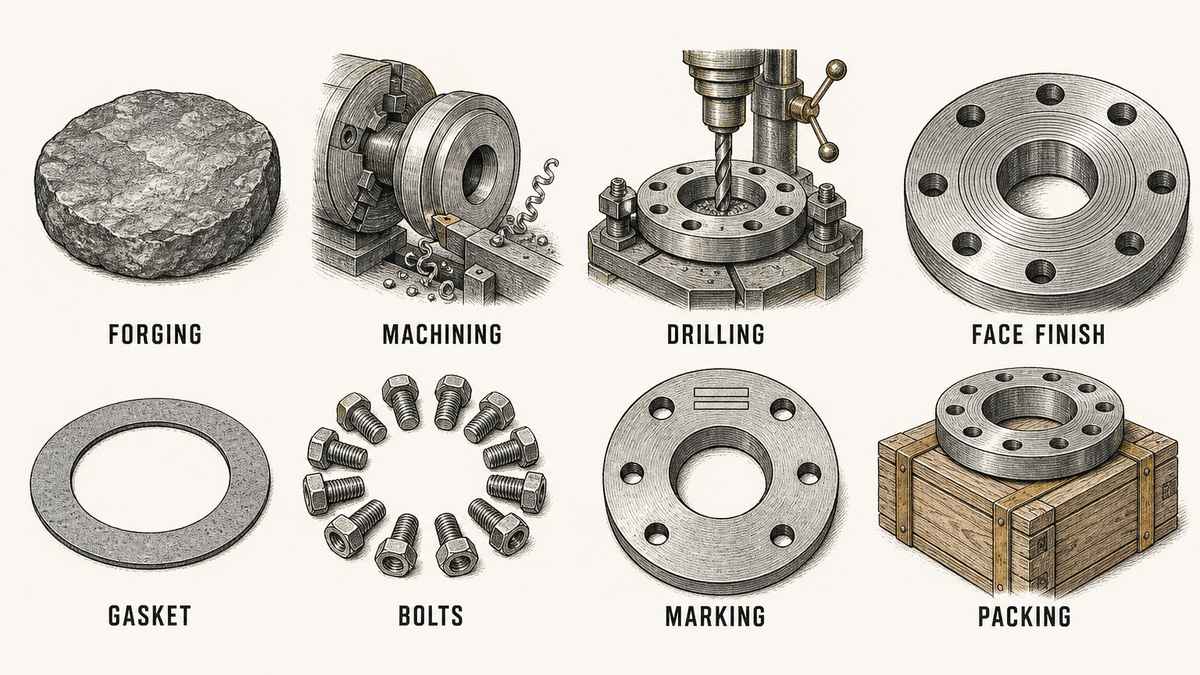
The habit that makes a flange quotation comparable is to ask for the blank weight and the machining time separately. Two prices for the same size and class that differ by a wide margin are almost always two different amounts of machine time, and the one with less of it is the one whose faces will not seal.
What Goes Wrong?
Four failures cover most of the complaints, and only one of them is visible without assembling a joint.
The gasket blows out. The gasket is squeezed out of the joint under pressure, and the line leaks at the flange. It happens when the load on the joint is uneven, when the face finish cannot hold the gasket, or when the gasket type does not suit the service. The flange itself is usually fine, and the customer will still call it a flange problem.
The face is scored or scratched. Deep marks run across the sealing ring, and each one is a channel for the contents of the pipe. This is the failure that happens between the factory and the plant: faces rubbing in a badly built crate, a flange dragged across a yard, or a face opened with the wrong tool during handling.
The joint sits cocked. The two flanges are bolted up but not parallel, so one side of the gasket is compressed and the other is barely touched. It is caused by uneven tightening, by a bolt hole pattern that does not match the counterpart, or by a warped flange, and it produces a leak that appears intermittently as the line heats and cools.
The face is pitted. Corrosion has eaten shallow craters across the sealing surface, so the gasket cannot bridge them. On a carbon steel flange stored or shipped badly, pitting appears in weeks, and it is the reason a flange should never arrive wet, or in contact with a wet surface.
Underneath all four sits the invisible one: the wrong steel grade. A flange made from a different grade than specified looks identical, machines identically and bolts up identically. It fails later, at temperature or under a load the specified grade would have carried, and the only way it is ever caught is by comparing the marking on the metal with the certificate in the file.
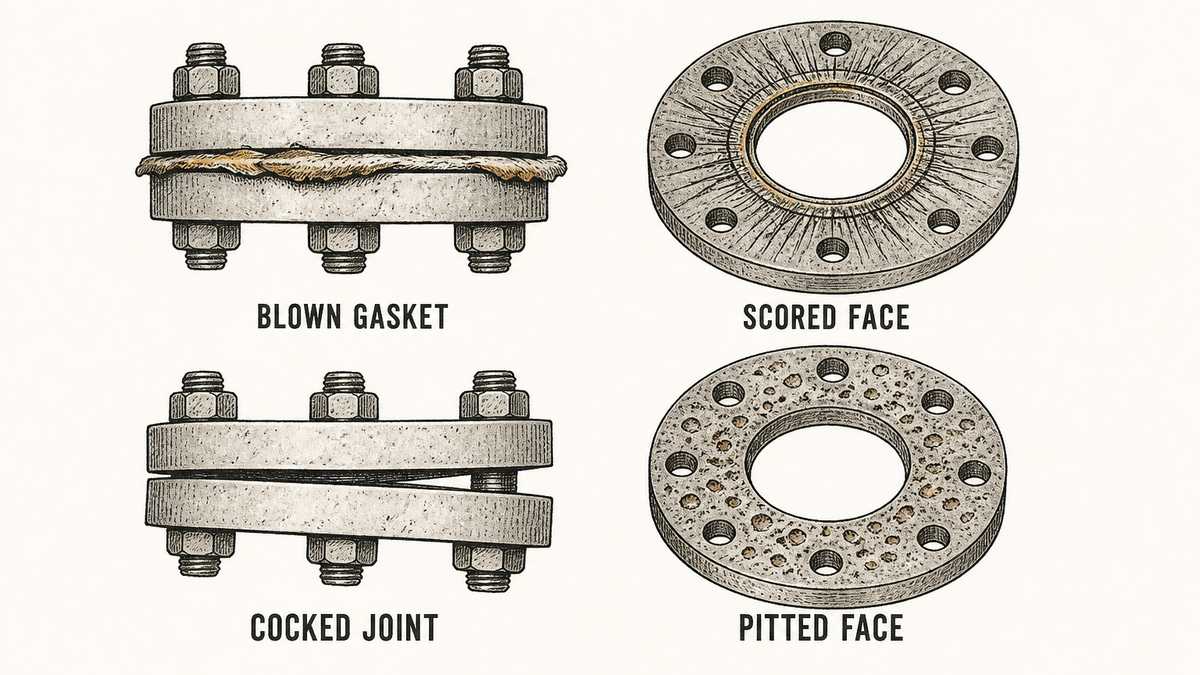
The pattern is worth stating plainly, because it changes what you inspect. On most industrial parts the factory is the main source of risk. On a flange, the factory is only one of three: the steel, the machining and the journey all get a vote, and the journey is the one nobody writes into an order. That is why face protection and a crate that holds the faces apart belong in the specification rather than in a later email.
How Do You Check a Manufacturer Before You Commit?
Start with the supply chain, because a flange factory is a forging and machining operation and the steel is the part it may not control.
Ask who forges the blank and what grade it is. A factory that buys blanks from a named mill can produce a certificate for the heat. One that buys whatever is on the yard cannot, and cannot tell you what you were sold.
Ask which standard it will be made to, and in what words it will show that. That is the answer to “or the equivalent”, and it should be a document, not a sentence.
Ask for the face finish figure and the flatness figure, with the method used to measure them. A supplier who answers “fine” has told you they do not measure it.
Ask whether bolts and gaskets are part of the quotation. Decide the answer, then put it in writing, because it is the most common assumption that turns out to be wrong.
Ask how the faces are protected for shipment. The answer should describe something that physically separates the machined surfaces.
Then check a sample yourself. Five things, all of them quick:
- Lay a straight edge across the face and look for light under it. A bowed or dished face shows up immediately, and no certificate reports it.
- Measure the bolt circle and the hole diameter at several points around the flange. Even spacing and consistent diameter is what makes the joint assemble without a fight.
- Look at the machined face under a light. Torn metal, chatter marks or a face that changes from rough to polished across the ring are finishing faults, and they are visible without any instrument.
- Read the marking and compare it with the certificate. Grade, size and class on the metal, and the heat number that ties it to the paperwork. This is the same discipline as checking any factory certificate in the issuer's own database.
- Weigh the flange against the blank weight the quotation claims. Steel does not lie: a flange that is lighter than its own blank figure is a flange with less material in it.
Then turn the answers into an inspection plan, because a sample you tested and a shipment you did not are two different things. The usual structure applies: a first article inspection on the first flange off the line, a the sample size for a pipe flange batch, and a pre-shipment inspection before the crates are closed. Three checks belong in that plan specifically on a flange: the straight-edge check across the face, the bolt circle and hole measurement, and a photographed marking matched against the certificate. A flange where the certificate is checked at the factory rather than at the port is a flange that will not be rejected on arrival.
One document is worth having before the first order. The specification sheet should state the type, the size, the class, the material grade, the standard, the face type, the face finish and the flatness with their measurement methods, the marking content, whether bolts and gaskets are included, the face protection and the packing — the specification sheet for a pipe flange sets out the format. And if you are still deciding between a manufacturer and a trader, telling a pipe flange maker from a reseller is the check to run first. On a flange it matters more than usual, because the steel is bought in and a trader can change the steel source between two orders without the flange changing shape.
Where Does a Cheap Quotation Get Its Money Back?
Eight lines get trimmed on this product, in roughly the order they go.
- A lighter blank. The dimensions still measure correct, the wall is thinner than the class calls for, and the flange weighs less than its own blank figure.
- A different steel grade. Identical in every visible way, and the reason the certificate matters. Look at how the same logic plays out on other loaded components in wire rope and its end fittings, where the invisible substitution is also the biggest saving.
- Less machining time. Heavier cuts, faster passes, and a face that is no longer flat enough to seal on a difficult service.
- The face finish left rough. Machined-looking and unable to hold a gasket, and impossible to see in a photograph.
- Bolt holes drilled to a cheaper pattern. Slightly wrong diameter or spacing, which costs the plant hours on site and produces a joint that bolts up crooked.
- No certificate, or a certificate for another heat. The flange is fine and the paperwork is not, which stops it being used in any plant that audits what it installs.
- Faces unprotected. A paper wrap instead of a separator, so the faces rub in the container and arrive scored.
- A lighter crate. The faces end up touching the floor of the crate, and the freight saving is paid for by the face finish.
The way to use this list is to put one written specification in front of two or three factories and ask each to confirm, line by line, that their price includes the grade, the standard, the face finish, the marking and the protection. Two prices for the same size and class are not a comparison. Two prices that both state the grade, the blank weight, the machining time and the face finish are one, and the cheaper flange is then cheap for a reason you can read. If you are comparing components of this kind across several orders, the same three checks that make a sprocket or a similar machined part comparable are the ones that work here.
Frequently Asked Questions
What does the class number on a flange actually mean?
It fixes the geometry so that any flange of that class will bolt to any other of the same size and class. It is not a pressure. The pressure a flange is allowed to carry falls as the temperature rises, and how far it falls depends on the material grade. The requirement pipeline flanges have to meet is to withstand the maximum operating pressure and to keep their physical and chemical properties at the temperature they will see in service, so a quotation that names only a class has left the performance undefined. Ask for the rating at your operating temperature, with the grade named.
Does the flange come with bolts and a gasket?
Usually not, unless you asked. A large share of flange quotations cover the flange alone, and the joint needs bolting hardware and a gasket as well. If you are supplying them, specify the bolt grade and coating and have them sized to the flange's own bolt holes, and choose the gasket and the tightening figure together, because the load the bolts need depends on the gasket. If you are not supplying them, say so on the order so nobody assumes otherwise.
Why did my flanged joint leak on start-up?
Almost always because the load went on unevenly. Bolts tightened in the wrong sequence tilt the flange, compress one side of the gasket and leave the other barely touched, and the joint leaks or blows the gasket out. Too much load crushes or extrudes the gasket, and too little never reaches its sealing stress. Check the tightening sequence, the figure the gasket maker specifies, the condition of the washers and whether the bolts are the grade that figure assumed.
What face finish should I specify?
A roughness figure with the method used to measure it, and a flatness figure alongside it. The finish has to be rough enough for the gasket to grip and fill the grooves, and smooth enough not to tear it, and the right value depends on the gasket type and the service. Asking for a figure and a method is what makes the requirement checkable; asking for “smooth” gives an inspector nothing to measure and gives the factory nothing to work to.
What does “or the equivalent” mean in the flange rules?
The rule that governs pipeline flanges requires a flange to meet the minimum requirements of a named dimensional standard or an equivalent, and separately that the assembly hold its maximum operating pressure at its service temperature. Allowing an equivalent stops the rule freezing technology in place, and it also means a flange that meets no published standard can arrive described as equivalent. The way to close that is to require a named standard and to say how it will be shown: a dimensional report and a material certificate naming the grade and the heat.
What should the specification sheet for a flange order say?
The type and the size; the class; the material grade; the standard it is to be made to; the face type; the face finish and the flatness with their measurement methods; the marking content; whether bolts and gaskets are included; how the faces are protected for shipment; the packing; and the tests and documents that come with the goods. Written as figures and named standards rather than descriptions, it is a document two factories can both quote against and an inspector can measure.
Send the grade and the service temperature — not just “a 6 inch flange”
Tell us the line it goes into, the size range and the pressure and temperature it has to hold, then the lines that decide whether the joint seals: the flange type, the class, the material grade, the standard it will be made to, the face type, the face finish and flatness figures with their measurement methods, whether bolts and gaskets are included, the marking content, how the faces are protected for shipment, and the certificates that come with the goods. Add your target volume and the destination. We will come back with the factories whose forging source, grade control and face finishing match your service, the specification written as figures and named standards, the blank, machining, finishing and paperwork lines shown separately so quotations become comparable, a sampling plan built around a straight edge and a bolt circle rather than a photograph, and a clear statement of which supplier owns which failure on what you are buying.
Request a Pipe Flange Sourcing Quote
Questions & Comments
We read every one and reply within 24 hoursSourcing pipe flanges and getting quotations that all say “6 inch flange, 150 lb”? Send the flange type, the class, the material grade, the standard it must be made to, the maximum operating temperature, the face type, the face finish and flatness figures, whether bolts and gaskets are included, and the certificates that come with the goods, and we can usually say which lines are missing from them. If flanges have already arrived with a scored face, a bolt pattern that will not line up, a certificate that names a different heat, or a joint that leaked on start-up, describe what you saw and roughly when it appeared, because the symptom usually says whether it was the steel, the machining, the face finishing or the packing.