
Etsy Dropshipping: What Is Allowed, and What Is Not
 ·
Updated October 14, 2026
·
16 min read
Most of what is published about Etsy and dropshipping describes a business that Etsy does not permit. The guides are written by print-on-demand services and sourcing tools, they explain how to connect a supplier feed to an Etsy shop, and they treat the arrangement as a normal way to run a store. Etsy's own help centre answers the question in one sentence, and the answer is no. That is not a technicality or a recent tightening: the prohibition sits alongside a definition of the model, and it is followed by a list of examples that includes the workaround most of those guides recommend. The useful question is therefore not how to get away with it. It is what Etsy actually permits, because the permitted routes are narrower, older, and considerably more specific than the phrase dropshipping suggests.
What Etsy Says, In Its Own Words
| Question | Etsy's answer |
|---|---|
| Is drop shipping allowed? | Not allowed, with a limited exception for craft and party supplies |
| Is reselling allowed? | Not allowed, except craft and party supplies, vintage over 20 years, and themed gift baskets |
| Does adding a card or gift tag make it allowed? | No, it is listed as a prohibited example |
| Is print on demand allowed? | Yes, if the item is your own design or the buyer's customisation |
| Must a production partner be disclosed? | Yes, along with accurate information about where it ships from |
What this guide covers
- What Etsy actually says, in its own words
- Why does adding a card or gift tag not fix it?
- The four grounds on which you may sell
- The route that does work: your design, a disclosed partner
- Which of the four a China-sourced operation can use
- What this changes about how you source
- Frequently asked questions
1. What Does Etsy Actually Say, In Its Own Words?
It says no, and it says it plainly enough that there is no room to read it as encouragement. The help article that answers the question opens with the prohibition rather than burying it, and the definition that follows is narrow enough to catch almost every arrangement the tool vendors describe.
Drop shipping is not allowed on Etsy, with the limited exception of Craft and Party Supplies. Sellers may drop ship craft and party supplies that support our creative community, enabling the creation of unique items and bringing personal touches to special events.
Drop shipping is the practice of selling ready-made products that are shipped directly from a third-party supplier to the customer, without any alteration or customization by the seller.
Reselling is the practice of selling a commercially available item that the seller did not make or design.
Etsy Help Centre, Does Etsy Allow Drop Shipping or Reselling? (read 14 October 2026)
Two things in that passage do most of the work, and both are easy to skim past. The first is the definition: the prohibited act is selling ready-made products shipped directly from a supplier without any alteration or customization by the seller. A store that connects a supplier catalogue to a shop and forwards orders has, by that description, done exactly the thing. The second is that the same page treats reselling as a separate prohibition, so a seller cannot escape the first rule by arguing that they are not dropshipping but merely reselling; both routes are closed, and they are closed by one page.
It is worth noticing what the exception is and what it is not. Etsy does not exempt craft and party supplies because they are low value or because enforcement is impractical; it exempts them because they support the creative activity the marketplace is built around. The reasoning matters more than the rule here, because it explains the direction of every later restriction. A material that somebody else uses to make something original fits that purpose. A finished object that somebody else made does not, however it is packaged or described.
The same page also states the position on production partners, which is where the useful part of this article begins. Rather than prohibiting all third-party manufacturing, Etsy permits it and attaches conditions, and the conditions are what separate a permitted operation from a prohibited one.
Using production partners, including print-on-demand services, to fulfill and ship orders is allowed on Etsy, as long as the items being sold are the seller's original design (or the buyer's customization).
However, if a seller uses a production partner to sell products they did not design and buyers did not personalize, this would violate Etsy's policies. The key distinction is that the items must be original creations, not ready-made or commercially available products.
Etsy Help Centre, Does Etsy Allow Drop Shipping or Reselling? (read 14 October 2026)
Read that as a permission with a condition attached rather than as a prohibition, and the shape of a workable Etsy operation becomes visible. You may have somebody else make the thing. You may have them ship it. What you may not do is sell a product that exists independently of you, that somebody already designed, and that a buyer did not ask you to customise. The distinction is not about who touches the parcel; it is about whether the object owes its existence to your design or the customer's instruction.
That is a stricter test than most platforms apply, and it is worth being precise about why it is stricter. A general marketplace has no position on whether the seller made the item, because its promise to the buyer is about price and delivery. Etsy's promise is about origin, and the entire search experience is organised around the assumption that the seller had something to do with the object. Once the promise is about origin, an operation that only moves goods from a supplier to a buyer is not a small difference from the model; it is the thing the model was defined against.
2. Why Does Adding a Card or Gift Tag Not Fix It?
Because Etsy names it. This is the single most consequential detail in the policy for anyone who has read a guide recommending exactly this, and it is not stated as a principle to be interpreted but as an example to be avoided.
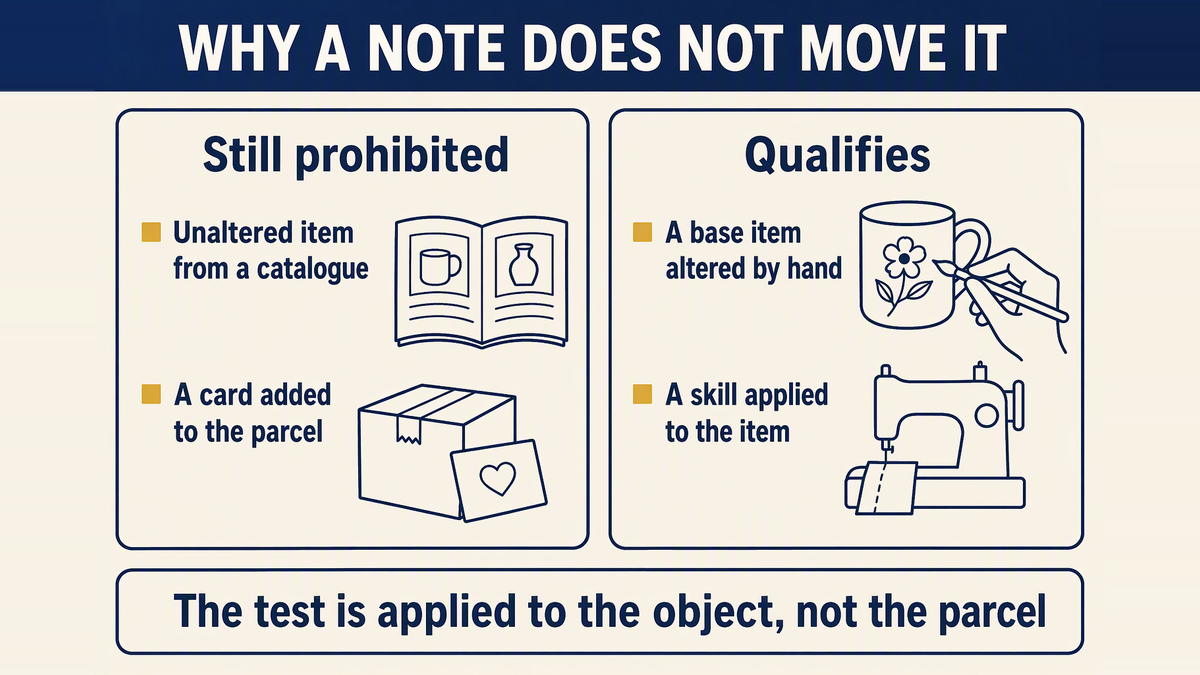
The following are examples of drop shipping and reselling that are not allowed on Etsy: … Adding a card, gift tag, or note to an otherwise unaltered commercially available item (e.g., a resold necklace with a personalized note.)
Etsy Help Centre, Does Etsy Allow Drop Shipping or Reselling? (read 14 October 2026)
The reasoning behind it is consistent, and once you see it the whole policy becomes predictable. Adding a note changes what the buyer receives but not what the buyer bought. The commercial item is still the product; the note is packaging with words on it. Etsy's line is drawn at the object rather than at the parcel, so anything that alters only the parcel cannot move an item from the prohibited side to the permitted side.
The Creativity Standards make the same point from the other direction, in the section covering items made by a seller. The qualifying route for an altered commercial item is described as a base item altered using specialized handcrafting skills, with hand-embroidering flowers onto a tote bag given as the example. The disqualifying version is described in almost exactly the terms you would expect: a commercially available base item with only superficial alteration, such as addition of a simple, mass-produced stick-on adornment. Between those two sentences sits the line that decides most arguments, and it is a line about the skill applied rather than the effort spent.
That distinction has a practical consequence which is easy to underestimate, because it determines whether a supplier relationship can be reshaped into something permitted. If your operation adds a printed insert to a finished product, no amount of care in the wording changes its category. If your operation takes a blank or base item and applies a skill to it, or has a partner produce your own design, the item starts from a different place. The first is a packaging decision. The second is a manufacturing decision, and only the second is available as a route.
One caution about relying on this section as a defence. The policy is a statement of what is permitted; enforcement is a separate question, and a listing that qualifies is still subject to Etsy's image requirements and to the disclosure duty described below. Getting the category right is the beginning rather than the end of the work. If you are unsure whether a particular item qualifies, the reliable move is to read the Creativity Standards section that covers your intended route and check your item against its own examples, rather than against the general description.
3. What Are the Four Grounds on Which You May Sell?
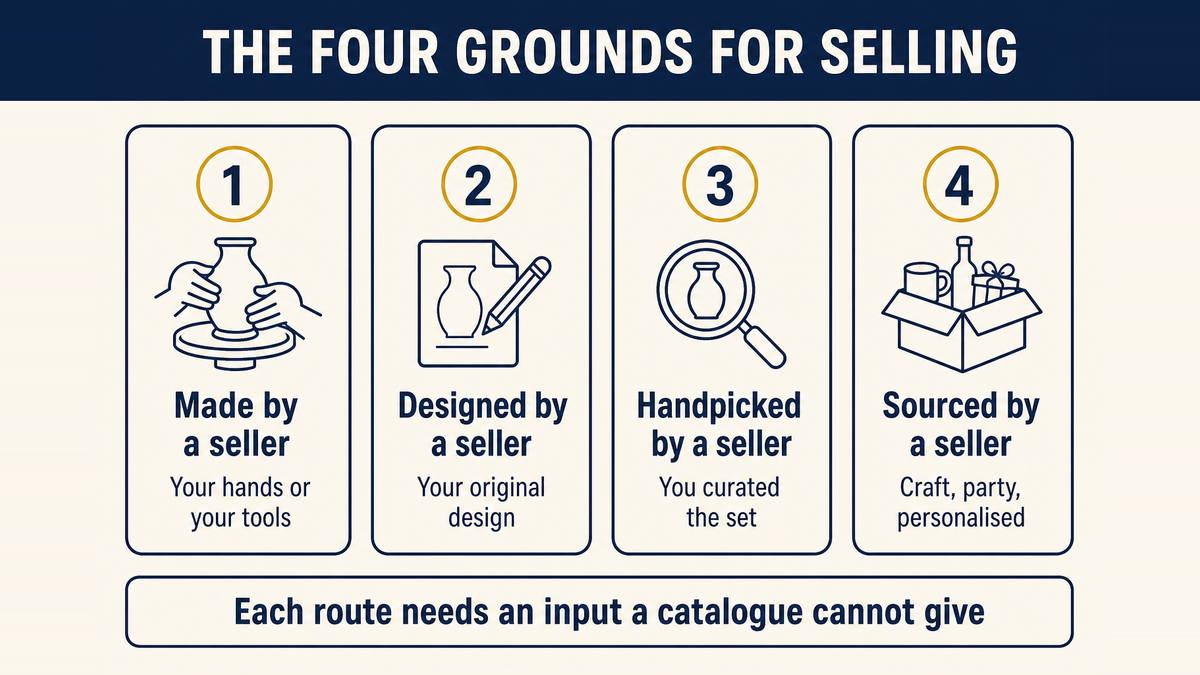
Etsy's Creativity Standards set out four routes, and almost every mistake in this area comes from assuming the list is longer than it is. The four are the whole of it: an item can be made by a seller, designed by a seller, handpicked by a seller, or sourced by a seller. Each has its own definition, each has its own explicit examples of what does not qualify, and the examples are unusually specific. The page carrying them is marked as last updated on 10 June 2025.
The Four Routes, and One Thing Each of Them Excludes
| Route | What it covers | Example that does not qualify |
|---|---|---|
| Made by a seller | Crafted by hand, altered or assembled by hand, or produced with personal computerised tools from your own design | An item assembled per the manufacturer's instructions, or a commercial base with a mass-produced stick-on adornment |
| Designed by a seller | Your original designs, including those produced by a production partner, and digital downloads | A bundle, collection or file of somebody else's work |
| Handpicked by a seller | Vintage items over 20 years old, items from nature, and themed gift baskets you curate | Resold commercial items newer than 20 years, and single-type or single-brand baskets |
| Sourced by a seller | Craft supplies, party supplies, and buyer-personalised items made by a production partner | Blank ready-to-use t-shirts, hats and tumblers; generic cooking, office or gardening supplies |
Two of the four routes are closed to a sourcing operation by their nature. Vintage requires items more than twenty years old, which no supplier catalogue provides, and items from nature requires things the seller personally found or grew. The remaining two are open, and both require something from you that a supplier cannot supply: a design in one case, and a valid judgement about what counts as a craft or party supply in the other.
The fourth route is where the confusion concentrates, because the phrase craft and party supplies is broad enough to sound permissive and the exclusions are sharp enough to remove most of what a supplier would happily ship you. The section excludes, by name, resold blank items that are ready to use without further crafting, including blank t-shirts, hats and tumblers; generic cooking tools and ingredients; and office, construction, gardening, cosmetic and home DIY supplies. It also excludes generic items that might be used at a party but are not decor or also have everyday uses, listing plain furniture, generic tableware, stage lights, speakers and costumes among them.
Read those exclusions together and a rule emerges that is more useful than the category names. Something qualifies as a craft supply when its purpose is to be turned into a new item by hand, and as a party supply when its purpose is to decorate one specific event. Something fails when it can be used as it arrives, or when it would be equally at home outside the event. A blank tumbler fails because it is finished; a paintable figurine passes because it is not. Balloons pass; a plain table that could also go in a kitchen does not.
If you take one thing from this section, take the direction of the test. Etsy asks what the item is for rather than what it is, which is why two objects made of the same material at the same factory can sit on opposite sides of the line. That is also why a supplier's product list is a poor guide to what is permitted: the supplier describes the material and the finish, and the policy cares about the intended use.
4. What Is the Route That Does Work?
Your own design, produced by a partner you disclose. That is the arrangement Etsy describes as permitted, and the disclosure requirements attached to it are specific enough that they should be treated as part of the production process rather than as an administrative afterthought.
Start with what the partner is, because the definition is narrower than the phrase supplier suggests. The Creativity Standards describe a production partner as a company or individual, not part of your shop, that helps physically produce items based on your original designs, and the examples given are an apparel producer, an engraver and a print-on-demand service. The defining feature is the direction of the idea: the design comes from you and the production is theirs. An arrangement where the design comes from the supplier and the production is theirs is not a production partnership in this sense, whatever the invoice calls it.
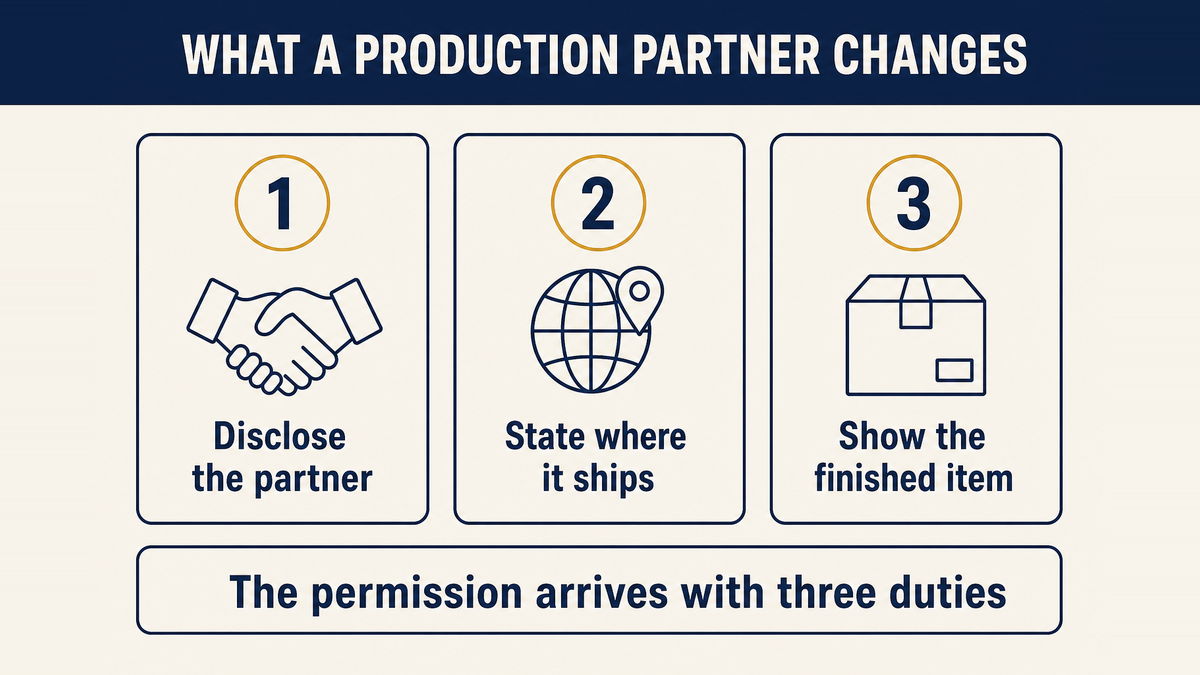
Sellers must disclose that an item is made by a production partner, and provide accurate information about where the item will ship from.
Etsy, Creativity Standards, section on items designed by a seller (page marked last updated 10 June 2025)
The second half of that sentence is the one that trips people, because it turns a shipping decision into a listing statement. If a partner in one country produces the item and another party ships it from somewhere else, the listing has to accurately describe where it comes from, and a listing that says one thing while the parcel originates somewhere else is inaccurate rather than merely conservative. Four routes are covered in the standards, and the shipping-origin requirement sits inside the designed-by route where the production is external.
There is a third requirement that concerns the images, and it applies to two of the four routes. Listings for items made by a seller, and for items designed by a seller, must use original photo or video content of the final product. The standards then add a rule specifically for personalised and custom items: the first image must show a finished, customised item rather than the blank product or placeholder text such as the words your text here. That constraint has an operational consequence, because it means the product cannot be listed properly until a real finished example exists, which in turn means the personalised route cannot be launched from a supplier catalogue and a mock-up alone. A sample of the finished, personalised article has to be made first.
The same section carves out a further category that is easy to overlook and relevant to a modern studio: a creation generated with an AI tool from your own original prompts counts as designed by a seller, and the seller must disclose within the listing description that AI was used. What does not qualify is an AI prompt bundle, which the standards list among items that do not qualify as designed by a seller. The pattern is the same one running through the whole page: a route is open when your own input is the thing that produced the object, and closed when the value being sold is somebody else's prepared material.
5. Which Routes Can a China-Sourced Operation Use?
Two of them, and both through the design side rather than the buying side. This is the part that usually goes badly, because a sourcing operation is set up to find things that already exist, and both open routes require something that does not exist until you make a decision about it.
The first is the designed-by route, which is the natural fit for a seller who is willing to create the design and let a factory produce it. The work here is a design decision followed by a production arrangement, which is a different sequence from buying a catalogue item and listing it. Our guide to putting your own brand and design on a product covers that sequence from the buyer's side, and our notes on the methods available for applying a design to a product are the practical companion, because the method chosen determines whether the result is a produced design or an altered base item.
The second is the sourced-by route, and specifically its last limb: items personalised with the buyer's own text or image and produced by a production partner. The standards give a t-shirt, hat or neon sign as examples, with the buyer's name or phrase applied. This is the closest thing to a per-order model that Etsy permits, and the reason it works is that the buyer's instruction is the design input, which means the item genuinely owes its existence to a specific customer's decision rather than to a catalogue.
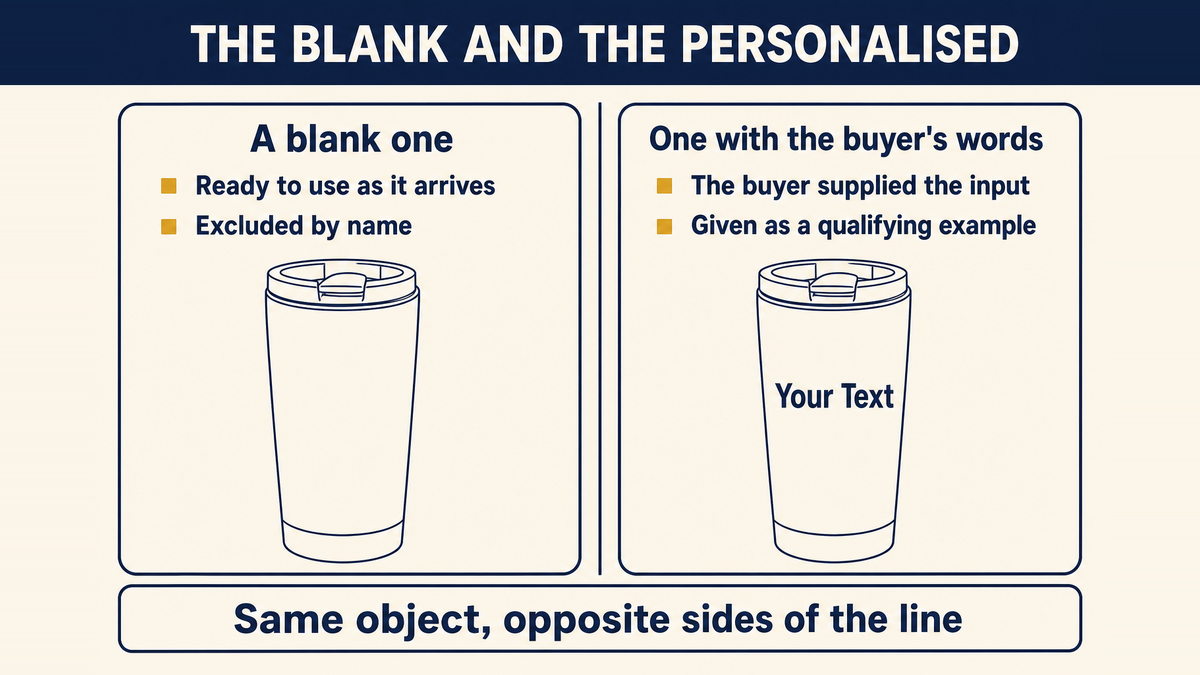
Between those two sits a boundary that a China-sourced operation will meet repeatedly, and the tumbler makes it concrete. A blank tumbler is excluded by name from the sourced-by route as a ready-to-use item. A tumbler personalised with the buyer's text, produced by a partner, is given as a qualifying example in the same section. The object is identical in both cases; the difference is entirely in who supplied the design input. If that seems like a fine distinction to build a business on, it is worth remembering that the policy is drawing the line at exactly the point its marketplace promise depends on, and that the distinction is therefore stable rather than arbitrary. Our guide to how insulated tumblers are made and printed is useful precisely because it separates the blank from the printed article at the manufacturing stage, which is where this distinction lives.
The practical test to apply before sourcing anything for Etsy is not whether the item is nice, cheap or unusual. It is whether you can finish this sentence with something true: this item exists in this form because of — and the ending has to be either your design or the buyer's instruction. If the honest ending is the supplier's catalogue, the item is on the wrong side of the line no matter how it is photographed or packaged.
6. What Does This Change About How You Source?
It moves the binding constraint from the supplier to the design, and it makes a few supply-side habits newly important. None of them are unusual in themselves, but the order in which they are needed changes, and in a per-order model the order is most of the difficulty.
The first consequence is that the first thing you need from a supplier is the specification, not the price. In a catalogue-based operation you choose an item and ask what it costs. On the designed-by route you have to be able to tell a factory what to make in enough detail that they can quote it, which means dimensions, materials, colours, tolerances and packaging decided before the first conversation rather than after the third sample. Our guide to how jewellery manufacturing is arranged with a Chinese partner shows the level of specification an order of this kind needs, and it is a useful model even for categories that have nothing to do with jewellery, because the structure of the conversation is the same.
The second is that personalisation has to be designed into the product rather than added to it. If the route you are using depends on the buyer's text or image, then the article must be one that can accept that input cleanly, at a cost that leaves something behind, without a new setup charge on every order. That is a manufacturing question and it is answered long before the listing is written. It also determines what the finished example looks like, which matters because the first image has to show the finished personalised item, and a product that personalises badly will produce a poor first image no matter how good the photography is.
The third is that packaging becomes part of the offer rather than a cost to be minimised, because on this marketplace the unboxing is part of what the buyer is paying for. That changes how you buy it: a printed box, a branded tag or a tissue wrap is a considered buy with a setup cost rather than an input to be shaved. Our guide to how custom boxes are sourced from a Chinese supplier works through the minimum quantities and setup costs, and our notes on which packaging materials are worth specifying cover the materials side of the same decision.
The fourth is that the supplier relationship has to survive being inspected. Because the route depends on your design being produced by a disclosed partner, the partner is part of the listing rather than a private arrangement, and an operation that looks improvised will be treated as one. Our notes on what a pre-shipment inspection covers and on how to read an AQL sample table are the practical side of that, and the wider point is that a production partner relationship which cannot withstand a quality check is not one you want to disclose anyway.
Finally, the parcel itself needs the same care it always did in a per-order model, and for a slightly different reason here. Since the buyer is paying for a made-for-them object, the parcel should present as the product rather than as a supplier's shipment. Our guide to removing supplier documents before dispatch covers the operational mechanics, and the discipline it describes is more relevant on a marketplace like this one than on a general marketplace, because the buyer's expectation is about origin.
7. Frequently Asked Questions
Is dropshipping allowed on Etsy?
Etsy's own help article states that drop shipping is not allowed on Etsy, with the limited exception of craft and party supplies. Etsy defines drop shipping as selling ready-made products shipped directly from a third-party supplier to the customer without any alteration or customisation by the seller. So the general model as it is usually described is the thing that is prohibited.
Can I dropship on Etsy if I add a card or gift tag?
No. Etsy's help article lists it explicitly as a prohibited example: adding a card, gift tag or note to an otherwise unaltered commercially available item. The same rule appears in the Creativity Standards, which say a commercially available base item with only superficial alteration such as a simple mass-produced stick-on adornment does not qualify. The alteration has to be the kind that uses a handcrafting skill, not an added note.
What is Etsy's exception for craft and party supplies?
Etsy permits drop shipping of craft and party supplies that support the creative community. In the Creativity Standards these sit under items sourced by a seller: craft supplies are tools or materials whose primary purpose is to create a new item by hand, and party supplies are items whose primary purpose is to decorate a special event. Countless lookalikes are excluded, including blank t-shirts, hats and tumblers ready to use, generic cooking tools, and party items that also have everyday uses.
Can I use a print-on-demand supplier for Etsy?
Yes, provided the item is your own original design or the buyer's customisation. Etsy states that using production partners, including print-on-demand services, to fulfil and ship orders is allowed as long as the items being sold are the seller's original design or the buyer's customisation. Using a production partner for products you did not design, and that buyers did not personalise, is stated to be a policy violation.
What must I disclose when I use a production partner?
Etsy requires sellers to disclose that an item is made by a production partner and to provide accurate information about where the item will ship from. The Creativity Standards also require original photo or video of the final product for made-by and designed-by listings, and they require the first image of a personalised or custom item to show a finished customised product rather than the blank item or placeholder text.
The Route That Survives Review, Written Out
We return the ground your operation can genuinely claim, the production evidence it requires, and the routes closed to China-sourced stock.
Write My Route Memo
Questions & Comments
We read every one and reply within 24 hoursTrying to work out which of Etsy's four grounds your item sits on, unsure whether your supplier counts as a production partner that has to be disclosed, or wondering what the first listing image has to show for a personalised product? Post what you intend to sell and who makes it, and our team will help you place it before you list it.