
Dropshipping Inventory Management: Where Holding Stock Starts to Pay
 ·
Updated October 13, 2026
·
15 min read
Most inventory advice for online stores assumes you already keep stock, and then explains how to track it. That skips the decision that matters, which is whether to keep any at all. Holding stock is not cheaper from the first day. It is cheaper from a particular point, and knowing where that point sits is more useful than any software feature.

The Two Models Side by Side
| Buying per order | Holding stock | |
|---|---|---|
| What you pay per unit | More, because you buy in ones. | Less, because you buy in hundreds. |
| What you pay per parcel | A lot, because every order crosses a border. | Less, because the parcel travels domestically. |
| What you carry | Almost no money at risk, and no information. | Money tied up, and the risk that it does not sell. |
What this guide covers
1. What Do You Actually Have When You Hold Nothing?
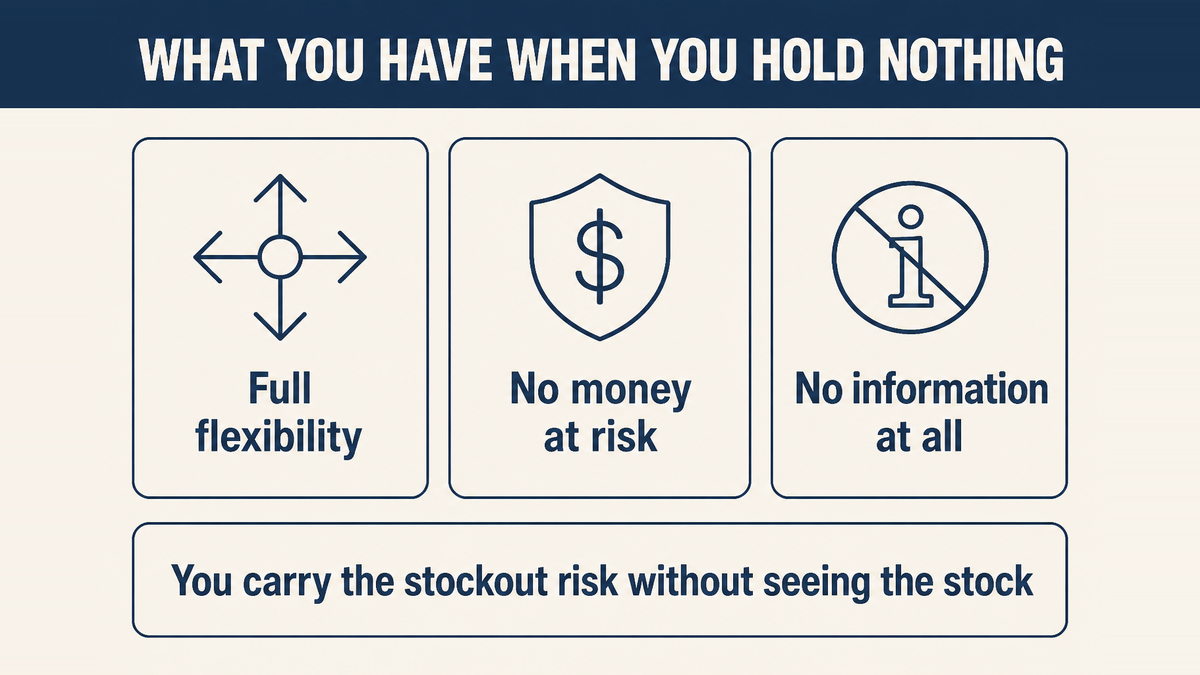
You have flexibility and a bill. Every order is bought fresh, so there is nothing to write off if the product turns out to be a bad idea, and that is a genuine advantage while you are still finding out what sells. What you pay for it is a higher unit price and a higher delivery cost on every single order.
What you do not have is information. This is the part that rarely appears in inventory guides, and it is the real structural weakness of the model. The stock you depend on belongs to somebody else, and you cannot see it. You do not know how many units the supplier holds, how quickly they are moving, when the next production run is, or whether the item is about to be discontinued.
That means you carry the entire consequence of a stockout while holding almost none of the information needed to avoid one. When the supplier runs out, you find out the way your customer does, which is at the moment the order cannot be filled. There is no report you can read in advance, because the number is not yours.
2. Where Is the Crossover Point?
It sits where the saving per order becomes larger than the cost of carrying the goods while they wait. Both sides of that comparison are ordinary numbers, so it is worth working through them rather than deciding by feel.
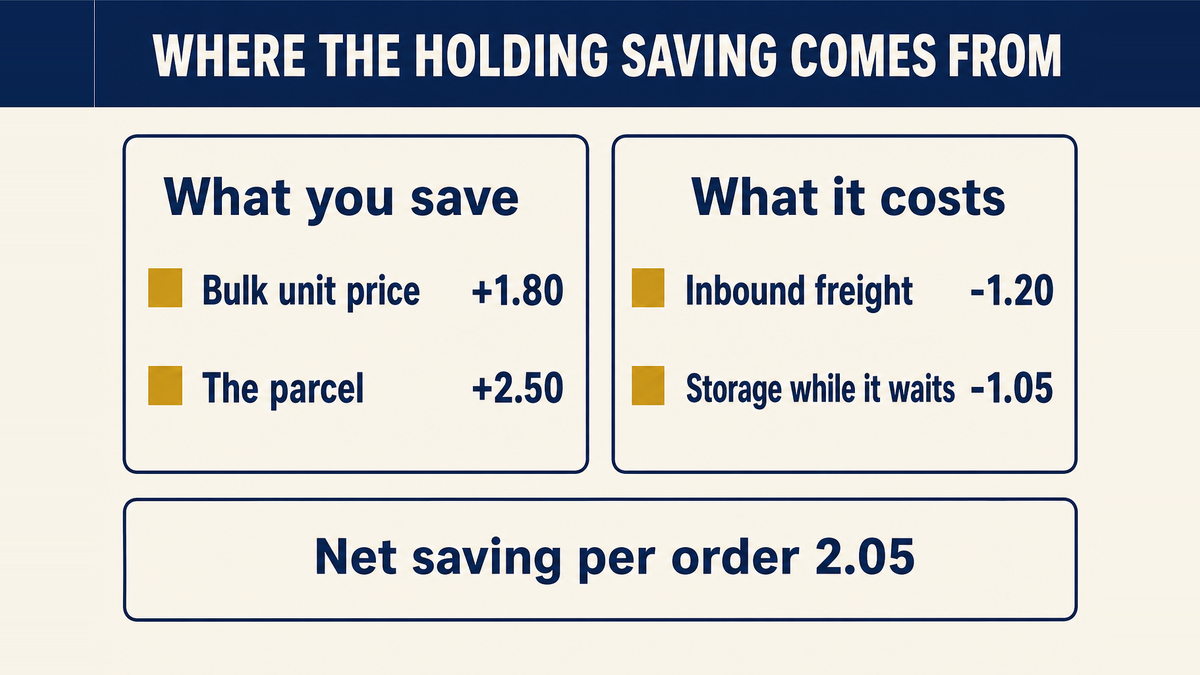
Take a thousand units. Buying them in bulk at 4.20 rather than in ones at 6.00 saves 1.80 a unit. Bringing them in as a shipment costs about 1.20 a unit, which is a new cost the per-order route did not have, and storing them costs about 0.35 a unit a month, which is another. Sending each one onward from stock costs about 4.00 instead of 6.50, because the parcel no longer crosses a border.
Add those up and the delivered cost per order falls from 12.50 to 10.45, a saving of 2.05. But look at where the saving comes from, because it is not where most people expect. The unit price contributes 1.80 of it. The parcel contributes 2.50. The delivery saving is the larger of the two, and the new costs, inbound freight and storage, take back 2.25 of it.
Run this with your own numbers before you commit to a first order, and notice which figure moves the answer. If your product is light and cheap to send per parcel, holding stock saves much less than the example above and the crossover moves a long way out. If it is heavy or awkward to send one at a time, the parcel saving dominates and the crossover arrives far sooner.
Lead time is the other number that moves the crossover, and it moves it in the opposite direction from volume. If the goods take three weeks to arrive, you need enough cover for three weeks of demand plus a cushion, and the money for that cover has to be found before any of it sells. If they take three months, you need roughly four times the cover for the same sales rate, so four times the cash is committed for four times as long. A long lead time does not only add waiting. It multiplies the amount of stock you are obliged to carry while you wait.
3. What Does Holding Stock Really Cost?
More than the storage bill, and the extra parts are the ones that decide whether the saving above survives. Holding cost has four components, and only the first is easy to see.
- Storage
- The space the goods occupy, charged monthly whether or not anything sells. This is the visible one, and it is usually the smallest of the four.
- The money tied up
- Cash spent on stock is cash that cannot be spent on advertising, on a second product, or kept as a buffer. If the stock sits for six months, the money has been unavailable for six months even if it eventually returns.
- Obsolescence
- A product that stops being wanted loses value quickly and completely, and unlike a slow month it does not recover. This is the component that turns a modest saving into a loss.
- Handling and shrinkage
- Counting, checking, repacking and the slow disappearance of units through damage and error. None of it is large, and all of it is real.
Put against the example, the arithmetic is tight rather than comfortable. Carrying a thousand units at 0.35 a month, held on average three months before they sell through, costs 1,050 in storage. The cash tied up averages about 2,700, and at a money cost of 12% a year over six months that adds roughly 162. The saving, if all thousand units sell, is 2,050. So the gain is around 838 dollars, and it exists only because the stock sold.
Change one assumption and it disappears. If only seven hundred of the thousand sell, the saving falls to 1,435 while the carrying cost stays near 1,212, and you are left with a gain of 223 dollars and three hundred units of unsold stock. The saving is real. It is also smaller than it looks, and it is entirely dependent on the goods moving.
Two guides belong with this arithmetic. Our guide to what a 3PL charges to store, pick and send shows how the monthly storage fee and the per-parcel fee are actually billed, which is the first line of the table above. Keeping an accurate count is what makes any of the comparison possible, and our notes on keeping a store and a warehouse in step cover how stock levels are held together between the two.
4. Why Are Stockouts and Overstock Not Equal?
Because one is a loss you watch happen and the other is a cost you can postpone noticing. That difference in how they feel, rather than any difference in their size, is what pushes sellers towards holding too much.
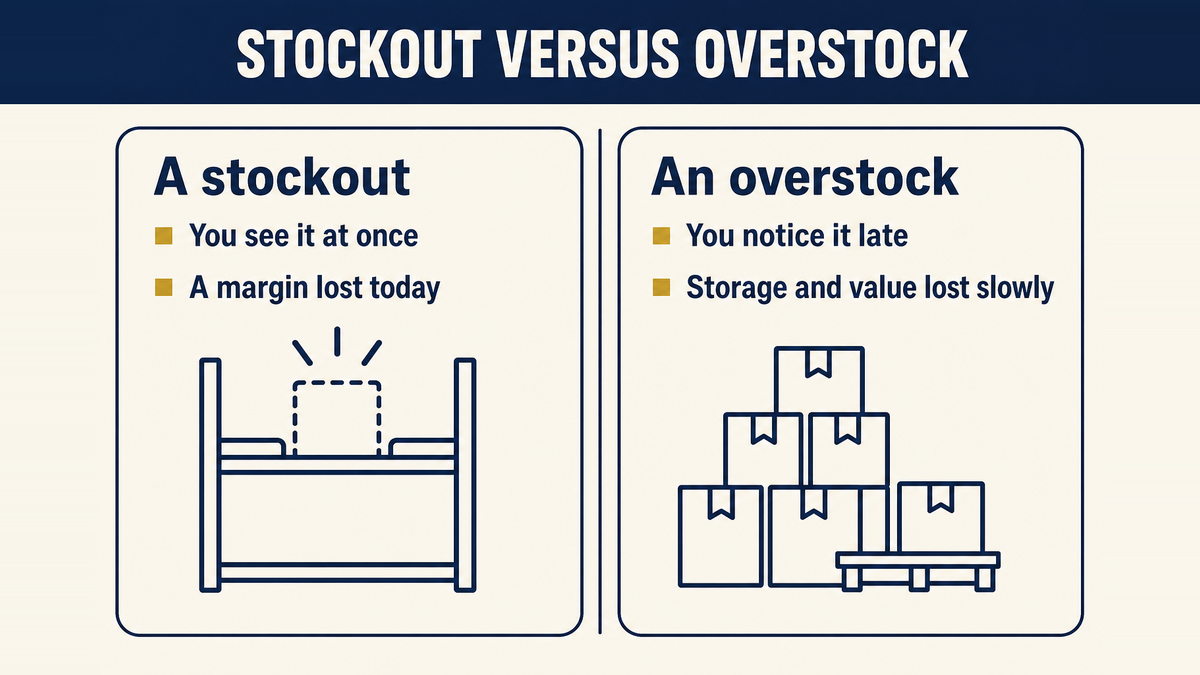
A stockout is immediate and specific. A customer wanted the item, you could not supply it, and the order went elsewhere. You will usually hear about it, and the customer may not come back. In a per-order model there is a second problem on top: you cannot see the shortage coming, because the number belongs to your supplier rather than to you.
An overstock is slow and diffuse. Nothing happens on the day you buy too much. The storage fee arrives as a slightly larger invoice, the cash simply is not there when you want it for something else, and the unsold units sit at the back of a shelf being worth less each month. Nothing announces itself, which is exactly why it accumulates.
So the useful habit is to make the invisible one visible. An ageing figure, which is simply how long each unit has been held, turns an overstock into a number you can look at. The unit that has been in stock for seven months is already a decision you are refusing to make, and the longer it stays the less it will ever be worth.
The buffer you need is set by variation during the lead time, not by your average sales. If demand is steady and the lead time is short, a small buffer is enough. If the lead time is long, or it moves, the same demand needs a much bigger cushion, because there is more time for the two to drift apart. Our guide to planning around the Chinese New Year factory shutdown is really a guide to lead times doubling for a few weeks, and it is the clearest example in this business of why a fixed buffer is not enough.
Sizing that buffer is a decision about risk rather than a search for the right number. The question is not how much stock to hold but how often you are willing to be caught short, and the honest answer for a new store is usually more often than feels comfortable, because unsold stock costs real money while a lost sale costs a margin. Once the sales rate is predictable, the same calculation that produced the crossover point will also tell you how much cover the pace of selling actually justifies.
5. Two Consequences People Miss
Deciding to hold stock changes more than your warehouse bill. Two of the knock-on effects are easy to overlook because neither appears on the same page as the decision.
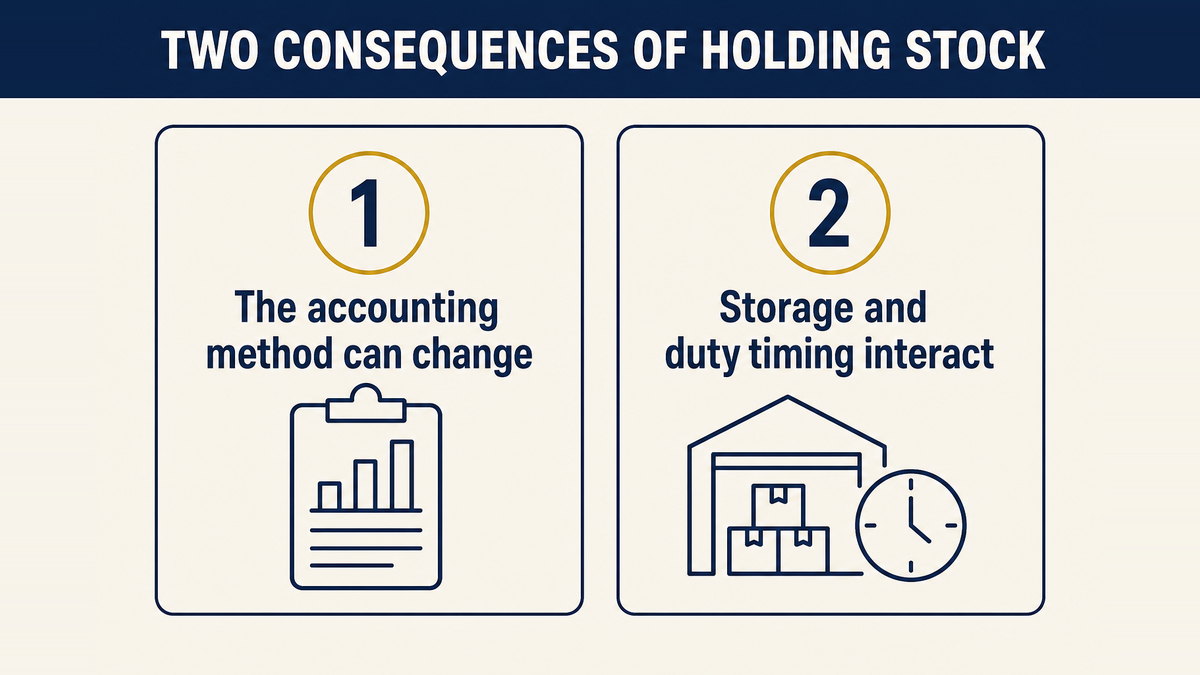
It can change how you account for the goods
Inventory is not only an asset you own. It is also a category you may be required to account for in a particular way, and the choice can change with the decision to hold.
If you are a small business taxpayer, you can choose not to keep an inventory, but you must still use a method of accounting for inventory that clearly reflects income. A small business taxpayer can account for inventory by treating the inventory as non-incidental materials and supplies, or by conforming to its treatment of inventory in an applicable financial statement. If, however, you choose to keep an inventory, you generally must use an accrual method of accounting and value the inventory each year to determine your cost of goods sold.
Internal Revenue Service, Publication 538: Accounting Periods and Methods, section on inventories
Read plainly, that says a business holding no inventory has a choice a business holding inventory may not have. The difference is administrative rather than dramatic, but it is real work, it usually arrives with an accountant's invoice, and it belongs in the comparison alongside the storage fee. Whether it applies to a particular business is a question for that business and its accountant rather than for an article.
Storage and duty timing interact
The second consequence concerns goods that came from outside the country, which is most of what a store like this sells. The customs regulations set out formal classes of warehouse for imported merchandise, including public bonded warehouses used exclusively for the storage of imported merchandise and importers' private bonded warehouses used for goods belonging to the proprietor.
Class 2. Importers' private bonded warehouses used exclusively for the storage of merchandise belonging or consigned to the proprietor thereof. · Class 3. Public bonded warehouses used exclusively for the storage of imported merchandise.
19 CFR 19.1, Classes of customs warehouses
The reason this is worth knowing is that it shows storage of imported goods is a regulated category rather than simply a shelf in a building, and that means the timing of when duty is settled can be arranged differently from the timing of when the goods arrive. For a store moving from per-order shipping to held stock, that timing question changes the working capital sum in the comparison above, and it is one to put to a broker or a customs specialist rather than to assume either way. Our guide to using a licensed customs broker covers who to ask and what to have ready.
The practical summary is that holding stock is a smaller decision than it looks and a wider one than it looks, at the same time. Smaller, because the saving per order in the first example is two dollars rather than twenty, and it depends entirely on the goods selling. Wider, because it pulls in your cash, your accounting and your customs arrangements, none of which appears in the storage quote. If you are still deciding what to hold, our notes on choosing a product worth committing to, on how minimum order quantities really work and on the move from per-order buying to holding stock cover the steps either side of this one. If the stock is going into your own space rather than a warehouse, our guide to sourcing racking covers what the shelving itself costs and how it is specified.
6. Frequently Asked Questions
Should a dropshipping store hold its own stock?
Not at the start, and not on the strength of the unit price alone. Holding stock pays when the saving per order is larger than the cost of carrying the goods while they wait, and that only happens once the volume is predictable enough that the stock turns over quickly.
What is the biggest saving from holding stock?
The parcel rather than the unit price. Sending one parcel from China on every order is expensive per order, and shipping domestically from stock is much cheaper, so the delivery saving is often larger than the discount earned by buying in bulk.
Why do sellers over-buy inventory?
Because the two mistakes do not feel equally bad. A stockout is a sale you know you lost, while an overstock is a cost you can postpone noticing. Until the storage bill or the unsold units are dealt with, over-buying looks like being prepared.
Can I see stock levels at my supplier?
Rarely with real accuracy, and that is the structural problem with the per-order model. You carry all of the risk of a stockout while having almost none of the information about the stock it depends on, so you cannot plan around a shortage you cannot see.
Does holding stock change my accounting?
It can. Under the published guidance, a small business taxpayer may choose not to keep an inventory, but a business that does keep one generally has to use an accrual method and value the inventory each year to work out its cost of goods sold. That is an administrative consequence of the decision, not only a cash one.
The Crossover Point, With Its Break-Even Row
We return the monthly cost of holding one unit, the volume where it undercuts per-order shipping, and two consequences people miss.
Model My Holding Cost
Questions & Comments
We read every one and reply within 24 hoursTrying to work out whether holding stock would actually save you money, unsure how big a buffer your lead time needs, or sitting on units that have been there too long? Post the product, the bulk price, your current parcel cost and how long the lead time runs, and our team will help you find the crossover point.