
Chinese New Year Factory Shutdown (CNY): Lead Times, Supply Chain Planning & Deadlines
 ·
Updated September 30, 2026
·
14 min read
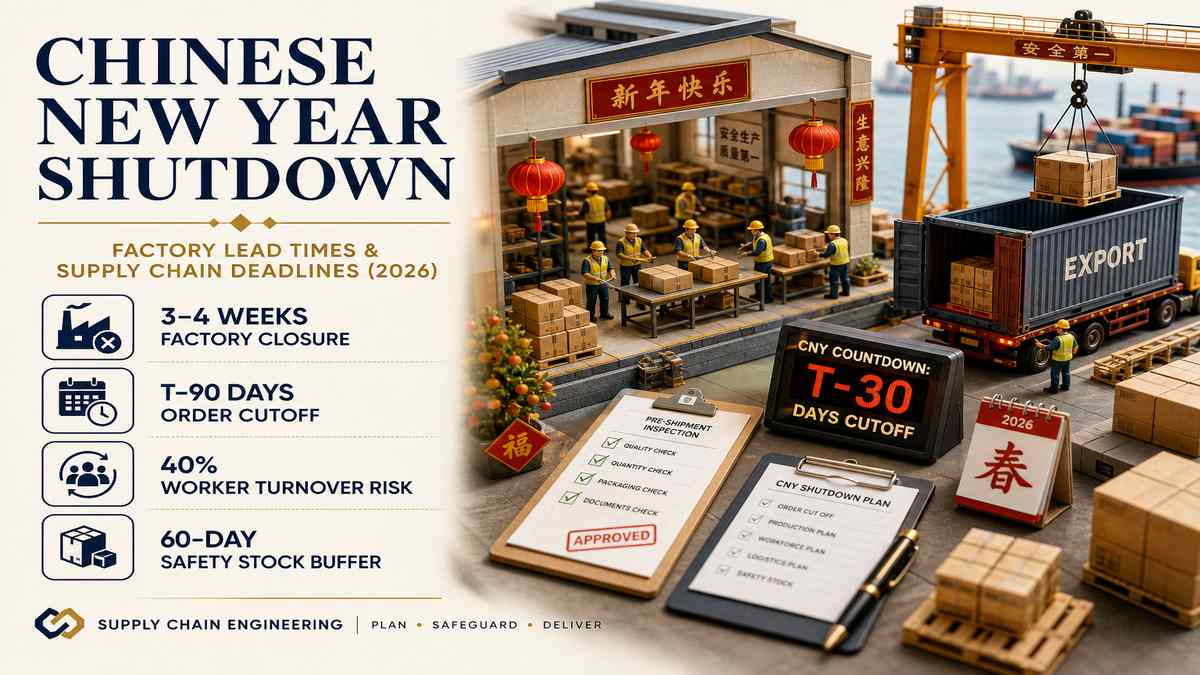
Direct Answer: While China’s official government holiday for the Spring Festival is 7 to 8 days, export manufacturing factories effectively shut down for 3 to 4 full weeks. Upstream raw material mills close 7 to 10 days early, domestic trucking fleets stop 12 to 15 days before the New Year, and 30% to 40% of migrant line workers do not return post-holiday. To prevent stockouts and avoid high defect rates, buyers must place purchase orders by late October (T-90 to T-100 days), maintain a 60-to-75-day inventory buffer, and enforce on-site quality inspections before final payments.
Every winter, the Chinese New Year (also known as the Lunar New Year or Spring Festival) creates the single largest annual supply chain disruption in global commerce. For foreign buyers, the biggest mistake is looking at China’s official statutory holiday calendar—which lists only 7 to 8 official days off—and assuming production will pause for just a week.
In reality, the operational blackout lasts between 20 and 35 consecutive days. China’s manufacturing sector relies heavily on hundreds of millions of migrant workers who travel thousands of miles back to inland provinces. Because public transport fills up rapidly, workers begin leaving factories up to two weeks before the official holiday date.
When you combine pre-holiday worker departures, early raw material mill closures, domestic freight halts, and the post-holiday hiring lag, global supply chains face an operational bottleneck of 6 to 8 weeks. If you do not plan your inventory runway well in advance, you risk empty warehouse shelves, missed retail seasons, and severe financial losses.
| Supply Chain Phase | Official Calendar Duration | Real Manufacturing Impact | Key Risk for Foreign Buyers |
|---|---|---|---|
| Pre-Holiday Slowdown | 0 Days (Normal working days) | 10–14 Days before New Year | Sub-tier component shortages, rushed line assembly, skipped curing steps |
| Full Factory Shutdown | 7–8 Statutory Days | 21–28 Full Calendar Days | Zero production output, closed customs offices, zero domestic trucking |
| Post-Holiday Ramp-Up | 0 Days (Offices officially open) | 14–21 Days after holiday | 30%–40% worker turnover, new worker errors, raw material backlogs |
| Total Supply Disruption | 7–8 Days | 45–60 Total Days | Empty retail inventory, lost seasonal sales, container rollovers |
Why Does the CNY Shutdown Disrupt Global Supply Chains for 6 to 8 Weeks?
To plan your production schedule safely, you must understand the four distinct domino effects that force factories to stop long before the holiday begins and recover slowly after it ends.
1. Upstream Raw Material & Coating Sub-Suppliers Close 7–10 Days Early
Your main assembly factory depends on dozens of tier-2 and tier-3 sub-suppliers for specialized parts, including packaging boxes, custom screws, molded plastics, surface plating, and raw metal sheets. These smaller sub-tier workshops operate on thin margins and shut down their furnaces, electroplating baths, and stamping lines 7 to 10 days before the main assembly plant closes.
If your finished product is missing a single custom silicone gasket or color-matched screw, your main supplier cannot finish the assembly. Once the raw material mills stop delivery in early January, assembly lines come to a complete standstill, regardless of how much pressure you apply.
2. Domestic Trucking & Logistics Lines Halt 12–15 Days Before New Year
Even if a factory manages to finish your production run on time, getting those goods from inland industrial cities (such as Dongguan, Ningbo, or Yiwu) to coastal container ports becomes extremely difficult. Long-haul truck drivers return to their home villages early to beat the massive national traffic jams.
Starting around two weeks before New Year’s Eve, domestic container drayage rates surge by 100% to 200%. In the final 7 days before the holiday, local trucking is virtually impossible to book at any price. Finished goods that are not loaded into ocean containers by mid-January remain stuck in factory warehouses until late February.
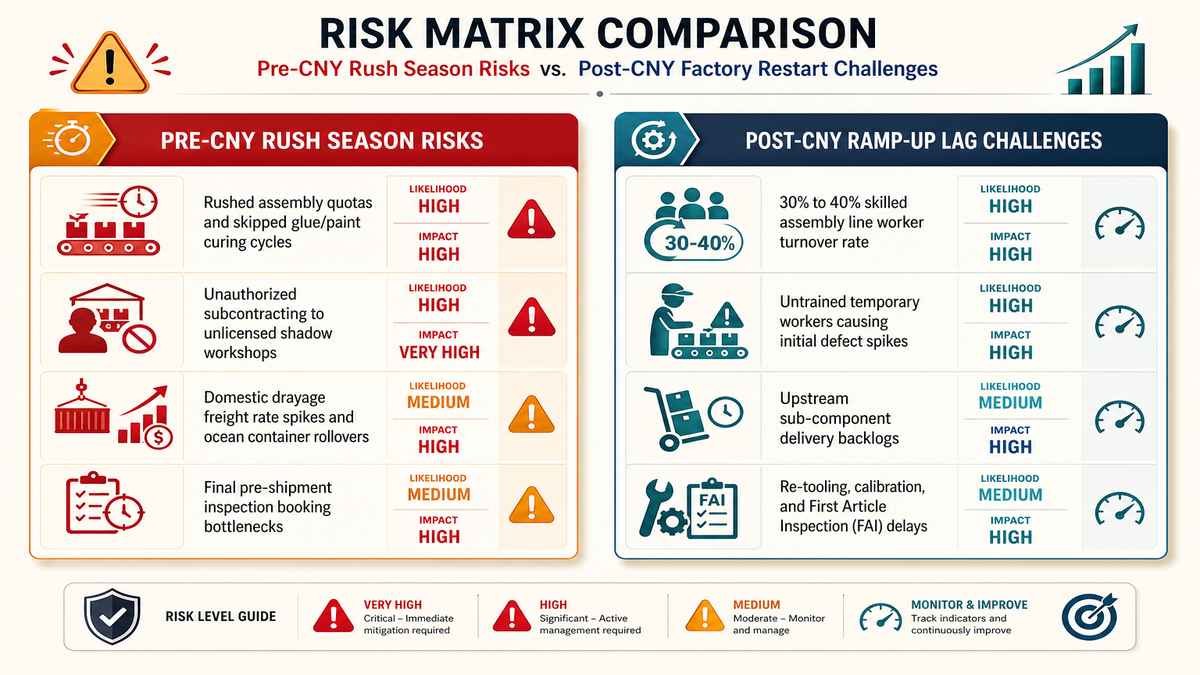
3. The 30%–40% Post-Holiday Worker Turnover and Ramp-Up Lag
Chinese New Year is the traditional window when factory workers receive their annual bonuses and decide whether to return to the same factory or seek higher-paying jobs elsewhere. On average, export factories face a 30% to 40% labor turnover rate every spring.
When factory gates reopen in mid-February, the assembly floor is staffed by brand-new, inexperienced operators who require hands-on training. Machines need recalibration, injection molds require thorough cleaning, and line efficiency drops to under 50% for the first three weeks of post-holiday production.
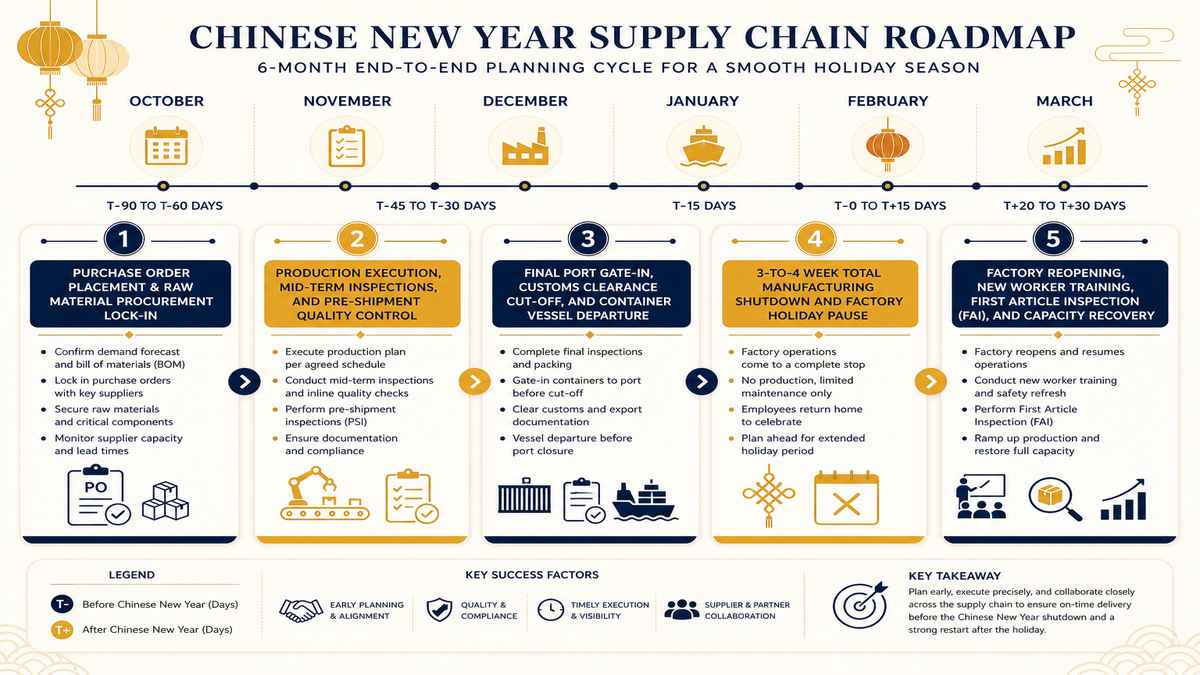
Complete CNY Supply Chain Timeline & Critical Cut-Off Deadlines
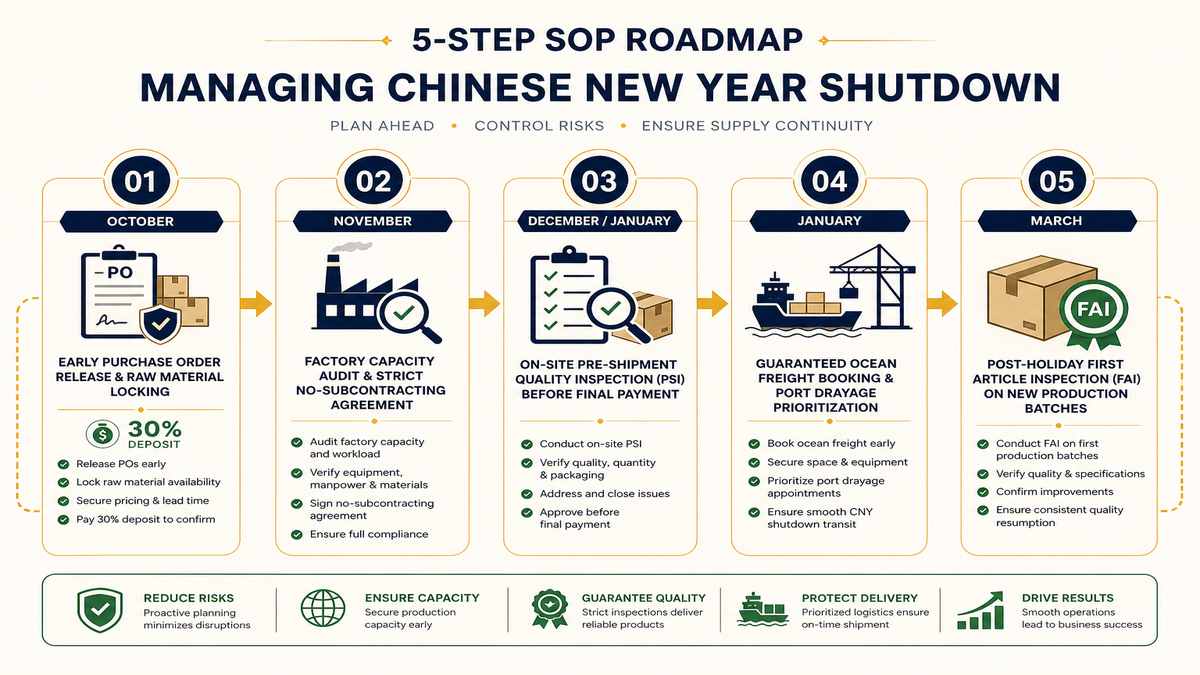
To ensure your cargo arrives in your home market on schedule, your procurement calendar must work backward from the Lunar New Year date. Below is the battle-tested chronological roadmap used by experienced sourcing professionals.
| Timeline Milestone | Target Calendar Window | Mandatory Buyer Action | What Happens at the Factory |
|---|---|---|---|
| T-100 to T-90 Days | Late October – Early November | Finalize sales forecasts, issue purchase orders, and pay the 30% production deposit. | Factory orders raw materials and locks production line slot before schedule fills up. |
| T-60 Days | Late November – Early December | Review raw material arrival and verify component pre-production schedules. | Sub-tier suppliers deliver raw materials; mass production tooling and stamping begins. |
| T-45 Days | Mid-December | Book ocean freight space and confirm destination port delivery windows. | Assembly lines run at peak speed; factory manages pre-holiday order backlog. |
| T-30 Days | Late December – Early January | Perform on-site quality control using final pre-shipment inspection (PSI) procedures. | Finished goods are packed into master cartons; final functional and visual testing occurs. |
| T-15 Days | Mid-January | Approve inspection report, release balance payment, and load container for port gate-in. | Domestic trucking finishes; cargo clears export customs and loads onto ocean vessels. |
| T-0 to T+15 Days | Late January – Mid-February | Monitor ocean vessel tracking and prepare destination customs import documentation. | Complete factory closure. Zero production, zero shipping, zero administrative replies. |
| T+20 to T+30 Days | Late February – March | Enforce strict post-holiday first article inspection (FAI) on new production runs. | Factory reopens, hires new operators, warms up machinery, and restarts supply chains. |
The 4 Biggest Pre-Holiday Quality & Shipping Traps (And How to Avoid Them)
The four weeks leading up to the holiday are the most hazardous period in the entire sourcing calendar. Under extreme pressure to finish orders before workers leave, suppliers often cut operational corners.
Trap 1: Rush-Job Quality Corners & Skipped Curing Cycles
When factory managers realize they are falling behind schedule, they speed up conveyor belts and shorten critical processing times. In electrical and plastic goods, adhesive drying times are cut in half, powder-coating ovens are run too quickly (causing paint peeling and surface blistering), and soldering points are left uninspected.
How to avoid it: Never accept a rushed ship date without a dedicated third-party inspection. Ensure your quality agreement specifies that all curing, aging, and drop testing times must be 100% completed according to standard protocols.
Trap 2: Unauthorized Subcontracting to Shadow Workshops
If a supplier overbooks its production capacity to maximize pre-holiday revenue, it may secretly outsource a portion of your order to unregulated local workshops. These shadow subcontractors lack cleanroom facilities, calibrated testing tools, and trained staff, leading to severe product variations.
How to avoid it: Require your supplier to sign an explicit no-subcontracting clause. Conduct unannounced on-site audits during peak production using factory audit checklists and worker capacity reviews to confirm that all goods are being produced within the approved facility.
Trap 3: Drayage Surges, Port Congestion & Rolled Containers
During the January pre-CNY rush, ocean container terminals in Shanghai, Ningbo, Shenzhen, and Qingdao experience severe congestion. Shipping lines regularly overbook vessels by 120% to 130%, bumping lower-priced containers to later sailings (a process called “container rolling”).
How to avoid it: Finalize your FOB and ocean freight booking arrangements at least 4 to 5 weeks before your target sailing date. Pay for premium equipment protection guarantees if your cargo is time-sensitive, and ensure your container gates into the port at least 48 hours before the customs cutoff window.
Trap 4: Spring Defect Spikes Caused by Brand-New Assembly Workers
When factories restart in late February and March, the high turnover rate creates a severe quality dip. Brand-new workers who have never handled your product make basic assembly errors, such as misrouting internal wire harnesses, using incorrect torque settings on fasteners, or placing incorrect labels on export cartons.
How to avoid it: Treat the first production run after Chinese New Year as a brand-new product launch. Always mandate a formal First Article Inspection (FAI) on the very first batch off the line before allowing the supplier to proceed with mass packaging.
Illustrative Scenario: How an Outdoor Gear Importer Saved $65,000 with a Split-Shipment Strategy
To see how proactive CNY planning protects your bottom line, consider the real-world case of an outdoor camping equipment brand based in Denver, Colorado.
- Batch 1 (4,000 Units – Fast Track): Produced immediately and shipped via ocean freight on December 28th. Passed full pre-shipment inspection with zero major defects and arrived in the US warehouse by early February to cover early-season demand.
- Raw Material Lock-In: The buyer paid a 30% advance deposit to purchase all aluminum tubing and 600D polyester fabric for the remaining 6,000 units before December 15th, storing the materials safely in the factory’s dry warehouse.
- Batch 2 (6,000 Units – Post-Holiday): Assembled in late February immediately upon factory reopening. Because the raw materials were already on-site, the factory began production on Day 1 without waiting for external metal mills to reopen.
Step-by-Step Action Plan: How Buyers Should Plan Inventory for CNY
To safeguard your business from holiday stockouts, follow this practical checklist starting in early autumn:
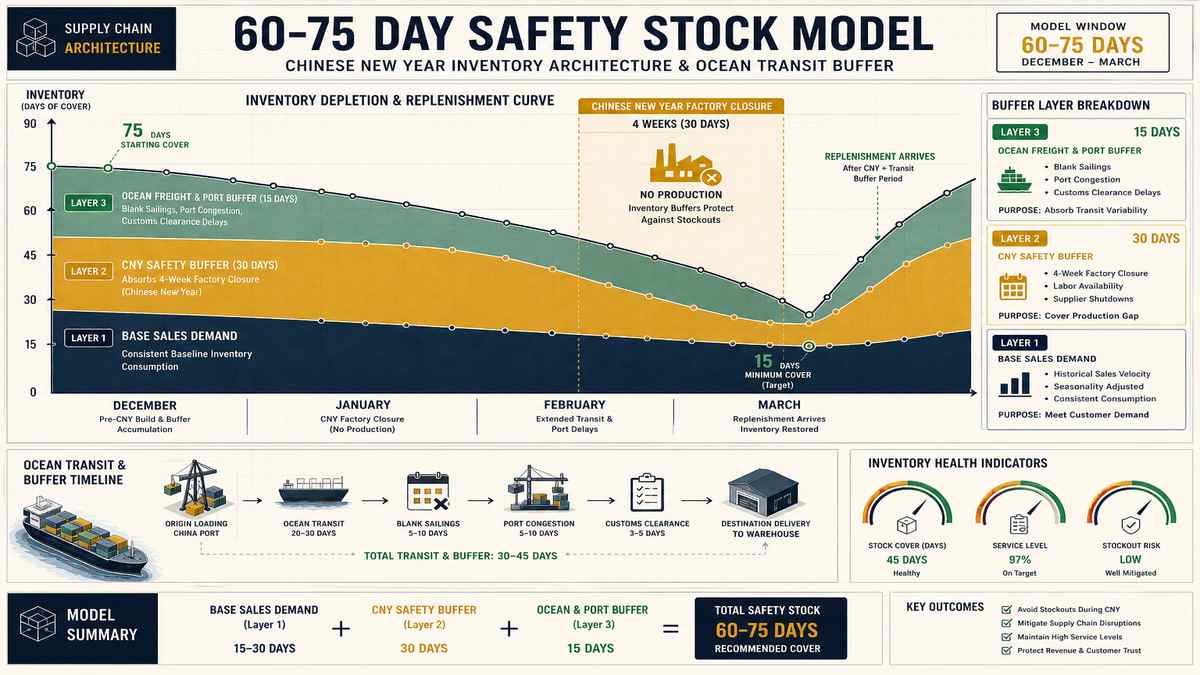
- Calculate Your 75-Day Inventory Buffer: Add your average monthly sales demand for January, February, and March. Ensure your domestic warehouse holds at least 2.5 months of stock before December 31st to absorb any ocean transit delays.
- Lock In Purchase Orders by October 31st: For all core product lines, confirm final purchase orders and transfer deposits at least 90 to 100 days before the Lunar New Year. Explicitly ask your supplier for their internal holiday closure dates and sub-supplier cutoff schedules.
- Review customs tariff classifications and HTS codes and Import Paperwork Early: Confirm that your commercial invoices, packing lists, and export certificates are drafted well before port customs offices close.
- Book Pre-Shipment Quality Inspections by Mid-December: Third-party inspection firms experience extreme booking crunches in January. Secure your inspection dates at least 3 weeks in advance to guarantee an on-site inspector is present.
- Never Release Balance Payments Without a Passed Inspection Report: If a factory rushes production and fails the quality check, you have zero leverage once the balance is paid and the workers have left for the holidays. Keep the balance payment conditional on a clean inspection sign-off.
- Reference Official Standards & Holiday Calendars: Always track the State Council of the People’s Republic of China official public holiday calendar, consult World Customs Organization port clearance guidelines, and maintain manufacturing rules under ISO 9001 quality management system standards.
Frequently Asked Questions (FAQ)
How long do factories in China close for Chinese New Year?
While China’s statutory public holiday is 7 to 8 days, export manufacturing factories typically shut down for 3 to 4 full weeks. Migrant assembly line workers travel back to their hometowns early, and upstream material suppliers pause operations 7 to 10 days before the national holiday. Full factory capacity does not recover until 2 to 3 weeks after the holiday ends.
When is the latest date to place purchase orders before CNY?
For standard manufactured goods with 30-to-45-day production lead times, purchase orders must be confirmed and deposits paid by late October or early November (at least 90 to 100 days before the Lunar New Year). Orders placed after mid-November will almost certainly finish after the holiday in March.
Why does product quality drop right before and after Chinese New Year?
Before the holiday, factory workers rush production quotas to catch holiday trains, leading to skipped curing times, rushed soldering, and hurried packaging. After the holiday, factories face a 30% to 40% worker turnover rate, meaning brand-new, untrained operators are assembling products, leading to higher initial defect rates.
How does CNY affect ocean freight rates and container bookings?
In the 3 to 4 weeks leading up to CNY, ocean freight spot rates spike by 20% to 50% due to surging export volume. Shipping lines experience severe overbooking, leading to rolled containers. Domestic container trucking rates also double in the final 10 days before the holiday as drivers leave early.
How much extra safety stock should importers hold during CNY?
Importers should maintain a buffer of 60 to 75 days of total inventory (around 2.5 months of forecasted sales) before January. This covers the 4-week factory closure, the 2-week ramp-up delay, and potential shipping port backlogs, preventing out-of-stock situations in February and March.
Protect Your Pre-Holiday China Production & Shipments in 2026
Our on-site sourcing and quality engineering team audits factory schedules, verifies raw material readiness, conducts unannounced pre-shipment inspections, and secures container space before holiday port shutdowns.
Get Free CNY Supply Chain Consultation
Questions & Comments
We read every one and reply within 24 hoursPreparing for an amfori BSCI or Sedex SMETA factory audit in China, dealing with Corrective Action Plan (CAP) remediation, or need guidance on retailer ethical sourcing requirements? Post your supplier location, industry sector, and audit questions below — our factory audit team will guide your ethical sourcing strategy.