
Cosmetic Bag Manufacturer: Makeup Bags From China
 ·
Updated October 12, 2026
·
18 min read
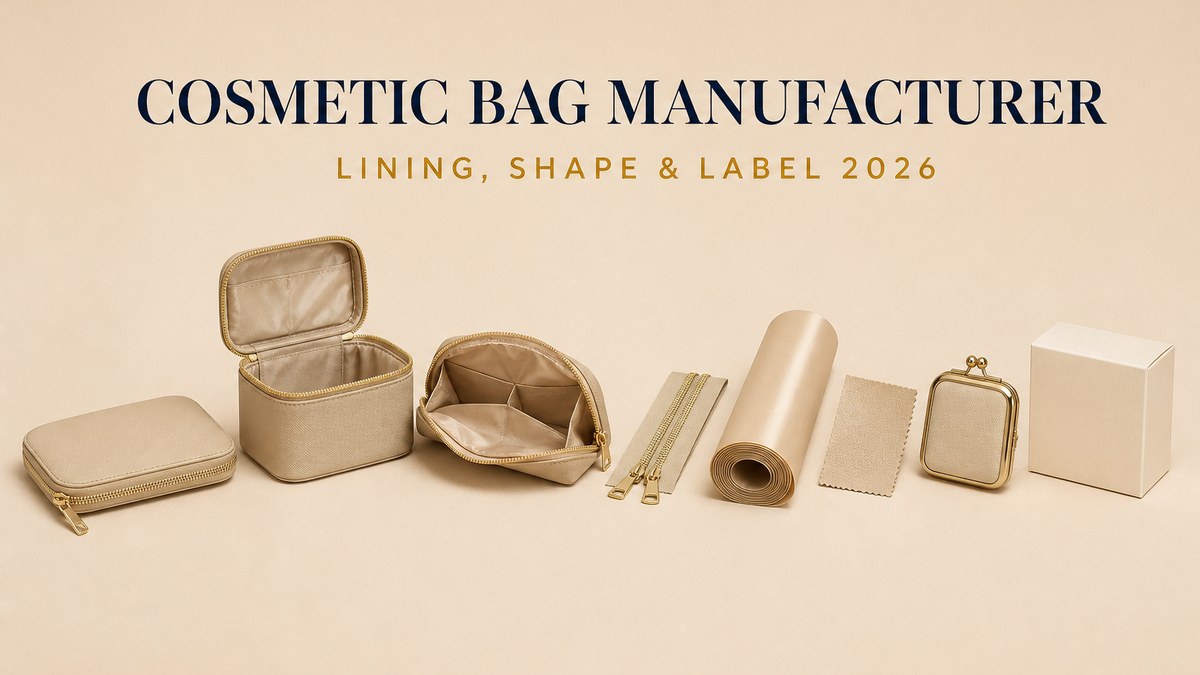
A cosmetic bag is the cheapest thing in a beauty range and the one item the customer touches every morning, so it is judged by feel and by whether it still looks right after a year. Both are decided inside the bag, in two layers nobody photographs: the lining that touches the products, and the stiffening that holds the shape. There is a third layer most buyers never think about, and it is not a material. It is the label. A small textile bag normally sits outside the fibre-content rules, which sounds like a free pass until you print a fibre name on the bag or write it into your listing, at which point the exemption stops and the full labelling duty comes back. This guide covers what a cosmetic bag is made of, why the lining and the shape decide whether it comes back, why a logo cracks on a bag but not on a flat panel, which labelling rules apply and where the trap is, how the price is built, and how to test a sample at your desk in twenty minutes.
What You Are Buying, and the Line That Decides It
| If you want | What it means in practice | The line on your order that decides whether it works |
|---|---|---|
| A lining the customer can wipe clean a year later | The wipe-clean claim belongs to a coating, and a coating can crack | The lining build, plus a fold-then-rub test on a creased panel |
| A bag that opens wide enough to pack | The opening is set by the gusset, not by the zipper length | The opening geometry, drawn, with the finished opening size |
| A case that still looks square after a suitcase | The base board is what holds the shape, and it can bend for good | The board specification, plus a fold-and-leave test on a sample |
| A logo that survives the fold it sits on | Print on a coated or PU face cracks at the crease, not on the flat | The decoration method, chosen for the fold, not for the flat panel |
| To know whether you have to label the fibre content | A bag is usually outside the rule, but your own words can pull it back in | Whether any fibre name appears on the bag, the tag or the listing |
| A price that survives a second quote | Most of a small bag's cost is cutting, sewing and the lining | The cost lines shown separately, with the lining named by build |
What Are You Actually Buying? A Shell, a Lining, and One Moving Part
A small case looks like one product and is really four parts stacked together, and only two of them are visible in a photograph.
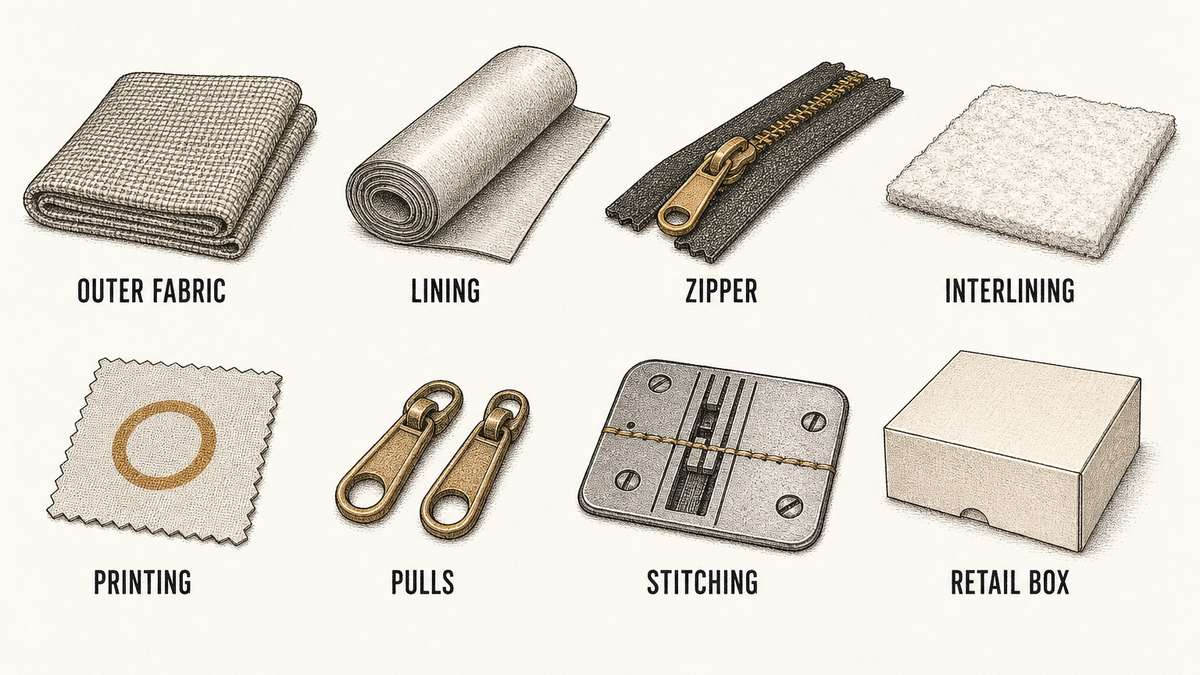
The shell. The outside face: a woven fabric, a coated fabric, or a PU face laminated to a backing. It decides how the bag looks and feels, and it is the layer every buyer specifies.
The interlining. The soft layer between shell and lining. It stops the bag feeling like a plastic bag and makes the panels hold a shape rather than hanging limp. It is bought by weight and thickness, and a lighter one is the easiest saving in the whole bill of materials, because a sample with less of it still looks correct on a table.
The base board or stiffener. A flat piece in the bottom, and sometimes in the ends. It makes a vanity case sit up on a dressing table instead of collapsing over its contents, and it is the part nobody asks about until customers complain that the bag will not stand.
The lining. The inner face, and for this product the most important surface in the item: what the customer's products sit against, what gets wiped, and what decides whether the inside still looks presentable after a year. It is also the hardest layer to inspect, because the only way to see it properly is to look inside an open bag with a light.
The one moving part. A zipper on a soft case, or a metal frame and clasp on a hard-edged one. On a soft case the zipper is the opening, the closure and the decorative line at once, which is why a small bag is far less forgiving of a cheap zipper than a large one.
If you want the detail on fabrics, coating types, zipper mechanics and hardware, that belongs to a different product: sourcing backpacks and bags from China works through those in the shapes where they matter most. What is different about a small case is that every decision is compressed into a surface the customer holds in one hand, and that the two layers carrying the risk are the two that are never photographed.
One commercial point follows. A cosmetic bag is often ordered as part of a set, where it is priced as the cheap line while the specification quietly slides. Decide early which piece carries the judgement of value, because it is rarely the piece you assumed.
Why Does the Lining Decide Whether the Bag Comes Back?
Because it is the only surface in the product that is asked to do three jobs at once: look clean, be easy to clean, and not change what it touches.
Three lining builds cover most of what you will be quoted, and they fail in different ways. A plain woven lining is a fabric, sometimes with a water-repellent finish: soft, pleasant in the hand, and not wipe-clean, because a spill soaks in and stays. A coated lining has a continuous film bonded to its face, so liquid sits on the surface and wipes away; it is the build most buyers ask for, and the one that fails visibly when the film is poor. A padded lining has a soft layer behind the fabric, which gives the bag its cushioned feel and is what makes a case feel expensive — and it is also what makes the inside harder to wipe, because a padded surface flexes under the cloth.
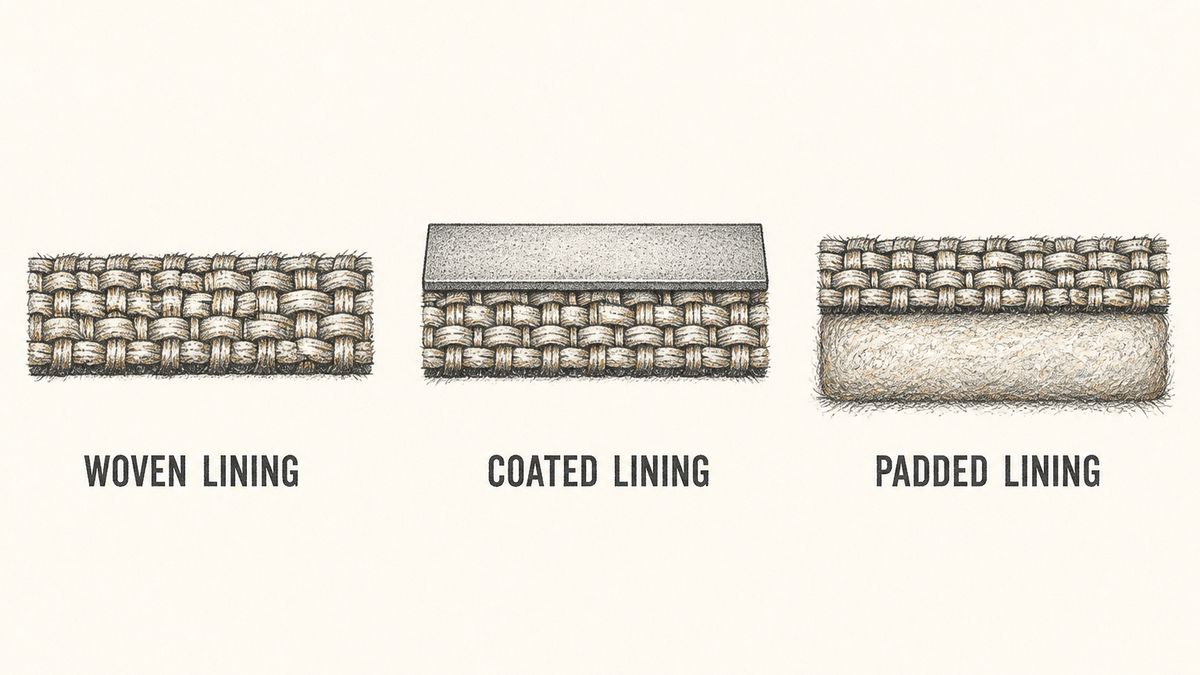
The first thing to get straight is that wipe clean is a test result, not a material name. A supplier can quote you a coated lining and send something genuinely coated, and still not promise that the coating will be there after the customer has folded the bag a hundred times and wiped the crease with a damp cloth. The failure looks like this: the film lifts along the crease, the colour underneath shows through, and the bag becomes the one thing the customer notices every morning.
So the specification should name the build and the test. Three questions settle it:
- What is the film made of, and how thick is it? Both belong on the order, because together they decide whether it survives a crease.
- What is the lining bonded to, and with what? A lining laminated to the shell with an adhesive is a different product from a lining sewn as a bag inside the shell. The laminated version is faster and cheaper, and it is the version that separates along the top edge — the failure where the lining comes away and hangs loose inside, which a customer sees every time they open the bag.
- Does the lining sit against bare contents, or is there a divider? On a small case the contents slide around, and everything sharp in a makeup bag is a corner of something. A divider or an elastic strap is what stops the lining being rubbed through in one place.
The second thing to get straight is the smell, because it is the complaint that arrives fastest. A lining that smells when the parcel is opened may simply need air, and the honest way to tell a smell that will go from one that will not is to test it warm: seal the sample in a bag, leave it somewhere warm for two days, then open it. A material that smells worse after that will not be fixed by airing.
The third point decides whether the inside still looks presentable in a year, and it is about construction rather than material. On a lined case the inside is a second bag sewn inside the first, and the seam that closes it is usually hidden under a binding or turned into the top edge. If that seam is left raw, or the binding is only stitched through on one side, the inside begins to come apart from the top down. Ask the factory to show you the inside of the top edge on a finished sample held open, and look at where the lining is attached and how. It takes ten seconds.
Why Does a Bag That Will Not Stand Up Get Returned?
Because a small case is a container for loose things, and a container that will not hold its own shape cannot be opened one-handed. That is a usability failure the customer feels every day, which makes it far more damaging than a small cosmetic fault.
Three things make a case stand up, and they work together.
The base board. A flat stiffener in the bottom, sewn between the shell and the lining. It decides whether the base stays flat, and its stiffness is a real number: a board specification, not a grade name. A board that is too soft lets the base bow; a board stiff enough for the dressing table but brittle cracks along a fold line instead of bending, and the bag has a permanent kink.
The interlining in the walls. The panels stop the sides folding inward. A case with a good base and limp walls still collapses at the corners.
The opening geometry. This is the part buyers miss. A soft case opens wide enough to pack only if the zipper is set into a gusset panel running around the sides, rather than sewn directly along the top edges of two flat panels. The second version is cheaper to cut and sew, looks the same when closed, and produces a bag you have to fight to fill. The finished opening — not the zipper length, the opening — belongs in your specification as a measurement.
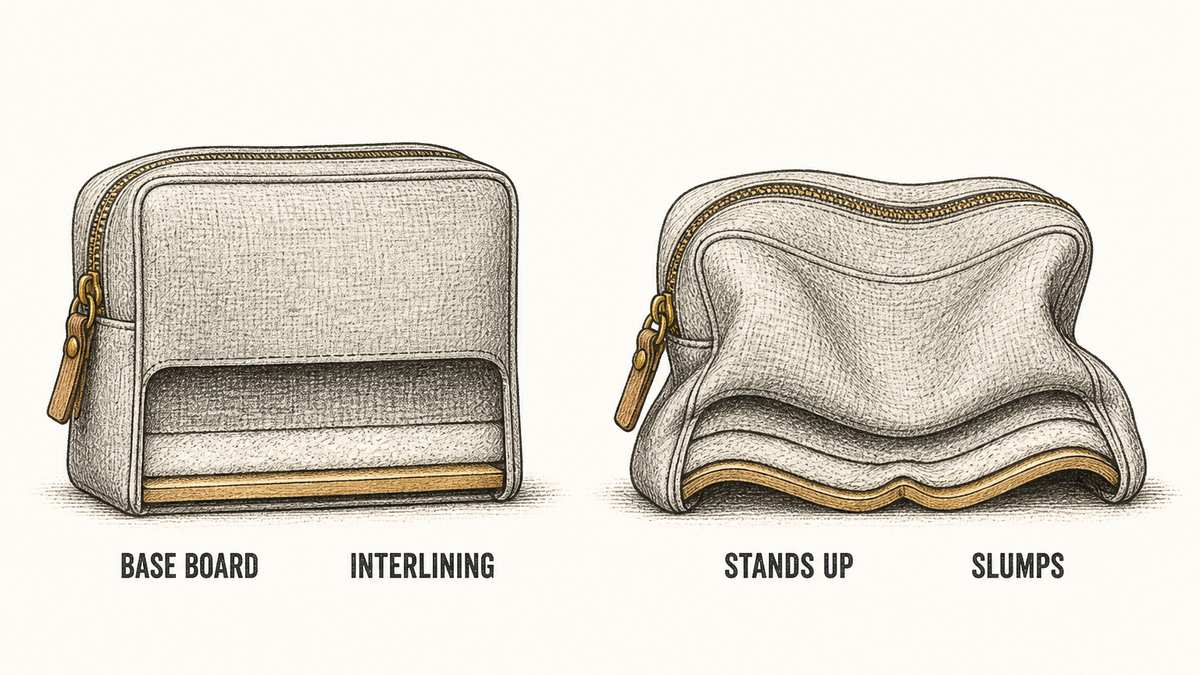
Here is the test that separates a case that stands from a case that only stands in a photograph. Fold the sample flat, put it under a heavy book or a carton overnight, then unfold it and look at it the next morning. What you are checking is not whether it opens — it will — but whether it returns to square, and whether the board has taken a set. That is exactly what happens to the bag in a suitcase or a drawer, and it is the one test a supplier will never run unprompted, because a good board and a cheap board both pass every test that happens on a table on the day of the sample.
Two smaller details are worth writing down. The first is the corner: ask whether corners are turned and topstitched or bound with a strip. Both are legitimate and they age differently — one wears at the corner point, the other can come loose where the binding ends. The second is the top edge, which is where a soft case gains much of its stiffness, because the zipper tape and the lining are joined there. If the top edge of your sample rolls between finger and thumb like a sock, the bag will not hold a shape however good the base board is.
Why Does the Logo Crack on a Bag but Not on a Flat Panel?
Because a printed mark is a thin film of ink sitting on top of a surface, and a fold asks that film to stretch. On a flat panel nothing stretches, so every sample passes. On the finished bag the mark sits on a panel that gets folded in half, pushed into a drawer and pressed under other bags, and the ink film breaks along the crease while the surface underneath is still perfectly good.
The way the mark is applied decides whether that happens, and the choice is narrower than most buyers expect.
Screen print. Ink laid onto the surface through a mesh, then cured. The strongest colour and the sharpest edge, and the cheapest way to mark a flat panel. Its weakness is exactly the fold: the ink sits on top of the face and cannot stretch with it. On a grained PU face it also sits on the high points, which is where it wears off first.
Heat transfer. A printed carrier film pressed on so the decoration bonds into the surface rather than resting on it. It handles a fold far better and holds detail on a textured face. It usually costs more per piece and the colour is slightly less punchy, a trade most buyers are happy to make once they have seen a cracked sample.
A separate label. A woven or printed label stitched on, or a small metal plate. There is no ink film on the panel, so there is nothing to crack; it moves the problem to the sewing line instead of the print line.
Embossing or debossing. The mark is pressed into the material with a tool instead of printed onto it. No ink and no colour to fade, a one-off tool cost per design, and a result that reads as more expensive than it is. On a small bag with a short mark, this is often the best answer and the one least likely to be offered.
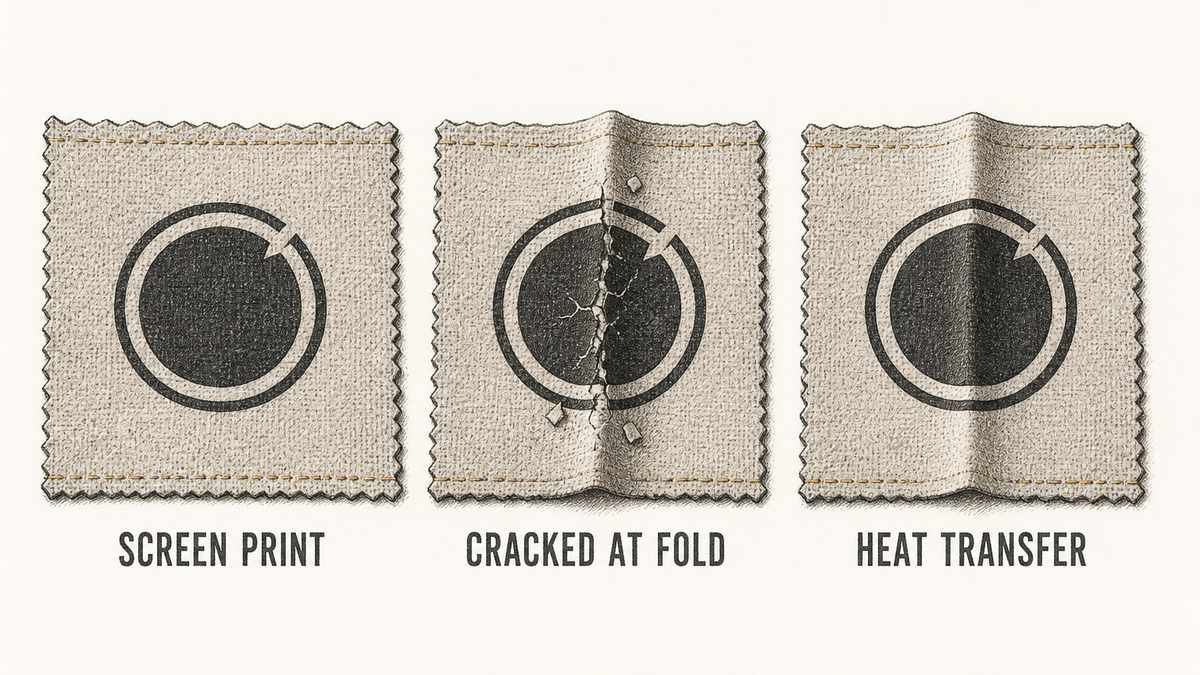
One habit turns this from a risk into a decision. Ask for the print sample on a folded panel, not on a flat swatch. Every factory can produce a flat swatch, and a flat swatch tells you nothing about the only condition that matters. Ask for a piece of the actual shell material, decorated with the actual mark, folded along the line the finished bag folds along, then opened again, and rub the crease with a thumb. That single request removes the whole category of complaint and costs a factory nothing.
Two follow-on details are worth settling at the same time. The first is placement: if your design puts the mark across a fold, say so on the artwork rather than leaving the supplier to notice, because the natural place to centre a logo is exactly where a bag folds. The second is the surface: a PU or coated face has a grain, and a mark applied over a grain covers the peaks and not the valleys, so it looks slightly broken up close and wears unevenly. On a hero product the answer is a smoother face under the mark rather than a heavier layer of ink. If you want the general method for getting a mark onto a Chinese-made product, including the artwork files and the approval steps, putting your logo on products made in China covers the process from the buyer's side.
Which Labelling Rules Apply, and Where Is the Trap?
Short answer: a small textile bag is normally outside the fibre-content labelling rules, so you do not have to sew in a fibre-content label — and the exemption disappears the moment you write a fibre name anywhere the customer can see it.
The rule in question is the United States set of labelling rules for textile products. Its coverage section, at 16 CFR 303.45, does two things that matter, and reading them in order is what makes the position clear.
First, it lists the products that are covered. The list is specific rather than a general statement about anything made of cloth: it names articles of wearing apparel, beddings, curtains and draperies, towels, cushions, furniture slip covers, sleeping bags, hammocks and similar items, along with all fibres, yarns and fabrics. A small bag is not on it, and it is worth noticing that cushions and sleeping bags are, because that shows how deliberate the list is.
Second, it excludes everything else. The same section states that all textile products other than the ones on that covered list are excluded from the rule's requirements, and then names further exclusions. Two matter here: coated fabrics, and the parts of a product made of coated fabric; and one-time-use disposable non-woven products. A bag body faced with a coated fabric is therefore outside the rule twice over.
That brings up a definition worth knowing, because “coated” has a precise meaning here and it is not the everyday one. The same part defines a coated fabric as one whose surface is coated, filled, impregnated or laminated with a film-forming material in such a way that the weight added is at least 35 percent of the fabric's weight before the coating was applied. So a light finish does not make a fabric coated under this rule, while a heavy PVC or PU face does. Ask the fabric mill, not the bag factory.
Now the trap. The same section says the exclusions stop applying if any representation about fibre content is made on a label or in an advertisement without a full and complete fibre-content disclosure in that same place. Read that backwards from how most buyers think: leaving the fibre out keeps you outside the rule, while describing it pulls you in fully. A hang tag that says the bag is cotton, or a listing bullet that says 100% canvas, without the complete disclosure, is the exposure. The section adds that the exclusions also stop applying if the fibre information given is untrue or misleading.
The commercial advice is short. Either say nothing about fibre content on the bag, the tag or the listing, or say it completely and correctly. What you cannot do safely is the thing that comes most naturally to a seller: name one fibre as a selling point, in a bullet point, and leave it there. You can read the coverage and exclusion section yourself, with the definitions, in 16 CFR Part 303.
One further provision explains why the paperwork matters as much as the label. The part states that textile products intended for uses outside the rule's scope are not subject to its labelling and invoicing requirements, as long as the invoice or another document covering how the products are sold states that they are not intended for uses that fall under the rule. So the paper trail has to say what the product is for. If you are sourcing bags that will be filled or repacked before they reach a consumer, ask your supplier to state the intended use on the invoice.
Two honest limits. This is one country's labelling rule and it says nothing about what a retailer in another market will require, which is usually stricter and set by contract. And country-of-origin marking is a separate rule handled at import rather than at labelling; that one belongs to your customs broker, and working with a customs broker on a first shipment is where to take it.
Which Rules Do Not Apply, and What That Does Not Mean
Two United States chemical rules get quoted at almost every bag project, and neither of them names this product. Knowing that is worth real money, because it stops you paying for tests that were never required.
The phthalate rule bans certain phthalates in children's toys and child care articles, and its prohibition section says exactly that. A cosmetic bag sold to adults is neither, so it sits outside that rule's scope.
The lead-in-paint rule declares three categories of banned product: the paint itself; toys and other articles intended for use by children that bear lead-containing paint; and furniture articles for consumer use that bear it. A soft cosmetic bag is neither an article intended for children nor a furniture article, so it does not sit in the categories that rule covers — you can check the scope and the banned product list in 16 CFR Part 1303, and the phthalate rule is at 16 CFR Part 1307. The paint itself is still banned as a product in its own right, which is why the coating you specify is a real question even though your bag is not a named category.
Here is what that does not mean. It does not mean the materials are unregulated. The pressure comes from three other places: the market you sell into, which may have its own chemical restrictions and documentation requirements; the retailer, whose restricted substance list you accepted when you listed the product; and your own claim, because describing a bag as water-resistant or as made of a named fibre writes a specification someone can test. And if the product genuinely is for children, you are in a different set of rules entirely, with testing and a certificate attached — children's product testing and the certificates behind it works through that properly.
How Is the Price Built?
A cosmetic bag quotation is unusual among soft goods, because the material is not where the money is. On a small case the material is a small share and the work is a large share, the opposite of what most buyers assume. That explains why the cheapest way to cut the cost of a bag is to simplify it, and why swapping the fabric for a cheaper one saves far less than you expect.
The outer fabric or face. Bought by the metre, and on a small bag the area is modest. This is the line everyone negotiates and the line with the least room in it.
The lining. Bought by the metre too, and the build matters more than the price per metre. A coated lining costs more than a plain woven one, and a lining made as a separate inner bag costs more to sew than one laminated to the shell. Both differences are worth paying for and both are invisible in a photo.
The interlining and the base board. Cheap per piece, and the first two things to shrink when a quotation needs to come down. Because the sample in front of you was made with the good version, you will not see the change until the shipment arrives.
The zipper and the pull. A bought-in part. A branded zipper with a metal pull costs several times an unbranded one, and on a small bag the zipper is a large share of the total precisely because the bag is small. This is also the line where a quotation can look competitive and not be.
Decoration. Usually a one-off setup charge per design plus a cost per piece, and the per-piece cost depends on the method: screen printing is cheapest, a heat transfer costs more, embossing carries a tool, a woven label is a bought-in item plus a sewing step. Choose the method for the fold, and compare prices for the same method.
Cutting and sewing. On a small case this is normally the largest line, and it is driven by the number of pieces in the bag rather than by its size. Two panels and a zipper is a different job from six panels, a gusset, a base board, an interior divider and a bound top edge. That is why the biggest lever on a cosmetic bag price is construction, not material.
The in-line check. Whether anybody looks at the bag before it is packed. One of the easiest lines to remove, and the line that decides how many shipments you inspect yourself.
The retail box or pouch. Often quoted separately. A bag in a plain bag and a bag in a printed box are different offers, and the difference frequently exceeds the difference in the bag.
The habit that makes a quotation comparable is to ask for the split, and specifically for the cutting and sewing time per piece. On a bag like this one, the labour figure is the quotation. Two factories quoting the same design with a large gap between them are almost never disagreeing about fabric; they disagree about how many operations the bag takes, and one has quietly left an operation out.
What Goes Wrong?
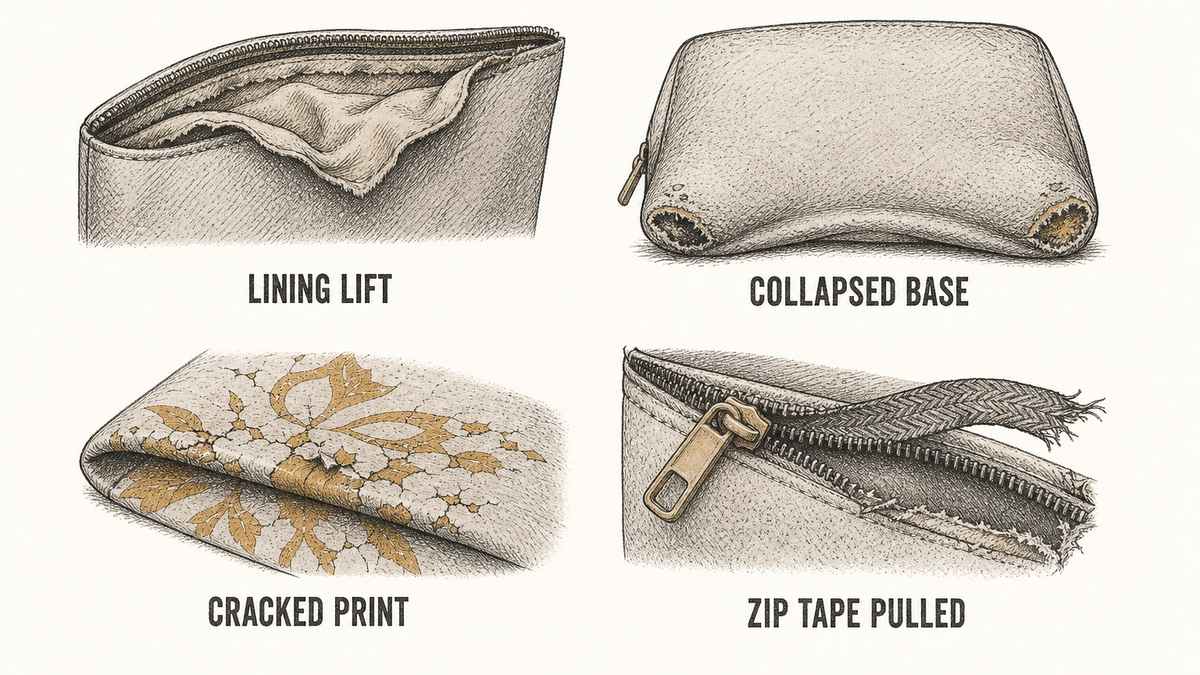
Five failures account for most of what you will hear about, and four of them are visible only when the bag is open or in use.
The lining comes away at the top edge. The inner lining is lifting and hanging loose, or the binding has pulled free along part of the rim. This is the most common complaint in the category and it is a construction fault rather than a material fault: the lining was laminated to the shell instead of being made as a separate inner bag, or the closing seam was not caught through both layers.
The base collapses and the corners wear through. The case will no longer sit up, the board has taken a bend, and the bottom corners look scuffed within months. The board was too soft or too brittle, or the wall interlining was too light to work with it.
The print cracks along the fold. The mark is intact on the flat panel and broken along the crease. Nothing was wrong with the artwork or the colour; the decoration method could not stretch.
The lining goes tacky, or it smells when it is warm. The surface stops feeling dry and starts feeling slightly sticky, and the bag smells different after a warm week than it did when it was opened. This does not improve with time or airing.
The zipper tape pulls away from the bag body. The fabric strip the teeth are mounted on has separated from the shell along the seam, usually near the end where the bag opens widest. It is a seam and reinforcement problem at the point of highest load, and the one failure on this list a customer describes as the bag having fallen apart.
The pattern is the same in most soft goods: none of these five is a manufacturing accident. Each is a decision made cheaply at the sampling stage and paid for at the customer — and on a small, cheap item the difference costs a few cents and shows up a year later, which is the hardest combination to catch by inspection.
How Do You Check a Manufacturer Before You Commit?
Start with the supply chain, because a small bag is an assembly of bought-in parts and a lot of the quality is decided before the factory touches it.
Ask who makes the lining, and what the film is. A factory that cannot name the lining build and its film is buying whatever is available, which means your second order will not match your first.
Ask whether the lining is laminated or sewn as a separate inner bag. This one question predicts the most common complaint in the category, and the answer changes the price. You are allowed to choose the more expensive answer.
Ask for the board and the interlining as numbers. Thickness and stiffness, not a grade name. Keep those numbers in your file, because they are the first things a quotation shaves.
Ask who decorates the panel. Many bag factories send panels out to a print shop. That is normal, and it means print quality is not under the factory's control unless they check it, so the check has to be written into the order.
Ask which bag families they already run. A factory that runs backpacks, cooler bags and cosmetic bags will have the construction experience you want; one that runs only one of them may still be excellent at it. What you are listening for is whether the answer is specific. Sourcing an insulated cooler bag covers the version where the bag also has to hold temperature, and the lining questions there are set by a different driver entirely.
Then test a sample yourself. Five things, all of them quick, and none of them requiring equipment:
- Fold the lined panel and rub the crease. Crease it firmly, open it, rub along the fold with a damp cloth. If the film lifts or the colour moves, the wipe-clean claim on your listing is already untrue.
- Fold the bag flat, weight it, leave it overnight. Unfold it in the morning and check whether it returns to square and whether the board has taken a set. This is the suitcase test, and the only one that catches a soft board.
- Fold the decorated panel and rub the crease with a thumb. Look for the mark breaking along the fold. Ask for this sample on the actual shell material, not a flat swatch.
- Seal the sample in a bag somewhere warm for two days, then open it and smell it. A smell that worsens when warm will not air out in a warehouse.
- Open the bag fully and look at the inside of the top edge. Find the seam where the lining is closed and check it is caught through both layers. Hold the bag open against a light; ten seconds is enough once you know what you are looking at.
Turn the answers into an inspection plan, because a sample you tested and a shipment you did not are two different things. The usual structure works on a small bag as well as a large one: a first article inspection on the first piece off the line, a the sample size for a cosmetic batch rather than from a feeling, and a the check on a cosmetic before the cartons are sealed. Three checks belong in that plan specifically: the fold-and-rub test on the lining, the open-bag look at the lining seam, and a photographed sample of the decorated panel. Each takes under a minute per piece once the inspector has been shown what to look for.
One document is worth having before the first order rather than after it. If the bag carries your brand, the specification sheet should state the shell material, the lining build and its film, the board and interlining as numbers, the finished opening size, the zipper and pull, the decoration method, the packing and the tests that will be run. Written as figures and materials rather than grade names, it is a document two factories can both quote against — the specification sheet for a cosmetic sets out the format. And if you are still choosing between a factory and a trader, telling a cosmetic maker from a reseller is the check to run first.
Where Does a Cheap Quotation Get Its Money Back?
Eight lines get trimmed on this product, and they are listed below roughly in the order they go. The first three are the ones that come back.
- A lighter interlining. Saves a few cents, and the sample with the full weight is the one you approved.
- A thinner lining, or one with no film. Turns a wipe-clean bag into an ordinary fabric bag without changing how it looks in a photograph.
- Laminating the lining instead of making a separate inner bag. The largest saving that shows up as a complaint, because it is exactly the construction that produces a loose flap of lining inside.
- A softer or thinner base board, or none at all. The bag still looks right on a table and stops standing up in a suitcase.
- An unbranded zipper and a lighter pull. Invisible until the tape separates, by which time the customer has formed a view about the brand.
- The cheapest decoration method. The mark cracks on the fold, where the customer's eye goes every day.
- Fewer operations. A bound top edge replaced by a raw one, piping dropped, a divider removed, single-needle stitching where a double row was specified. Each is small; together they are the difference between a bag that lasts and one that does not.
- No in-line check. Nothing is looked at before packing, so a shipment carries whatever the line produced that day.
The useful way to use this list is to compare two quotations against the same written specification, then ask each factory to confirm, line by line, that their quote includes the things on it. A factory that will not confirm the lining build, the board and the decoration method is not quoting your product. It is quoting a bag that looks like your product, and the difference costs nothing to find out now and a great deal to find out later.
Frequently Asked Questions
Do I need a fibre-content label on a cosmetic bag?
Normally no. The United States textile labelling rule lists the products it covers at 16 CFR 303.45, and a bag is not among them, while the same section states that products outside that list are excluded; coated fabric, and the coated parts of a product, are excluded as well. The exclusion stops applying if you give fibre information on a label or in an advertisement without the full disclosure in the same place. So either say nothing about fibre content, or say it completely.
Why is my wipe-clean lining peeling and going tacky?
Because wipe clean is a property of a coating, and a coating can fail in two ways. A film that is too thin or too brittle lifts along the creases. A material that changes with warmth feels tacky and smells worse after the bag has been somewhere warm. Test it before you commit: crease the lined panel, rub the crease with a damp cloth, then seal a sample in a bag somewhere warm for two days and open it.
Why does my bag no longer stand up after shipping?
The stiffener in the base has taken a bend, or the interlining in the walls is too light to hold the panels. A soft board bows under the contents and stays bowed; a brittle one cracks along the fold instead of flexing. The test is to fold the sample flat, weight it, leave it overnight, then unfold it and see whether the bag returns to square. That is what a suitcase does, and it never happens on the day a sample is presented.
Why did my logo crack along the fold?
Because a screen-printed mark is a thin film of ink resting on the surface, and it cannot stretch when the panel folds. Ask for the decorated sample on a piece of the actual shell material, folded along the line the finished bag folds along, rather than on a flat swatch, which always passes. If the mark must sit across a fold, a heat transfer bonds into the surface instead of resting on it, and a stitched label or an embossed mark removes the problem because there is no ink film at all.
Do the phthalate and lead-in-paint rules apply to a cosmetic bag?
Both are written for other categories. The phthalate rule covers children's toys and child care articles, and an adult cosmetic bag is neither. The lead-in-paint rule bans three categories: the paint itself, toys and other articles intended for children bearing lead-containing paint, and furniture articles for consumer use bearing it. A soft bag is not in those categories, though the paint remains a banned product in its own right, which is why the coating you specify is still a real question. Pressure on the materials usually comes instead from the destination market, the retailer's own requirements and your own claims.
What should the specification sheet for a cosmetic bag say?
The shell material and its weight; the lining build and its film, with the film thickness; whether the lining is laminated to the shell or sewn as a separate inner bag; the base board and interlining as thickness and stiffness figures; the finished opening size, not the zipper length; the zipper type and pull; the decoration method and its position relative to any fold; the stitching and edge treatment; the packing; and the tests per piece and per shipment. Written that way it makes two quotations comparable and gives an inspector something to measure.
Send the lining build and the opening size — not just “a makeup bag”
Tell us the sizes in your range, the shell material you have in mind and the decoration method, then the lines that decide whether the bag comes back: the lining build and its film, whether it is laminated or sewn as a separate inner bag, the base board and interlining as numbers, the finished opening size rather than the zipper length, the zipper and pull, the stitching and edge treatment, whether the bag is checked before packing, and the market you are shipping into. Add your target volume and whether the artwork is finished. We will come back with the factories whose lining, board and decoration match your product, the specification written as figures and materials, the cutting, sewing, lining and decoration lines shown separately, and a sampling plan built around folding a panel and weighing a base rather than photographing a closed bag.
Request a Cosmetic Bag Sourcing Quote
Questions & Comments
We read every one and reply within 24 hoursSourcing cosmetic bags and getting quotations that all say “PU leather”? Send the lining build and the film it uses, whether the lining is laminated or sewn as a separate inner bag, the base board and interlining as numbers, the finished opening size, and how the logo is applied and where it sits relative to a fold, and we can usually say which lines are missing from them. If bags have already arrived with a lining that has come away inside, a base that has collapsed, a logo cracked along the crease, or a smell that got worse in warm weather, describe what you saw and roughly how long it took to appear, because the symptom usually says whether it was the lining, the board, the decoration method or the material itself.