
Backpack & Bag Manufacturing Sourcing Guide: Fabrics, Zippers, Hardware & the Rules That Apply
 ·
Updated October 9, 2026
·
23 min read
A backpack is bought on the fabric and returned for the zipper. That gap between what sells the bag and what ruins it is where a sourcing order succeeds or fails, and it is the gap most quotations ignore, because fabric is easy to compare and a zipper is not. This guide covers the fabrics by denier and coating, the three zipper families, the hardware that carries the load, and two sets of rules that apply to bags specifically — one for anything marketed to children, and one that names backpacks by name and requires a signed certificate with every order.
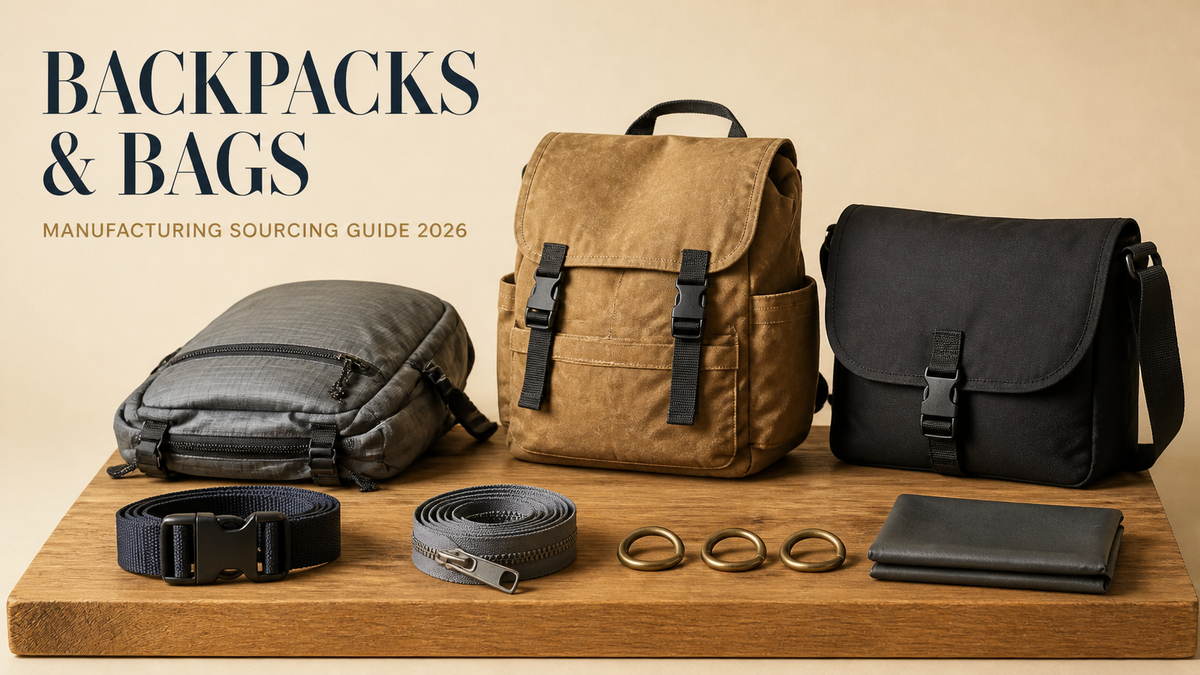
Which Fabric and Hardware to Order, Matched to How the Bag Will Be Used
| If the bag is for | Order this | Because |
|---|---|---|
| Everyday commuting and school | 600D polyester, PU back | The default in the category for a reason. Cheap, abrasion resistant, and the polyurethane backing stops water passing through the weave. |
| Hiking and heavy loads | 420D or 500D nylon, ripstop | Denier is not the whole story. A 420D nylon outlasts a 600D polyester, because nylon fibre is the stronger of the two. Ripstop stops a tear spreading. |
| Frequent travel and airport handling | 1000D nylon or ballistic weave | Thicker yarn at the abrasion points, where a bag actually wears. Heavy, so specify it where it earns its weight rather than all over. |
| A heritage or craft look | Waxed canvas, or recycled canvas | Cotton ages and takes a patina. Note that a waxed finish transfers to anything it touches, which is a feature or a complaint depending on the buyer. |
| Anything marketed to children | Any of the above, plus the children’s regime | Third-party testing at an accepted laboratory, a Children’s Product Certificate, and a tracking label fixed to the product and its packaging. |
| Anything sold in California | Any of the above, plus the PFAS certificate | Backpacks are named in the law that restricts PFAS in textile articles. The manufacturer has to sign a certificate that the bag does not contain them. |
What this guide covers
- Fabrics: denier, coating and what each one is for
- Zippers: the part that decides whether the bag comes back
- Hardware: buckles, webbing and load paths
- Capacity, compartments and the spec sheet
- If the bag is for children: testing, the certificate and the tracking label
- PFAS: the rule that names backpacks and demands a signed certificate
- Tooling, MOQ and the private label routes
- How to test and inspect a bag order
- A five-step sourcing roadmap
- Frequently asked questions
1. Fabrics: Denier, Coating and What Each One Is For
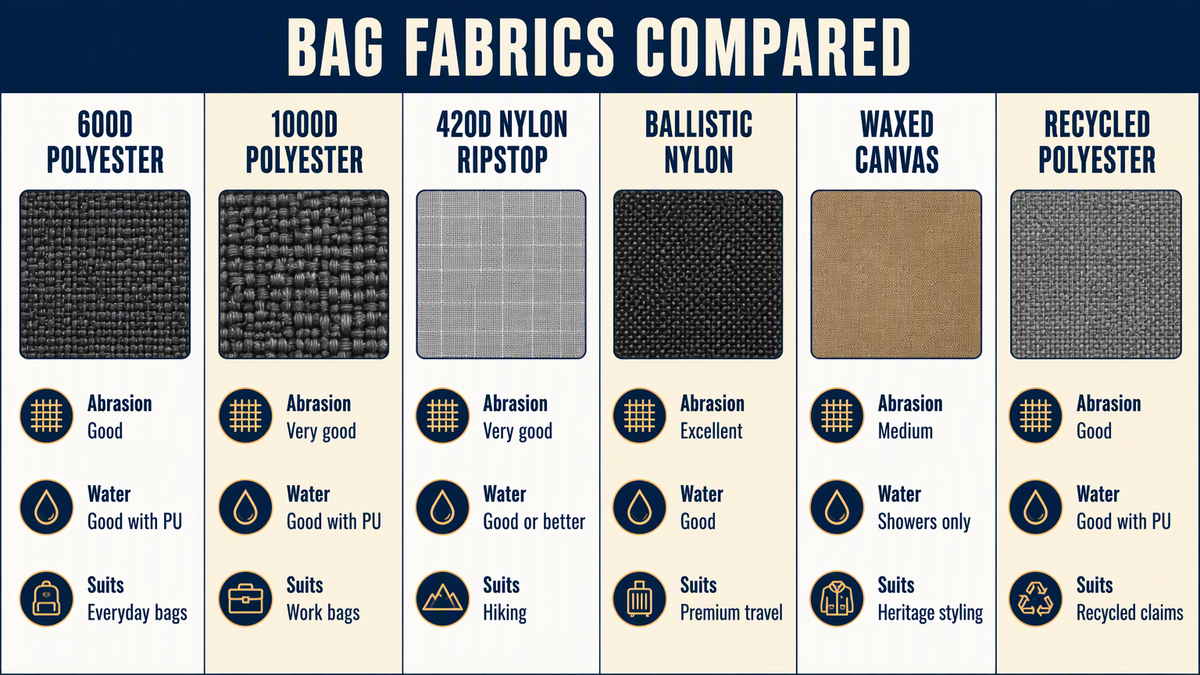
Two numbers describe almost every bag fabric, and buyers usually quote only one of them. Denier describes the thickness of the yarn. GSM describes the weight of the finished fabric. They are not the same measurement, and a specification that gives only denier has left out half the answer.
| Fabric | Feel | Abrasion | Water | Suits |
|---|---|---|---|---|
| 600D polyester | Firm, slight sheen | Good | Good with PU back | The everyday bag |
| 1000D polyester | Heavy, stiff | Very good | Good with PU back | Work bags, tool bags |
| 420D nylon ripstop | Light, grid texture | Very good | Good, or better with a coating | Hiking, lightweight travel |
| Ballistic nylon | Dense, woven texture | Excellent | Good | Premium travel and luggage |
| Waxed canvas | Cotton, matte | Medium | Showers only | Heritage and craft positioning |
| Recycled polyester (rPET) | Like virgin polyester | Good | Good with PU back | Any bag with a recycled claim |
Why denier alone misleads you
The instinct is to assume a higher denier is a stronger fabric, and it is not, because the number measures yarn thickness rather than fibre strength. Nylon is the stronger fibre, so a lighter nylon can outlast a heavier polyester. A 420D nylon ripstop is a tougher bag fabric than a 600D polyester, even though the polyester number is larger. That single comparison is worth more in a negotiation than any amount of haggling over price, because it lets you ask for the right material instead of accepting whatever the number suggests.
The second half of the specification is the backing. Almost every bag fabric is laminated to something on the inside, usually polyurethane, and that layer is what stops water passing through the weave. The outer fabric is treated with a water-repellent finish on top of it, and the two together are what a supplier means when it says a bag is water resistant.
The water-repellent finish is now a legal question, not just a technical one
Traditional water-repellent finishes on outdoor fabrics were built on fluorine chemistry, which is what made them work so well and is also why they are being restricted. The details are in section 6, but the sourcing consequence belongs here: if you are specifying a durable water-repellent finish, ask which chemistry it is and ask for the test report, because a fluorine-free finish behaves differently on a nylon than on a polyester and may need to be reformulated for your fabric.
2. Zippers: The Part That Decides Whether the Bag Comes Back
If you read reviews of backpacks, the failures cluster in one place. The fabric rarely tears, the straps rarely break, and the zipper is the component that ends the product’s life. It is also the component most often quoted as a single word with no specification attached.
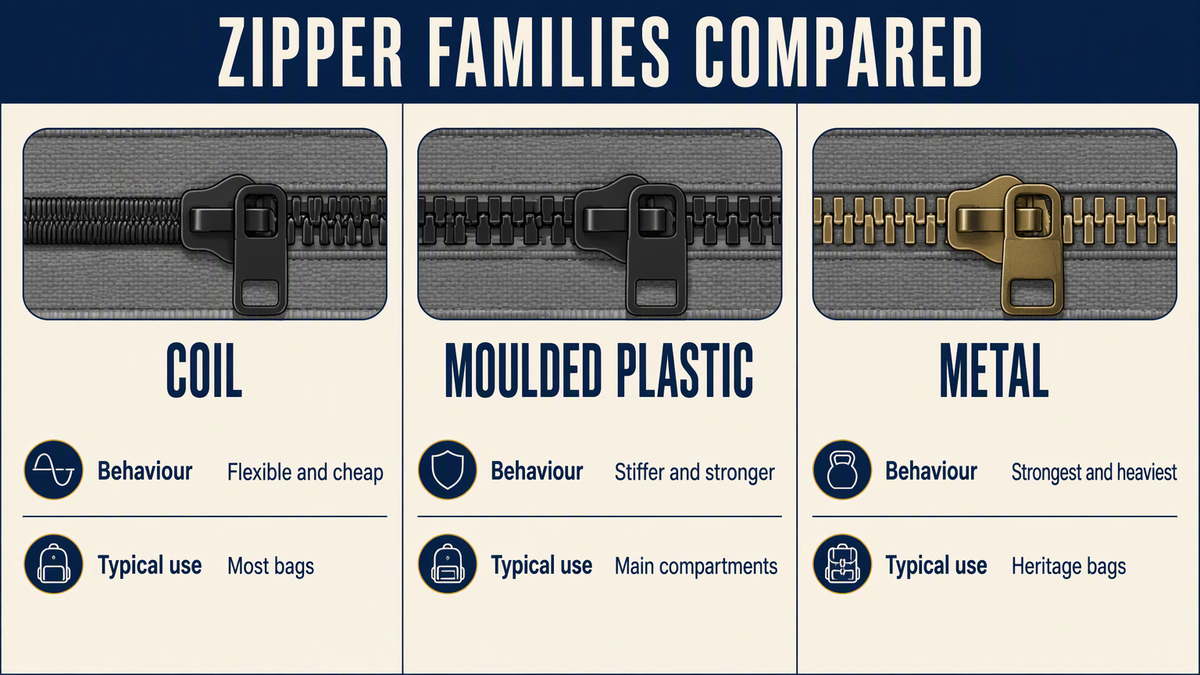
| Zipper Family | How It Looks | Behaviour | Typical Use |
|---|---|---|---|
| Coil | A continuous spiral of plastic teeth | Flexible, forgives a misaligned seam, cheap | Most bags, including most backpacks |
| Moulded plastic | Individual moulded teeth | Stiffer and stronger than coil, self-repairing in some designs | Main compartments and heavy loads |
| Metal | Individual metal teeth | Strongest and heaviest, feels premium | Heritage bags and denim styling |
The three numbers on a zipper order
A zipper is specified by its family, its size number, and its finish, and the size number is not a measurement you can check with a ruler. The number refers to the width of the teeth when closed, so a larger number means a heavier zipper. On a bag, the main compartment usually takes a heavier zipper than the small pockets, and the difference matters because a zipper that is too light for the load is the failure customers report as teeth splitting behind the slider.
The second thing to settle is whether the tape and the teeth are matched to the fabric. A zipper that is correct in size but sewn into a fabric that shrinks differently will pucker, and a puckered zipper seizes. This is one of the reasons to keep the fabric supply and the zipper supply visible to each other rather than buying them from two unconnected traders.
Do not accept the word “YKK” as a specification, and do not assume it settles the question. A brand name on a zipper is a claim about who made it, not about which zipper was chosen. Ask for the family, the size number and the finish, in writing, and ask which zipper the sample used. Then check the sample against the bulk order, because substituting a lighter zipper of the same brand is the single most common quiet substitution in bag manufacturing.
What to measure instead of trusting the label
Two numbers decide whether a zipper will survive normal use. The first is the force needed to pull the slider along the tape, measured on a sample and again after the zipper has been cycled many times. A zipper that starts easy and ends stiff has a slider that is wearing or teeth that are deforming.
The second is whether the slider stays where it is put. A slider that drifts open under load is the complaint a customer makes as “the zipper opens by itself”, and it is usually a slider sizing problem rather than a teeth problem. Both of these are measurable in a few minutes on a bench, and both are worth writing into the order because they are the two failures that generate returns.
3. Hardware: Buckles, Webbing and Load Paths
Hardware is cheap per piece and expensive per failure, because a buckle that breaks does not damage a pocket, it ends the bag. The specification work here is small and the payoff is disproportionate.
| Component | Common Materials | How It Fails |
|---|---|---|
| Side-release buckle | Acetal, nylon, metal | A tab snaps off, or the spring bar loses tension and the buckle releases under load |
| Ladder lock slider | Acetal, metal | Teeth stop gripping the webbing, so the strap slips down as the bag is carried |
| D-ring and loop | Acetal, steel, aluminium | The ring bends open, or the webbing loop wears through at the stitching |
| Webbing | Polypropylene, nylon, polyester | Frays at a cut end, or stretches where it is sewn to the bag |
| Hook-and-loop tape | Nylon | Loses grip as lint fills the hooks |
Acetal is the default for a reason
Most bag buckles are made from acetal, a stiff engineering plastic that holds its shape under repeated flexing. It is the right material for a component that clicks open and shut every day. Nylon buckles are cheaper and more flexible, which makes them pleasant to use and weaker under a hard pull, so they belong on a light bag rather than on a load-bearing strap. Metal hardware is the strongest and the heaviest, and it brings its own consideration: a plated metal buckle in constant contact with skin falls under the same nickel release restrictions that apply to any metal worn against the body.
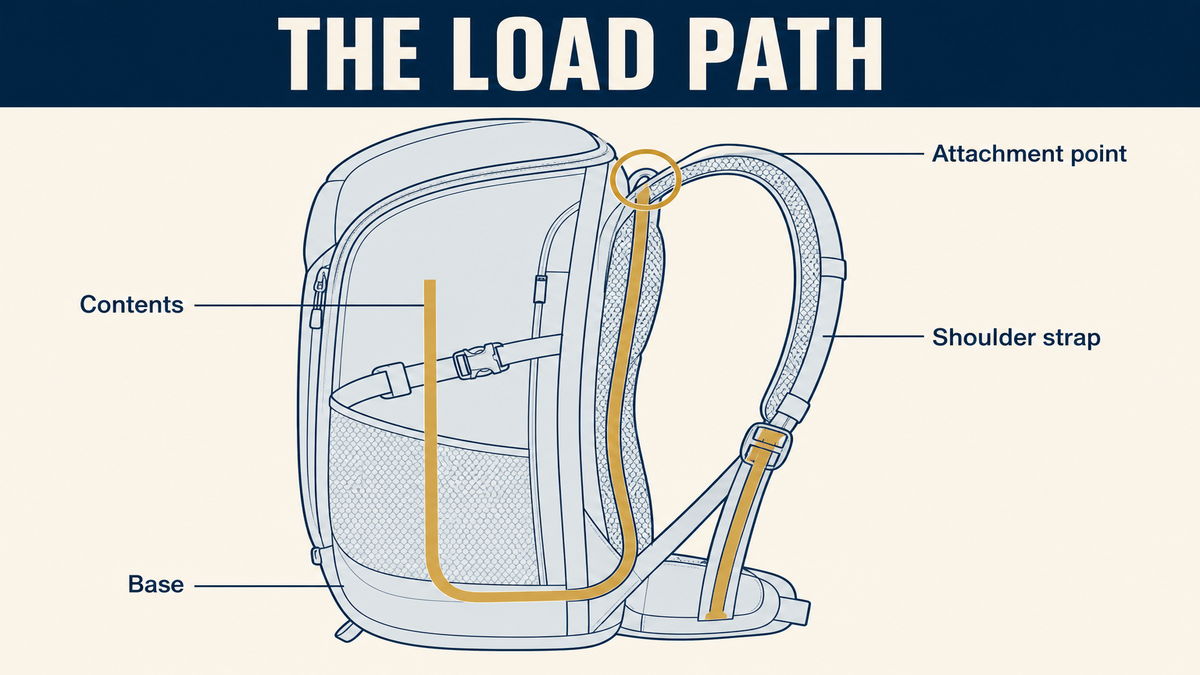
Follow the load path rather than the parts list
The useful way to review bag hardware is to trace where the weight goes. In a backpack, that path runs from the contents, through the base, into the shoulder straps, through the adjustment buckles, and into the attachment points at the top of the bag. The attachment point is where the load concentrates, and it is where a bag fails first. So the questions that matter are not how many buckles the bag has, but what load the buckles are rated for, what width and material the webbing is, and how the webbing is attached to the body of the bag.
Webbing is specified by width and by fibre, and the fibre choice is about stretch. Nylon webbing stretches less under a sustained load than polypropylene, which is why it appears on straps that carry weight and why polypropylene is fine for a light drawstring. A strap that creeps longer over a long walk is a nylon-versus-polypropylene decision that was never made.
4. Capacity, Compartments and the Spec Sheet
Capacity is the specification buyers argue about most and define least. Litres are calculated from the bag’s dimensions, and there is more than one way to calculate them, so two factories can quote the same shape with different numbers and both be telling the truth about their own method.
The practical answer is to stop treating litres as an absolute and start treating the internal dimensions as the specification. A laptop compartment has to fit a specific laptop, and that is a measurement in millimetres rather than a volume claim. Ask for the internal dimensions of each compartment, the padded drop of the laptop sleeve, and the depth of the base, then check them against the devices the bag is meant to carry. Litres are useful on a shelf; dimensions are useful in production.
- External dimensions
- What the retailer uses for shelf and shipping data. Measure a sample yourself, because a bag that is a centimetre over a carrier’s size band can cost more to ship than it earns.
- Internal compartment dimensions
- The numbers that decide whether the product works. A laptop sleeve is a fit question, and a sleeve that is close but not right produces returns.
- Base depth and structure
- A structured base holds its shape when the bag is half empty. Specify whether the base is padded, panelised or soft, because it changes the weight and the cost.
- Strap width and padding
- Narrow or unpadded straps concentrate load and are the second most common comfort complaint after the zipper.
- Hardware weight
- Worth summing rather than assuming. Metal hardware can add more to the shipped weight than a heavier fabric, and weight is a freight cost on every unit.
5. If the Bag Is for Children: Testing, the Certificate and the Tracking Label
A school backpack is a children’s product, and that single classification changes the paperwork more than any other decision in this guide. The test the regulator applies is how the product is designed and intended and how it is marketed, not who happens to buy it, so a bag sold to adults and a visually identical bag sold to children sit under different regimes.
What a children’s product has to have
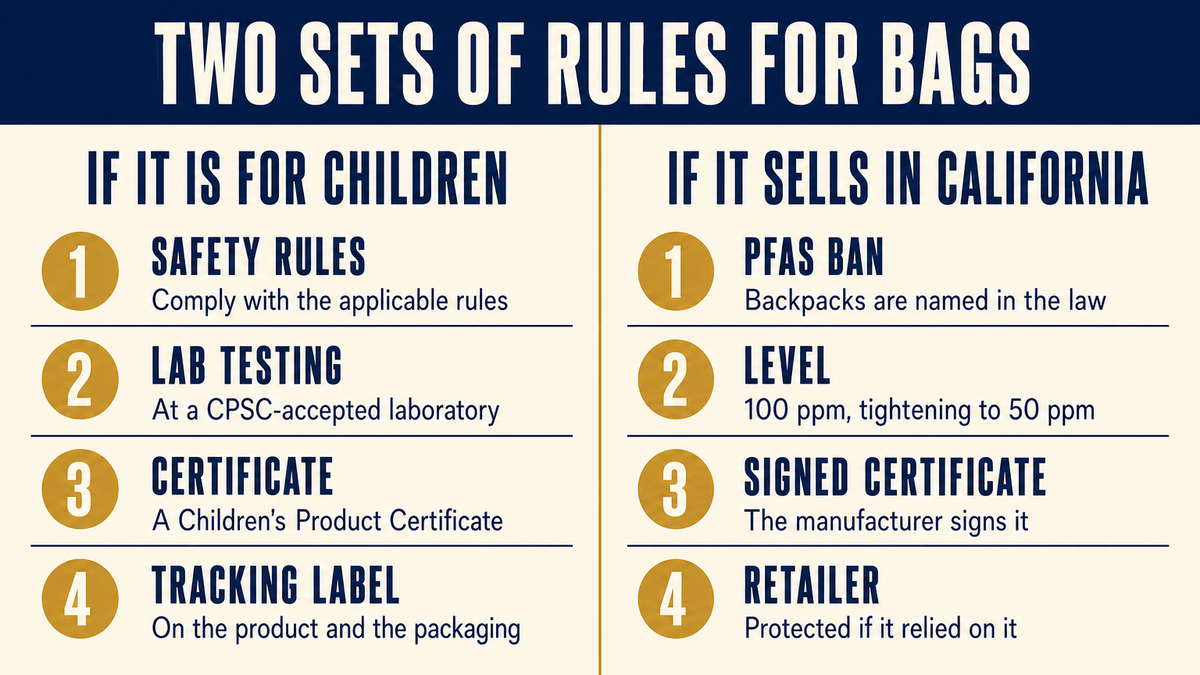
The Consumer Product Safety Improvement Act sets out four requirements for children’s products, and they are worth reading as a list because suppliers tend to know one of them and not the rest. The CPSC publishes the detail on its page covering the Consumer Product Safety Improvement Act, and the requirement is that a children’s product must:
- Meet the rules
- Comply with all applicable children’s product safety rules, which for a bag means the rules that apply to its materials and its components rather than to a toy standard.
- Be tested
- Be tested against the rule by a CPSC-accepted accredited laboratory, unless the product falls under an exception. This is third-party testing at a laboratory the regulator recognises, not a supplier’s own test report.
- Carry a certificate
- Have a written Children’s Product Certificate setting out the evidence that the testing produced. This is the document a retailer will ask for, and it comes from the testing rather than from the factory’s own letterhead.
- Carry a tracking label
- Have permanent tracking information affixed to the product and its packaging where practicable.
The tracking label, and the four things it has to disclose
The tracking label is the requirement that catches people out, because it is not a sticker added at the last minute. The CPSC’s business guidance on tracking labels sets out that the marks must be visible and legible, must be permanently affixed to the product and its packaging to the extent practicable, and must make the following information findable:
- The manufacturer, importer or private labeler name
- The location and date of production
- Detailed information about the manufacturing process, such as a batch or run number
- Any other information that helps identify the specific source, such as the address of the manufacturing plant
Two details make this easier than it first looks, and one makes it harder. It is easier because the information may be in code form, as long as a consumer knows who to contact to interpret the code, which is why a short alphanumeric string is normal. It is easier again because the CPSC states that the tracking label requirement is not a safety rule requiring certification, so the certificate does not have to reference it. It is harder because the label has to be permanently affixed, which means it has to be designed into the bag rather than added to the carton, and that has to happen before the order is placed rather than after.
Ask your factory for a sample of the tracking label it intends to use and read it against the four items above. A label that carries a batch code but no location and date of production is a partial label, and the fix is a change to the print file rather than a change to the product, provided you find it before the run.
6. PFAS: The Rule That Names Backpacks and Demands a Signed Certificate
This is the section most bag buyers have not read, and it applies to ordinary bags rather than to specialist outdoor gear. California passed a law restricting perfluoroalkyl and polyfluoroalkyl substances, known as PFAS, in textile articles, and the text of that law puts backpacks squarely inside its scope.
The definition is the part to read carefully. The law defines textile articles as textile goods of a type customarily and ordinarily used in households and businesses, and then lists what is included, naming accessories, handbags and backpacks alongside apparel. The full text is published on the California Legislative Information site, and it is worth opening for the definition alone, because a supplier who assumes this only affects jackets will be wrong about your bag.
What the rule actually requires
- The ban
- From 1 January 2025, no person may manufacture, distribute, sell or offer for sale in the state any new, not previously used, textile article containing regulated PFAS.
- The level
- Regulated PFAS includes PFAS present at or above a level measured as total organic fluorine: 100 parts per million from 1 January 2025, tightening to 50 parts per million from 1 January 2027.
- The certificate
- The manufacturer must give the people who offer the product for sale or distribution a signed certificate stating that the article does not contain regulated PFAS. The certificate must be signed by an authorised official of the manufacturer, and it may be provided electronically.
- The retailer’s protection
- A distributor or retailer who is not the manufacturer is not in violation if it relied in good faith on the certificate the manufacturer provided.
- The alternative
- The law also requires the manufacturer to use the least toxic alternative when removing regulated PFAS from a textile article, so “we removed it” is not the whole obligation.
What this means for your order
Three practical consequences follow, and all three belong in the written order rather than in a conversation. First, if your bag has a water-repellent finish, ask which chemistry it is and ask for a test report showing total organic fluorine rather than a supplier’s statement that the bag is PFAS free. Second, ask who signs the certificate and in whose name, because the obligation sits with the manufacturer and your retailer will want the document. Third, note the 2027 date now, because a bag that passes at 100 parts per million today can fail at 50 parts per million on a reorder, and the fabric you approve this year may need to change.
There is a wider point here that is easy to miss. A restriction written for one American state is not the only rule in play, because the European Union restricts PFAS separately and the direction of travel is one way. If you are specifying a water-repellent finish for a bag you intend to sell for several seasons in more than one market, ask the fabric mill what its fluorine-free options are now, while a fabric change is still a specification decision rather than a recall.
Put the PFAS certificate and the tracking label in the same clause of the order, because they fail in the same way. Both are documents that exist only if someone remembered to create them, both are the manufacturer’s responsibility, and both are discovered missing when the goods are already on the water rather than before.
7. Tooling, MOQ and the Private Label Routes
Bag manufacturing has almost no tooling, which is why the category is friendly to a first order. There is no mould to cut and no press to build. What you pay for instead is pattern making, sampling and the minimum the factory will accept to set up a line.
An existing shape with your own fabric, colour and logo. The cheapest way to test a market, and the only route where a genuinely small first order is realistic.
An existing body with your own compartment layout, your own zipper and your own hardware. Usually the best value in bags, because the changes that make a bag feel yours are pattern changes rather than new tooling.
Your own silhouette, pattern and size range. Priced like design work rather than tooling, and it makes sense once you are committed to a range rather than a single bag.
What actually sets the minimum order
Because there is no mould, a bag minimum is driven by the cost of setting up the line, buying fabric to a minimum from the mill, and running the sample cycle. That gives you three ways to negotiate that have nothing to do with price.
The first is to use a fabric the factory already stocks, which removes the mill’s own minimum from the calculation. The second is to accept a standard colour rather than a custom dye lot, since a custom dye adds its own minimum on top of the fabric minimum. The third, and the most effective, is to ask when the next slot is rather than what the standard minimum is, because a factory’s quoted minimum is often a statement about how busy the line is rather than a fixed rule. A short factory audit also tells you whether the factory sews the bags itself or passes them to a subcontractor, which is the difference between a quality conversation and a quality guess.
8. How to Test and Inspect a Bag Order
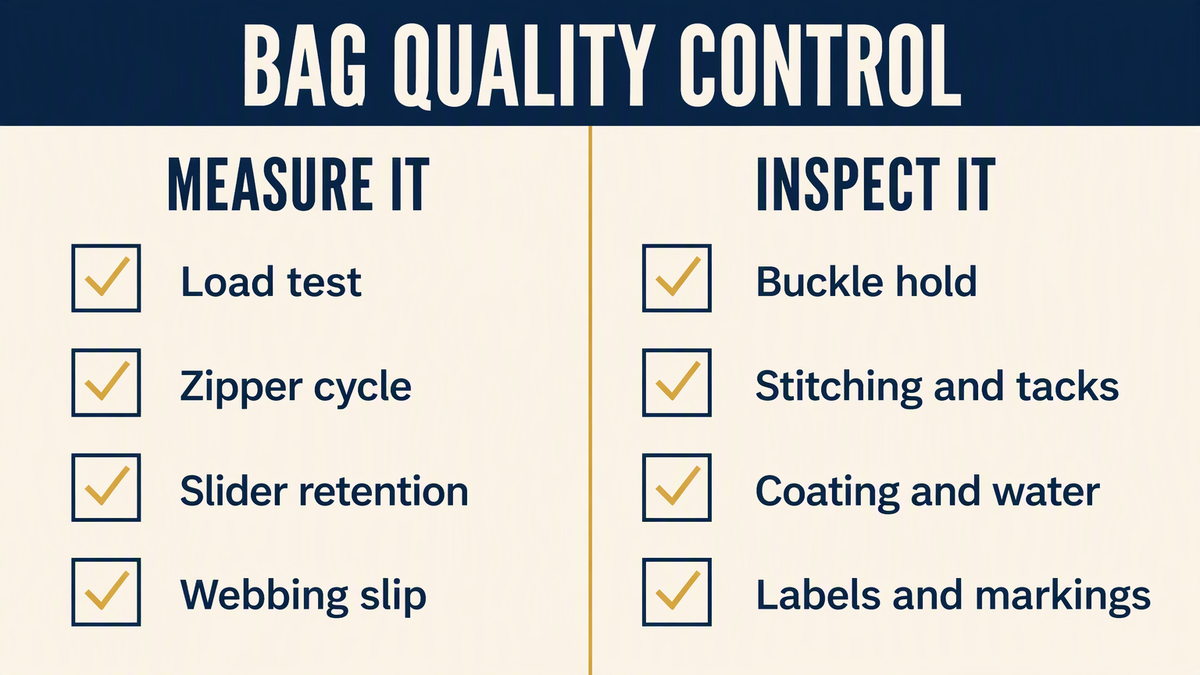
These eight checks cover the parts that generate returns, and they fit into one inspection visit with a filled bag and a bench.
- Load test
- Fill the bag to its stated capacity with a known weight and carry it, then hang it by one shoulder strap. Look at the attachment point, because that is where the load path ends and where the stitching gives first.
- Zipper cycle
- Open and close the main compartment repeatedly, then measure how much harder it has become. A zipper that stiffens has a slider that is wearing or teeth that are deforming.
- Slider retention
- Load the closed bag and press on it. A slider that drifts open under pressure is a slider sizing problem, and it is what a customer reports as a bag that unzips itself.
- Buckle release and hold
- Click it shut, pull hard, and check the release tab does not deform. Then repeat it enough times to see whether the spring bar loses tension.
- Webbing slip
- Adjust the ladder lock, load the strap, and check the webbing does not creep through the slider. Strap creep is a slow failure the buyer experiences as a bag that will not stay adjusted.
- Stitching and bar tacks
- Count the stitches per centimetre at the stress points and confirm the bar tacks are where the drawing shows them. The bar tack is a short dense stitch that stops a seam tearing, and a missing one is invisible until it matters.
- Coating and water
- Pour a measured amount of water on the fabric and watch how long it takes to bead and how long before it soaks through. Then check the water-repellent claim against the chemistry the factory declared.
- Labels and markings
- Confirm the country of origin marking, the wash or care label, the tracking label if the bag is a children’s product, and the brand label, all as approved.
Two of these produce a number and should be recorded rather than judged by eye: the load test and the zipper cycle. A bag that carries its rated weight cold and a bag that carries it after a hundred cycles are different products, and the second number is the one that predicts returns. That measured approach is what a first article inspection formalises on the first production run, and what a pre-shipment inspection repeats before the container is booked. If the bags carry your brand, the artwork and label approval loop is the same one that applies to any decorated product, which our guide to custom logo printing and finishing walks through.
9. A Five-Step Sourcing Roadmap
Worked in this order, these five stages keep both the quality problem and the paperwork problem out of your first bag order.
- Specify the fabric by denier and by fibre together. Denier alone misleads, because a lighter nylon can outlast a heavier polyester. Name the fibre, the denier, the backing and the water-repellent chemistry as four separate lines.
- Specify the zipper by family, size and finish. Never accept a brand name as a specification. Ask which zipper the sample used, then check the bulk order against it, because a lighter zipper of the same brand is the most common quiet substitution in the category.
- Trace the load path and specify at the stress points. The attachment point where the strap meets the bag is where a backpack fails first, so that is where the bar tacks, the webbing and the hardware rating matter most.
- Decide the regulatory regime before you design the label. If the bag is marketed to children, the children’s testing and tracking label requirements apply and the label has to be designed into the product. If it goes to California, backpacks are named in the PFAS rule and you need a signed certificate. Our breakdown of CPSIA testing and the Children’s Product Certificate covers the first in detail.
- Put the documents in the written order. The tracking label artwork, the certificate, the test reports and the origin marking all belong in the order rather than in an email thread, which is what a bilingual sales contract is for. Check the origin marking on the label at the same time, because bags are a category where the accepted short forms are narrower than suppliers assume, as our guide to made in PRC versus made in China labelling sets out.
Everything in this guide sits inside our Apparel, Fashion & Bags sourcing hub, which collects the fabric, component and factory guides for this category in one place.
10. Frequently Asked Questions
Is a higher denier always a stronger bag fabric?
No, and the assumption costs buyers money in both directions. Denier measures the thickness of the yarn, not the strength of the fibre, and nylon is the stronger fibre of the two most common options. That means a 420D nylon ripstop is a tougher bag fabric than a 600D polyester even though the polyester number is larger. Specify the fibre and the denier together, then add the backing and the finish, because those decide the water resistance rather than the yarn does.
Does it matter which zipper brand I use?
The brand matters less than the specification, and a brand name is not a specification. Ask for the zipper family, the size number and the finish in writing, and ask which zipper the approved sample used. A larger size number means a heavier zipper, and a zipper that is too light for the load is what customers report as teeth splitting behind the slider. Check the bulk order against the sample, because substituting a lighter zipper of the same brand is the most common quiet substitution in bag manufacturing.
Does the children’s product regime apply to a school backpack?
It applies based on how the product is designed, intended and marketed, so a backpack marketed for children is a children’s product and carries the full set of obligations. Those are: complying with the applicable children’s product safety rules, testing at a CPSC-accepted accredited laboratory unless the product falls under an exception, holding a written Children’s Product Certificate, and carrying permanent tracking information on the product and its packaging where practicable. The certificate is a separate document from the tracking label, and the tracking label requirement is not itself a safety rule requiring certification.
What has to be on the tracking label?
Four things have to be findable from the marks: the manufacturer, importer or private labeler name; the location and date of production; detailed information about the manufacturing process such as a batch or run number; and any other information that helps identify the specific source, such as the plant address. The marks must be visible and legible and permanently affixed to the product and its packaging to the extent practicable. The information may be in code form as long as a consumer knows who to contact to interpret the code, which is why a short alphanumeric string is normal.
Do PFAS rules apply to ordinary backpacks, or only to outdoor gear?
They apply to ordinary backpacks. The California law restricting PFAS in textile articles defines textile articles as textile goods customarily and ordinarily used in households and businesses and lists accessories, handbags and backpacks alongside apparel. From 1 January 2025 no person may manufacture, distribute, sell or offer for sale a new textile article containing regulated PFAS, where regulated includes PFAS present at or above 100 parts per million measured as total organic fluorine, tightening to 50 parts per million from 1 January 2027. The manufacturer must provide a signed certificate, and a retailer who relied on it in good faith is protected.
What is a realistic minimum order for a custom backpack?
Bags have almost no tooling, so the minimum comes from setting up the line, buying fabric to the mill’s minimum, and running the sample cycle rather than from a mould. An existing stock design with your own fabric, colour and logo can often start at a modest quantity. To lower the minimum without arguing about price, use a fabric the factory already stocks, accept a standard colour instead of a custom dye lot, and ask when the next convenient slot is rather than what the standard minimum is.
Get the Fabric, Zipper and Paperwork Checked Before You Order
Our team specifies the fabric by fibre and denier together, locks the zipper by family and size so the bulk order can be checked against the sample, traces the load path to the attachment points that fail first, and confirms the tracking label, the children’s testing route and the signed PFAS certificate are all in the written order before production starts.
Request a Backpack & Bag Sourcing Quote
Questions & Comments
We read every one and reply within 24 hoursNot sure whether 600D polyester or a lighter nylon is the tougher fabric, trying to pin down which zipper your sample actually used, or working out whether the children’s testing or the PFAS certificate applies to your bag? Post your fabric, zipper spec or sample results below and our team will help you read them.