
Cooler Bag Manufacturer Sourcing Guide: Liners, Ice Retention, Zippers and MOQ
 ·
Updated October 9, 2026
·
23 min read
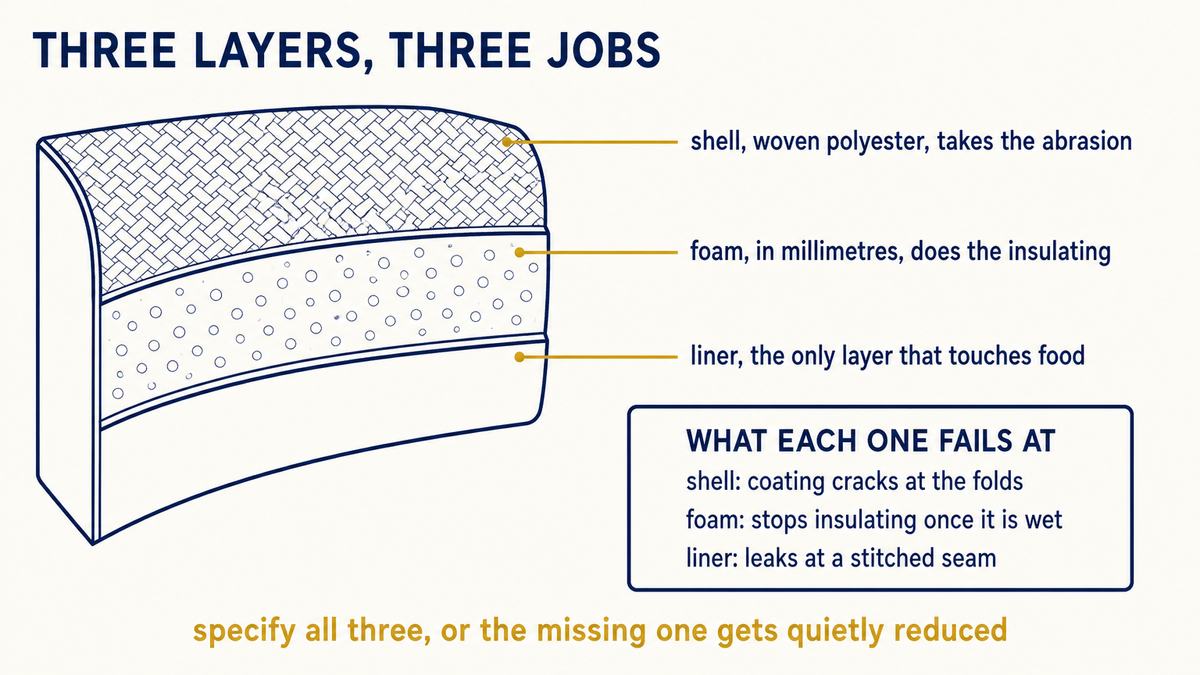
A cooler bag is three layers doing three different jobs: a shell that takes the abrasion, a foam core that does the insulating, and a liner that touches your customer's food. Almost every cooler bag complaint traces back to one of them being specified as an afterthought, and the two that matter most are the ones buyers never write down — the foam thickness in millimetres, and whether the liner is a separate welded bag or a fabric sewn straight through. This guide covers what the layers do, why an ice retention figure means nothing without its test conditions, what the food-contact rules say about the liner, which zipper actually holds water, and how to test a sample before you commit to a run.
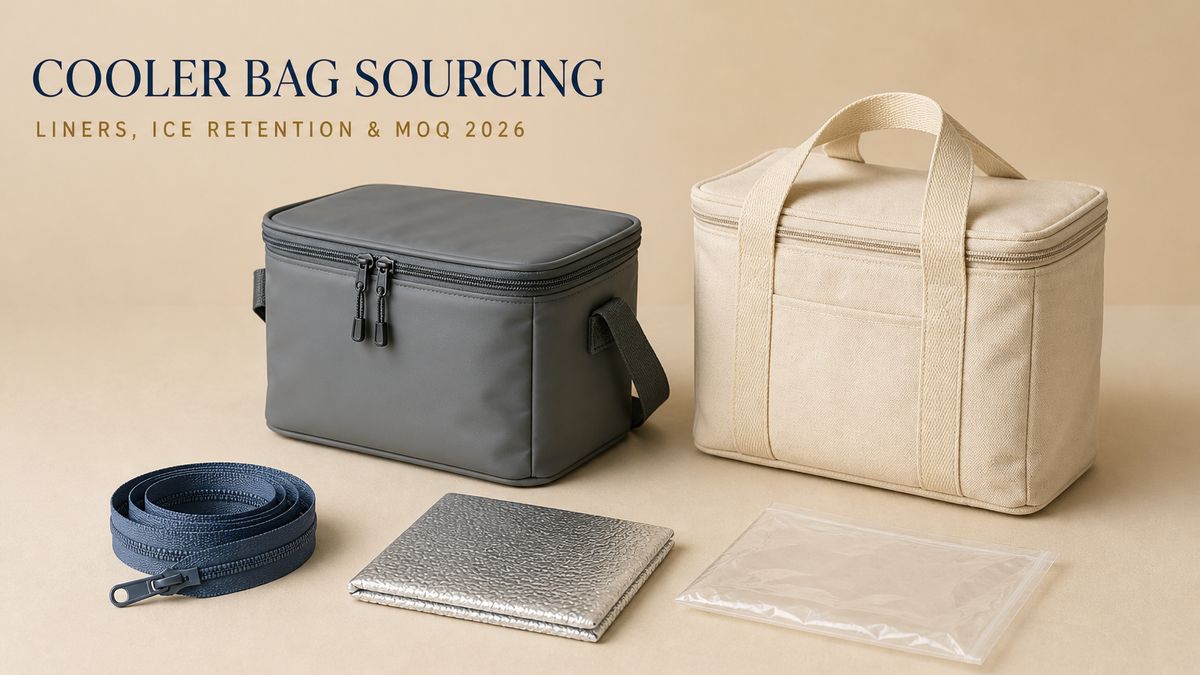
What to Specify, by What You Are Selling
| If you are making | Specify this | Because |
|---|---|---|
| A branded lunch bag | A welded liner, and the foam thickness in millimetres | The liner is the part in contact with food, so how it is joined decides whether the bag leaks into the shell. Foam thickness is the number that sets how long the cold lasts, and it is the easiest thing to quietly reduce. |
| A day-trip cooler bag | A leak-proof zipper or a lid with a gasket, and an ice retention figure with its test conditions | A standard coil zipper is the main leak path on a soft bag. And a retention claim without a starting ice weight and an ambient temperature cannot be compared with anything, including another supplier's claim. |
| A promotional cooler at volume | A stock bag with your printing, and the print method named | You avoid the pattern-making and cutting dies that a custom shape needs, and you find out how the supplier performs before paying for tooling. The print method decides whether the logo survives a summer in a car. |
| A premium bag at a higher price | A patch or embroidery rather than print, and a thicker liner | Embroidery and patches outlast print on a coated fabric, and they read as a more expensive product. A heavier liner resists punctures from cutlery and ice edges. |
| Anything sold as food-safe | The liner material and the section of the food-contact rules it is permitted under | The liner is a food-contact surface, and the rulebook names specific polymer families rather than approving "food grade" as a word. Ask which route the material takes and keep the answer. |
| A bag with a custom shape | The tooling quoted as its own line, with the pattern cost broken out | A custom shape needs a pattern and cutting dies before anything can be cut. That is a one-time cost, and a blended figure hides how much of your first order is tooling. |
1. What a Cooler Bag Quotation Actually Covers
A cooler bag is assembled from bought-in materials rather than made from a single input, which is why two quotations for the same drawing can differ by half. The fabric, the foam, the liner, the zipper and the printing are five separate purchases before anyone sews anything.
- The shell fabric
- Usually a woven polyester, described by its denier, which is the weight of the yarn. A higher denier is a heavier, more abrasion-resistant cloth. Often coated on the back with PVC, PU or TPU to shed water, and the coating choice is a price and an environmental decision.
- The insulation
- Foam, measured in millimetres. This is the layer that actually does the work, and it is the single number most worth arguing about. More thickness costs more and insulates better, up to the point where the bag becomes bulky.
- The liner
- The inner surface that touches food and drink, and usually the most technical part of the bag. It has to be weldable, because a liner that is sewn rather than welded leaks at the stitch holes.
- The zipper
- Bought in, and the main leak path on a soft bag. A standard coil zipper is not watertight. A coated or leak-proof zipper is a different component at a different price.
- The webbing and hardware
- Straps, handles, buckles, D-rings. Cheap per unit and the components most likely to be the point of failure on a heavy load, because a bag full of ice and drinks weighs far more than it looks.
- The printing
- One set-up per design, then a cost per unit. On coated fabric the surface treatment before printing matters more than the ink, which is why print fails at the creases first.
- The cutting dies and pattern
- For a custom shape, a pattern and cutting dies, paid once. A stock shape avoids this entirely, which is why the promotional route starts so much cheaper.
2. The Three Layers, and What Each One Is For
Separating the three layers is the fastest way to understand a cooler bag, because each one fails in its own way and each is bought from a different supplier.
| Layer | What it is | How it fails |
|---|---|---|
| Shell | Woven polyester, described in denier, usually with a water-resistant coating on the inside face. | Abrades and fades, and the coating can crack at the folds before the fabric itself wears out. Copying a design without checking the fabric weight is the usual cause of a bag that feels cheap. |
| Foam | Polyethylene foam is the common choice, with EVA and polyurethane foams offering more performance at higher cost. Measured in millimetres. | Loses its insulating value when it takes on water, which is why the liner matters to a layer that never touches food. Thin foam is the most common way a bag is quietly downgraded. |
| Liner | The food-contact surface. Commonly a polyethylene-based film or an ethylene-vinyl acetate material, chosen partly because it can be heat-welded into a watertight bag. | Leaks at the seams if it is sewn rather than welded, punctures on ice edges, and can transfer odour to food if the wrong material is used. |
Why the three have to be specified together
The layers interact, and getting one right does not rescue the others. A heavy shell on thin foam gives a bag that looks expensive and performs badly. Thick foam behind a stitched liner gives a bag that insulates until the foam gets wet, then stops insulating altogether. A welded liner inside a bag with a standard zipper gives a watertight inner bag inside a shell that fills with meltwater.
So the specification has to state all three, and it has to state the joints as well: how the liner is closed, and what seals the opening. Those two lines are where a cooler bag is won or lost, and they are the two lines most often missing from a first order.
3. Ice Retention: What the Figure Means and What It Does Not
Ice retention is the headline claim on every cooler bag, and it is also the easiest thing in the category to state misleadingly without saying anything untrue. A bag does not have an ice retention time. A bag has an ice retention time under a particular set of conditions, and change any one of them and the number moves.
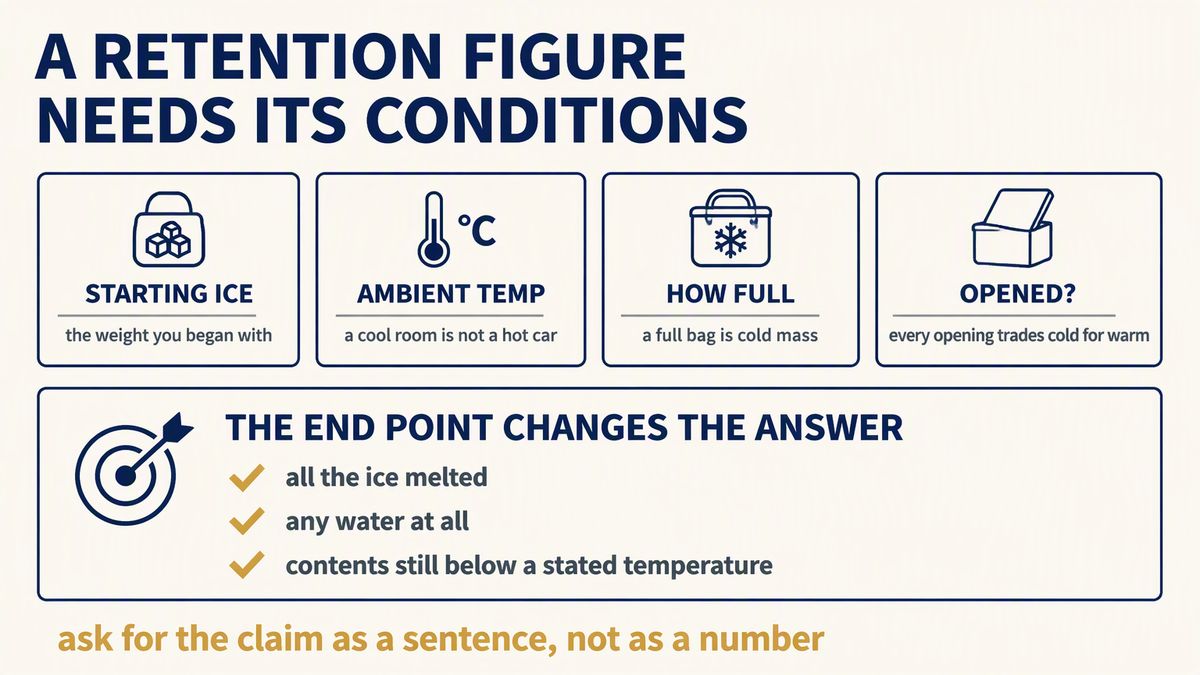
Four variables decide the result, and a claim that omits them cannot be compared with anything.
- How much ice you started with, by weight. Twice the ice lasts far longer than the same bag holding half as much, even with no other change.
- The ambient temperature. A bag tested in a cool room is not the same product as one tested in a hot car.
- How full the bag was. A cooler works best when it is full, because the contents are cold mass. A half-empty bag has air in it, and air is the thing insulation is fighting.
- Whether it was opened. Every opening exchanges cold air for warm, and a bag tested closed for a day is a different test from one opened for lunch.
How to write an ice retention specification
Ask for the figure as a sentence rather than a number: the starting ice weight, the ambient temperature, whether the bag was pre-chilled, whether it was opened during the test, and the end point used. The end point is the part most often left vague, and it changes the answer completely — all the ice melted, any water at all, or the contents still below a stated temperature are three different tests.
Soft against hard, honestly
A soft bag will not match a rigid cooler on retention, and it is not meant to. A hard cooler traps a rigid cold mass behind a thick wall and a lid with a gasket; a soft bag is flexible by design, which is exactly what makes it foldable, light and comfortable to carry. The realistic promise for a soft bag is a day out — a picnic, a commute, a trip to the beach — rather than several days in the open. Selling it as a multi-day cooler is the fastest way to generate returns that were never a manufacturing fault.
If your product page promises days, the specification needs to say what test produced that number, and the test needs to resemble the way a customer uses the bag. That is the same discipline that applies to any performance claim, and our first article inspection guide sets out how to fold performance checks into the approval stage rather than discovering them at delivery.
4. The Liner and the Food-Contact Rules
The liner is the part of a cooler bag that touches food and drink, which makes it a food-contact surface in the same way a bottle's gasket is. That has a practical consequence most supplier conversations never reach: the liner material does not have to be approved as a whole product. It has to sit inside a specific route in the food-contact rules, and which route it takes depends on what the polymer is.
Where a liner sits in the rulebook
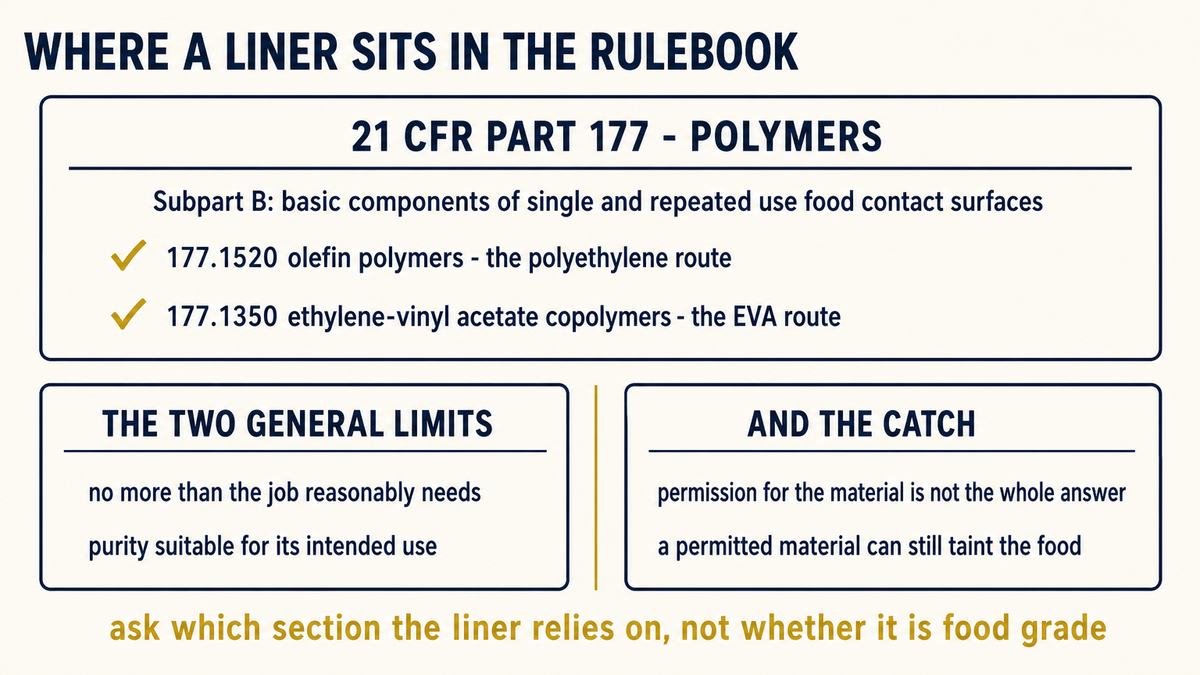
The relevant part is 21 CFR Part 177, which covers indirect food additives that are polymers. Inside it, Subpart B is headed Substances for Use as Basic Components of Single and Repeated Use Food Contact Surfaces, and it runs from § 177.1010 to § 177.2000. A cooler bag liner is used over and over, so it is the repeated-use half of that heading that matters.
Two of the sections in Subpart B are the ones a liner most often relies on, and they correspond to the two material families you will be offered:
| Section | Covers | Which liner it matches |
|---|---|---|
| § 177.1520 | Olefin polymers | A polyethylene-based liner film, the common low-cost choice. |
| § 177.1350 | Ethylene-vinyl acetate copolymers | An EVA or polyethylene-vinyl-acetate liner, chosen where the liner has to stay softer and weld cleanly. |
This turns a vague question into a checkable one. Instead of asking whether the liner is food grade — a phrase with no fixed meaning in the rules — ask which of those sections the liner material relies on. A supplier with a real answer has a material specification in front of them. A supplier without one has been quoting a category word.
The two limits that apply whatever the material is
21 CFR Part 174 sets the general conditions that sit above all of it. It defines good manufacturing practice for food-contact articles as including two restrictions. First, the quantity of any substance that may get into food as a result of being used in the article shall not exceed, where no limits are specified, that which results from use of the substance in an amount not more than reasonably required to accomplish the intended physical or technical effect, and must not be intended to produce a technical effect in the food itself. Second, any substance used as a component of a food-contact article shall be of a purity suitable for its intended use.
In plain terms for a cooler bag: the foam behind the liner, the adhesive holding the liner in place, the printing on the outside and the plasticiser in any of them are all covered by the same reasoning. If it can migrate, the amount has to be no more than the job actually needs, and the material has to be clean enough for the use.
The sentence that catches people out
Here is the part worth reading twice, and it comes from the rule itself. Part 174 states that the existence of a regulation permitting a substance for use in food-contact articles shall not be construed to relieve such use of the substance or article from compliance with any other provision of the Federal Food, Drug, and Cosmetic Act. It then gives its own example: if a packaging material that is properly covered by a regulation were found on appropriate test to impart odour or taste to a specific food product so as to render it unfit, the permitting regulation would not relieve that use.
Read that against a cooler bag and the practical meaning is unmistakable. A liner material can be permitted, and your bag can still be the reason a customer's sandwich tastes of plastic. Permission for the material and acceptability of the finished article are two separate questions, and the rules say so in their own words rather than leaving it to interpretation.
That distinction is also the answer to a complaint you will eventually receive, because "smells of plastic" is the most common quality objection in this category. It is not normally a defect in the material. It is the finished article failing a test that the material was never asked to pass.
Test odour with a real food item rather than an empty bag. Fats and breads pick up transferred odour far more readily than a plastic liner left empty, which is why an empty-bag sniff test passes and a lunch still tastes wrong. Put a slice of bread and a knob of butter in the sample, close it, leave it somewhere warm for a few hours, then try them. It costs nothing, it needs no lab, and it is the closest thing to the test your customer will run.
5. The Zipper: Where a Cooler Bag Fails
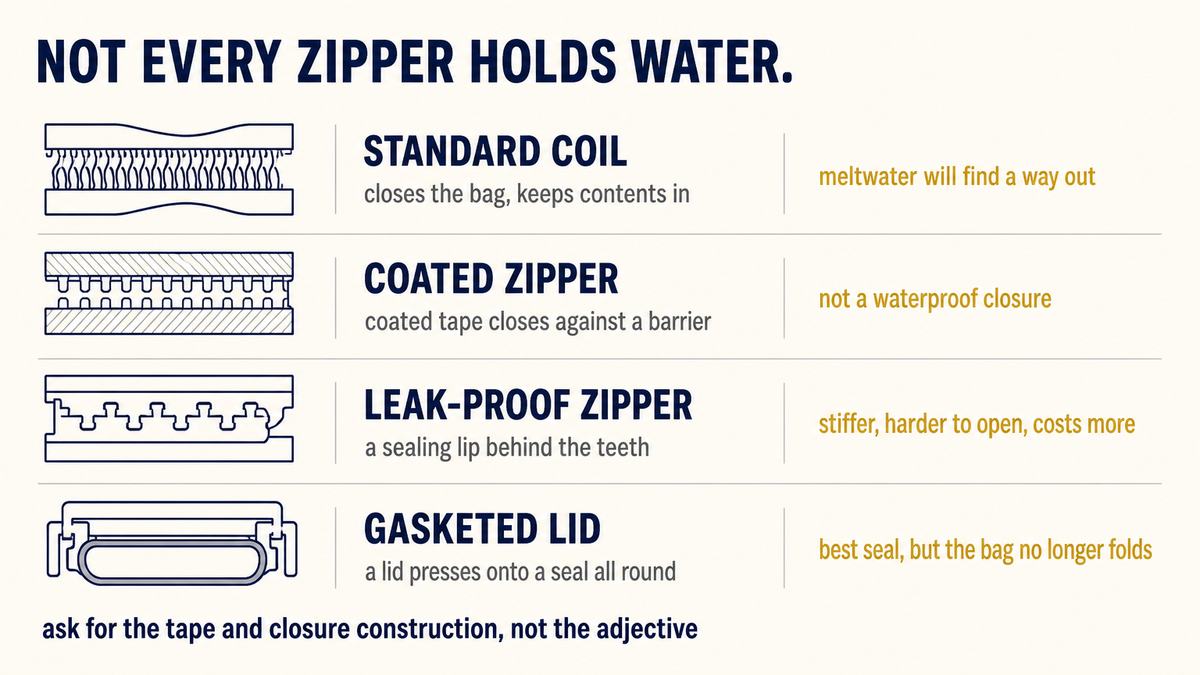
On a soft cooler bag the zipper is the weakest point in the whole build, for a simple reason: the fabric and the liner can be made watertight, but the opening has to be opened. Every design decision after that is a trade between how well it seals and how easily a customer can get a hand inside.
| Opening | How it seals | The trade |
|---|---|---|
| Standard coil zipper | It does not. It closes the bag and keeps the contents in. | The cheapest option and fine for a lunch bag carried upright. Meltwater will find a way out, so it is the wrong choice for a bag that will be laid flat or tipped. |
| Coated or water-resistant zipper | The tape is coated so the teeth close against a barrier. | A meaningful step up for modest cost. Not a waterproof closure, and it still relies on the customer closing it properly. |
| Leak-proof or waterproof zipper | A sealing lip or an inner membrane closes behind the teeth. | The closest a soft bag gets to holding water. Stiffer, harder to open, and the component itself is a different price bracket. |
| Hinged lid with a gasket | Rather than a zipper, a rigid or semi-rigid lid presses onto a seal all the way round. | The best sealing of the four, at the cost of a much less foldable bag. Suits a box-shaped cooler tote rather than a flattish lunch bag. |
Three things to ask about any zipper
Which one it is, by name. "Water-resistant zipper" and "waterproof zipper" are used interchangeably by suppliers and they are not the same component. Ask for the tape and the closure construction rather than the adjective.
The cycle life. A zipper fails by wearing out, and the failure is gradual before it is sudden. Ask how many open-and-close cycles the specification expects. On a lunch bag used daily, a low cycle count is a product that starts leaking inside a year.
The pull and slider. Both are bought in, like the zipper itself, and both are cheap to upgrade and easy to skip. A weak slider is the reason a zip splits at the middle when the bag is full, which is the complaint customers describe as the zipper "breaking" when nothing has actually broken.
6. Seams and Welds: The Construction Detail Nobody Specifies
This is the single most useful construction question in the category, and it rarely appears on a first order.
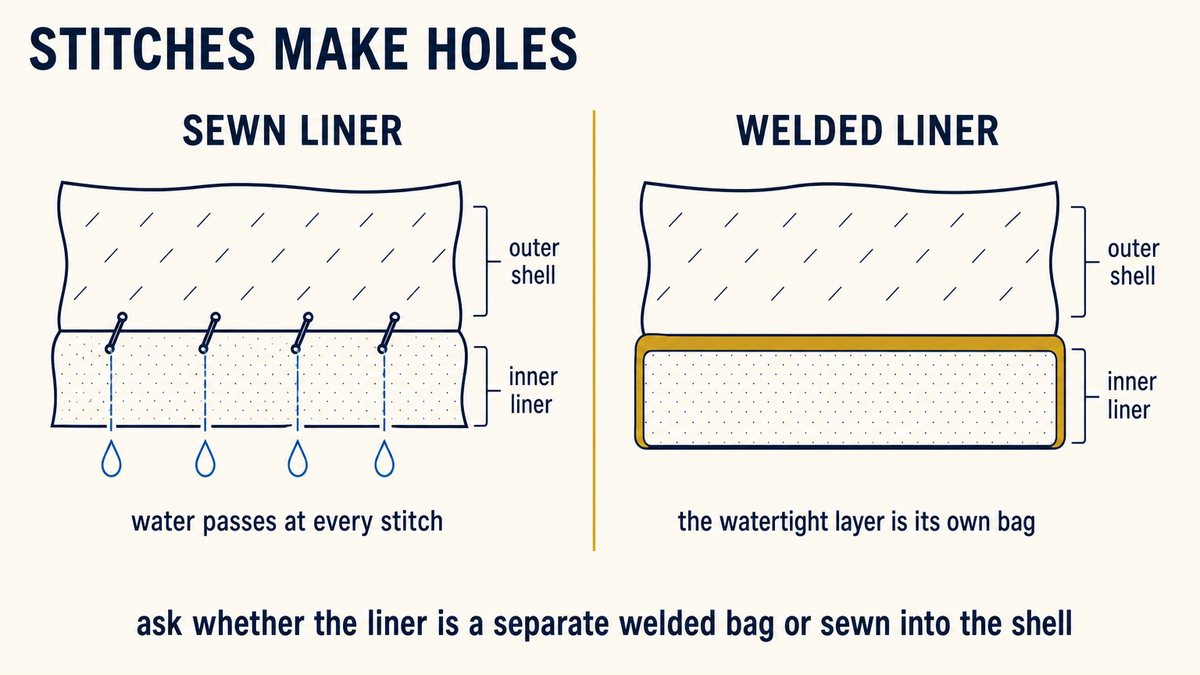
A stitched seam is not watertight. Thread passes through fabric, and every stitch leaves a hole. So a bag whose liner is sewn — either sewn directly to the shell, or sewn and then turned — will pass water at the seams, and no amount of good coating changes that, because the hole goes through the coating too.
The watertight construction works differently. The liner is made as a separate bag in its own right, closed by heat welding along its edges, and then inserted into the shell. The shell is sewn, because a sewn shell is strong and cheap. The liner is welded, because a welded liner holds water. The two are joined at the opening, where the zipper takes over.
Two questions follow, and either one settles the specification.
- Is the liner a separate welded bag, or is it sewn into the shell? If the answer is welded, the seams will hold. If the answer is sewn, the product is a tote with a wipeable lining, which is a legitimate product and should be described as one.
- How is the liner closed at the top? This is where the welded bag meets the opening. A liner that simply stops at the zipper tape leaves a path for water around its own edge, and that path is invisible on a finished bag.
Welding quality is worth checking on the sample by hand. A welded seam should be continuous, even in width, and free of thin spots where the heat has not fully fused the film. A weak weld looks identical to a good one until the bag is full, which is another reason to test a sample with water rather than trust the construction description.
7. Printing, Patches and the Decorations That Last
Cooler bags are usually bought as branded items, which makes the decoration part of the product rather than a finishing touch. It is also the part most exposed to abrasion, because a bag is folded, dragged and packed against things.
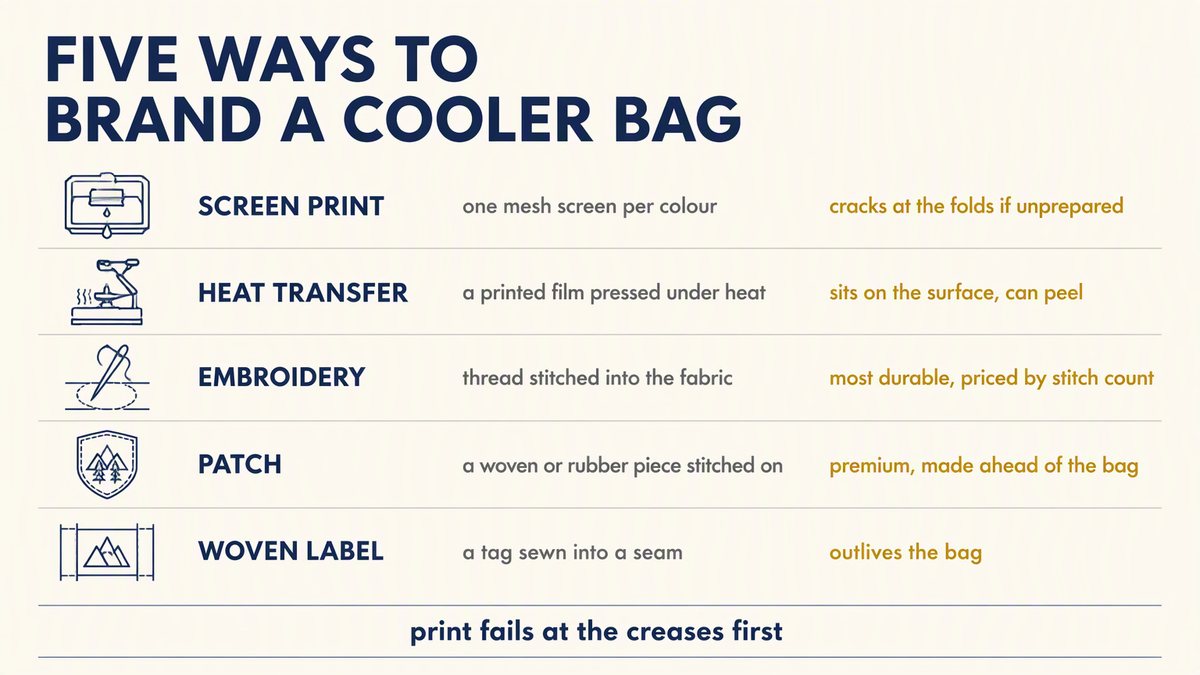
| Method | How it works | How it wears |
|---|---|---|
| Screen printing | Ink pushed through a mesh, one screen per colour, onto the fabric. | Good for bold, few-colour logos and the cheapest at volume. On a coated fabric it will crack at the folds if the surface was not prepared before printing. |
| Heat transfer | A printed film is pressed onto the surface under heat and pressure. | Handles full-colour and photographic artwork, which screen printing cannot. It sits on the surface, so it is the method most likely to peel at an edge. |
| Embroidery | Thread is stitched directly into the fabric. | The most durable option and it reads as the most expensive. Cost is driven by stitch count, so a detailed logo is a slow, expensive run. |
| Patch | A separate piece — woven, embroidered, rubber or leatherette — is stitched or heat-applied onto the bag. | Premium look, and it can be made in advance and applied later, which is handy for mixed orders. On a flexible bag, patch stiffness is worth checking at the fold. |
| Woven label | A narrow woven tag sewn into a seam, carrying the brand or the care information. | Lasts as long as the bag, because it is a component rather than a decoration. The right place for the logo if the bag will also carry a large printed graphic. |
Two practical points follow, and both of them save money.
Surface preparation is part of the print specification. Most print failures on coated fabric are a preparation problem rather than an ink problem, so ask what is done to the surface before printing, and ask it as a question with a technical answer rather than a yes or no. Then check the print where the bag folds, because that is where it will fail first and where a lab sample laid flat will look perfect.
A patch is often the cheapest way to look expensive. It moves the decoration off the surface that takes the abrasion, it can be produced ahead of the bag, and it allows a small logo to carry texture. If the logo also has to work on a sleeve, a tag and a sticker, our custom logo printing and finishing guide covers how the options differ across those surfaces.
8. How to Test a Cooler Bag Sample
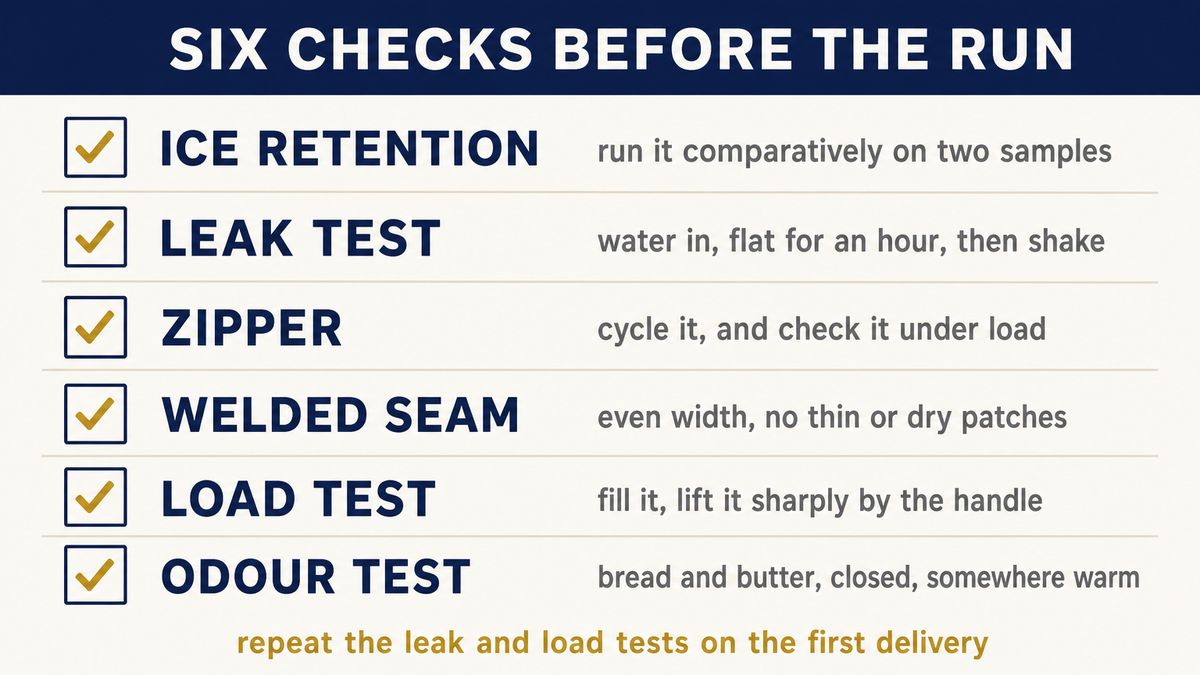
Nothing here needs a laboratory, and that is deliberate. Cooler bags fail in ways you can reproduce at a table, which means you can settle most supplier claims yourself before placing a production order.
- Ice retention, run comparatively. Weigh the ice, record the room temperature, leave the bag closed, and check it on a schedule. Run the identical test on two suppliers' samples on the same day, because the comparison is the result rather than either number on its own.
- The leak test. A third full of water, closed, laid flat for an hour, then examined under the seams and along the zip. Then shake it, which is the part that finds the liner-to-zipper join.
- The zipper, by hand. Open and close it until your patience runs out, then check whether it still closes against itself and whether the slider still joins the teeth when the bag is under load. Ask the supplier for the cycle figure and treat a refusal to give one as an answer.
- The welded seam, by eye and by hand. Run a thumb along the inside of the liner seam looking for a run of even width with no thin or un-fused patch, and feel for a hard ridge where the film has been melted properly.
- The load test. Fill the bag to its stated capacity with something heavy, then carry it by the handle and lift it sharply a few times. The straps, the webbing and the buckles take far more force than an empty bag suggests, and this is where a cheap bag announces itself.
- The odour test. Bread and butter, in a closed bag, warm, for a few hours. It is the only test that answers the question the rules raise and the material specification does not.
Then repeat the two cheapest of these — the leak test and the load test — on the first delivery rather than trusting the sample. Samples are made slowly and inspected carefully; production is neither. Our pre-shipment inspection guide covers how to write the brief so it comes back with counts and measurements rather than an opinion.
9. Minimum Order, Tooling and the Wholesale Route
Three things drive the minimum on a cooler bag order, and they multiply rather than add.
A custom shape needs a pattern and cutting dies. The fabric is cut to a pattern, so a shape that is not already in production needs the pattern made and dies cut before anything can be assembled. This is a one-time cost and it is the reason a custom bag starts where a stock bag does not.
Each material has its own buying minimum. The foam comes in a thickness, the liner comes in a roll width, and the zipper comes in a length. None of these are bought in ones and twos, and a bag that uses an unusual foam thickness or an unusual zip length may push you into buying a full roll or a full box of a component you only need a little of.
Each print design is its own set-up. One screen per colour on a screen-printed logo, or one transfer per design. A range of designs is a range of set-ups, which is the same multiplication that applies to any decorated product.
| Route | What you pay for | What it means |
|---|---|---|
| Stock bag, stock colour, your print | Print set-up and your own art | The lowest entry point and the fastest to market. You do not own the shape, so you cannot stop another brand selling the same bag with different art. |
| Stock bag, your own colourway and trim | A material run plus printing | A middle step. The shape is shared but the product looks like yours, and you learn how the supplier performs before paying for a pattern. |
| Your own shape and your own pattern | The pattern, the cutting dies and the first run | The only route that gives you a product nobody else has. Budget the tooling as a decision separate from the production order, and fix the ownership in writing. |
Wholesale and private label are different purchases and buyers often conflate them. Buying wholesale means buying bags that already exist, in colourways that already exist, at a price that falls with quantity — the right route for testing whether the category sells, and the wrong one if your whole proposition is the design. Ask any supplier which of their products are stock and which are tooled to a specific customer, because the answer tells you how much of what you are being shown is actually available to you. Our factory audit guide covers how to check whether the supplier welds the liner in-house or buys finished liners in, which on cooler bags is a common arrangement and a common source of delay.
10. A Five-Step Sourcing Roadmap
- Write the three layers down. Shell fabric by denier and coating, foam by thickness in millimetres, liner by material family. A specification with two of the three is an invitation to downgrade the third.
- Specify the construction, not just the materials. A separate welded liner rather than a sewn one, and how the liner is closed at the opening. This is the line that decides whether the bag holds water.
- Name the opening. Standard coil, coated, leak-proof or gasketed lid, with a cycle figure. The best liner in the world will not make an ordinary zipper hold water.
- Ask which food-contact section the liner relies on, keep the answer, and test the finished bag with a real food item rather than trusting a material claim.
- Run the leak test and the load test on the sample and again on the first delivery. They need no equipment, they take twenty minutes, and they find the two failures customers report most often.
Everything in this guide sits inside our Outdoor, Camping & Fitness sourcing hub, which collects the camping, outdoor and fitness gear guides in one place.
11. Frequently Asked Questions
Why does my cooler bag leak at the seams?
Because the watertight layer is sewn rather than welded. Every stitch passes a thread through the fabric and each one leaves a hole, and the hole goes through any coating on the cloth as well, so no amount of surface treatment fixes it. The construction that holds water is different: the liner is made as a separate bag in its own right, with its edges heat welded closed, and then inserted into a shell that is sewn because a sewn shell is strong and cheap. So the question to ask a supplier is whether the liner is a separate welded bag or a fabric sewn into the shell. If it is sewn, the product is a tote with a wipeable lining, which is a perfectly good product and should be described as one rather than as leak-proof.
What does "24 hour ice retention" actually mean?
Nothing on its own, because a bag does not have a retention time — it has a retention time under particular conditions. Four things decide the result: how much ice you started with by weight, the ambient temperature, how full the bag was, and whether it was opened during the test. Change any one of them and the number moves, which is why two suppliers can both claim a day and sell you very different bags. Ask for the claim as a sentence rather than a figure: the starting ice weight, the ambient temperature, whether the bag was pre-chilled, whether it was opened, and what end point was used. All the ice melted, any water at all, and the contents still below a stated temperature are three different tests with three different answers.
Does a cooler bag liner have to be food safe, and how do I check it?
The liner is the surface that touches food and drink, so it is a food-contact surface, and the rules handle that by describing polymer families rather than approving a phrase. The relevant part is 21 CFR Part 177, and inside it Subpart B covers substances for use as basic components of single and repeated use food contact surfaces — a cooler bag liner is used repeatedly, so it is that half of the heading that applies. Two sections match the common materials: § 177.1520 for olefin polymers, which is the polyethylene route, and § 177.1350 for ethylene-vinyl acetate copolymers. So the useful question is not whether the liner is food grade but which of those sections the material relies on. A supplier with an answer has a material specification; a supplier without one has been quoting a category word.
My bag smells of plastic and it taints the food. Is that a material fault?
Usually not, and the rules explain why. 21 CFR Part 174 states that a regulation permitting a substance for food-contact use does not relieve that use from any other requirement, and gives its own example: if a properly regulated packaging material were found on appropriate test to impart odour or taste to a food so as to make it unfit, the permitting regulation would not relieve it. In other words, a permitted material and an acceptable finished product are two separate questions, and the rules say so themselves. So the fault is normally in the finished article rather than the polymer: it can be the adhesive, the foam, an additive, or simply a material that was permitted for a use other than holding warm food. Test it the way a customer will, with bread and butter in a closed bag left somewhere warm, because an empty bag sniff test passes when a lunch does not.
What is the minimum order for a custom cooler bag?
It depends on the route, and three costs multiply rather than add. A custom shape needs a pattern and cutting dies before any fabric can be cut, which is why it starts where a stock bag does not. Each material carries its own buying minimum — foam comes in a thickness, liner in a roll width, zippers in a length — so an unusual specification can force you to buy a full roll of something you only need a little of. And every print design is its own set-up, one screen per colour or one transfer per design. The usual first order is a stock bag in a stock colour, printed with your artwork, which keeps the minimum low and tells you how the supplier performs before you pay for tooling.
Which zipper should I specify for a cooler bag?
It depends on whether the bag needs to hold liquid in. A standard coil zipper simply closes the bag and keeps the contents in place, and it is fine for a lunch bag that always travels upright. A coated or water-resistant zipper adds a barrier across the tape and is a meaningful step up for a modest cost, though it is not a waterproof closure. A leak-proof or waterproof zipper uses a sealing lip or an inner membrane behind the teeth and is the closest a soft bag gets to holding water, at the cost of being stiffer and harder to open. If the bag is box-shaped rather than flat, a hinged lid pressing onto a gasket all the way round seals better than any zipper, at the cost of the bag no longer folding. Whichever you choose, ask for the tape and closure construction rather than the adjective, and ask for the cycle life, because a zipper fails gradually before it fails visibly.
Get the Three Layers and the Seam Construction Specified Before You Order
Our team writes the specification for the shell, the foam thickness in millimetres and the liner material, confirms whether the liner is a separate welded bag, names the opening and its cycle life, checks the food-contact route the liner relies on, and runs the leak and load tests on the first batch.
Request a Cooler Bag Sourcing Quote
Questions & Comments
We read every one and reply within 24 hoursCOMMENTS INTRO FOR THIS ARTICLE — write a topic-specific question prompt here.