
Bucket Elevator Manufacturer: Sourcing Bucket Elevators From China
 ·
Updated October 12, 2026
·
27 min read
A bucket elevator is quoted on capacity and height, and it is bought by weight: the tallest machine on the project and usually the heaviest thing on the shipping list. What those two figures do not tell you is that the machine is really a choice of four things, and each of them has a version that runs for years and a version that destroys itself. The bucket decides what the machine can carry. The belt or chain decides how much you can pull with it. The take-up decides whether the belt stays on the pulley. And a set of small devices on the head and boot decides whether the machine is allowed to operate at all where grain or dust is present, because in the United States that last group is not an option list. It is a rule, written by name, with a number attached to each device.
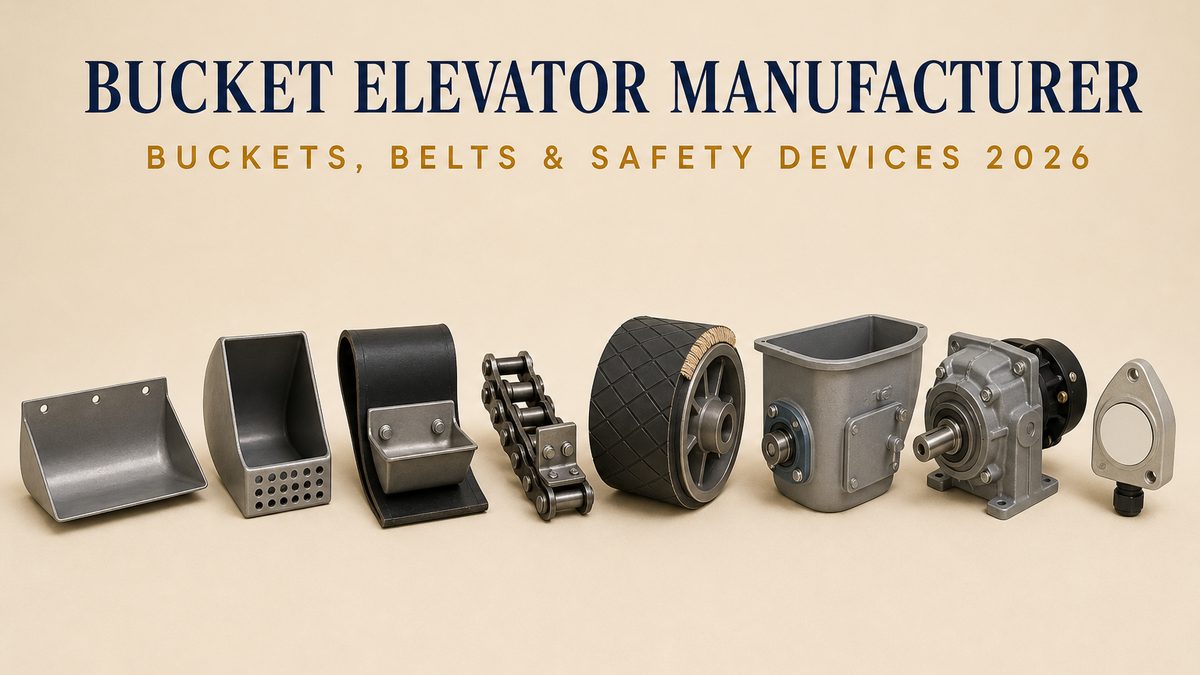
Six Lines That Decide Whether a Bucket Elevator Quote Is Complete
| What the buyer has to settle | Why it is not obvious | The line on your order that closes it |
|---|---|---|
| What the machine has to carry | Capacity in tonnes per hour means nothing without the bulk density and the shape of the material | The product, its density and its largest lump, given as numbers |
| Whether the buckets will empty | A bucket that will not release its load recirculates the product instead of conveying it | The bucket style and speed, chosen together rather than separately |
| Belt or chain | They look similar on a photograph and behave differently on a hot, wet or abrasive product | The belt or chain specification, its strength and its material |
| What holds the belt on the pulley | The take-up is the part nobody specifies, and it is the part that keeps the belt tracking | The take-up type and its travel, with the lagging named |
| What happens when the leg stops loaded | A full leg running backwards will undo the drive and bury the boot | A backstop, and a boot that can be cleared without jogging |
| Which safety devices the machine must have | Where grain or dust is present these devices are required by name, not offered as options | The device list, quoted as supplied items with a drawing |
What a Bucket Elevator Is, and the Names It Is Sold Under
A bucket elevator is a machine that lifts loose material vertically by carrying it upward in small containers attached to a moving loop. The loop is either a belt or a chain. The containers are buckets. The whole thing runs inside a tall narrow casing, with a pulley or a sprocket at the top to drive it and another at the bottom to turn it around, and material goes in at the bottom and falls out at the top.
That is a simple machine and it has been built the same way for a century. Everything interesting about buying one is in the choices inside that description, and the first choice is what to call it, because three different names turn up on quotations.
- Bucket elevator
- The standard name, and the one to use on an order. It describes a vertical machine with buckets on a belt or a chain, discharging over the top. If somebody offers you a bucket elevator, this is what they mean.
- Vertical conveyor
- A wider term that includes bucket elevators but also covers other ways of lifting material straight up, such as a continuous chain with flights or a vertical screw. The search term is used by both buyers and sellers, and it is worth knowing that a quotation headed vertical conveyor may or may not be a bucket elevator at all.
- Z-type elevator
- A bucket elevator whose casing runs horizontally at the bottom, turns upward in the middle and turns horizontal again at the top, so the machine is shaped like the letter. It solves the problem of getting material from a low point on one side to a high point on the other without a separate feeder, and it is common in food plants where the product arrives at floor level and has to be tipped into a hopper above a machine.
- Grain leg, or elevator leg
- The trade name in a grain facility, where these machines are used to lift grain from a receiving pit to the top of a silo or a bin. It matters commercially rather than technically: the rules that govern bucket elevators in the United States were written for grain facilities, and they use this word throughout.
Two boundaries are worth drawing before going further. A bucket elevator lifts material vertically; a machine that moves it sideways is a conveyor, which is a different product with a different set of buying questions, and the horizontal members of the same family are covered in this guide to a the screw conveyor feeding a bucket elevator. And a bucket elevator is not a crane or a hoist: it moves bulk material continuously, not discrete loads, and nothing about it is designed to be stood under.
The reason to be careful with the name is that the rules attach to it. A machine sold as a vertical conveyor with buckets on a belt, installed in a grain facility, is a bucket elevator in the eyes of the rule, and it will be inspected as one. The words on the quotation do not change what it is.
The Types You Will Be Quoted, and Where Each One Fits
Four arrangements cover almost every quotation, and the choice between them is made by the shape of the building and the material, not by preference.
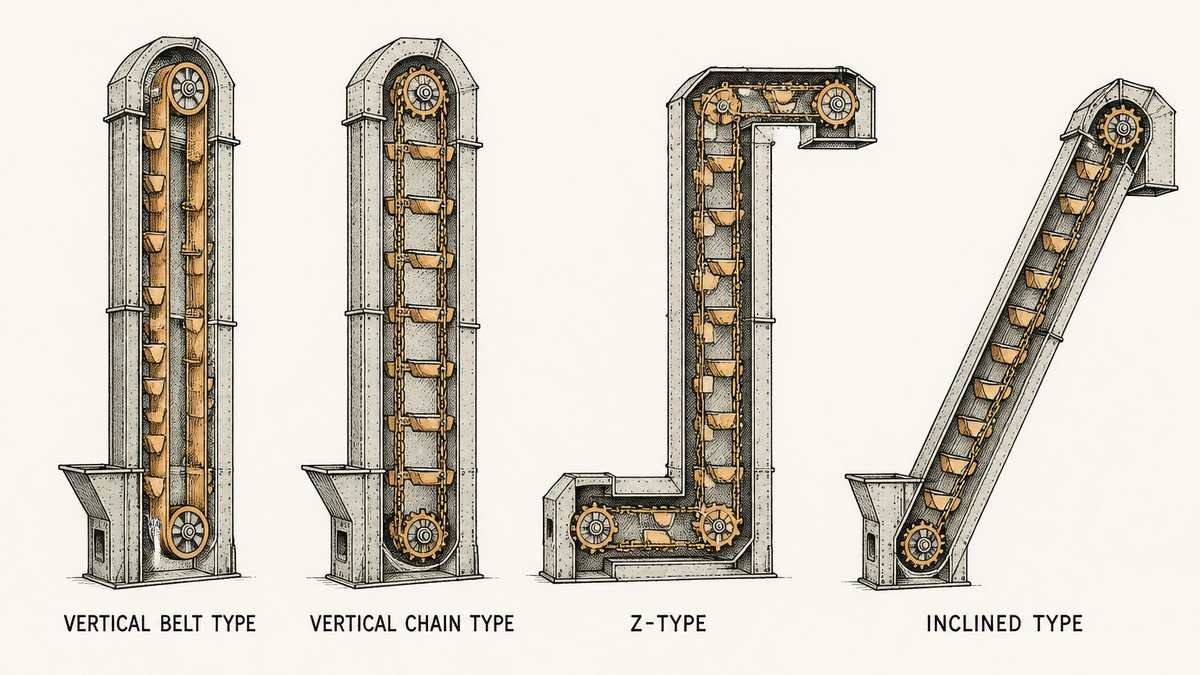
The vertical belt type is the standard machine and the one most quotations describe. A single flat belt carries buckets up one side of the casing and returns down the other, over a pulley at the top and around a pulley in the boot at the bottom. It is quiet, it is cheap to replace when it wears, and it is the gentlest of the four on the product because the buckets simply lift and tip. Its limits are heat and sharp edges: a hot product shortens belt life quickly, and a product containing long sharp pieces will find the belt.
The vertical chain type carries the same buckets but on a chain, usually two parallel strands with the buckets hung between them on brackets. Chain tolerates heat, abrasion and heavy lumps far better than belt, and it does not care about being wet. In exchange it is heavier, noisier, it needs lubrication, and it costs more to replace. Chain is the answer for hot clinker, foundry sand, sharp aggregate and heavy mineral products. It is also the answer where the bucket load is very high, because a chain simply pulls harder than a belt can.
The Z-type machine is a bucket elevator with a horizontal intake and a horizontal discharge. Instead of a boot that material falls into, it has a horizontal run at the bottom into which the product is fed, and the buckets scoop it up as they pass; at the top the casing turns horizontal again and the buckets tip the product out sideways onto a short conveyor or into a chute. It is the machine of choice in a food plant where the product comes off one machine at low level and has to go into another at high level, and it is harder to build well than a straight vertical machine because it has two extra direction changes and a more complicated bucket path.
The inclined machine is a straight casing laid at an angle rather than vertically. It is chosen when a vertical machine will not fit under the roof, or when the discharge point is not directly above the intake. Inclined machines need more belt tension for the same load, because part of the bucket's effort goes into dragging rather than lifting, and the buckets have to be a style that will not spill on the incline. If a quotation offers an inclined machine where a vertical one would fit, it is usually because the machine is being built from stock casing lengths rather than to the drawing.
Two further choices cut across all four types and are worth naming because they are where a quotation is quietly made cheaper.
The first is casings built in sections rather than as a welded monolith. Almost every industrial elevator ships as a stack of bolted casing sections, which is what makes transport possible at all. What varies is the flange quality: a properly built machine has machined or at least flat and square flange faces with a gasket, so the sections line up straight and stay air-tight. A cheap machine ships sections whose flanges are flame-cut and unpainted, and when they are bolted together the leg is out of line over its height, which sets up a permanent belt tracking problem that no take-up can fix. Ask how the flanges are made and whether the sections are match-marked to each other.
The second is which end carries the drive. Almost all machines are head-driven, with the gearbox at the top, because that puts the pulling effort where the load is. A boot-driven machine exists and is used on small units and on Z-types, and it has one real disadvantage: it pulls the belt from the wrong end, so the working side of the belt is under lower tension and the buckets can ride loose. If you are offered a boot drive on a tall machine, ask why.
Inside the Machine: Head, Boot, Casing and the Path the Buckets Take
A bucket elevator has six features worth naming, and every quotation you receive is a set of decisions about them.
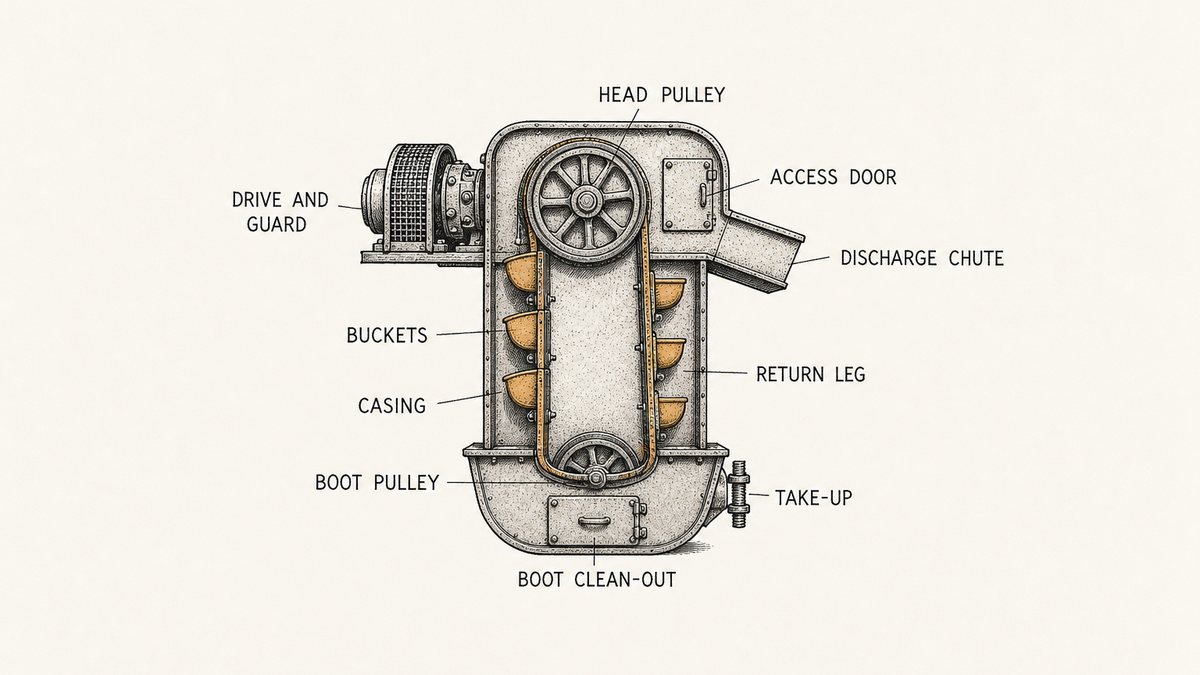
The head section is the top of the machine. It holds the driving pulley on its shaft and bearings, it carries the discharge chute where the product leaves, and it is usually where the gearbox and motor sit. It is also the part a rule pays attention to, because the head is where the belt and the pulley are closest to each other and where the bucket tips its load. A well-built head has an inspection opening in its side so that somebody can look at the pulley, the lagging, the belt and the discharge throat without dismantling anything.
The boot section is the bottom. It holds the turning pulley on a sliding or adjustable mounting, it has an inlet where the product falls in, and it collects whatever the buckets did not pick up. The boot is where a bucket elevator fails first, because it is where the product sits when the machine stops, and it is the part that gets buried when a leg plugs. It needs a clean-out opening on its face and enough room below the pulley that a small amount of material can sit there without touching the belt.
The casing is the tall box the whole machine runs inside. It is normally built from bolted sections of sheet steel, sometimes with a bolted or flanged joint every metre or so, and it serves four purposes at once: it supports the head and boot, it keeps the product inside, it keeps people out, and on a dusty product it stops the dust getting into the building. Its stiffness is not a cosmetic matter. A casing that flexes under load changes the distance between the head and boot pulleys, and that changes the belt tension, which is the origin of a surprising number of tracking complaints.
The buckets are the containers, bolted to the belt or hung between the chain strands at a fixed spacing. They are covered in their own section below, because they are the cheapest part of the machine and the one that most directly decides what it can carry.
The belt or chain is the loop that carries them, running over the head pulley, down the return side, around the boot pulley and back up. It is the part that transmits the pull, and it is the part that sets the machine's limit. Belt and chain are not interchangeable and the choice is made from the product, not the price.
The take-up is the mechanism that keeps the loop tight. It is either a screw take-up, which is a threaded rod through a lug on the boot bearing, or a gravity take-up, which hangs a weight on the boot bearing so the tension looks after itself. It is the single most-skipped line on a bucket elevator specification and it is the mechanism that decides whether the belt stays on the pulley for the next five years. A machine with no take-up travel left at commissioning has nowhere to go when the belt stretches, which it will.
Two less obvious features matter as much as the six above. The first is the discharge chute at the head. Its shape decides whether the product leaves the machine or falls back down the return leg, and on a sticky product a badly shaped chute is the reason a machine appears to have less capacity than its drawing. The second is the access: openings in the head and boot that are big enough to get a hand and a torch through, with covers that go back on. Machines with no access get cleaned by improvisation, and improvisation around a bucket elevator is how people are hurt.
The Buckets: Style, Material and What They Can Carry
The buckets are what most buyers look at first and specify last, and yet they decide whether the machine empties properly, what it can carry and how often it has to be stopped.
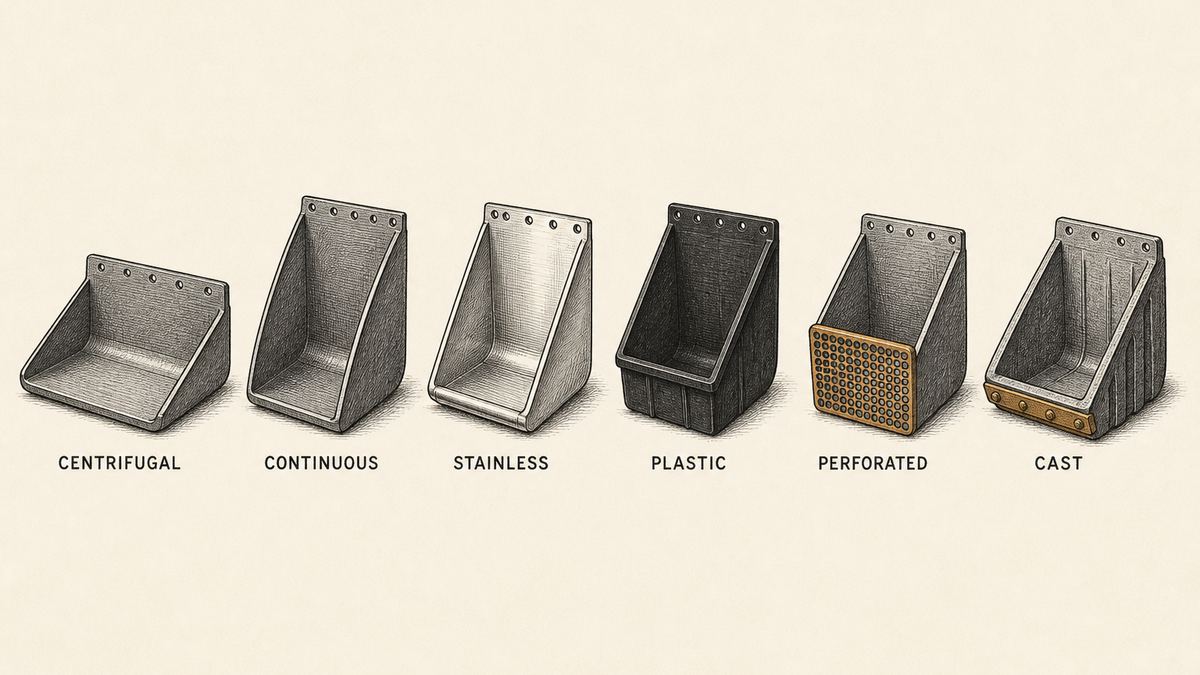
Style comes first, and there are two. A shallow, wide bucket with a low front lip is the centrifugal discharge pattern. It works because the machine runs fast enough that the bucket flings its contents out over the lip as it passes over the head pulley. A deep, narrow bucket with high sides and a steep back is the continuous discharge pattern. It works because the buckets are mounted close together and each one tips its load onto the back of the bucket in front as it turns over, so the product slides out rather than being thrown. The distinction matters because the two styles demand different speeds: a centrifugal bucket on a slow machine will not empty and simply carries the product round the loop, while a continuous bucket on a fast machine scatters the product instead of placing it.
A third pattern sits between them and is worth knowing about. The positive discharge bucket has a steep front face and is used where the product is sticky or stringy, because it scrapes itself out rather than relying on either throwing or sliding. On the products that cause the worst problems, this is the bucket that solves them.
Material comes second, and it is decided by the product and the environment. Pressed steel is the default for most dry, non-corrosive materials and it is cheap and accurate. Stainless steel is needed for food, for wet or acidic products and wherever the machine will be washed. Moulded plastic and polyurethane are used for food and for sticky products, because the material releases better and the bucket is light, which matters on a long machine because every kilogram of bucket has to be lifted thousands of times a shift. Cast steel and cast iron buckets have thicker walls and a heavier lip and are used where lumps and abrasion would destroy a pressed bucket.
Then there is the question of what the bucket does with liquid. A perforated bucket, or one with a mesh front panel, drains as the bucket climbs, so the product arrives at the top drier than it left the bottom. That is not a small benefit on washed vegetables, on sand and gravel, or anywhere the material arrives wet from a previous process. It is also the version that clogs easiest on a fibrous product, so it is a choice to make deliberately rather than to accept by default.
Three specification lines close this section, and all three are practical.
The bucket spacing. Buckets mounted far apart carry more per bucket and empty better on a fast machine. Buckets mounted close together give a smoother flow and are what a continuous discharge machine needs. Spacing is a design output rather than a free choice, and a quotation that does not state it has not finished the design.
The bucket wall thickness and the lip. The lip is the part that wears, and it is where a bucket dies: the leading edge thins, curls back and eventually tears at the mounting holes. Thicker lips last longer and cost a little more, and on an abrasive product that is the right trade. Ask for the wall thickness, because it is the cheapest thing on the whole machine to reduce without telling you.
The fixings. Buckets are bolted to the belt or to the chain through holes in the bucket back. The bolts are the part that fails, and they fail in a way that damages everything downstream: a bolt head or a loose bucket goes round the machine and tears up the casing, the belt and the discharge. Ask what the fixings are, whether they are countersunk or have low heads, and whether the nuts are on the outside where they can be reached. A bucket attached with the wrong bolt is a five-dollar part that writes off a fifty-thousand-dollar machine.
The Belt or Chain, the Head Pulley and the Take-Up
This is the group of parts that decides how much the machine can pull and whether it keeps pulling it.
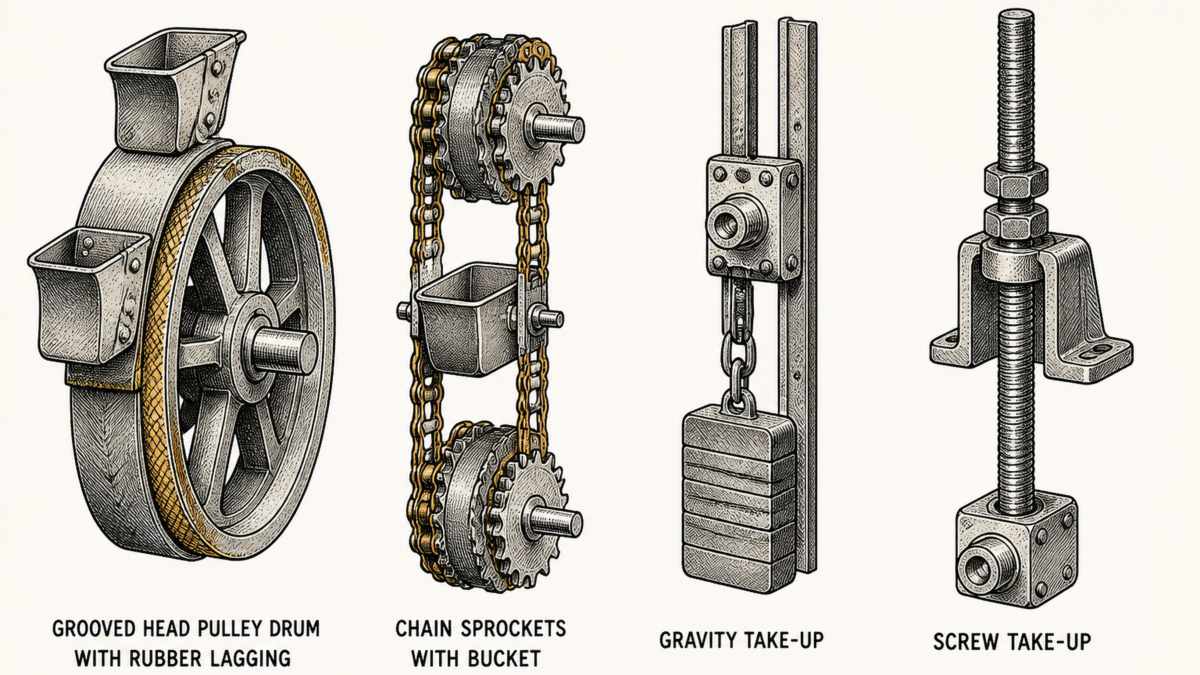
The belt is the quiet default. It is a flat belt, usually fabric-reinforced rubber, running on a flat or slightly crowned pulley. It is light, it is quiet, it does not need lubricating, and it absorbs shock. Its limits are heat and sharp material, and there is a third limit that matters more than either on grain: a belt is an electrical insulator, and a belt running at speed in a dusty atmosphere can carry a static charge. That fact is the origin of a specific requirement described in the safety section, and it is why the belt on a grain leg is not an ordinary belt.
Belt strength is specified as a breaking strength per unit of width, and the sensible way to buy is to ask what the calculated working tension is and what the belt's rated strength is, rather than accepting a belt described as heavy duty. A belt that is merely adequate on paper will be the reason the machine cannot be run at its rated capacity, because the way to get more capacity out of a bucket elevator is to run it faster, and the way to run it faster is to have a belt that can take the tension. Belt selection for conveying generally is its own subject and is covered in this guide to a conveyor belt manufacturer.
The chain is the heavy answer. Two strands of roller chain, or a single strand on small machines, running on sprockets at the head and boot. Chain tolerates a hot product because there is no rubber in it, it tolerates a heavy lump because it pulls rather than grips, and it will keep working when it is wet or dirty. Its costs are real: it is heavier, so the drive is bigger; it needs lubrication, which on a food machine is a problem in itself; and it wears at every pin, so a chain has a definite life and a stretch that eventually has to be taken out or the chain replaced. A worn chain also rides up on the sprocket teeth, which increases the pitch diameter and puts the buckets slightly out of step with the discharge.
The head pulley is the driving pulley and it is normally covered in rubber, called lagging, to raise the grip between pulley and belt. That covering is a genuine wear part and worth specifying: a thin lagging wears through on one side, the belt starts slipping, and the machine loses capacity for a reason nobody can see without opening the head. The boot pulley is usually plain and often smaller, and it is the part that gets buried when the boot fills up.
The take-up is the last and least appreciated. A screw take-up is a threaded rod that pulls the boot pulley down and holds it with lock nuts. It is simple, cheap and completely static, which means somebody has to notice that the belt is loose and go and tighten it. A gravity take-up hangs a weight on the boot bearing so that the tension stays constant by itself as the belt stretches and as the load changes. It costs more, needs space below the boot, and on a long or heavily loaded machine it is the difference between a belt that tracks and a belt that has to be adjusted every fortnight.
The travel of the take-up is the line to check on the drawing. A take-up with a short travel is used up within the first year of a belt's life, and after that the machine has no adjustment left, which means the next step is a new belt whether the old one needed replacing or not. Ask for the take-up travel, not just the take-up type.
The Drive End: Gearbox, Backstop and What Happens When It Stops
The drive of a bucket elevator is a geared motor and a small number of accessories, and the accessories are where the machine is either safe or dangerous.
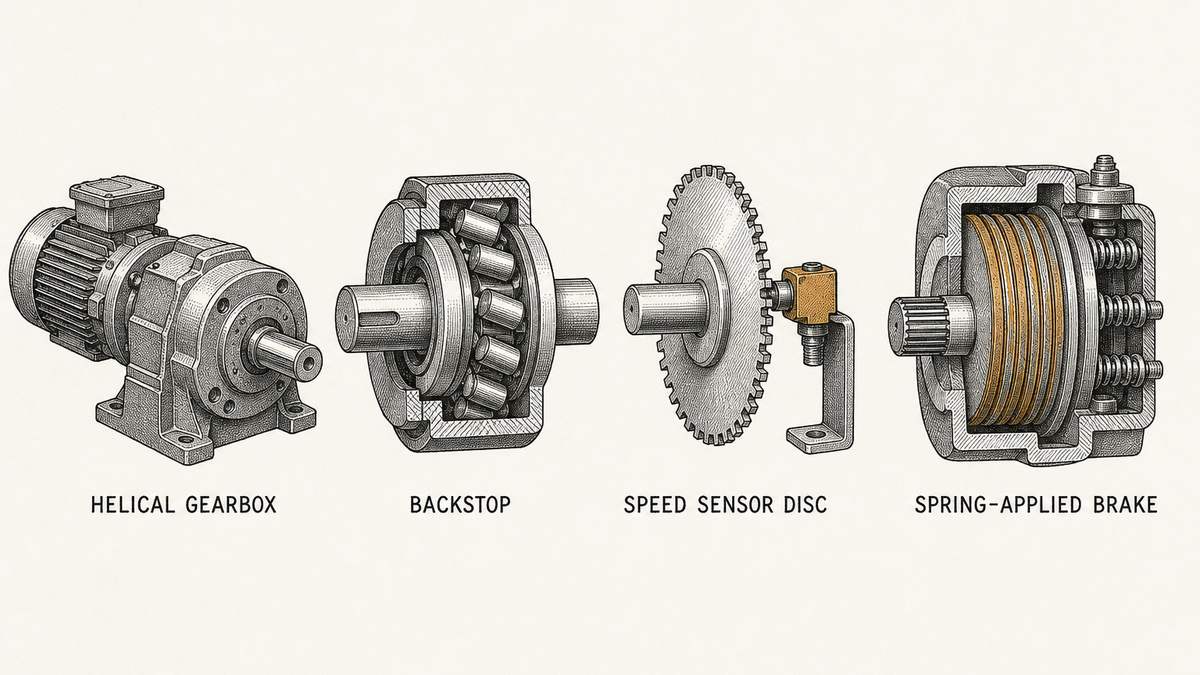
The gearbox and motor are the ordinary part, and the specification question is simply whether they are in scope. A bucket elevator needs a low output speed and a high torque, so it almost always uses a helical or a shaft-mounted gearbox with a modest motor. Buying the machine complete with its geared motor is usually cheaper and always simpler than fitting one locally, because the mounting flange, the output shaft and the coupling all come matched. Buying it without, to save money, is one of the commonest reasons a project runs late.
The backstop is the accessory that matters most and gets specified least. It is a one-way device fitted between the gearbox and the machine so that the drive can turn the elevator forward but not backward. On a bucket elevator it is not a refinement: a loaded leg is a heavy weight on one side of the loop, and when the motor stops, that weight wants to run the machine backwards. Without a backstop the machine will run back on its own, the buckets will fill the boot with material that has to be dug out by hand, and on a badly arranged drive the reversal can undo the coupling. A backstop is a small, cheap component that costs a fraction of what the alternative event costs.
The related accessory is a brake, and the difference between the two is worth understanding because they are often confused. A backstop prevents rotation in one direction and does nothing else. A brake stops the machine and holds it, and it matters where the elevator has to come to rest in a controlled way, or where the drive has to be held against a load that is trying to move it even before it comes to rest. A cheap drive will have neither; a properly specified one will have a backstop at least.
Speed sensing is the third accessory, and it is the mechanical half of a safety device described in the next sections. A small toothed wheel on the drive shaft with a sensor head held close to its teeth gives a signal whose frequency follows the shaft speed, which is how a control panel knows the machine is turning and how fast. On machines that have to satisfy the grain rules, this signal is not an indicator for the operator to watch; it is the input that shuts the machine down.
One more drive decision is worth making at the enquiry rather than afterwards. A bucket elevator is often expected to be speed-adjustable, because the capacity of the machine rises and falls with belt speed, and a plant's throughput changes. That means either a variable speed drive on the motor or a change of pulley ratio, and the two have very different cost and very different consequences. A variable speed drive is flexible and costs money. A pulley change is free at the design stage and costs a shutdown afterwards. If the throughput is expected to grow, say so before the machine is built, because designing the drive with the headroom in it is nearly free at that point.
Capacity, Speed and the Figures to Ask For
Capacity is where quotations are most often compared unfairly, because there are several different capacities and only one of them is useful.
Ask for capacity in tonnes per hour at a stated bulk density. A bucket elevator's capacity is really a volume per hour, because the buckets carry a volume. Converting that to tonnes per hour requires the density of the material, and density varies enormously between products that look similar. A quotation that says a machine is rated at a certain tonnage without naming the density has quoted you a volume rating wearing a weight label. Give the density, and ask for the capacity at that density.
Ask for the capacity with a stated bucket fill. Buckets are never completely full. A centrifugal discharge machine relies on the bucket being partly empty so the product can be thrown out; a continuous discharge machine fills its buckets more fully because they tip onto each other. Design figures assume a fill factor, and a quotation that is enthusiastic has assumed a generous one. Ask what fill the figure is based on.
Ask for the belt speed and the resulting figure. Capacity rises with speed, and speed is limited by two things: whether the buckets will still empty cleanly at that speed, and whether the belt can take the tension. A machine sold on a high speed to reach a capacity figure may be a machine that wears out its belt and its buckets early, or that throws product past the discharge chute. Ask for the speed, and ask whether the bucket style is matched to it.
Ask for the power at the shaft, not the motor rating. The power needed to lift material has two parts: the useful work of raising the weight, and the losses in the belt, the bearings and the buckets. A quotation that gives only a motor size has given you a number that includes a safety margin you cannot see. The shaft power figure tells you what the machine actually needs, and from it you can work out the running cost, which on a machine that runs continuously is the largest number in the whole order.
Two further figures close this section and both are about the material rather than the machine.
The largest lump the machine will pass. A bucket elevator will carry a lump that fits into a bucket and will jam on one that does not, and a jam in a bucket elevator is not a small event: the machine is full of stored energy and something has to give. Ask for the maximum lump size the machine will handle, and compare it with the largest piece your product contains.
The angle of repose and the flowability of the product. Material that flows easily falls into the boot and is picked up cleanly. Material that is sticky, that bridges, or that has a shallow angle of repose will build up in the boot and have to be helped. That is a design conversation about the boot inlet and the clean-out, and it belongs at the enquiry stage rather than after the first blockage. If the product is known to be difficult, say what it does: whether it bridges, whether it packs, whether it sets hard when it cools.
Dust, Static and the Risk That Shapes the Whole Design
Every bucket elevator handling a dry organic product is a dust machine. It shakes the product, it drops it, it tips it, and in doing so it makes a cloud of fine particles inside a closed steel box. On most materials that cloud is harmless. On grain, flour, sugar, starch, some plastics and a long list of other powders, that cloud will burn, and a cloud of the right concentration in a closed box is an explosion waiting for an ignition source.
Two of the ignition sources are built into the machine itself, and understanding them explains the whole safety section that follows.
The first is heat from friction. A belt slipping on a pulley, a bearing running dry, a choked boot with the belt sawing through a pile of material: all three make heat in a place where the dust is thickest. A bearing that overheats inside a leg casing, buried in dust, is the ignition source that grain industry rules are written around, and it is why those rules say something specific about where bearings may be mounted.
The second is a static spark. A rubber belt running over a pulley at speed is a generator. The belt and the pulley are rubbed together thousands of times a minute, the charge has nowhere to go because rubber is an insulator, and it builds up until it jumps. In a dusty atmosphere that jump is an ignition source. This is why a grain leg does not use an ordinary black rubber belt, and it is why the rule on belts is written in terms of electrical resistance rather than in terms of strength.
Three further sources have nothing to do with the machine and everything to do with the room it is in. Tramp metal that arrives in the product can strike the casing and spark. Hot work, meaning welding or cutting, on or near a leg during a maintenance stop is a classic cause of a grain dust explosion. And a choked leg that is repeatedly jogged to clear it creates both heat and a lot of disturbed dust at once, which is why the rule forbids the practice outright.
The design consequences are worth naming before the rules, because they explain why the rules are written as they are. A bucket elevator that has to handle a combustible dust wants bearings outside the leg where they can be seen and cooled, or monitored if they cannot be moved. It wants a belt that cannot hold a charge. It wants to know quickly if the belt slows down or starts to wander, because both are signs that something is rubbing. It wants to be emptied rather than jogged when it plugs. And it wants to be built so that somebody can get at the head and the boot to look, because a machine that cannot be inspected will not be.
If the product is not combustible, none of the rules below apply to your machine, and the section is still worth reading, because the same devices are the ones that stop a machine from destroying itself, and the same logic about access and inspection applies. If the product is combustible, then the section is not advice. It is the list of what the machine has to have.
The Safety Devices US Grain Rules Require on a Bucket Elevator
In the United States, bucket elevators inside grain handling facilities are governed by 29 CFR 1910.272, Grain handling facilities. The section is unusual among machinery rules in that a whole paragraph of it is titled, in the regulation's own words, inside bucket elevators. That paragraph is where the hardware requirements live, and reading it is the fastest way for a buyer to understand what has to be on the drawing.
Three limits on the scope are worth knowing before the requirements, because a supplier may or may not know them.
The rule defines an inside bucket elevator narrowly: a bucket elevator whose boot and more than twenty percent of its total leg height, measured above ground level, sit inside the grain elevator structure. An elevator whose leg stands outside the building is not an inside elevator, and the parts of the rule covering bearing placement, motion detection and belt alignment are written around the inside case. The rule also carves out three groups entirely: seed plants that prepare seed for planting, on-farm storage, and feed lots. And the paragraphs on emergency escape, dryers and inside bucket elevators apply only to grain elevators, which the rule defines as facilities that receive, handle, store and ship bulk raw agricultural commodities such as corn, wheat, oats, barley, sunflower seeds and soybeans.
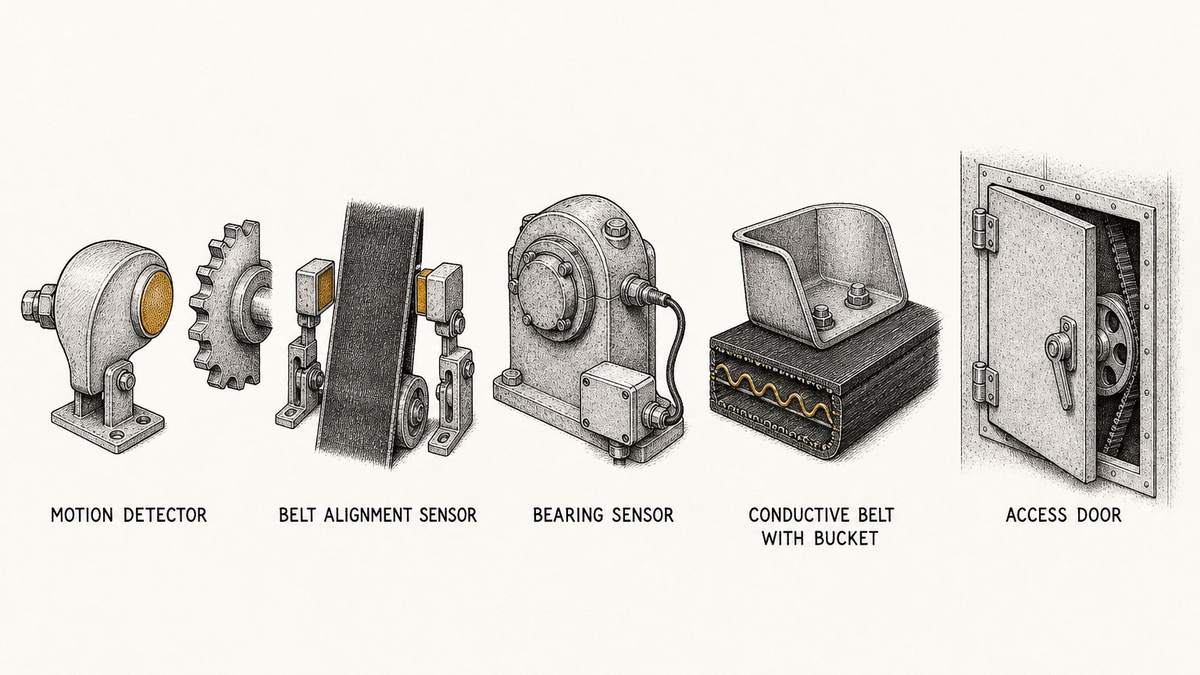
The bearing rule is the one that changes the casting. The regulation offers a choice and both halves have to be understood as a manufacturing instruction. Bearings must be mounted externally to the leg casing, or the machine must provide vibration monitoring, temperature monitoring, or some other means of monitoring the condition of bearings that are mounted inside or partly inside the leg casing. The first option changes the shape of the head and boot: the bearing housings move outboard, on stub shafts or on brackets that pass through the casing wall, so that the bearing sits in the open air where it can be seen, felt and greased. The second option keeps the compact arrangement and adds a sensor and a control panel. As a buyer, this is a decision to state on the enquiry, because a supplier who has not been told will build whichever is cheaper for them, and a bearing buried inside a leg with no monitoring is exactly the arrangement the rule exists to prevent.
The motion detection rule is the one with a number in it. Bucket elevators have to be equipped with a motion detection device which will shut the elevator down when the belt speed is reduced by no more than twenty percent of the normal operating speed. Read carefully, the twenty percent is a limit on the device's sensitivity, not a tolerance in the machine: the requirement is that the device must react at or before a twenty percent drop, so a device that only trips at a fifty percent drop does not meet it. Practically, this is a sensor looking at a shaft or a sensing wheel, wired to a control panel that stops the drive. It is the device that catches a slipping belt, a failing bearing and a drive that has lost its grip, and it catches them all before the belt starts sawing through material.
The belt alignment rule offers a choice of two answers. The machine must either be equipped with a belt alignment monitoring device that will raise an alarm when the belt is not tracking properly, or it must be provided with a means to keep the belt tracking properly, such as a system that keeps the alignment adjusted by itself. The first is detection and the second is correction. Detection means sensor heads beside each edge of the belt at the head or boot, watching for the belt leaving its position. Correction means a self-aligning arrangement, usually a pulley mounted so that it steers the belt back. Note one important difference between the two: the alignment device raises an alarm, while the motion detector shuts the machine down. A buyer who wants the machine to stop on a misaligned belt rather than merely announce it should say so, because that is a control-panel decision and not something the rule requires.
The belt has to be conductive, and this is a specification line, not a preference. The rule requires that all belts and lagging bought after the effective date of the standard shall be conductive, with a surface electrical resistance not to exceed three hundred megohms. That figure is the reason a grain leg belt is not bought on price from a generic belt supplier. It is also the reason the belt on a grain machine should come with a test report rather than an assurance, and it is the reason the lagging on the head pulley is specified at the same time as the belt, because the rule names both.
The machine has to be built with access, and the rule says where. Bucket elevators have to be equipped with a means of access to the head pulley section so that the head pulley, the lagging, the belt and the discharge throat of the elevator head can all be inspected. The boot section has to have a means of access for clean-out of the boot and for inspection of the boot, the pulley and the belt. This is a fabrication requirement: the openings have to exist in the casing, they have to be big enough to be useful, and they have to have covers. On a Chinese-built machine this is one of the most commonly missed items, because it adds a hole, a frame and a door to a drawing that is otherwise simpler without them. Ask to see the head and boot in the general arrangement drawing and confirm the access is shown.
One thing is forbidden outright. Bucket elevators are not to be jogged to free a choked leg. Jogging is defined as repeatedly starting and stopping the drive motor in an attempt to clear the material, and the rule bans it because each start delivers a full torque impulse into a jammed machine while stirring up the dust that is already present. The practical consequence for your order is that a machine which plugs easily is a machine that will be jogged, whatever the rule says, because the alternative is to dig it out by hand. That is why the boot clean-out access, the boot shape and the inlet design are safety features and not conveniences.
Two exemptions decide whether any of the above applies to your machine, and both are worth putting to a supplier. The motion detection and belt alignment requirements do not apply to a grain elevator with a permanent storage capacity of less than one million bushels, provided that bucket movement and belt tracking are visually inspected every day. And the bearing, motion detection and belt alignment requirements all fall away on a bucket elevator that is equipped with an operational fire and explosion suppression system protecting at least the head and the boot, or that has dust control keeping the dust concentration inside the elevator at least twenty-five percent below the lower explosive limit at all times during operation. Those are real carve-outs, they are used in practice, and a supplier who can discuss them has read the rule. A supplier who has never heard of them will simply build what they always build.
Two further points complete the picture for a machine going anywhere the first rule does not reach. A bucket elevator installed at a quarry or a mine is governed instead by the mining rules, and the applicable one for the guarding of the moving parts is 30 CFR 56.14107, which requires moving machine parts to be guarded against contact with gears, sprockets, chains, drive, head, tail and takeup pulleys, flywheels, couplings, shafts and fan blades. It contains one number worth knowing because it changes the design: guards are not required where the exposed moving parts are at least seven feet away from walking or working surfaces. Below that height the drive, the coupling and any exposed pulley must be covered; above it, they need not be. And whatever the installation, the casing of a bucket elevator is a tall steel box with an opening at the top and an opening at the bottom, and the openings are where people are hurt. A machine designed with the access at head and boot, and guards on the drive, has answered both the letter and the reason for it.
Inspection, Records and What the Buyer Ends Up Owning
A bucket elevator is a machine that has to be looked at, and on a grain installation the looking is itself regulated. This section is short and it is the part of the article most often missing from a supplier conversation, because it is about duties that land on the buyer's plant rather than on the factory.
The rules require records, not just inspections. A grain facility is required to correct any dust collection system that is malfunctioning or running below its designed efficiency. It is required to correct or take out of service overheated bearings and slipping or misaligned belts associated with inside bucket elevators, and it has to do so promptly. And it has to keep a certification record of each inspection, containing the date of the inspection, the name of the person who performed it, and the serial number or other identifier of the equipment. For a buyer putting a bucket elevator into a grain plant, those three items are a piece of the specification: the machine needs an identifier stamped or plated on it so that the record can name it, and it needs bearings and belts that somebody can actually see and check without a major dismantle.
A second rule turns those duties into a general habit. The mining rule at 30 CFR 56.14100 applies to equipment at mines and quarries, and it states the same idea in the plainest possible words: defects on any equipment, machinery and tools that affect safety have to be corrected in a timely manner so that they do not create a hazard to people. Where a defect makes continued operation hazardous, the rule requires the defective item to be taken out of service and put in a designated area posted for that purpose, or marked with a tag or other effective method so that it cannot be used again until it is put right. That is the standard a plant will be held to, and it is a good reason to buy a machine whose faults announce themselves: a bearing sensor, a motion detector and a belt alignment device all convert a hidden defect into a signal, and a signal is what turns a maintenance job into a planned one.
The inspection list for the machine itself is short and physical. Look at the buckets for worn lips and loose or missing bolts. Look at the belt or chain for stretch, edge damage and worn pins, and check the belt tension against the take-up travel so you know how much adjustment is left. Look at the head pulley lagging for a worn patch and at the boot pulley for scoring. Check the boot for built-up material that is narrowing the clearance under the pulley. Check that the bearing sensors and the motion detector are fitted where they were specified and wired to something. Check that the access covers at head and boot go back on and stay on. And check the drive for oil weeping and for a backstop that actually holds, which is done by turning the machine backwards by hand with the drive isolated.
Then keep the paperwork together, because the machine's value depends on it. For a grain installation, that means the belt's surface resistance test report, since a belt without its report cannot be shown to meet the three hundred megohm limit. It means the general arrangement drawing with the head and boot access shown, so that a future inspector can see what was supplied. And it means the spare parts list with the take-up travel, the bucket spacing and the belt specification written on it, because the belt will be replaced by somebody who was not involved in the order, and the second belt is where a good machine gets quietly downgraded to a bad one.
What to Put in the Specification Sheet
A bucket elevator is a large machine and a cheaply written enquiry produces a cheaply built answer. What follows is the list worth putting on one page. The general shape of the document is the same for any fabricated assembly out of a Chinese workshop and is set out in this guide to a the enquiry format for a fabricated assembly.
The material. What it is, its bulk density, its temperature, whether it is wet or dry, its largest lump and how much of the material is that size. Add whether it is abrasive, whether it is corrosive, and on a food product whether it has to be kept clean. If the product is a combustible dust, say so in those words, because that single line brings a whole set of requirements with it and it is the line most often left out of an enquiry.
The duty. Capacity in tonnes per hour at the stated density, and the lift height as a dimension from the intake centre to the discharge centre. Add the shape of the installation if it is not a straight vertical run, because Z-type and inclined machines are different products from a vertical one.
The type. Vertical belt, vertical chain, Z-type or inclined, and the reason if it is not vertical. State whether the drive is at the head.
The buckets. Style, material, wall thickness, and the spacing. If the product is sticky or stringy, say so, so that the style can be chosen for release rather than for capacity.
The belt or the chain. Material and construction, and the rated strength. On a machine where the grain rules apply, add the electrical resistance requirement and ask for the test report as a delivered document, and specify the lagging at the same time. On a chain machine, name the chain size and the pin and bush material.
The pulleys. Diameter, face width, and the lagging specification with its thickness. State the crown if there is one.
The take-up. Type, and the amount of travel. This is the line that decides how long the first belt lasts, and it is almost always missing from an enquiry.
The drive. Whether the motor and gearbox are in scope, the output speed, the shaft power, and the supply voltage and frequency. Add the backstop and the brake, each named as a supplied item. Add whether the speed has to be variable, and if it does, whether the adjustment is by a variable speed drive or by a pulley change.
The safety devices, if the dust is combustible. Name each one rather than asking for the rules in general: the motion detection device with its trip point, the belt alignment arrangement with a decision on alarm or shutdown, the bearing arrangement with a decision on external mounting or monitoring, the conductive belt and lagging with the resistance limit, and the access at the head and the boot. Add the fire and explosion suppression or the dust control arrangement if there is one, because that is what determines whether some of the other requirements fall away.
Access and guarding. Openings at the head and the boot with hinged or bolted covers, a clean-out at the boot, and guards over the drive, the coupling and any exposed pulley that sits below the height at which guarding stops being required.
Materials of construction. Casing thickness and finish, whether the casing is painted inside as well as outside, and whether any part is stainless. Casing sections are where a cheap machine saves money invisibly, so name the sheet thickness and ask how the section flanges are made and whether the sections are match-marked.
Marking, packing and documentation. What is to be plated on the machine, including an identifier for the inspection records. How the casing sections are to be packed for a container, and a packing list showing every section with its mark. And the documents: the general arrangement drawing, the belt or chain certificate where one is required, the motor and gearbox data, and the spare parts list.
Spares. A set of buckets, a set of bucket bolts, and the head pulley lagging. These are the three items that stop the machine when they fail, they are all cheap, and they all travel far more cheaply in the same crate as the machine than they do on a separate order six months later.
Inspecting a Bucket Elevator Before It Ships
A bucket elevator is expensive to send back. It is too big for a parcel, it travels as a stack of steel sections, and once it is in a plant it is easier to work around a fault than to argue about one. That makes the factory inspection the most valuable half-day on the whole order, and it should be done with the machine assembled rather than on a pile of loose sections. The wider sequence is set out in this guide to an inspection before the goods ship.
Assemble the trial run and turn it by hand first. Before anything is powered, the belt or chain should be movable by hand around the whole loop, with even resistance and no tight spot. A belt that is pinched between a bucket and a pulley, a bucket that fouls the casing, and a chain that is too tight will all show up in this one check, and none of them will show up on a photograph.
Check the align and the square. The casing sections should be bolted up in the factory and the leg measured for straightness and for twist. Look at the section joints: the flanges should meet with no visible step and the casing should not lean. A leg that is out of line at the factory will be out of line in your plant, and the belt will track against one side of the pulleys for its entire life. If the machine is shipped partly assembled and the rest is bolted together on site, ask for the sections to be match-marked and for the marks to be photographed, because a section fitted the wrong way round is a leg that will never run straight.
Look at the buckets and their fixings. Buckets should be evenly spaced, square to the belt or chain, and bolted with the right bolts, correctly tightened, with the nuts on the accessible side. Count the buckets against the drawing. Check the wall thickness of a bucket with a gauge rather than your hand. And check that no bucket fouls the casing or the discharge throat as it goes round: rotate the machine through a full loop and watch each bucket pass the head.
Check the belt or the chain against its specification. Width, thickness and strength are the three figures to confirm. On a grain machine, check the belt's markings and the test report for its electrical resistance, because a belt that does not meet the limit cannot be used and cannot be fixed afterwards. On a chain machine, check the chain size, check that the pin and bush material is what was ordered, and check that the chain runs on the sprocket teeth across their full width rather than riding on the tips.
Check the pulleys and the lagging. Measure the head pulley diameter and the face width. Look at the lagging: it should be bonded all round with no lifting edges, and its thickness is worth measuring because this is a wear part that is easy to make thin. Check the boot pulley for scoring and check that the gap between the boot pulley and the boot floor is what the drawing says, because that gap is what decides how easily the machine plugs.
Check the take-up travel. Run the take-up from one end of its travel to the other and measure it. This is the check that tells you how much adjustment you have bought, and a take-up with a short travel on a tall machine is a promise that the first belt will be replaced early. Confirm the take-up type against the order, because a gravity take-up and a screw take-up are not interchangeable and the weight is easy to omit from a shipment.
Check the safety devices as hardware, not as promises. On a machine where the grain rules apply, this is the list that matters. Confirm the motion detection device is fitted, that its sensing head is close enough to its target to work, and that its trip point is set as specified. Confirm the belt alignment arrangement is fitted at both edges, and confirm whether it alarms or shuts down. Confirm where the bearings are: either outside the leg casing where you can see them, or inside with a sensor fitted and wired. Confirm the access openings exist at the head and the boot, that they are big enough to be useful, and that the covers close and latch. Confirm the backstop by turning the drive backwards with the machine isolated, and confirm the guards are fitted over the drive and the coupling with no sharp edges.
Run it and read the numbers. Ask for the machine to be run empty and then loaded, and for the current drawn, the belt speed and the noise to be recorded. An empty run tells you about alignment and bearing condition. A loaded run tells you whether the buckets empty cleanly over the head and whether the discharge chute actually clears the product, which is the single most common thing wrong with a new machine and the hardest thing to fix once it is installed under a roof. If the factory cannot run the machine loaded because it has no test material, ask it to run with a substitute of similar density and behaviour, and treat a flat refusal as information about the supplier.
Then check the paperwork and the packing, and hold a reference. The general arrangement drawing should match what was built, including the access openings. The packing list should name every casing section with its mark. Take one bucket and one length of the belt as a retained sample, in writing, as the reference for replacements: on a machine where a substituted bucket or a substituted belt is invisible until it fails, a reference sample is the only way to keep the second delivery honest. That principle, applied to a first shipment, is the point of a an approved first article. And do all of it before the crate is closed, because the difference between a correction and a claim is whether the machine is still in the factory.
The Defects That Show Up in the First Month
Bucket elevator problems fall into two groups, and the group a fault belongs to decides who pays for it. One group is built in service by choices made at the order stage. The other arrives with the machine and is invisible until it fails.
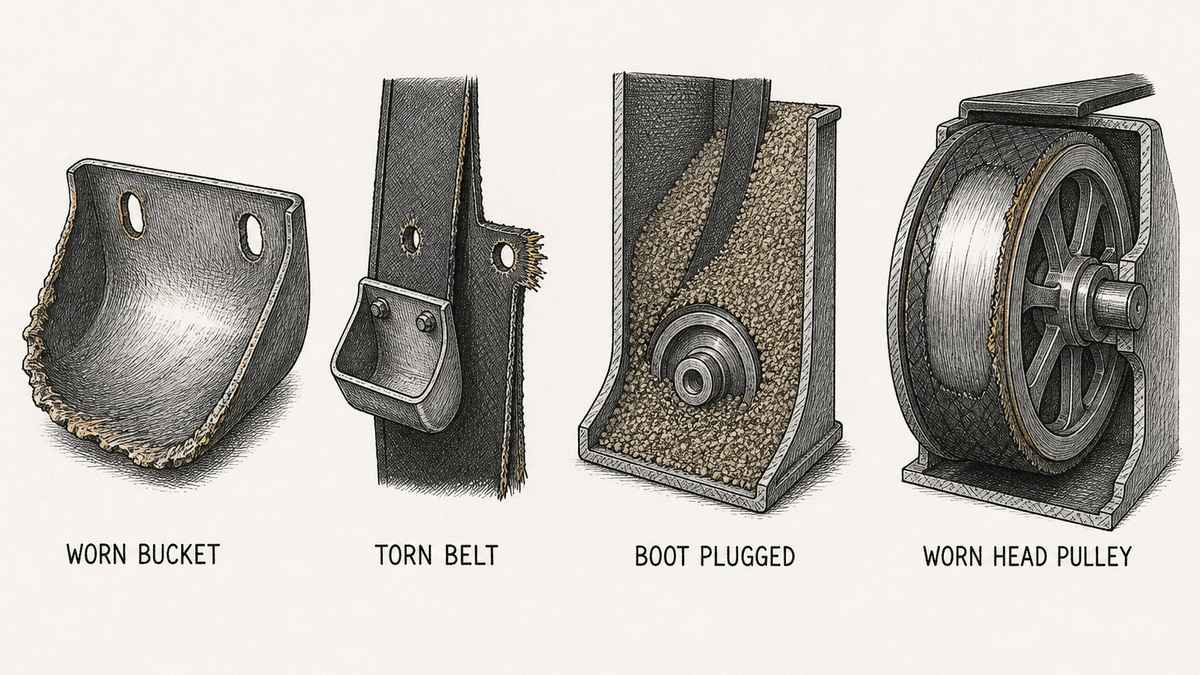
A plugged boot is built in service and it is a capacity story. Loose material packs around the bottom pulley, buries the return belt and fills the corner of the trough, and the machine stops. There are four usual causes and they overlap. The machine is being fed faster than it can lift, which is an inlet or a control problem rather than a machine fault. The boot is too shallow, so the small amount of material that always sits in a boot has nowhere to go and reaches the pulley. The buckets are not picking up cleanly at the boot, which happens when the inlet is positioned so that material piles in front of the buckets instead of being scooped, or when the belt speed is too low for the bucket style. Or the material is simply difficult: sticky, or lumpy, or arriving wet. The diagnostic detail is the shape of the pile. Material packed evenly across the whole boot points at capacity and boot shape. Material piled in one corner points at the inlet. And a machine that plugs only in wet weather is telling you about the product.
A worn bucket lip is built in service and it is a speed-and-abrasion story. The leading edge thins, curls back and finally tears at the mounting holes. This is ordinary wear on an abrasive product and it is what the wall thickness line on the specification is buying you. What is not ordinary is a bucket whose lip wears out on one side only, which points at a bucket that is not square to the belt, or at a run of buckets that are all sitting at the same angle because the belt is tracking against one side of the pulley. And a bucket whose mounting holes are elongated rather than its lip worn points somewhere else entirely: at loose bolts, which are the beginning of a much more expensive failure.
A torn or splitting belt is built in service, and the place the tear starts tells you the cause. A split running along one edge points at tracking: the belt has been running against the casing or the edge of a pulley, and something is misaligned or the take-up has stopped doing its job. A ragged break at a bucket mounting points at the fixings: a bolt head standing proud, a hole that has cracked, or a bucket that has been catching on something. A belt that is stretched beyond its take-up travel, with the boot pulley sitting against the end of its adjustment, points at a belt that was too light for the tension from the beginning. That last one is the fault most often blamed on the belt and actually caused at the order, because the belt was chosen on price and the speed was chosen for capacity.
A worn head pulley lagging is built in service and it is the quietest of the four. The rubber covering wears through in a broad flat patch on one side, goes glazed and polished, and from then on the belt slips there instead of gripping. The machine loses capacity, the motor draws more, and the belt heats. Because the wear is inside the head, nobody sees it until something else goes wrong. It is also the most avoidable: lagging wears that way when the belt is not tracking properly or when the tension is too low, so a lagging failure is usually the second symptom of a fault that started as tracking.
Five Faults and Which Side Each One Is On
| The fault | What gives it away | Whose side it is on |
|---|---|---|
| Boot plugs within the first weeks | Material packed evenly across the whole boot rather than piled in one corner | The supplier's, if the boot depth and the inlet do not match the drawing |
| Belt tracks hard against one side from the first run | A leg that is visibly out of line, or casing sections with a step at the joints | The supplier's, and it is a building fault rather than a wear fault |
| Bucket lips worn through on one side only | Even wear along the lip on one side of the bucket and almost none on the other | The supplier's, if the buckets are not square to the belt or the chain |
| Belt split along one edge | A clean lengthwise split rather than a ragged break at a fixing | The plant's, and the answer is tracking and take-up rather than a new belt |
| Belt stretched past the take-up travel | The boot pulley sitting against the end of its adjustment with the belt still loose | The plant's, and the answer was a stronger belt or a larger take-up travel at the order |
| Motion detector never trips | A device fitted with its sensing head too far from its target, or set at the wrong speed | The supplier's, and it is the fault that matters most, because the device is worthless until it works |
The way to use that table is to send a photograph and a description before sending a claim. A supplier who can tell the difference between an even wear line and a one-sided one, and between a lengthwise split and a ragged break, is a supplier who knows how the machine behaves. A supplier who agrees to replace anything without asking a single question is not being generous: they are avoiding finding out what went wrong, and the next bucket will wear the same way. More of the detail behind that approach is set out in this guide to defect classification.
Price, MOQ and Lead Time: What Actually Moves the Number
This article does not quote prices, because a bucket elevator price with no height, no capacity and no material schedule attached to it is not information. What it can do is name the things that move the number, so that when two quotations differ by a factor you know which question to ask.
Height is the biggest single driver, and it is a square-footage question as much as a cost one. A taller machine needs more casing, more belt or chain, more buckets and a stiffer structure, and the cost rises faster than the height because the structure has to resist more. On a very tall machine the casing sections start to dominate the price, which is why a supplier will suggest a heavier section only when pushed. Ask for the casing sheet thickness on the drawing and compare it between quotations, because it is the classic place a heavy machine is quietly made lighter.
The belt or chain specification is the second driver and the least visible. A light belt on a tall machine will reach the capacity figure on paper and will not hold the tension in service. A heavier belt costs more and lasts. A chain costs more again and brings lubrication and weight with it. Comparing two quotations for the same machine without comparing their belt strength figures compares nothing at all.
The safety devices add far less than buyers expect, and they are where a cheap quotation is cheapest. A motion detector, an alignment sensor head, a bearing sensor and the access openings at head and boot together are a modest sum against the machine. A quotation that omits them is cheaper by that modest sum and cannot be used in a grain plant. Ask for the devices to be quoted as separate lines, so you can see both their cost and whether they are there at all.
The drive is a step change, not a slope. Machine with motor and gearbox, machine without, and machine with a variable speed drive are three different price bands. Neither arrangement is wrong, but the same line has to appear on both quotations before any comparison means anything. The same applies to the backstop and the brake: name them as supplied items so they cannot be left out and described as standard.
Materials and finish move the number in a way that is easy to hide. Painted carbon steel, painted inside as well, stainless casing, stainless buckets and a stainless head are five different specifications and not five grades of the same one. Name which parts are which material, in writing, because a quotation that says stainless and delivers painted steel wetted ends passes a quick look and fails on a wet product within a season.
Packing and shipping deserve an early line, because this machine is mostly air and steel sheet. Casing sections are bulky and light, which means a container fills by volume long before it fills by weight, and the freight is charged on the dimensional volume rather than the actual weight. Working that out before the order, rather than after, changes how the machine is designed for shipment: sections that nest, buckets packed inside the casings, and the drive crateable. The arithmetic is set out in this guide to volumetric weight and CBM, and the loading itself is worth watching, because a stack of tall casing sections is one of the easiest cargoes in the world to load badly and one of the hardest to inspect on arrival. Arranging that is the subject of this guide to container loading supervision.
Two commercial points are worth more than a price list. The first is to buy the wearing parts with the machine: a set of buckets, a set of bucket bolts, and the head pulley lagging. All three are cheap, all three stop the machine when they fail, and all three travel far more cheaply in the machine's own crate than on a separate order. The second is to ask what a new casing section costs before you need one, and whether the factory can supply a single section later. A machine damaged by a jam or by a handling accident is repaired by replacing one or two sections, and a supplier who can supply one section later is worth more than one who only sells complete machines.
On lead time, the shape of the answer is simple. A machine built to a standard sample is quick. A machine of an unusual height, or with a special belt, or with a food-grade finish, is slower by the time it takes to detail and fabricate, which is the point where a late order stops being a delivery problem and starts being a building problem, because the machine usually has to go in before the roof does. Ask how long the detail drawings take, not just the fabrication, and ask it before the structural steel is ordered rather than after.
Questions Buyers Ask
How do I work out what size bucket elevator I need?
Start from the material and the duty, not the machine. You need the bulk density of the product, the largest lump in it, and the capacity you want in tonnes per hour, and you need the lift height measured from where the material enters to where it has to be discharged. The capacity then follows from the bucket size, the spacing and the belt speed together, and the height sets the belt or chain tension, which sets the strength you have to buy. A supplier who asks for the density, the lump size and the two measurement points before quoting is working the problem properly. A supplier who asks only for capacity and height has left the two figures that decide whether the buckets will empty and whether the belt will hold.
Belt or chain — which should I choose?
Ask what the material does. A belt is quiet, light, needs no lubrication and is cheap to replace, and it suits dry, cool, non-abrasive products; its two enemies are heat and sharp material, and on a combustible dust it also has to be a conductive belt rather than an ordinary one. A chain tolerates heat, abrasion, heavy lumps and wet material far better, and it pulls harder, which is what a tall machine or a dense product needs. It costs more to buy, needs lubricating, and is noisier. So: cool and clean points to belt, hot and harsh points to chain, and a machine where the tension needed is high points to chain regardless of the product. If the machine is going into a flour mill or a grain facility, the belt's electrical resistance requirements come before the choice of belt or chain at all.
Why does my bucket elevator keep plugging the boot?
Look at where the material piles up, because the shape of the pile names the cause. Material packed evenly right across the boot means the machine is being fed faster than it can lift, or the boot is too shallow for the amount that always sits there, so it reaches the bottom pulley and buries the belt. Material piled in one corner points at the inlet: the product is landing in front of the buckets instead of being scooped up, which is a positioning problem rather than a capacity problem. A machine that plugs only when the product is wet is telling you about the product, and the answer is a different boot design, a different bucket, or drying. And a machine that plugs and is then cleared by jogging the drive is being run in a way the grain rules forbid outright, so the real fix is to make sure it does not plug.
What does a backstop do, and do I need one?
A backstop is a one-way device on the drive that lets the machine turn forward and prevents it turning backwards. On a bucket elevator you need one, because a loaded leg is a heavy weight hanging on one side of the loop, and when the motor stops that weight wants to run the machine backwards. Without a backstop the machine can run back on its own after shutdown, the buckets fill the boot with material that has to be dug out by hand, and on some drive arrangements the reversal undoes the coupling as well. It is a small and inexpensive component compared with the cost of the event it prevents. A brake is a different thing: it brings the machine to rest and holds it, and it is specified where the drive has to be stopped in a controlled way rather than simply prevented from reversing.
Why does my belt keep running off the pulley?
Four causes cover most cases, and they can be told apart by when the fault appears. If the belt has tracked badly since the first run, the machine is built out of line: a leg with a twist, casing sections with a step at the joints, or the head and boot pulleys not parallel to each other. That is a supplier's fault and no amount of adjustment will fix it. If the belt ran well for a while and then started wandering, the take-up has run out of travel and the belt has gone slack, or the lagging on the head pulley has worn through on one side. If the belt moves toward one side only when the machine is loaded, the machine is being fed unevenly and one side of the buckets is heavier. And if it wanders on a machine that is simply very tall, the casing is flexing under load, which changes the distance between the two pulleys and takes the tension out of the belt. Look at the take-up position first, because it is the cheapest thing to check.
How do I check a bucket elevator supplier who says they are a manufacturer?
Ask four things and read the answers. Will they send a general arrangement drawing showing the casing sheet thickness, the section flange details, the bucket spacing, the belt or chain strength and the take-up travel? Those five lines are what a real builder knows off hand and what a trader has to go and ask somebody else. Can they quote the safety devices as separate lines, and can they name the motion detector's trip point and say whether the alignment arrangement alarms or shuts the machine down? Will the casing sections be match-marked, and will they photograph the machine assembled and run before it is crated? And do they know what happens to the requirements when a machine has a fire and explosion suppression system or dust control that keeps the concentration below a quarter of the lower explosive limit? A factory that builds these machines for grain plants answers all four from its own records. A trader answers the price and the delivery date and refers the rest upstream, which is a perfectly good answer when it is given openly and a warning when it is not.
Send the material, the capacity and the height — and say whether the dust burns
Tell us what the machine has to lift, then the lines that decide whether it will: the product with its bulk density, its temperature, whether it is wet or dry, and its largest lump with how often lumps of that size arrive; the capacity you need in tonnes per hour at that density, and the lift height measured from the intake centre to the discharge centre, plus the shape of the run if it is not straight vertical; whether the product is abrasive or corrosive, and whether it has to be kept clean; and one line in particular, in your own words, on whether the dust is combustible, because that single answer brings a set of required devices with it. Then the machine: vertical belt, vertical chain, Z-type or inclined, with the reason if it is not vertical; whether the drive is at the head and whether the motor and gearbox are in scope, with the output speed, the shaft power and the supply; the backstop and the brake named as supplied items; the bucket style, material, wall thickness and spacing, chosen for release as well as for capacity; the belt or chain construction with its rated strength, and on a grain machine its electrical resistance requirement with a test report promised as a document; the head pulley diameter and its lagging specification with a thickness; the take-up type and how much travel it has; access openings at the head and the boot with covers, and guards over the drive and coupling; the casing sheet thickness and finish, whether any part is stainless, and whether the sections are match-marked; and a set of buckets, bucket bolts and lagging travelling in the same crate. If a machine is already installed and giving trouble, describe what happens and roughly when: where the material piles in the boot, whether the belt has tracked badly since the first run or started wandering later, where the wear sits on the bucket lips, where a belt split begins, and whether the take-up still has travel left. The place the fault appears usually says which line of the specification was decided badly.
Request a Bucket Elevator Sourcing Quote
Questions & Comments
We read every one and reply within 24 hoursElevator problems are almost always settled before the order is placed: the boot, the discharge and the chain take-up are chosen once and then lived with for years. Tell us the material, the lift and the capacity, and we will tell you where the design usually goes wrong.