
Screw Conveyor Manufacturer: Sourcing Screw Conveyors From China
 ·
Updated October 12, 2026
·
25 min read
A screw conveyor is the simplest machine in bulk handling and the easiest one to buy wrongly. It looks like a pipe with a spiral inside, and it is quoted as a diameter and a length, which is exactly how a buyer ends up with a machine that moves half the rate they needed, wears a hole in its own floor, or chokes every time the material is damp. Five figures decide what it will actually do. Then there is the part most quotations never mention: the United States rule that names screw conveyors does so in one sentence, and the sentence is about the moving part rather than about the machine.

Six Lines That Decide Whether a Screw Conveyor Quote Is Complete
| What the buyer has to settle | Why it is not obvious | The line on your order that closes it |
|---|---|---|
| What the diameter is actually rated at | Capacity depends on pitch, speed and how full the trough runs, not on diameter on its own | Diameter, pitch, speed and loading, named together |
| Whether the machine suits the material | Bulk density, abrasiveness and the way the material flows decide more than the steel does | The material's bulk density, abrasiveness and flow behaviour |
| How long a run the machine will make | Every extra length adds a hanger bearing, an interruption in the flights and a power penalty | The run length, the length of each screw section and the number of hangers |
| What the trough cover is really for | The rule names the flights, so the cover is the guard rather than weather protection | A cover that cannot be lifted off and left off in service |
| What warns people and what stops the machine | A pre-start alarm, a stop at the operator station and a stop at the drive are all named in the rule | Alarm, two stop stations, and a stop that has to be reset before restart |
| What happens when it chokes | A jam is cleared by hand, which is the moment the machine has to be locked and tagged | A lockable isolator, a hasp, and a written clearing routine |
What a Screw Conveyor Is, and the Five Figures That Decide It
A screw conveyor is a helical flight rotating inside a stationary trough. Material enters through an opening in the top, the rotating flight pushes it along the trough like a nut travelling along a bolt that cannot move, and it leaves through an opening at the far end or through the floor. Nothing about the principle is complicated. The complication is that the machine is described by a diameter and understood through five figures.
- Diameter
- The outside diameter of the flight. It is the figure everyone quotes and the least informative one on its own, because it fixes the trough cross-section rather than the throughput.
- Pitch
- The distance from one flight to the next along the shaft. A standard screw has a pitch equal to its diameter, and a short-pitch screw has less. Pitch is the figure that turns a diameter into a volumetric displacement per turn.
- Speed
- How fast the screw turns. It multiplies the displacement per turn into a rate, and it is also the figure that is limited by the material, because a fast screw throws abrasive material against the trough wall.
- Length and the number of sections
- How far the material travels, and how the screw is built up to get there. A long run is made from several screw sections joined by couplings, supported at intervals by hanger bearings, and every one of those supports is an interruption.
- Loading
- How full the trough runs, written as a fraction of its cross-section. It is not a free choice: fine free-flowing material can be run fuller than a lumpy or sticky one, and the difference between a lightly loaded and a heavily loaded conveyor is a large multiple of throughput.
Those five are locked together, and the way they are locked is worth stating plainly because it is where a quotation goes wrong. The volume the screw moves in one turn is roughly the trough area the flight sweeps, multiplied by the pitch, multiplied by how full the trough is. Multiply that by the speed and you have a rate. So a buyer who asks for a diameter has asked for one factor out of four, and a supplier who answers with a diameter has answered one factor out of four. The conversation that produces a machine which works is the one where both the material and the rate are on the table before anything is quoted.
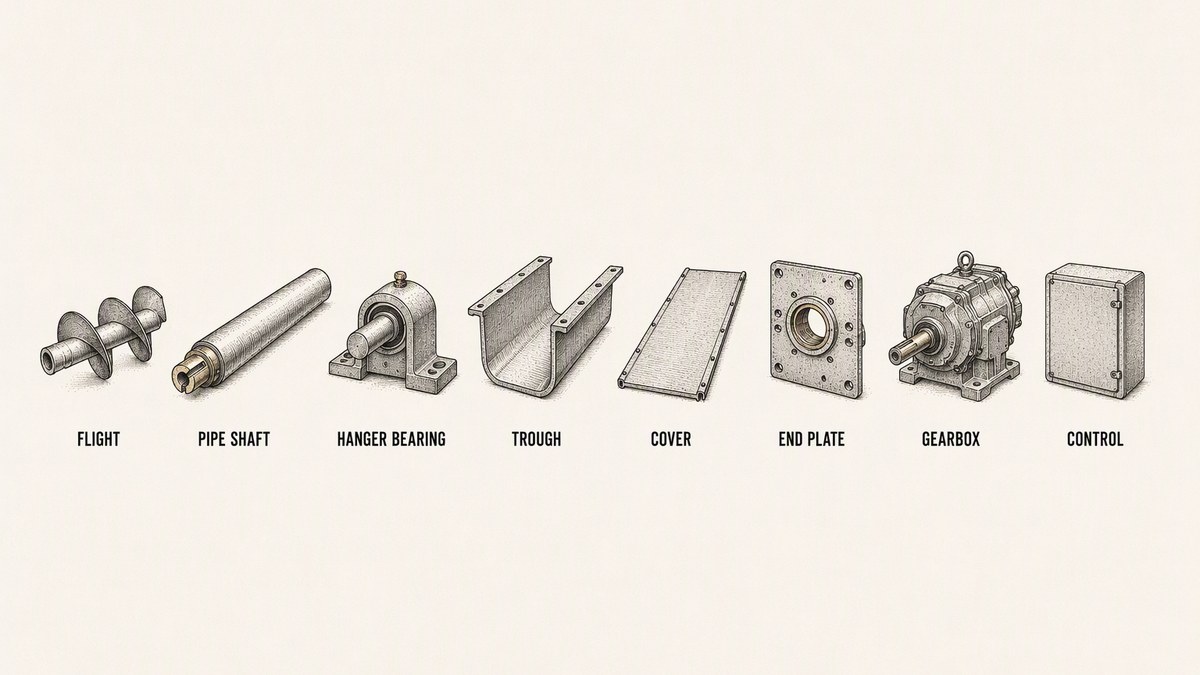
One distinction belongs at the start, because it changes what you are buying. A rigid screw conveyor is the machine described above: a steel trough, a steel screw on a pipe shaft, supported by bearings, and built in a workshop to a drawing. A flexible screw conveyor is a different product that shares the same principle: a close-wound spiral inside a flexible tube, usually fed from a hopper through an angled or curved path, with no hanger bearings at all. The flexible version cannot run as full or as far, and it is normally chosen for smaller rates and for routing material through a path a rigid trough could not follow. They are sold by different factories, and a quotation that does not say which one you are being offered has not told you what you are buying.
Capacity Is Not a Diameter
Here is the sentence worth taking from this article: a screw conveyor does not have a capacity. It has a capacity at a stated pitch, at a stated speed, at a stated loading, with a stated material.
Follow the volume through one turn of the screw. The flight sweeps the trough cross-section, so the space between two consecutive flights is a slice of the trough. That slice advances one pitch per turn. If the trough were completely full, the volume moved per turn would be the slice volume; because a screw conveyor is never run completely full, the real figure is that volume multiplied by a loading fraction. Then multiply by the speed and the arithmetic is done. Three consequences fall out of that, and each one has cost a buyer money.
Diameter alone tells you almost nothing. Doubling the diameter does not double the capacity, because the trough area grows with the square of the diameter while the pitch grows in step, and because a larger screw is normally run more slowly to keep the same flight-edge speed. The practical result is that a small screw turning fast and a large screw turning slowly can be much closer in throughput than their diameters suggest, and the choice between them is decided by the material rather than by the rate.
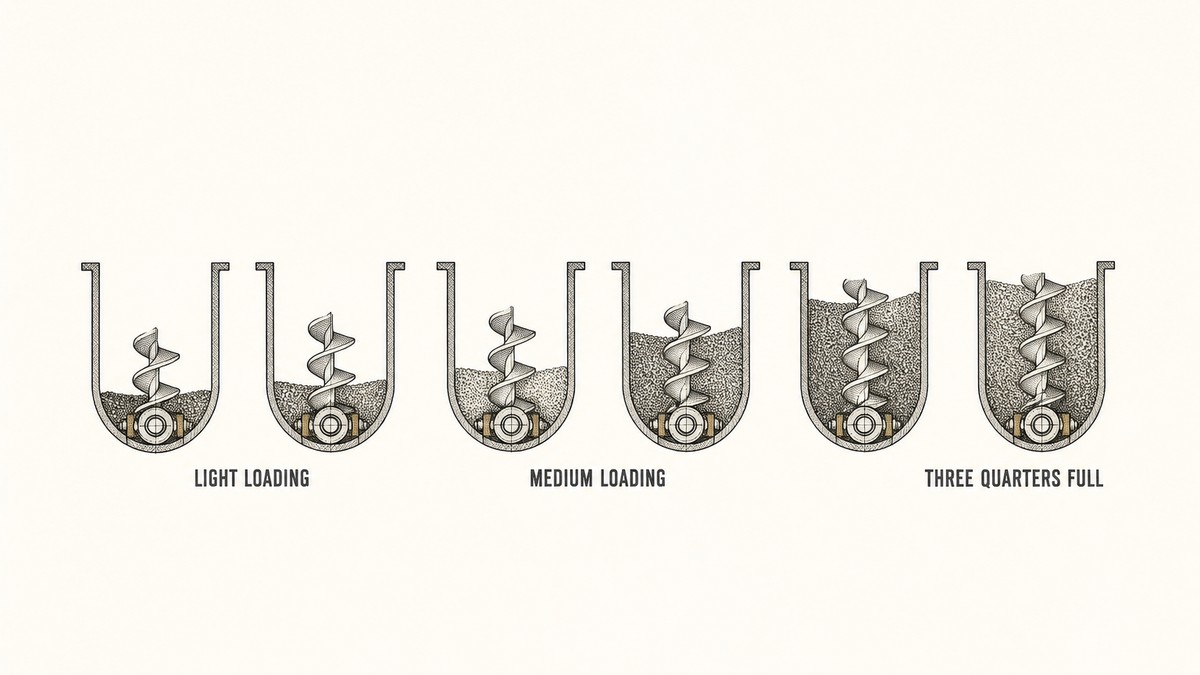
The loading fraction is set by the material, not by ambition. Running a trough fuller is the cheapest way to raise capacity, so it is always tempting. What stops it is the material itself. A fine, dry, free-flowing powder can be run at a high loading because it behaves like a liquid and finds its own level. A lumpy material cannot, because the lumps have to be able to move past each other without bridging. A sticky or damp material cannot, because it climbs the flight and packs. An abrasive material is normally run at a lower loading and a slower speed, not for its own sake but to keep the material from being thrown hard against the trough wall. Every one of those is a property of the material, so the material is the specification.
Inclination costs you twice. Angling a screw conveyor upwards is common and reasonable, but it does two things at once. Material falls back down the incline, so the effective throughput drops at a rate that grows quickly with the angle, and the power needed rises because the machine is now lifting as well as pushing. A conveyor that was comfortably inside its capacity when horizontal can be well outside it at even a modest angle, and a quotation that gives one capacity figure without stating the angle has given you a figure that applies to a machine you are not installing.
There is a fourth consequence that is less about arithmetic and more about why machines fail early, and it is worth putting in the same breath as the capacity. A screw conveyor is usually run at a fraction of what the screw could physically displace, and the reason is wear rather than capacity. The flight edge runs close to the trough floor with a small gap, and material in that gap is ground between two steel surfaces on every turn. Run the machine harder or fuller and you do not only stress the drive; you accelerate the grinding. That is why the honest answer to “can we get more out of it?” is usually “not for long”, and why a buyer who needs more throughput is generally better advised to buy a larger machine than to run a smaller one harder.
The Screw Itself: Helicoid, Sectional, and Where the Wear Goes
The flight is the part that touches everything, so it is the part that wears, and how it is made decides how it wears.
There are two ways to build a screw, and they behave differently in service. A helicoid flight is formed as one continuous spiral, made by taking flat strip steel and cold-rolling it into the helix, with the inner edge stretched and the outer edge compressed. It has no joints along its length, so it presents a smooth face to the material and nothing to catch on. It is the normal choice for general conveying, and it is the reason a screw conveyor looks like one continuous piece of steel.
A sectional flight is built up from separate flat segments, each cut to shape and welded to the pipe at intervals around the circumference. It is more work to make and it looks less elegant, but it can be produced in thicker material and in shapes that a rolling process cannot manage, and it is the usual choice for heavy abrasive duty and for large diameters. Its characteristic weakness is that it has joints, and joints are where a crack starts.
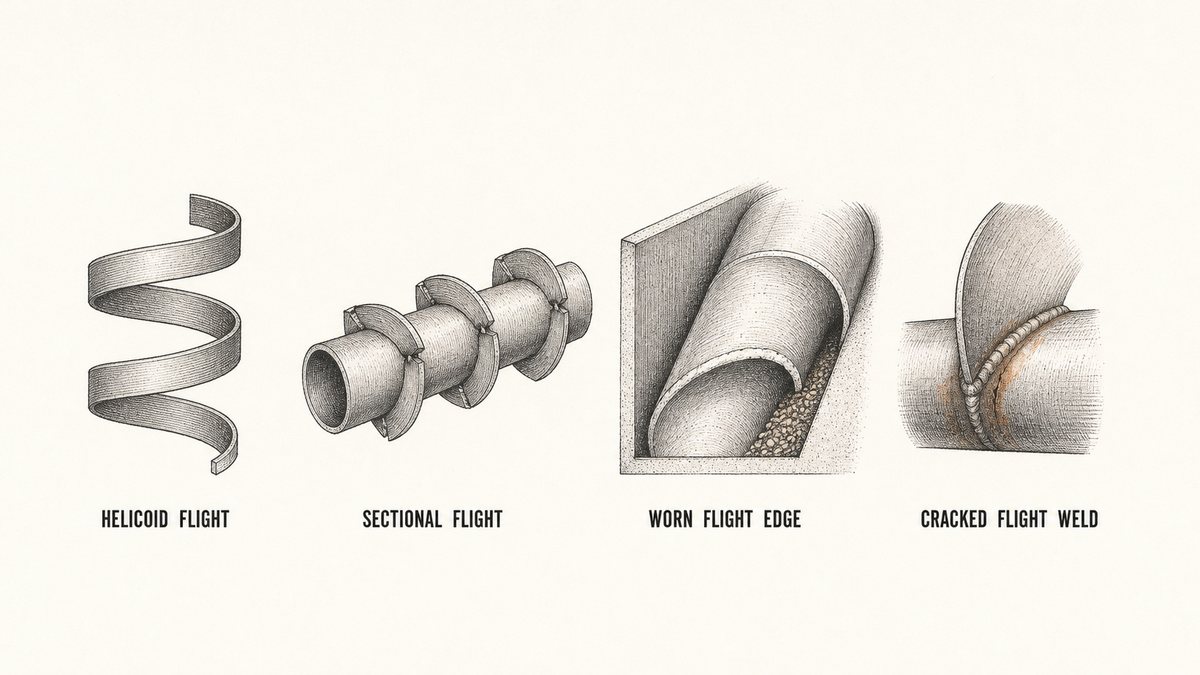
Now the wear, because it is predictable and it is where the money goes. Three places on a screw conveyor wear faster than the rest, and all three are places where material is trapped between two surfaces.
The first is the outer edge of the flight. It runs close to the trough floor, and whatever sits in that gap is crushed on every turn. The edge rounds off, the gap opens, and a wider gap holds more material, which wears the edge faster still. This is why a hard-faced or thicker flight edge is offered on abrasive duty, and it is also why the clearance between flight and trough is a number worth having on the drawing rather than a matter of what the workshop happens to do.
The second is the trough floor directly under the flight edge. The same trapped material is grinding against the trough as well as the flight, and over time it wears a groove, then a channel, and eventually a hole. A trough worn through is not just a conveying problem; it is a housekeeping problem and a dust problem, and it is usually discovered when material starts appearing on the floor beneath a machine that was working perfectly well the day before.
The third is the weld where the flight meets the pipe shaft. The flight is carrying a load that changes direction every turn, and the joint between flight and shaft sees all of it. A crack at the root of that weld is the classic fatigue failure on a screw conveyor, and like most fatigue cracks it grows quietly. It is found by looking at the flight where it joins the shaft, particularly on the compression side of a section, and it is the reason a sectional screw deserves a closer look at its joints than a helicoid one does.
One more choice belongs here because it decides what happens when wear finally wins. A screw can be supplied with the flights hard-faced or with renewable flight tips, or the whole screw can be a wear item that is replaced as a unit. Neither is wrong, and the answer depends on the material and on how quickly the replacement can be got. On abrasive duty in a plant that cannot stop, a screw you can rebuild in the workshop is worth more than a screw that lasts longer but cannot be repaired on site — and a supplier who can tell you which of those two they supply has understood the question.
Hanger Bearings: The Interruption in the Middle
A screw cannot be supported only at its ends. Past a certain length it would sag, whip and rub, so it is supported at intervals by hanger bearings — bearing blocks hung from a bracket off the top of the trough, with the screw passing through them. They are necessary, and they are the source of most of the trouble on a long run.
The reason is geometry. A hanger bearing sits in the middle of the material path, so the flights have to be interrupted where it passes. At each one there is a gap in the flight, a solid obstruction in the flow, and a bearing housing that material can pile up against. The screw no longer looks like an unbroken spiral, because it is not one: it is a series of screw sections joined at the hangers, and each joint is a place where the material has to make its way past something that is not moving.
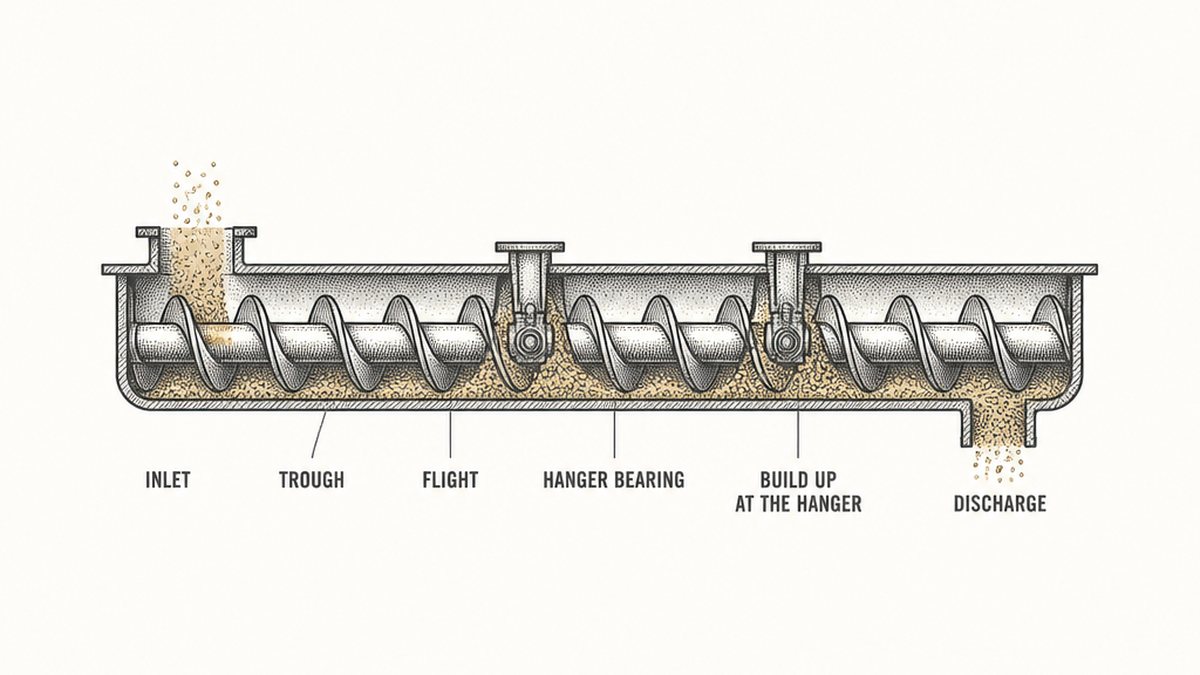
Four things follow, and the first three can be settled on the drawing.
The spacing is a design decision, not a workshop habit. Hangers have to be close enough together to keep the screw from sagging, and the spacing that is close enough depends on the diameter of the screw, the material of the shaft and the load it carries. Ask for the hanger spacing on the drawing. A very long spacing is cheaper to build and is a machine that will rub.
Fewer hangers is better, if the shaft can take it. This is the reason large screw conveyors are built with a pipe shaft rather than a solid one: a pipe of the same weight is far stiffer in bending, so the same screw can span further between supports. Every hanger you remove is a gap removed, a place for material to collect removed, and a maintenance item removed. If a factory proposes a long hanger spacing, the right question is what the shaft diameter is, not whether the hangers are unnecessary.
The hanger bearing itself is a consumable in a dirty duty. A hanger bearing sits inside the material, and its seal is doing the hardest job on the machine. On a dusty or abrasive product it will need to be a design that can be lubricated from outside the trough, because a bearing that has to be reached through the material to be greased will not be greased. Ask how the hanger bearings are lubricated and where the grease points are, and be suspicious of an answer that involves lifting a cover.
The fourth consequence is the one that bites in operation rather than in design: the hanger is where a conveyor chokes. Material that is slightly damp, slightly sticky or slightly too coarse for the loading will build up around the first hanger before it builds up anywhere else, because the hanger gives it something to catch on. That build-up reduces the open area, which slows the material, which lets more build up. A machine that is only just good enough for its material will fail at a hanger first, every time. When a customer tells you their conveyor chokes, the useful first question is not what the material weighs but whether the problem starts near the inlet or further down the run.
Trough, Cover and the Rule That Names Turning Flights
This is the section to take to a supplier, because the American rule on conveyors names the screw conveyor in one sentence and the sentence is about the moving part.
The rule is 29 CFR 1926.555, headed Conveyors. It is unusually direct for a rule of its kind, and its general requirements are worth reading as a list of things a conveyor is supposed to have. The paragraph that concerns this product is short:
“Screw conveyors shall be guarded to prevent employee contact with turning flights.”
Read what that sentence does and does not say. It does not require a cover. It requires that the machine be guarded so that a person cannot touch the turning flights, and it names the flights rather than the machine, which is the important part. On a screw conveyor the moving part is also the conveying medium, and it runs the entire length of the machine inside a trough that is open along its whole top unless something closes it. So the trough cover is not weather protection, and it is not there to keep dust in. It is the guard, and it is the only guard there can be, because there is nowhere else to put one.
That reframing has practical consequences for a buyer, and they are all things that can be written into an order.
A cover that can be lifted off will be lifted off. The normal way to inspect a screw conveyor, clear a partial blockage or check a hanger bearing is to take the cover off, and the normal reason it stays off is that putting it back involves lining up a row of bolts. On a machine handling food, or a machine in a plant where a jam is a weekly event, the cover is the part most likely to be missing when somebody is hurt. Bolted covers with a gasket are right for a dusty or hygienic duty; hinged covers with latches and an interlock are right where the machine has to be opened often; and a cover that is in several short sections is easier to handle than one long panel that needs two people. Ask what the cover fixing is, and ask how many people it takes to remove it.
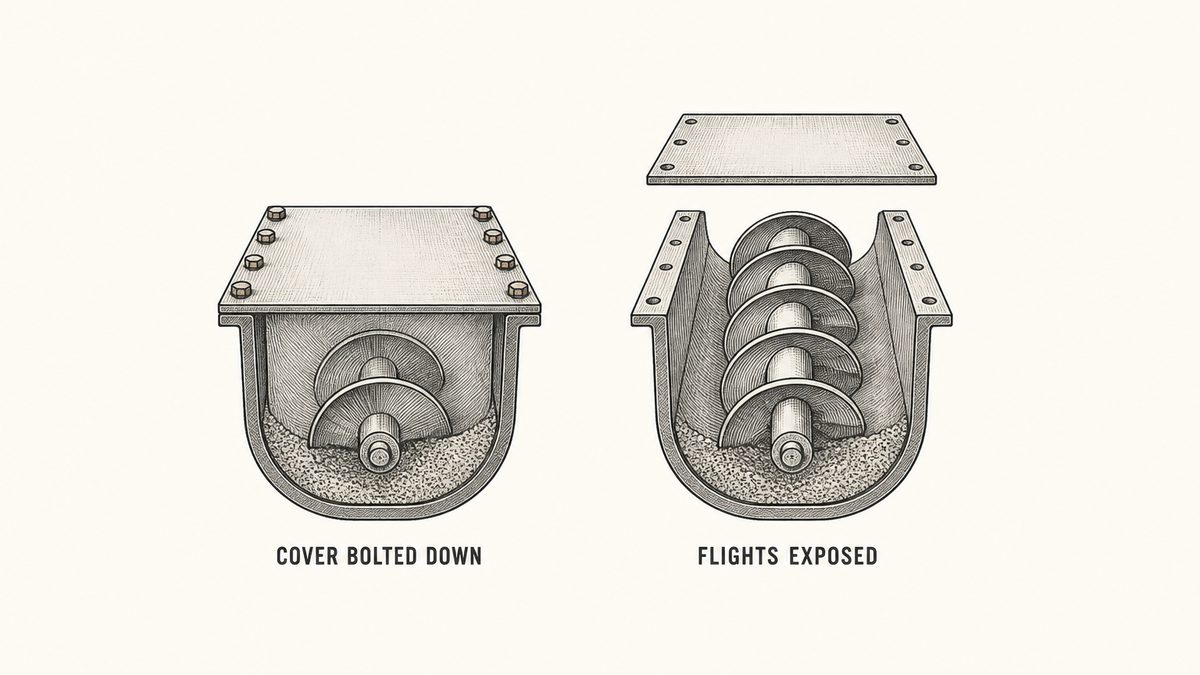
The ends and the openings are part of the same question. A guarded trough with an unguarded inlet is not a guarded machine. Material entering through an open inlet chute can be pushed back up that chute by a blockage, and a person clearing the chute by hand is reaching towards the flights. Inlet and outlet openings need their own guarding, and on a machine fed from a hopper the answer is usually a grate or a grid over the opening, sized so that a hand cannot pass through it. This is the same principle as the trough cover, applied to every other way into the machine, and it is the part that gets forgotten because the trough cover is the visible one. It is also the same duty that the general machine guarding rule puts on every machine in a workplace: protect the operator from the point of operation, from rotating parts and from the places where surfaces close on each other. On a screw conveyor the rotating part runs the whole length of the machine, so the duty runs the whole length of it too.
The trough itself decides whether the cover can do its job. A trough is usually formed from steel into a U, with flanged top edges for the cover to sit on, and the flanges are what make a closing cover practical. A trough without flanges invites a loosely laid plate, and a loosely laid plate is a cover in name only. On abrasive or corrosive duty the trough material and thickness matter as much as the flight does, because the trough floor is the other half of the grinding pair described earlier. Ask for the trough material and thickness, and ask whether the inside is lined or hard-faced where the material runs.
One more thing belongs with the guard, and it is a design point rather than a rule point. Screw conveyors are often installed under a floor, in a trench, or along a wall, and the cover is then the surface a person walks on. That changes what the cover has to be: it becomes a walking surface, which brings its own requirements about strength and about the openings in it. A machine whose cover is also a floor is a machine that must not be opened without the area being made safe first, and the drawing should show that.
The Rest of the Conveyor Rule: Alarms, Stops, Signs and Tags
The same section of the rule carries seven more requirements, and taken together they are the best free specification for a conveyor control system that exists.
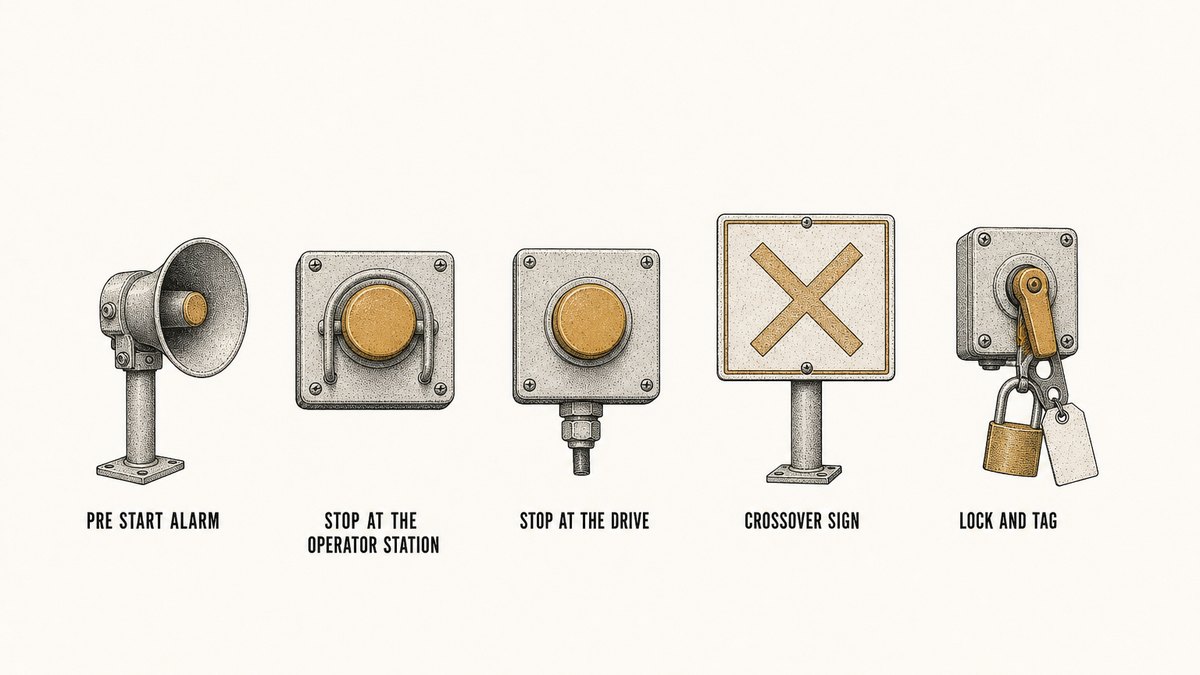
A warning before it starts. The rule requires that conveyor systems be fitted with an audible warning signal that sounds immediately before the conveyor starts. This is not decoration. A screw conveyor is often long, partly enclosed, and started from somewhere the operator cannot see the whole of it, and the alarm is what tells a person who has a hand in an inspection hatch that the machine is about to move. It is also one of the most commonly missing items on an imported machine, because nothing on the conveyor itself stops working without it. Write it into the order, and check on arrival that the alarm is audible from the far end of the run rather than from the control panel.
A stop where the work happens. The rule requires a means of stopping the motor or engine at the operator's station, and it adds that where the operator's station is at a remote point, similar means of stopping must be provided at the motor location as well. Two stop stations, in other words, and the second one is the one buyers leave out. A conveyor can be started at the drive end and inspected at the discharge end, and a person standing at the discharge end needs a stop button they can reach without walking back along a machine that is running.
A stop that stays stopped. The rule requires that emergency stop switches be arranged so that the conveyor cannot be started again until the switch that stopped it has been reset. This is the difference between a latching stop and a momentary button, and it is a design detail on the control panel rather than a machine feature. A momentary button that stops the conveyor while it is pressed is not an emergency stop; it is a pause button. Ask what type the stop buttons are, and ask whether they have to be physically reset, because on a mixed-language quotation the words for the two functions are easy to confuse.
Guarding what passes overhead. Where a conveyor passes over work areas, aisles or walkways, the rule requires suitable guards to protect the people working below. On a screw conveyor this most often means the cover over a section of trough that runs above a walkway, and it is a reminder that the trough floor is not a sealed container: material, and on a worn trough a good deal of fine dust, can come down through it.
Marking the crossings. Crossovers, aisles and passageways have to be marked with suitable signs. A screw conveyor laid across a walkway is a trip hazard and a low-level obstruction, and the sign is the minimum; the better answer is a proper crossover with a step, which is a product you can order with the machine.
Locking and tagging for repairs. The rule is explicit: conveyors shall be locked out or otherwise made inoperable, and tagged out with a Do Not Operate tag, during repairs and when running the machine would be hazardous to the people doing the maintenance. Notice that this requirement is written into the conveyor rule itself, which is unusual and tells you how often it has been the cause of an injury. On a screw conveyor the practical consequence is that clearing a jam is a lockout job, because reaching into the trough to clear a blockage is exactly the situation the sentence describes. The hardware answer is a lockable isolator and a hasp, which is the same conclusion the earlier section reached from the other direction.
The eighth paragraph of the rule is the one that reaches beyond the text, and it is worth knowing about because it is a standard rather than a requirement. It says that conveyors in use must meet the applicable requirements for design, construction, inspection, testing, maintenance and operation as set out in a named consensus standard for conveyors. That standard is published for sale rather than free, and it has been revised many times since the edition named in the rule, so this article does not summarise it and does not quote a figure from it. What a buyer can take from the paragraph without buying anything is the direction: a conveyor is expected to be designed, inspected, tested and maintained to a documented standard, which is the reason the next few sections are about drawings, checks and records rather than about steel.
The Drive End: Gearbox, Thrust and What a Jam Does to It
The drive end of a screw conveyor is where all the force the machine uses arrives, and it is where the machine's own weight works against it.
A screw conveyor pushes material along the trough, and the material pushes back. That reaction travels down the screw and out through the end of the shaft, so the drive end has to carry an axial load as well as turn a shaft. That is why a screw conveyor drive is not simply a gearbox bolted to a shaft: there is a thrust bearing at the drive end sized to take the reaction, and a tail bearing at the other end that holds the far end of the screw in line. Get the thrust arrangement wrong and the gearbox will fail, not because the gearbox is weak but because it is being asked to absorb a force along its axis that it was never meant to take.
The common drive arrangements are a shaft-mounted gearbox, where the gearbox is fitted directly onto the conveyor shaft with a hollow bore and restrained by a torque arm, and a chain or belt drive from a separate motor and reducer. The shaft-mounted arrangement is compact and takes the thrust cleanly, and its one weakness is the torque arm: if the arm is not anchored properly the gearbox will rotate about the shaft under load, which wrecks the seal and the bearings. The chain drive is easier to service and easier to change the speed on, and it adds a guard, an alignment job and a set of wearing parts. Both are legitimate; a quotation should say which one it is, because on a mixed-language data sheet the difference can be one word.
Then there is the jam, which is the event the drive end is really designed around. When a screw conveyor chokes, the material stops moving and the screw stops turning, and the motor keeps trying. What happens next depends entirely on what is in the circuit. With a correctly set protection, the drive stops and nothing is damaged. Without it, three things happen in order: the torque climbs until something slips or breaks; the weakest part in the chain gives way, which is usually the shear pin, the chain, the coupling or a key; and if none of those gives way, the shaft itself can twist or the trough can distort. A screw conveyor that has been stalled repeatedly will show it at the coupling and at the flight welds long before it fails outright.
So the drive specification is where a buyer should spend effort that looks disproportionate and is not. Ask what protects the drive against overload, whether that protection is a shear pin, a torque limiter, a slipping clutch or an electrical device, and where it is set. Ask whether the setting can be changed without opening the machine. And ask whether the protection can be restored without a spare part, because a shear pin that nobody stocks is a machine that stays stopped. The cheapest and most useful answer, on most bulk duties, is a shear pin with a spare taped to the guard, and that is a sentence worth putting on the order.
Jams, Chokes and the Ten Minutes That Hurt People
Everything above describes a machine that is running. This section describes the ten minutes that decide whether it hurts anybody, and it is the part of this article worth reading twice.
A screw conveyor chokes for a small number of reasons, and they are worth knowing because most of them are decided long before the machine is installed. The material may be wetter than the design assumed, so it sticks to the flights and builds up rather than sliding. The feed may be delivering more than the conveyor was sized for, so the trough fills and the material has nowhere to go. A hanger bearing may have collected a build-up, as the earlier section described, narrowing the path. An outlet may be partly blocked, so the machine is being asked to push against a full trough downstream. Or a lump, a foreign object or a piece of failed flight may be wedged between the flight and the trough wall.
What matters is not the cause but the response, and the response on almost every site in the world is the same: somebody switches the conveyor off, opens the cover and puts a hand, a bar or a spade into the trough to clear the blockage. That is the moment the machine has to be locked and tagged, and it is the moment it usually is not, because the person doing it is the person who just switched it off and is standing next to it. The conveyor rule quoted earlier says in plain words that conveyors have to be locked out or otherwise made inoperable and tagged out during repairs and when running would be hazardous to the people doing maintenance. Clearing a jam is both.
Three practical things make the difference between a written procedure and a procedure that is followed, and all three are purchasing decisions rather than training decisions.
A lockable isolator, in reach of the machine. The lockout rule, the control of hazardous energy, is the same one that governs every other machine, and it needs an isolating device that accepts a lock and a hasp. If the only way to isolate the conveyor is a breaker in a panel at the other end of the plant, the procedure will be skipped on the day it matters. Put the isolator where the person clearing the jam is standing.
An inspection opening that does not require reaching into the machine. Where a machine has to be cleared regularly, the design can help. An inspection hatch at each hanger position, a clean-out door at the discharge, or a short removable trough section lets a person see the blockage and work at it from above rather than reaching along the flights. That is a small change to a drawing and a large change to how the job is done.
A way to prove the machine is not going to move. This is the part people find hardest, and it is worth stating plainly because the rule is written for it. Switching a conveyor off at the local stop does not isolate it, and a machine that has been stopped by its own control system can be restarted by whoever resets it. The only thing that makes the machine safe to reach into is that the energy is isolated, locked, and the isolation has been proved by trying to start it and finding that it will not. That sequence belongs in a written procedure for the machine, and a supplier who can provide one for the machine they are selling you has understood their own product.
The Material Decides More Than the Machine
Ask an experienced bulk-handling engineer what a screw conveyor will do and the first question back is not about the machine. It is about the material, and that is not a habit. It is the design method.
Seven properties of the material decide the machine, and a buyer who can supply them removes most of the risk from the order.
- Bulk density
- How heavy the material is per cubic metre in the state it will actually be conveyed, not in the state it arrives. This is what converts the volume the screw displaces into the tonnage per hour that a customer asked for, and it is the figure most often taken from a specification sheet rather than measured.
- Abrasiveness
- How hard the material is on steel. It decides the flight material and thickness, whether the flights are hard-faced, the trough thickness and any lining, and the speed the screw is allowed to run at. On an abrasive product the answer is nearly always a slower screw in thicker steel, which is a bigger machine for the same rate.
- Particle size and shape
- The largest lump has to be able to travel the machine, including past every hanger bearing. Sharp, angular material wears differently from rounded material and behaves differently when it packs. A lump that is a large fraction of the trough height will bridge, and no amount of drive power will move it.
- Flow behaviour
- How the material behaves when it is poured, heaped and pushed. A free-flowing material finds its own level and can be run at a high loading; a cohesive one climbs the flights and packs; a material that aerates easily will flood out of an opening the moment it is disturbed. This is the property that sets the loading fraction, and therefore the capacity, more than any other.
- Moisture
- The most common single cause of trouble on a screw conveyor. A material that is dry and free-flowing when it was tested can be sticky and bridging a month later, and the change is usually seasonal, upstream in the process, or a consequence of a change in the product. A design that has no margin for a wetter material is a design that will choke.
- Temperature
- How hot or cold the material is when it arrives. Hot material expands the screw and the trough by different amounts, which changes clearances; very cold material can freeze to the flights in a cold store or an outdoor installation.
- Corrosiveness
- Whether the material attacks steel, and whether it does so only when wet. This decides the material of construction and the coating, and on food and chemical duty it decides whether the machine can be cleaned and whether the surfaces that touch the product have to be a particular grade.
The practical conclusion is short and it is the one piece of advice worth carrying away from this section. Send the material specification, and where the material is unusual, send a sample. A factory that designs screw conveyors with nothing but a material name is guessing at seven properties, and when a machine underperforms, nobody can say which of the seven the guess got wrong. A factory that asks for a bulk density, a particle size, a moisture figure and a note on abrasiveness is doing the job, and the questions themselves are the evidence.
There is a second half to this that buyers find uncomfortable, and it is worth saying out loud. The material can change after the machine is installed, and it usually does. A supplier changes a formulation, a dryer runs slightly differently, a new batch of raw material arrives wetter than the last. The machine does not know, and the first symptom is a conveyor that suddenly chokes. The reason to keep the material data with the machine's drawings is not paperwork: it is so that when the material changes, somebody can compare what the machine was designed for with what it is now being asked to carry, and that comparison is only possible if the original assumptions were written down.
Layout: Inlets, Outlets, Transfers and the Space You Forgot
A screw conveyor is a simple machine with a long list of ways to be installed badly, and almost all of them are decided by the layout rather than by the conveyor.
The most important one is the feed. A screw conveyor is a volumetric device: it moves a roughly fixed volume per turn, so it will happily be overloaded if material is allowed to pour in faster than the screw can carry it away. A conveyor fed from a bin with a gate wide open, or placed directly under a hopper outlet that was designed for a different machine, will run full, stall, and be described as a bad conveyor when it was a bad feed. The correct arrangement is a controlled feeder upstream that delivers the design rate, and the honest way to buy both is to specify them together. If the conveyor is being fed by something the buyer already owns, give the factory that machine's output rate and its variability, because a feeder that delivers twice its stated rate at start-up is a common cause of a choked conveyor.
Inlets and outlets come next, and they are worth drawing rather than describing. An inlet can be at the end, in the top of the first section, or somewhere along the run, and the position changes the amount of the machine that is doing useful work. An outlet can be at the far end or through the floor at any point, and a bottom outlet near the end is common because it lets a single screw serve as both a conveyor and a distributor when fitted with a gate. What matters is that the openings are big enough not to restrict the flow and that they have a controlled way of being opened, because an outlet that can be partly closed is a way of raising the level of material in the trough — useful when done deliberately, and a cause of blockage when done by accident.
Then there is the part of the layout that gets forgotten until the machine is on site: access. A screw conveyor needs room for three things that are not obvious on a plan. The cover has to be lifted or slid off, which means clear space above and to one side. The drive has to be got off, which means more space than the gearbox occupies, because a gearbox comes off along the shaft. And the hanger bearings have to be reached for greasing and eventual replacement, which means access at points distributed along the whole run. A conveyor installed with its drive against a wall, or under a pipe rack with no room to lift a cover, is a machine whose maintenance will be done badly for the rest of its life. It costs nothing to check this on the drawing.
Two more layout items belong on the list, and both are common enough to be worth stating. A conveyor in a trench or pit will collect water, wash-down and spillage unless the pit is drained and the machine is raised or supported clear of the floor, and a machine standing in water will rust from the bottom up. And a long, hot or cold run will change length between installation and operation, which on a machine fixed rigidly at both ends puts a load into the trough and the bearings. Ask how the machine is supported, whether one end is free to move, and where the fixing points are, because those are the questions that separate a general arrangement drawing from a sketch.
Finally, the length. A single screw conveyor run has practical limits, and they are set by the screw rather than by ambition: the longer the unsupported spans between hangers, and the more hangers there are, the more the machine interferes with its own material. Past a certain length the answer is not a longer conveyor but two conveyors in series, or a different type of machine entirely. A factory that tells you a single run is too long for your duty and proposes a transfer is giving you an honest answer, and it is worth noticing, because it is an answer a factory that only sells screw conveyors does not always give.
Reading a Screw Conveyor Supplier's Data Sheet
Most screw conveyor listings give a diameter, a length, a material and a price. Ten lines turn that into a machine you can hold somebody to, and every one of them is a figure the factory already has or ought to have.
- The diameter, the pitch and the loading assumed
- Three figures rather than one. The loading is the one that decides what the capacity figure means, and a capacity quoted without it is a figure from a table for a material that may not be yours.
- The speed, and the capacity at that speed
- The working speed, not the maximum the machine could be run at. Speed is chosen from the material and the abrasiveness, so a capacity quoted at a speed the factory would not actually set is not a useful figure.
- The inclination, and the capacity at that angle
- Whether the machine is horizontal, and if not, what the throughput becomes. A single capacity figure with no angle stated describes a horizontal machine, which may not be the one you are installing.
- Flight type, thickness and material
- Helicoid or sectional, the flight thickness, the steel grade, and whether the flights or flight tips are hard-faced. This is the line that decides how long the machine lasts on an abrasive duty.
- Trough material, thickness and the flight clearance
- The trough is the other half of the grinding pair, and the clearance between the flight edge and the trough floor sets how much material is ground between them. Ask for the clearance as a figure.
- The cover, its fixing and its sections
- How the cover is held down, whether it is in one piece or several, whether it carries a gasket, and whether it has an interlock where the machine is opened often. This is the guard, so the fixing is a safety specification.
- Hanger spacing, hanger type and lubrication
- How far apart the hangers are, what kind of bearing they carry, and how they are greased or otherwise maintained from outside the trough. On a dusty duty the last of those decides whether they survive.
- Shaft, couplings, thrust and tail bearings
- The shaft type and diameter, how the screw sections are joined, and what takes the axial thrust at the drive end and holds the tail end in line. The thrust arrangement is what stops the gearbox being asked to do a job it was not built for.
- Drive, gearbox rating and overload protection
- The drive arrangement, the gearbox rating, and what protects the machine against a jam, where that protection is set and whether it can be restored without a spare part.
- Safety hardware and the written procedure
- The pre-start alarm, the stop stations and whether the stops latch, the guarding of every opening, the isolator and whether it accepts a lock, and whether the factory will supply a written procedure for clearing a blockage on its own machine.
Add the drawings and the assumptions and the list is complete: a general arrangement showing the machine in its layout, cross-sections showing the trough and the hanger positions, a drive drawing, and a written statement of the material properties the design was based on. Send all of it to two or three factories as a written request rather than asking for a price against a diameter, and the replies sort themselves. A factory that makes screw conveyors will answer the pitch, the hanger spacing and the flight clearance from its own drawings, because those are the figures it designs with. A trader will answer the diameter, the length and the price and pass the rest upstream.That is a perfectly good answer when it is given openly, and it is the same test that separates a maker from a reseller on any industrial product: ask how the flight is formed and who forms it, because a trading company cannot describe the tooling.
One habit makes the whole conversation shorter, and it is worth the small effort. Send the material properties in a fixed format — bulk density, largest particle size, moisture, temperature, abrasiveness in plain words, and whether the material is food contact — and ask for the capacity figure back with the loading and the inclination it assumes. A factory that receives a request in that shape usually answers in the same shape, and the two quotations that come back can then be compared line by line instead of by which number is larger.
If the machine is being bought to match an existing conveyor elsewhere in the plant, two more items are worth sending, because they cost nothing and prevent a mismatch. The first is the existing machine's actual duty: what it is fed at, how full it runs, and whether anything about it has been a problem. The second is the reason for the replacement or the addition, because a machine bought to solve a choking problem should not be specified from the same assumptions that produced the choking. A factory that asks why is doing engineering; a factory that only asks what is quoting. Our note on writing a specification sheet a Chinese factory can build to covers the same ground for the machine as a whole, and it applies here with the material data added.
What Goes Wrong, and What It Looks Like on Arrival
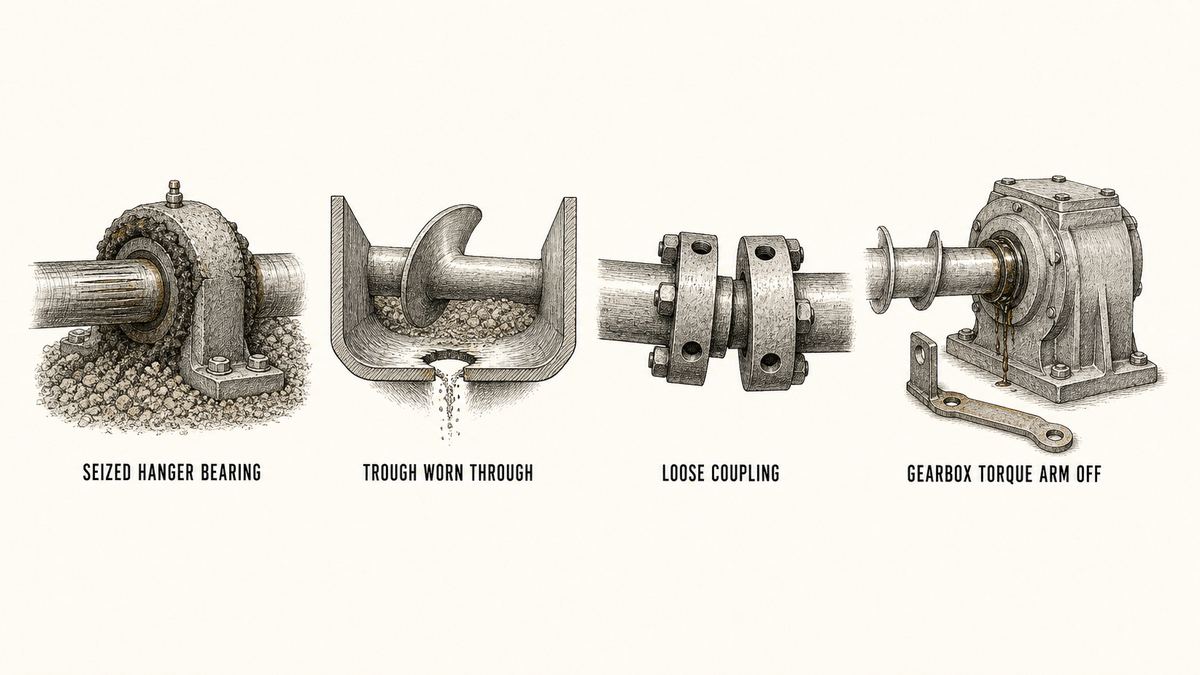
Four faults account for most of the trouble on a screw conveyor, and they divide into the ones the machine arrives with and the ones the first month of running creates.
A seized hanger bearing. The bearing that sits inside the material path is the hardest worked part on the machine, and it fails in a way that is easy to see once the cover comes off: the shaft through it is scored and grooved, hardened material is crusted around the housing, and the bearing no longer turns. Two things cause it. The first is a seal that could not keep the material out, which on a fine dusty product is most seals given enough time. The second, and the more common, is lubrication that was designed to be done from a position nobody can reach, so it was not done. The check on arrival is to turn the screw by hand with the cover off and listen, and to confirm where each grease point is and whether it is reachable from outside the trough. If the answer involves lifting a cover, the design has set the machine up to fail.
A trough worn through. A hole in the trough floor, directly beneath the line the flight edge runs along, with the metal around it thinned and bright and fine material trickling through. This is the end point of the grinding described earlier, and it is the fault that takes longest to happen and is least expected when it does. It is worth knowing three things about it. It appears under the flight edge rather than anywhere else, so it is a line and not a patch. It is much faster on an abrasive material, a wet material or a machine that has been run fuller than it was designed for. And it is repairable, with a patch or a replacement trough section, but the repair has to account for the fact that the rest of the floor is thinner than it started. Check the trough thickness on arrival, and check whether the inside is lined where the material runs.
A loose coupling. The joints between screw sections are bolted, they live inside the trough, and they work loose. On arrival the check is simple: with the cover off, look along each coupling for missing bolts, for bolts that are not tight, and for the two shaft ends being out of line. A coupling that has been allowed to run loose will show fretting and bright wear marks around the bolt holes, and a shaft end that has been moving will show a step where the two halves meet. It is worth checking this before the machine is loaded, because a loose coupling found in place is a lockout job rather than an inspection.
A gearbox torque arm off its anchor. A shaft-mounted gearbox is restrained by a torque arm, and if the arm is not anchored or its anchor has come loose, the gearbox rotates about the shaft under load. The visible symptoms are a weep of oil at the output seal, because the seal is being asked to accommodate movement it was not designed for, and a torque arm that is plainly hanging free. It is a fault that arrives with the machine more often than it develops in service, because the arm is easy to leave unbolted during installation and the machine will run for a while without it. Look at the anchor on arrival and confirm it is fixed to something solid rather than to a thin panel.
What a visual check cannot catch is the half of the problem that was decided before the steel was cut, and on this product that half is larger than on most. Nobody can see, by looking at a finished conveyor, whether the capacity figure was quoted at a loading that suits the material; whether the design was based on a measured bulk density or on a name; whether the flight clearance and the hanger spacing came from a drawing or from habit; whether the pre-start alarm can be heard at the far end of the run; whether the stop buttons latch or merely pause; or whether the cover fixing is one that a person will bother to refit. Those are settled by reading rather than by looking, and on a first order they are worth writing into a specification and checking against the first machine before the rest of the batch is built.That is the routine a new screw needs before the batch is built, and on a machine with this many internal parts it pays back faster than on most.The other half of a bulk handling line is the belt that takes the material on from here, and the two are usually specified together: one machine moves the material, the other decides how it arrives on the belt.
How the Price Is Built, and How to Check the Supplier Behind It
A screw conveyor has ten cost lines and a quotation shows one of them, which is usually a price per metre. Knowing the other nine is what makes two offers comparable instead of merely different.
- The screw
- The flight type, the flight thickness, the steel grade, whether the flights are hard-faced, the shaft type and diameter, and the work of forming or welding the flights onto the shaft. On an abrasive duty this line is the difference between two machines that look identical in a photograph.
- The trough
- Material, thickness, how it is formed and how the flanges are attached, plus any lining or hard facing on the floor where the material runs. A thin trough is a machine with a dated life.
- The cover
- The cover material and thickness, its fixing method, how many sections it comes in, any gaskets, and any interlock where the machine is opened often. This is the guard, so it is not a place to save money.
- The hanger bearings
- Bearing type, seal type, how many there are, and how they are lubricated. The count follows from the length and the spacing, so a longer machine at the same price has probably been given fewer hangers.
- End plates and bearings
- The drive end plate, the tail end plate, the thrust bearing at the drive end and the tail bearing, all of which have to carry loads the shaft applies to them.
- The drive
- Gearbox, motor, coupling arrangement, torque arm and anchor, and the overload protection with its setting. A cheap drive is cheap because something in that list has been made smaller.
- The controls
- The panel, the pre-start alarm, the stop stations, whether the stops latch, the wiring and the enclosure rating. This is a short list of small items and it is the list that most affects whether anybody gets hurt.
- Fabrication and welding
- The labour content: forming or welding the flights, building the trough, aligning the sections, and checking that the screw turns freely in the trough before it is painted. A screw that rubs will be felt by hand long before it is heard by ear.
- Finishing
- Surface preparation and the coating system, inside and outside, and on food or chemical duty the grade of finish and whether it can be cleaned. The internal finish is the one that matters and the one that is hardest to inspect after the machine is closed.
- Packing and freight
- A screw conveyor is long, awkward and light for its volume, so you are buying space and handling rather than weight. Packing decides whether the trough arrives straight, and a long machine is often shipped in sections for exactly that reason.
Two of those lines are worth more attention than the rest when comparing offers, and neither is the one with the biggest number attached. The first is the flight and the trough together, because they are the two surfaces that wear and they are decided by a material specification that a buyer can check. The second is the controls and the guarding, because they are a small part of the price and the whole of the safety case, and because they are the part most easily dropped from a quotation that has been made to a price.
Minimum order quantity on this product follows the drawing rather than the factory's appetite. A standard machine in a standard diameter and length is often made in small numbers, because the flight-forming and trough-forming work is the same whatever the quantity. A non-standard pitch, a different trough depth, a specific hanger spacing, an unusual material of construction or a machine built to fit an existing layout means new drawings and new fixtures, so the first order carries that work and the quantity follows. Because the machine is long, a single unit is already an awkward shipment, so work the packing method out early rather than discovering that the trough has been shipped in one piece that will not fit on the truck.
Then check the party you are talking to, and on this product four questions do most of the work. Ask who forms or welds the flights, and on what machine, because that answer tells you whether the factory owns the tooling or buys screws in. Ask whether they will send a general arrangement drawing and a cross-section before you order, because a factory that designs screw conveyors has both. Ask whether the capacity figure comes with a loading and an inclination, and whether they want the material data before they quote. And ask whether they will write a procedure for clearing a blockage on the machine they are selling, naming the isolator and the sequence, because that is a document only a factory that has thought about the person servicing the machine can produce.If the certificates matter to your own process, the issuer's database is where one is tested.When the first machine is ready, have the assembled conveyor checked against the ten lines you wrote before it ships, and take the number of conveyors to open from the sampling table. On a conveyor the check that pays is dimensional plus one functional: the trough and flight dimensions against the drawing, the hanger spacing, the cover fixing, and the screw turned by hand to confirm it clears the trough for its whole length.
Frequently Asked Questions
How do I work out what size screw conveyor I need?
Start with the material rather than the machine. You need the bulk density, the largest particle size, the moisture content and a plain description of how abrasive and how free-flowing the material is. Those set the loading fraction and the speed, and the loading and the speed together with the pitch are what convert a diameter into a throughput. Then state the rate you need, the length of the run, and whether the machine is horizontal or inclined, because an incline reduces what the machine will carry. A supplier who answers with a capacity figure should also state the loading, the speed and the inclination the figure assumes, otherwise the number describes a different machine from the one you are buying.
What is the difference between a rigid and a flexible screw conveyor?
A rigid screw conveyor is a steel helical flight on a pipe shaft turning inside a rigid steel trough, supported at intervals by hanger bearings, and built to a drawing. A flexible screw conveyor is a close-wound spiral inside a flexible tube, usually fed from a hopper, with no hanger bearings, and it can follow an angled or curved path that a rigid trough could not. The flexible version normally carries a smaller rate over a shorter distance and is chosen for routing rather than for volume. They are different products sold by different factories, so a quotation should say which one is being offered.
Why does my screw conveyor keep choking?
On a machine that has been running, there are five usual answers. The material has become wetter or stickier than the design assumed, so it builds up instead of sliding. The feed is delivering more than the machine was sized for, and the trough is filling because nothing upstream is controlling the rate. A hanger bearing has collected a build-up, which narrows the path and slows the material. An outlet is partly blocked, so the machine is pushing against a full trough downstream. Or a lump or a foreign object is wedged between the flight and the trough wall. The useful first question is where the problem starts, because a build-up near the inlet points at the feed and a build-up further along points at a hanger.
Does a screw conveyor need a cover over the trough?
The requirement is about guarding rather than about covers. The American conveyor rule says that screw conveyors have to be guarded to prevent employee contact with turning flights, and on a screw conveyor the moving part runs the whole length of an open trough. So the trough cover is the guard rather than weather protection, and it is the only place a guard can go. That makes the fixing a safety specification rather than a convenience: a cover held by a row of bolts will be left off after the third blockage, and the openings at the inlet, the outlet and any inspection hatch need guarding of their own, because a guarded trough with an unguarded inlet is not a guarded machine.
What should warn people before a screw conveyor starts?
The American conveyor rule requires conveyor systems to be fitted with an audible warning signal that sounds immediately before the conveyor starts. On a long or partly enclosed screw conveyor that alarm is what tells somebody with a hand in an inspection hatch that the machine is about to move, and it is one of the items most often missing on an imported machine because nothing about the conveyor stops working without it. The same section of the rule requires a means of stopping the motor at the operator's station and a second one at the drive if the operator's station is at a remote point, and it requires that an emergency stop be arranged so that the conveyor cannot be restarted until the stop has been reset. Ask what type the stop buttons are, because a stop that only pauses while it is held is not an emergency stop.
How do I check a screw conveyor supplier who says they are a manufacturer?
Ask four concrete questions. Who forms or welds the flights, and on what machine? Will they send a general arrangement drawing and a cross-section before you order? Does their capacity figure come with the loading and the inclination it assumes, and do they ask for material data before they quote? And will they write a procedure for clearing a blockage on the machine, naming the isolator and the sequence of steps? A factory that makes screw conveyors answers all four from its own records and can send the drawings. A trader answers the diameter, the length and the price and refers the rest upstream, which is a fine answer when it is given openly and a warning when it is not.
Send the material and the rate — not just a diameter
Tell us what the machine has to carry and how fast, then the lines that decide whether it will: the material's bulk density, largest particle size, moisture, temperature and abrasiveness in plain words; the rate you need in tonnes or cubic metres per hour; the run length and the number of screw sections; whether the machine is horizontal or inclined and by roughly how much; the trough material and thickness with the flight clearance; the flight type with its thickness and any hard facing; the hanger spacing and how the hangers are lubricated; the shaft, the couplings and what takes the thrust at the drive end; the drive arrangement with its overload protection and where that protection is set; and the safety hardware — a pre-start alarm, a stop at the operator station, a stop at the drive, latching emergency stops, guarding at every opening, a lockable isolator and a written clearing procedure. If a conveyor is already in service and giving trouble, describe what happens and roughly when: where the blockage starts, whether the problem began after a change of material or weather, whether the trough is weeping dust underneath, whether a hanger bearing has seized, or whether the cover has quietly stopped being refitted. The symptom usually says which line of the specification was decided badly.
Request a Screw Conveyor Sourcing Quote
Questions & Comments
We read every one and reply within 24 hoursSourcing screw conveyors and getting quotations that only say a diameter and a price per metre? Send the material and the rate, then the lines that decide whether the machine will carry them: the material's bulk density, largest particle size, moisture, temperature and a plain note on how abrasive it is; the rate you need per hour; the run length and how many screw sections it takes; whether the machine is horizontal or inclined; the trough material and thickness with the flight clearance; the flight type, thickness and any hard facing; the hanger spacing and how the hangers are lubricated; the shaft, the couplings and what takes the thrust at the drive end; the drive with its overload protection and where that is set; and the safety hardware — a pre-start alarm, a stop at the operator station, a stop at the drive, latching emergency stops, guarding at every opening, a lockable isolator and a written clearing procedure. If a conveyor is already running and giving trouble, describe what happens and roughly when: where a blockage starts, whether it began after a change of material or a change in the weather, whether the trough is weeping dust underneath, whether a hanger bearing has seized, or whether the cover stopped being refitted some months ago. The symptom usually says which line of the specification was decided badly.