
NRE Fee From a Chinese Factory: What You Pay For and Who Owns It
 ·
Updated October 24, 2026
·
13 min read
An NRE fee is a one-time payment for engineering work, and it is not repeated on each unit. It is not a deposit, and it is not tooling. The fee pays for the hours that turn your idea into a file a factory can build from. Two things decide whether the number is fair: what the fee covers, and who keeps the result. There is a third thing most buyers miss. Under US customs law, a payment like this often counts as part of the goods you import.

The Short Answer
The fee is paid once. It covers work done before production starts. That means engineering hours, drawings, a trial run, a test fixture, and the program a machine needs. None of that repeats when the next order ships.
Tooling is a different thing. Tooling is the steel that shapes the part: a mould, a die, a jig. You also pay for the steel once. But the steel still exists afterwards, and that is the whole difference.
Many quotes put both into one number. That is where trouble starts. A factory writes 模具费, the usual word for a mould cost. The same line can mean the mould alone. It can also mean the mould plus the trial run plus the engineer's week. Ask for the split before anyone talks about the total.
Here is the short version. An NRE fee buys work. Tooling buys hardware. A sample fee buys one part you can hold. Pay for the one you agreed to, and make sure the quote uses that name.
What the Fee Actually Pays For
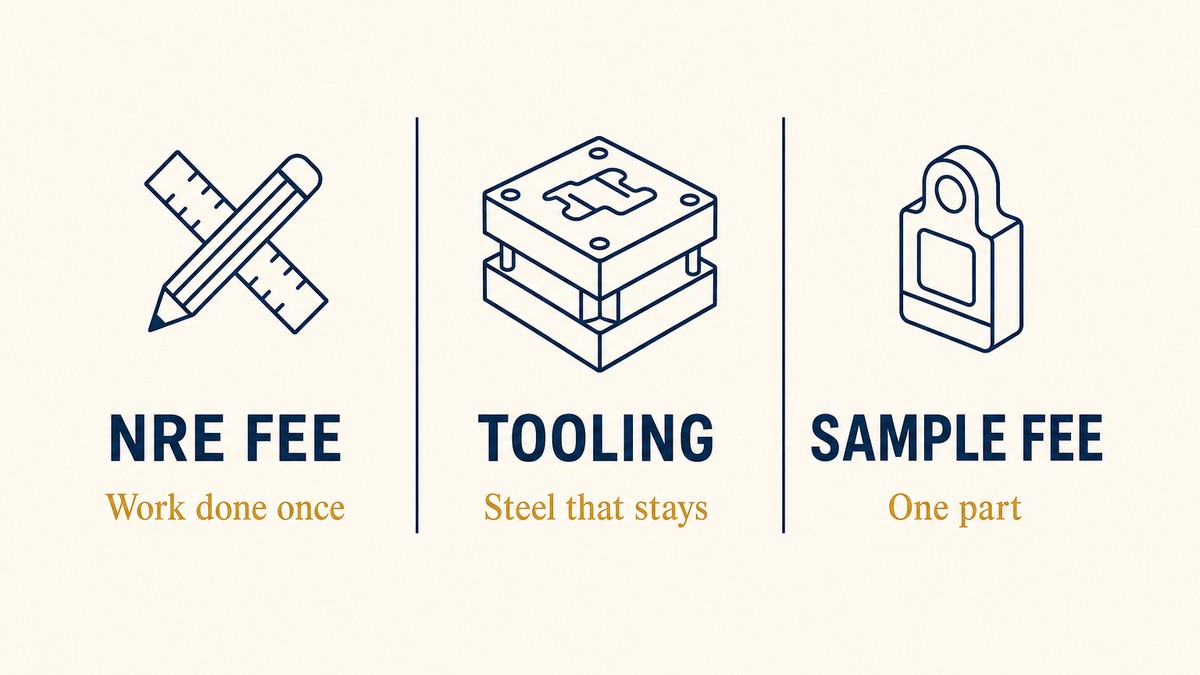
An engineering fee can cover four kinds of work. A good quote names which ones it pays for. A weak quote just gives a number.
- Design work
- Turning a sketch into a drawing with sizes, materials and a finish. This is where a factory earns the fee, because a drawing that cannot be made is worth nothing.
- Trial run
- The first parts off the line, and the time spent setting the machine to make them. Setting up a mould or a programme is not free, and it is not repeated on the second order.
- Fixtures
- Jigs, gauges and test rigs built so the part can be held and checked. These are often kept by the factory, which is fine, as long as you know it.
- Files
- Drawings for a lab test, a materials list, a first-article report. Some factories charge for this, some do not. It should never be a surprise line after the deposit.
None of these four items scales with your order size. That is the test. If a charge grows when you double the quantity, it is not an engineering fee. It is a unit cost with a different name.
One more split matters, and it is easy to get wrong. A fee for design work done by the factory is not the same as a fee for a part you already designed. In the second case you are not buying engineering. You are buying a check on someone else's drawing, and that should cost less.
Why a Factory Asks for It
A factory quoting a custom part carries a risk that a catalogue seller does not. It has to spend hours before it knows if the job is real. Then it has to spend more before it knows if the part can be made at the price quoted. The fee covers that risk.
There is a second reason, and buyers like it less. The fee filters. A factory that spends two days on drawings for a buyer who never orders has lost two days. A fee turns that loss into a small payment. Expect a real factory to ask, especially on a part with tight sizes or a new material.
There is a third reason that is pure cash flow. A small factory may not have the spare engineering time to give away. The fee pays a wage while the work is done. This is normal, and it is not a warning sign by itself.
What separates a fair fee from a bad one is not the amount. It is whether the work described in the quote matches the work you need. A fee for a trial run you did not ask for is not a fee for engineering.
The Part Most Buyers Miss: Customs Value
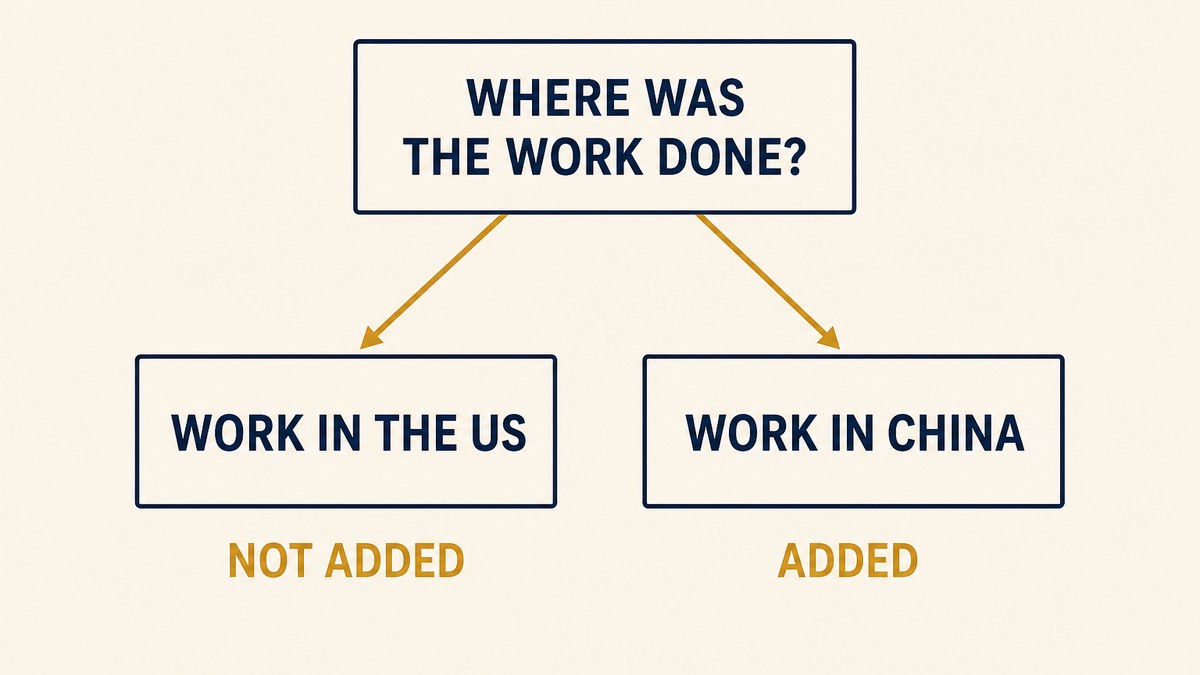
When your goods land in the United States, 19 CFR 152.103 decides what value is declared. That value is not only the price per unit on the invoice. Several amounts are added to it. One of them is the value of an "assist".
An assist is a plain idea with a legal name. It is something you give the factory, free or below cost, so it can make your goods. Under 19 CFR 152.102(a)(1) the list includes materials, tools and dies, and engineering work done outside the United States. A design, a drawing, a programme, a set of plans.
Read those two lists again, because an NRE fee can land in both. Engineering work done in China fits the fourth item. Tooling paid for separately fits the second. Either way, the value goes into the customs value, and duty is paid on it.
| What you paid for | Where the work happened | Usual treatment |
|---|---|---|
| Design work bought from a US firm, then handed to the factory | United States | Not added to customs value |
| Drawings, programming or trial work done by the factory | China | Fits the assist list, so it is added |
| Tooling paid as a separate line, outside the unit price | Abroad | Treated as a tooling assist, so it is added |
| Engineering or tooling already inside the unit price | Either | Not added twice |
The first and third rows are not my reading. They come from the two examples printed under 19 CFR 152.103(d)(2). In the first, a US importer buys designs from a US engineering company and sends them to a foreign producer. The answer given is no: design work done in the United States may not be added. In the second, a US importer gives moulds to a foreign shipper, some made at home and some in a third country. The answer is yes: those moulds must be added.
Put the two side by side and the rule shows itself. What changes the answer is where the work was done, not who signed the cheque. Pay a Shanghai engineer to draw your part and the value was created in China. Pay an Ohio engineer for the same drawing and it was created in the United States.
The fourth row comes from 19 CFR 152.103(b)(2). An amount is added only to the extent that it is not already inside the price you paid. So if the factory rolled the engineering into a higher unit price, there is nothing left to add. That single sentence is why the split in a quote is a customs decision, not a filing habit.
Two more details from the same rule are worth knowing. A mould that has already been used is valued lower, to reflect that use. Repairs or changes to a tool can push the value back up. And a tool you bought second-hand is valued at what you paid, not at what a new one would cost.
None of this means every fee is an assist. Whether a particular payment counts is a customs question, and the answer depends on what changed hands and what the files say. A written opinion from a customs broker costs far less than a correction after the fact. The point for a buyer is simpler. The question exists, and a quote that buries the engineering inside a unit price answers it by accident.
Three Ways to Spread the Fee Over Your Order
The customs value is not a lump you must declare at once. Under 19 CFR 152.103(e)(1) the value of an assist can be shared out over the goods. The split has to be fair, and it has to follow normal accounting practice. When the whole run is going to the United States, the rule names three methods.
| Method | What the first units carry | When it suits you |
|---|---|---|
| All on the first shipment | The whole fee | Small tool, one shipment, or a short programme |
| Spread over units made by the first shipment | A middle share | Factory has already built stock ahead of your order |
| Spread over the whole expected run | The thinnest share | Long programme with a steady monthly pull |
The rule also prints a worked example, and it is worth copying into your own notes. You order 10,000 units. By the time the first 1,000 reach you, the factory has made 4,000. You may ask to spread the fee over 1,000, over 4,000, or over all 10,000. Any of the three is allowed. A different method is allowed too, if it follows normal accounting practice.
The choice does not usually change the total duty. A flat rate times the same total value gives the same number. What it changes is timing, and timing is cash. Spreading over the whole run keeps the first invoices small, which helps when you are still testing the market.
There is a risk in the third method. If you spread over 10,000 units and the programme stops at 3,000, most of the fee was never declared with any shipment. That is a question for your broker before you choose, not after. A short first run and a long plan do not sit well together.
One more limit is in 19 CFR 152.103(c). An amount is only added when there is enough information to fix it. If the fee is real but the files are vague, the value cannot be settled on that basis. Keep the invoice, the payment receipt and the engineering scope in one folder. That folder is what your broker will ask for.
The fee also has to be fixed before the first shipment, not guessed at the end of the year. If you do not yet know the full amount, say so in the file and agree a method with your broker early. That is far easier than rebuilding a value later.
Who Owns the Mould and the Files
Paying for a tool is not the same as owning it. Ownership is decided by what the contract says, and often by nothing at all. In a plain order with no contract, the factory keeps the tool. You paid for it, and it still belongs to the factory. That is normal in this trade, and it is also a trap.
Four things can be owned separately, and buyers usually name only the first one.
- The tool
- The steel itself. Worth less than buyers think, because a mould cut for one press may not fit another factory's machine.
- The drawings
- The files that describe the part. These are worth more than the tool, because any good shop can cut a new tool from good drawings.
- The programme
- Machine code, a laser path, a test routine. Easy to forget, hard to rebuild, and almost never handed over unless asked for.
- The report
- The first-article and test files. Without them, a second factory starts from zero on proving the part meets the standard.
So the useful clause is not "we own the mould". The useful clause is a short list. The tool, the drawings, the programme and the report belong to the buyer. The tool carries the buyer's name. All four are released on request, at the buyer's cost. A factory that agrees to that in writing is telling you something about how it works.
Marking matters more than contracts in daily practice. A mould with your company name stamped into the side is hard to argue about later, and it costs nothing at the time of cutting. Ask for it before the tool is made, because the marking cannot be added afterwards without a second setup.
There is a fair limit here. Owning the drawings does not mean the factory must hand over its process notes, its supplier list or its settings. Those are its own work. The line is simple: what you paid to have created is yours, and what the factory learned while making your part is not.
The clause itself is shorter than most buyers expect. Who owns a mould once the tool is paid for depends on that one paragraph, and on nothing else in the order.
If you plan to use a second source later, the drawings are the item to secure. That is also why a specification sheet the factory can build from is worth more than a photo and a price. It is the only file that lets another shop quote the same part without guessing.
Amortisation, Rebates and the Promise About Volume
Three payment structures are common on a custom part. They look similar on an invoice and behave very differently over a year.
| Structure | What you pay up front | What happens at volume |
|---|---|---|
| One-time fee | The full fee | Nothing. It stays paid |
| Fee waived above a set quantity | The full fee | It comes back as a credit note |
| Fee built into the unit price | Nothing separate | The unit price should drop at the agreed quantity |
The second structure is the one that causes arguments. A factory says the fee is free above 5,000 units. That is a promise about the future, and three details decide whether it means anything. The trigger should be units shipped, not months elapsed. The amount should be the exact figure, not a percentage. And the return should be a credit note against your next order, because cash refunds are rare.
The third structure hides the fee, and it hides the end of it. If the engineering is spread across the unit price, the price should fall once the agreed quantity has been reached. Ask for that quantity in writing at the start. Otherwise a fee for a tool that is already paid off keeps riding on every reorder, and nobody notices for a year.
A fourth pattern is worth naming because it is not a fee at all. Some quotes raise the unit price to cover engineering and then still add a separate charge for samples. That is a double charge, and it is easy to spot once you ask what the sample price includes.
The cleanest habit is to ask one question on every custom quote: is the engineering inside the unit price or outside it? The answer decides how you read every other number on the page, and it decides what your broker will need later.
Five Names for the Same Line
A Chinese quote rarely says NRE. It uses one of a handful of words, and the word is a clue about what is being bought. Ask which one is meant, and ask what it covers.
| Term on the quote | Usually covers | What to check |
|---|---|---|
| 模具费 | The mould or die | Steel size, number of cavities, who keeps it |
| 开模费 | Cutting a new tool from scratch | Whether a cheaper existing tool would do |
| 试模费 | Trial shots and machine setting | How many trials are included |
| 打样费 | A few sample parts | That it does not include the mould |
| 开发费 | Design and engineering hours | The scope, in pages, not in words |
Two of these are routinely confused. 打样费 is a sample fee, and it should buy parts, not steel. 开发费 is a design fee, and it should buy hours and files. When a quote uses 开发费 for something that turns out to include a mould, ask for the two lines to be split. A factory that can split them is a factory that knows its own costs.
The last one is the most useful. If the whole charge is written as NRE in English, the factory is used to foreign buyers and probably has a template for this. That is a good sign. It usually means there will be a drawing to sign, and a drawing is the thing you actually want to review.
One practical note on language. Do not accept a one-word reply to "what does this include". Ask for the scope in the same message as the price. If the answer is a single line, that line is the whole contract, and it will be read in the factory's favour later.
Four Questions to Settle Before You Pay
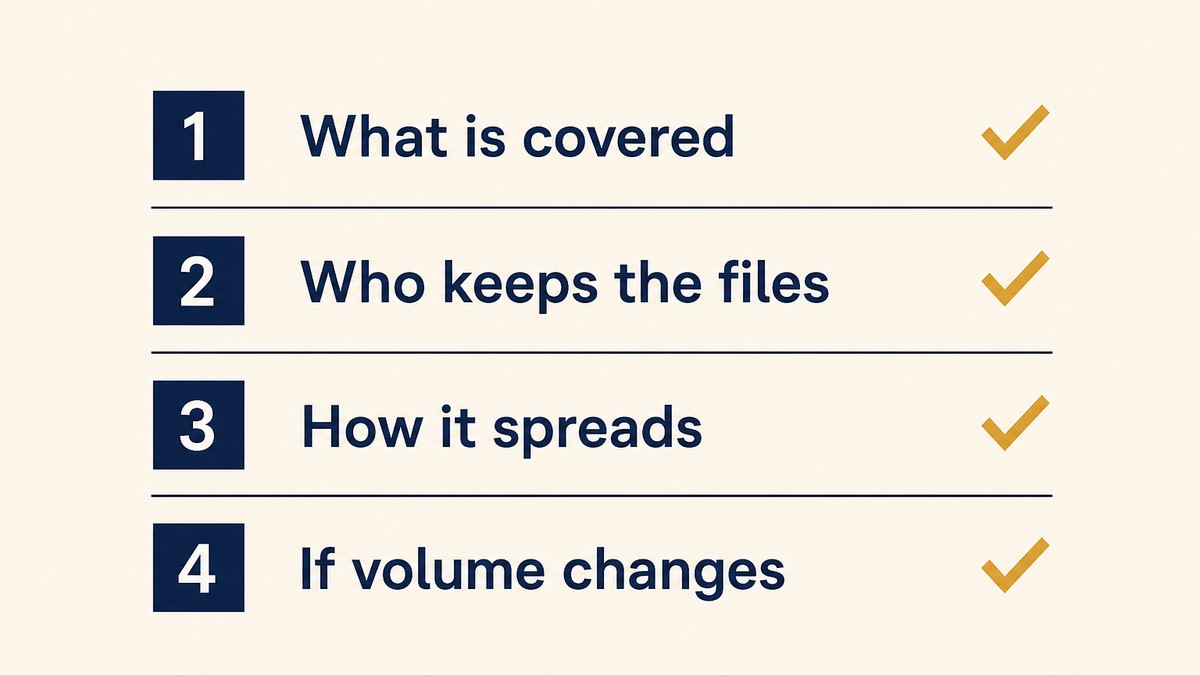
A fee is easy to argue about and hard to check. These four questions turn it into something you can check, and each one has a written answer.
One. What exactly is covered? Ask for a list, not a sentence. Three or four bullet points that name the drawings, the trial run, the sample count and the report. If the list is short, the fee is small and the scope is small. Those two should match.
Two. Who keeps the files? Ask for the tool, the drawings, the programme and the report to be named in the order. Ask for the buyer's name stamped on the tool. This costs nothing at the cutting stage and saves a long argument later. It also decides whether you can get a product manufactured in China at a second plant if the first one disappoints you.
Three. How will the fee be spread? This is the customs question from earlier, and it has a practical form. If the fee is a separate line, agree a spreading method before the first shipment. If it is inside the unit price, get the quantity at which it ends. Both answers belong in the order, not in an email thread.
Four. What if volume changes? Ask what happens if you order half of what you planned, and what happens if you order double. A fair answer changes the unit price, not the scope. A weak answer changes the fee without explaining why.
Those four answers also tell you which kind of order you are placing, because OEM and ODM orders carry different design duties. On an ODM part, the factory already owns the design, and you are paying for a change to it. On an OEM part, the design is yours, and the fee should buy files you keep.
Four Patterns That Should Slow You Down
A fee with no scope is the first. If the line has a number and nothing else, you are paying for an unknown. Ask for the scope, and treat a refusal as an answer.
The second is a fee that grows with the order. Engineering does not get bigger because you ordered more units. If the charge rises with quantity, it is a unit cost, and it belongs in the unit price where you can compare it.
The third is a fee that appears after the deposit. It is usually called a sample charge, a test charge or a packing change. Some of these are real. The test is whether the cost could have been seen at quote stage. If it could, it should have been there.
The fourth is a waiver with no trigger. A promise to refund the fee above a volume is worth exactly what the writing says. If the volume is vague, or the refund is described as "to be discussed", it is not a term. It is a hope.
One last check sits outside the fee itself. The freight line follows the Incoterm you chose, and freight is handled separately from customs value. A quote that mixes the two makes both harder to read, so ask for them on separate lines.
Questions Buyers Ask About NRE Fees
What does NRE stand for?
Non-recurring engineering. The words mean the work happens once and is not repeated per unit. A fee for that work is called an NRE fee, and it covers engineering hours, drawings, trial runs and fixtures. It does not cover materials.
Is an NRE fee refundable?
Only if the order says so. Some factories credit the fee back once a set quantity ships, and some do not. Write the trigger in units, the exact amount, and how the money returns. Without those three, a refund promise cannot be enforced.
Is NRE the same as tooling?
No. Tooling is the steel that shapes the part, and it still exists after the order. An NRE fee buys work that leaves no hardware behind. Quotes often fold both into one line, which is why asking for the split is the first thing to do.
Does an NRE fee change what I pay in duty?
It can. Under 19 CFR 152.102 an engineering payment for work done outside the United States can count as an assist. Assists are added to the customs value. Work done in the United States is treated differently. Ask your broker how your own payment should be declared.
How much should an NRE fee be?
There is no standard figure, and any page that gives one is guessing. The fee reflects engineering hours and how much new work the part needs. Ask for the hours and the rate per hour, then compare that to the scope you were given. A number without hours cannot be judged.
Who owns the mould after I pay for it?
Whoever the order says. In a plain order with no clause, the factory keeps it, even though you paid. Name the tool, the drawings, the programme and the report in the order. Ask for your company name to be stamped on the tool before it is cut.
The Bottom Line
An NRE fee is not a trick. A factory that spends real hours on your part deserves to be paid for them. The problems come from a fee with no scope, a tool with no owner, and a payment that nobody thought about at customs.
So treat the fee as three decisions instead of one number. What work am I buying? Who keeps what comes out of it? And where does the value land when the goods arrive? Answer those before the deposit, and the fee stops being a negotiation and becomes a line you can check.
Read the Fee Before the Deposit
Send us the quote line and the drawing behind it. We read the scope, split engineering from tooling, and tell you who keeps the files. If the fee belongs in your customs value, we say so before the first shipment leaves, not after your broker asks.
Review My NRE Line
Questions & Comments
We read every one and reply within 24 hoursHave you been quoted a fee with no scope behind it? Send the line and the drawing. Tell us what the factory says the fee buys, and whether the tool is yours afterwards. We will tell you what is missing before the deposit.