
Prototype Tooling vs. Production Tooling: Rapid Prototyping Guide for Hardware (2026 Guide)
 ·
Updated October 1, 2026
·
20 min read
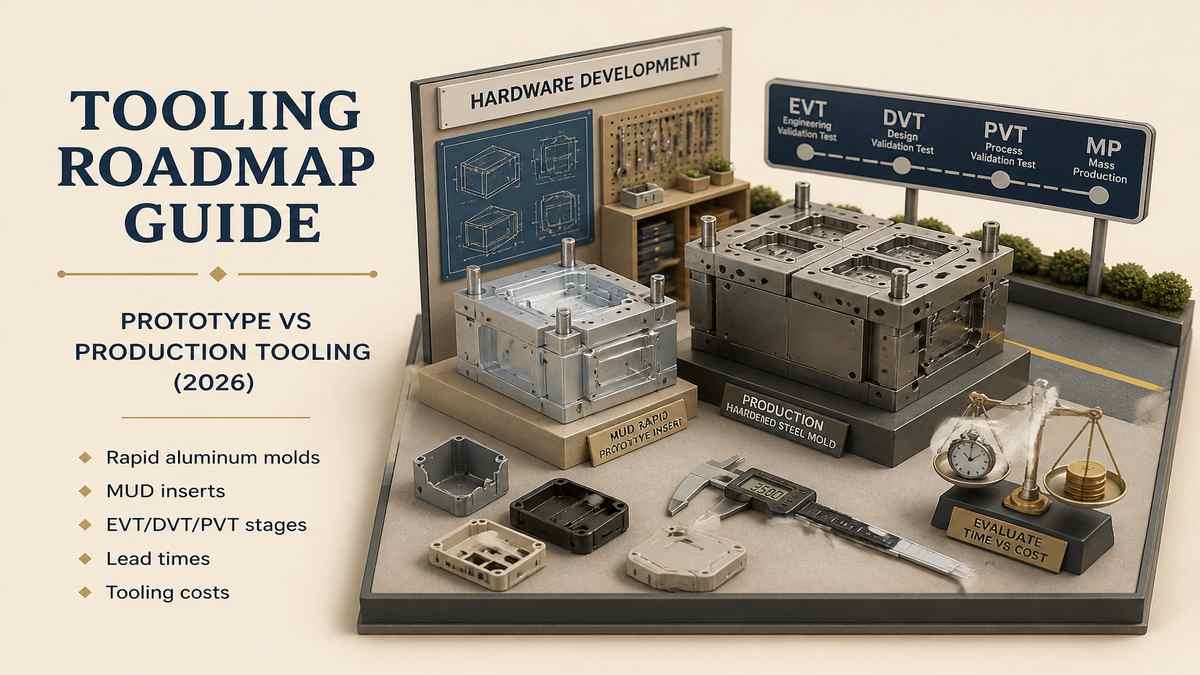
Direct Answer: The fundamental choice between Prototype Tooling (Rapid Soft Tooling) and Production Tooling (Hard Tooling) is a strategic balance between speed, upfront capital risk, and mass manufacturing scalability. In 2026, the 10-second decision rule is simple: (1) Prototype Tooling uses 7075 aircraft-grade aluminum or pre-hardened soft steel (P20/S50C) with Master Unit Die (MUD) interchangeable inserts to produce 500 to 10,000 parts in final production plastics (ABS, PC, Nylon) within 7 to 14 days for $1,500 to $4,500; it is designed for DVT functional testing, regulatory FCC/CE lab checks, and low-cost design iterations; (2) Production Tooling uses fully hardened steel (S136, H13) with multi-cavity automated hot runners to produce 500,000 to 1,000,000+ parts in 35 to 60 days for $12,000 to $50,000+; it is engineered for high-speed continuous output at the lowest possible per-piece price. Skipping prototype tooling and jumping directly to production steel molds is the single biggest cause of bankrupting hardware startups.
In physical product development, 3D printing (SLA/SLS) and CNC machining are wonderful for early aesthetic models, but they cannot replicate the true molecular strength, shrink rates, weld lines, and snap-fit mechanics of injection-molded plastic parts. When a hardware team needs 200 real plastic enclosures for drop testing or Kickstarter deliveries, full production steel tooling is too slow and too expensive.
This is where Rapid Prototype Tooling (Bridge Tooling) bridges the engineering gap. In this comprehensive 2026 guide, we compare prototype vs. production tooling across 7 core manufacturing metrics, map out the hardware development lifecycle (EVT, DVT, PVT, MP), break down the 3 core rapid tooling technologies in Chinese toolrooms, expose the 3 fatal mistakes of skipping prototype molds, and outline a 5-step SOP to take your hardware from CAD concept to container shipping.
Prototype Tooling vs. Production Tooling: Head-to-Head Comparison
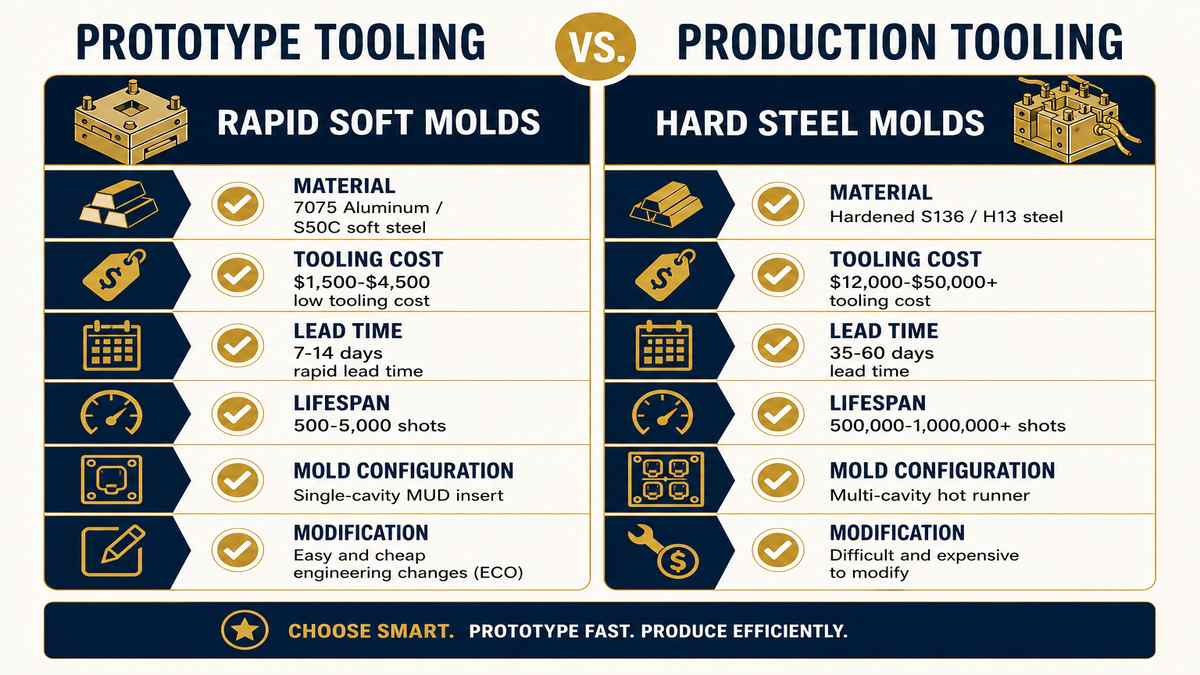
To evaluate these two tooling methodologies side by side, review this comparative manufacturing matrix:
| Evaluation Dimension | 1. Prototype Tooling (Rapid Soft Tooling) | 2. Production Tooling (Hardened Steel Tooling) |
|---|---|---|
| Core & Cavity Metallurgy | 7075 Aluminum / S50C Soft Steel / P20 (HRC 20–32). | Hardened Stainless S136 / H13 / NAK80 (HRC 48–54). |
| Upfront Tooling Investment | Low ($1,500 – $4,500) (20% to 30% of hard tooling). | High ($12,000 – $50,000+). |
| Fabrication Lead Time | Ultra Fast: 7 to 14 Business Days. | Moderate: 35 to 60 Business Days. |
| Rated Mold Shot Lifespan | 500 to 10,000 Shots (SPI Class 104/105). | 500,000 to 1,000,000+ Shots (SPI Class 101/102). |
| Plastic Part Piece Price | Moderate ($1.50 – $4.00/pc due to manual cycle times). | Lowest ($0.30 – $0.90/pc with automated cycles). |
| Engineering Changes (ECO) | Fast & Inexpensive (Aluminum cuts easily; $200–$500). | Difficult & Costly (Requires EDM/Welding; $2,000–$6,000). |
| Gating & Runner Structure | Single-cavity MUD insert with cold runner. | Multi-cavity (4/8/16-cavity) balanced hot runner. |
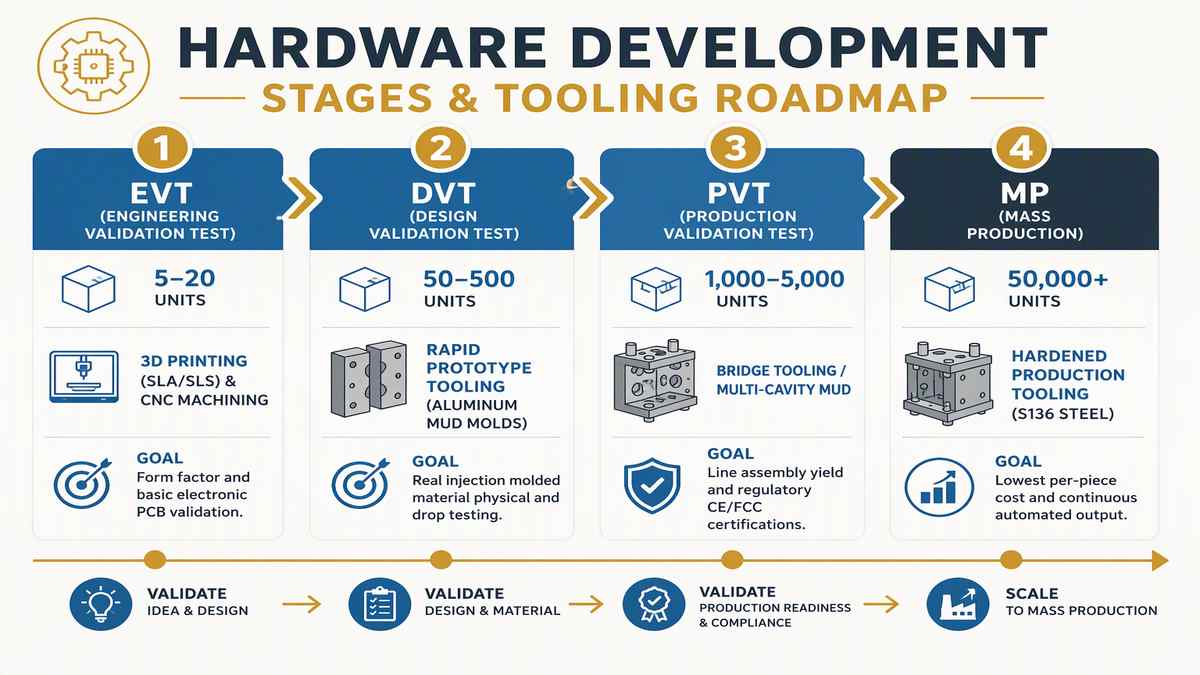
Hardware Development Stages: Mapping Tooling to EVT, DVT, PVT & MP
Professional consumer hardware teams navigate four disciplined engineering validation milestones. Match your tooling strategy to each phase:
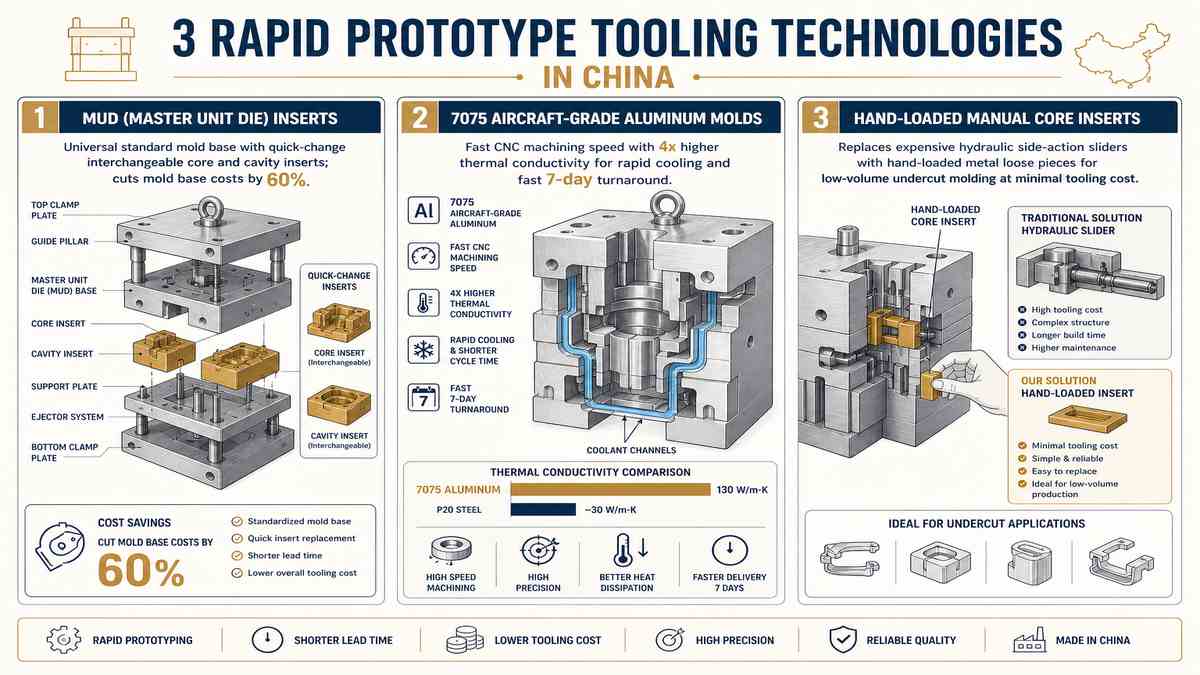
3 Rapid Prototype Tooling Technologies in Chinese Toolrooms
Chinese rapid toolrooms in Shenzhen, Dongguan, and Ningbo use three primary mechanical architectures to deliver prototype injection molds in 7 to 14 days:
ECO Modifications: “Steel-Safe” Design Flexibility
The primary advantage of rapid prototype tooling during DVT testing is the ease of making Engineering Change Orders (ECO):
3 Deadly Mistakes of Skipping Prototype Tooling
Founders often try to save money by jumping directly from 3D CAD to a \$30,000 hardened production steel mold. Here is why that strategy frequently proves fatal:
5-Step SOP for Hardware Tooling: From Rapid Prototype to Mass Production
Follow this disciplined standard operating workflow to de-risk your hardware product development:
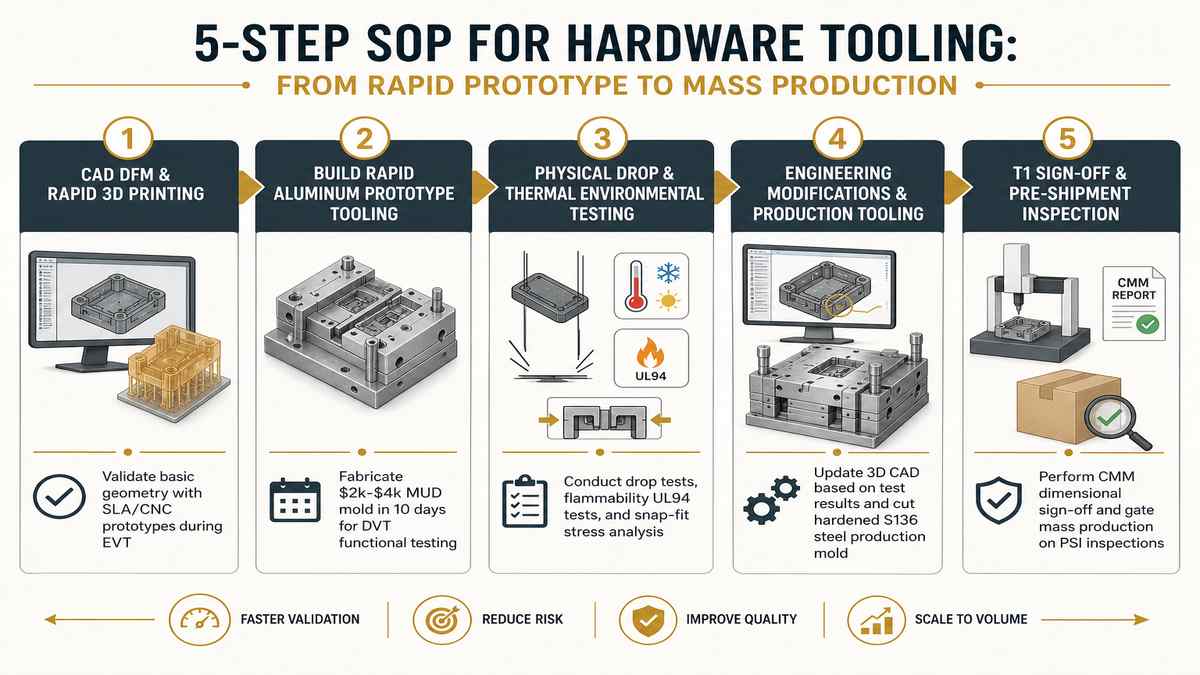
- Execute CAD DFM & Moldflow Simulation: Review draft angles (≥1.5°), enforce uniform wall thickness (2.0–2.5 mm), and analyze gate locations under Plastics Industry Association SPI Mold Standards.
- Build Rapid Aluminum Prototype Tooling for DVT: Commission a \$2,000–\$4,000 MUD rapid aluminum prototype mold to produce 100 to 500 parts in final engineering resin (ABS/PC/PA) within 10 to 14 business days.
- Conduct Physical Drop, Thermal & Regulatory Testing: Subject prototype molded parts to mechanical drop tests, snap-fit stress cycles, thermal chamber baking, and laboratory certification tests under ASTM International Standards.
- Freeze 3D CAD & Cut Hardened Production Steel Tooling: Apply design tweaks to the master CAD model, choose between OEM custom tooling vs ODM private label manufacturing, and cut a multi-cavity hardened S136/NAK80 steel production mold with balanced hot runners.
- Sign Off on FAI Golden Samples & Pre-Shipment Inspection (PSI): Audit the injection facility under ISO 9001 Quality Management Standards using our China factory audit checklist review, sign an enforceable bilingual manufacturing contract under PRC law, execute a formal first article inspection (FAI) sample review, and gate final payments on a passed pre-shipment inspection (PSI) in China.
4 Data Freeze Gates Before Cutting Production Hard Steel
To ensure zero tooling rework, never cut hardened multi-cavity steel molds until your rapid prototype parts pass these four gates:
| Engineering Gate | Validation Method | Pass / Fail Acceptance Standard |
|---|---|---|
| 1. CMM 3D Dimensional Match | Coordinate Measuring Machine scan. | 100% of critical tolerance dimensions match 3D CAD (±0.05 mm). |
| 2. Snap-Fit & Ultrasonic Weld | 100-cycle repeated mechanical engagement. | Zero stress cracking, white stress marks, or latch breakage. |
| 3. Actual Resin Shrink Rate | Caliper measurement of cooled molded parts. | Actual shrinkage matches toolmaker’s CAD scaling factor. |
| 4. Cosmetic Parting Line Sign-off | Industrial designer visual inspection. | Parting line, ejector pin marks, and gate vestige approved. |
Illustrative Scenario: How a Boston Hardware Team Saved \$36,000 with Rapid Tooling
To see how prototype tooling de-risks hardware commercialization, review this medical handheld device case study:
A medical hardware startup in Boston, Massachusetts was developing a handheld ultrasound therapy scanner (Medical-grade PC+TPU enclosure, \$280,000 target production value).
- The High-Risk Temptation: Eager to meet trade show deadlines, the engineering team initially considered skipping rapid tooling and placing an immediate \$36,000 buy order for a hardened 4-cavity dual-shot S136 production mold (8 weeks lead time).
- The Rapid Tooling Intervention: Sourcing Pioneer persuaded the team to first build a \$3,800 rapid aluminum MUD prototype tool (9 days lead time) to mold 150 units in medical PC for DVT drop testing.
- The Critical Flaw Discovered: During the 1.2-meter drop test on concrete, the internal screw boss pillars anchoring the heavy lithium battery cracked. Because the mold was rapid aluminum, Sourcing Pioneer’s toolmakers in Dongguan added structural gussets and thickened the boss walls for only \$350 and 48 hours of CNC re-cutting.
- The Commercial Outcome: The corrected design passed all medical IEC 60601 electrical and drop tests on the second attempt. The team then cut their S136 production mold with 100% confidence, saving \$36,000 in ruined tooling and preventing a 3-month launch delay.
Frequently Asked Questions (FAQ)
What is the difference between prototype tooling and production tooling?
Prototype tooling (rapid soft tooling) uses 7075 aluminum or pre-hardened soft steel (P20/S50C) to produce 500 to 10,000 real plastic parts in 7 to 14 days for $1,500 to $4,500. Production tooling (hard tooling) uses vacuum-hardened steel (S136/H13) with automated multi-cavity hot runners to produce 500,000 to 1,000,000+ parts in 35 to 60 days for $12,000 to $50,000+.
Why shouldn’t hardware startups skip prototype tooling and go straight to production molds?
Skipping prototype tooling risks catastrophic financial loss. If an unvalidated CAD design has snap-fit failures, warpage, or regulatory test issues, modifying a hardened production steel mold costs thousands of dollars and causes months of delay. Prototype tooling allows cheap, rapid engineering design updates in days.
What are MUD mold inserts in rapid tooling?
MUD stands for Master Unit Die. In this rapid tooling system, the toolmaker uses a standard universal mold base frame that stays permanently in the injection press, only machining small, interchangeable core and cavity steel/aluminum inserts, cutting tooling costs by 50% to 60%.
At what stage of hardware development should you use rapid prototype tooling?
Rapid prototype tooling is used primarily during the DVT (Design Validation Test) and PVT (Production Validation Test / Bridge Tooling) stages to produce 50 to 2,000 functional units for mechanical drop testing, regulatory certifications (FCC, CE, UL), and initial market crowdfunding fulfillment.
How fast can Chinese moldmakers build prototype tooling?
Experienced Chinese rapid toolrooms in Shenzhen, Dongguan, and Ningbo typically deliver T1 test sample parts from aluminum prototype molds within 7 to 12 business days following CAD DFM approval.
Validate Hardware Prototypes Fast with Low-Cost Rapid Tooling in China
Our China hardware engineering team conducts DFM moldflow reviews, audits rapid aluminum MUD tooling, supervises DVT drop testing, and transitions your product smoothly into mass production.
Get Free Rapid Tooling Engineering Review
Questions & Comments
We read every one and reply within 24 hoursDeciding between rapid aluminum prototype tooling and hardened production molds, wondering about MUD insert lead times, or need on-site DVT testing in China? Post your hardware and tooling questions below — our on-the-ground manufacturing engineers will guide your prototyping strategy.