
Dropshipping Packaging: How to Brand a Parcel You Never Touch
 ·
Updated October 14, 2026
·
12 min read
Packaging is the one part of the customer experience a store can control completely, and in a dropshipping model it is the one part the store never physically touches. That is the whole problem in a sentence. Custom boxes are quoted per thousand because a printing plate or a die has to be made before the run; a dropshipper sells one unit at a time and has nowhere to put five hundred boxes. This guide is about the five routes through that clash, about the money that packaging quietly moves from the parcel to the freight bill, and about the one thing on your packaging that a regulator reads rather than a customer.
1. The Clash: Sold by the Thousand, Shipped One at a Time
Nearly every problem in this subject comes from one structural opposition. Packaging is a manufactured item sold in runs, and its price is built around setting up a machine. A dropshipping store is a business with no warehouse, no packing bench and no stock. Ask a converter for branded boxes and you will get a quote with a minimum in the hundreds or thousands; ask your supplier to use them and you have to explain where the boxes are.
That opposition is why the advice in this area is so often wrong. The usual suggestion is to buy packaging from a specialist and have it shipped to the supplier, which works only if the supplier agrees, if the quantities line up with their packing runs, and if you are willing to fund a stock of empty boxes that has to travel in both directions before it goes anywhere useful. The rest of this guide takes the routes that avoid it.
It is worth saying why this deserves the effort, because a store that ships in plain packaging is not obviously damaged by it. The reason is that packaging is the only physical thing the business puts into a customer’s hands. Everything else a brand does sits on a screen, and a screen is shared with a dozen other tabs. A parcel is opened once, in a room, by somebody who has just paid for it. That one moment is the only point at which the brand is an object rather than a picture, and it is the reason the question of whether the parcel can carry a mark at all matters more in this model than it does in a shop.
Before choosing one, it is worth seeing what actually differs between buying in bulk and branding a parcel you will never see.
| The question | Buying packaging in bulk | Branding a parcel you don’t pack |
|---|---|---|
| How it is priced | Per thousand, falling with quantity | Per label, per card, or per parcel |
| Who applies it | You, at the packing bench | The supplier or the warehouse |
| What you store | Boxes, void fill, inserts | Nothing, or a sheet of labels |
| What a change costs | A pallet of dead stock | A new digital print run |
| What decides the price | The run length | The setup you avoided |
What this guide covers
2. Why the Bulk Minimum Exists
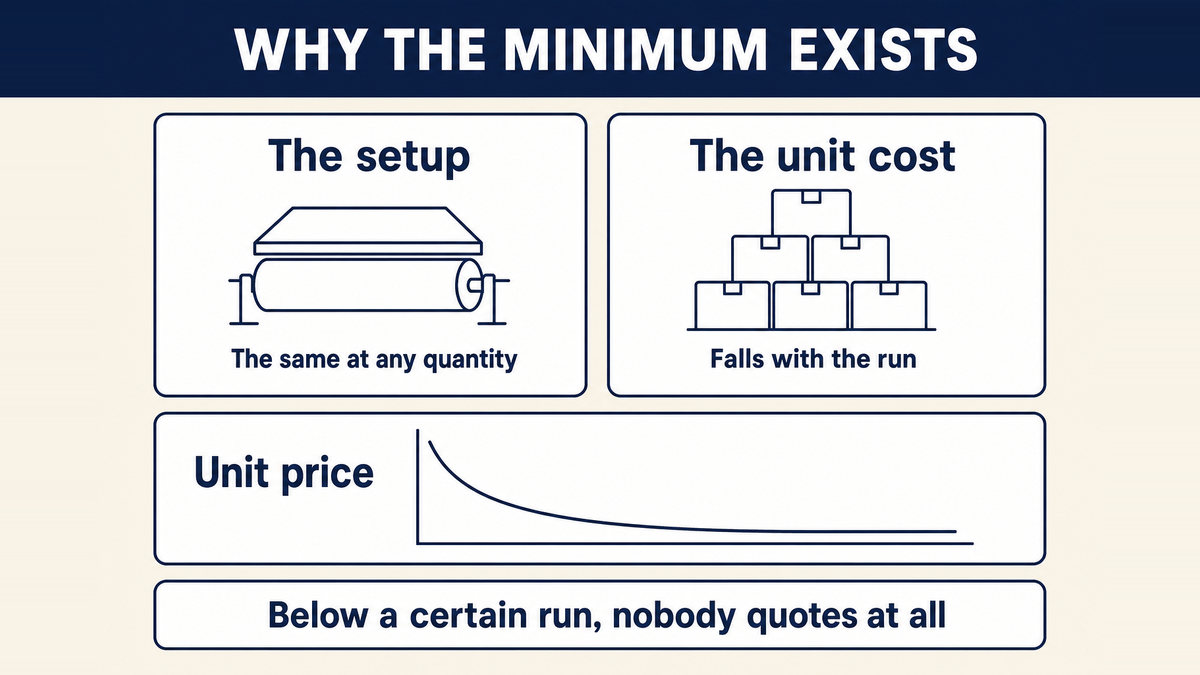
The minimum is set by the setup rather than by the material. Printing a box or a mailer means making a plate or a die first, mounting it on a machine, and running the job. That setup cost is the same whether the run is five hundred units or fifty thousand, so it is spread across whatever quantity is ordered. At low quantities the setup is most of the price; as the quantity rises it stops being the main cost and the unit price flattens out.
Understanding that shape changes how the quote should be read. A price for five hundred boxes is often not five times the price for a hundred. It is frequently worse than that, and sometimes the supplier simply declines, because the run does not cover the machine time it occupies. The barrier is not that small orders are expensive in absolute terms; it is that the pricing curve makes a small order look like poor sense to everyone including the person quoting it.
There is, however, a version of branded packaging with no setup at all, and it is the most useful single fact in this subject. A plain box or mailer plus a printed label has no plate, because the label is printed digitally and digitally printed work has no fixed setup. The label is also the smallest printed surface available, so it wastes the least material.
Which gives the useful reframing: the cheap route into branded packaging is not finding cheaper packaging. It is reducing the area that gets printed until the setup disappears. Once that is the objective, the options arrange themselves.
3. Five Routes That Work Without Holding Stock
Each of these removes a different part of the problem, and they can be combined. They are listed from the least stock to the most.
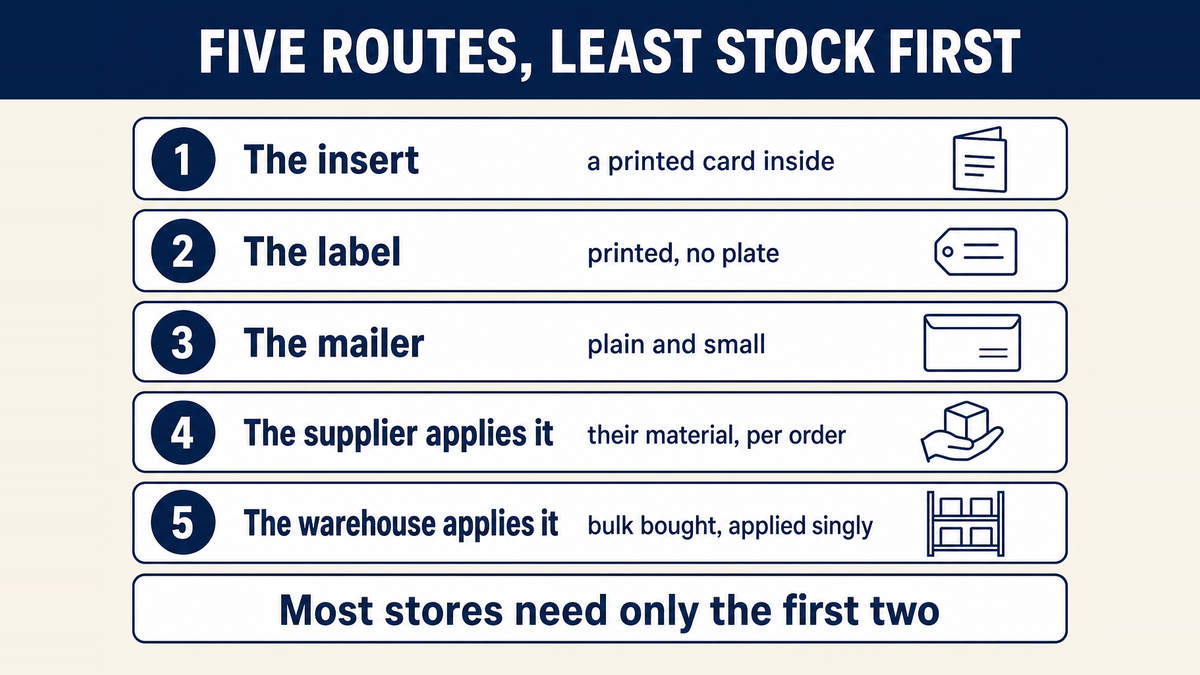
Route 1: brand the insert, not the box
A printed card is small, light, digitally printed and cheap at low quantities. It travels inside whatever packaging the supplier was already going to use, so it needs no change to the packing process and no negotiation about boxes. It also survives the journey better than a printed exterior, because it is protected. For most no-stock sellers this is the first thing to do and often the only thing that is needed.
Route 2: brand with a label or a sticker
A plain mailer plus a printed label gets the mark onto the outside of the parcel with no plate and no minimum worth arguing about. The trade is that the mark sits on a label rather than being printed into the box, which reads differently in a photograph but identically on a doorstep. Labels are also the easiest element to change, because a new design means a new sheet rather than a dead pallet.
Route 3: choose the substrate that needs no branding
A poly mailer is light, cheap and does not invite printing. Where the product tolerates it, the mailer does two jobs at once: it removes the packaging print decision and it reduces the size of the parcel, which matters for the reason set out in section 5. This is not a compromise on branding so much as a decision to put the brand on the inside and let the outside be plain and small.
Route 4: have the supplier apply your packaging per order
Some suppliers will pack to a buyer’s specification on every order rather than only on a bulk run. When they will, the minimum moves from your order to their material buying, which is a far better place for it, and you hold nothing. The negotiation is about their packing line rather than about price, so the useful questions are whether they can hold the packaging at their end and whether the per-order handling charge changes. If you are still building the supplier relationship, how we handle sourcing requests covers where that conversation sits in the process.
Route 5: let a warehouse apply the packaging
If goods are already being shipped from domestic stock, the packaging stock can live at the warehouse rather than in your home. The boxes are bought in bulk, which is what makes them cheap, and applied one at a time, which is what makes them useful. The trade is that you now own packaging as inventory, and a design change leaves you with stock in someone else’s racking. What holding stock does to the rest of the business, and where it starts to pay, is set out in where holding stock starts to pay.
The five are not equal, and the order to try them in is not simply the order they appear above. The first two cost close to nothing and can be done this month: a card and a label. The third is really a product decision wearing a packaging coat, and belongs with the choice of what to sell rather than with the choice of how to send it. The fourth and fifth both depend on somebody else agreeing to hold your material, so they only become available once there is a supplier or a warehouse relationship worth asking. Most stores should do the first two and stop there, and only move on when order volume makes the handling charge smaller than the value of the brand arriving in a printed box.
4. The Claim You Print Is Read by a Regulator
Everything above is a commercial decision. There is one part of packaging that is not, and it is the sentence you put on it about the environment. Packaging is where environmental claims live, and in the United States those claims are governed by published guides that say when one is misleading. The general rule for recyclability is stated plainly.
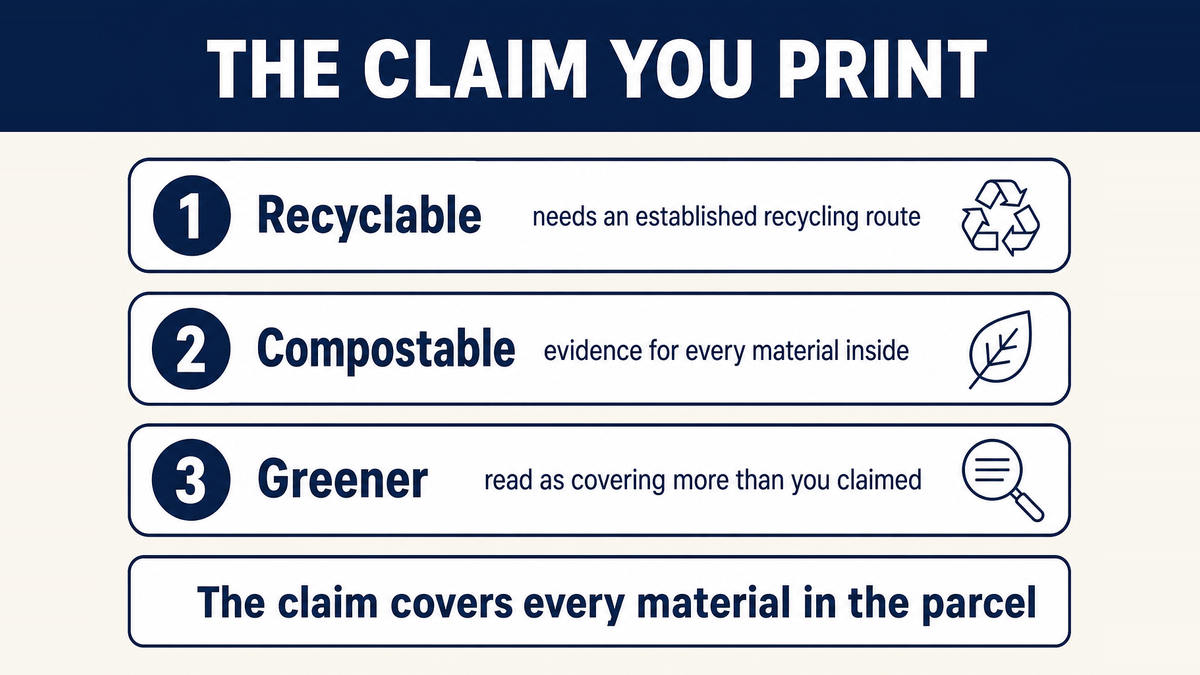
It is deceptive to misrepresent, directly or by implication, that a product or package is recyclable. A product or package should not be marketed as recyclable unless it can be collected, separated, or otherwise recovered from the waste stream through an established recycling program for reuse or use in manufacturing or assembling another item.
Federal Trade Commission, 16 CFR 260.12(a), Recyclable claims (read 14 October 2026)
The part that catches sellers is what the guides do with a parcel made of more than one thing. An example in the same section makes the point with a shower curtain in a plastic package: because the label does not say whether the claim refers to the package or to the product inside, the claim is treated as covering both, and it is misleading if any part of either cannot be recycled. A dropshipped parcel is exactly that situation. The outer box, the void fill, the tape, the insert and the product’s own wrapper are five different materials, and a flat claim on the outside is read as a claim about the parcel a customer opens.
Compostability works the same way and asks for more. A compostable claim is expected to rest on competent and reliable scientific evidence that all the materials in the item break down into usable compost in a safe and timely manner, and it has to be qualified where the item cannot be composted in a home pile.
It is deceptive to misrepresent, directly or by implication, that a product or package is compostable. A marketer claiming that an item is compostable should have competent and reliable scientific evidence that all the materials in the item will break down into, or otherwise become part of, usable compost… in a safe and timely manner.
Federal Trade Commission, 16 CFR 260.7(b), Compostable claims (read 14 October 2026)
There is one more pattern worth knowing, because it is the one that catches well-meaning sellers rather than careless ones. A comparative word such as greener is read broadly. The guides describe a package that weighs 15 per cent less than the previous one and is otherwise unchanged, where the claim is misleading because a reasonable buyer would take greener to mean other environmental aspects improved too. For a store that has just switched to a lighter mailer, that is the sentence to avoid, and the safe version is the narrow one: say lighter, say what got lighter, and claim nothing else.
One point about responsibility is worth stating, because a packaging claim is arranged by three parties who each assume one of the others is carrying it. The converter prints what it is told to print, the supplier applies the packaging, and the store writes the copy. The guides are addressed to the marketer, which in an ordinary supply chain means the party whose product or packaging carries the claim and who put it into the market. That is the store, not the printer and not the factory, and it is the reason a claim cannot be handed off along with the artwork. If a supplier offers to print something on the box by default, read the sentence before it goes on, because it will be yours once the parcel is in circulation.
None of that is a reason to print nothing. It is a reason to print something you can support, and to keep the claim as narrow as the fact behind it. The material side of choosing a lower-impact substrate, including how the certification schemes work, is covered in eco-friendly and biodegradable packaging options.
5. Packaging Is Also a Freight Decision
The second cost hidden in a packaging choice is the one it adds to the freight bill, and it is larger than most sellers expect because parcels stop being priced by weight once they grow past a published size.
Parcels that exceed one cubic foot (1,728 cubic inches) are charged based on the actual weight or the dimensional weight, whichever is greater… Parcels that exceed 22 inches but not greater than 30 inches in length, add $4.50. Parcels that exceed 30 inches in length, add $21.00. Parcels that exceed 2 cubic feet (3456 cubic inches), add $35.00.
United States Postal Service, Notice 123, Price List (read 14 October 2026)
Three consequences follow for anyone choosing packaging for a light product.
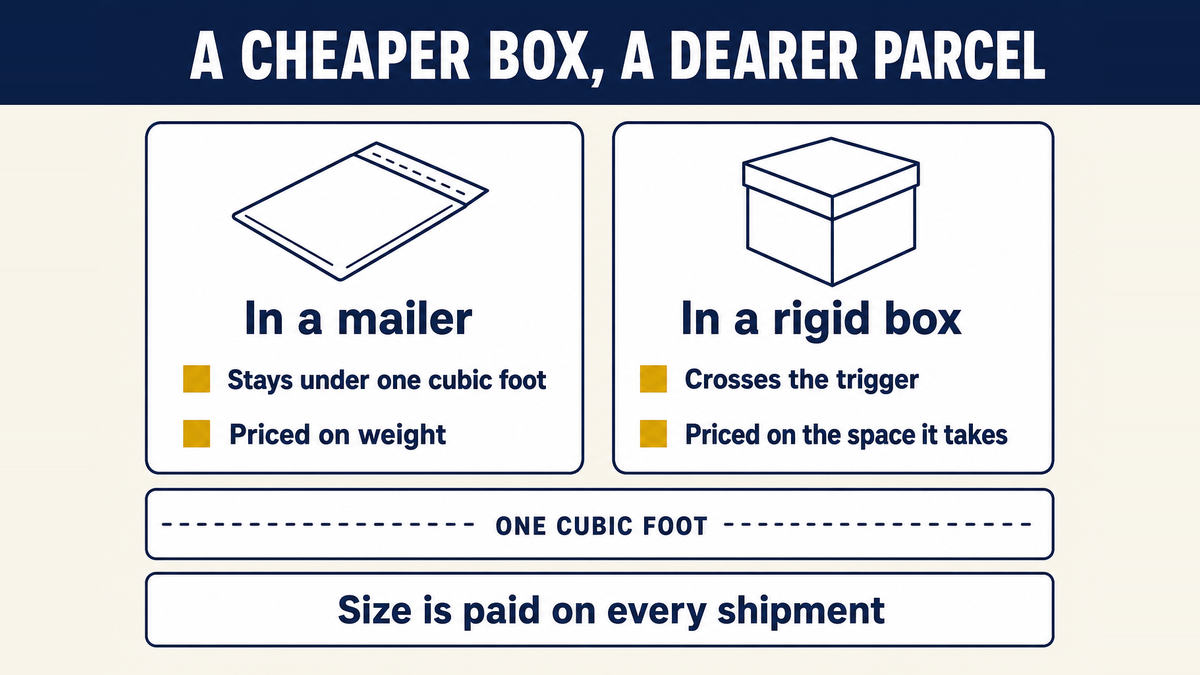
The first is that the better-looking option is often the more expensive one to send. A rigid printed box is bulkier than a padded mailer for the same item, and a cubic foot is roughly a twelve-inch cube. Put a small product in a substantial box and the parcel can cross from weight pricing into space pricing, where the numbers above begin to apply on top of the base rate.
The second is that the flat additions make small packaging changes worth real money. Because the charges for length and for volume are fixed amounts rather than percentages, shaving a parcel back under a length step saves the same sum on every order, and it saves it on a cheap item and an expensive one alike. That is why a mailer can beat a box even when the box costs less to buy: the box’s cost is paid once per unit, and the parcel’s size is paid on every shipment.
The third is that branding and volume pull in the same direction if you let them. The route that removes the printing setup — a label on a plain mailer — is also the route that keeps the parcel small. Reducing the printed surface and reducing the packed size are usually the same decision, and it is worth checking whether a proposed packaging upgrade does both or trades one for the other. How the charge is calculated from packing rather than from product is set out in how volume decides what a parcel is charged.
Before committing to a packaging change, it is worth measuring one parcel instead of estimating it. Take the product as it is genuinely packed, add the protection it actually needs, and measure the candidate box against the mailer you use today. A tape measure and a kitchen scale settle in five minutes what a spreadsheet will argue about for an hour, and the number that matters is the packed size rather than the product size. Anything that moves a parcel across one of the published steps is worth knowing before the packaging is ordered rather than after it has been printed.
6. What to Settle Before Ordering
Five things, in the order that mistakes cost money.
- Decide which surface is printed. Box, mailer, insert or label. This single choice decides whether you pay a setup, and it is usually made backwards — a design is chosen first and the surface is fitted to it afterwards.
- Ask whether the setup is paid once or per run. A plate kept on file changes the economics of a reorder, and a design change throws it away. Ask before the design is finalised rather than after.
- Establish who applies it and in what quantity. Per order, per hundred, or at your own bench. If the answer involves shipping packaging to a supplier, confirm they will hold it and ask what changes on their handling charge.
- Read the environmental claim before it is printed. Keep it to what you can support, and remember that a claim on the outside covers every material inside the parcel. If the substrate is the reason for the claim, the material guidance is in packaging materials compared.
- Measure the packed parcel, not the product. The packaging decision is a freight decision, and the number that reaches the freight bill is the size of the box as it is sent.
The whole subject reduces to one question: which surface carries your mark? Print the box and you buy a stock of boxes. Print a label or a card and you buy a sheet. Everything else in packaging follows from that choice.
7. Frequently Asked Questions
Can I get custom packaging if I dropship?
Yes, and the practical route is to reduce the area that gets printed rather than to look for a cheaper box. A printed card inside plain packaging, or a printed label on a plain mailer, carries the mark with no printing plate and therefore no large minimum. Printed boxes are the expensive version because the setup has to be spread across a run.
What is the minimum order for custom packaging?
It is set by the setup rather than by the material: the plate or die, the machine time and the run. Because that setup is the same at any quantity, it is most of the cost on a small order and a rounding error on a large one, which is why the unit price falls steeply and then flattens. Digital printing on labels and cards avoids the setup altogether.
Is branded packaging worth it for a dropshipping store?
For the insert and the label, usually yes, because both are cheap at small quantities and neither requires you to hold stock. For printed boxes, only once volume justifies the run, and even then the parcel gets bigger, which adds a freight cost on every order that the box price does not show. Check both numbers before deciding.
Can I say my packaging is recyclable?
Only if it can genuinely be collected, separated or otherwise recovered through an established recycling program. The important detail is that a claim on the outside of a parcel is read as a claim about the parcel a customer opens, so a recyclable box with non-recyclable void fill inside it makes the flat claim a problem. Keep the wording as narrow as the fact.
Should I use boxes or poly mailers?
Where the product tolerates a mailer, it usually wins on both counts: no printing setup and a smaller parcel. Parcels are priced on whichever is greater once they pass one cubic foot, and flat additions apply past twenty-two and thirty inches, so a mailer that keeps a parcel below those steps saves money on every shipment. Boxes earn their place when the product needs protection, not when it needs a logo.
Every Environmental Claim, Checked
We return each recyclability or compostability statement against the standard permitting it, and the carton change that lowers freight.
Review My Claims
Questions & Comments
We read every one and reply within 24 hoursTrying to get your mark onto a parcel you never pack, working out whether a printed box is worth the run, or checking whether an environmental claim on your packaging is one you can actually support? Tell us what you ship and how many orders a month you handle, and our team will show you which branded surface fits that volume without a printing plate.