
Dropshipping Beauty Products: The Label, the Date and the Carrier Decide It
 ·
Updated October 13, 2026
·
16 min read
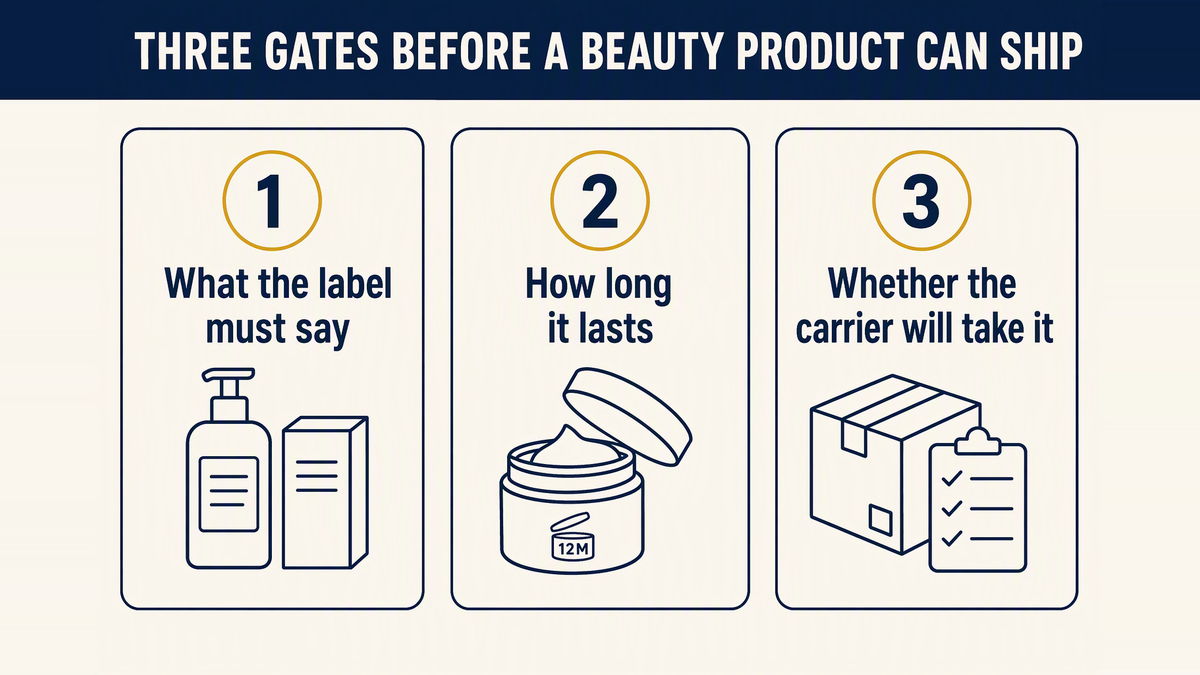
Beauty has the margin, the customers who come back and the shelf appeal that most dropshipping categories can only envy. It also has three gates that a mug or a phone case never meets, and every one of them is decided by paperwork rather than by taste. A product can look perfect, photograph beautifully and still be unsellable, because of what is printed on the bottle, how long it lasts, and whether a carrier is allowed to take it.

The Three Gates
| Gate | What it decides | Where you settle it |
|---|---|---|
| The label | Whether the words on the bottle are allowed at all. | On the artwork, before the first print run. |
| The date | Whether the product is still worth selling by the time it reaches a customer. | In the order you place, as a minimum remaining life. |
| The carrier | Whether the parcel may travel at all, and by which route. | In the formulation and the packaging, not at the counter. |
What this guide covers
1. Why Does Beauty Look Easy and Not Be?
Because the parts of the business you can judge by eye are the easy parts. A serum and a phone case look equally simple in a product photo, and the difference between them shows up in documents rather than in appearance.
Beauty is also the category most often recommended to beginners, partly because a small bottle is cheap to import and easy to store. What that advice leaves out is that a small bottle carries more rules per gram than almost anything else on a store. Food has its own rules, but a notebook has effectively none. A cosmetic sits somewhere in between, and the rules attach to the product rather than to the seller's good intentions.
The practical result is that the three gates below are not obstacles to clear once and then forget. They are the questions to ask before you buy anything, and the answers decide which items belong in your range at all.
2. Gate One: What Must the Label Say?
In the United States the ingredient declaration on a cosmetic is not optional and not a marketing choice. It is a rule with a stated method and a stated minimum size, and both are worth knowing because they turn a design question into something you can check.
The label on each package of a cosmetic shall bear a declaration of the name of each ingredient in descending order of predominance, except that fragrance or flavor may be listed as fragrance or flavor.
21 CFR 701.3(a), Designation of ingredients
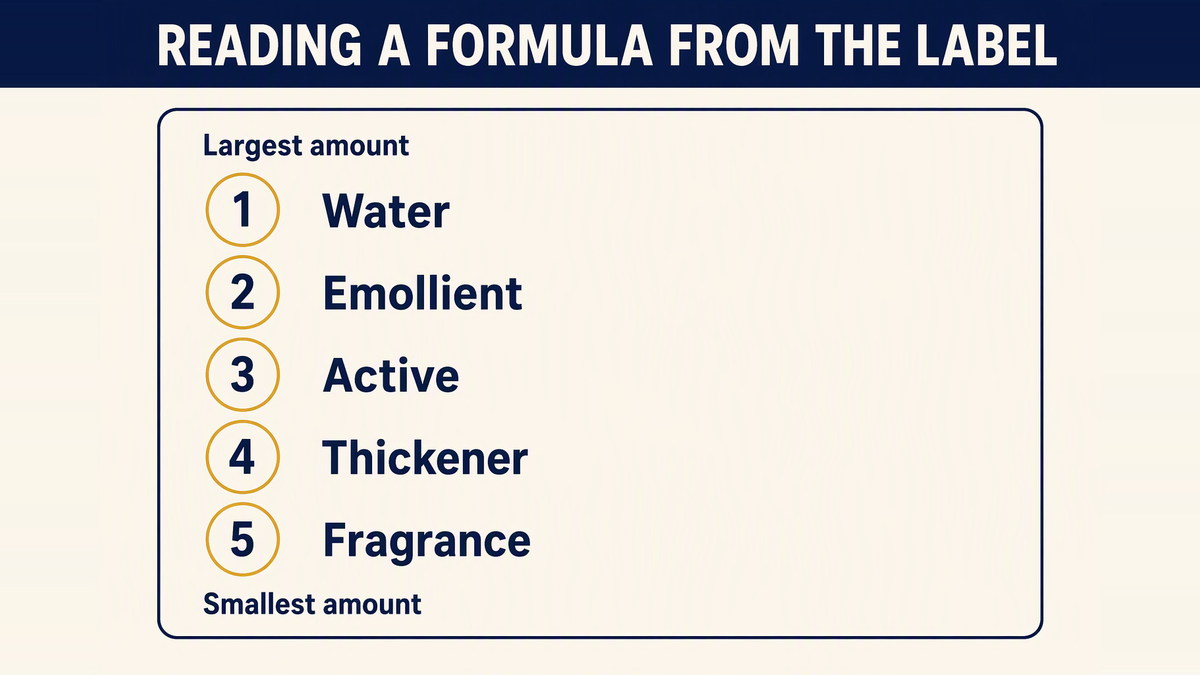
Two useful things fall out of that sentence. The first is that the declaration is mandatory, so a bottle that arrives from a supplier without one cannot simply be listed as it stands. The second is the phrase descending order of predominance, which means the list is ordered by quantity. The ingredient at the top is present in the largest amount, and the last ingredient is present in the smallest.
The same section sets out how the declaration has to look, and this is the part sellers usually learn about only when a buyer complains:
The declaration of ingredients shall appear with such prominence and conspicuousness as to render it likely to be read and understood by ordinary individuals under normal conditions of purchase. The declaration shall appear on any appropriate information panel in letters not less than 1/16 of an inch in height.
21 CFR 701.3(b), Designation of ingredients
One sixteenth of an inch is not a large number, but it is a number, and that is what makes it useful. On a small bottle the ingredient list is often the first thing a designer shrinks to make room for a logo, and a list that has been squeezed to fit is exactly the kind of detail that is decided on the artwork rather than noticed afterwards. The declaration also has its own place on the pack: the information panel, not the front.
For a dropshipping store the practical form of this gate is simple. Ask for a photograph of the finished label with a ruler beside it, or order one unit and measure it yourself. A supplier who cannot produce that photograph is not necessarily refusing. They may simply never have been asked, because most of their buyers have not thought about it either.
3. What Does the Ingredient List Tell You About a Supplier?
Because the list runs from most to least, it is also the shortest honest summary of a formula you will ever get. A supplier can describe a cream as rich, premium or advanced, but the order of the first four or five entries tells you what the product is actually made of, and that is information you can compare between two suppliers without a laboratory.
This is the most useful reading habit in the category. Water, then a bulk emollient, then an active, then a thickener, then preservative and fragrance near the bottom is a normal sequence. When the same four names appear in a different order between two quotations, the products are not the same product, whatever the photographs suggest, and the difference usually shows up in texture and in how long a jar lasts a customer.
It also tells you what you are buying when you buy an existing formula rather than commissioning one. If the list is short and the same across a supplier's whole range, you are looking at one base with a few variations rather than a set of distinct products, which is worth knowing before you build a store around fourteen different items.
4. Gate Two: The Date Nobody Shows You
A cosmetic is a perishable product, and the clock runs at different speeds depending on what is inside it. Water is the dividing line. A product built mainly on oil or wax has little in it that can spoil, while a product containing water depends on its preservative system to stay in good condition, and that system has a working life.
In a dropshipping model this matters more than in any other way of selling, because the stock is not in your hands. You cannot walk to a shelf and read the batch code. The unit that ships to your customer may have been made last month or two years ago, and neither you nor the buyer finds out until it arrives.
The fix costs nothing and belongs in the order you place. State a minimum remaining life on arrival rather than a shelf life from the factory, because the two are not the same thing. A product with a three-year life that has already spent eighteen months in a warehouse has eighteen months left, and the supplier who quotes you the three-year figure is not misleading you so much as answering a different question.
Ask for three things in writing: the minimum remaining life on arrival, the batch or lot number, and the production date marked on the carton. The batch number is the one people forget, and it is the one that matters on the day something goes wrong. If a supplier recalls a batch, a store that can identify which orders contained it can act; a store that cannot has to decide between contacting every customer and contacting none.
There is also a commercial reason to care, beyond spoilage. A water-based product that has spent a long time in storage can separate, change texture or lose its scent before the customer finishes it, and a complaint about a product that turned is far harder to answer than a complaint about a delivery that was late. Late is a fact you can check. Turned is a judgement, and it usually ends in a refund.
5. Gate Three: What Will the Carrier Not Take?
Some beauty products cannot travel by the route your store is built on, and this is decided by chemistry rather than by price. The Postal Service sets out what may be sent by mail according to hazard class, and two of those classes cover a surprising share of a typical beauty range.
343 Flammable and Combustible Liquids (Hazard Class 3) · 342 Gases (Hazard Class 2)
USPS Publication 52: Hazardous, Restricted, and Perishable Mail, mailability by hazard class
The two categories catch more products than most sellers expect. An alcohol-based fragrance is a flammable liquid. Nail polish and nail polish remover are flammable liquids. A spray deodorant, a setting spray or a dry shampoo in an aerosol can is a compressed gas, which is Hazard Class 2. None of these are unusual items; they are the items a beauty store is most likely to want. Air transport is stricter again, which is why the restrictive list lands hardest on a model that ships a single unit from China on every order.
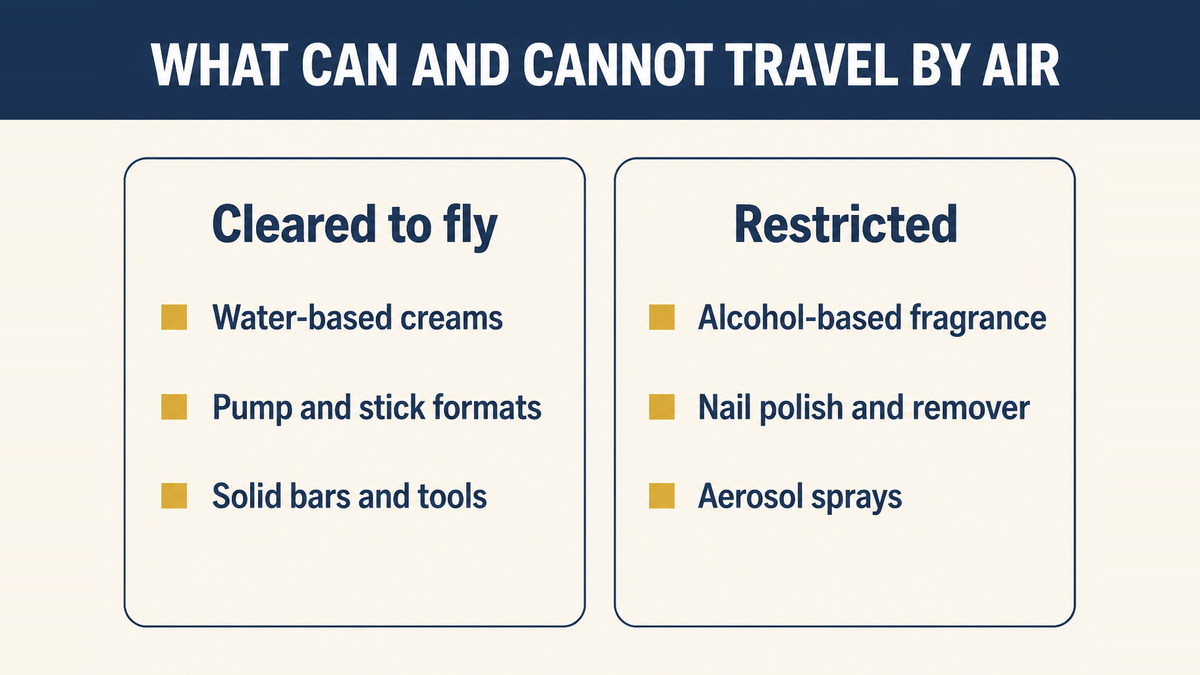
The choice this gives you is a real one and it changes the shape of the range. You can build around products whose formulation avoids the restricted classes, which usually means water-based rather than alcohol-based and a pump or a stick rather than an aerosol. You can hold stock on the customer's side of the border so the parcel travels domestically on the ground. Or you can leave that part of the category to sellers who hold stock. What you cannot do is assume a product is shippable because a supplier will happily quote it.
Freight mode and hazard class interact, so the choice between air and sea is not only about cost and speed on these items. Our air freight versus sea freight comparison covers how the modes differ on cost and transit time, and the same shipment that is routine by sea can be a restricted booking by air once the formulation is taken into account.
6. Where Is the Line Between a Cosmetic and a Drug?
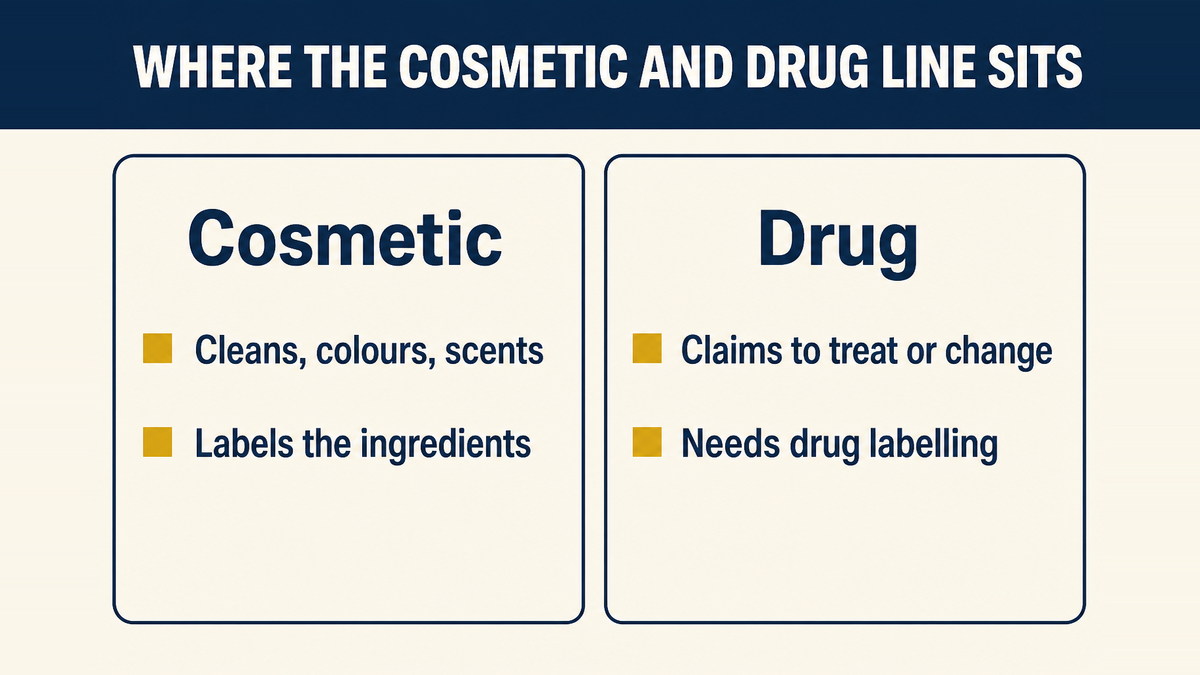
The line is drawn by what the product claims, not by what it contains, and it is the gate most likely to be tripped by accident. A product that promises to change how the body works or to treat a condition is being presented as a drug, and that changes what has to be printed on the pack.
A product that includes the term "sunscreen" in its labeling or in any other way represents or suggests that it is intended to prevent, cure, treat, or mitigate disease or to affect a structure or function of the body comes within the definition of a drug in section 201(g)(1) of the act.
21 CFR 700.35(a), Cosmetics containing sunscreen ingredients
Sunscreen is only the clearest example. The same section explains why: when a buyer reads the word, they expect protection from the harmful effects of the sun, so the product is understood as doing something to the body rather than to the surface of the skin. The rule that follows is that a cosmetic which is also a drug is subject to the drug rules as well as the cosmetic ones, which means a different panel on the pack and a different set of obligations behind it.
Remember that the claim on your own product page counts too. Supplier copy often arrives already crossing the line, describing a cream as treating a condition or repairing the skin, and that text is easy to paste into a listing without reading it closely. Rewriting the copy is cheap. Withdrawing a claim after it has been published is not.
7. What Still Works?
Sort the category by the three gates and the answer stops being about taste. What survives is what carries no restricted formulation, no water-based clock and no treatment claim, and there is more of that in beauty than the popular lists suggest.
| Product | Label | Date | Carrier | Where it sits |
|---|---|---|---|---|
| Brushes, sponges and tools | Low | None | None | Easiest to run |
| Cosmetic bags and cases | Low | None | None | Easiest to run |
| Solid soap and shampoo bars | Low | Low | None | Easiest to run |
| Oils, balms and butters | Low | Moderate | Low | Manageable |
| Lip gloss and lip balm | Moderate | Moderate | Low | Manageable |
| Creams and serums with water | Moderate | High | Low | Needs dated stock |
| Nail polish and remover | Moderate | Low | High | Restricted route |
| Alcohol-based fragrance | Moderate | Moderate | High | Restricted route |
| Aerosol sprays | Low | Low | High | Restricted route |
| Anything labelled sunscreen | Highest | Moderate | Low | Needs drug labelling |
Two shapes sit at the top of that list and they share a reason. Brushes, tools, bags and bars are all non-liquid, so the carrier gate disappears, and none of them contains water in a form that spoils, so the date gate fades as well. They are also the parts of the category where the label is least likely to carry a claim that crosses the line.
If you want to sell a formulation, the route that removes the most risk is to own it rather than to resell someone else's: your own artwork, your own wording, and an order that states a remaining life. Our guide to labelling on China-made goods covers how artwork and declarations are handled with a factory, and if your range leans on tools rather than liquids, our guide to the brush shapes worth stocking and our notes on tools and accessories cover the half of the category that clears all three gates. Where the parcel itself is the constraint, our guide to shipping marks on cartons covers how the outer packaging is marked, which is also what a carrier reads first.
8. Frequently Asked Questions
What has to be on a beauty product label?
In the United States every cosmetic must carry a declaration of each ingredient in descending order of predominance, printed on the information panel in letters at least one sixteenth of an inch high. Fragrance and flavor may be listed under those two words rather than by name.
Can I sell a beauty product without an ingredient list?
Not as a cosmetic in the United States. The declaration is required on each package, so a product that arrives without one has to be relabelled or left on the shelf. It is one of the first things to look at on a sample rather than on a sales page.
When does a beauty product count as a drug?
When it claims to change how the body works or to treat a condition. Using the word sunscreen is the clearest example, because a product labelled that way is generally treated as a drug and needs drug labelling instead of cosmetic labelling.
Why can some beauty products not be sent by air?
Because flammable liquids, gases and aerosols are restricted mail and restricted air cargo. Perfume, nail polish and spray deodorant fall into those groups, so the ship-per-order route from China tends not to work for them.
Does shelf life matter in beauty dropshipping?
It matters more than in most categories, because you cannot see the batch date on a product sitting in someone else's warehouse. A short-dated item arrives, sits, and reaches the customer late, which is a complaint you cannot fix after the sale.
Label, Date, Carrier: One Row Each
We return the declaration set the label needs, the shelf life remaining at delivery, and the carrier restriction that rules the item out.
Score My Three Gates
Questions & Comments
We read every one and reply within 24 hoursStuck on whether a beauty product can be listed as it arrives, unsure what remaining shelf life to ask for, or been quoted a perfume or an aerosol that no carrier will touch? Post the product, the formulation type and the label wording, and our team will help you work out which gate it fails and what to change.