
Jeans Manufacturing Sourcing Guide: Denim, Washing, Hardware, Fit & Labelling Rules
 ·
Updated October 9, 2026
·
25 min read
A jeans factory quotation covers cutting and sewing, and very little else. The fabric, the washing, the metal parts and the labels are usually separate lines or separate companies, and it is the wash — not the sewing — that decides what your product looks like at the end. This guide covers how a pair of jeans is actually specified: denim weight and stretch, the laundry stage that sets your colour, the hardware that fails tests, how fit is graded and measured, and the three United States labelling rules that apply to every pair you import, whether or not anyone at the factory mentions them.
What to Order, and What to Ask For, by the Kind of Jeans You Are Selling
| If you are selling | Order this | Because |
|---|---|---|
| A clean, dark wash at a low price | 10–12 oz rigid or low-stretch denim, rinse wash only | A rinse is the cheapest wash and the most repeatable one. Every extra effect after that adds a hand operation, a chemical or both, and each one adds variation between pieces. |
| A vintage or worn look | 11–13 oz denim with a hand-sanded and stonewashed recipe | Hand sanding is what produces whiskers and worn edges. It is done with a tool against a person's hand, so no two pieces match exactly. Approve the standard on a real garment, not a swatch. |
| Everyday stretch jeans | 9–11 oz denim with 1–2% elastane and a stated recovery | The failure in stretch denim is growth, not breakage. A pair that grows two sizes over a day gets returned, and the number that predicts it is the recovery percentage, not the stretch percentage. |
| Winter or lined jeans | Brushed-back or fleece-lined denim | A raised surface changes how the fabric is tested for flammability under United States rules, and the test has to be run again after refurbishing. Lined goods are the category where this catches people out. |
| A premium, small-run line | Selvedge denim on a narrow loom, with the selvedge kept visible | Real selvedge comes from a narrow loom, which makes less fabric at a slower speed. If the price you are quoted matches ordinary wide-loom denim, the fabric is not what you were told. |
| Children's jeans | Any of the above, plus the children's testing route | Children's clothing carries its own testing, certification and tracking label rules, and the decision has to be made before the pattern and artwork are final. |
1. What a Jeans Quotation Actually Covers, and the Three Costs It Leaves Out
A cut-and-sew price means the factory cuts your denim and sews the garment. In most quotations that is all it covers, and the three largest remaining costs — the fabric, the washing and the metal parts — are either listed as separate lines or quietly absent because a different company supplies them.
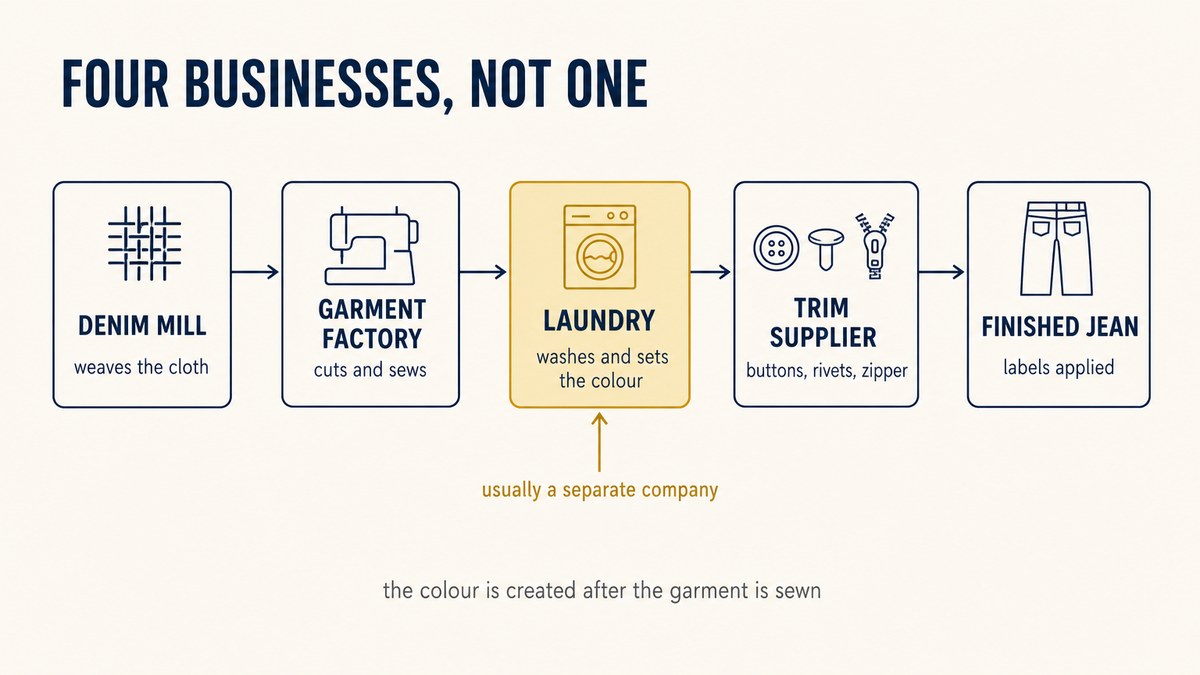
This is not a trick, and factories are not usually hiding anything. Denim manufacturing is genuinely split between businesses. A mill weaves the cloth. A garment factory cuts and sews it. A laundry, which may be a completely separate company in the same industrial zone, washes it. A trim supplier makes the buttons and rivets. Each one quotes separately, and if you only ever see one number, you are only seeing one of them.
- Cut and sew
- Almost always included. Pattern making, grading, cutting, sewing, and the finishing of seams and bar-tacks at the stress points.
- Denim fabric
- Sometimes included, often quoted separately at cost plus a handling charge. Ask for the weight in ounces, the fibre content with percentages, and the mill name. A quotation that says only "cotton denim" is not a specification.
- Washing
- The single most variable line. Frequently subcontracted by the sewing factory to a laundry it does not own. This is the first thing to ask about, because if the wash is done by a third party, your factory cannot control your colour.
- Hardware and trims
- Buttons, rivets, zipper, woven labels, leather patch, hangtags, and the polybag. Usually quoted separately, and usually where a cheap quotation hides its savings.
- Labelling and testing
- Rarely in the price at all. The care label content, the fibre content statement, and any required testing are the importer's duties, and they are usually treated as your problem rather than the factory's.
There is a second reason to separate the lines. When one number covers everything, you cannot tell which part got cheaper when a factory comes back with a lower price on a reorder. Splitting fabric, wash and trims makes the quotation comparable, and it makes a price reduction explainable rather than mysterious. Our bilingual sales contract guide covers how to write these lines into the agreement so they stay fixed for the order rather than being renegotiated at shipping time.
2. Denim Fabric: Weight, Construction and Stretch
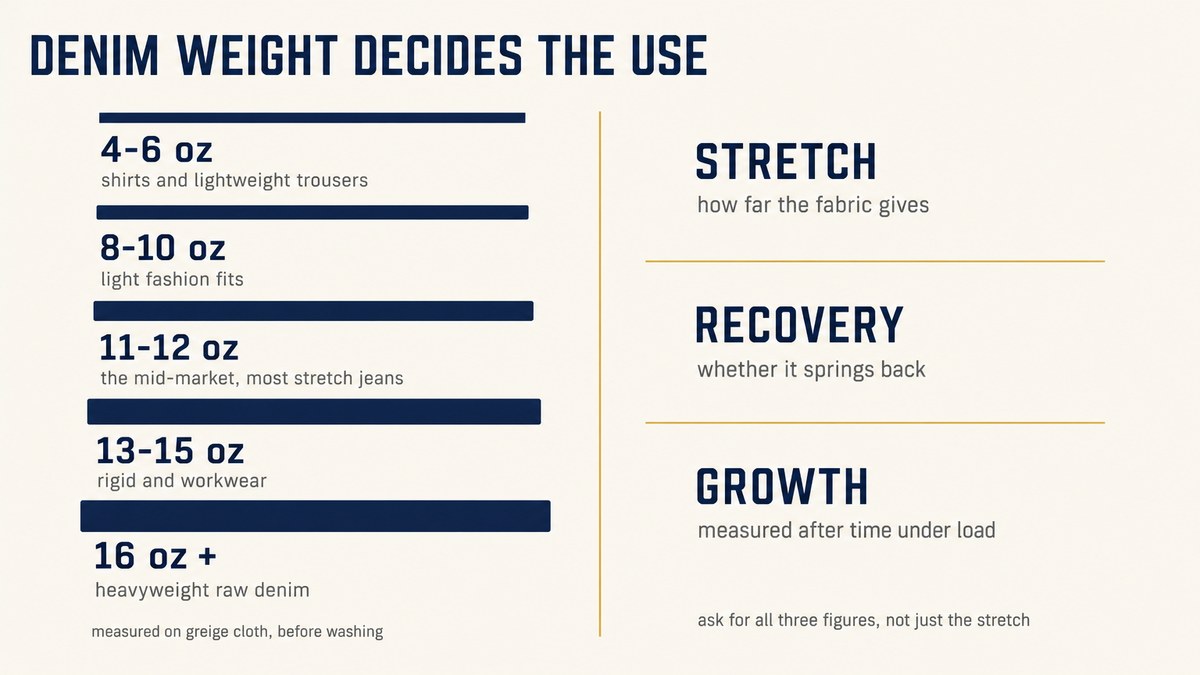
Specify denim by weight in ounces per square yard, by construction, and by stretch with a recovery figure. Everything else — the colour name, the hand, the look on a screen — sits on top of those three numbers, and none of them can be judged from a photograph.
Weight is the number that decides what the fabric is good for, and it is measured on the greige cloth rather than the finished, washed garment. This matters because a 12 oz denim after a heavy wash is not 12 oz any more. If your factory quotes a weight without saying whether it was measured before or after washing, the number is not comparable to anything.
| Weight | What it is used for | What to watch |
|---|---|---|
| 4–6 oz | Shirts, lightweight summer trousers, some children's wear | Too light for a fly front that has to hold a zipper and a button without stretching out of shape. |
| 8–10 oz | Lightweight jeans, chambray-style trousers, women's fashion fits | Takes a wash effect quickly, so a worn look can go further than you intended in a single pass. |
| 11–12 oz | The middle of the market and most stretch jeans | The easiest weight to source well. If you are starting out, start here. |
| 13–15 oz | Rigid jeans, workwear, heritage-style fits | Heavier cloth dulls cutting blades and needles faster, so the factory has to change them more often or the seams pucker. |
| 16 oz and up | Heavyweight raw denim for a specialist market | Fewer mills weave it, so the lead time is longer and the minimum order per colour is higher. |
Indigo is a surface dye, and that changes everything about colour
In indigo denim the yarn is dyed on the outside and stays white at its core. That is not a manufacturing fault, it is how indigo denim is built, and it is the reason denim fades at all. The practical consequence for a buyer is that colour cannot be matched the way a solid-dyed fabric is matched. There is no single dye lot number that guarantees the same blue twice, because the depth of colour depends on how many times the yarn was dipped and how the finished garment was washed.
So do not ask a supplier to guarantee a colour match to a Pantone reference. Ask them to approve a wash standard — a real washed garment, sealed, dated and signed — and then measure later production against that garment under the same light. This one change removes most of the arguments that happen at shipment time.
Stretch: the percentage that matters is the one you are not being quoted
Stretch denim is quoted by the elastane percentage, usually somewhere between 1% and 4%. But the number that predicts whether a pair of jeans will be worn or returned is recovery — how far the fabric springs back after being stretched and held. Denim with 2% elastane and poor recovery will bag at the knees and the seat by the end of a day, and it will do it on the first wearing.
Ask for the stretch percentage, the recovery percentage, and the growth figure measured after a set time under load. If the factory cannot give you the last two, that is useful information in itself: they have quoted you the easy number and do not hold the one that decides the outcome.
Selvedge and wide loom
Selvedge denim is woven on a narrow shuttle loom, which produces a finished edge that does not fray. The loom is slower and makes less fabric per hour, which is the entire reason the cloth costs more. Wide-loom denim is produced on modern looms and cut from a wide sheet, so there is no selvedge to show.
Buy a metre of the fabric before you approve the garment. A washed sample garment tells you what the wash did; it does not tell you how the cloth behaves in the hand, how it frays when cut, or how much it shrinks. A metre of greige and a metre of the same cloth after washing, measured against each other, gives you the shrinkage figure from your own test rather than from a datasheet.
3. The Wash House: The Step That Decides Your Colour
For anything other than a raw or rinse-only jean, the colour is created after the garment is sewn, in a laundry. The fabric arrives as one shade of blue, every garment is made from it, and then the laundry removes colour in a controlled way until the garment matches a standard. This is why two jeans made from identical fabric in the same factory can look nothing alike.
Understanding this changes how you write a specification. You are not ordering a fabric colour. You are ordering a recipe, and the recipe is applied to a finished garment, so it has to be approved on a finished garment.
| Wash type | How the effect is made | What it costs you in consistency |
|---|---|---|
| Rinse | A clean-up wash to remove sizing and settle the cloth | Lowest variation of any wash. The safest choice for a first order. |
| Enzyme | Enzymes break down surface indigo without stones | Softer hand than stonewashing, and easier to repeat than a stone load. |
| Stonewash | Pumice stones tumble against the garment | The stones break down as they run, so a load late in the day behaves differently from the first load. |
| Acid and bleach | Chemical spotting, usually applied by hand | Hand-applied effects never match piece to piece. Approve a tolerance, not a single photo. |
| Hand sanding | An operator sands the whiskers, pockets and edges | The most variable operation in the whole product, because it is a person with a tool and a reference garment. |
| Laser and ozone | Machines that produce wear marks and fading without hand tools | Far more repeatable, but not every laundry owns the equipment. Ask before you design around it. |
Two operational points follow from the table, and both save money.
First, approve in three rounds, not one. A wash recipe is developed on a sample, corrected, and then confirmed. Round one tells you the direction, round two is usually close, round three is the standard you seal. Skipping to round three is why a first production run arrives looking nothing like the sample — the recipe was never actually settled.
Second, keep the approved sample sealed and dated, and keep a second copy. The sealed standard is the only thing that makes a later argument about colour resolvable. Photographs are not a standard, because the same garment photographed under a warm bulb and a cool bulb looks like two products.
Ask the laundry how many garments go into one drum, and how many drums a colour needs. That single answer tells you two things at once: why your minimum order is what it is, and how much colour variation to expect between the first drum and the last. If your order is one drum and a part-load, expect the part-load to be the odd one out.
Before you commit to a laundry, it is worth walking the process. Our factory audit guide sets out what to photograph and which records to ask for, including the wash recipe sheets that show whether the laundry works to a written standard or from memory.
4. Buttons, Rivets and Zippers: The Parts That Crack and Rust
Check three things on hardware: whether the part is strong enough to stay attached, whether it will survive the wash and wear without corroding, and what metal it is actually made of. The third one is the one that gets overlooked, and it is the one that carries a legal risk rather than a quality risk.
Strength: where each part actually breaks
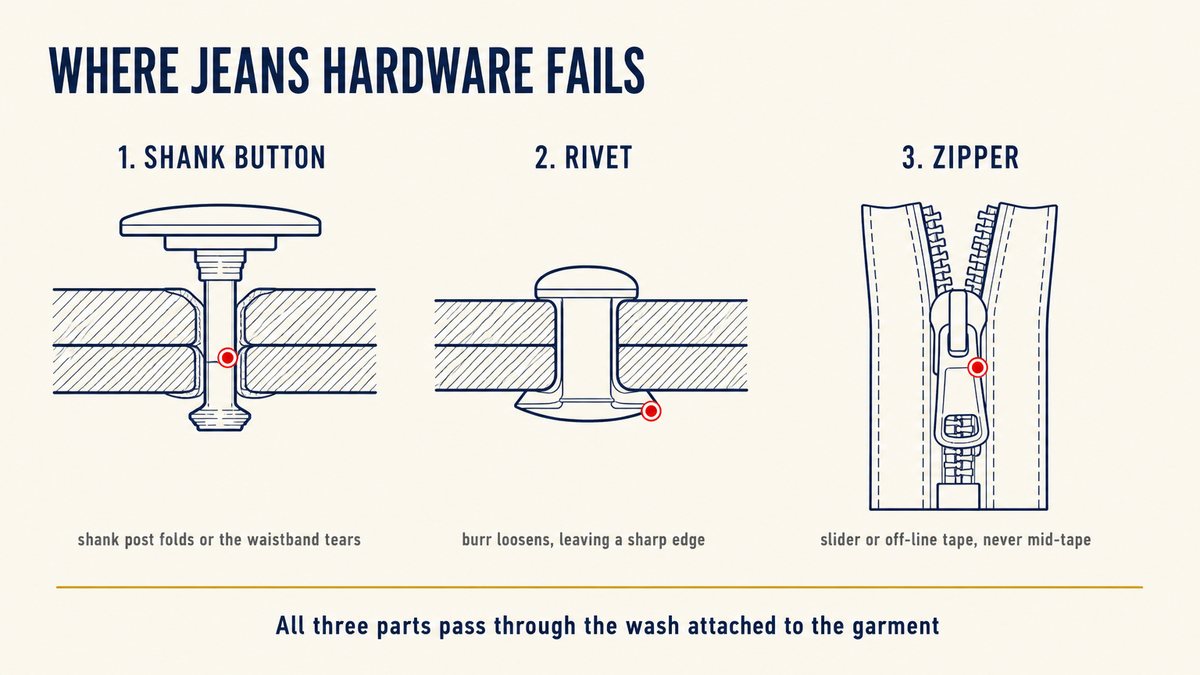
A shank button is held to the waistband by a metal post that is struck over on the inside. The failure mode is not the button face cracking, it is the post folding or the waistband tearing around it. A cheap zinc-alloy button is more likely to crack at the shank than a brass one, and the difference is not visible from the outside.
Rivets fail at the burr, which is the small cap that holds the rivet through the pocket corner. If the burr is too soft it loosens, and a loose rivet is a sharp edge against skin. A zipper rarely fails in the middle of the tape; it fails at the slider, or when the tape is sewn in slightly off-line so the teeth never mesh cleanly.
So the checks to agree before production are specific: the pull-off strength of the button, the burr security at each rivet, and a zipper function test across the full length plus a flex test at the slider. These are cheap tests to run on a first article and expensive to discover on a finished order of twenty thousand pieces. The first article inspection stage is where they belong.
Corrosion: the wash is the harshest thing that happens to the metal
Buttons and rivets go through the laundry attached to the garment, which means they meet water, heat, enzymes, and sometimes bleach. A plated part can lose its plating in the drum and come out looking dull while the rest of the garment looks right. If your hardware has a coloured or polished finish, ask for a sample that has been through the actual wash recipe your order will use, not a polished sample straight from the trim supplier.
The metal itself: the part with a legal answer
Buttons, rivets and zipper pulls sit against skin for hours, which puts them in a different category from a purely decorative metal part. Nickel is the substance to think about, because it is a common cause of skin reactions in people who wear metal against the skin all day.
The practical approach is to ask, in writing, for the metal specification of every metal part and for the test report that supports it. Then check that the report names the actual part, the actual metal, and a test method — a report that covers "buttons" without naming the metal or the method is not worth the paper. Ask too which market the report was written for, because limits differ between markets and a report written to one market's limit does not answer a question about another's.
5. Fit, Grading and Shrinkage: Why Waist and Inseam Are in Inches
Denim is sold by waist and inseam in inches in the United States, so the pattern, the size chart, the specification sheet and the inspection measurements should all be in inches. Converting to centimetres and back introduces rounding at every step, and rounding is how a size chart ends up half a size off across a whole range.
Pick one unit for the whole conversation and keep it. If your factory works in centimetres internally, fine — but the document you approve should state the inches, and the inspection report should come back in the same inches you approved.
The measurement has to name the state of the garment
Denim shrinks when it is washed, and it shrinks unevenly: the warp and the weft do not move by the same amount, which is why a washed jean can be right in the waist and short in the leg. This is why every measurement in a specification must be tied to a condition — after washing, relaxed, laid flat, measured before the first wear — or the number is meaningless.
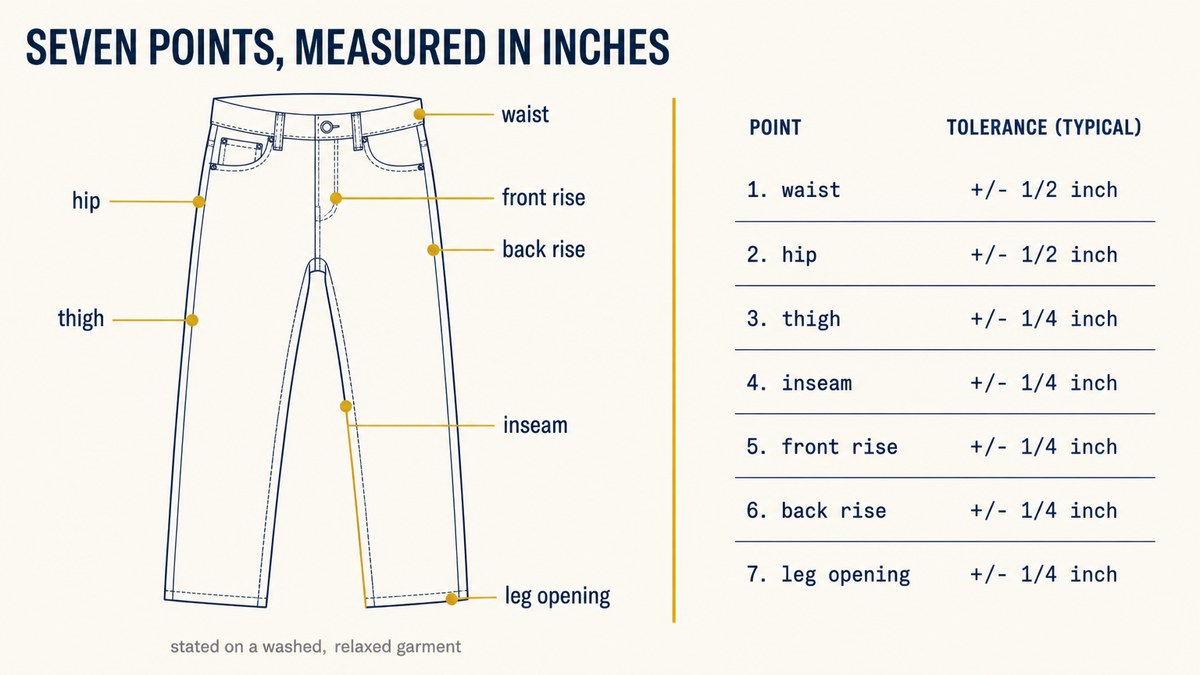
Write the condition into the sheet, then agree a tolerance for each point. A typical sheet looks like this.
| Measurement point | Typical tolerance | Why it matters more or less than the others |
|---|---|---|
| Waist, laid flat | ±1/2 inch | The point a customer notices first, and the one a return is most often about. |
| Hip, at the widest point | ±1/2 inch | Controls whether the jean sits or pulls. A hip that is tight makes the whole fit read as wrong. |
| Thigh, 1 inch below the crotch | ±1/4 inch | A small number here changes comfort noticeably, and it is the point factories most often cut close to save fabric. |
| Inseam | ±1/4 inch | The easiest point to hold, because it is cut to length. If it is out, the cutting table is the problem. |
| Front rise | ±1/4 inch | Decides where the waistband sits, which is the whole character of the fit. |
| Back rise | ±1/4 inch | Too short and the jean gaps at the back when the wearer bends. A very common complaint and a cheap fix at the pattern stage. |
| Leg opening | ±1/4 inch | Small in absolute terms but it is what makes a straight cut look like a straight cut. |
Grading: the waist steps, the inseam usually does not
Sizing up is not a uniform enlargement. Around the waist and hip the steps are real increments, and the steps are usually smaller at the top of the range than at the bottom, because bodies do not scale evenly. The inseam is different: a leg length is a leg length, so most ranges hold two or three inseam options flat across the waist sizes rather than grading the inseam continuously.
This is worth checking on the size chart before you approve it. A chart where every measurement grows by the same amount at every size, including the inseam, is a chart that was generated rather than graded, and it will produce a range where the middle sizes fit and the ends do not.
6. The Labelling Rules: Fibre Content, Care and Flammability
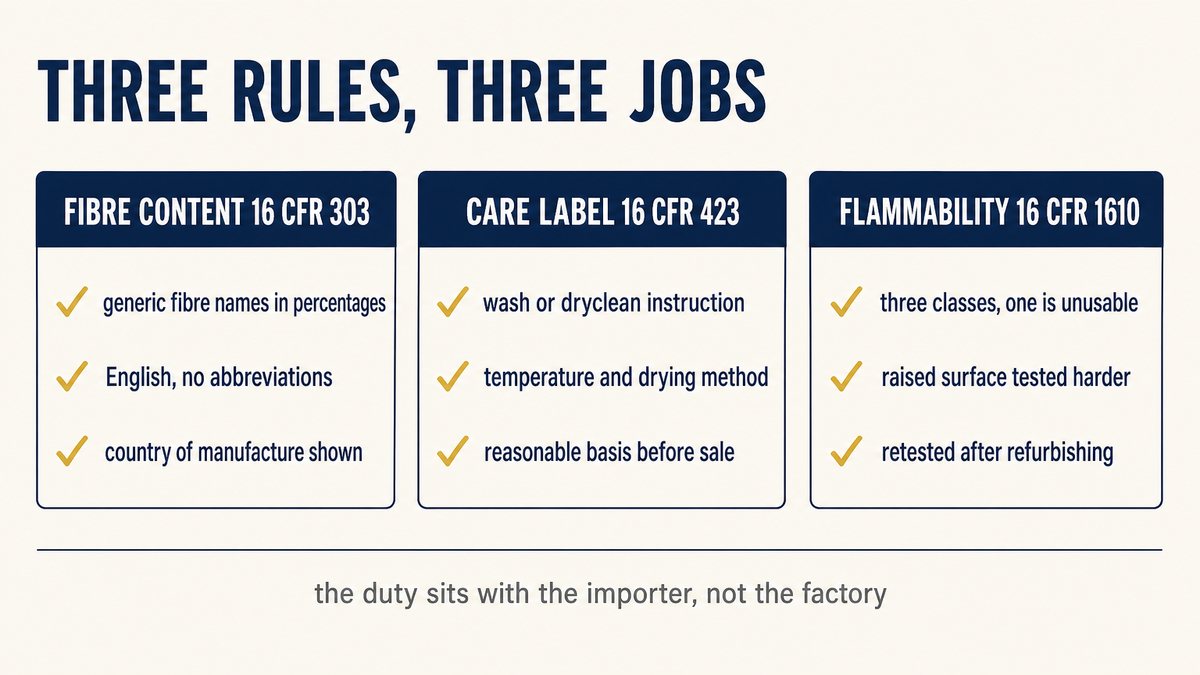
Three United States rules apply to every pair of jeans you import, and all three place the duty on the importer rather than the factory. Nobody at the factory will raise them with you, because they are not the factory's responsibility. You are the importer, so you are the one who has to get them right.
What it is made of: the fibre content rules
Fibre content is governed by the rules under the Textile Fiber Products Identification Act, collected at 16 CFR Part 303. The rules are more specific than most buyers expect, and a few of the requirements regularly catch imports out.
Fibres have to be named by their generic name, in percentages by weight, and the order is by weight from the largest down. The statement has to be in English. Abbreviations, ditto marks and asterisks are not allowed as substitutes for a fibre name, which means a label cannot say "60% cotton, 30% poly, 10% other" as a shorthand for the full generic names. A registered identification number can stand in for the company name, and the country where the product was processed or manufactured has to appear as well.
There is also a rule about using the words "All" or "100%", and a rule setting tolerances on fibre content. The tolerances matter for a stretch jean specifically, because a small percentage of elastane is doing a lot of work. If the label claims a figure, the garment has to sit within the allowed range of that claim, and a supplier who blends slightly differently to save money can push you outside it without telling you.
How to clean it: the care label, and the duty that comes before the sale
Care labelling is governed by 16 CFR Part 423. The label must give either a washing instruction or a drycleaning instruction. If it gives a washing instruction, it has to say whether the garment is machine washed or hand washed and give a water temperature in ordinary terms such as cold, warm or hot — unless hot water up to 145 °F will not harm it, in which case no temperature needs to be named. It must state how to dry it and, if machine drying is allowed, a drying temperature, on the same principle. Ironing appears only when it is regularly needed. Bleach is covered by three specific options: no mention when any bleach is safe, "No bleach" or "Do not bleach" when none is, and "Only non-chlorine bleach, when needed" when only the non-chlorine type is safe. Warnings have to use words such as "Do not", "No" or "Only".
Then comes the part that matters most for a sourcing decision. The rules require that the manufacturer or importer has a reasonable basis for the care information before the product is sold, and treating a failure to hold that basis as an unfair or deceptive practice. The basis can be reliable test evidence, the results of a fair sample test, or current technical literature and past experience — but it has to exist, and it has to exist in advance.
This is the single most useful sentence in this article for a buyer. A factory telling you "machine wash cold" is not a reasonable basis — it is a sentence. What you need is the test evidence that supports the wash instruction you are about to print, and you need it before the goods are sold, not after a customer complains. Ask the factory for it as a document, keep it with the order file, and treat "we have always used that label" as an answer that has not answered anything.
Whether it is safe to wear: the flammability standard
Clothing textiles also have to meet the flammability standard for clothing textiles at 16 CFR Part 1610. The standard sets three classes, and the middle one is only available to some fabrics.
For a plain surface fabric, a burn time of 3.5 seconds or more is Class 1, normal flammability, and is acceptable for clothing. Below that, the fabric is Class 3 — described in the standard as rapid and intense burning, and not to be used for clothing at all. Class 2 is intermediate flammability and applies only to raised surface fabrics, which can be used for clothing.
That phrase, raised surface textile fabric, is why this section belongs in a jeans guide. The standard defines it as a fabric with an intentionally raised fibre or yarn surface, such as a pile, including flocked pile, nap or tufting. Brushed-back denim and fleece-lined denim sit squarely inside that definition. Raised surface fabrics are tested differently from plain ones, the specimens are brushed before testing, and the pass level is a longer burn time — more than 7.0 seconds, or a rapid surface flash that is too weak to ignite or fuse the base fabric.
There is a further step that surprises people. The fabric has to be tested both as supplied and again after being refurbished, which in the standard means dry cleaned and then laundered. The final classification is whichever of the two results is worse. A lined winter jean can pass comfortably on the fabric as supplied and fail after the refurbishing cycle, which is the kind of outcome you want to discover on a test report rather than in a customs inspection.
One labelling point connects back to the country of origin, which has to appear on the label. Where the jeans are sewn decides what that statement should say, and the wording is narrower than most suppliers assume — our origin marking guide walks through the difference between the accepted forms.
7. How to Inspect a Jeans Order
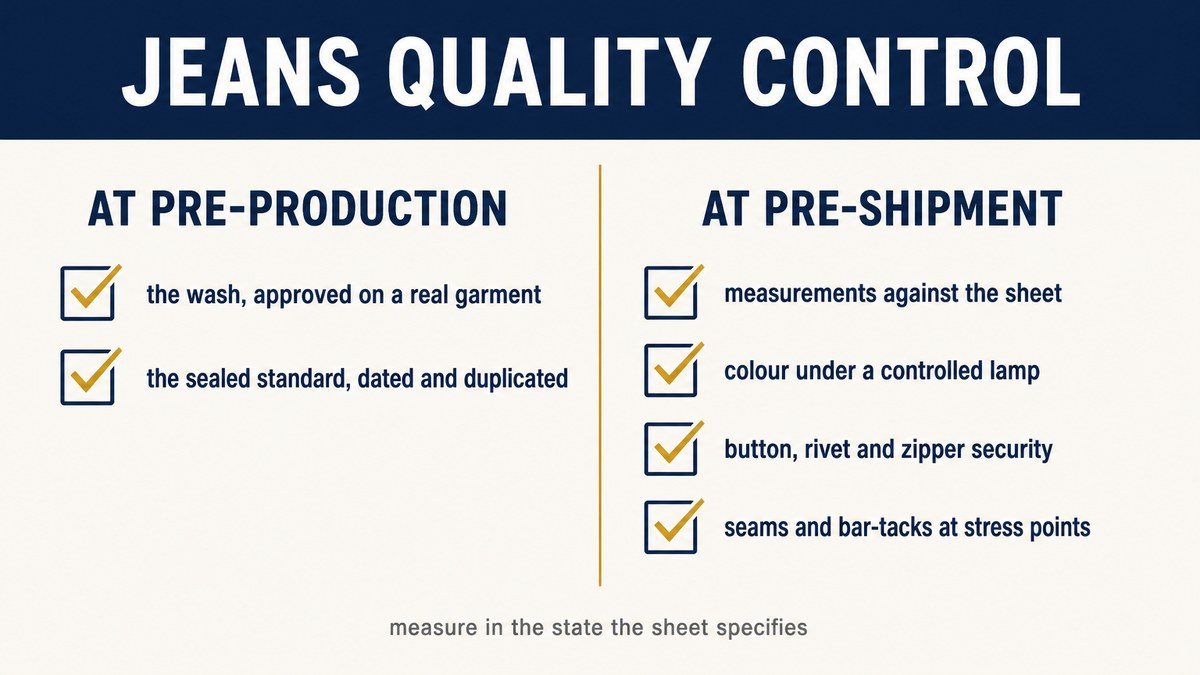
Inspect in two stages: approve the wash before bulk starts, then check the finished order against the sealed standard. Both stages are cheap, and neither can be replaced by the other.
The pre-production stage is where the wash recipe gets settled. Nothing should go into bulk until a garment has been washed, measured and approved, because everything downstream depends on that one decision. Once bulk is running, the pre-shipment stage checks four things.
- Measurements against the sheet. Measure a spread of sizes, not just the middle one, and measure them in the state the sheet specifies. A garment measured straight off the line is not the same object as a washed one.
- Colour against the sealed standard. Do this under a consistent light, ideally a daylight-corrected lamp, with the production piece and the standard side by side. Checking colour under a warm bulb or from a photograph on a phone is how disagreements start.
- Hardware security. Check the button pull-off, every rivet burr, and run the zipper the full length. Also check the hardware colour has survived the wash, which is where a plated part shows up as different from the rest.
- Seams and stress points. Look at the inseam and the crotch, the bar-tacks at the pocket corners and the belt loops, and whether the seam allowances have been finished or left raw and fraying.
Two checks are worth adding for specific products. On stretch denim, take a garment and stretch the knee area, hold it, release it, and see how it comes back. On lined or brushed goods, check the lining is attached where it is meant to be and does not twist after washing. Our pre-shipment inspection guide covers how to set the inspection up so the report comes back with measurements you can act on rather than a paragraph of opinion.
8. Tooling, MOQ and the Private Label Route
What limits your minimum order in denim is usually the washing, not the sewing. A sewing line can start and stop at almost any quantity, but a wash drum has to be loaded to a sensible level or the recipe does not behave, so the laundry sets a minimum per colour and per wash. This is the practical reason a three-colour order costs more per piece than a one-colour order: you are buying three separate drums, not three times the sewing.
| Route | What you are buying | What drives the minimum |
|---|---|---|
| Stock fit with your labels | An existing pattern and grade, with your woven label, patch and hardware | The wash drum and the label print run. Cheapest route, and the fastest to a first sale. |
| Stock fit, changed fabric or wash | An existing pattern in a denim or wash the factory has to develop for you | Fabric availability per colour, plus the wash development rounds. A new wash is a project, not a line item. |
| Your own pattern and grade | A pattern made to your measurements, graded across your size range | Pattern and grading time, sample rounds, and the size range itself. A wider range multiplies the fitting work. |
Tooling in this category is modest by hard-goods standards. There is no injection mould, so the fixed costs sit in pattern making, grading, sample rounds and the wash development rather than in a tool. That makes denim friendly to a first order — and it also means the fixed cost is mostly time, which is why sample rounds are the thing to protect when a schedule slips. Our custom logo printing and finishing guide covers the label, patch and hangtag options, which are where a small brand gets the most visible quality for the least money.
9. A Five-Step Jeans Sourcing Roadmap
- Fix the specification before you ask for a price. Weight, fibre content with percentages, stretch and recovery, wash type, and the measurement sheet with its condition and tolerances. A quotation against a loose brief cannot be compared with anything.
- Separate the four cost lines in the quotation. Fabric, cut and sew, wash, and trims. Ask which are done in-house and which are subcontracted, so you know where your colour and your deadlines actually live.
- Develop and seal the wash before bulk. Three rounds, approved on real garments, with the standard sealed, dated and duplicated. Nothing goes into production until this is done.
- Write the labelling duties down. Fibre content, care instructions with the evidence that supports them, and the testing plan. Decide who holds which document, and get it in the order file rather than in an email.
- Inspect twice. First article on a new pattern, pre-shipment on the bulk order, with the measurement report in the units you approved. Keep the sealed standards for the next order.
Everything in this guide sits inside our Apparel, Fashion & Bags sourcing hub, which collects the garment, fabric and accessory guides for this category in one place.
10. Frequently Asked Questions
Why is my jeans order more expensive per piece than the sample quote suggested?
Almost always because of the wash. A sample is a handful of garments processed alongside other work, so the laundry cost per piece looks small. In production the same wash is quoted as a full drum, and if the order runs several colours each colour needs its own load. Ask for the quotation split into fabric, cut and sew, wash and trims — once the wash is broken out you can see the real driver instead of guessing. A second common cause is hardware: a cheap sample button is often replaced with the specified one at production, at a price nobody quoted.
Can I ask the factory to match a Pantone colour for my denim?
Not in the way that works for a solid-dyed fabric, and it is worth understanding why before you make it a requirement. Indigo denim is dyed on the surface of the yarn while the core stays white, and the finished shade depends on how many dips the yarn took and what the wash did to it afterwards. There is no single dye lot that fixes the colour. The workable approach is to approve a washed garment as the standard, seal it, and measure later production against that garment. Ask for a Pantone match and you will get a verbal yes and no protection.
What does "recovery" mean in stretch denim, and why should I care?
Recovery is how completely the fabric returns to its original size after being stretched and held. Stretch percentage tells you how far the fabric can go; recovery tells you whether it comes back. A jean made from fabric with good stretch and weak recovery will fit well in the shop and bag at the knees and seat during the first day of wear, which is exactly the kind of fault that turns into a return. Ask for both figures, plus growth measured after a set time under load. If the factory only has the stretch number, they have quoted the easy figure.
Do the United States labelling rules apply to me if the factory prints the labels?
Yes, and this is the most common misunderstanding in the whole process. The duties fall on the manufacturer or importer, which means the brand selling the jeans in the United States, not the factory that printed the tag. Three sets of rules apply: fibre content under the textile fibre rules, care instructions under the care labelling rule, and the flammability standard for clothing textiles. The care labelling rule goes further than most people realise — it requires a reasonable basis for the care information to exist before the product is sold, so a verbal instruction from the factory is not enough. Hold the test evidence yourself.
Are fleece-lined or brushed-back jeans treated differently from ordinary denim?
Yes, and this catches people out because the difference is not obvious. Under the clothing flammability standard, a fabric with an intentionally raised fibre surface — a nap, a pile, a brushed back — is classified as a raised surface textile fabric and is tested differently from a plain one: the specimens are brushed before testing and the required burn time is longer. The fabric also has to be tested twice, once as supplied and once after a dry clean and launder cycle, and the worse of the two results is the one that counts. A lined winter jean can pass comfortably on the first test and fail on the second, which is why the test programme belongs in the order plan.
How do I know whether a quoted minimum order is real?
Ask what sets it. In denim the honest answer is usually the wash drum, because a laundry needs a sensible load for the recipe to behave, and that minimum applies per colour rather than per order. If a supplier quotes a minimum that seems unusually low, ask which parts are done in-house and how the wash will be run — sometimes the answer is that the goods are added to someone else's drum, which works, but it means less control over your colour and a schedule you do not own. A minimum tied to a real constraint is a minimum you can plan around.
Get the Wash Sealed and the Labels Checked Before You Order
Our team writes the denim specification in weight, stretch and recovery, separates fabric, wash and trims into comparable cost lines, develops the wash to a sealed standard on real garments, and checks the fibre content, care instruction and flammability position before anything is printed. You get a quotation you can compare and a product that does not come back.
Request a Jeans Sourcing Quote
Questions & Comments
We read every one and reply within 24 hoursCOMMENTS INTRO FOR THIS ARTICLE — write a topic-specific question prompt here.