
Dropshipping Home Decor: The Parcel, Not the Product, Decides Your Margin
 ·
Updated October 13, 2026
·
15 min read
In most categories the carrier charges you for what the parcel weighs. In home decor that is often not what happens, because a mirror, a lamp shade or a floor vase takes up a great deal of room while weighing almost nothing. When the two disagree, the carrier charges for the space, and the spread between the two numbers is where a home decor margin quietly disappears.

What You Are Actually Charged For
| Measure | What it describes | When it decides the bill |
|---|---|---|
| Actual weight | What the parcel weighs on a scale. | When the item is dense, such as ceramics or metal. |
| Dimensional weight | A weight worked out from the box's length, width and height. | When the item is large and light, which is most home decor. |
What this guide covers
1. Why Is Home Decor Priced by the Box?
Because a delivery van and an aircraft hold are limited by space as much as by weight, and a carrier has to recover the cost of the room your parcel takes up. A parcel the size of a coffee table occupies the same slot whether it holds a heavy machine part or a handful of dried flowers.
Home decor sits at the worst end of that trade. The category is full of items chosen precisely because they are big enough to be seen from across a room: mirrors, framed prints, lamp shades, floor vases, woven baskets, oversized cushions. Every one of them is designed to occupy volume, and volume is the thing the carrier is selling.
So the cost question in this category is not "how heavy is it" but "how much room does it take". That single change of question explains most of the pricing surprises sellers meet, and it is the reason two products with identical unit costs can have completely different margins.
2. What Is the Rule, Written Out?
The rule is simple enough to apply on paper, and the United States Postal Service states it plainly. The chargeable figure is the greater of the actual weight and a weight worked out from the size of the parcel.
Additional Fees: Dimensional (DIM) weight rates apply to large, lightweight packages. If your package is larger than 1 cubic foot (1,728 cubic inches): Multiply Length x Width x Height and divide by 139 to get the DIM weight in pounds. Any fraction of an inch must be rounded up to the next whole inch.
Two details in that wording decide a lot of money, and both are easy to miss. First, the size-based figure only applies above one cubic foot, which is 1,728 cubic inches, and a parcel has to be larger than that before it comes into play at all. Second, every measurement is rounded up to the next whole inch before the sum is worked out. A box that is 23.2 inches long is measured as 24, and that extra inch is charged for.
The same section of the Postal Service's rules puts the greater-of principle in formal terms:
Postage for Destination Entry parcels exceeding 1 cubic foot (1,728 cubic inches) is based on the actual weight or the dimensional weight, whichever is greater.
USPS Domestic Mail Manual 253.1.2, Dimensional Weight Price for Low-Density Parcels
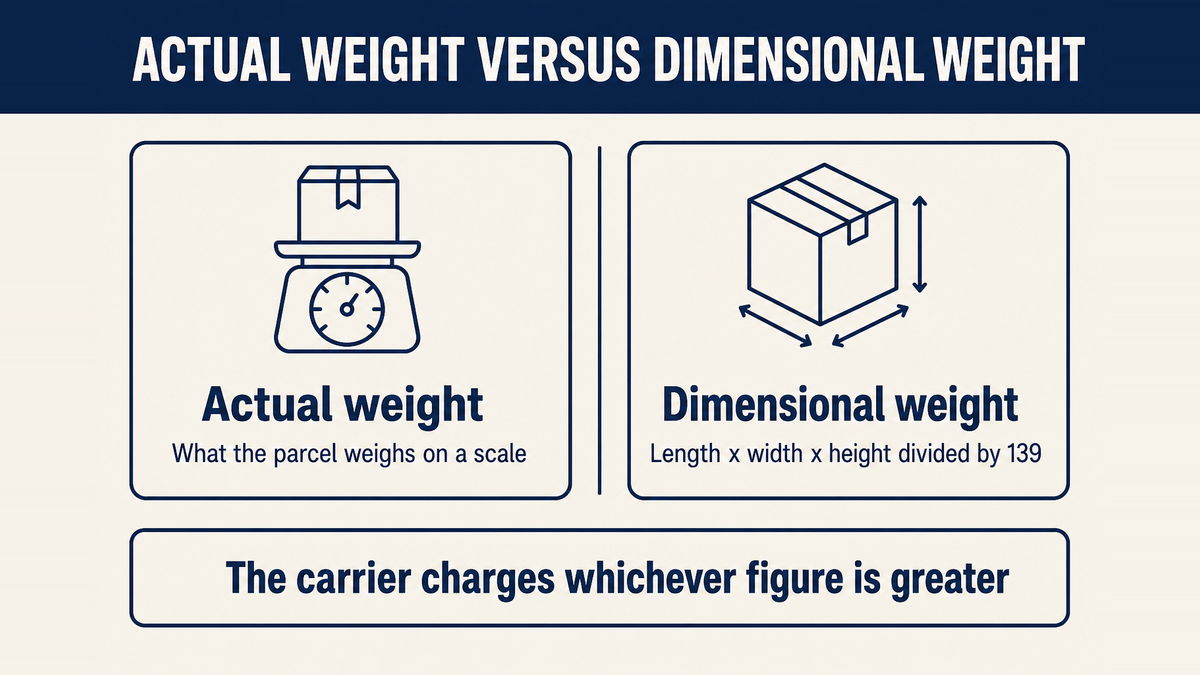
Take the measurement from the outside of the parcel, not from the product. The box adds to every dimension, and because each measurement is rounded up on its own, a box that pushes a side past the next whole inch adds a full inch to that side of the calculation rather than the fraction you actually spent.
3. Four Worked Examples
The arithmetic explains the category faster than any description, so here it is applied to four items a home decor store might actually list. Each uses the method above, with each measurement already rounded up and the result rounded up to the next whole pound.
| Item | Actual weight | Box (inches) | Cubic inches | Charged as |
|---|---|---|---|---|
| Ceramic vase | 6 lb | 13 x 12 x 12 | 1,872 | 14 lb |
| Wall mirror | 4 lb | 30 x 24 x 4 | 2,880 | 21 lb |
| Set of 4 planters | 14 lb | 20 x 20 x 20 | 8,000 | 58 lb |
| Flat-pack side table | 30 lb | 32 x 20 x 6 | 3,840 | 30 lb, because the actual weight is higher |
Read the mirror line again. The item weighs four pounds and is charged as twenty-one, because 30 by 24 by 4 is 2,880 cubic inches, and 2,880 divided by 139 is 20.7, rounded up. The parcel is being billed for the air around the glass.
You can run this check across your own range in an afternoon. For each item, take the carton you actually ship it in, measure the outside in inches, round every side up, multiply the three numbers, and divide by 139. Put that figure next to the actual weight and keep the larger of the two. Then sort the list by the gap between them, and the worst offenders in your catalogue will all be waiting at one end of it. That gap is the money you are paying for air.
The flat-pack table shows the other side of the rule working in your favour. Its box is large enough to trigger the size-based figure, which works out at 28 pounds, but the item is genuinely heavy, so the actual weight wins and the volume is never charged. That is the shape to aim for in this category: dense enough that the scale decides the bill rather than the tape measure.
4. Why Is Light and Bulky the Worst Shape?
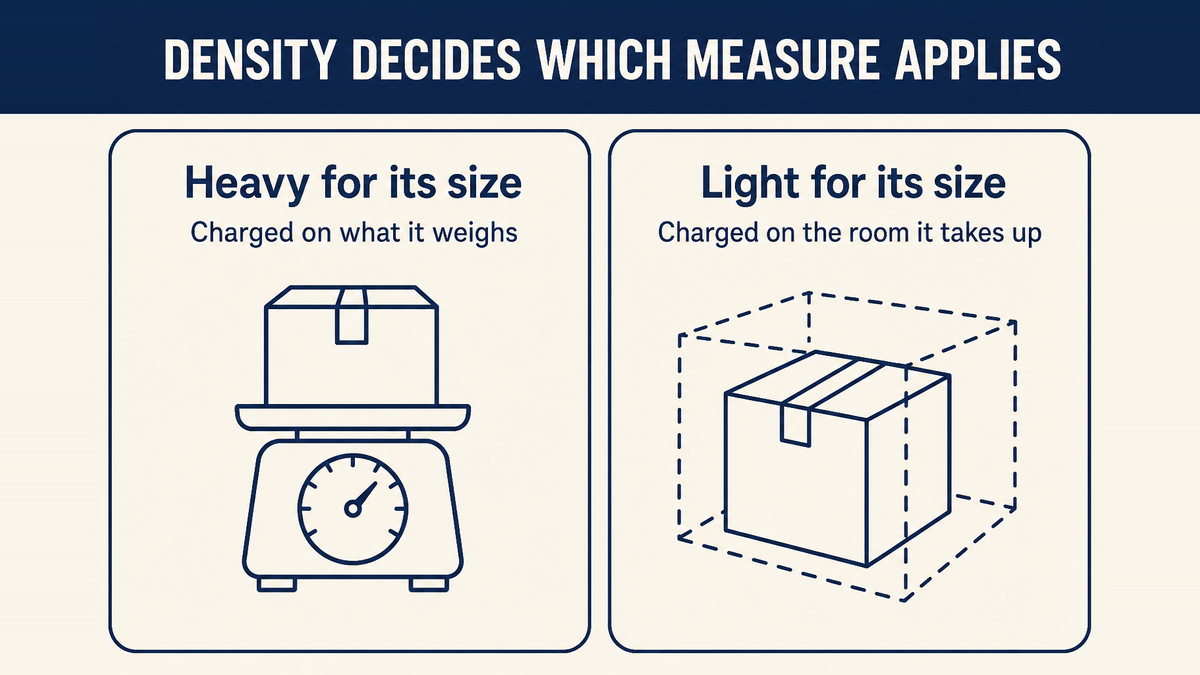
Because the two measures disagree exactly where home decor lives, and the disagreement runs one way. Sort the category by a single ratio, weight divided by volume, and the behaviour becomes predictable.
An item that is heavy for its size never faces the size-based charge, because the scale always wins. An item that is light for its size always faces it, because the tape measure always wins. There is no middle ground where the seller escapes: the parcel is billed on whichever figure is larger, and one of the two is always larger.
That is why a woven basket and a granite bookend of the same selling price can have completely different economics. The bookend is charged for what it weighs. The basket is charged for the room it takes up, which may be several times more.
There is a second half to the problem, and it is about price rather than size. The parcel costs what it costs no matter what is inside it, so the cheaper the item, the larger the share of its selling price that delivery takes. A low-cost, low-density item is the one combination in this category where shipping can be a bigger number than the product. That is the shape to avoid, and it is also the shape most easily found, because light and inexpensive items are exactly what is easiest to import and store.
The same volume problem appears on the import side, where air and express freight are priced on volumetric weight for the same reason. Our guide to working out volumetric weight covers how the figure is built for shipments, and how a shipment that is priced on volume changes what you should buy in the first place. If you are still choosing between air and sea for a bulky range, that comparison is in our air freight versus sea freight guide.
5. How Do You Shrink the Parcel?
You cannot make the product heavier to escape the size-based charge without wasting money, so the lever is volume. Three changes to the way an item is bought and packed do most of the work, and all three are decided with the supplier rather than with the carrier.
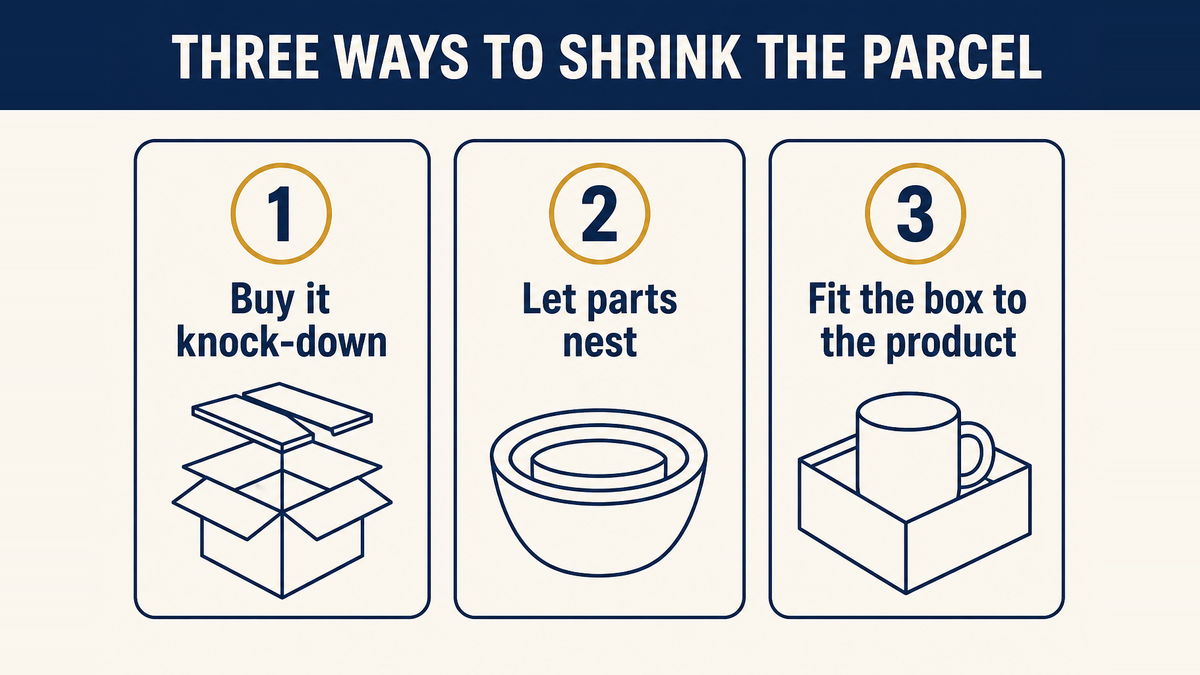
- Buy it knock-down. A table, a shelf or a lamp base that ships as flat parts rather than assembled ones can cut the parcel from a cube to a slab. Ask for the knock-down version by name, because many suppliers offer both and quote the assembled one by default. This is the single largest change available in the category, and our guide to buying furniture from China covers how flat-pack changes cost, damage and returns at the same time.
- Let parts nest. A set of four planters stacked inside one another is one parcel the size of the largest planter. A set of four packed side by side is a parcel four times as wide. Ask the factory to nest wherever the shape allows, and specify it, because unless the order says so the default is to protect each piece separately.
- Fit the box to the product. Void fill protects an item, but it also adds volume that is charged for on every parcel. Ask for the smallest box that still passes a drop test rather than whatever carton is nearest the packing bench, and remember that each measurement is rounded up on its own, so a box designed to land just under the next whole inch saves more than the fraction involved.
A worked figure shows what the rounding rule is worth. Suppose a cushion needs a carton 22 inches wide, and the supplier's nearest standard carton is 23.5 inches. That carton is measured as 24, and with the other sides at 22 and 18 the cubic size goes from 8,712 to 9,504. Divided by 139 those work out at 63 pounds and 69, so one and a half inches of extra width costs six pounds of chargeable weight on every single parcel. Over a year of orders, a carton decision made on price alone can outweigh the carton price by a wide margin.
Do not trade protection for volume without testing. A parcel that arrives broken costs far more than a slightly larger box, because you lose the product, the outward freight, the return and the customer at the same time. Cut the box down, then put the smaller box through a drop test before you make it the standard. Our guide to corrugated box types and flute grades covers how board grade and box style trade strength against thickness, and our overview of packaging materials for wholesale sets out what each option costs and protects.
6. What Do You Do With the Items That Fail?
Some pieces cannot be made dense or small without becoming a different product. For those, the useful move is to decide deliberately rather than to discover the problem after a month of selling at a loss.
| Situation | What it usually means | The move that fits |
|---|---|---|
| Size-based figure is a little above the actual weight | The parcel is close to the break-even shape. | Shrink the box or build the cost into the price. |
| Size-based figure is far above the actual weight | The item is a volume product and will always be priced as one. | Bundle it, so one parcel carries several items and one charge covers them all. |
| Item is genuinely large and cannot be nested | The parcel network is the wrong channel for it. | Treat it as freight rather than as a parcel, and price it with that in mind. |
| Item is low-priced and light at the same time | Delivery will always be a large slice of the selling price. | Drop it from the range, or move it into a set with a denser product. |
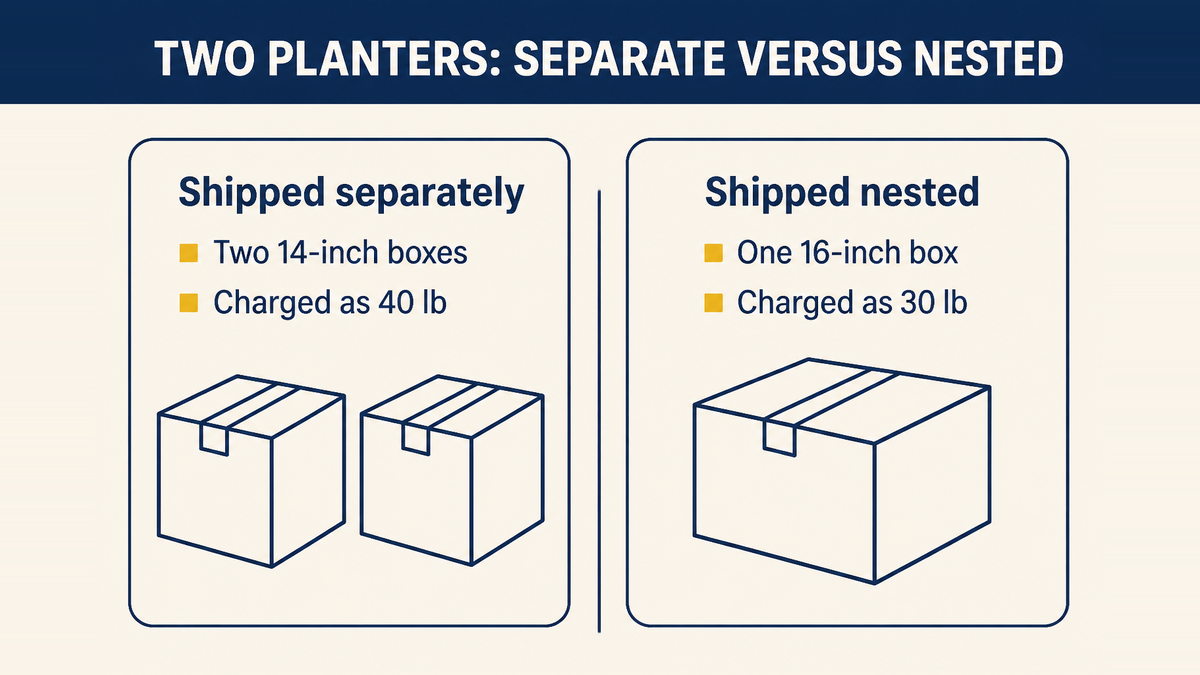
Two planters show how much that is worth. Sent one to a parcel in a 14-inch cube each, both are charged at 20 pounds, so 40 pounds in total. Nested inside one another in a 16-inch cube, the pair weighs 16 pounds and is charged at 30. The second planter has travelled for ten pounds of chargeable weight instead of twenty, and there is one parcel to track rather than two.
Bundling deserves more attention than it usually gets, because it works directly against the structure of the charge. The size-based figure is worked out once per parcel, so filling a parcel that is already being sent with a second light item adds almost nothing to the shipping cost and adds a whole item to the order. Two nested planters in one box are cheaper to send than two boxes containing one planter each, and the same logic holds for a mirror and its hanging kit, or a vase and its dried stems.
Where the item really cannot be reduced, the honest answer is often to stop selling it as a parcel. Assembled furniture is the clearest case: it travels as freight, it is more likely to arrive damaged, and it is expensive to send back, which is a poor fit for a store whose promise is a quick parcel. The pieces that do work in a parcel-based home decor range tend to be accessories and flat-pack items rather than anything assembled. If you are choosing what to stock next, our notes on picking a product that sells cover the demand side, and our guide to warehouse picking and courier rates covers what a fulfilment partner charges per parcel once the volume figure is already fixed.
7. Frequently Asked Questions
Why is shipping so expensive for home decor?
Because carriers charge on the greater of actual weight and dimensional weight. A large light parcel is billed for the space it fills, so a four-pound mirror in a thirty-inch box can be charged as twenty-one pounds.
What is dimensional weight?
It is a weight worked out from the size of the parcel rather than what is inside it. Multiply the length, width and height in inches, then divide by the carrier's divisor, which is 139 in the United States Postal Service method. Round the result up to the next whole pound.
Which home decor items are hardest to ship?
Anything large and light: mirrors, lamp shades, wall art, floor vases and open baskets. They take up a lot of space for very little weight, which is exactly the shape that dimensional weight treats worst.
How do I reduce shipping cost on bulky items?
Cut the volume rather than the weight. Flat-pack the item, let pieces nest inside each other, and use a box that fits the product instead of one that is nearly the right size. A few inches off one side can move a parcel into a cheaper band.
Should I dropship furniture at all?
Only in a narrow form. Flat-pack pieces and small accessories can work, but assembled furniture travels as freight, arrives damaged more often, and is expensive to return, so the parcel network is the wrong channel for most of it.
Four Items, Priced by the Parcel
We return four configurations of your range with the dimensional charge for each, and the carton change that removes the surcharge.
Price My Four Items
Questions & Comments
We read every one and reply within 24 hoursNot sure whether an item in your range is being billed on weight or on size, or got a shipping quote that looks far too high for what the box holds? Post the item, the box dimensions and the actual weight, and our team will work out the chargeable figure and where the volume is going.