
Wholesale Furniture Suppliers in China: A Buyer's Guide
 ·
Updated October 11, 2026
·
20 min read
Furniture is the one category where the shipping usually costs more than the goods, and where one rule makes you — not the factory — the company legally responsible. Both of those surprise first-time buyers, and both are decided before a single order is placed. A sofa or a cabinet is mostly air once packed, so the design decision that matters most is how flat it can be made to travel; and if the piece contains any composite wood panel, the panel has to be certified, and the party who keeps the paperwork is the one importing it. This guide covers what you are actually buying, why the panel core and the moisture figure decide the outcome, which rule makes you the regulated party, where the furniture gives way first, why freight usually beats the product price, and where a cheap quotation gets its money back.
What to Pin Down First, by What You Are Buying
| If you are buying | Pin this down first | Because |
|---|---|---|
| Anything with a composite wood panel in it | The panel's formaldehyde certification, and the name of the certifier | The importer, not the factory, is the party the rule binds. A certificate you cannot look up is not a certificate you can rely on. |
| A bulky item where you want a low landed cost | The packed volume per unit, before the unit price | On furniture the freight is normally the largest single line, so a design that packs flatter saves more than any discount you could negotiate. |
| Anything with a drawer or a door | The hardware by brand and grade | Hinges, runners and catches are bought-in parts, usually made by a different company from the furniture, and they are what your customer touches every day. |
| Flat-pack or knock-down furniture | The joint system, and who assembles it the first time | A knock-down joint is only as good as its fittings and its instructions. The customer assembles it in a room you have never seen. |
| Anything with solid wood in it | The moisture content as a number, and how it was measured | Wood moves as the air around it changes, and it keeps moving after it has been delivered. A board dried for one climate will not behave in another. |
| An order shipped on wooden pallets or in a wooden crate | Whether the wood carries a valid heat-treatment stamp | Untreated solid wood packaging can be refused at the destination border, and the cost of that falls on the importer. The full set of rules is covered in our guide to the palletizing rules for a sea container. |
What Are the Four Ways Wholesale Furniture Is Built, and Which Are You Buying?
Four constructions, and the price gap between them has almost nothing to do with how the piece looks in a photograph. This is the single most important thing to understand about this category: a finished piece of furniture tells you what is on the outside and almost nothing about what is underneath it.
Solid wood. The piece is made from timber, often in several parts joined together. It is the most expensive route, the one buyers ask for by name, and the one most often misdescribed — a piece can be solid wood in the frame and something else entirely across the top and the sides. When a supplier says solid wood, the useful next question is which parts, and in what thickness.
A panel with a real wood face. A manufactured board with a thin slice of real timber glued to the visible surface. This is how most mid-market and premium furniture is actually made, because it is more stable than solid timber and far cheaper for large flat surfaces. The word to watch is the thickness and the quality of that facing slice, because it is a very thin layer with a real cost difference between grades — and it is the layer that lifts when something goes wrong.
A panel with a factory-made face. A board with a printed or laminated surface instead of real wood: melamine paper, a printed decor, or a hard laminate. These are the workhorses of flat-pack and contract furniture, they are hard-wearing, and they are the easiest to clean. The trade-off is that the wood grain is a picture rather than a material, so the edge of every panel has to be finished properly or the illusion collapses the moment somebody looks at a cut edge.
Knock-down, which is a delivery method rather than a material. Any of the three above can be built to ship flat and be assembled at the other end. Buyers often treat this as a budget option, and it is true that it is the cheapest way to move furniture — but it is not automatically a cheaper product. A well-engineered knock-down piece can be better made than a cheap assembled one, because the design had to solve the joint instead of hiding it. What it always adds is a dependency: the customer, or their staff, has to put it together correctly.
The verdict runs the opposite way from what most buyers expect. At the top of a market, solid wood in the visible parts and a stable panel where nobody looks is normal and sensible. Selling volume, a faced panel built to knock down is the right answer, and the money you would have spent on timber is better spent on hardware and edge finishing. What you should not do is pick a construction by the photograph, or take a supplier's word for which of the four you are getting without it written into the specification — and writing it down properly is the same exercise as building any product specification sheet for a Chinese factory.
Why Does the Core of the Panel Decide Everything?
Because the visible surface is the thinnest and cheapest layer of the three that make up a panel, and the two you cannot see are the ones that decide whether the piece is still straight in a year.
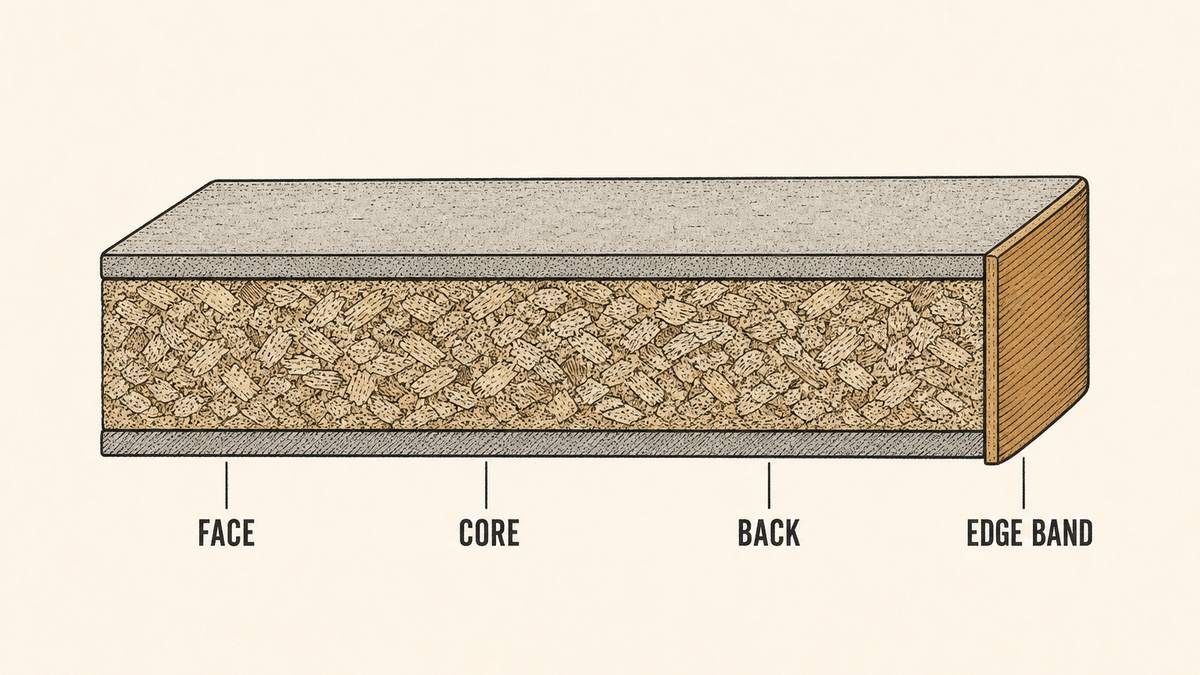
The core is the board, and the board is a choice. Medium-density fibreboard, particle board, plywood, blockboard and solid timber all get called “wood” in a quotation. They differ in weight, in how well they hold a screw, in how they behave when they get damp, and in price. Particle board is the cheapest and the weakest at a fixing point; plywood is the most dimensionally stable and the most expensive of the manufactured options; solid timber is the strongest and the most likely to move. Ask for the board by name and by thickness, because “18 mm board” can mean several different products.
The back layer is not decoration, and this is the detail that separates a good panel from a bad one. A manufactured panel has a face on one side and a balancing layer on the other, and the two pull against each other. Skimp on the back — or leave it off where it will not be seen — and the panel is unbalanced, so it cups and bows as the humidity changes. A bowed door panel is not a defect that appears on arrival; it is a design decision that shows up a season later, and a common reason a buyer's second order looks worse than their first.
The edge is where the whole thing can be judged. Cut a panel and you expose the core, the one part of the board that must never be left open, because that is where moisture gets in and where the board swells and crumbles. Edge banding is the strip applied over that cut edge, and it is the cheapest place in the product to save money and the easiest to inspect. Look at it on a sample under a light: a properly applied band is tight to the surface, the same thickness as the board, with no visible line you can catch a fingernail in, and it is glued rather than just pressed on. A band peeling at a corner before the furniture has been used will be peeling at every corner after a month in a real room.
Two questions cover all of this and cost nothing to ask. First: what is the core board, by material and thickness? Second: how is the edge finished, and what is it finished with? A supplier who can answer both is quoting on a product. A supplier who answers with the name of a wood-effect colour has quoted you a picture.
Which Rule Makes You, the Importer, the Regulated Party?
If your furniture contains a manufactured wood panel, and almost all of it does, then the panels are regulated in the United States for the formaldehyde they emit, and the party the rule binds on import is the importer — you, not the factory. Buyers usually discover this late, and it is worth understanding before you choose a supplier.
What the rule covers. The standard sits in 40 CFR Part 770, made under the Toxic Substances Control Act. It applies to specified composite wood products — hardwood plywood, medium-density fibreboard and particle board — and to the finished goods that contain them. If your table top, your cabinet carcass or your drawer base is a manufactured board, the rule has something to say about it.
What it requires in practice, for a buyer. Panels have to be certified by an EPA-recognised third-party certifier, and the finished goods have to be labelled and supported by records that follow the goods. So the question is not “does the factory have a certificate” but “which certifier certified the panel in this product”. The Agency publishes both the standard and a list of the certifiers it recognises, so this is checkable rather than a matter of trust: the emission standards are set out in the EPA's formaldehyde emission standards for composite wood products, and the certifiers who can certify a panel appear on the list of EPA-recognised third-party certifiers.
Why it changes your supplier questions. A factory that buys its boards from a mill and cuts them into furniture may hold nothing that satisfies the rule on its own — the certification belongs to the panel and travels with it. So ask three things, in this order. Which board mill makes the panels in this product? Which recognised certifier certified them? Can you send the certificate, so I can match its number and the mill against the certifier's own record? A supplier who works with a serious mill answers all three without hesitating. One who has never been asked it is not organised for your market.
Two claims that are not the same as certification. “No added formaldehyde” is a resin description, used loosely in trade conversations and sometimes for panels that are not certified at all. The same goes for the emission grades buyers quote at each other, which describe a resin class rather than proving that a panel in a shipment was made and tested under the programme. Neither replaces a certificate from a recognised certifier, and neither moves the obligation away from the importer. Confirm the actual limits and the labelling requirement against the rule for the specific products you import, or with a customs broker, rather than relying on a supplier's summary of it.
And keep the paperwork. Because the duties sit with the importer, the records have to be yours and findable later. Put the panel mill, the certifier and the certificate reference on the order and keep them with the shipment file. If this is your first time buying anything made from a manufactured board, read the rule properly rather than collecting a certificate and hoping that is the end of it.
Why Does Furniture Move After It Arrives?
Because wood never stops exchanging moisture with the air around it, and furniture is dried for one climate and then delivered into a different one. This is the failure that no amount of care at the factory can prevent if the target was wrong, and it is the reason a sample can arrive perfect and a shipment can arrive a season later with complaints.
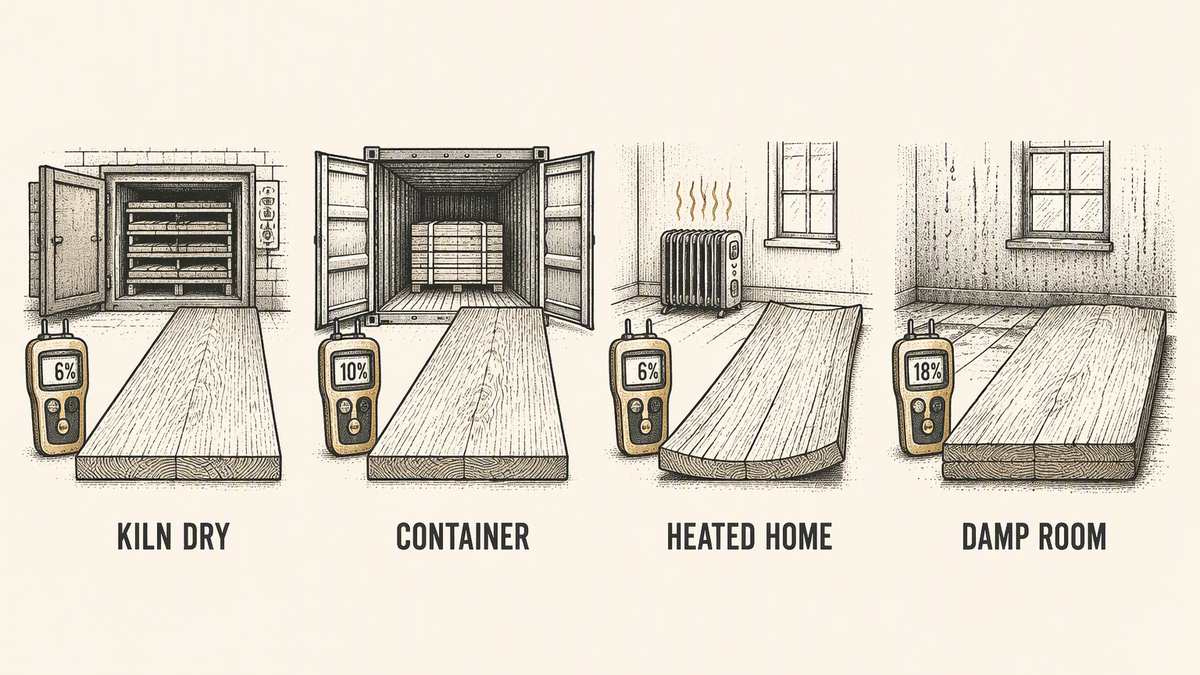
What the number means. Timber is dried to a target moisture content, expressed as a percentage of its dry weight, and the target is chosen to match the climate the furniture will live in. A board dried for a humid coastal market and then delivered into a centrally heated apartment in a cold, dry region loses moisture, shrinks very slightly across its width, and takes the whole assembly with it. A board dried for a dry market and shipped into a damp one gains moisture and swells. Same mistake, opposite directions, and neither shows up at the factory gate.
What it looks like when it goes wrong. Joints that were tight open up into visible gaps. A drawer that glided starts to bind, then sticks. A panel that was flat cups gently along its length, which on a door means it no longer meets a carcass squarely. Veneer develops fine cracks along the grain, and on a badly dried board the core itself swells at an unprotected edge and crumbles. Your customer will not blame the climate for any of this. They will blame you, and they are right to, because the target was yours to specify.
What to ask, and what to do at your end. Ask for the moisture content as a figure, and ask how and where in the board it was measured — the outside of a stack dries faster than the middle, so a reading off the top of a pile tells you less than a supplier will imply. Then do two cheap things yourself. Buy a moisture meter and take readings from several boards in the delivery, including one from deep inside a stack, and compare them against what was ordered rather than against the number on the label. And let the furniture settle in the room it will be installed in before fixing it in place, because a piece straight out of a container is still in transit as far as its own moisture is concerned.
One packaging detail belongs here too, because it is part of the same problem. Whether the goods travel sealed against moisture with a desiccant or open to the air inside a carton should be decided to match the destination climate and the transit time, not copied from whatever the factory does by default. Ask what the packaging does about moisture, and if the answer is nothing, that is worth knowing before the container is loaded rather than after it is opened.
Where Does Wholesale Furniture Give Way First?
At the fittings. Every moving part on a piece of furniture — the hinge, the runner, the catch, the knock-down joint — is a bought-in component, usually made by a specialist company unrelated to the furniture factory, and it is what your customer touches fifty times a week.
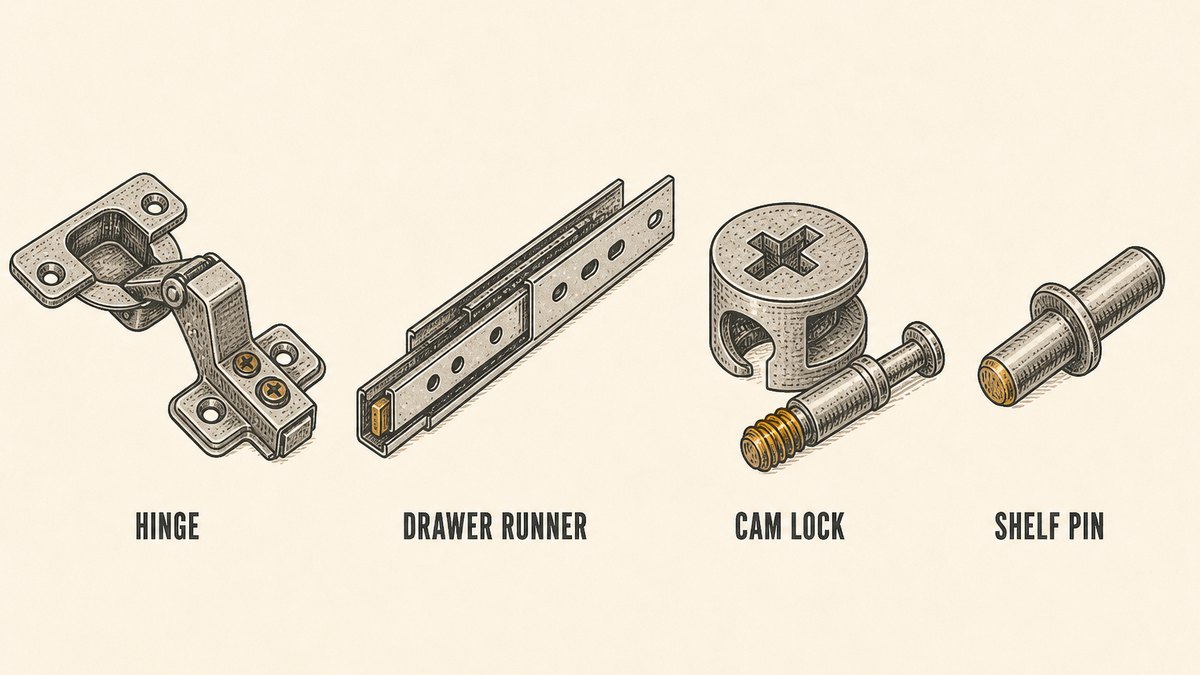
The runner is the drawer. This is the clearest example in the whole category. Two drawers built from identical board, one on a cheap runner and one on a decent one, are the same product in a photograph, the same product on a specification sheet if the hardware line is left blank, and completely different products in daily use. A cheap runner scrapes, sags under load, and gives a drawer that has to be lifted to close. Since a drawer is one of the few parts of furniture a customer interacts with constantly, this is where a saving gets noticed fastest.
Adjustability is worth more than it sounds. A better hinge can be adjusted in more directions, so a door that hangs a few millimetres low can be corrected at the customer's home instead of becoming a return. On a flat-pack product this matters more, because the panels are assembled by somebody who is not a carpenter. Ask whether the hinge is adjustable and in how many ways; the answer is a good proxy for whether the factory buys hardware for the customer or for the invoice.
The knock-down fitting is a precision part. Cam locks and their dowels work to a tolerance, and the hole they sit in has to be drilled to match. A fitting installed in a hole drilled slightly too deep or too shallow will hold on the bench and loosen in a customer's living room, and the symptom is a cabinet that rocks and a joint that cannot be tightened again. Ask what fitting is used and whether the drilling is set up for that specific fitting, rather than assuming the two were matched because the sample went together.
Then ask about the fixing points, not just the fittings. A shelf is only as strong as the pins and the board they sit in, and a screw is only as strong as the board it is driven into — which is where the choice of core material comes back into the conversation, because a particle board holds a screw far less well than plywood. Ask for the load each shelf or drawer is rated to, in kilograms, and treat a vague answer as an answer. If a supplier will not put a figure on what a shelf holds, nobody has thought about what happens when a customer puts a full set of plates on it.
How Is the Price Built, and Why Does Freight Usually Beat It?
Because furniture is mostly air once it is packed, the number that decides the landed cost is usually the volume of the packed unit rather than the price of the piece. This is the one category where a design change is worth more money than a negotiation.
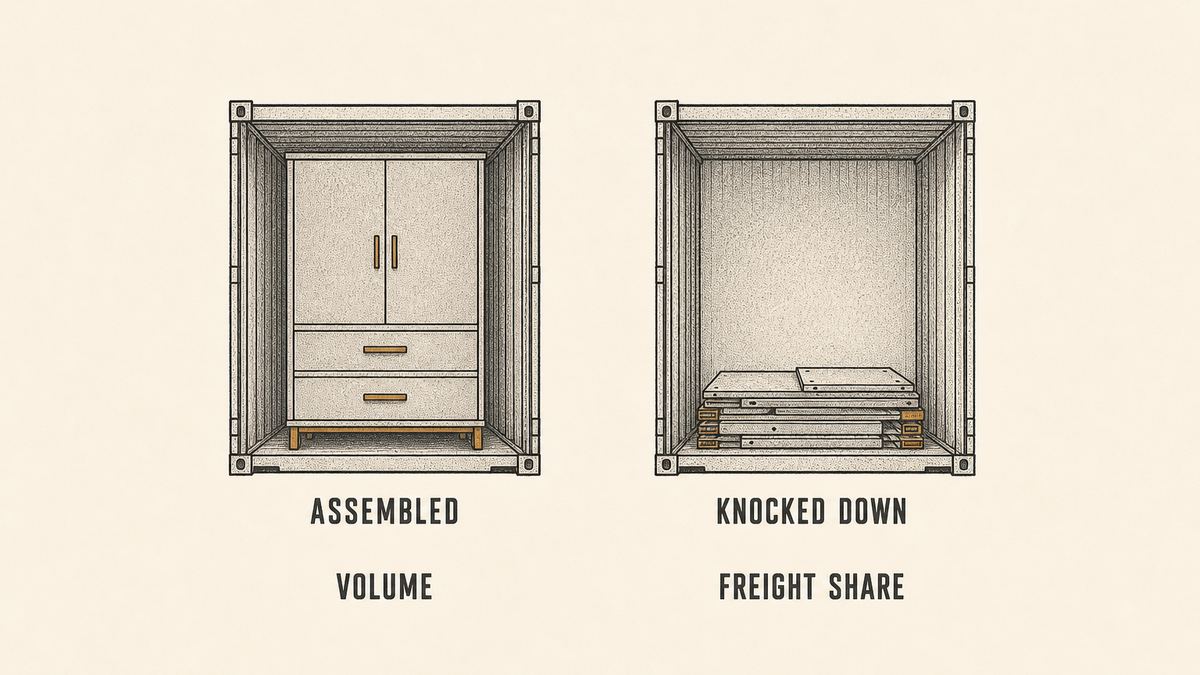
The goods side has five lines. The board by material and thickness; the facing and the edge treatment; the hardware by brand and grade; the labour to cut, drill, edge, finish and assemble; and the packaging. Ask for those five separately. The board is the biggest, the hardware the smallest and most consequential, and the packaging the line buyers most often forget to ask about.
The freight side is where the money actually goes. Sea freight for bulky goods is billed on the space taken up as well as the weight, and furniture routinely runs into that rule, so what you are really buying is cubic metres. Measure the packed carton, not the assembled piece, and work out the volume per unit before you compare quotations; the arithmetic behind it is the same for any bulky product and is set out in how the volumetric weight of a furniture is worked out. Then do the sum again for the knock-down version of the same piece, because flat panels can be the difference between paying for a container that is full of a product and paying for one that is full of air.
And then the mode decision, which follows from the volume. Once you know your volume in cubic metres, the choice between sharing a container and taking one outright becomes a calculation rather than a guess, and the crossover arrives earlier than most buyers expect because a bulky, light product fills a container long before it reaches the weight limit: the breakeven is worked through in full or shared container for a furniture. If you buy from more than one factory, combining the orders before they ship changes the same calculation again, which is what a consolidation warehouse in China is for. And because none of this stops at the port, the full set of lines between the quotation and the delivered invoice is worked through in what your order really costs once landed.
The minimum order is set by the board and the finish. Cutting a batch of panels produces offcuts, and setting up a finishing line for a particular colour and surface costs the same whether the run is 200 pieces or 2,000. That is why a furniture minimum is set by the smallest run the line can be set up for, rather than a number the factory chose to impose, and why a supplier who agrees to a smaller run normally quotes a higher unit price. If a first order has to be small, ask what the setup costs are as separate figures — the same discipline that makes any two furniture quotations comparable at all.
What Goes Wrong?
Four failures, and three of them happen after the furniture has left the factory. That ratio is what makes this category different to work with: the faults you can catch on a sample are the minority, and the ones that reach your customers are decided by the specification rather than by the inspection.
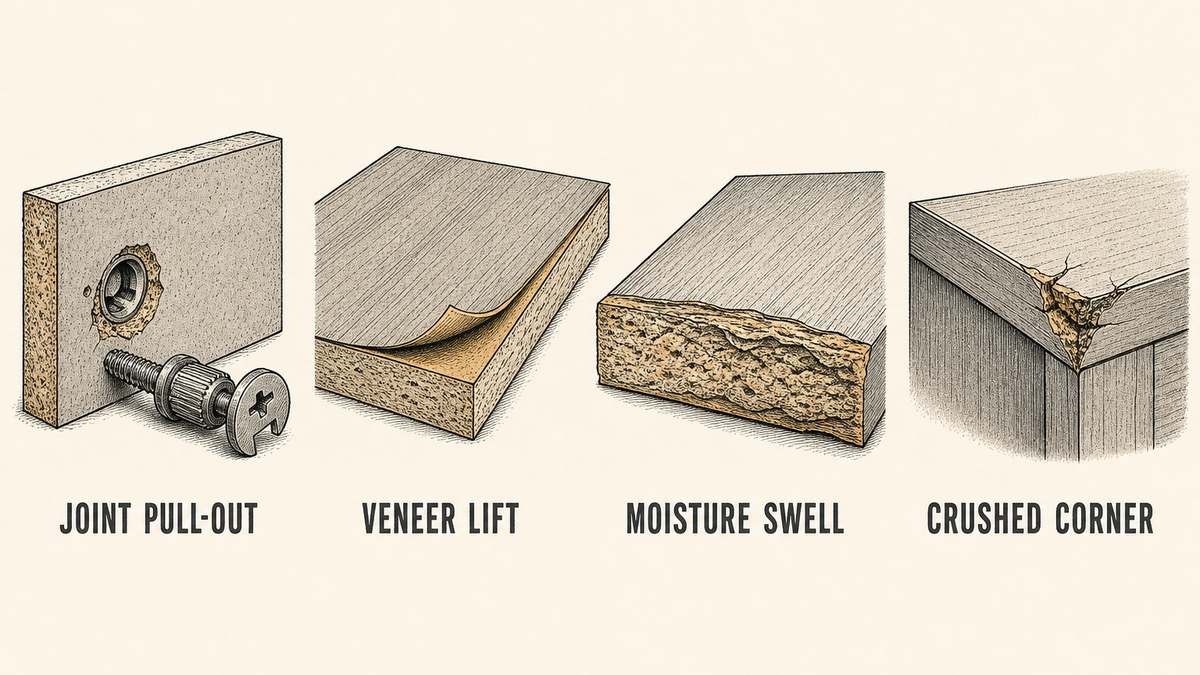
A joint that pulls out. The fitting has loosened or torn out of the board, usually at a knock-down joint or a hinge screw. Three causes are worth separating: the fitting was matched to a hole drilled to the wrong depth; the core board is too soft to hold a screw at that point; or the customer over-tightened it during assembly. Only the third is anybody else's fault, which is why the drilling and the core material belong on the order and not in a conversation.
Veneer lifting. The thin facing layer bubbles or peels away from the core, most often starting at a corner or along an edge. It happens for the same reason a wrap lifts off a box: a thin layer glued to a thicker one, exposed to a change in humidity, with nothing holding the edge. It is a strong signal that the back layer of that panel was skimped on, because an unbalanced panel moves more than a balanced one and takes its facing with it.
Moisture swell. An edge swells, splits and crumbles, and the damage cannot be repaired because the core has changed shape rather than the surface coming loose. It almost always starts at an edge where the banding was incomplete or the panel was left exposed somewhere nobody planned to look — the underside of a top, the back of a carcass, the inside of a plinth. Every exposed edge is a route in for moisture, which is why edge coverage is a specification item and not a cosmetic one.
A crushed corner. This one is not the furniture's fault at all. It is packaging, and on furniture packaging is a finished product rather than a wrapper: corner blocks, edge protection, a layer between stacked panels and a carton stiff enough to carry the stack above it. A piece can be perfectly made and still arrive with a customer refusing it because one table top has split the corner of another. Ask what protects the corners and the edges, separately from what protects the product.
The fifth failure does not damage anything and still costs you the order. It is a colour that does not match between production runs. Wood finishes, printed décors and stains all vary slightly from batch to batch, and unless the supplier records the batch and keeps a physical reference, your second order will be a slightly different colour from your first. For a retailer selling two pieces as a set, or a customer adding a chair to a table bought last year, that difference is the whole complaint. Ask how colour is controlled across runs and hold a signed physical sample, because “the same specification” is not the same as “the same colour”.
How Do You Check a Furniture Supplier Before You Commit?
Start with the question that reveals the shape of the company rather than its size: which parts of this product do you make, and who makes the rest? A furniture factory normally cuts, drills, edges and finishes panels, and buys its boards from a mill and its fittings from a hardware company. A supplier who names all three knows their own supply chain; one who claims to make everything has told you less. The general method for telling a maker from a reseller is set out in telling a furniture maker from a reseller.
Ask for the panel mill, the certifier and the certificate. These are three separate answers and a supplier who can give all three is already working with buyers in your market. Then check the certificate against the certifier's own list rather than the file you were sent, using the same approach as the furniture certificate, checked in the certifier's own register.
Ask for the moisture content and how it was measured. You want a number and a method, not a reassurance that the timber is dry. Ask where in the stack the reading was taken, because a reading off the top of a pile and one from the middle are not the same measurement. Then take your own readings on arrival, from several boards and at least one from deep inside a stack.
Ask which fitting is used, and whether the drilling is set up for it. This is the question that separates a factory that assembles furniture from one that designs it. A cam lock and the hole it sits in are a matched pair, and a supplier who can name the fitting's make and how the drilling is controlled has solved the joint. One who answers “standard” has not.
Ask for load ratings in figures. How many kilograms does the shelf hold, and how many does the drawer runner carry. If nobody can answer, nobody has tested it, and a customer will do the testing for you with a full set of plates.
Then test the sample, physically. Sit it in a room for a while rather than judging it the hour it arrives, then open and close the drawer fifty times and feel for the change. Put the rated load on the shelf and leave it. Run a fingernail along every edge band to find a loose one, and look at the cut edges with a light — including the ones nobody will ever see, because those are where the moisture will get in. Check that the panel is the construction you ordered, not a better one.
Inspect before it ships, and inspect the packing as carefully as the furniture. What to check is panel thickness and material, edge banding on every exposed edge, hardware bag contents counted against the bill of materials, packed carton dimensions against the volume you were quoted, corner and edge protection, moisture readings, and the carton marking. None of that can be judged from a photograph, so the measurements a shipment check rests on is the only version worth doing, and on a load this bulky the carton count settles how many cartons to open. On this product, measure the carton and check the edges first, and photograph second.
Then plan the load, not just the booking. Furniture is bulky and top-heavy, so the way the cartons are arranged in the container is part of the product's journey rather than an afterthought. If the goods travel on wooden pallets, confirm the treatment stamp before loading; if they travel loose, confirm what stops the stack moving. The rules for both are in the same place, and the export carton marking that lets a warehouse identify the pieces without opening everything is covered in the carton marking on a furniture.
Where Does a Cheap Quotation Get Its Money Back?
A cheap furniture quotation is usually a real price for a thinner board, a thinner facing, cheaper fittings and less packaging — and the customer is going to sit on it, lean on it and pull its drawers for years. Nine lines go missing, and the last three reach your customers rather than your warehouse.
- The board thickness. A thinner panel at the same stated size. It is the single biggest material line and the easiest to reduce quietly, and it shows up as a shelf that bows and a carcass that flexes rather than as anything a photograph would catch.
- The core material. A cheaper board at the same thickness. This is the line that decides how well a screw holds, so it is the difference between a hinge that stays tight and one that works loose — and unlike thickness, it cannot be seen at all once the piece is assembled.
- The facing. Real timber veneer replaced by a printed paper decor. From a metre away the two are hard to tell apart, and from thirty centimetres they are not, and the printed version will not take a repair the way a real one does.
- The back layer. The invisible layer that balances the panel reduced in grade, or left off entirely where it will not be seen. The saving is real, the panel is now unbalanced, and the bill for it arrives a season later as a door that no longer sits square.
- The edge banding. Thinner band, cheaper glue, or a band applied over only the edges that a customer might look at. Every exposed edge is a route for moisture into the core, and an edge band is the cheapest line in the product to inspect and one of the most expensive to have got wrong.
- The hardware. Hinges, runners and knock-down fittings swapped for lighter grades from a different maker. Nothing changes in the drawing, and the difference is entirely in the hand of the person who uses the drawer every morning.
- The moisture control. Boards bought in at whatever moisture they happen to be, with no conditioning step and no record of where in the stack the readings were taken. It costs nothing to skip, cannot be detected at the factory gate, and only appears once the furniture has spent a season in a real room.
- The packaging. Corner blocks, edge protection and an inner layer between stacked panels are all real cost and none of it appears in the unit price of a chair. Deleting it is the cheapest saving available and the fastest way to have a customer refuse a delivery that was made perfectly.
- The carton-out figure. A packed volume quoted optimistically, so the container is planned around a number the goods cannot actually achieve. You discover this at the loading dock, when the container does not close, and the second container is yours to pay for.
The way to close those nine lines is to put them on the enquiry rather than argue about them afterwards, and to make the quotation show them: the board by material and thickness, the facing by type, whether the back layer is present and what it is, the edge banding by thickness and adhesive, the hardware by make and grade with the drilling set up for it, shelf and drawer load ratings in kilograms, the moisture content as a figure with the measuring method, what protects the corners and edges, and the packed carton dimensions with the volume per unit. A supplier who can answer all nine is quoting on furniture rather than on a picture of furniture.
One closing point. Furniture is the product your customer keeps longest and forgives least, and it is the one where the biggest cost line is invisible on the invoice and decided by the designer rather than the price. So the two decisions worth the most attention are the hardest to see: how much air the piece has to ship, and how much board is really in it.
Frequently Asked Questions
Can I buy wholesale furniture directly from a Chinese manufacturer?
Yes, and at volume it is normally the cheapest route — but who you are actually talking to matters more than the label. Many companies presenting as furniture manufacturers cut and finish panels in house and buy their boards and their fittings elsewhere, which is normal as long as they say so. Confirm three things: who makes the board, who does the edge and surface finishing, and who supplies the fittings. A supplier who can name all three controls the parts that decide whether the furniture survives. If you are buying several unrelated products in one shipment, a good trading company can still be the better partner, because the margin buys you consolidation.
Do furniture wholesalers sell directly to the public?
Generally no. A wholesale supplier sells to businesses, and their pricing, minimums and terms are built around that. When a supplier does sell to individuals it is normally a retail arm, with retail prices and retail minimums rather than the wholesale terms you expected — which is why buyers looking for one piece at wholesale pricing end up disappointed rather than cheated. If you want a single item, expect to pay retail, or treat it as a sample and ask for the sample cost to be credited against a later bulk order. That is a normal request and often granted.
What is TSCA Title VI, and does it apply to my furniture?
It is the United States rule that sets formaldehyde emission standards for composite wood products and for the finished goods made from them, and it sits in 40 CFR Part 770. If your furniture contains hardwood plywood, medium-density fibreboard or particle board — and most furniture does, even when it looks like solid timber — the rule applies. The important part is who it binds: the duties to keep records and to apply the labelling fall on the importer, which is you. So the practical question is not whether the factory has a certificate but which recognised certifier certified the panels, and whether you can check that against the certifier's own record. Confirm the specific limits and labelling for your products against the rule itself or with a customs broker.
How much does it cost to ship furniture from China?
There is no useful single figure, because furniture freight is driven by volume rather than weight, and the volume depends on how flat the piece packs. So the first number to get is the packed carton size and the cubic metres per unit, not a rate. With that, the choice between sharing a container and taking one outright becomes a calculation, and on bulky light goods the crossover arrives earlier than most buyers expect, because the container fills with space long before it reaches its weight limit. Air freight is worth considering only for a sample or an urgent restock. Ask your forwarder for an all-in figure to your door and ask what it excludes, because the invoice that arrives after the ship docks is the one that surprises people.
What is the minimum order for custom furniture?
It is set by the production line rather than the supplier's preference. Cutting panels produces offcuts, and setting up a finishing line for a particular colour and surface costs the same on a small run as a large one, so a factory quotes the smallest run worth starting. That is why a supplier who agrees to a smaller quantity normally charges more per unit, and it is not a negotiating position. Ask for the setup costs as separate figures to see how much of the price is one-off, and ask whether the cutting and the finishing could be split across two runs to lower the entry cost.
Why did my furniture arrive with open joints or cracks?
The usual answer is moisture rather than workmanship. Timber is dried to a target that suits one climate, and if that target did not match the climate where the furniture ends up, the wood keeps changing shape after delivery. A board that loses moisture shrinks across its width, which opens joints and cups flat panels; a board that gains moisture swells, which makes drawers stick and can split an edge where the core is exposed. Look at where the damage is. Cracks along the grain and gaps at joints point at the moisture target; damage on edges and corners points at the packaging; loose fittings point at the hardware or the drilling. Three different conversations, three different fixes.
Send the packed volume, not just the product photo
Tell us what you want to sell and where it will live, and then the lines that decide whether it works: the construction and which parts are solid wood, the core board by material and thickness, the facing by type, what balances the back of each panel, the edge banding by thickness and adhesive, the hardware by make and grade with the drilling set up for that fitting, shelf and drawer load ratings in kilograms, the moisture content as a figure with the measuring method, the packing that protects corners and edges, the packed carton dimensions with volume per unit, how the panels and fittings are labelled and recorded for the formaldehyde rule, and the destination climate the furniture has to settle into. Add your target volume and the market you sell into. Those answers settle the board, the joint and the freight before a price means anything. We will come back with the factories whose board source, edge-finishing line and hardware actually match your product, the specification written as figures rather than wood-effect names, the setup and freight lines shown separately so quotations become comparable, a sampling plan built around measuring the carton and testing the edges rather than photographing a sample, and a clear statement of which supplier owns which failure on what you are buying.
Request a Furniture Sourcing Quote
Questions & Comments
We read every one and reply within 24 hoursComparing furniture quotations that all look the same on the photo? Post the core board by material and thickness, the moisture figure, and who supplies the hardware, and we can usually say which lines are missing from them. If a piece has already arrived with an open joint, a lifted veneer, a swollen edge or a bashed corner, describe where it went wrong and how long after delivery it appeared, because the timing usually says whether it was the board, the moisture or the packing.