
Box Compression Test (BCT) & Edge Crush Test (ECT): Calculating Carton Stacking Strength (2026 Guide)
 ·
Updated October 1, 2026
·
20 min read
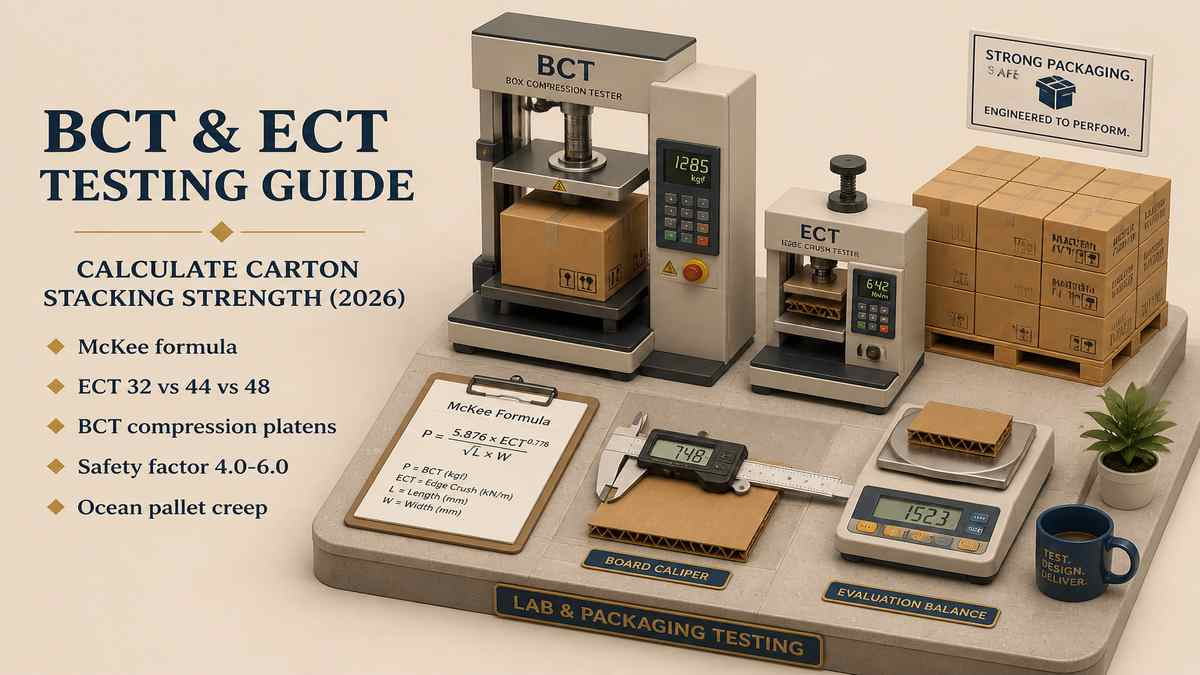
Direct Answer: In 2026, understanding the engineering relationship between Edge Crush Test (ECT) and Box Compression Test (BCT) is the only mathematical guarantee that your export shipping cartons will not collapse under pallet stacking loads. The core difference is straightforward: (1) ECT (TAPPI T 811) tests raw corrugated board samples to measure edgewise compression strength in lbs/in (e.g., 32 ECT, 44 ECT, 48 ECT); (2) BCT (ASTM D642) tests a fully assembled, 3D corrugated box under hydraulic platens to measure total top-to-bottom load capacity in pounds (lbs) or Newtons (N). Using the McKee Formula [ BCT = 5.87 x ECT x √(t x Z) ], packaging engineers calculate the exact theoretical strength of a box based on board caliper thickness (t) and box perimeter (Z). However, because real-world ocean containers experience 90% relative humidity, 60-day dynamic transit creep, and interlocking pallet degradation, engineers must apply a Safety Factor of 4.5 to 6.0 to ensure the bottom carton never buckles.
Every year, global importers lose millions of dollars when bottom-tier shipping cartons crush inside maritime shipping containers, destroying high-value consumer electronics, ceramics, and boxed retail merchandise.
To ensure your base box specifications match your logistics requirements before calculating load math, review our technical guide on custom shipping boxes and corrugated flute types across single-wall and double-wall boards.
Many brand founders wrongly assume that a box rated for a 20 kg payload can automatically support 100 kg of weight stacked above it in a warehouse. In reality, static laboratory ratings degrade rapidly under maritime environmental factors.
In this comprehensive 2026 packaging engineering guide, we break down the 7 key differences between BCT and ECT, explain the McKee calculation formula with a step-by-step mathematical example, provide real-world environmental degradation multipliers, expose 3 common factory testing tricks, and outline a 5-step SOP to test and audit carton stacking strength in China with zero collapse defects.
Box Compression Test (BCT) vs. Edge Crush Test (ECT): Head-to-Head Comparison
To evaluate these two packaging strength testing methodologies side by side, review this comparative engineering matrix:
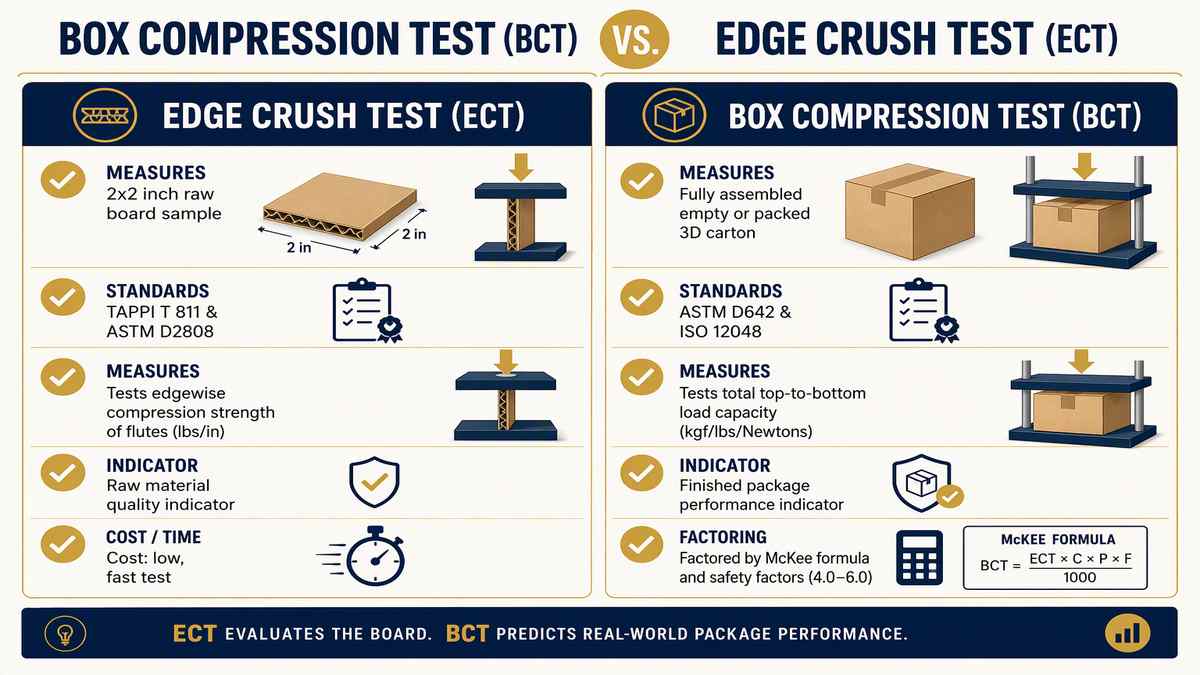
| Evaluation Dimension | 1. Edge Crush Test (ECT – 边压强度测试) | 2. Box Compression Test (BCT – 整箱抗压测试) |
|---|---|---|
| Test Specimen Form | Small rectangular raw board piece (2″ x 2″ / 50 x 50 mm). | Fully assembled 3D corrugated carton. |
| Testing Machinery | Compact benchtop crush tester with guide blocks. | Heavy hydraulic platen compression tester. |
| International Standard | TAPPI T 811, FEFCO No. 8, ISO 3037. | ASTM D642, TAPPI T 804, ISO 12048. |
| Unit of Measurement | Pounds per linear inch (lbs/in) or kN/m. | Pounds of force (lbf), kgf, or Newtons (N). |
| Primary Engineering Role | Raw material quality and fluting bond check. | Finished package stacking performance check. |
| Geometric Influence | Board thickness & paper quality only. | Length, width, height, perimeter, and crease lines. |
| Real-World Limitation | Does not account for box size, creases, or handles. | Requires physical box assembly & expensive machinery. |
The McKee Formula: Converting Raw Board ECT into Finished Box BCT
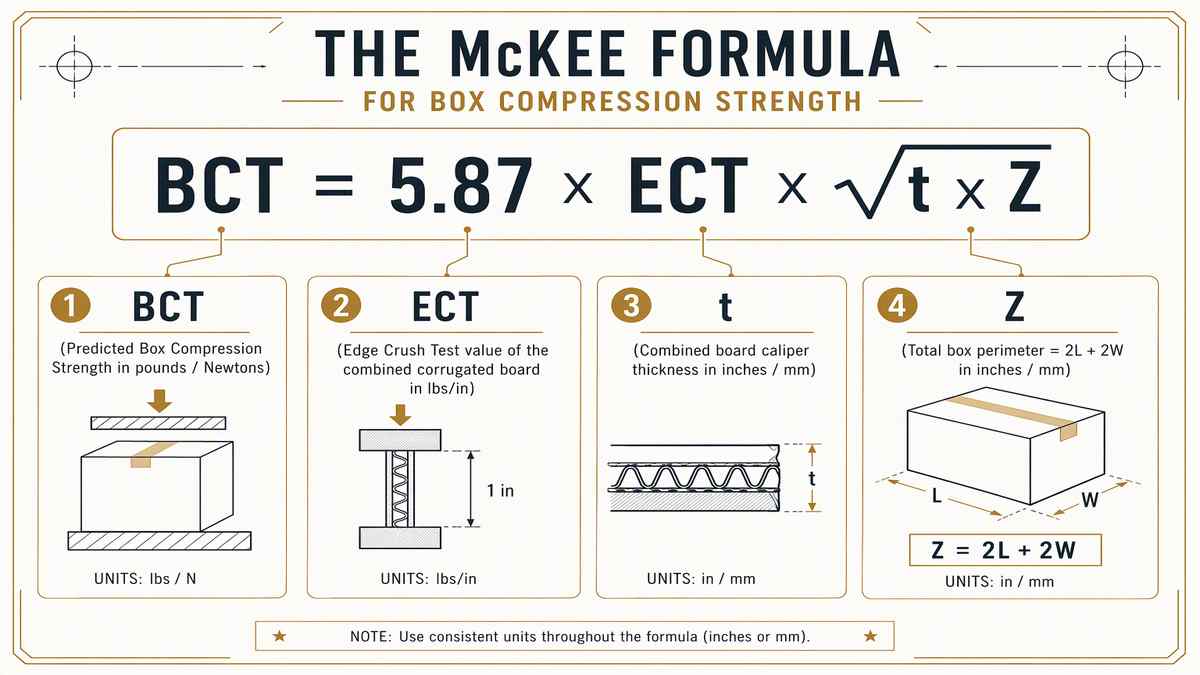
Developed by the Institute of Paper Chemistry, the McKee Formula is the universal mathematical equation used to predict finished box compression strength from raw board test data:
To align your structural flute choices with your broader packaging architecture, examine our guide on the types of packaging materials for wholesale products across paperboard, poly, and rigid gift boxes.
BCT = 5.87 × ECT × √( t × Z )
- BCT: Estimated Box Compression Strength in pounds of force (lbf).
- ECT: Edge Crush Test value of the combined corrugated board in lbs/in (e.g., 44 ECT).
- t: Combined corrugated board caliper thickness in inches (e.g., 0.26 inches for BC-flute).
- Z: Box perimeter in inches, calculated as: Z = 2 × (Length + Width).
BCT (Newtons) = 1.82 × ECT (kN/m) × √( t (mm) × Z (mm) )
Note: 1 pound of force (lbf) = 4.448 Newtons = 0.4536 kg of compressive force.Environmental Degradation Multipliers & The Safety Factor (S = 4.5 to 6.0)
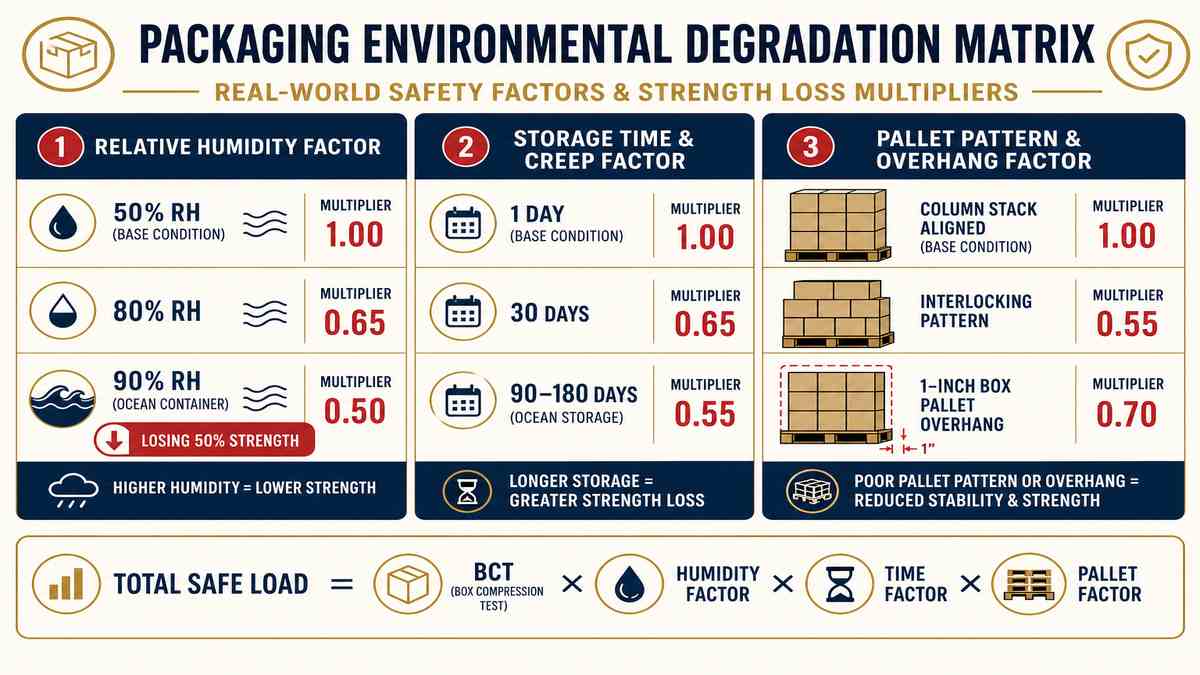
A corrugated box tested in a climate-controlled laboratory (23°C, 50% Relative Humidity) delivers its peak dynamic strength. In real-world shipping, environmental degradation drastically reduces load capacity:
Laboratory testing of corrugated paperboard strength must follow standardized conditioning guidelines published by the Technical Association of the Pulp and Paper Industry (TAPPI) Standards to establish reliable baseline performance.
- Column Aligned Stacking (Corner-to-Corner): Retains 100% (1.00 multiplier) of compression strength.
- Interlocking Stacking (Brick Pattern): Distributes load away from rigid corners into weak sidewalls, dropping strength to 0.55 (a 45% loss).
- Pallet Overhang (1 inch / 25 mm): Unsupported box edges reduce strength to 0.70 (a 30% loss).
Step-by-Step Stacking Strength Calculation Example
To see how packaging engineers calculate required box specifications in practice, review this commercial calculation example:
3 Dirty Tricks in Box Testing & How to Prevent Them
Low-cost packaging suppliers manipulate laboratory compression data to pass buyer inspections. Watch out for these three practices:
When engineering high-volume custom packaging, maintaining brand fidelity across printing plates is essential, as detailed in our guide on how to put your logo on products from China for private label goods.
5-Step SOP for Calculating Stacking Strength & Testing BCT in China
Follow this standard operating procedure to calculate, test, and audit carton stacking strength with zero packaging defects:
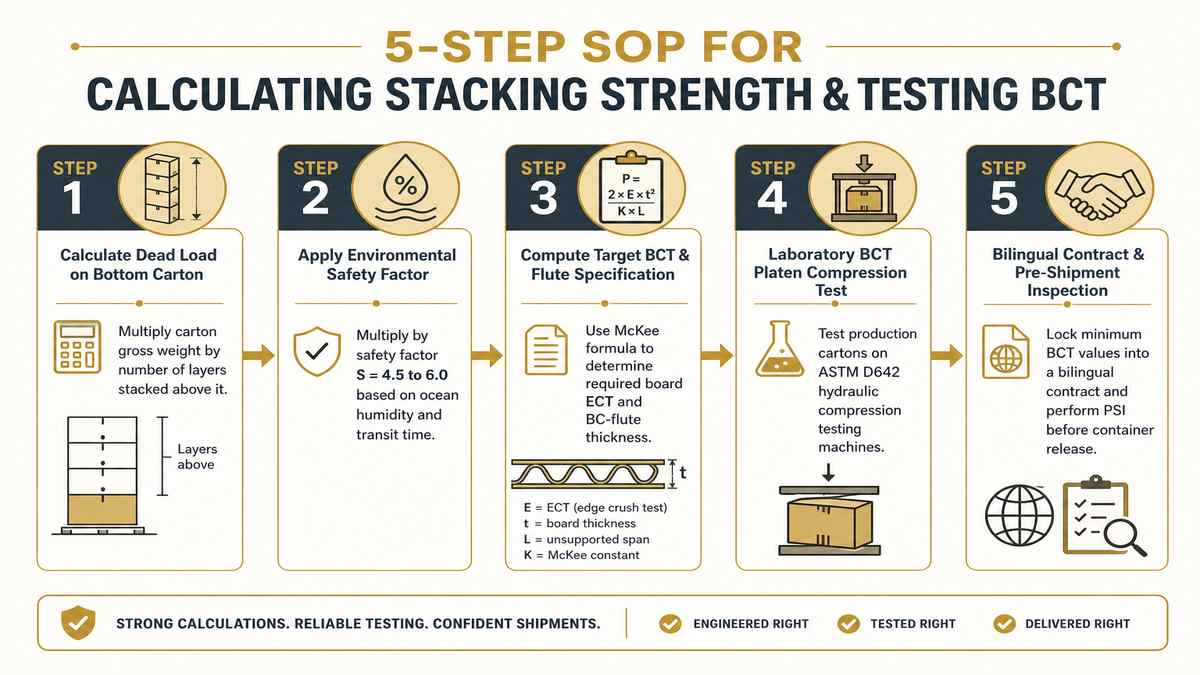
Before issuing mass production packaging orders, audit the converter’s testing laboratory and corrugated fluting machinery using our comprehensive China factory audit checklist review to check calibrated equipment.
To establish baseline quality before cutting corrugated board, check that testing facilities operate calibrated equipment under ASTM International Compression Testing Standards ASTM D642.
- Calculate Static Pallet Load & Environmental Factors: Determine total carton gross weight, pallet layer count, transit duration, and container humidity levels.
- Compute Target BCT & Board ECT Specifications: Apply the McKee formula with a safety factor of S = 4.5 to 6.0 to calculate required ECT board ratings and flute profiles.
- Sign Enforceable Bilingual Packaging Contract: Lock minimum ECT values (e.g., 44 ECT), minimum BCT compression thresholds (e.g., 4,200 N), and paper grades into an enforceable bilingual manufacturing sales contract under PRC law.
- Inspect Unprinted Structural Samples with FAI Sign-off: Order production sample boxes and execute a formal first article inspection (FAI) sample review, conducting laboratory ECT and BCT tests on physical samples.
- Execute Pre-Shipment Inspection (PSI) & Pallet Audit: Perform a comprehensive pre-shipment inspection (PSI) in China under AQL 2.5 standards, confirming column pallet alignment, zero overhang, and full H-taping before container dispatch.
Certified packaging audits must follow factory inspection guidelines established under ISO 9001 Quality Management Standards to prevent shipping failure.
Illustrative Scenario: How an Appliance Brand Saved \$42,000 via BCT Math
To see how strict BCT calculation prevents catastrophic supply chain failures, review this commercial appliance case study:
A specialty coffee equipment company in Seattle, Washington developed a custom commercial dual-boiler espresso machine (Net weight: 24 kg per unit, \$1,400 retail value, \$280,000 shipment value).
- The Crushed Pallet Disaster: The supplier initially shipped the units in single-wall 32 ECT C-flute cartons. On pallets stacked 4 layers high during a 35-day ocean voyage, the bottom-tier cartons crushed under the 72 kg overhead load in 85% ocean humidity. Over 18% of bottom machines suffered dented stainless steel frames and misaligned pump brackets, resulting in \$42,000 in customer warranty claims.
- The Sourcing Pioneer Engineering Overhaul: Sourcing Pioneer calculated the exact McKee requirements: Dead Load (72 kg) × Safety Factor (5.2) = Required BCT of 374 kgf (3,670 N). The packaging was re-engineered to 48 ECT 5-ply BC-Flute with imported K=K virgin kraft liners (175gsm) and high-density foam corner posts.
- Certified Laboratory BCT A Check: Sample cartons underwent ASTM D642 testing on calibrated hydraulic platens, achieving an average BCT of 4,120 N (exceeding safety requirements).
- The Commercial Outcome: Across a 2,000-unit ocean shipment, the brand achieved 100% zero carton crushing and a 0.0% shipping transit defect rate, permanently protecting product margins and brand reputation.
Frequently Asked Questions (FAQ)
What is the difference between Edge Crush Test (ECT) and Box Compression Test (BCT)?
Edge Crush Test (ECT, TAPPI T 811) tests a small 2×2 inch piece of raw corrugated cardboard to measure the edgewise compression strength of the flutes in lbs/in. Box Compression Test (BCT, ASTM D642) tests a complete 3D assembled carton between hydraulic platens to measure the maximum compressive force in pounds or Newtons before the box collapses.
What is the McKee formula for calculating box compression strength?
The McKee formula is: BCT = 5.87 x ECT x sqrt(t x Z), where ECT is the edge crush strength in lbs/in, t is the combined corrugated board caliper thickness in inches, and Z is the box perimeter (2L + 2W) in inches. It allows packaging engineers to estimate finished box strength directly from raw board specifications.
Why must packaging engineers apply a safety factor (4.0 to 6.0) to BCT calculations?
Laboratory BCT tests measure peak dynamic strength under dry, static conditions. In real-world ocean shipping, cartons lose up to 50% strength from 90% relative humidity, 45% strength from long-term dynamic creep (30 to 90 days), and 45% strength from interlocking pallet patterns, requiring an overall safety factor of 4.5 to 6.0 — measured on the pallet deck the stack actually sits on.
How does relative humidity affect corrugated carton stacking strength?
Corrugated paper fibers are hygroscopic. At standard 50% relative humidity, a box retains 100% of its rated strength. At 80% RH, it retains only 65% strength. In high-humidity ocean shipping containers (90% RH), compression strength drops by 50%, causing under-engineered bottom cartons to crush.
How does box overhang on a shipping pallet reduce compression strength?
When corrugated master cartons overhang the wooden pallet edge by just 1 inch (2.5 cm), the unsupported bottom box corners and edges lose up to 30% to 35% of their vertical load-bearing capacity, accelerating pallet collapse in transit.
Engineer Heavy-Duty Corrugated Cartons with Lab-Certified Stacking Strength
Our China packaging engineering team computes McKee BCT formulas, checks TAPPI ECT board ratings, inspects corrugated fluting mediums, and oversees on-site platen compression testing.
Get Free Carton BCT Calculation & Audit
Questions & Comments
We read every one and reply within 24 hoursCalculating BCT box compression strength for ocean pallets, selecting between 32 ECT and 44 ECT board, or need on-site hydraulic platen compression testing in Ningbo, Yiwu, or Shenzhen? Post your corrugated packaging questions below — our on-the-ground manufacturing engineers will guide your technical calculations.