

Walmart Dropshipping: The Minimum Bar Is a US Warehouse
 ·
Updated October 14, 2026
·
16 min read
Most discussions of this topic start from the wrong end, by asking whether the platform permits the arrangement. That question matters, but it is not the one that decides anything, because Walmart publishes a list of minimum qualifications for joining and one line in that list quietly rules out the version of the model most people have in mind. The list does not ask you to promise fast shipping or to meet a performance score. It asks where your goods will be held, and it gives you two acceptable answers: Walmart's own fulfilment service, or another business-to-consumer warehouse in the United States that can handle returns. Everything else about the arrangement is downstream of that, which is why the interesting question is not whether per-order shipping is allowed but what a seller actually has to build before the question arises.
What Walmart Asks For, and What It Rules Out
| Requirement | What it rules out |
|---|---|
| A business tax ID or licence number, plus documents confirming your business name and address | An informal or unregistered operation |
| A history of marketplace or ecommerce success | A brand new seller with no track record |
| Products carrying GTIN or UPC numbers from a GS1 Company Prefix | Making up a barcode, or selling unbranded catalogue goods |
| Fulfilment through Walmart's service or another US warehouse with returns capability | Per-order shipping from an overseas supplier |
What this guide covers
- What does Walmart actually require to join?
- Why is the product-number line a second barrier?
- What is Walmart's fulfilment service, exactly?
- What does the import programme tell you about where goods sit?
- So what is actually possible for an overseas seller?
- The order to do things in if you want to sell there
- Frequently asked questions
1. What Does Walmart Actually Require to Join?
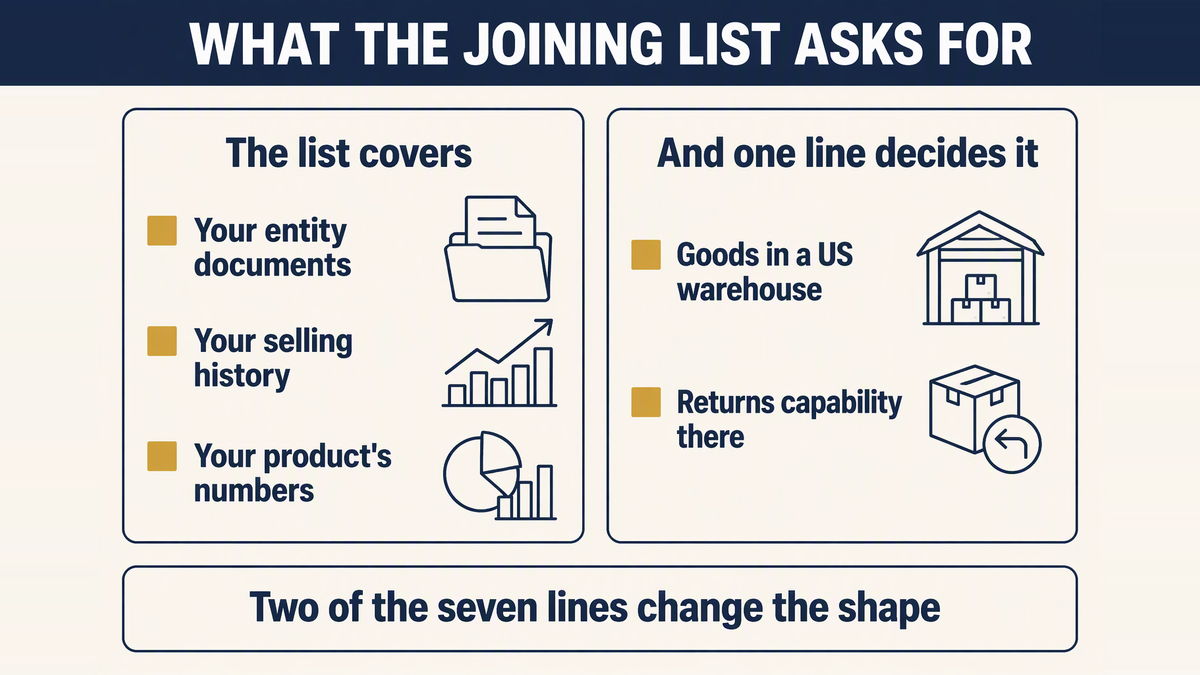
Seven lines, published on Walmart's own seller site, and they are more specific than the surrounding marketing copy suggests. This is the list in full, because the two lines that matter are easy to skim past when they are read alongside the rest.
What are the minimum qualifications to join Walmart Marketplace? To get started you'll need:
- Business Tax ID(s) (SSN not accepted) or Business License Number
- Supporting documents that verify your Business Name and Address
- History of marketplace or eCommerce success
- Products that have GTIN/UPC GS1 Company Prefix Numbers
- Catalog that complies with Walmart Prohibited Products Policy
- Fulfillment through Walmart Fulfillment Services (WFS) or another B2C US warehouse with returns capability
- An account with a compatible payment processor
Walmart Marketplace, minimum qualifications (read 14 October 2026)
The sixth line is the one that reorganises the whole question. Read it as a requirement rather than as advice and it says that the goods must be held somewhere that can ship and accept returns, and that the somewhere must be in the United States. A seller shipping each order from a supplier abroad has no answer to that line, because they do not hold goods anywhere. The arrangement is not being judged on its delivery speed or its customer service; it is being assessed on whether there is a place where the inventory sits. That is a structural test rather than a performance one, and it is why the usual discussion about fast shipping and performance scores is beside the point.
The third line does something similar in a quieter way. A history of marketplace or ecommerce success is a requirement, not a preference, which means the platform is not set up as a place to find out whether you can sell. For a sourcing operation that has sold elsewhere it is a formality to document; for a first venture it is a wall. Taken together, the two lines describe a seller who has already been selling and who has already arranged storage, which is the profile the rest of the platform is built around rather than a coincidence.
The first two lines are worth noting for a different reason, because they establish that the entity itself has to be documentable. A business tax identification number is required and a personal social security number is explicitly not accepted, and the supporting documents have to confirm both the name and the address. This is the part of the list that most often ends a plan early, and it ends it before anything about products or fulfilment is discussed. If the entity cannot be documented to that standard, nothing else on the list matters.
One honest limit on what this section can tell you. Walmart refers sellers to a Seller Performance Standards document, and the public page for it was not reachable from here, so this guide does not state the on-time delivery rate, valid tracking rate or cancellation thresholds that Walmart applies. Those figures exist and they are enforced, but they should be read from the source rather than from an article. What is quoted above is the minimum-qualifications list, which is published openly and is the part that determines whether the model fits at all.
2. Why Is the Product-Number Line a Second Barrier?
Because a GTIN is not something you assign to a product; it is something you are allocated, and the allocation comes with an owner. That distinction is easy to miss when a marketplace requirement is phrased as a list of things you either have or do not have, and it changes what a seller can legitimately put on a listing.
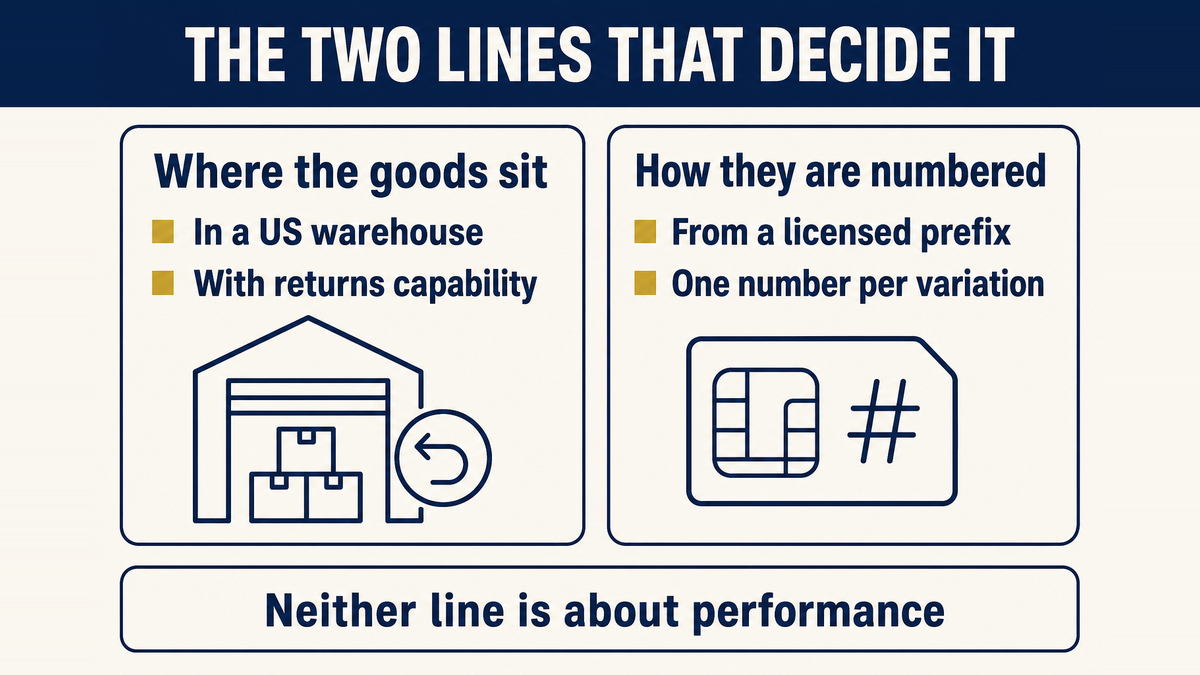
The mechanics are set by the standards body rather than by any platform. A GS1 Company Prefix is licensed to a single company and comes in different capacities representing the maximum number of unique products that licence can identify, and each variation of each product needs its own number. Two consequences follow. The first is that a seller cannot invent a number that will work, because a barcode that was not allocated to anybody will not resolve to a product. The second, which matters more here, is that a product already on the market under somebody else's brand already has a number, and that number belongs to the brand owner rather than to a reseller. Our earlier article on the identifier problem in automating a store's order flow covers the same constraint from the software side, and the constraint is identical in both places.
Put the two requirements side by side and the shape of an acceptable seller becomes clearer. Walmart asks for goods held in a US warehouse and for products carrying numbers from a licensed prefix. Taken together they describe a seller who owns or controls a product, holds it in-country, and can identify it properly. A reseller who forwards orders for someone else's branded catalogue item satisfies neither, and no amount of configuration changes that, because both requirements are about what the seller is rather than about how well the seller performs.
3. What Is Walmart's Fulfilment Service, Exactly?
It is a stockholding service, which is worth stating plainly because the phrase fulfilment service can be read as a shipping arrangement rather than a storage one. Walmart describes it as picking, packing and shipping orders in two days or less, with inventory spread across fulfilment centres nationwide so that customers receive orders faster. The inventory has to get there first, and getting it there is the seller's job.
Walmart Fulfillment Services (WFS) picks, packs and ships orders in two days or less. Reach millions of Walmart shoppers quickly, at rates that cost 15% less than other marketplace fulfillment providers.
50% GMV growth, on average, for items with the 'Fulfilled by Walmart' tag and delivery promises of two days or less.
You send — Join Walmart Marketplace, set up WFS and ship inventory to Walmart fulfillment centers.
Walmart Fulfillment Services, service page (read 14 October 2026)
Read the third line as the operational summary, because it is the one written without marketing gloss: you send inventory. That single step is the whole difference between this arrangement and a per-order model, and it is also the step that makes the two-day promise possible at all. A promise of two days is not a claim about how quickly a parcel moves; it is a claim about where the parcel already is. Nothing in the service's description suggests it can be used without goods sitting in a Walmart facility.
The published item requirements confirm the same reading. Items must be up to 500 pounds with maximum dimensions of 120 by 105 by 93 inches including packaging, they must be non-perishable and must not need temperature control, and the inventory must be shipped from within the United States or cleared through customs. Every one of those conditions assumes an inbound shipment of goods rather than a stream of individual orders. There is also a stated expectation about scale that is easy to overlook: Walmart recommends setting up at least 50 items with continual inventory replenishment, while also saying there are no minimums or maximums. The absence of a hard minimum and the presence of a recommendation are consistent, and the recommendation tells you what the service is designed around.
One detail is worth noting because it changes what a seller has to build rather than only what they have to pay. Walmart states that WFS handles customers' order-related questions and field returns in any Walmart store or by mail. On a general marketplace that work belongs to the seller, which is exactly the burden our guide to running a per-order fulfilment operation describes in detail. Here it is part of the service, and the reason it is part of the service is that the goods are in the building. Customer service on a held item is a different problem from customer service on an item you have never seen.
The company also publishes a seller's own description of making this change, which is more useful than the marketing figures because it is specific about what was given up:
We send inventory a couple times a month now instead of drop-shipping daily and they make sure the product is there in a timely manner.
Zack Means, Operations Analyst Officer, DUDE Wipes, quoted by Walmart Fulfillment Services (read 14 October 2026)
That sentence is published by Walmart as an endorsement, and it is worth reading for exactly what it says: a seller moved from sending orders daily to sending inventory a couple of times a month. The direction of travel is the opposite of the per-order model, and it is being presented as an improvement. Whether it is an improvement for a particular seller depends on the arithmetic rather than on the principle, which is the subject of the section after next.
4. What Does the Import Programme Tell You About Where Goods Sit?
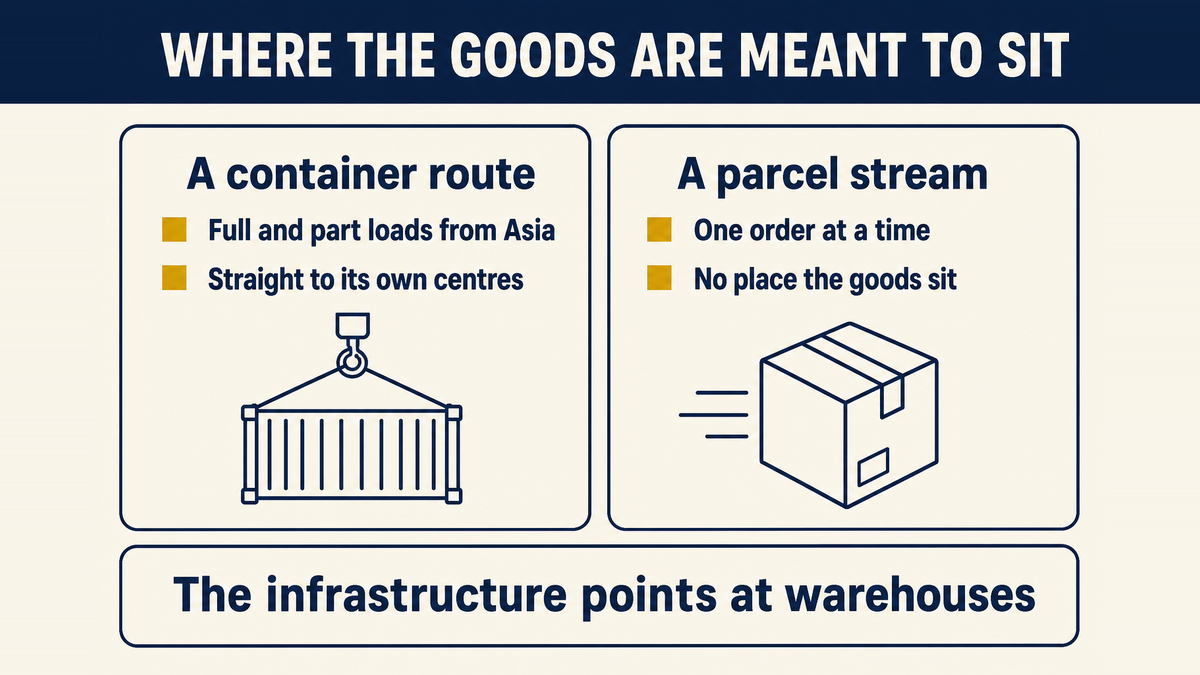
That the platform has built a supply route whose destination is its own warehouses, which is the clearest available statement of what the model is designed to look like. If the intended arrangement were per-order shipping, the useful infrastructure would be a parcel network. What Walmart has built instead is a container route from Asia into its fulfilment centres.
Walmart Cross Border: Imports makes your inventory available to sell sooner by transporting Full Container Load (FCL) and Less Than Container Load (LCL) from ports across Asia direct to Walmart Fulfillment Services (WFS) facilities.
Streamline shipping — Let Walmart manage the entire shipment cycle — customs, exceptions, inbound handing — with FCL and LCL available from China, Cambodia, India and Vietnam.
Walmart Cross Border offers sellers an average port-to-door transit time of 23 days. … Walmart Cross Border: Imports allows you to save an average of 15% on your total supply chain costs.
Walmart Cross Border: Imports, programme page (read 14 October 2026)
Notice what kind of programme this is. It is a freight service, priced in container loads, with customs handling included and a transit time measured in weeks. The economics only work if you are moving a quantity of goods at once, which is a statement about the business it is built for. A seller sending one parcel per order has no use for a less-than-container load, and a seller sending a container has already made the decision that the previous sections describe as required.
The transit figure is worth holding on to, because it defines the constraint that holding stock introduces. An average of twenty-three days from port to door sits in front of every replenishment cycle, so the quantity you send has to cover demand for longer than that plus a cushion. That is the arithmetic our guide to moving from per-order buying to holding stock works through, and it is the reason the move is a change of model rather than a change of supplier. The import programme makes that change easier to execute; it does not make it smaller.
There is also a customs consequence that a first container brings with it and a stream of parcels does not. A commercial import needs a classification for the goods, which means a tariff code, and it usually needs an entry process that a broker handles. Our explainer on what an HTS code is and how it is used covers the classification side, and our notes on what a customs broker does for you cover the entry side. Neither is difficult, and both are steps a per-order seller never sees.
5. So What Is Actually Possible for an Overseas Seller?
Two realistic answers, and neither of them is the model as usually described. Being precise about which one you are choosing is the useful part of this section, because the phrase selling on Walmart covers both and they require different businesses.
The first is to become the seller the platform is built for. That means an entity that can be documented, a product whose numbers come from a licensed prefix, a quantity of goods moved into a US warehouse, and a replenishment cycle that respects the transit time. On that arrangement Walmart's fees are published and clear: no monthly or setup fees, and a referral fee that varies by category and total sales price and ranges from 6 per cent to 15 per cent. Walmart's fulfilment service charges separately for the storage, picking, packing and shipping, and it takes on the returns and customer questions. If you are comparing this with a per-order operation, the comparison is not between two shipping methods; it is between a business that holds inventory and one that does not.
Build that arithmetic once and the reason the platform steers towards stock becomes visible. A referral fee of six to fifteen per cent is charged on the sale price, and only the seller side of a fixed-cost structure can absorb it at low order values. This is the same division our breakdown of how an order's cost adds up from unit price to landed cost sets out, and it explains why a marketplace with a fast-delivery promise and a percentage fee naturally selects for larger baskets and stocked goods. Walmart is not being unusual here; it is being explicit about a preference that most platforms imply.
The second answer is to use the platform as a second channel rather than a starting point. Walmart's fulfilment service can be used to fulfil orders placed on other marketplaces and on your own site, which means an operation that has already built a US inventory position for one channel can add Walmart without building a second supply chain. That is a different decision from deciding where to begin, and it is the one that fits a sourcing operation which has already made the move to holding stock. Our notes on how US-based supplier arrangements compare with buying direct are the relevant companion, because the choice of where the stock sits is the same choice in both cases.
One thing this article is deliberately not doing is telling you that per-order selling is forbidden. What can be quoted is the minimum-qualifications list, and that list requires a US fulfilment arrangement. If you want a ruling on a specific arrangement, the reliable route is Walmart's own seller support, and the answer you get should be kept in writing. Treat any article, including this one, as a description of what is published rather than as a permission.
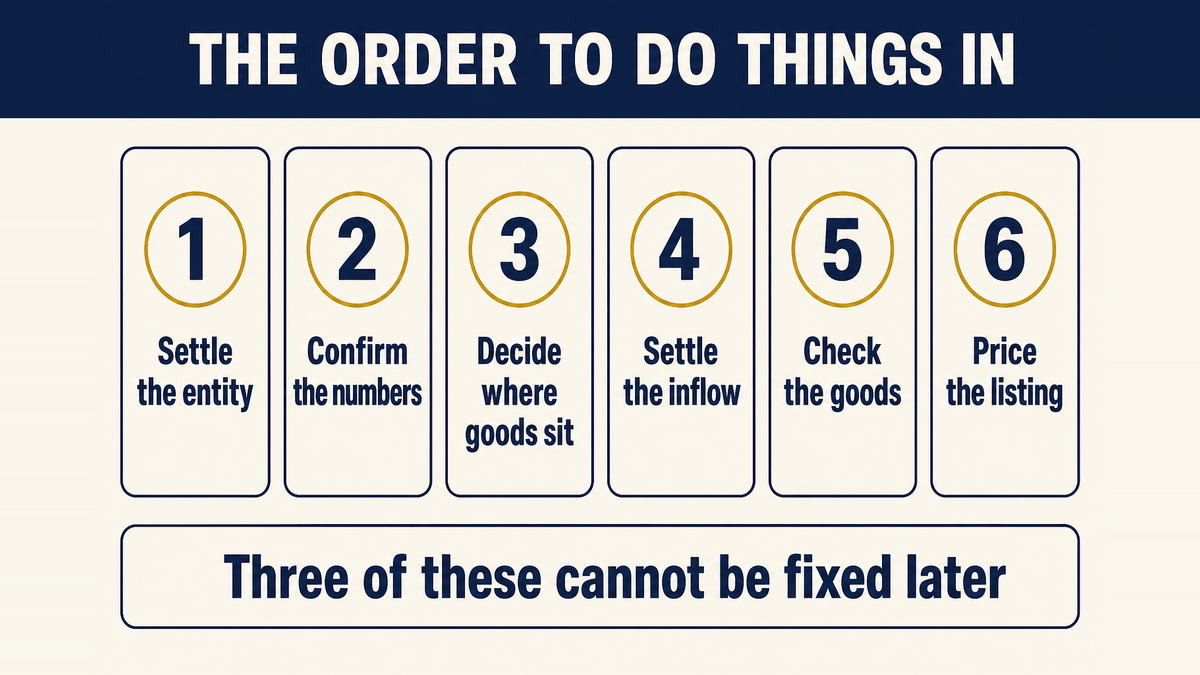
6. What Is the Order to Do Things In?
Six steps, and the sequence matters because three of them are prerequisites that cannot be fixed later. Attempting them in a different order is how a plan stalls at the point where money has been spent and nothing can be listed.
- Settle the entity and the documents first
- A business tax identification number is required and a personal social security number is not accepted, and the documents have to confirm both the business name and the address. This is the step that quietly ends plans, so it belongs before any product work rather than after.
- Confirm the numbers before choosing the product
- A product needs a GTIN or UPC from a GS1 Company Prefix, and each variation needs its own. Working out which prefix applies and whether you are entitled to use it decides whether the product is listable long before anyone discusses price.
- Decide where the goods will sit
- Walmart's service or another US warehouse with returns capability. The choice determines your storage and handling costs, your replenishment cycle and whether returns are handled for you or by you, so it is a business decision rather than a logistics one.
- Then settle the inflow
- Once you know where the goods sit, the freight question becomes concrete: which quantity covers demand across a transit time measured in weeks, and what that costs to bring in. Our guide to what a warehouse charges to store, pick and send an order shows how the storage side is billed once the goods are in place.
- Check the goods before they enter the channel
- A stocked position turns a quality problem into a returned order rather than a cancelled one, because the goods are already with the platform. Our notes on what a pre-shipment inspection covers and on how an inbound shipment is checked for a marketplace cover the checks that belong before the container rather than after.
- Only then build the listing and the pricing
- Price against the referral rate and the storage cost together, on your smaller baskets rather than your average one. Our article on how to tell a product that will sell from one that will not is the right companion here, and our notes on why marketplace listings get taken down are worth reading before launch rather than after, because the same operational habits that cause removals elsewhere cause them here.
7. Frequently Asked Questions
Is dropshipping allowed on Walmart Marketplace?
Walmart publishes a list of minimum qualifications to join, and two of the lines change the shape of the question. The list asks for products that have GTIN or UPC numbers from a GS1 Company Prefix, and for fulfilment through Walmart Fulfillment Services or another B2C US warehouse with returns capability. The minimum bar is therefore a US fulfilment arrangement rather than a supplier shipping per order, which is the arrangement most people mean by dropshipping.
Can I sell on Walmart from China without a US warehouse?
The published minimum qualifications do not describe that route. They require business tax identification, documents confirming your business name and address, a history of marketplace or ecommerce success, GS1-based product numbers, and fulfilment through Walmart Fulfillment Services or another B2C US warehouse with returns capability. Walmart does operate an import programme, but it moves full and less-than-container loads from Asia into its own fulfillment centres rather than enabling per-order shipping.
What does Walmart Fulfillment Services require?
Walmart states that WFS picks, packs and ships orders in two days or less, that inventory is spread across fulfillment centres nationwide, and that there are no inventory minimums or maximums. Items must be up to 500 pounds with maximum dimensions of 120 by 105 by 93 inches including packaging, must be non-perishable and not require temperature control, and must be inventory shipped from the US or cleared through customs. Walmart recommends setting up at least 50 items with continual replenishment.
What fees does Walmart Marketplace charge?
Walmart states that sellers pay zero monthly or setup fees and only a referral fee on items sold, and that referral fee rates vary by category and total sales price and range from 6 per cent to 15 per cent. Walmart Fulfillment Services is charged separately and the company describes its rates as transparent with no setup, monthly or hidden fees. The referral rate matters more on low-value items, because it is charged on the sale price.
Is a fast delivery promise worth holding stock for?
Walmart publishes its own measurement of that. It states that sellers using Walmart Fulfillment Services see 50 per cent GMV growth, on average, for items with the Fulfilled by Walmart tag and delivery promises of two days or less. A seller testimonial published by Walmart describes sending inventory a couple of times a month instead of drop-shipping daily. Both are the company's own figures and quotes, so they should be read as its argument rather than as a neutral study.
What Is Possible for an Overseas Seller
We return the qualification list, the product-number requirement, and the fulfilment arrangement that satisfies the warehouse condition.
Memo My Eligibility
Questions & Comments
We read every one and reply within 24 hoursTrying to work out whether your product can carry a GS1-based product number, unsure what a US stock position would cost to keep running, or wondering whether your entity documents meet the minimum qualifications before you spend anything? Post the product, how you would identify it and where you could hold it, and our team will help you work out what the bar actually requires.