
Dropshipping Suppliers in the USA: When a Domestic Supplier Wins, and When Importing Does
 ·
Updated October 12, 2026
·
17 min read
A US supplier sells you speed, not advantage. That is the whole decision in one line: if your customers are paying for a parcel that arrives in days, a domestic supplier is worth the higher unit price, and if they are not, you are the one paying for that speed out of your own margin. So the question is never "should I use a US supplier" on its own. It is "which of the three fulfilment routes matches the promise I made at checkout".
Three Routes, and Who Carries What
| Route | Who holds the stock | What you pay per order | What you carry |
|---|---|---|---|
| A US supplier's list | The supplier, at its own risk. | Their price, which already includes that risk. | Price competition, and no control over the specification. |
| Import per order | Nobody until the order lands. | A lower unit price, plus duty, entry and courier on every parcel. | The cost of each parcel, which does not fall when the order value falls. |
| Source in China, hold stock in a US warehouse | You, from the moment you commit. | A picking and packing fee per order. | The money tied up in the stock, and the risk that it does not sell. |
What this guide covers
1. Do You Actually Need a US Supplier?
Only if the promise you made at checkout requires one. A domestic supplier is a way to buy speed, not a way to buy an advantage, and speed is only worth paying for when your customer is paying for it too.
So answer the delivery question first, because it decides everything after it. If your product page says the parcel arrives in two to four days, the stock has to sit on the customer's side of the border, whether you own it or a supplier does. If it says seven to fifteen days, importing per order is perfectly consistent with what you promised, and the domestic premium buys you nothing your customer was expecting.
Most stores get this backwards. They pick a supplier first, then write a delivery promise that matches whatever that supplier happens to do, and then discover that the promise they have to keep is not the one their prices were built for. Decide the promise, then price it, then choose the route that fits the price you can charge.
2. What Are the Three Fulfilment Routes?
There are only three, and they differ in who holds the stock and who carries the duty. That single difference explains nearly every cost and every risk you will meet later.
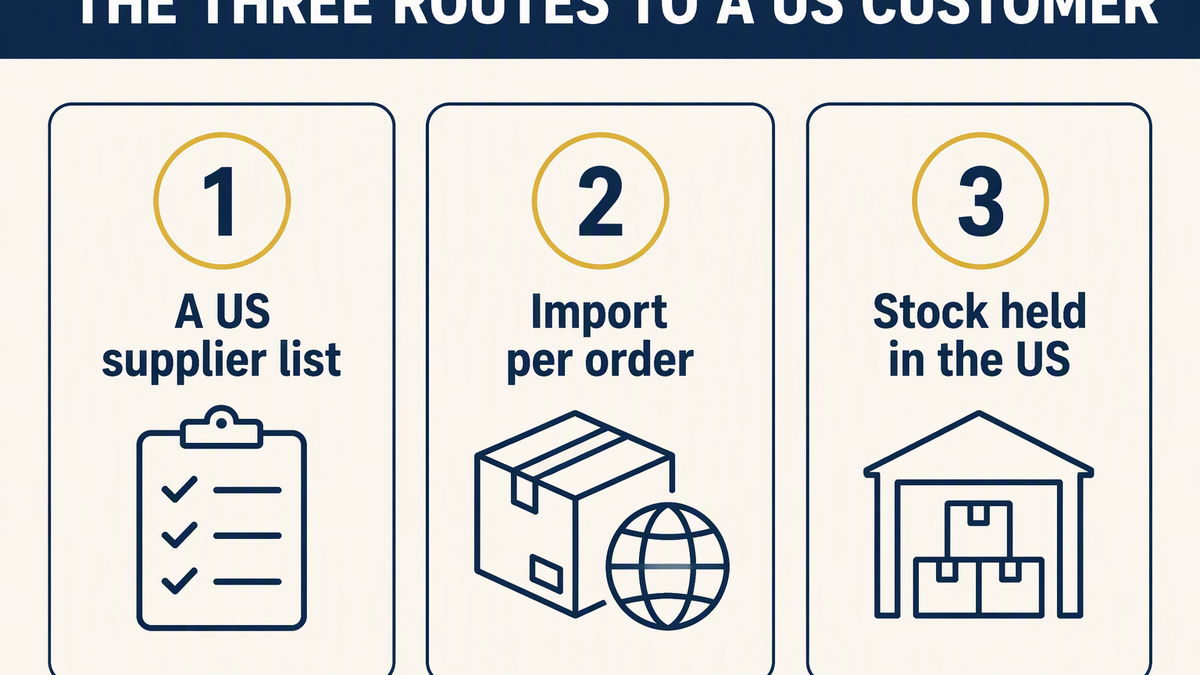
- A US supplier's list
- You pick from items someone else already imported and stored. You get speed and no commitment, and in return you accept their price, their specification and whatever they decide to stock next quarter. You are a reseller of a catalogue that any other store can also resell.
- Importing per order
- You take the order first and buy the unit after, so nothing sits on your balance sheet. The unit price is lower and the flexibility is real, but every parcel carries its own duty, entry and courier cost, and those charges are the same whether the item sells for forty dollars or four hundred.
- Sourcing in China with stock held closer to the customer
- You buy once and hold, either as a shipment to your own space or with a warehouse that picks and packs per order. This is the route that gives you both a lower unit cost and a fast parcel, and it is the only one where you have to be right about demand before you find out.
The mistake most sellers make is comparing the three on unit price. Unit price is the smallest part of the difference, and it is the only part these routes have in common.
3. Why Can a Dearer US Supplier Still Be Cheaper?
Because the two routes charge you in different places, and one of them charges per parcel rather than per unit. A US supplier adds to the price of every unit. Importing subtracts nothing from the unit price but adds duty, entry fees and courier cost to every parcel, and a parcel is charged the same whether it contains one cheap item or one expensive one.
That is why the comparison goes wrong in both directions. For a low-value, light item, the fixed parcel costs can swallow the saving on the unit price, and the local supplier is genuinely cheaper to serve. For a high-value or heavy item, the unit saving usually dominates, and importing wins easily. The route is not a matter of taste, it is a matter of the ratio between your selling price and your parcel cost.
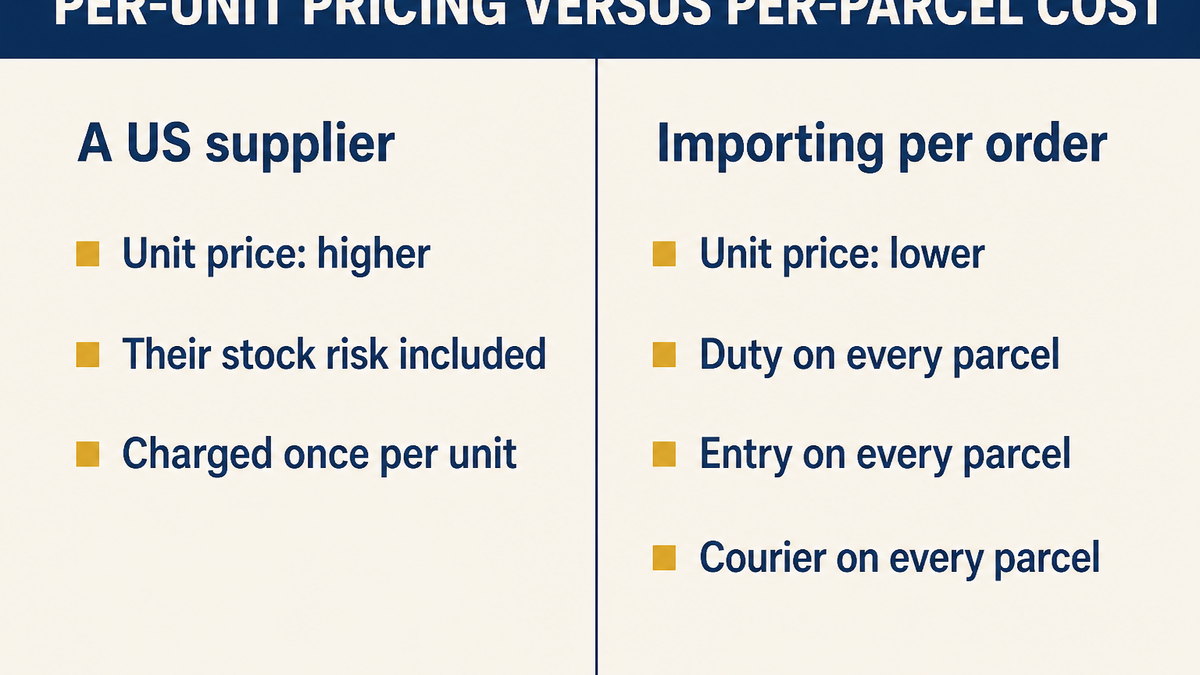
The only fair comparison is total cost per delivered order, and you can only build it with real numbers. Take one product, get a quote including shipping and duty to the customer's postcode, add the entry and courier fees, and set that against the local supplier's price plus their shipping. Do it once per product rather than once per store, because the answer changes with the item's weight and value, and that is why no single supplier list can answer it for you.
4. What Changed in 2025 and Moved the Line?
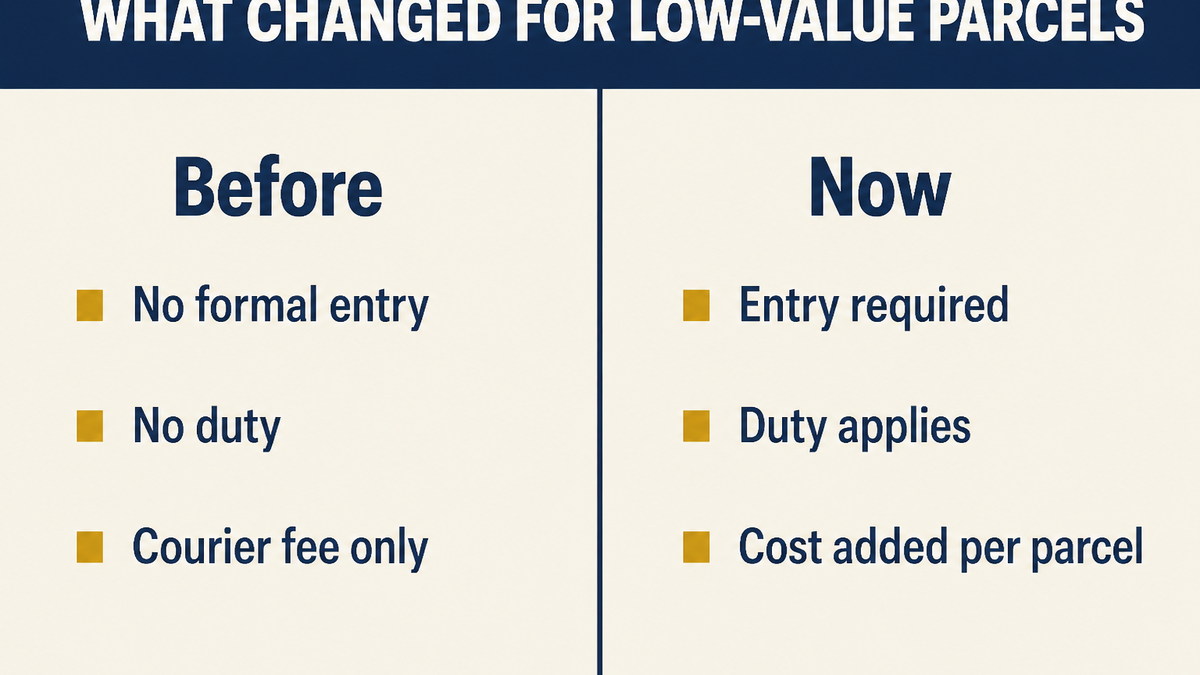
The free pass for low-value parcels ended. For years a small parcel could enter the United States without a formal entry and without duty, which made shipping one unit at a time from China artificially cheap. That treatment was withdrawn, first for goods of China and Hong Kong and later for all countries, as the Federal Register notice implementing Executive Order 14256 records.
The practical effect is that a parcel which used to cost you a courier fee now also carries a duty cost and, in many cases, an entry cost. Two consequences follow, and they matter more than the headline rate. First, the line between the three routes moved toward holding stock closer to the customer, because the per-order route got more expensive while the hold-stock route did not. Second, the move is strongest on cheap items, because the new charges are fixed per parcel and a cheap item has the least value to absorb them.
Check the duty you would actually pay rather than assuming a rate. Classification decides it, two similar products can fall under codes with very different rates, and the answer belongs in the comparison rather than after it. Look up the code on the USITC Harmonized Tariff Schedule before you decide a route, and if your product is cheap and light, expect the parcel-level charges to be the deciding number rather than the unit price.
5. What Do You Give Up When You Resell a Catalogue?
Three things: the specification, the ability to improve the product, and any reason for a customer to choose you. A catalogue item is offered to every other store at the same price, so once the listing is identical the only lever left is discounting.
None of that makes reselling wrong. It is the fastest way to start, it needs no capital, and for a product that is genuinely a plain commodity the speed is the whole value. What it does mean is that you should know which business you are in. Reselling is a business of traffic and price. Owning the specification is a business of product. The confusion between the two is what makes sellers blame their marketing for a problem that lives in their supply.
The tell is simple to apply to your own store. If you cannot say what is different about your version of the product, then nothing is, and you are competing on the only variable left. That is a fine place to be while you are learning what sells, and a bad place to stay once you know.
There is a second cost that appears only after a year, and it is the one people underestimate. A catalogue is not yours, so the supplier can change it whenever it likes. An item that sold well can be dropped from the range, restocked in a different material, or handed to a bigger account first, and you find out when an order fails rather than when a contract is discussed. Nothing in your store changes, and the product underneath it does.
That is why the switch from reselling to owning the product is usually triggered by an event rather than by a plan. The item you built a page around goes out of stock for a season, or arrives different, and the store that had no way to fix it starts looking for one. Deciding the trigger in advance, and knowing which products would be worth owning, means you get to choose when that happens instead of being told.
6. How Do You Check That a US Supplier Holds US Stock?
Ask for the shipping address, the carrier and the daily cut-off time, then run one test order to a real postcode and watch where it starts its journey. A US-sounding brand proves nothing at all, and several suppliers ship from China behind a name that sounds domestic.
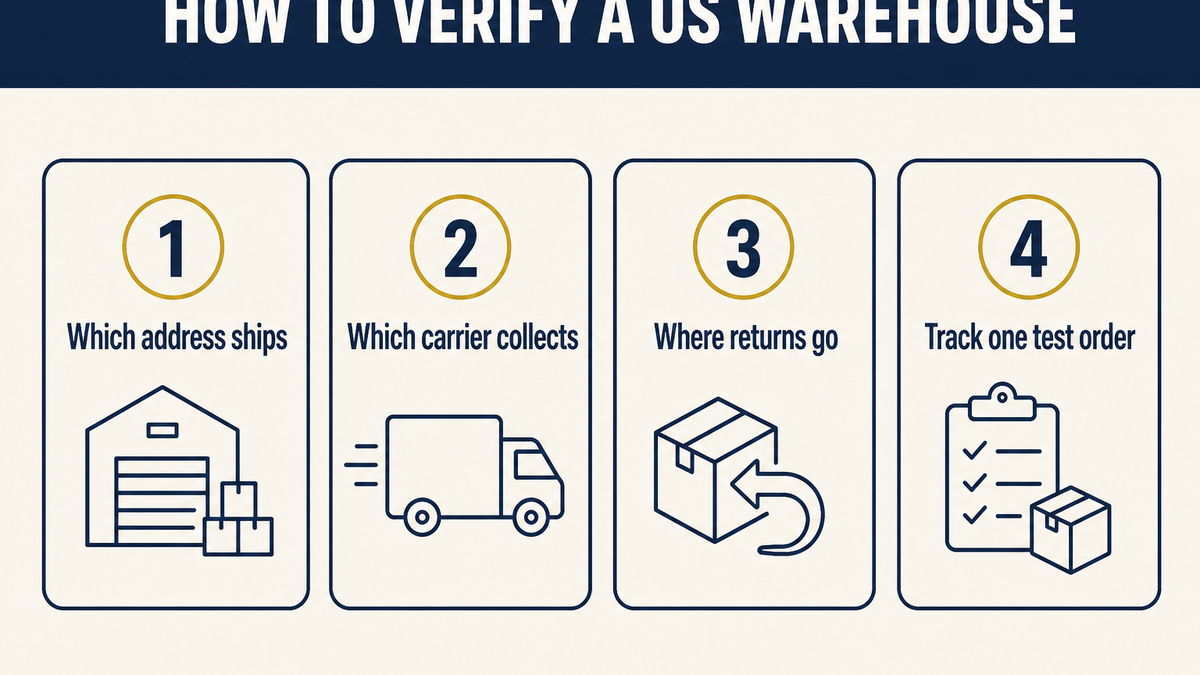
- Ask which address the parcel ships from. A city and state in the United States should be available before you sign up, not after your first order. If the answer is a country rather than an address, you have your answer.
- Ask which carrier collects it. A domestic carrier name with a domestic cut-off time is consistent with a US warehouse. A cut-off time that lands in the middle of the American night is consistent with a warehouse somewhere else.
- Ask what happens on a return. A domestic return address is the strongest single proof of a domestic stock point, because returns are the thing that is expensive to fake.
- Run one test order. Send it to a postcode you know, then read the tracking as an ordinary customer would. Where the tracking starts tells you the truth that the sales page did not.
Never promise a delivery window on the strength of a supplier's marketing page. Ask the three questions first, then write the promise to match what the tracking actually does on your test order. A delivery promise you cannot keep costs more than a slow parcel, because it costs the customer as well.
7. When Should You Switch Routes?
Switch when the reason you chose your current route has stopped being true. Each of the three has one signal that tells you it has stopped earning its place, and the signal is always about cost or control rather than about the route being bad.
| Your current route | The signal it has stopped earning its place | Where to move |
|---|---|---|
| A US supplier's list | Your margin is set by their price and you cannot raise yours. | Import per order, or hold your own stock once volume is steady. |
| Import per order | Per-parcel charges and delivery complaints exceed the unit saving. | Hold stock closer to the customer, or move to a warehouse that picks per order. |
| Holding your own stock | Stock is ageing and cash is tied up in items that are not selling fast. | Shrink the range back to the core sizes or the core products and top up per order. |
The mechanics of each move are the part that catches people out, because the costs change shape as you cross. Holding stock adds storage, picking and the risk of unsold units, and the point at which it pays for itself is not the same for a light item and a bulky one. The route from per-order fulfilment to holding stock is set out in our guide to moving from dropshipping to wholesale, and what a US-based holding operation costs per parcel is in our China 3PL warehousing and order fulfilment guide.
Whichever route you run, two habits protect the margin. Have the goods checked before they ship rather than after they sell, using an independent quality inspection, and make sure the parcel carries your paperwork and not the supplier's, which our guide to blind dropshipping covers. The full landed-cost picture for importing is in our dropshipping from China guide.
8. Frequently Asked Questions
Do I need a US dropshipping supplier?
Only if your delivery promise requires it. A US supplier is the right answer when your customers expect the parcel within days and your product is already a commodity, because then you are buying speed rather than an advantage. If you are still finding out what sells, importing per order costs less and tells you more.
Why are US suppliers more expensive?
Because they are selling you a finished position rather than a product. Their price includes holding the stock, paying US rent and wages, and carrying the risk that the stock does not sell. When you import per order you pay a lower unit price instead, and you carry the duty, the entry fees and the courier cost yourself on every parcel.
Is a US supplier always faster?
No, and a US-sounding brand does not prove a US warehouse. Ask which address the parcel ships from, which carrier collects it, and what the daily cut-off time is. A supplier that ships from China behind a US name gives you the slow route at the fast price.
What did the change to de minimis mean for dropshipping?
It removed the free pass that low-value parcels used to enjoy, first for goods of China and Hong Kong and later for all countries. A parcel that once cleared with no entry and no duty can now require both, which raises the cost of shipping per order from China and moves the decision toward holding stock closer to the customer.
When should I move from a US supplier to importing?
When your unit volume is predictable and your margin is being squeezed by the supplier's price rather than by your own costs. At that point owning the specification and buying at volume is worth more than the convenience of a catalogue, but the commitment means you also take on the stock risk.
Three Routes, One Landed-Cost Column
We return the three fulfilment routes with landed cost per unit, the 2025 change that moved the line, and the catalogue limits of each.
Model My Three Routes
Questions & Comments
We read every one and reply within 24 hoursChoosing between a US supplier and importing for a specific product, unsure whether the duty change makes your route uneconomic, or got a quote that looks too good because nobody added entry and courier? Post the product, the price you sell at and the postcode you ship to, and our team will help you build the comparison properly.